Dr. Doug Petrovich identifies the pre-Uruk-dispersion city of Eridu as the original site of Babel. It is in southern Mesopotamia, farther south than the later city which was also called Babel.
His own translation of the Hebrew word usually rendered as “tower” notes that this is a word that can also mean temple or platform (such as a platform where ceremonies would be performed). In fact, what we find at Eridu is an Ancient-Near-Eastern-style temple that was torn down and rebuilt bigger a number of times, then had a massive platform added in front of it that dwarfed the temple itself. This was then abandoned abruptly, sat there for about 1000 years, and then Sumerians from the city of Ur attempted to add to or restore it.
That is what I remember from the video after having watched it a few days ago. I don’t believe I got any details wrong, but you can check by watching it yourself. Dr. Petrovich has a much dryer style of delivery than the inimitable geologist Dr. Kurt Wise.
Obviously, Dr. Petrovich’s interpretation of the “tower” of Babel differs from the treatment I gave it in my own books: it is farther south, and though big, it is not an actual skyscraper-type tower. Still, I can’t get over the coolness of the idea that archaeologists might actually have found it. I dealt with this problem in The Long Guest by having a year of heavy rains almost completely destroy the tower (made of mud bricks) after it was abandoned. If I had followed Dr. Petrovich, I need not have bothered.
Too much attention should not be paid to those writers who say (holding one the while with a fixed and hypnotic gaze): “I don’t really invent the plot, you know — I just let the characters come into my mind and let them take charge of it.” Writers who work this way do not, as a matter of brutal fact, usually produce very good books. The lay public (most of them confirmed mystagogues) rather like to believe in this inspirational fancy; but as a rule the element of pure craftsmanship is more important than most of us are willing to admit. Nevertheless, the free will of a genuinely created character has a certain reality, which the writer will defy at his peril.
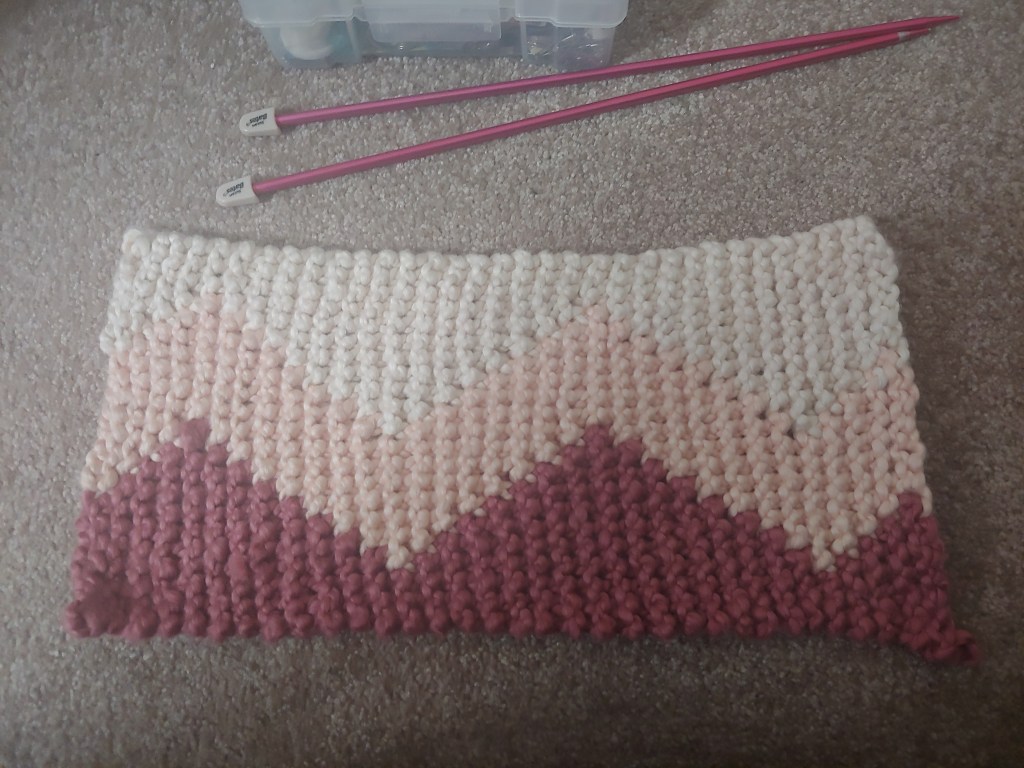
We bought yarn in the colors the little girl liked. I had wanted to try a zigzag pattern on the next poncho I made. Turns out, when you do a modified zigzag using colors with an ombre-type fade, it looks like mountains receding into the distance! Who knew?
The picture above is one half of the poncho. I made the other half identical, sewed them together corner to corner, and added a brown tassel:
I like this mountain-y look so much, I am tempted to make one for myself some day. But that’s off in (you might say) the misty future, as I have a few other projects to get to plus a nerve injury in one arm to baby.
Dorothy Sayers (1893 – 1957) was the author of the Lord Peter mystery series, numerous plays, and a translation of the Divine Comedy. She was part of the Christian literary flowering in the early 1900s which also encompassed T.S. Eliot, Charles Williams, J.R.R. Tolkien and C.S. Lewis. “She explored by-ways of knowledge, delighted in puzzles and enjoyed many a fight which she conducted with wit and good humour. Her formidable presence, magnificent brain and logical presentation put her in great demand as a lecturer.” (About Dorothy Sayers)
Me and Ms. Sayers
This particular book, The Mind of the Maker, turns out to have a personal history for me. I’ve been vaguely aware of it for years as a book “I really should read some time.” I first remember hearing it recommended by C.S. Lewis in one of his short apologetics books, where in the process of pointing out that any thinking about nonphysical things will necessarily be metaphorical, and that this does not mean that the thinker is taking the metaphor literally, he remarks that “anyone who wishes to think clearly about this topic must read The Mind of the Maker by Dorothy Sayers.”
My dad has a large personal library, and last year, while I was poking around in it looking to borrow some other book(s), I came upon TMoTM, and borrowed that one too. And lo and behold! According to the inscription on the inside cover, this very book was actually given to me by my dad, almost 30 years ago. Even back then he knew I was a creative writer, though at the time I was a very immature and inexperienced creative writer, and was apparently not ready for Sayers. I don’t know how TMoTM made it back into his library. Perhaps I left it there when I went off to university, or when I went to move overseas. Anway, now, after having done some living and some creating, I am ready for this magnificent work of Sayers’, and what a sweet reunion it has been.
I should mention that I have also read many of Sayers’ Lord Peter mysteries, which is helpful because she uses them as illustrations sometimes in The Mind of the Maker. I have not read her translation of The Divine Comedy.
A Must-Read for Artists
The first thing to know about this book is that it’s delightfully readable. Sayers was, after all, a good writer, and she had worked for some years in advertising. This book is full of bon mots, terrific quotes, and so forth, and in fact I plan to post quotes from it for a long time on the Thursday quotation post on Out of Babel. So, although the subject matter might seem kind of abstract, the book is not difficult to read or understand. If you want to read it, don’t be afraid: go ahead and read it. Ms. Sayers will not allow you to get lost or even bored.
The thesis of this book is easy to summarize, but hard to believe until you’ve seen it fleshed out. Ms. Sayers, an Anglican, asserts that we can understand the Mind of the Maker (i.e. God) by looking at the dynamics of the creative process in the minds of lesser makers (people, specifically creative artists). God is, after all, the ultimate creative artist. She talks about “the artist” a lot, but inevitably most of her examples are drawn from the art forms she knew best: novels and plays. Her insights about the creative process were instantly recognizable to this novelist.
Diving a little deeper, she maintains that we can understand the orthodox Christian doctrine of the Trinity (yes, the Trinity) by looking at the dynamics of how an artist produces his or her work. The work itself, she says, is present in what you might call three persons. There is what she calls the Idea, which is the work as a whole, as author first envisions it when she “sees the end from the beginning.” Then there is the physical manifestation of the work (its incarnation, as it were), which is the only means by which any other person can know it. This is the physical book or play; and, in the case of a play, the stage, actors, costumes, etc. … the whole event. The process of converting the Idea into this physical form is hard work, and the artist carries it out by means of what Sayers calls Energy or Activity. Finally, there is the work as an experience that the reader or theater goer has as they read or hear the story. This too is the piece of art itself, and this Sayers calls the Power. Each of these states of the play or novel, Idea, Energy, and Power, can be legitimately said to be the entire play or novel, not just a part of it. Yet they can be distinguished from each other. All three have to be present if the reader is to have an experience of the novel, or the audience an experience of the play. In the Trinity, the Idea corresponds to the Father, the Energy to the Son or the Word, and the Power to the Holy Spirit.
I hope this does not sound blasphemous. As we read through the book, it is striking how well the dynamics of bringing a work of creative art into being parallel the doctrines of the Trinity, and help us to understand them. Sayers would say, of course, that this is no coincidence. It is because people are indeed made in the image of God, and when we engage in creative work, there is something in our structure that parallels His structure as a Maker.
There is, as you might expect, an interesting discussion of the process of the author creating characters that in some sense exist independently of herself, and how this relates to human free will.
Even if you are not interested in the Trinity, I recommend this book to any writer who wants to read the insights of another writer who is intimately familiar with reading and writing literature, including the dynamics of plotting and pantsing, and of being asked if your characters’ tastes and opinions are the same as your own and why you can’t “make X character do Y.” There are also some delightful examples of bad writing that Ms. Sayers quotes as she illustrates different ways in which the creative process can break down. I don’t know how relatable this book may be to artists in different media, such as music or visual arts, but I would encourage them to check it out as well.
Our speculations about Shakespeare are almost as multifarious and foolish as our speculations about the maker of the universe, and, like those, are frequently concerned to establish that his works were not made by him but by another person of the same name.
Everyone has to have their 15 minutes of appearing on video, right?
My wonderful sister, who has a YouTube channel, graciously offered to interview me about The Scattering Trilogy. Here, you can watch us chat about genres, languages, and paganism, and how it all fits in.
We are bringing you good news, telling you to turn from these worthless things to the living God, who made heaven and earth and sea and everything in them. In the past, He let all nations go their own way. Yet He has not left himself without testimony: He has shown kindness by giving you rain from heaven and crops in their seasons; He provides you with plenty of food and fills your hearts with joy.
Paul, speaking to a crowd of pagans in the city of Lystra, Asia Minor, Acts 14:15 – 17



 Out of Babel Books