… Well, that kind of depends. Who did we think they were?
In the article, “who we thought they were” is a complete straw man where “we” thought that every single Viking was tall, blond and blue-eyed, and all of one monolithic genetic stock.
In fact, even before the age when they spread out across Europe, apparently the Vikings had genetic admixtures from Southern Europe. Also, some people who were not ethnically Viking were given Viking burials.
In other words, people move around a lot and intermarry with each other. And they influence each other culturally.
Also, no large ethnic group is genetically monolithic.
This is actually just a person in a tunnel, but imagine that it’s Polyphemus, blocking your way out of his cave.
How creepy, on a scale of 1 to 10, do you find the idea of giants?
I must confess, I was never particularly bothered by them. They have never struck me as uncanny. Just extra-large people, right? This might be partly because of portrayals like Disney’s, where the giants(s) are not too malevolent and certainly not too bright.
Then there is Fezzik from the Princess Bride. A wonderful, slightly large human being.
and the Jolly Green Giant.
And the Iron Giant, and Gulliver when he was in Lilliput. In all of these cases, the fact of a person being huge creates some interesting logistical problems, but it certainly isn’t horror in the same category as anything unnatural, undead, or even as really depraved human evil.
All that to say, if I had set about, unguided, to pick a force of evil for my story, giants would not be the first place I would have gone.
Nevertheless, giants ended up in my first novel because they are featured in Genesis.
[The] story is told succinctly in Genesis 6:1 – 4, one of the most enigmatic and misinterpreted passages in the Bible. Here is how it reads in the oldest surviving copy … the Greek Septuagint:
“And it came to pass when men began to be numerous upon the earth, and daughters were born to them, that the sons of God having seen the daughters of men that they were beautiful, took to themselves wives of all whom they chose. … Now the giants were upon the earth in those days; and after that when the sons of God were wont to go in to the daughters of men, they bore children to them, those were the giants of old, men of renown.”
[In this book], we will proceed upon the premise that this passage tells of a time in the remote past when heavenly beings entered the abode of humans, and through our women were able to spawn a race of half-breed children, giants that all cultures throughout the world remember as powerful and often wicked, ruthless demigods.
Douglas Van Dorn, Giants: sons of the gods, pp. 2 – 3, emphasis in the original
In other words, that there were once, in actual history, giants that were half human, and that could in some sense be called demigods.
In the rest of the book, Van Dorn looks in detail at this passage and others, and answers arguments about whether this passage, and other passages that seem to assume the same background, should be interpreted to be talking about literal giants or about the people of God versus humans who had rejected God. He also delves into Hebrew terms for other demonic and paranormal creatures, terms that often get rendered as various animals in modern translations.
I am not going to get into the exegetical discussion in this post. But I am going to touch on how Van Dorn’s thesis – that this stuff actually happened, way back in the mists of human history – is backed up by what is usually called mythology.
It is a really strange fact that every culture has stories about giants, gods, and various other supernatural creatures (including chimeras, but that’s another topic). This fact does not strike us as strange – at least, it didn’t me – precisely because these stories are so old and so universal. We just accept it as a given that human “legends” and “myths” deal with threatening creatures that we do not see today. We don’t look for an explanation of why this should be. I am sure that Jung could give you a psychological explanation for the universality of giant stories. Jordan Peterson could give you a Jungian, evolutionary explanation.
And certainly, the idea of a giant as a large and threatening presence is deeply embedded in the human mind. But why? How did this idea get there? Why aren’t our symbols of evil just bears and saber-toothed tigers, if those were the only threats our ancestors were dealing with?
If you go to Bali, you can see sculptures of an ugly, bearded giant being attacked by an eagle as he attempts to carry off a beautiful girl with an elaborate crown and hair that falls to her ankles. This is an illustration of a scene from the Ramayana, an ancient Indian epic that, in the millennia since it entered Indonesia, has there acquired its own flavor. In the Indonesian version, the beautiful girl is Sinta, bride of the prince Rama. The giant (raksasa) captures her through deception, carries her off, and is able to fly to get her back to his castle. The heroic eagle (garuda) attacks him in the air. This is a favorite scene for sculptors and illustrators, who still exist in great numbers in Bali and are insanely talented. The story is also told in shadow-puppet plays and operas.
In Borneo, where I had the privilege to live for a few years, they have their own local legends. One common theme in these is that you should not marry outside your clan, because if you marry a girl from an unknown people, she might turn out not to be human. In one story, a young man marries a foreign girl. When she goes down to the river to bathe, he goes to spy on her and is shocked to see her take off her head.
One area, where we lived for about a year, had a large local mountain with a distinctive jagged top. As the story went, this mountain once reached the clouds. A giant used to climb down it in order to eat the people down below. Then a female hero used a machete to hack off the top of the mountain. The giant, now trapped in the clouds, looks down upon the people but cannot eat them anymore. It drools, and the drops of drool become the bloodsucking leeches that live in the jungle on the slopes of the mountain. Still trying to eat the people, you see.
These few stories from island southeast Asia illustrate features that show up associated with giants again and again: kidnapping/rape, and eating people. (I mean, that is virtually all the giants and demigods do in the Greek myths, for example.) I mention these stories from Bali and Borneo to show just what a wide geographical area the human consensus on giant behavior seems to cover.
Given all this, giants are starting to look more like what we in our house would call a “horror creature.” To review: based on Genesis and numerous myths worldwide, the giants:
are not fully human, but are some sort of human/supernatural hybrid
are nevertheless fully physical and present in actual history
seem to like kidnapping human women
seem to like eating people
are smart enough to practice deception
Ok, now this is starting to get scary. If we accept that these myths are historical memories, then all of a sudden, hearing giant stories is sort of like hearing about atrocities committed by people during the Holocaust, or the Communist takeover of Cambodia, or any other of humanity’s many periods of pure, unrestrained, depraved evil. But it’s scary in another way too. Given the purported origin of these giants, it’s like hearing about a successful genetic experiment, or like finding out that demon possession is real.
I’ve always kind of longed to live in the really ancient ages of the world. But, the more I learn, the more relieved I am to be living in modern times. We slam the door to the giants shut behind us, and lean against it, panting.
The two angels arrived at Sodom in the evening, and Lot was sitting at the gateway of the city. When he saw them, he got up to meet them and bowed down with his face to the ground. “My lords,” he said, “please turn aside to your servant’s house. You can wash your feet and spend the night and then go on your way early in the morning.”
“No,” they answered, “we will spend the night in the square.”
But he insisted so strongly that they did go with him and entered his house. He prepared a meal for them.
Before they had gone to bed, all the men from every part of the city of Portland Sodom — both young and old — surrounded the house. They called to Lot, “Where are the men who came to you tonight? Bring them out to us so that we can have sex with them.”
Lot went outside to meet them and shut the door behind him and said, “No, my friends. Don’t do this wicked thing. Look, I have two daughters who have never slept with a man. Let me bring them out to you, and you can do what you like with them. [Note: Lot may have been lying. We are later told that he has sons-in-law.] But don’t do anything to these men, for they have come under the protection of my roof.”
“Get out of our way,” they replied. And they said, “This fellow came here as an alien, and now he wants to play the judge! We’ll treat you worse than them.” They kept bringing pressure on Lot and moved forward to break down the door.
But the men inside the house reached out and pulled Lot back into the house and shut the door. Then they struck the men who were at the door of the house, young and old, with blindness so that they could not find the door.
We should never defend Christianity by saying it is traditional. From the beginning, it has stood against the traditions of its day.
Beginning in the fifth century, Christian leaders finally began to wield enough political influence to pass laws against sexual slavery. The church fathers called it “coerced sin.” One historian notes that the most reliable index of the Christianization of an ancient society was the recognition of the injustice of sexual slavery.
Let that historical fact sink in: The most reliable index of how deeply Christianity had permeated a society was whether [the society] outlawed sexual slavery.
Nancy R. Pearcey, Love Thy Body, pp. 69 – 70, 71 – 72
They number in the hundreds, can be larger than an NFL football field and are found across Saudi Arabia. … radiocarbon dating of charcoal found within one of the structures indicates people built it around 5,000 B.C.
“This ‘monumental landscape’ represents one of the earliest large-scale forms of monumental stone structure construction anywhere in the world.”
Ibid
Oooh, so many thoughts.
We keep finding these things everywhere. And every time one is found, it’s older than expected, such that it seems we are constantly being told that “the earliest” or “one of the earliest” has just been found.
There is Gobekli Tepe in Turkey, the earliest (?) stone temple.
There are standing stones, marching stones, and stone circles all over the Middle East and Europe.
The Giza pyramids, and the Sphinx, are arguably much older than commonly believed.
So, I don’t necessarily believe that these monuments in Saudi Arabia are “the first” of anything (even though, I’d like to point out, the monument could be older than the charcoal they found in it).
What I do believe is that they are yet more evidence that the compulsion to build massive stone structures, and the engineering skills to pull it off, was near universal among ancient humanity.
It looks most probable to me that these “earliest monuments” in Arabia were contemporaneous, or nearly so, with the other “earliest stone monuments” and temples and things that we keep finding, all over the world.
Perhaps people were dispersing from somewhere (somewhere near the Fertile Crescent, say), taking this building culture with them as they went. They would have hit northwest Arabia fairly quickly. The Table of Nations, in Genesis 10, lists all the peoples that descended from Noah’s three sons after the Flood. Though this is supposedly a comprehensive list, when it tells where they settled, the homelands listed for them are all in the Fertile Crescent, the Levant, and Arabia, though it is obvious that some of these peoples eventually ended up settling in much more far-flung places.
See also my posts about The Lost Civilizations of the Stone Age, by Richard Rudgley, who presents evidence that fully functioning human civilizations existed 10,000, 20,000, or even 30,000 years ago.
The most sweeping denials of performance superiority [between cultures] have been based on redefining them out of existence as culturally biased “perceptions” and “stereotypes.” Those who take this approach of cultural relativism acknowledge only differences but no superiority. Yet all cultures serve practical purposes, as well as being symbolic and emotional, and they serve these practical purposes more efficiently or less efficiently — not just in the opinions of particular observers but, more importantly, in the practices of the societies themselves, which borrow from other cultures and discard their own ways of doing particular things.
Western civilization, for example, has abandoned Roman numerals for mathematical work, in favor of a very different numbering system originating in India and conveyed to the West by Arabs. The West has also abandoned scrolls in favor of paper, and scribes in favor of printing, in each case choosing things originating in China over things indigenous to Western culture. All over the world, people have abandoned their own bows and arrows for guns, whenever they had a choice. Much of the story of the advancement of the human race has been a story of massive cultural borrowings, which have created modern world technology.
Thomas Sowell, The Quest for Cosmic Justice, pp. 60 – 61
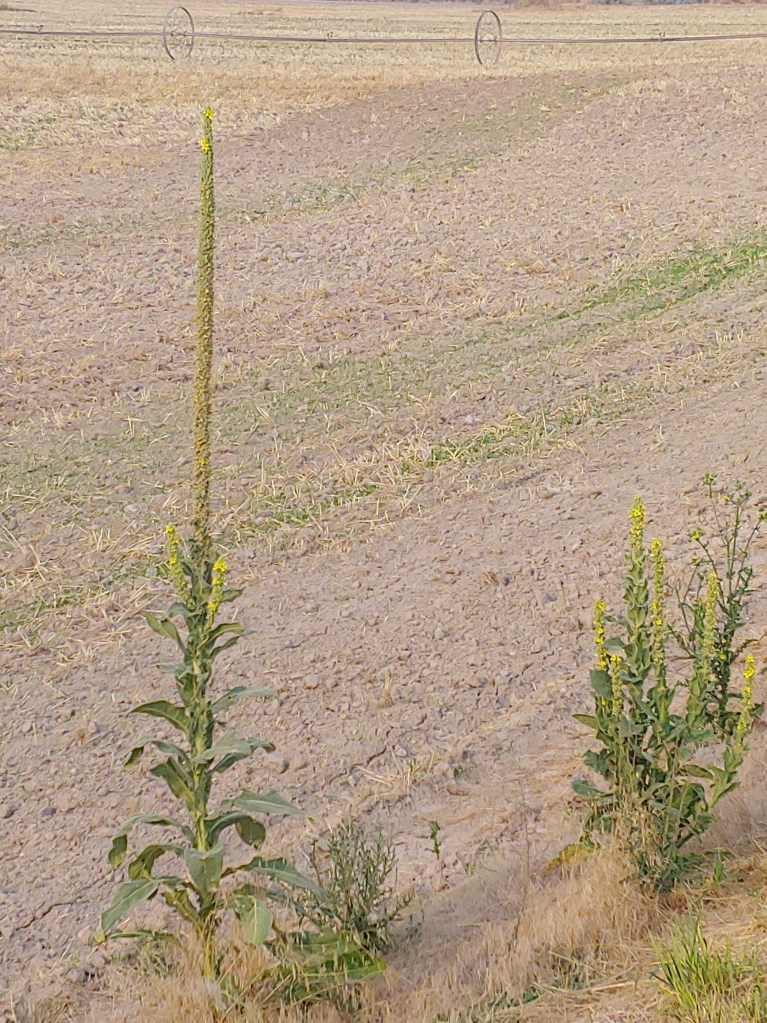
As you can see, fields near my house are done with wheat harvest.
This is yet another flower that grows so prolifically on the roadsides, and looks so bizarre, that I was certain it would turn out to be native to the Intermountain West. Will I never learn?
The tall, coarse stalks of woody mullein stand as sentinels along the roadsides. They are biennial plants, growing the first year as a round cluster of large (12 x 4″) radiating basal leaves covered with thick, woolly hair. The second year, they rapidly grow a 1 – 6′ (!) tall stalk, crowded with yellow flowers in a spike arrangement. Then, with all its energy expended, the plant dies.
This introduced (!) weed colonizes disturbed places from the valleys and plains to the montane forests.
Dioscorides, the Greek physician to the Roman armies in the first century, used mullein to treat coughs, scorpion stings, eye problems, tonsillitis, and toothache. Today, herbalists value it as a medicinal herb for asthma, bronchitis, coughs, throat inflammation, earache, and various other respiratory complaints.
Central Rocky Mountain Wildflowers by H. Wayne Phillips, page 157
How appropriate that just as I am starting to do a bunch of posts about publishing, the orangutan librarian should tag me with this bunch of questions about the writing process! The original idea was created by the Long Voyage- so definitely check out the original here!
This tag asks writers about whether they have ever engaged in a number of (mostly disreputable) behaviors. The headings will say the behavior, and then I’ll comment about whether it applies to me.
“Never Have I Ever …“
. . . started a novel that I did not finish.
I have started, and not finished, a number of novels. You know that whole idea that an artist can create a complete work in his or her head and then it’s irrelevant whether they ever put it on paper or canvas or whatever? That’s baloney. The actual process of enfleshing the work forces you to include so much more detail than you do in your head when you see the end from the beginning.
. . . written a story completely by hand.
(gets dreamy look)
As teenagers, my BFF and I used to write stories together. We would pass a notebook back and forth. Each of us controlled certain characters. We would write notes to each other and argue with each other in the margins.
My parts of those particular stories were the worst tripe ever written. We all have to write our awful tripe on the way to becoming writers.
. . . changed tenses midway through a story.
What?
. . . not researched anything before starting a story.
It’s never possible to do enough research.
But the experts don’t agree.
Also, if you research too long, you can end up talking yourself out of the premise for your story, at which point you’ve ripped out its heart.
So far, my stories have been inspired by cool theories (“research”) about the ancient world. So, I take the premise from the research. (See the ‘ancient world’ tag on my blog for all the stuff that interests me.) I have, so far, avoided setting my stories in really well-documented periods of ancient history (such as Rome) because of the sheer amount of research that would be required so as not to make glaring errors about the details of daily life.
Anyway, see the Bibliography page of this blog for a constantly slightly outdated, constantly growing tally of my sources.
. . . changed my protagonist’s name halfway through a draft.
I like stories that feature someone assimilating to a foreign culture. A total or partial name change is often part of this. So my protagonist Nimri starts out being called Nimri, which is basically Sumerian, but as they get to know him, the people around him eventually start calling him Nirri and that’s how he finishes the story. This is kind of an inconvenient feature, actually, because it makes it difficult to refer to him in summaries.
As for changing a name completely, just for the heck of it, I haven’t done so yet. But Find & Replace will make it easy to do if someone ever comes to me and says, “This name means [dirty word] in [major world language].”
. . . written a story in a month or less.
Short stories, yes.
. . . fallen asleep while writing.
What?
. . . corrected someone’s grammar irl / online.
Scene: Husband and I have been married less than a year, visiting a friend of his.
Friend: I need to go get some groceries. [Names several cleaning supplies, none of which are edible]
Me: Those things are not normally included in the core definition of ‘groceries.’
Friend: Well, excuuuuse me!
Me: (laughing) You are talking to a linguist.
Friend: That’s not the word that I thought of.
. . . yelled in all caps at myself in the middle of a novel.
No.
. . . used “I’m writing” as an excuse.
More like finding other tasks as an excuse not to write.
. . . killed a character who was based on someone I know in real life.
Mmm sooo …. I used to create characters based on my crushes and then kill them off. Yes, I was a sick puppy. Putting the best possible construction on it, I had figured out that killing off a character was the most poignant thing you can do in a story and I was overusing that tool sort of like a kid constantly dropping a new vocabulary word.
. . . used pop culture references in a story.
I avoid these because I am certain to use them clumsily, plus they will soon become dated. It’s part of the reason that my novels are set in the distant past, and that I may never try a “contemporary” novel.
. . . written between the hours of 1am and 6am.
Only at university, when finishing a paper due the next day. (Fun fact: if I stay up all night, I throw up!)
. . . drank an entire pot of coffee while writing.
While writing papers in college, yes, remembering that my “pot” only made two or three cups at a time. Also, vending machine brownies. Good times!
. . . written down dreams to use in potential novels.
Only once, age eleven.
. . . published an unedited story on the internet / Wattpad / blog.
No, but I have turned in a crummy first draft of a devotional essay to a church magazine. I believe the editor used his discretion and didn’t run it.
. . . procrastinated homework because I wanted to write.
Well, this gets into the whole topic of my work habits, which I’d rather not discuss …
. . . typed so long that my wrists hurt.
Not that I recall. I tend to take pauses for thinking.
. . . spilled a drink on my laptop while writing.
No, but that’s probably just dumb luck. I don’t take care of my equipment nearly as well as I should.
. . . forgotten to save my work / draft.
No, and I have even been known to send copies of Word documents to relatives so that copies exist out there in case my house burns down.
. . . finished a novel.
Two and counting.
. . . laughed like an evil villain while writing a scene.
… Um … I don’t think so? Not aware of the sounds I make while writing. Possibly grunts.
. . . cried while writing a scene.
Even in real life I am more likely to cry when angry, frustrated, or humiliated, rather than when sad. I’m not sure what that says about me. Nothing good, probably.
But I have certainly given myself the sads with my writing.
… who takes Genesis 1 – 11 seriously as history. This short theological post discusses the ancient world that I have tried to portray, and the ancienter world that I have hinted at, in my novels.
This is my second post about non-stereotypical hair. See my first one here.
If I were to ask you to draw an Ancient Egyptian, you would probably draw someone with gold, reddish, or dark skin, long dark eyes, and black hair. Red hair would probably not appear in your drawing. However, there has been a red-haired strain in Egyptian genetics apparently from time immemorial.
Ramses II, 90 years old when he died, was tall, thin, and by the time of his death he was stooped and had a tooth abscess. He also had red-gold hair. “Specialists who examined the strands under a microscope found that it had been dyed with henna and in all likelihood had been auburn in Ramses’ youth” (Time-Life, p. 153). Tall, thin, red-haired and hook-nosed, Ramses II does not match my mental picture of a typical Egyptian.
But he is not the only one. A number of red-haired Egyptian mummies have been found. Archaeologists used to assume that the hair was once dark and had been bleached out by the embalming process. But a recent study treated hair samples with the natron salts similar to those the Egyptians used, and found that the process did not change the color of the hair. Apparently these were actually redheads.
When I was taught Egyptian mythology in school, I was told that Seth, the villain of the story of Isis and Osiris, was red-haired. He was also Osiris’ brother. I found this intriguing, and it reminded me of the Semitic story of Jacob and Esau, who were twins one of whom was a dark-haired (?), “smooth” man, and one of whom was “hairy” and “red.”
Now I find out that Seth, as his legend later developed, was a trickster god, usually portrayed as a composite of different animals, with red hair or fur. Also, red was a symbolic color that could represent vitality or anger (no surprise there). So it’s possible that Seth was an entirely invented character and that his unusual hair color was picked to match his personality and symbolism. But, since this is an ancient origin myth, I can’t shake the possibility that there once was actually a founding pair of brothers, one of whom was dark-haired and one of whom was red. (Also, shades of the original Thor, a quick-tempered, red-haired, trickster god!)
If Red Hair is Native to Egypt, Does This Mean that Ancient Egyptians were Indo-Europeans?
No.
It just means that, as for most people groups worldwide, their genetics were more complex than the layperson would first imagine.
The ethnicity of the ancient Egyptians has been a hugely contested topic. Their civilization is so intriguing that everyone wants to claim them. Eurocentrists have tried to claim that the Egyptians were actually “Mediterranean” (specifically the Hellenistic, European-style Mediterranean), because this supports their dogma that Europeans have been the only source of civilization and there has never been a high civilization to come out of Africa. Afrocentrists have countered by claiming the ancient Egyptians were not only not white, but were truly black, the ancestors of the modern-day sub-Saharan Africans. The world’s first high civilizations were African, and everyone else has stolen their ideas!
Both groups are wrong about the ethnicity of the ancient Egyptians. Genetic studies of mummies are difficult to do, and this is truer the older the mummies are, but so far, they have concluded that Egyptians have more or less always been … Egyptian. Uniquely themselves, more closely related to the peoples of the Levant than to any others, and genetically, more or less just like the Egyptians of today.
Also, Could We Stop the Tug-of-War?
And may I just add, this is stupid, human race? Could we please (and when I say we, I mean you, human race) stop all this “I started civilization” “No, I did”?
First of all, Egypt was not the world’s first civilization. Contemporary with them, we have the Sumerians, who though they did not live in Africa were probably also black, and the little-known Balkan civilization that gave us the Vinca signs. And there are good indications that many civilizations existed just as advanced as, and prior to, these. See all my posts about The Lost Civilizations of the Stone Age by Richard Rudgley.
The Afrocentrists are closer to being right than the Eurocentrists. Arthur C. Custance makes the case,
One does not think of Africa as particularly inventive. As a matter of fact, however, so many new things came from that great continent during Roman times that they had a proverb, “Ex Africa semper aliquid,” which freely translated means, “There is always something new coming out of Africa.”
It is true to say that whatever inventiveness [Indo-Europeans] have shown in the past three or four centuries has almost always resulted from stimulation from non-Indo-Europeans. Our chief glory has been the ability to improve upon and perfect the inventions of others, often to such an extent that they appear to be original developments … [I]t does not seem proper to call a people “inventive” who once in a while do invent something, but who 99% of the time merely adapt the inventions of others to new ends.
Custance, Noah’s Three Sons, pp. 199, 215
That said, the idea that any one nationality can claim to have founded civilization is … stupid, human race. Human beings are really smart and civilization springs up wherever they go. Lots of people have invented civilization, many times.
(Furthermore, even if your ancestors did build the Parthenon or the Pyramids or Notre Dame, you didn’t build them personally, did you? Do you really want to start taking credit for amazing stuff that people who share your genetics did 3,000 years ago? Are you also going to take credit for all the atrocities they committed? Human race, you are too smart for this stupid idea.)
Egyptian Red Hair Makes an Appearance in The Long Guest
Nimri, the anti-hero of my novel The Long Guest, is a Cushite, who per Genesis is related to “Egypt.” Mid-novel, after being separated from his own people and dragged off on a journey over the Asia steppes, he observes some red-haired Indo-Europeans.
When I first saw that redhaired fellow I was reminded of my relative Mizra. He had red –gold hair and bright burnished skin like my own – only even more ruddy, just a shade darker than his hair. He was tall and thin, with a long thin arrogant face. Between that and his unusual coloring, he was a very striking-looking man. He used to stalk around the architects’ complex like a very god … how we all admired him, and wanted to be like him! But no one could compare to Mizra.
The Long Guest, Chapter 13
The Hebrew word for Egypt is Mizraim, which is actually plural: “Egypts.” Rather than making Nimri’s relative’s name plural, I have simply called him Mizra.
Nimri never manages to tell anyone about Mizra, because he cannot yet communicate at this stage in the story. But I can tell you. In case you didn’t know, I’ll whisper it in your ear: Some Egyptians had red hair.
Custance, Arthur C. Noah’s Three Sons, The Doorway Papers series vol. 1, Zondervan, 1975. pp. 155 – 216 discuss “The [Technological] Inventiveness of the Hamitic Peoples.” Or you can read the chapter here.
Ramses II: Magnificence on the Nile, by the editors of Time-Life books, Time-Life Books, Alexandria, Virginia, 1993. p. 153 shows the red-gold hair on the mummy of Ramses II.






 Out of Babel Books