… God would provide a lamb?
That first line still gives me goosebumps.

… God would provide a lamb?
That first line still gives me goosebumps.

I hope you are not tired of hearing me rant about pagan cultures and why Christians should not think of pagan cultural practices a contaminating substance. This topic may be starting to seem as if it’s relevant only to anthropology geeks like myself, who use their spare time to write anthropology-heavy novels about people who were pagan by default because they lived in a time when there was no other way to be.
But, on the contrary, I think it is very relevant to everyone. There are modern-day tribal people who would like to follow Christ without giving up their entire cultural identity. There are neo-pagans who, living in our technological, post-Christian world, turn to the religions of their ancestors (or a personalized version thereof) because they are looking for something that it appears neither secularism nor the modern evangelical church can offer.
There are Christians who, because of an incomplete understanding of these issues, put stumbling blocks in the path of both the aforesaid groups and in the path of their fellow believers who would like to have a whole, rounded culture. And finally, there are enemies of Christ who would like nothing better than to portray His followers as puritanical, culturally vacuous, colonizing Western imperialists. And who knows, perhaps they actually believe that they are.
All of these people could benefit from a deeper understanding of how formerly pagan practices carry meaning in the modern day. That’s why I have said that, although Christmas trees are not actually pagan, I would still have one if they were. And I will go farther. My kids and I make jack-o-lanterns too. Call, and raise you Hallowe’en. Also, I bake Christmas cookies, hide Easter eggs (!), say “bless you” when someone sneezes, and had bridesmaids at my wedding.
The following is a re-working of a book review I once wrote, which I hope will help to clarify some of the issues. Enjoy! Then go out and kiss under the mistletoe!

This book examines a variety of common church practices. It really needs to be reviewed chapter by chapter, because some of the chapters raise good questions about complex topics (for example the one about baptism), while others are just laughable (for example the one about why it’s a sin to dress up for church). But lacking the space for such a detailed approach, I would like to focus on a particular assumption that underlies this book and its scare-mongering cover: the idea that anything that started out as a pagan practice is unlawful for Christians. (The key word here is “started out.”)
In the acknowledgements, Frank Viola tells us the origin of this book: “I left the institutional church … I sought to understand how the Christian church ended up in its present state. For years I tried to get my hands on a documented book that traced the origin of every nonbiblical practice we Christians observe every week.” (xiii) Notice, Viola had already decided that institutional Christianity was thoroughly broken. He “knew” that most things most churches were doing, were unbiblical (they may be too, but not in the way Voila thinks). If these practices did not originate in the Bible, they must have come from somewhere else. Since Viola could not find the book he was looking for, he researched and wrote it himself. To his credit, he acknowledges the limits of his research and hopes that true scholars will pick up where he left off.
Viola’s experience is re-created within each chapter. First, we are told that whatever practice the chapter is treating (church buildings, sermons, etc.) is unbiblical. Then, there follows a brief historical survey of how such a practice developed from paganism. Then, we are given the real reasons the authors dislike the practice: arguments that it is undemocratic, unbiblical, or both. These later arguments are real arguments and deserve to be answered. But they are irrelevant to whether a given practice is pagan. If Jesus commands us to do something that the pagans also do (e.g., be shrewd in dealing with people – Luke 16:8 – 9), then that practice is biblical, right? A practice should stand or fall on its own merits, regardless of what it resembles or what it developed from. But in the authors’ minds, if they can show that something developed from a similar thing that was pagan, they have got at least halfway to proving it is unbiblical. And I fear that many American Christians would agree with them.
Interestingly, modern neopagans share this assumption. (You can find their articles on the Internet.) They delight in pointing out the similarities between Christian and pagan practices, and especially the borrowings. They assume that by pointing these out, they have proved that Christianity is not unique.
G.K. Chesterton, in his book The Everlasting Man, has blown this argument apart. He argues that human beings were created by God to do certain things. Human beings, wherever they live and whatever their religion, will do these things. They will have festivals and parties at certain times of the year. They will pray. They will make beautiful clothes and dress up sometimes. When circumstances permit, they will bake cakes. All this is part of the creation order and the cultural mandate, in addition to being lots of fun. The tragedy of pagans, Chesterton continues, is that they do not really have anything or anyone to do these things to or about. They are forever in search of an entity and an event that matches their huge, God-given, distinctively human capacity for celebration and worship. Eventually, it all falls through and degenerates into violence, or superstitious fear, or a sexual free for all.
But God does not command us to stop doing legitimate and lawful things when we leave the pagan gods to worship Christ. He redeems these things! For the first time, we do them for a good reason. So once, we baked hot cross buns unto the Spring Equinox. Now, we bake them unto Christ, and eat with even more joy in our hearts. Once we sang songs and made art unto our pagan gods. Now we sing and make them unto Christ!
Let me hasten to add that of course some pagan practices cannot be carried over into the Christian life. Worshipping other gods is out. So is temple prostitution, consulting the dead, divination, practicing magic, and making images to be worshipped. All of these are explicitly forbidden in the Bible, so we do not need to discuss their origins to see that they are unbiblical. Oh, and don’t let me forget a really big one: sacrificing our children to our gods, whatever those gods might be.
But there are a host of human activities that are not unlawful in themselves, are not condemned in Scripture, yet were certainly done by pagans before they were done by Christians (or even Jews). What I think the authors fail to realize (and what many of us in this modern age fail to realize) is that every human activity, good or bad, was originally done by pagans. Think about the wide range of things this encompasses. It includes cooking, medicine, self-defense, pregnancy and childbirth, coming of age, wedding ceremonies, engineering and construction. It is going to be awfully difficult to find one of these life passages that is not marked by practices that were once pagan.
Pagans are human beings, and they do everything that human beings do. So, art, formal clothing, dancing, and yes, sacred buildings, priests, and sermons are not necessarily forbidden to us just because pagans do them. We will have to find stronger arguments if we want to get rid of these things. What we cannot do is strengthen a weak argument against a practice by tacking the word “pagan” on it. This is dishonest, and frankly it is unfair to pagans. Why blame them for the fact that you don’t like liturgical robes?
“Is anyone on earth not an immigrant?”
(Someone sent me this link because the article’s reference to migrations reminded them of my book The Long Guest. I’m flattered.)
If you think about this question for two seconds, the obvious answer is “no.” If people dispersed from wherever they arose (or were created), then we are all “immigrants” in the sense that our ancestors have moved from place to place. A lot.
Two thoughts about this.
Thank you. This has been a public service announcement.

This post is about how we got our Christmas trees. For the record, I would probably still have a Christmas tree in the house even if it they were pagan in origin. (I’ll explain why in a different post, drawing on G.K. Chesterton.) But Christmas trees aren’t pagan. At least, not entirely.
Yes, I had barbarian ancestors, in Ireland, England, Friesland, and probably among the other Germanic tribes as well. Some of them were headhunters, if you go back far enough. (For example, pre-Roman Celts were.) All of us had barbarian ancestors, right? And we love them.
St. Boniface was a missionary during the 700s to pagan Germanic tribes such as the Hessians. At that time, oak trees were an important part of pagan worship all across Europe. You can trace this among the Greeks, for example, and, on the other side of the continent, among the Druids. These trees were felt to be mystical, were sacred to the more important local gods, whichever those were, and were the site of animal and in some cases human sacrifice.
St. Boniface famously cut down a huge oak tree on Mt. Gudenberg, which the Hessians held as sacred to Thor.
Now, I would like to note that marching in and destroying a culture’s most sacred symbol is not commonly accepted as good missionary practice. It is not generally the way to win hearts and minds, you might say.
The more preferred method is the one Paul took in the Areopagus, where he noticed that the Athenians had an altar “to an unknown god,” and began to talk to them about this unknown god as someone he could make known, even quoting their own poets to them (Acts 17:16 – 34). In other words, he understood the culture, knew how to speak to people in their own terms, and in these terms was able to explain the Gospel. In fact, a city clerk was able to testify, “These men have neither robbed temples nor blasphemed our goddess” (Acts 19:37). Later (for example, in Ephesus) we see pagan Greeks voluntarily burning their own spellbooks and magic charms when they convert to Christ (Acts 19:17 – 20). This is, in general, a much better way. (Although note that later in the chapter, it causes pushback from those who were losing money in the charm-and-idol trade.)
However, occasionally it is appropriate for a representative of the living God to challenge a local god directly. This is called a power encounter. Elijah, a prophet of ancient Israel, staged a power encounter when he challenged 450 priests of the pagan god Baal to get Baal to bring down fire on an animal sacrifice that had been prepared for him. When no fire came after they had chanted, prayed, and cut themselves all day, Elijah prayed to the God of Israel, who immediately sent fire that burned up not only the sacrifice that had been prepared for Him, but also the stones of the altar (I Kings chapter 18). So, there are times when a power encounter is called for.
A wise missionary who had traveled and talked to Christians all over the world once told me, during a class on the subject, that power encounters tend to be successful in the sense of winning people’s hearts only when they arise naturally. If an outsider comes in and tries to force a power encounter, “It usually just damages relationships.” But people are ready when, say, there had been disagreement in the village or nation about which god to follow, and someone in authority says, “O.K. We are going to settle this once and for all.”
That appears to be the kind of power encounter that Elijah had. Israel was ostensibly supposed to be serving their God, but the king, Ahab, had married a pagan princess and was serving her gods as well. In fact, Ahab had been waffling for years. There had been a drought (which Ahab knew that Elijah — read God — was causing). Everyone was sick of the starvation and the uncertainty. Before calling down the fire, Elijah prays, “Answer me, O LORD, answer me, so these people will know that you, O LORD, are God, and that you are turning their hearts back again.” (I Kings 18:37)
Similar circumstances appear to have been behind Boniface’s decision to cut down the great oak tree. In one of the sources I cite below, Boniface is surrounded by a crowd of bearded, long-haired Hessian chiefs and warriors, who are watching him cut down the oak and waiting for Thor to strike him down. When he is able successfully to cut down the oak, they are shaken. “If our gods are powerless to protect their own holy places, then they are nothing” (Hannula p. 62). Clearly, Boniface had been among them for some time, and the Hessians were already beginning to have doubts and questions, before the oak was felled.
Also note that, just as with Elijah, Boniface was not a colonizer coming in with superior technological power to bulldoze the Hessians’ culture. They could have killed him, just as Ahab could have had Elijah killed. A colonizer coming in with gunboats to destroy a sacred site is not a good look, and it’s not really a power encounter either, because what is being brought to bear in such a case is man’s power and not God’s.
In some versions of this story, Boniface “gives” the Hessians a fir tree to replace the oak he cut down. (In some versions, it miraculously sprouts from the spot.) Instead of celebrating Winter Solstice at the oak tree, they would now celebrate Christ-mass (during Winter Solstice, because everyone needs a holiday around that time) at the fir tree. So, yes, it’s a Christian symbol.
Now, every holiday tradition, laden with symbols and accretions, draws from all kinds of streams. So let me hasten to say that St. Boniface was not the only contributor to the Christmas tree. People have been using trees as objects of decoration, celebration, and well-placed or mis-placed worship, all through history. Some of our Christmas traditions, such as decorating our houses with evergreen and holly boughs, giving gifts, and even pointed red caps, come from the Roman festival of Saturnalia. This is what holidays are like. This is what symbols are like. This is what it is like to be human.
Still, I’d like to say thanks to St. Boniface for getting some of my ancestors started on the tradition of the Christmas tree.
BBC, “Devon Myths and Legends,” http://www.bbc.co.uk/devon/content/articles/2005/12/05/st_boniface_christmas_tree_feature
Foster, Genevieve, Augustus Caesar’s World: 44 BC to AD 14, Beautiful Feet Books, 1947, 1975, Saturnalia on p. 56 ff.
Hannula, Richard, Trial and Triumph: Stories from church history, Canon Press, 1999. Boniface in chapter 9, pp. 61 – 64.
Puiu, Tibi, “The origin and history of the Christmas tree: from paganism to modern ubiquity,” ZME Science, https://www.zmescience.com/science/history-science/origin-christmas-tree-pagan/
[I]n these pagan cults there is every shade of sincerity — and insincerity. In what sense exactly did an Athenian really think he had to sacrifice to Pallas Athene? In what sense did Dr. Johnson really think that he had to touch all the posts in the street or that he had to collect orange-peel? In what sense does a child really think that he ought to step on every alternate paving-stone? … [These things] have the sincerity of art as a symbol that expresses very real spiritualities under the surface of life. But they are only sincere in the same sense as art; not sincere in the same sense as morality. The child does not think it is wrong to step on the paving-stone as he thinks it is wrong to step on the dog’s tail.
These are the myths: and he who has no sympathy with myths has no sympathy with men. But he who has most sympathy with myths will most fully realize that they are not and never were a religion…. They satisfy some of the needs satisfied by religion; and notably the need for doing certain things at certain dates; the need of the twin ideas of festivity and formality. But though they provide a man with a calendar they do not provide him with a creed. A man did not stand up and say ‘I believe in Jupiter and Juno and Neptune,’ etc., as he stands up and says ‘I believe in God the Father Almighty’ and the rest of the Apostles Creed.
The crux and crisis is that man found it natural to worship; even natural to worship unnatural things. The posture of the idol might be stiff and strange; but the gesture of the worshipper was generous and beautiful. He not only felt freer when he bent; he actually felt taller when he bowed. Henceforth anything that took away the gesture of worship would stunt and even maim him forever. If man cannot pray he is gagged; if he cannot kneel he is in irons.
When the man makes the gesture of salutation and sacrifice, when he pours out the libation or lifts up the sword, he knows he is doing a worthy and virile thing. He knows he is doing one of the things for which a man was made. His imaginative experiment is therefore justified. But precisely because it began with imagination, there is to the end something of mockery in it, and especially in the object of it.
G.K. Chesteron, The Everlasting Man, excerpts from the argument that runs pages 107 – 112
Today I am posting a video of a song by the incomparable Jamie Soles.
A couple of warnings: I recommend you just listen to the audio. Don’t look at the screen, because the words pulse in a way that is likely to give you a seizure. I apologize; this was the only YouTube version of the song I could find.
Secondly: This song will make you bawl, particularly if you are a parent.
The back story goes as follows. The relationship between King David and his adult son Absalom had deteriorated badly. The story of that is also tragic, but too long to tell here. It’s in 2 Samuel 13 – 14. Eventually Absalom, having lost all respect for David, stages a coup (2 Sam. 15). David actually has to flee Jerusalem. Eventually, his men fight Absalom’s in a bloody battle in the forest. 20,000 men die (2 Sam. 18). Absalom, as he rides his mule through the woods, gets his head (possibly his long, luxuriant hair?) caught in the branches of an oak tree. His mule runs off and Absalom is left dangling there. David’s bloodthirsty general, Joab, finds him, stabs him in the heart with three javelins, and buries him unceremoniously in a pit. (2 Sam. 18:6 – 17) This even though David, who at first had wanted to go out himself into the battle, had instructed his generals, “Deal gently with the young man Absalom for my sake.”
Word comes to David that Absalom is dead before his victorious army returns to the city. When they come back, they can hear David in the small room over the city gate (the “judgment seat”), weeply loudly and saying over and over again, “Oh, Absalom, my son, my son, if only I had died instead of you!” The army sneaks into the city in shame, like defeated men.
Joab goes up into the room and berates David for not honoring his soldiers. “You love those who hate you and hate those who love you. You have made it clear today that … you would be pleased if Absalom were alive today and all of us were dead.” (2 Sam. 19:6)
This is not true, of course. No way this situation could have gone would have made David happy. But Joab just doesn’t get it.
I kind of hate that this story is in the Bible, because I wish the whole thing had never happened. It’s one of those slo-mo tragedies where, just when you think that every single thing has already gone wrong, the situation unspools some dismaying new tentacle of horror.
On the other hand, given that it did happen, I am glad this story is in the Bible. Clearly, this is not some slappy-happy, naive, “everything-will-be-great-if-we-all-just-believe-in-our-hearts” kind of document. This document was written by and for people who live in the actual world, where each of us, by the time we are adults, has witnessed or experienced this very kind of thing: complicated, tragic, stupid, seems like it could have been prevented at any point along the way. God is aware of these situations and of how stupid and futile and tragic they are. He is a God for people who find themselves in those situations.
Ahem. OK, sermon over. I guess I got carried away. Here’s the song.
How do you handle expresssions of time when writing about a preindustrial culture that does not use our time divisons?
I’m not meaning to imply that people in preindustrial cultures take no notice of time. This is a notion, sometimes asserted, that goes with the romantic “noble savage” idea that because hunter-gatherers live closer to the earth, they necessarily live a “simpler” life, comparatively free from worries, cares, and conflict. See The Gods Must Be Crazy, the Wild Yam Question, and many others.
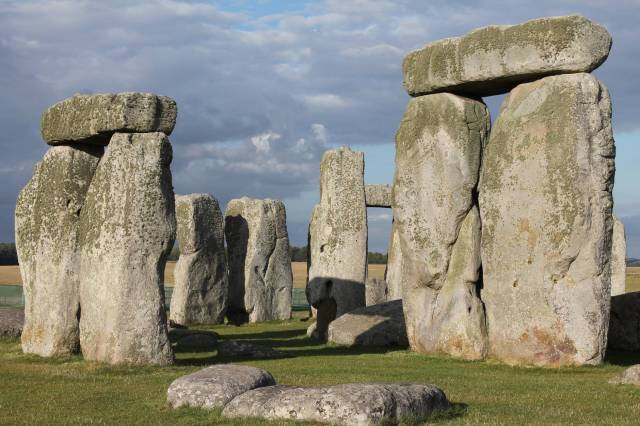
In fact, the earth is trying to kill you, so people who live close to the earth have plenty of survival-related worries (besides the usual human sin problem that did not first arise with industrialization). Farmers have to pay detailed attention to months and seasons, as do hunters, who also have to be concerned with times of day. So, no, there are no “time-free” people. In fact, there have been many ancient cultures that were very, very concerned with calendars. See Stonehenge, above, which was apparently a computer for predicting eclipses, and the Maya, who could be fairly said to be obsessed with dates.
But, of course, it makes no sense to have a hunter-gatherer culture going around talking about the months by the names we give them. Let alone the days of the week, although if you follow Genesis, people have always known that days come in sevens and one day is for rest. Talk of seconds and minutes is even more of an atmosphere killer when it comes to verisimilitude.
Sci-fi writers can make up their own time divisions or draw on terms from sci-fi convention: clicks, parsecs, light-years, cycles, and no, I don’t know what most of these words mean really. They are fun, though. Perhaps in the comments you can enlighten me.
Anyway, here is how I deal with time. I didn’t spend a lot of … you-know-what … thinking about this when I first started drafting. I became more aware of it as my characters moved more into a hunter-gatherer lifestyle. You will still occasionally see the word, for example, “hours” crop up in my books. But when it would not take too much rewriting to get rid of modern time-words, here is what I use:
Some books need warning labels. Especially history books. Heck, history needs a warning label! Heck, this entire world needs one! It should read something like: Fallen World. Danger, Difficulty, Death.
For all these reasons, the brilliant graphic artist Nathan Hale puts warning labels on the the brilliant historical books he produces for children. The labels are tailored to each individual story. For example:

Note the delightfully specific terrors promised, such as “underwater toilets” and “Swedish swearing.” (And yes, the book delivers those very things. It makes sense in context. So does the bomb on a stick.)

Besides the horrors and heroics that we all know her life contained, we get “supernatural visions” (Harriet’s and, before her, Nat Turner’s); “massacre” (led by Nat Turner); “muskrat trapping” (more of a hardship than it sounds); and, of course the “drugged babies” are so that the escapees would not be caught.
Now, I write fiction, and it’s pretty dramatic and everything, but nothing I or anyone else will write can compare to the drama and poignancy of Harriet Tubman’s life.
With that disclaimer, here — and you can tell that I worked really hard on this — is a warning label of my own, done in the style of graphic artist Nathan Hale, applied to my book The Long Guest.

In the comments, please post a goofy warning label of your own about your own book or a favorite book.
To-day all our novels and newspapers will be found swarming with allusions to a popular character called a Cave-Man. So far as I can understand, his chief occupation in life was knocking his wife about …
In fact, people have been interested in everything about the cave-man except what he did in the cave. Now there does happen to be some real evidence of what he did in the cave. What was found in the cave was not the horrible, gory club notched with the number of women it had knocked on the head. [It was] drawings or paintings of animals; and they were drawn or painted not only by a man but by an artist. They showed the experimental and adventurous spirit of the artist, the spirit that does not avoid but attempts difficult things; as where the draughtsman had represented the action of the stag when he swings his head clean round and noses towards his tail. In this and twenty other details it is clear that the artist had watched animals with a certain interest and presumably a certain pleasure. [I]t would seem that he was not only an artist but a naturalist.
When novelists and educationists and psychologists of all sorts talk about the cave-man, they never conceive him in connection with anything that is really in the cave. When the realist of the sex novel writes, ‘Red sparks danced in Dagmar Doubledick’s brain; he felt the spirit of the cave-man rising within him,’ the novelist’s readers would be very much disappointed if Dagmar only went off and drew large pictures of cows on the drawing-room wall.
G.K. Chesterton, The Everlasting Man (orig. ed. published 1925), pp. 27 – 30
So, tomorrow is election day in the United States. It’s going to be hell for everyone.
But don’t be sad, because The Long Guest goes on sale today!
So, strap on your face mask and your riot gear, venture out and vote … and then come home and curl up with a hot beverage and a book about an apocalypse you can enjoy. Leave everything else in the hands of God.

