They say it’s melting. Maybe Graham Hancock will get his onetime wish and we can do Antarctic archaeology and find out whether it was really the site of Atlantis.
(When I first saw the satellite image of Eagle Island, visible in the second article, for a second I thought it was the whole continent. The headline in my browser had been something like “Antarctic Ice Melting,” and then there’s this image, left and right, left mostly snow-covered, right showing lots of brown rock, melt ponds, coastline. I was like, “WOW! That melted REALLY fast! We can see the land and everything! Oh … wait … that’s a small island, not the whole continent.”)
Today’s post comes from chapters 4 and 5 of this book.
Writing is a human practice.
Of course it is possible to have a human society without writing, but the impulse to devise a writing system, looked at historically, may have been the rule rather than the exception.
This is counter-intuitive, of course. “Symbolic logic” seems like it ought to be unnatural to humans, especially if we are thinking of humans as basically advanced animals, rather than as embodied spirits. But if we think of mind as primary, everything changes. It’s telling that reading and writing are one of the learning channels that can come naturally to people, in addition to the visual, the audio, and the kinesthetic. But I’m getting ahead of myself.
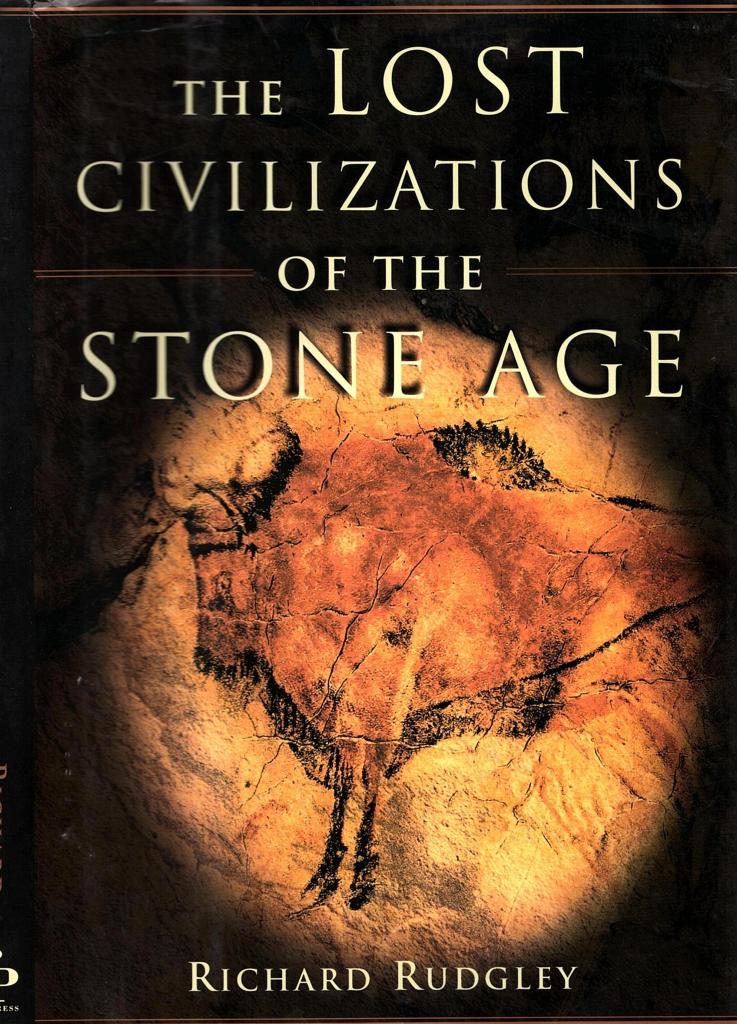
Welcome to the third post taken from Lost Civilizations of the Stone Age by Richard Rudgley. Call this the writing edition. This post hits the highlights of Rudgley’s chapters 4 and 5, pages 58 through 85.
Nah, Ancient People Didn’t Write, They were Barbarians!
The idea of writing as an exception in human history has become dogma:
The proposition that Ice Age reindeer hunters invented writing fifteen thousand years ago or more is utterly inadmissible and unthinkable. All the data that archaeologists have amassed during the last one hundred years reinforce the assumption that Sumerians and Egyptians invented true writing during the second half of the fourth millennium. The Palaeolithic-Mesolithic-Neolithic progression to civilisation is almost as fundamental an article of contemporary scientific faith as heliocentrism. Writing is the diagnostic trait … of civilisation. Writing, says I.J. Gelb, ‘distinguishes civilised man from barbarian.’ If the Ice-Age inhabitants of France and Spain invented writing thousands of years before civilisation arose in the Near East, then our most cherished beliefs about the nature of society and the course of human development would be demolished.
Allan Forbes and Thomas Crowder, quoted in Rudgley, p. 75
Of course, the demolishing of our most cherished beliefs about the course of human development is exactly what, Rudgley is arguing, is going to have to happen.
In the last few chapters I have selected only a small number of the complex sign systems that have been preserved from prehistoric times. My concentration on the Near East and more particularly on Europe should not be taken to imply that such systems did not exist elsewhere in the prehistoric world. Far from it; investigations of numerous collections of signs are being undertaken in places as far afield as the Arabian peninsula, China and Australia. Millions of prehistoric signs across the continents have already been recorded, and more and more are being discovered all the time. … It no longer seems sufficient to retain a simplistic evolutionary sequence of events leading up to the Sumerian [writing] breakthrough some 5,000 years ago.
Rudgley, p. 81
Let’s look at these complex sign systems that Rudgley has mentioned.
The Vinca Signs
I was an adult before I ever heard the phrase “Old Europe.” I was doing research for a planned book, and I was surprised to learn that in southeast Europe (between the Balkans and the Black Sea), as early as 4,000 or 5,000 BC, there were not only cities but a writing system (undeciphered) known as the Vinca signs. It turns out that these cities and this writing system were probably part of a culture that obtained over much of Europe before the coming of the Indo-Europeans, which is called Old Europe. This is the culture that Marija Gimbutas believes was “the civilization of the goddess.”
Just as a reminder, these dates for the Vinca culture are before the very first human cities and writing are supposed to have arisen, in Sumeria in Mesopotamia, about 3,000 BC.
Perhaps I didn’t hear about the Vinca signs in school because they were only discovered in Transylvania 1961. (I was born in 1976, but we all know how long it takes new archaeological findings to get interpreted, integrated into the overall system, and eventually make it into school textbooks.) After being discovered, the signs were assumed to be derived from Mesopotamian cultures such as Sumer and Crete, because it was accepted dogma that writing was first invented in Mesopotamia. Later, the tablets on which the Vinca signs were discovered were carbon-dated and found to be older than the Mesopotamian writing systems. This led to a big disagreement between those who wanted to believe the carbon dates, and those who wanted to believe the more recent dates for Old European archaeological sites, which were then conventional.
Then, in 1969, more, similar signs were discovered on a plaque in Bulgaria and dated to be 6,000 – 7,000 years old. By this time, archaeologists were beginning to accept the carbon dating of these Old European sites. But since they still did not want to admit that writing might have been invented before Sumer, most of them decided “[the signs] could not be real writing and their apparent resemblance was simply coincidental.” (Rudgley p. 63)
An archaeologist named Winn analyzed the Vinca signs and while he is not willing to go further than calling them “pre-writing,” he concludes that they are “conventionalised and standardised, and that they represent a corpus of signs known and used over a wide area for several centuries.” (Rudgley 66)
Meanwhile, Marija Gimbutas and also Harald Haarmann of the University of Helsinki both feel the Vinca signs are true writing and that they developed out of religious or magical signs, not out of economic tallies like the Sumerian alphabet.
Haarmann notes that there a number of striking parallels between the various strands of the pre-Indo-European cultural fabric – especially those related to religious symbolism and mythology. Among these common features is the use of the bull and the snake as important religious symbols. In the case of the snake it is a form of the goddess intimately intertwined with the bird goddess motif in both Old European and later Cretan iconography. The bee and the butterfly are also recurrent divine attributes, and the butterfly is represented by … the double ax. Haarmann sees the goddess mythology of Old Europe echoed in these motifs that also feature prominently in the ancient civilisation of Crete. He then traces the links between the Old European script – as found in the Vinca culture – and later systems of writing, particularly those of Crete.
Rudgley, pp. 68 – 69
Rudgley’s Figure 15 (p.70). On the left are the Vinca signs, on the right is Linear A from Crete.
Ice Age Signs
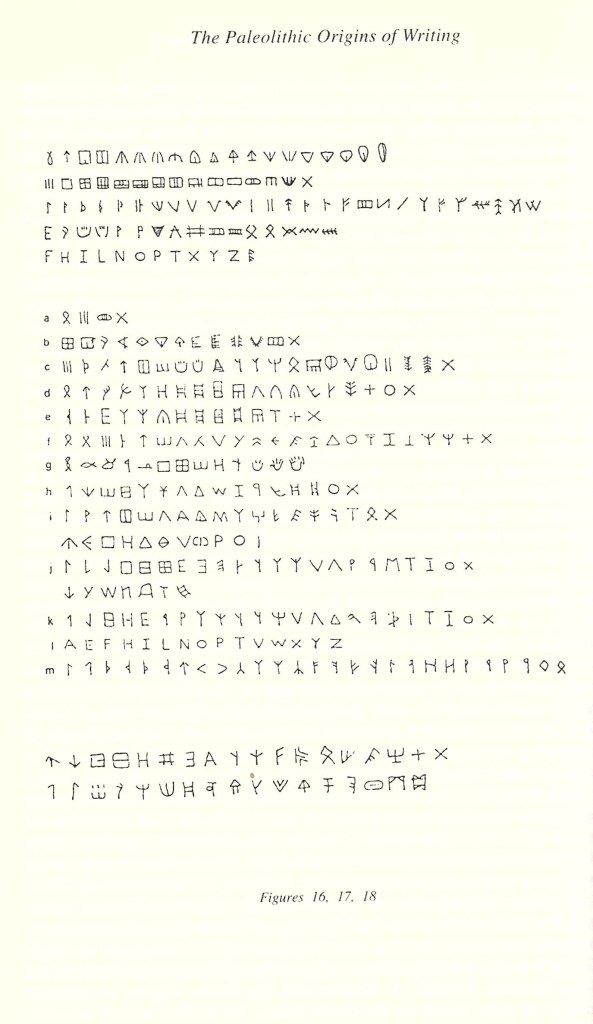
There are quite a number of symbols that appear on artifacts or are associated with paintings from the Neolithic and even the Palaeolithic period. These include crosses, spirals, dots, “lozenges” (ovals), and the zigzag, which is very common and seems to have been used to represent water. (By the way, note the zigzags among the Kachina Bridge petroglyphs.) “The discovery in the early 1970s of a bone fragment from the Mousterian site of Bacho Kiro in Bulgaria suggests that the use of the signs may date back to the time of the Neanderthals. This fragment of bone was engraved with the zigzag motif …” and apparently on purpose, not accidentally in the course of doing some other repetitive task. (Rudgley 73)
“The single V and the chevron (an inverted V) are among the most common of the recurrent motifs in the Stone Age.” (Rudgley p. 74) Gimbutas, of course, interprets the V as a symbol for the female genitals and/or Bird Goddess, but it could be just … you know … a symbol.
Archaeologist André Leroi-Gourhan has interpreted the many signs found at various Palaeolithic cave art sites not as a form of hunting magic (contra previous interpretations), but as a symbolic system. “Leroi-Gourhan admitted to us shortly before his death, ‘At Lascaux I really believed they had come very close to an alphabet.’” (Rudgley p. 77)
Rudgley’s Figures 16 – 18 (p. 78). Top paragraph: some of the Franco-Cantabrian (Stone Age) signs. Middle paragraph: a – hieroglyphic determinatives; b – Sumerian pictoral writing; c – Indus Valley; d – Linear A; e- Linear B; f – Cypriote; g – Proto-Sinaitic; h- Phoenician; i – Iberian; j – Etruscan; k – Greek (Western Branch); l – Roman; m – Runic. Bottom paragraph: some of the signs found on oracle bones in very ancient China.
But Can You Prove It’s Writing?
Every time some symbols are discovered that are so ancient they strain belief, anyone who doesn’t want to accept them as writing can easily go in to a number of calisthenic moves to cast doubt on this. If the item the signs are found on is in poor condition, they can question whether the marks were even intentional. Perhaps they were accidental scratches, the product of some other activity. If the marks are undeniably made by people, they can be dismissed as doodles. The Vinca signs, when first found, were speculated to have been copied randomly from Mediterranean signs by people who believed these things had mysterious power, but did not understand their meaning. Rudgley also notes that the Old European signs have been interpreted as purely magic symbols, as if a magical intent were to make them non-writing.
In short, any time we are presented with a complex system, there are always a million ways to get out of attributing it to a mind. This is doubly true if we aren’t able to interpret its meaning, but you will even see people do this with messages that they ought to be able to understand. Of course, it can also work the other way, where people see meaning in complex patterns where it wasn’t intended. Often what it comes down to is whether we want there to be a meaning there. Do we, or do we not, want to be in contact with another mind? If for whatever reason we don’t, we can always find a logical way to avoid that contact.
So in the case of apparent writing systems that we haven’t cracked and probably never will, our attitude towards them is going to depend heavily on what we believe about ancient people’s minds. Were they basically like ours, or were they different, animal? We will see more writing systems if we are expecting that they came from people. If we are not expecting to encounter people, then nothing is going to convince us that these are writing systems.
Was Adam a Writer?
My mind was blown, while taking an Old Testament Backgrounds course years ago, when I read an essay that asserted that Adam was able to write and in fact had left a written record for his descendants.
This idea seems completely loony on the face of it … until you realize that the only reason it seems loony is that we are assuming that writing is a recent, unnatural development, the product of tens of millennia of human cultural evolution, and not a characteristic human activity that is, so to speak, wired in.
The essay interpreted the early chapters of Genesis in this way. There will be a short historical record, followed by the phrase “the book of [name],” indicating that the passage immediately preceding was by that author.
Passage
Recounts
Closes with
Genesis 1:1 – 4:26
Creation (in poetry), fall, Cain and Abel, some of Cain’s descendants, Seth
Gen. 5:1 “the book of Adam”
Gen. 5:1b – 6:8
Recap of creation of Adam, Seth’s descendants up to Noah and his sons, Nephilim, God’s resolve to wipe out mankind, God’s favor on Noah
Gen. 6:9a “the book of Noah”
Gen. 6:9b – 11:9
Building of the ark, the Flood, emerging from the ark, the Table of Nations, the Tower of Babel
Gen. 11:10 “the book of Shem”
Gen. 11: 10b – 11:26
Genealogy from Shem to Terah and his son Abram
Gen. 11:27 “the book of Terah”
Gen. 11:27b – 25:18
Terah moves his family to Haran, Terah dies, a whole bunch of stuff happens to Abram, death of Sarah, Isaac finds a wife, Abraham dies, genealogy of the Ishmaelites
Gen. 25:19 “the book of Abraham’s son Isaac”
Gen. 25:19b – 37:1
Jacob’s entire life, death of Isaac, genealogy of Esau
Gen. 37:2 “the book of Jacob”
In Genesis, the author’s name comes after the notes he left.
I realize this might be a lot to accept. It’s just food for thought. It does explain why it says “the book of _________” (or, in my NIV, “this is the account of __________”), after the bulk of that person’s story.
Get it? Get it?
(By the way … for those wondering about the title of this post … prostitution is referred to as “the world’s oldest profession.” Erma Bombeck, mother and humorist, has published a book hilariously titled Motherhood: The Second Oldest Profession. The title of this post references those two, because the post is about the fact that writing is very, very old. I don’t mean to imply that a writer’s life has any necessary connection to the other two professions, although of course this does invite all kinds of clever remarks.)
This post is the second in a series of posts based on chapters from this book:
The Lost Civilizations of the Stone Age by Richard Rudgley, Touchstone, 2000.
As Rudgley writes in the Introduction:
In this book I will show … how great is the debt of historical societies to their prehistoric counterparts in all spheres of cultural life; and how civilised in many respects were those human cultures that have been reviled as savage.
Ibid, p. 1
What do you mean, “Stone Age”?
“Stone Age,” of course, sounds very ancient, and that is by design. But when Rudgley talks about the Stone Age, often the dates involved are “only” about 12,000 to 10,000 years ago (approximately the time we think that people were crossing the Land Bridge). This falls before the beginning of recorded history — we think — unless we are willing to accept local origin myths worldwide as inevitably garbled historical records. After the small amount of study I have done about the historicity of myths, of Genesis, and of the many amazing prehistoric engineering feats, I no longer think of Stone Age people as “cave men,” but rather as fully modern humans, certainly our intellectual equals and probably our superiors. For my disclaimer about the dating of archaeological sites and prehistoric events, see my last post about Rudgley, here.
The “Venuses” of Eurasia
Chapter 14 of Rudgley (pp 184 – 200) discusses the large number of small female figurines which have been found all over Europe and as far east as Siberia. These are called “Venuses,” though of course they would not have been called that by the original artists. They were being produced (if we take the dating at face value) over a period of many thousands of years.
The oldest one, according to Rudgley, dates to the Aurignacian age, about 31,000 years ago: “the Venus of Galgenburg [Austria].” It is 7 mm tall, made of a soft green stone, and is artistically sophisticated. The figure is posed as if dancing. She is bearing her weight on her left leg. The right leg is carved free of the left and braces on the base of the figure. The right arm is carved free of the body, with the hand bracing on the knee. Clearly the sculptor knew what he or she was doing when it came to posing the figure, carving free limbs that would not break off, and piercing through the material without breaking it. Since this is (by hypothesis) the oldest such figure that we have, it’s clear that we don’t have a case of an artistic tradition that started out crude and later became more advanced. (pp 192 – 194)
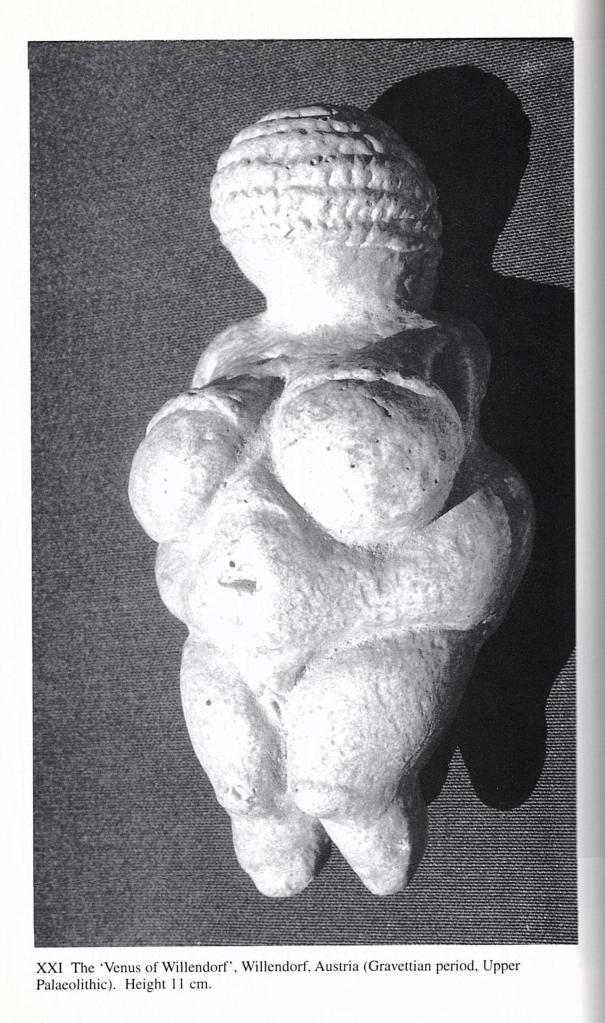
Probably the best-known of these figures is the Venus of Willendorf (also found in Austria).
When I was first exposed (pun not intended) to this little figurine, it was introduced to me simply as “the mother goddess.” Although shocking to modern eyes, it is certainly a work of art. As you can see, it has no face, but it has a considerable amount of detail in odd places such as the knees, private parts, and hairdo. The hair looks a bit like corn rows to me, but could also be braids wrapped around the head or even styled curls a la the Babylonian kings. “Alexander Marshack believes the coiffure of the Willendorf figurine may be one of the symbols of a mature and fertile woman” (198).
Not all of the Stone Age Venuses are fat or naked.
Bednarik is very skeptical about the usefulness of lumping all female figurines of the period together, noting that they are extremely diverse in numerous ways. Some are naked; others partly or fully clothed. Some are in pregnant condition; others are not. Some are fat to the point of obesity, whilst others are very slender. Beyond the fact that they all depict females and most come from the same period of the Upper Palaeolithic, they appear to have little in common.
Ibid, p. 197
The Meaning of the Venuses
Figures like the Willendorf Venus are very intriguing to some people, for obvious reasons. The explanation most ready to hand is that they are artifacts of some kind of fertility religion. This explanation is the more intuitive because of what we know about the importance that fertility often plays in pagan religions worldwide.
Marija Gimbutas has taken these figures and other evidence to posit a wide-ranging “civilization of the goddess” in Old Europe. (She published a book with that title in 1991.) She deduces (or speculates) quite a lot about this religion from Venus artifacts and from other sources. Her thesis is that the gentle, goddess-worshipping Old Europeans were overrun by warlike worshippers of a sky god coming from the Eurasian steppes (i.e. the Indo-Europeans). Gimbutas’ work had quite a strong influence on one of my high school literature teachers, who emphasized to us that worshipers of a male sky god “always” come to rape, pillage and plunder, steal, kill, and destroy. (At this point, the neo-pagans in the class would give the Christians the side eye.) We will deal with Gimbutas in another post, probably later this year.
In Jean M. Auel’s Clan of the Cave Bear books, the venuses are definitely symbols of a goddess of fertility and sexuality. Her male lead Jondalar comes from a matriarchal society in western Europe where the figurines are referred to as doni. Jondalar, when distressed, will even exclaim, “Oh, Doni!” The female lead Ayla, meanwhile, was raised by Neanderthals, who in Auel’s books severely oppress their women (because, of course, they fear their procreative power).
Moving even farther along the continuum of being obsessed with sex, Rudgley’s chapter includes a hilarious discussion of how some archaeologists have gotten over-excited and begun to interpret nearly all Palaeolithic art as porn.
It has been suggested that another important aspect of Aurignacian art was their liberal and frequent use of sexual imagery, particularly … female genitalia. This theory was first developed by l’Abbe Breuil … The idea soon caught on among French prehistorians and became something of a dogma, and various shapes engraved in stone … that looked vaguely like a vulva were automatically perceived as such by scholars eager to discover further proof of the prehistoric obsession with sexual matters. … Perhaps the most absurd example of all is a description of a simple straight line as a representation of the vaginal opening.
Ibid, pp. 194 – 195
It just cracks me up that these were French prehistorians. Of course they were. Of course.
Rudgley sums up in a way that I think is quite reasonable and balanced:
[T]he fact that the figurines are found across a huge geographical area and a period of thousands and thousands of years means that it would be ridiculous to think that they all symbolised the same thing to their extremely diverse makers. It is quite apparent that the female body was used to express numerous concerns in Palaeolithic times. [198]
We can now see how any crude explanation of the Willendorf figurine as simply a fertility figure or an object of sexual desire is entirely inadequate. The representation of the female body during the Upper Palaeolithic period … was a symbol of cosmological significance that was able to express all aspects of Palaeolithic human concerns. [199]
If the female body was one of the most widespread and elaborate images of the Old Stone Age, and a symbol for the various forces of nature and the various aspects of culture, would it really be so far from the mark to believe that the figurines actually embody aspects of the Palaeolithic worship of a goddess? [200]
Rudgley, Lost Civilizations, chapter 14
… So, Why Are They Affirming Again?
Well, obviously, on the most superficial level, the Willendorf Venus is an implied affirmation to any modern woman who is pregnant, aging, or concerned about her weight. Somebody worked very hard to portray this lady.
On a slightly deeper level, our modern culture is one that really hates the idea of motherhood. We don’t like the idea that potential motherhood is a defining characteristic of being a woman, or that it might be a worthy or even glorious goal. Unfortunately for our tidy little minds, though, motherhood (besides being a kind of superpower) is in fact a built-in goal in the design of women. Which means that knocking it as a role and calling is pretty hard on women, even those who don’t realize it, because we, as a culture, are constantly asking them, in a thousand ways large and small, if for the sake of decency they could please not exist.
In this kind of environment, it’s a tonic to know that it was not always thus. There could exist – there apparently did exist – a culture that greatly valued, perhaps even worshiped, mothers. You don’t have to be an acolyte of the goddess to appreciate the boost this gives women.
Worshiping a good thing, rather than its creator, is idolatry and idols always turn on their followers. Thus, a religion of motherhood certainly would have come with its own distortions and injustices (such as devaluing infertile women, as we see in the Old Testament). But still … it’s nice to know that at one time a mature, even obese woman was considered a thing so good that she could possibly be worshiped.
I am dealing with this topic not because I feel a particular affinity for it. I don’t enjoy looking at the Venus of Willendorf, and despite the paragraph above I would not want to look like her. I tackled these figurines because my area of interest is prehistory, and durned if they don’t show up in it. Finding out how affirming they are to women was just an unexpected bonus. And if they do feel really weird even as they are affirming, I think the weirdness comes because they are from such a different culture.
This post is the first in a series I have planned about prehistory. Each post will draw on one or more chapters from the book The Lost Civilizations of the Stone Age, by Richard Rudgley, Touchstone, 2000. From the front flap:
Our long-held myths are exploding. Recent discoveries of astonishing accomplishments from the Neolithic Age – in art, technology, writing, math, science, religion, and medicine, and exploration – demand a fundamental rethinking of human history before the dawn of civilization.
Lost Civilizations, inside flap
So, Rudgley’s thesis is basically that there was, in fact, civilization long before there was civilization. That is, of course, also a theme of this blog. “Ancient people were smarter than we think,” or that art, literature, science and civilization are the natural state of human beings and have been present (ebbing and flowing of course) as long as there has been humanity.
A near-universal theme in the mythologies of the world is that the present state of the world, and more specifically the social world, is in decline — a fall from the Garden of Eden or from a Golden Age. Modern civilization has turned these traditional mythological assumptions on their head and written a new script, one based on the idea of social progress and evolution. In this new mythology the notion of civilization (as it is generally understood) replaces Eden and this novel paradise exists not at the beginning of time but, if not right now, then just around the corner. Civilization is … presented as the final flowering of human achievement born out of a long and interminable struggle against the powers of darkness and ignorance that are represented by the Stone Age.
Lost Civilizations, Introduction, page 1
I have come to believe in the ancientness of civilization because I take ancient documents seriously as historical records: Genesis, primarily, but also the other legends and myths from around the world which Rudgley mentions in his intro. This suspicion that ancient people were much smarter than we give them credit for was further strengthened as I learned about some of their buildingprojects. Now Rudgley is presenting archaeological evidence that they knew far more than we suspect about art, mathematics, the natural sciences, and medicine.
Disclaimer about Dates
By the way, I don’t have a coherent way to sort out which archaeological dates to accept and which ones to doubt. As far as I can tell from my reading, all methods of dating archaeological sites are based on some form of dead reckoning.
Carbon dating depends on certain assumptions about rates of molecular decay, which can’t be proven in the first place and can also be thrown off universally or locally by events such as a comet strike. Carbon dating also seems to be less reliable the farther we go back in time.
Dating by archaeological layers also depends on assumptions about different historical periods and what might be diagnostic of each, except in cases where a site can be reliably linked to a known historical event (which is obviously only the case for relatively recent sites). Other than that, it’s all dead reckoning.
Dating events in human history by the use of genetics depends upon assuming that all genetic differences evolved and assuming certain rates of change. Historical linguistics has the same problem.
Finally, historical records such as the genealogies found in Genesis and in the oral traditions of other peoples worldwide hit only the highlights of a family line and don’t give us any idea how many generations were skipped.
Each of these methods can be pretty convincing in specific cases. It is even more convincing when one or more methods converge, yielding the same date range. But even when that happens, it’s still just one method of dead reckoning appearing to validate another. And most often, different dating methods contradict each other. If a plurality of them converged on one timeline for human history, maybe we could accept that. But they don’t. It’s complete chaos.
I would love to present a clever, coherent, data-grounded rubric for sorting all this stuff out. But I’m not a professional in any of these fields. Even if I were, the pros don’t all agree with one another. It’s starting to look like, in order to have a sorting method that makes sense, I would have to do full-time research for several years. Maybe for a lifetime. So I got nothin’.
My working theory is that humanity, and hence human civilization, is tens of thousands but not hundreds of thousands and certainly not millions of years old. I can’t prove this. No one can.
So, in these posts about Rudgley’s book, I’ll just present the dates as he gives them. I won’t try to integrate them with the picture of ancient human history that I have been piecing together in my books and in other posts on this site, all of which could be invalidated at any time by a new historical or archaeological discovery. Sometimes Rudgley gives dates that are hundreds of thousands or even millions of years old (though not in this chapter). I might be skeptical that they are really that old, but can still accept that these people were living long before mainstream archaeology tells us that there was “civilization.”
On to the Icky Stuff!
So. Stone Age Surgery.
Undoubtedly the widest-known major surgical operation in tribal cultures is trepanation … which, as will become clear, was also known in the Stone Age. This operation involves the removing of one or more parts of the skull without damaging the blood vessels, the three membranes that envelop the brain … or the actual brain.
Lost Civilizations, p 126
That’s right, removing parts of the skull. There are three methods by which this can be done: scraping, “a mixture of boring and sawing,” and “the push-plough method,” which involves creating an oval groove in the skull (basically another method of scraping).
Thomas Wilson Parry, MD (1866 – 1945), became fascinated by trepanation and practiced various methods of it on human skulls (not on live patients), “using implements made of obsidian, flint, slate, glass, shell and shark teeth.” “Parry records that the average time it took him to perform a trepanation by the scraping method on a fresh adult skull was half an hour. He found both flint and obsidian excellent materials to work with surgically, and also expressed the opinion that shells — which were used in Oceania to perform such operations — were highly effective too.” (page 128)
Trepanation appears to be less painful than it sounds. It has been used at various times and places to treat epilepsy, mental illness, head injuries, severe headaches, vertigo and deafness (129). It is “still regularly practised among the Gusii of Kenya, a Bantu people with a population of about one million, and theirs is perhaps the last surviving traditional practice of its kind.” (130) Trepanation was also practiced by the Incas and the pre-Inca peoples; in Neolithic Europe; in 6th-century BC Palestine; and now, trepanned skulls a few thousand years old have also been found in Australia.
Rudgley points out that “as it is usually only the bones of Stone Age people that survive to be discovered … any operation that was performed on the soft parts of the body cannot be detected.” (136) If Neolithic people were willing and able occasionally to practice trepanation, it seems likely that they were able to perform less risky kinds of surgery too. There is some evidence from Neolithic Europe of various kinds of dentistry, including toothpick grooves, birch bark chewing gum, and even a skull with a tooth that has been drilled. (136)
Rudgley’s chapter on trepanation (“Stone Age Surgery”) comes after a chapter called “Under the Knife” (pp 116 – 125), which discusses medical procedures in “tribal” cultures that are known from history and ethnography. This includes everything from circumcision in the Ancient Near East, to amputation among the Australian aborigines, to very detailed anatomical knowledge among the Aleutian islanders. The chapter concludes with two horrifying yet impressive accounts of successful surgeries in a tribal context. There is a c-section performed in Uganda in 1879, and various tumor removals performed in the Ellice [sic] Islands in the 1920s. The message is clear: modern, “civilized” people don’t have a corner on medical knowledge.
Antiseptics and Painkillers
We don’t know whether Stone Age people had germ theory. Nor, if they had it, do we know how they referred to germs. In one of Ursula le Guin’s novels, a wound getting infected is called “the evil of the blade.” That’s hardly less scientific than calling it an “infection,” as long as you know how to prevent or treat it.
Studies of both the trepanned skulls of the Incas and some of those found in Neolithic Europe indicate that healing seems to have been the norm in both cases. It is hard to explain the Stone Age success rate without concluding that some kind of effective antiseptic agent must have been used. Furthermore, the surgeons of the time must have understood the need for it.
Lost Civilizations, p 131
If germ theory was ever explicitly known, it was obviously forgotten at some point in human history, only to be re-discovered much later. But even if people were operating on a different theory, it would be possible for them to know the importance of cleanliness and to know how to treat a patient using any of a large number of natural substances that have antiseptic properties. The words “Stone Age” naturally evoke the image of a cave man, and the idea of a cave man naturally includes an individual who never takes a bath. But it ain’t necessarily so.
It is also possible that people’s immune systems were much stronger many years ago, if we are willing to entertain the idea that the human race has declined over time rather than evolving upwards.
Now, I am sure you want to know about painkillers. Here, gleaned from Rudgley’s Stone Age Surgery chapter, is a short list of substances that have been used as painkillers at different times and places:
cocaine (in coca leaves — South America)
wine mixed with extract of mandrake (first-century Greece)
mandrake beer (ancient Egypt)
possibly just beer
the opium poppy (starting in the Mediterranean around 6000 BC and spreading west from there)
cannabis (native to Central Asia, but quickly spread to Old Europe and China)
betel nut (Southeast Asia)
tobacco (in the Americas)
pituri (a nicotine-bearing plant used by the Australian Aborigines)
Clearly, although we might prefer modern anesthesia, ancient peoples were not completely without recourse when it came to pain. Most of the substances on this list are attested not only in history but also in ancient burials.
And Now, the Lucky Honoree of this Post
This post is dedicated to a certain relative of mine whose birthday today is. Like the surgeons in this post, he is both very smart, and now, as of this birthday … ancient.
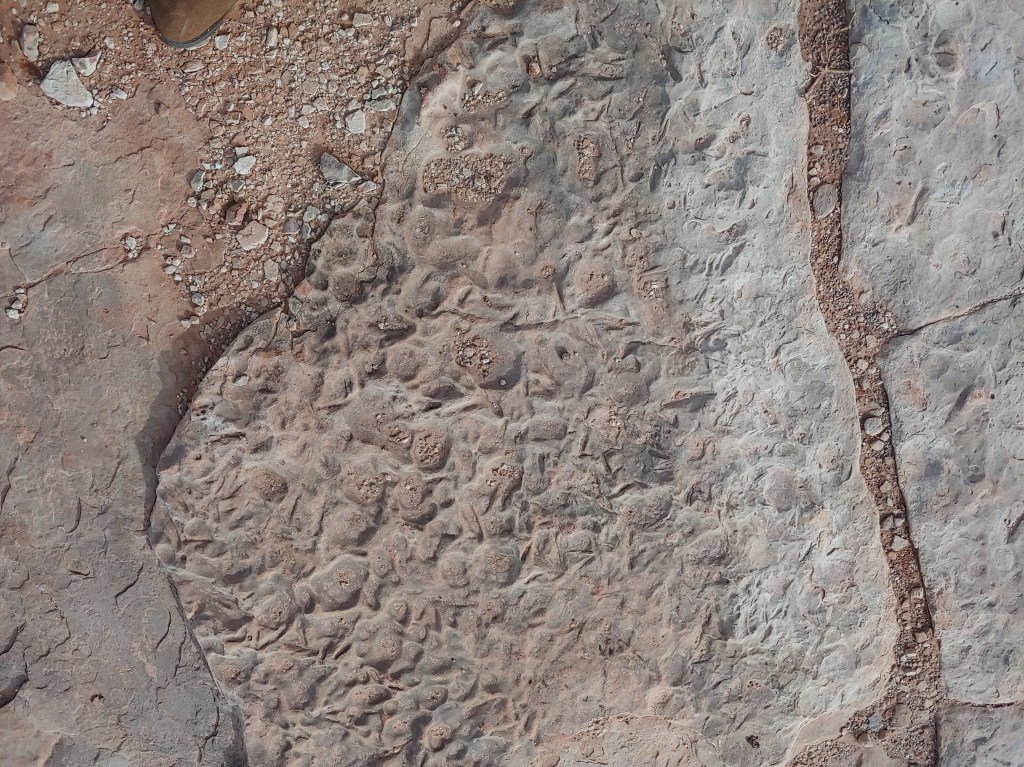
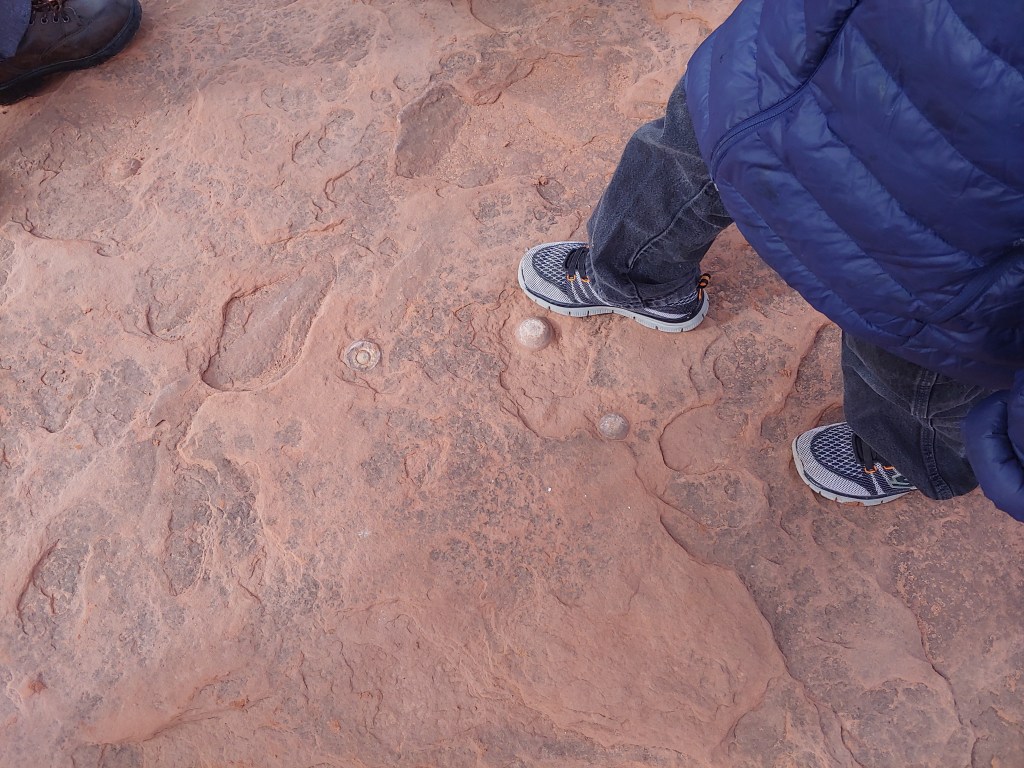
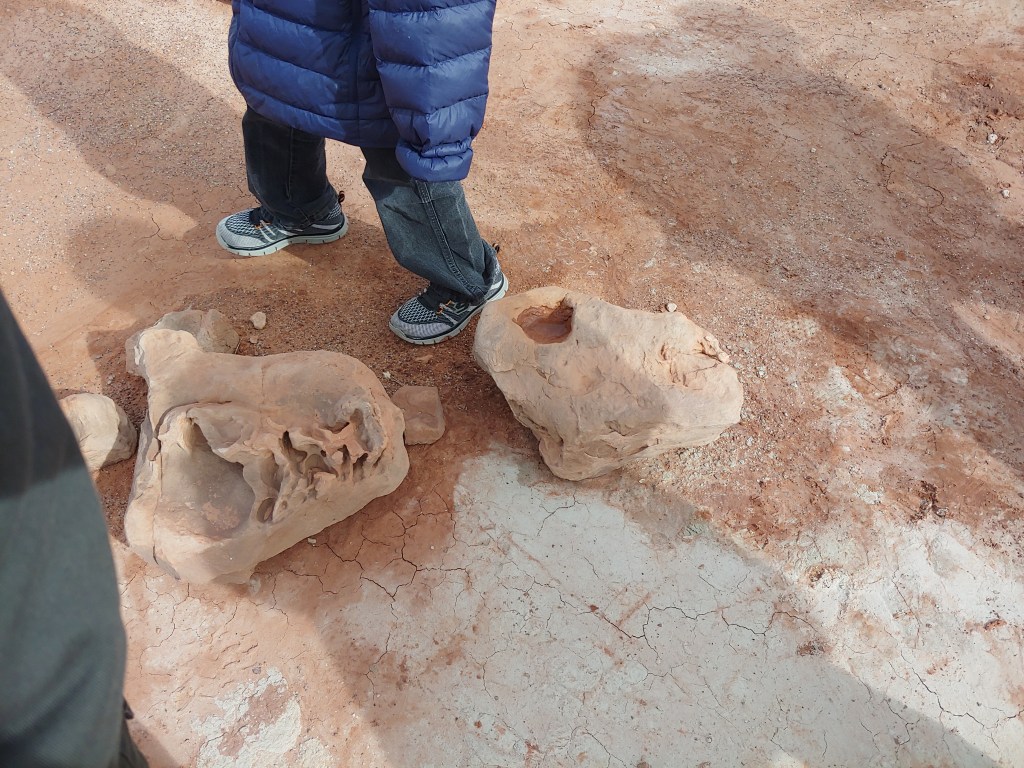
Maiasaurus tracks. Mother and baby tracks visible.T-Rex! I have a picture of my kids standing on this footprint, but want to protect their privacy.swamp grassfossilized dinosaur eggs (son’s foot for scale)skull, and neck vertebraeThis one is, according to our guide, a human footprint.This little rise was the only high point in the area, except that we were already on high ground as the road climbed towards Tuba City.
There were also some coprolites, big rock cow pies which had been stacked and made into a little fence at one point. Nothing like a stone wall built of dino poop.
Philanthropic: Not in the sense of charity, but in the literal sense of loving + people. The opposite, in other words, of mis-anthropic.
Of the decade: The decade is drawing to a close, so everything we post in the next few days can legitimately be called of the decade! What a fun opportunity.
At Christmastime, Christians like to quote Isaiah. That’s because this Old Testament prophet has several passages that are clearly Messianic and, in retrospect, clearly prophesy Christ. Like many prophetic passages, they have at least a triple meaning. They are prophesies about God restoring Israel from the Babylonian exile … they are prophesies about the coming of Christ, which happened several hundred years later … and they are prophecies about the ultimate golden age of the world which Christ will eventually bring about (although not, as it turns out, immediately upon His first coming, though his life on earth did get the process started). All these things are telescoped together in a breathtaking poetic sweep.
This is the most often quoted passage from Isaiah at Christmastime:
The people walking in darkness have seen a great light;
on those living in the land of the shadow of death a light has dawned. …
Every warrior’s boot used in battle and every garment rolled in blood
will be destined for burning, will be fuel for the fire.
For to us a child is born, to us a son is given,
and the government will be on his shoulders.
And he will be called Wonderful Counselor, Mighty God,
Everlasting Father, Prince of Peace.
Of the increase of his government and peace
there will be no end.
He will reign on David’s throne and over his kingdom,
establishing it and upholding it with justice and righteousness from that time and on and forever.
The zeal of the Lord Almighty will accomplish this.
Isaiah 9:2, 5 – 7, New International Version
This is the go-to Christmas passage.
Another one that you sometimes hear quoted is this:
A shoot will come up from the stump of Jesse;
from his roots a branch will bear fruit.
The Spirit of the Lord will rest on him —
the Spirit of wisdom and of understanding,
the Spirit of counsel and of power,
the Spirit of knowledge and of the fear of the Lord —
and he will delight in the fear of the Lord.
He will not judge by what he sees with his eyes
or decide by what he hears with his ears;
but with righteousness he will judge the needy,
with justice he will give decisions for the poor of the earth.
He will strike the earth with the rod of his mouth;
with the breath of his lips he will slay the wicked.
Righteousness will be his belt and faithfulness the sash around his waist.
The wolf will live with the lamb,
the leopard will lie down with the goat,
and the calf and the lion and the yearling together;
and a little child will lead them.
The cow will feed with the bear,
their young will lie down together,
and the lion will eat straw like the ox.
The infant will play near the hole of the cobra,
and the young child put his hand into the viper’s nest.
They will neither harm nor destroy on all my holy mountain,
for the earth will be full of the knowledge of the Lord
as the waters cover the sea.
Isaiah 11:1 – 9, NIV
There. That ought to keep you going for days.
But Isaiah is a big book (66 chapters), and these two passages are only from the beginning of it. Tomorrow I will post some lesser-known quotes from Isaiah that are among my favorites.
In the meantime, Merry Christmas! “God bless us, every one!”
And now to Rome, as always in December, came the Saturnalia.
“Io! Saturnalia!” That was the call that ushered in the merriest holiday of the Roman year — that hilarious, glorious, mid-December festival, the Saturnalia.
“Io! Saturnalia! Io! Io! Io!” That was the greeting that echoed through the holiday season. For it was in honor of Saturn — good, old, generous Saturn, kindest and most provident of the gods.
During those mid-December days (first three, later seven) no war was ever declared, nor battles fought, no criminals tried or punished. Courts were closed; schools dismissed; even the slave markets were shut down. During those days, all slaves were free [just] as in those golden days of old, all people had been equal. Everyone, rich, poor, young and old joined in a glorious holiday.
The day began with a sacrifice of thanksgiving in the early morning, followed by a public feast at midday, which turned into a wild, hilarious carnival before evening. In red pointed caps and colored costumes, merrymakers went singing and laughing through the streets, showering wheat and barley like confetti, and granting every wish, no matter how wild, ridiculous, or disgusting, made by the lucky one who had been chosen “King of the Saturnalia.”
The weeks ahead were always filled with preparation. Candlemakers and makers of dolls were busy pouring wax, turning out little earthenware images, and setting up booths for the doll fair. Every child would want a doll, and every household would need many candles for the Saturnalia.
Holly branches, with their bright berries, had to be cut and carted into the city, and houses trimmed with evergreen. Gifts for the family and friends must be selected and wrapped. For on the second day, after a family dinner of roast young pig, with all the trimmings, came an exchange of presents!
Augustus Caesar’s World: 44 BC to AD 14 by Genevieve Foster, Beautiful Feet Books, 1947, 1975, pp. 56 – 58
Sometimes you want to see something with your own eyes.
My Dinosaurs in History post includes a link to a web site that discusses an Anasazi petroglyph that looks an awful lot like a dinosaur. Even on the web site, you can tell that the original petroglyph is very, very faint.
from the Defending Genesis web sitefrom Defending Genesis again
It’s on Kachina Bridge, which is in Natural Bridges National Park in southern Utah. So when I learned I would be passing through southern Utah, I thought I had better go and look at the thing myself. Do my due diligence. How could I live near this thing, drive right by it, and not try to get a glimpse?
Getting to Kachina Bridge
Here’s how to get to Kachina Bridge. First you drive to Natural Bridges National Park, which is about 35 miles from the main highway. The road is very good, but it is so twisty, with so much climbing, that the 35 mile drive took us about an hour.
We checked in at the Visitors’ Center and showed our national parks pass. From there, you drive your car around a one-way loop that takes you past all the major overlooks in the park. From the loop, you can park your car and access the trail heads. Kachina Bridge is down in a rocky canyon. The trail is about 1.5 miles round trip, but it’s basically vertical. It’s a combination of stone steps, scrambling over red rock following a trail marked by little cairns, scrambling down red rock faces aided by handrails the park has installed, and, in one case, a short climb down a wooden ladder.
It’s a beautiful hike, but despite what the Defending Genesis web site says, this trail would not be easy to navigate while carrying something bulky such as a ladder. In our case, it was made more beautiful and more perilous by the presence of snow and icy patches.
(By the way, could I just pause here and express how grateful I am for our national parks. Someone has created and maintained a fantastic road to get out to this place, then a driving loop and parking places, and then a trail with carved steps, handholds, etc. Because of all this, I (and even my kids!) are able to access this remote and beautiful spot. Without all this, we would have no reason to go there, no way to get there, and probably no idea that the place existed.)
Anyway, finally we were on the canyon bottom. We followed a gravel path beside a stream, and eventually we emerged and – ta-da! – there was the bridge before us.
Sneaky Petroglyphs
When you first get to the bridge, your natural instinct is to approach it and then walk under it. Consequently, I at first walked right past all the petroglyphs without even noticing them. Or actually, I walked right under them.
The biggest group of petroglyphs is on the side of Kachina Bridge that faces you as you approach it. They are on a relatively flat, vertical strip of canyon wall, about 10 or 15 feet up, with a ledge protruding below them. To get a close look at them, you would need to scale the ledge using rock climbing equipment or a ladder. If you stand right underneath them, the ledge partially blocks your view. So if, like me, all you have is a stupid cell phone camera, you have to back way up and then use the zoom to get grainy “close ups” of the petroglyphs.
Showing the ledge. What looks like a tiny pueblo under it is eroded red clay. The glyphs we’ll be looking at in a moment are farther along to the left of this group.
Some of these petroglyphs are really famous, but some of the most famous ones are the hardest to see. They are made up of dibbles in the rock which itself has an irregular surface. I imagine that the best time to photograph them would be morning or evening when the slanting light would help pick them out. (We were there at noon.) And to use a professional camera with a good zoom lens maybe.
For example, can you see three human figures, zigzags, and spirals in this photograph?Here I’ve used Paint to enhance the ones I could see … which did not include the second man’s head. There is also a turtle-like something I did not enhance because I wasn’t sure of it.
Me, Trying to Photograph Them Anyway
So I wandered around in the snow and took about a million photos of the different sections of the wall with my cell phone, hoping that I might photograph the dinosaur by accident and be able to find it later. There were so many petroglyphs, and many of them overlapping each other, and I had no idea where in this composite mural the supposed dinosaur might be.
I also took some photographs of the whole scene from a distance to give a sense of context of the petroglyphs.
As I stumped around in the frozen red mud, I thought to myself. These are so hard to get to and photograph. How hard must they have been to make? What would motivate anyone to make all this art (or language) in this hard-to-get-to spot? It’s a similar question to cave paintings. Of course, there is lots of good information out there about what these spirals and zigzags and blocky figures tell us about probable Anasazi cosmology. The only thing I could undeniably tell that the original artists must have been saying, though, was,
“We were here!”
I Did Photograph It! But You Can’t See It
When I got home, I tracked down the web site and tried to identify which section of the wall the dino petroglyph occupied. Turns out I did photograph that section of wall! Here it is.
It’s actually just to the right of the spirals, zigzags, and people I had to enhance.
Of course, you can’t see the dino at all. So I cannot verify that the thing is there. Certainly you can’t see it with the naked eye, from a distance, at noon on a winter day. But then, that goes for many of the petroglyphs.
In this picture, you can see the spiral that is to the right of the dinosaur’s head but not the dinosaur itself.
Further evidence that the dino glyph is actually there: Senter and Cole went out of their way to analyze it and disprove it. They seem to be able to see it, I guess. Enough that it bothers them.
My Kids Trying to Help Me Find the Dinosaur
Sometimes another pair of eyes helps, so before we left I asked my kids (who had spent the previous hour scrambling over red boulders and breaking ice in the stream) to see if they could spot any dinosaur.
They didn’t spot the dinosaur, but they did point out a number of glyphs that could have been dinosaurs (or, from that distance, anything).
Here are some clearer ones on the other side of Kachina Bridge. I don’t know what the situation was like when these were first made, but now, they are on a sheer wall that looms directly over the deepest part of the icy stream.
This one, which a dispassionate observer has called “Chicken Man,” could be a large bird. Or (just a thought here), it could be a T-Rex if we are assuming there are multiple glyphs of dinosaurs. At any rate, the 3-toed, bird-like foot, long neck, and fat body on 2 legs are clearly visible.
This one, which my son suggested as a possible dino, looks more like a giraffe to me, but who knows. Or it could be pure symbol, not meant to represent an animal at all. As you can see, it’s near the giant chicken.
Lesson Learned
So that’s my fail. I can tell you that there is not, on Kachina Bridge, a dinosaur petroglyph that you can’t miss and that unmistakably leaps out at the lay person.
I can tell you that there are many interesting symbols which are hard to discern and need to be (and have been) photographed and analyzed by experts who are familiar with Southwestern archeaology and anthropology.
And that, like everything having to do with ancient man and with dinosaurs, the process of interpretation is more art than science and is hugely influenced by our assumptions.









 Out of Babel Books