The name Huitzilopochtli means “hummingbird of the left [hand]” or “hummingbird of the South.” Now, if we were to play a word-association game and I said “hummingbird,” I doubt that the first thing out of your mouth would be “human sacrifice.” This was not true of the tribe of the Mexica, however.
The hummingbird was closely linked both with human sacrifice and with rain, since it appears in the rainy season, so the bird was associated with the form of death believed to feed the sun and with fertility as well. Huitzilopochtli [after, in the myth, killing his sister and routing his brothers] was no longer just an obscure earth deity, he was now the Lord of the Daylight Sky, the Rising Sun, and his symbol, the hummingbird, also came to represent the fallen warriors who accompanied the sun on his daily journey. Among his other attributes, the Mexica came to believe in Huitzilopochtli as the God of War … who incited his chosen people to greatness … by the force of their own hearts and their arms which would “lift the Mexican nation to the clouds.” These same hearts and arms were also to provide the vital, nourishing blood that sustained the god and the Aztec world.
The Aztecs, by Brian M. Fagan, pp. 55 – 56
Got that? Hummingbird >>> rainy season >>> fertility >>> human sacrifice >>> war.
The Mexica were sacrificing to Huitzilopochtli as they wandered around central Mexico, fighting one people after another, before they ever founded their great capital city of Tenochtitlan. (We are still not clear on the location of their original homeland.) However, if we count from the founding of Tenochtitlan in the year Two House (probably about A.D. 1325), when the Mexica built a reed temple to the hummingbird god on the small island where they had seen an eagle perched on a prickly pear, then Huitzilopochtli reigned in central Mexico just under 200 years. Cortez arrived in 1519, and by 1522, Tenochtitlan was destroyed.
According to the ancient world view that dates back to Genesis, the One God temporarily gave the lesser gods control over various nations. At Babel, when He scatters the peoples, there are 70 groups, corresponding to the 70 gods that traditionally composed God’s council in Ugaritic and Hebrew mythology. But the gods do a rotten job of leading their people. They tend to behave tyrannically, as do the human rulers who both serve and imitate them. Hints begin very early that one day, the gods’ time will be up. The One God will take back direct rule, not just of the Hebrews, but of all nations of the earth. Then all the nations will once again be His portion, His inheritance.
In the meantime, He lets them run, and things get very bad. When things get too bad in a nation, the One God often judges them. He brings that civilization to an end, usually by using another nation (equally wicked but not yet ready for their own judgement). Defeat in war was well known in the ancient world as a sign that our god had either abandoned us or been defeated by a foreign god. It was well known to the Hebrews as a sign that the One God had had enough of the way this lesser god, and these human kings, were running this nation.
Some nations got to go a very long time. Before the Israelites went into slavery in Egypt, the One God predicted that He would bring them to the land of Canaan four hundred years later — but not yet, “for the sin of the Amorites has not yet reached its full measure.” The Phoenicians, who would burn live babies to appease their god Moloch, got to go on with their wicked ways until Rome destroyed Carthage in 146 B.C. … a very long run indeed. Rome would have her turn many centuries later.
Using this scale, the reign of Huitzilopochtli was shockingly short. Less than two centuries … but what centuries they were! By the time judgement arrived in the person of Cortez, the Mexica were carrying out raids and wars farther and farther afield (almost to Guatemala) to feed the demand for prisoners whose hearts were ripped out of them and offered to Huitzilopochtli, now almost daily. The bodies were kicked down the steps of the temple. Depending upon the type of sacrifice, the arms and legs might later be eaten with some prickly pear on the side. The skulls were stored on massive skull racks. Aztec warriors moved up the ranks based upon how many prisoners they had captured for sacrifice. After a certain number, they were allowed to wear a mohawk. More captures, and they earned a cotton cloak, a necklace, a feathered headdress.
When Cortez and his men were fighting their way out of the city for the first time, astoundingly they managed to capture the temple, though it was covered in hundreds of very tough Aztec warriors. They then took the statue of Huitzilopochtli and hurled it down the temple steps … the very steps down which so many human bodies had been flung. Then, with heavy casualties, a few of them managed to escape the city. On the way back to their base among the Tlaxcalans, they fought battle after battle in which they were massively outnumbered. They should have perished dozens of times, but they didn’t. About a year later, Tenochtitlan was under siege and the Mexica, unable to keep up with death rate, began throwing the bodies of their fallen loved ones into the canals of the city. Hardened Spanish warriors couldn’t handle the smell when they entered the city. Nor could they stop their Tlaxcalan allies from slaughtering the Aztec civilians. God’s judgement on a 200-year orgy of bloodshed was a terrible thing to behold.
Today, Huitzilopochtli is an obscure name. Many people have heard of the Aztecs, and even of Quetzalcoatl, but the hummingbird of the south is not a name on everyone’s lips. He who once filled millions of people with terror has passed into obscurity. Now he’s a bit of trivia, a name known to experts on Mesoamerican history and archaeology only. Nor is Huitzilopochtli alone in this. He has joined the ranks of many gods, such as Moloch, Ishtar, Vesta, Cernunnos, and Tanit, who were once mighty in their lands and now are known only by people with a special interest in a particular corner of history. There are other gods, of course, whose names we do not know. We find a strangely shaped cultic object and we can only speculate. All of these lesser gods have become part of history. But everyone knows the name of Christ, the one Who sets the prisoners free. If someone wants to break into a strong man’s house and take his precious possessions, his people, one must first tie up the strong man.
R.I.P., Huitzilopochtli. You had a good run — 200 years — but beating hearts will be cut out and offered to you no more.
Tenochtitlan was the capital of the Aztec Empire. (We call them Aztecs after the legendary land from which they said they had come; they called themselves the Mexica, so as you can see, all of Mexico is named for their empire.)
The city was built out in a shallow, semi-salt and semi-fresh lake, Lake Texcoco. It was reached by large stone causeways which had forts guarding them and had gaps in them where bridges could be lifted to repel invaders. The city itself was honeycombed with canals. It had four residential quarters and a large central plaza where all the main temples were. Buildings tended to have flat roofs.
When I read Cortez and the Aztec Conquesta while back, I found out that, as you might expect, the geography of Tenochtitlan played a huge role in all that went down there. The Spanish were first welcomed (uneasily) into the city. They later got trapped there and had to fight their way out, with catastrophic casualties, when things went wrong. When they returned, fortified with Tlaxcala Indians and additional Spaniards, they spent months building a fleet of boats and then capturing the towns that ringed Lake Texcoco to use as bases. Even then, they had to besiege the city for 50 days. Even then, the construction of the city was so useful for street fighting that the Spaniards and Tlaxcalans eventually had to literally tear down the buildings in order to take the city.
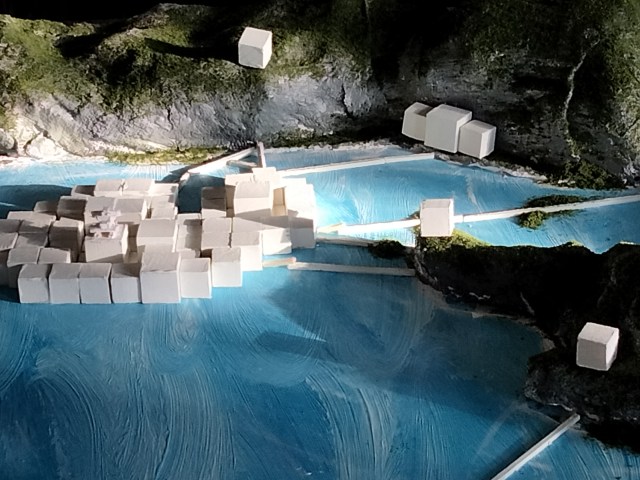
It’s funny how a person’s most eccentric interests sometimes come in useful. This year, I was given the task of teaching the period of about 1400 – 1800 A.D. to young minds. When we came to the part about Cortez, I thought it would be useful to have a model of the city. I thought I could use model-train materials to build it. For sources on how the city layout looked, I drew on Cortez and the Aztec Conquest by Irwin R. Blacker, The Aztecs by Brian M. Fagan, and maps I found on Pinterest. There is not perfect agreement among all sources about the exact location of the different villages and causeways, and there were far more settlements in the hills surrounding the city than I will be able to show. I also had to leave out some causeways for the sake of simplicity.
So, here goes:
I took a wooden display board (actually meant to bear an inspirational slogan) and painted in Lake Texcoco.
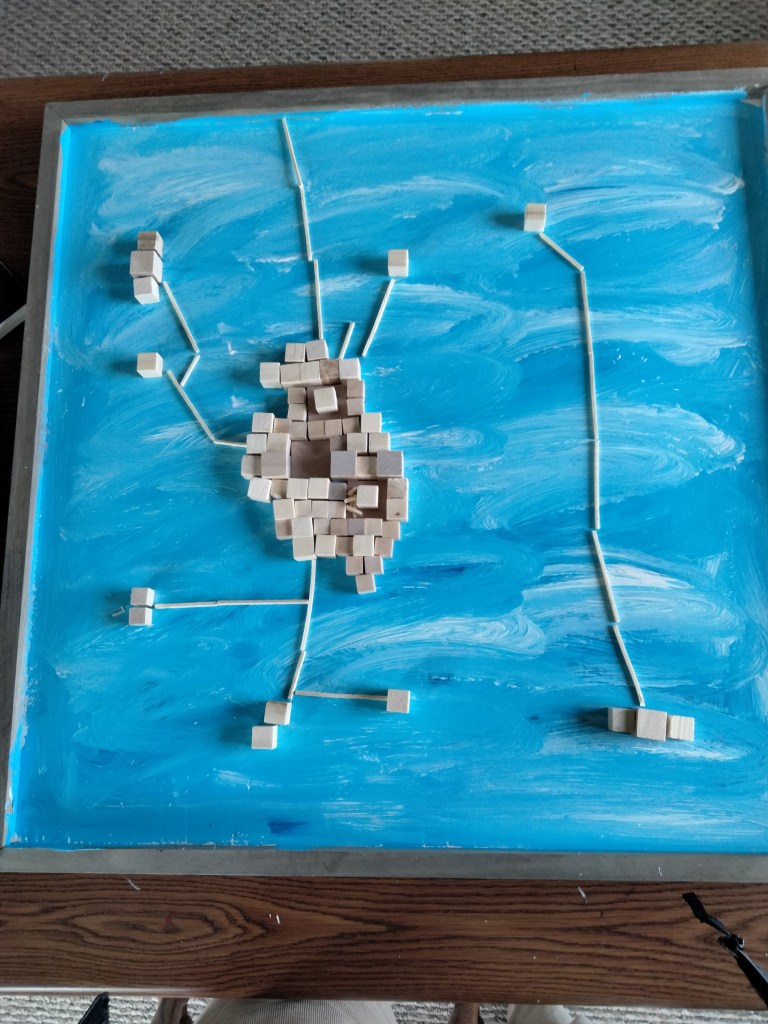
Then I set out the variously-sized wooden blocks, slabs, and matchsticks I had purchased at the hobby store, planning where the city, towns, and causeways would go.
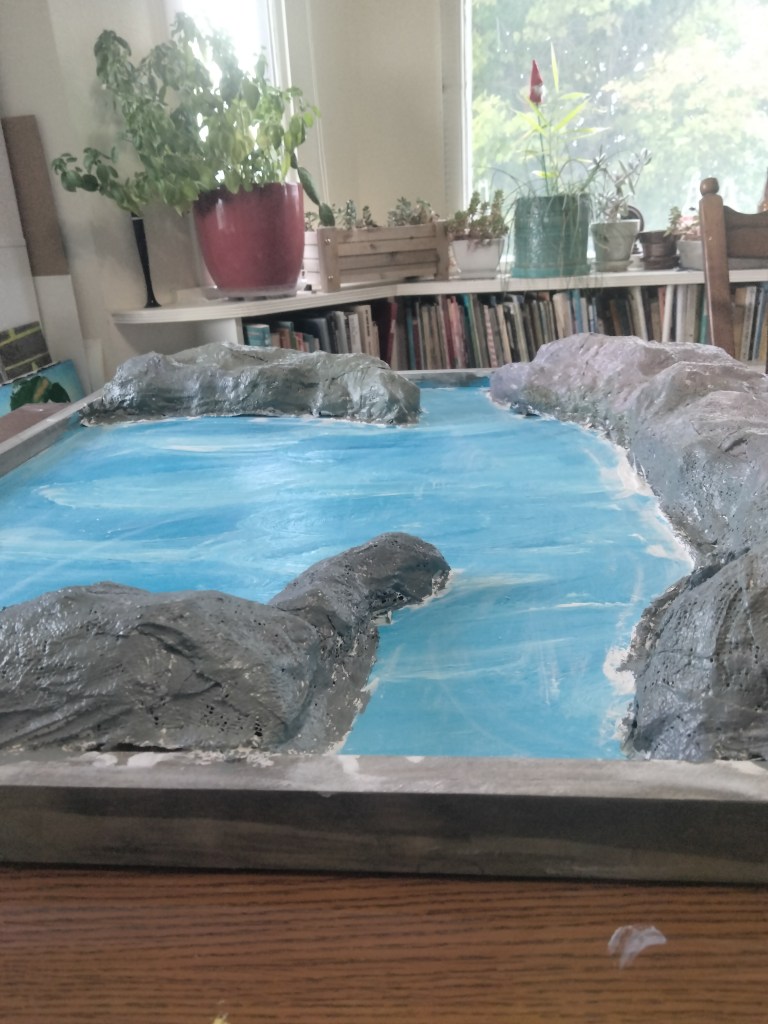
Based on this plan, I was then able to add the “land.” The first step was crumbled packing paper, masking taped down.
Then, paper-mache strips that can be dipped in water and smoothed down to make the hills.
I then painted the hills. I had to mix colors several times, so some of the hills are more greenish and some more greyish. That’s not a huge problem because I have “jungle” greenery to add, and also, the area is somewhat arid.
Meanwhile, I painted the blocks white. Actually, the city was probably very colorful, but I am going for a basic look. White represents stone. If desired, I can add color to the temple area over the following years.
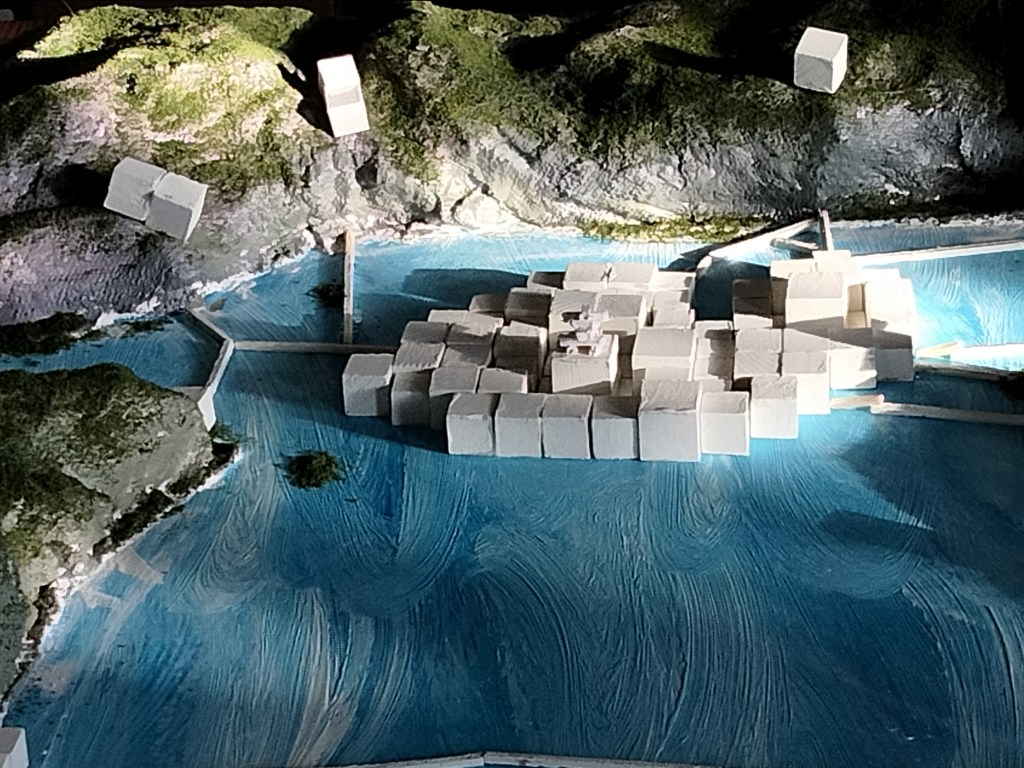
Then it was time for the fun part: the hobby store sells “greenery” in a shaker can. I painted glue onto the hills and shook the greenery on. It sticks amazingly well. Let dry, then vacuum up the extra.
Now I placed the city and towns and glued them down, then added additional glue and greenery to make “islands.”
The city is actually two cities: Tenochtitlan, and Tlatelolco slightly to the north and west. I have given each city its own central plaza with a temple in it. The “temples” in my model are actually way too big relative to the size of the city, but this model is not meant to be perfectly to scale.
Final step: photograph in slanting sunlight.
Epic!
In days ahead, I plan to add a compass rose out in the lake and fancy title on the side, but for now, this ain’t bad.
Turns out, “uncovering your father’s nakedness” isn’t quite as bad you suspected … but it’s still pretty bad.
Also, lots of interesting stuff about other aspects of worldview in the ancient world, including that hair was seen as a genital structure by first-century Greek scientists, which is probably the explanation for why women were supposed to cover their hair in public (particularly in church) and men to wear theirs short.
There have been a number of proposed sites for Atlantis. Graham Hancock has proposed Antarctica,North America, and probably some other places that I don’t know about. I’ve also heard rumors that the sunken continent could be in the Bahamas area and could explain the Bermuda Triangle phenomenon. The Disney movie Atlantis locates it off the coast of Iceland, and I have also heard people advocate the Eye of the Sahara in Mauritania. (The idea being that, before continental uplift, this site was closer to the coast, and it could have been inundated by a tsunami or something like that.) Well, the article above makes what strikes me as the most likely proposal yet.
The super-island of the Cyclades Plateau (Plato’s Atlantis) was drowned by the sea at around 8000 BC, during the rapid rise of the Mediterranean and just prior to the flooding of the Black Sea (see UNESCO study, 2009.) Incidentally, around this time, Lake Agassiz, a gigantic glacial lake in North America, also burst open and began to drain into the Atlantic. It is worth noting that Lake Agassiz covered an area larger than all the Great Lakes combined (440,000 Km 2) and at times, it contained more fresh water than all the lakes in the world today. The total fresh water outflow from this lake alone was so immense, scientists believe it raised the oceans worldwide by as much as nine feet and further produced the 8.2 kilo-year event that followed, a mini ice age that lasted 400 years! This global cataclysm at the end of the last Ice Age, which ultimately raised sea levels by 400 feet, not only erased our early history, but this could also be the event we all inadvertently refer to as the “Great Flood.”
ibid
Proposing the Cyclades Plateau as the site of Atlantis ties its inundation to a known rise in sea levels that happened right around the date that Plato says Atlantis was submerged. The article shows maps of what the plateau would have looked like and how it roughly matches Plato’s description of Atlantis (though the scale is slightly off). Of course, in my integrated version of ancient history, it went like this:
Pangea
Continental Sprint, involving cataclysmic earthquakes and also tsunamis. This is the Great Flood
A cold, rainy period after the Flood, leading to the Ice Age, which meant lower sea levels, coinciding with human dispersion across the newly shaped continents
As the Ice Age ended, we get sea levels rising and large but not worldwide local floods like those described above.
The article also suggests that this civilization was part of a larger pan-Mediterranean civilization:
Finally, a 10,000 year old Mediterranean civilization, may help explain more archaeological oddities in this region. Recent erosion and seismic tests at the Giza Plateau, indicated that the Great Sphinx may be much older structure than previously thought, and along with the site of Gobekli Tepe in Turkey, both seem to coincide with Plato’s story of Atlantis. Is it possible that Gobekli Tepe and the monument of The Great Sphinx could be remnants of the same advanced civilization Plato referenced in his story, one that was aggressively advancing against its neighbors in Africa and the Middle East, or do those belong to another culture? And what about the advanced proto-Euphratean people who descended upon the Mesopotamia around 7000 BC, from a region “unknown.” Could these enigmatic people be the refugees of the same culture who fled the Mediterranean basin and moved eastwards to escape the inundation? Undoubtedly, they could have brought with them the story of the great flood as well as the skills and technology to incite yet another great civilization, like that of ancient Sumer (just as the survivors around the Cyclades and neighboring islands may have ultimately contributed to the rise of the Minoans).
ibid
This sort of thing is catnip to me.
Finally, for the reconstructive geneticsnerds among us (raises hand), the article offers bonus evidence that the residents of this Aegean Atlantis may have island-hopped their way to North America, which would explain why Haplogroup X is concentrated most heavily in the eastern Mediterranean and around the Great Lakes. (Bonus: the Great Lakes area was also the source of a particular type of copper that was used in the Mediterranean during the Bronze Age.)
I enjoyed this movie more than I expected to. I thought it was going to be some kind of mystical journey with a guru or something. Instead, it’s a pretty good story reminiscent of those found in The Arabian Nights.
I don’t recommend you watch it necessarily, because there are a lot of scenes with naked people. Including multiple scenes with multiple obese naked people in a room covered with fur. (Yes, strange. And disgusting. It was the Ottoman Empire, what can I say?)
So given that you will probably not be watching it, I won’t worry about spoilers.
The Summary
Alithea is a “narratologist” (story expert) who travels to Istanbul for a conference. While in front of an audience, she keeps seeing a frightening, oversized, deadly white guy dressed as, maybe, an ancient Babylonian. This vision opens its mouth and appears to swallow her, and she passes out. Now, maybe I wasn’t paying very good attention, but it seems to me that this scary guy is a plot hole that never gets explained. He shows up in the background in some scenes later in the story, but it is never brought out what, if anything, is his relationship to the main action of the story. Ditto the odd dwarf character with the tall, Nephilim-like head who tries to take Alithea’s suitcase in the Istanbul airport.
Anyway, it’s after this that the main story begins. In a Turkish junk shop, Alithea buys a little blown-glass bottle that has been somewhat deformed at some point by a fire. She takes it back to her hotel room, starts scrubbing it, and out comes a djinn (Idris Elba). At first, Alithea and the djinn can’t communicate, but she finds that she can speak to him in Greek, and after a few moments of watching TV, he picks up on English. He tells her that she gets three wishes, but as a story expert, she knows that every single story involving three wishes is a cautionary tale, so her response is something along the lines of “no way.”
Then the djinn starts to tell his own story, which spans three thousand years. He has had three episodes of being imprisoned in various small vessels. Apparently, he was originally a free djinn, and was in love with the queen of Sheba (incidentally also his cousin – cue nakedness). When Solomon, who in this version of the story was the supplicant, shows up and woos the queen, the djinn’s heart is broken, and Solomon, “a powerful wizard,” imprisons him for the first time.
The first person to release him is a slave girl who’s in love with a prince. She wishes for the prince to fall in love with her, and then to become pregnant by him. Unfortunately, she gets caught up in palace politics, and when the prince falls out of favor, she is killed before she can make her third wish.
The second attempted escape, and imprisonment, is the one featuring the fat people in the sable room. It’s sad and grotesque, but has no love interest for the djinn.
In the third go-round, the djinn is released by a plain but intelligent young woman who is the third wife of a rich man and is essentially a prisoner. (No nudity, but horrifying brief sex scenes with her aged husband.) This young lady uses her first two wishes to learn “all the knowledge in the world” (she and djinn are shown studying together) and to become a formidable scientist. This is where we learn that the djinn is made of electromagnetic particles: “You are made of dust. I am made of subtle fire.” He falls in love with her mind, and tries to prevent her making her third wish so that he can stay with her forever. Feeling controlled, she accidentally traps him in the glass bottle with her third wish.
By the time the narratologist has heard these moving stories, she is ready to make a wish. She wishes to experience that kind of world-without-end love … with the djinn.
C’mon … Really?
At this point the cynic in me wakes up and says, Lady, has it occurred to you that this very large magical dude is telling you these sad stories in order to elicit precisely that wish? He’s lived through millennia having a once-in-a-lifetime love with one human woman after another. The man is an interdimensional slut.
However, the writers for this movie are not as cynical as I am. The djinn appears to make a good-faith effort to fulfill Alithea’s wish, even traveling back with her to London. When it becomes apparent that living in a large, modern city is too hard on him, in a metaphysical sort of way, Alithea wishes “If you cannot stay with me, I wish that you could be where you belong.” (Again: Was that his goal all along?) He does come back and visit her from time to time, which is nice and makes it seem less like she got played.
And here come the giants finally
For those who are interested in my books, this movie has a similar sort of vibe in a few different ways. For one thing, it features an older woman having an affair with a large, impressive foreign man with whom she can’t at first communicate. (I’m always a sucker for scenes where people try to find a common language.) In fact, if Hollywood is paying attention, Idris Elba could do a fine job playing Nimri. (Tilda Swinton could not play Zillah. Sorry.)
But secondly, and on to the main point of this post … giants.
I have put giants in my books because they feature in Scripture and in history. I have made them scary, nonhuman creatures because that is what they are in Scripture and in history, but prior to this, I was never particularly frightened by the idea of giants. I didn’t think of a larger size as anything necessarily to be afraid of, so I didn’t find them scary until I started researching what the historical record says about their behavior.
But watching this movie, I discovered that their size itself makes me physically uncomfortable.
When the djinn first comes out of the bottle, it’s in the form of particles. These particles swirl out of the hotel bathroom and into the main part of the hotel room. The next thing that Alithea sees are enormous golden toes sticking in through the bathroom door.
When she goes out into the bedroom, the djinn is so large that he is literally crouched over like a person trapped in a small box. The camera doesn’t show us this right away. It just shows her face looking at something disturbing and incredible. Then when we do see the djinn, we still don’t get a look at his face, because his back is to us.
Already at this point, I was thinking my first wish would be, “Could you please make yourself smaller?” His size is inconvenient and it makes the room seem weird.
Soon, the djinn makes himself a bit more human-sized (and dons a hotel bathrobe, as you can see above). But even then, he is not … quite … on a human scale. He’s just a little bit too big. The picture above doesn’t capture this very well, but it’s the closest I could find. Tilda Swinton is petite, but she’s not that petite compared to the other humans in the story. She’s not that much shorter than they are.
Somewhat surprisingly, this also made me uncomfortable. Maybe it’s the way that the different scale messes with your perception of reality and your ability to trust your own senses. He’s too big to be human, but he’s not a tank like, say, Shaq. He’s in proportion – just not human proportion.
I was surprised by the fact that this made me — I repeat — physically uncomfortable. So, I guess, it turns out, my stories are even creepier than I realized. Because even when they are well-intentioned (?), like this djinn, I really don’t like giants.
This is Mary Harrington. She has written a book, and here it is:
Mary is an academic. She describes herself as someone who has “liberalled as hard as it is possible to liberal.” She believed all the lies that were told her by the sexual revolution, and though she has no desire to share the details, says her experience of it was comparable to that of Bridget Phetasy, with her famously heartbreaking article, “I Regret Being A Slut.”
Progressivism is no longer in the interests of women
As you can see from the phrase that makes “liberal” into a verb, Mary has quite the way with words. The basic thesis of her book is that the progressive religion, by making personal autonomy the only definition of the good to which everything else must be sacrificed, has gone way past the point of diminishing returns and is now actually harming women rather than helping them. But since Mary is so articulate and fiery, she can put it far better than I can:
We’re increasingly uncertain about what it means to be [sexually] dimorphic. But when we socialise in disembodied ways online, even as biotech promises total mastery of the bodies we’re trying to leave behind, these efforts to abolish sex dimorphism in the name of ‘human’ will end up abolishing what makes us human men and women, leaving something profoundly post-human in its place. In this vision, our bodies cease to be interdependent, sexed and sentient, and are instead re-imagined as a kind of Meat Lego, built of parts that can be reassembled at will. And this vision in turn legitimises a view of men and women alike as raw resource for commodification, by a market that wears women’s political interests as a skin suit but is ever more inimical to those interests in practice.
What we call ‘feminism’ today … should more accurately be called ‘bio-libertarianism,’ [and it is] taking on increasingly pseudo-religious overtones. This doctrine focuses on extending individual freedom as far as possible, into the realm of the body, stripped alike of physical, cultural or reproductive dimorphism in favour of a self-created ‘human’ autonomy. This protean condition is ostensibly in the name of progress. But its realisation is radically at odds with the political interests of all but the wealthiest women — and especially those women who are mothers.
… nothwithstanding the hopes of ‘radical’ progressives and cyborg feminism, a howlingly dystopian scenario can’t in fact be transformed into a dream future just by looking at it differently.
ibid, p. 17, 18, 19
I mean, I couldn’t agree more. The most obvious people to suffer from the real-life application of what Mary elsewhere calls “Meat-Lego Gnosticism,” are children. Babies and children need their moms. In fact, Mary’s thinking began to really change on this topic of progress when she had a child of her own and was shocked by the instant bond.
But even a little bit of thought shows that women are also suffering, because most women, like Mary, actually want to bear and raise their own children, preferably in a household with the child’s father. And, in fact, men are suffering too, not only because half of those motherless children grow up to be men, but because it turns out that humans were made to be embodied, and so living a disembodied life, alienated from our physicality and from human relationships, makes all humans miserable.
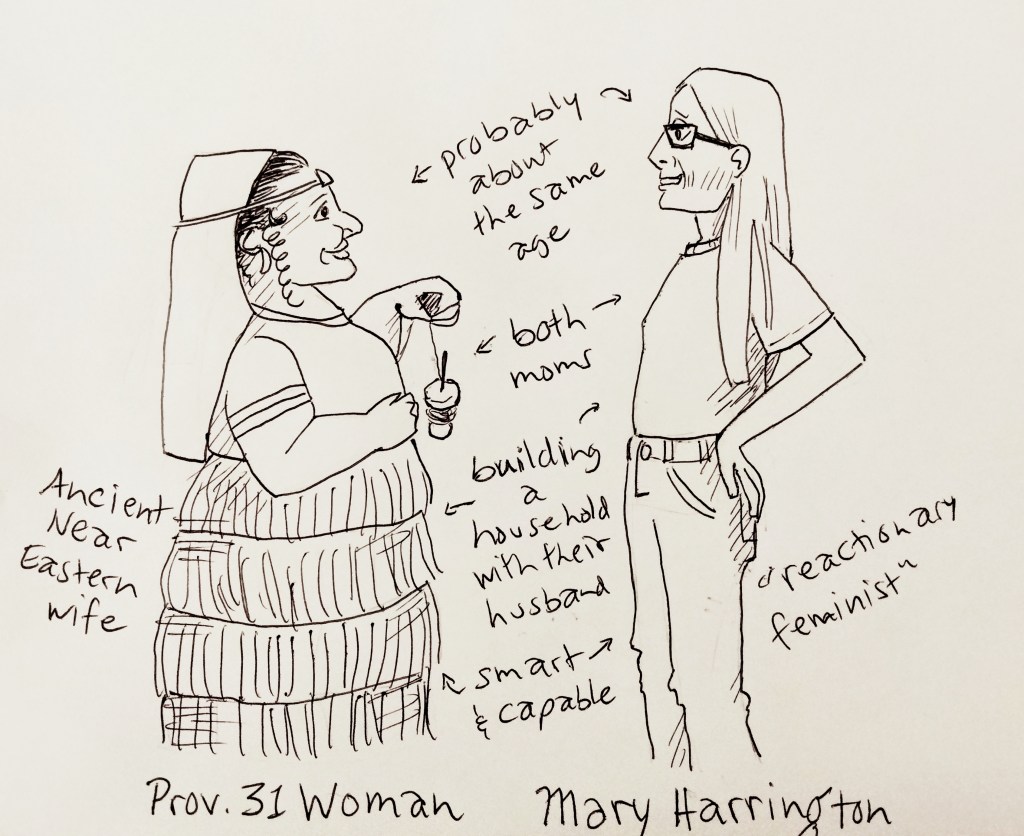
Mary calls herself a “reactionary feminist” because she is reacting against “progress” in favor of the interests of women.
Down with Big Romance
Often, when people reject progressive feminism, the only alternative that they hear presented is “traditional marriage,” by which they mean the 1950s sitcom model. But that model is actually not traditional marriage so much as postindustrial marriage.
Harrington spends a lot of space in the book pointing out how, with industrialization, many of the homesteading tasks that were once the responsibility of the housewife got outsourced to the market. She draws on Dorothy Sayers for this, who pointed it out a long time ago in her essay “Are Women Human?” I wanted to quote Sayers directly, but don’t have a copy of the essay on hand. Essentially, she says that before the industrial revolution, women got to do milking, cheesemaking, beer brewing, baking, spinning, weaving, sewing, mending, and a number of other arts and crafts that took quite a lot of skill and are also fun. Sayers’ main point is that, in the wake of all these trades being moved out of the household, it is no wonder that middle- and upper-class women are bored and would like to do something other than sit around the house. Harrington’s application of this point is a little different. She points out that in economic terms, before industrialization a wife contributed really essential labor to the household. A husband could not get along economically without her. Because both spouses were committed to keeping the same ship afloat, the man was less likely to abandon the woman.
Post- Industrial Revolution, the woman (particularly in upper and middle classes) now contributed much less to the household economically. The man was the sole wage earner, which gave him a lot of economic power. He could treat his wife badly, and she’d have no recourse. It is to this shifting dynamic that Harrington attributes the rise of Big Romance. A husband and wife must like each other, must be madly in love, and then he will treat her kindly despite the imbalance of economic power.
I think Harrington’s analysis has merit, though it doesn’t tell the whole story. For example, I would argue that relations between men and women first got badly messed up at the Fall. Wife abuse was certainly possible before the Industrial Revolution. Also, I would argue that Big Romance owes something to the concept of Courtly Love in the Middle Ages, which in turn owes something to Paul’s exhortation to newly Christianized former pagans: “Husbands, love your wives as Christ loved the church and gave Himself up for her.” But all that said, I do think Harrington is on to something here. Obviously, when we are talking in broad strokes about the relationships between men in general and women in general, over centuries or millennia, there are going to be a ton of cultural and historical and literary and religious and yes, economic factors that go into it, even if we confine our survey to just the West.
Mixed-Economy Households
So, if we don’t like Meat-Lego “feminism” and we don’t like 1950s Big Romance, what’s left? At this point, Mary’s book begins to have the feel of re-inventing the wheel. Metaphors abound that compare modern men and women’s situation to rebuilding, using broken tools, in a postapocalyptic wasteland. Mary doesn’t know a lot about what a life that is good for women, children, and men should look like, but she is pretty sure that for the majority of people, it’s going to be in families built on heterosexual marriage. And she’s aware that, to find a good model, we’ll have to go back before the Industrial Revolution.
Here’s what she comes up with.
The weakness of [proposals to go back to 1950s style marriage] isn’t that they’re unworkable, or even that they’re ‘traditional,’ but that they’re not traditional enough. For most of history, men and women worked together, in a productive household, and this is the model reactionary feminism should aim to retrieve.
Remote work, e-commerce and the ‘portfolio career’ are not without risks … But cyborg developments also offer scope for families to carve out lives where both partners blend family obligations, public-facing economic activity and rewarding local community activities in productive mixed-economy households, where both partners are partly or wholly home-based and work collaboratively on the common tasks of the household, whether money-earning, food production, childcare or housekeeping.
ibid, p. 179, 180
She then profiles two young women who are doing just that. Willow, in Canada, is a writer and mom to a small baby who, when childcare allows, also works with her husband on the family woodworking business. (He does the building, she does the finishing, basically.) Ashley and her husband, in Uruguay, have three children and do a mix of homesteading and language teaching.
In [Ashley’s] view, the romance comes not through the ego-fulfillment of a perfectly congenial partner, but working with someone to build something that will outlast them: ‘It’s much more romantic in the end when you realise this home, this life, these children, if they’re thriving it’s a result of our shared ability to create something greater together through our interdependence and cooperation … We’re working towards something bigger than ourselves. We’re building a legacy.’
Isn’t this a rather bleak and utilitarian view of a long-term relationship, though? To this I can only say that in my own experience, in practice the Big Romance focus on maximum emotional intensity and minimum commitment is bleaker. … A commons is, by definition, not available for consumption by anyone with the freedom to contract, or the money to buy, but only to those who share and sustain it.
ibid, pp. 183 – 184
What’s interesting about this vision of the household is that it has been described, not by “conservatives,” but by Reformed Christians, frequently, even within the past few years. Douglas Wilson, whom Mary Harrington has perhaps never heard of, has by now written a small library’s worth of volumes on this very topic. His daughter, Rebekah Merkle, has a book and a documentary about it, both called Eve in Exile.
And here, in his video Theology of the Household, Alistair Roberts lays out a view that is strikingly similar to the one in Harrington’s book:
Not surprisingly, these Christian thinkers are getting their picture of a household that is good for both men and women from … the Bible. And now I’d like you to meet Reactionary Feminism’s poster girl, and surprise! it’s not Mary Harrington.
The Proverbs 31 Woman
A wife of noble character who can find? She is worth far more than rubies. Her husband has full confidence in her and lacks nothing of value. She brings him good, not harm, all the days of her life. She selects wool and flax and works with eager hands. She is like the merchant ships, bringing her food from afar. She gets up while it is still dark; she provides food for her family and portions for her servant girls. She considers a field and buys it; out of her earnings she plants a vineyard. She sets about her work vigorously; her arms are strong for her tasks. She sees that her trading is profitable, and her lamp does not go out at night. In her hand she holds the distaff and grasps the spindle with her fingers. She opens her arms to the poor and extends her hands to the needy. When it snows, she has no fear for her household, for all of them are clothed in scarlet. She makes coverings for her bed; she is clothed in fine linen and purple. Her husband is respected at the city gate, where he takes his seat among the elders of the land. She makes linen garments and sells them, and supplies the merchants with sashes. She is clothed with strength and dignity; she can laugh at the days to come. She speaks with wisdom, and faithful instruction is on her tongue. She watches over the affairs of her household and does not eat the bread of idleness. Her children arise and call her blessed; her husband also, and he praises her: ‘Many women do noble things, but you surpass them all.’ Charm is deceptive, and beauty is fleeting, but a woman who fears the Lord is to be praised. Give her the reward she has earned, and let her works bring her praise at the city gate.
Proverbs 31:10 – 31, NIV
Wow!
So, this is an older lady, a matriarch. She has children, and she is honored both by her husband, her children, and the public for her role as a matriarch. (Contrast this with Meat Lego feminism, where being a mom means you are dumb and irrelevant.) Perhaps this lady is beautiful, but we are not told that. In any case, she is an older woman, and “beauty is fleeting.” Her beauty has faded. But she has style (clothed in linen, purple, and scarlet). There is a lot of emphasis on her strength and capability. She engages in cottage industry, she has employees (servant girls), and she handles money and gets into real estate. She speaks with wisdom and faithful instruction, which probably primarily is directed at her children, but this could include her mentoring younger women and nowadays it could include being a writer like Willow. Her husband is a pillar of the community, and this is not to the exclusion of his excellent wife, but because of her and because of the kind of household they have built together. She, too, is known in the community and opens her hands to the poor. They are the people you go to if you need advice or help.
And, finally, this lady is not meant to be an outlier. “Many women do noble things, but you surpass them all.” The idea is that there are a lot of amazing women out there, but every husband should feel this way about his wife, that she is the best. The Prov. 31 woman is an older matriarch, so she has had time to build up an impressive portfolio of skills and accomplishments that for many young moms is years away. But this is where they can end up, if they are given support and honor in their role as moms and are shown what is possible.
In other words – I wouldn’t make this a headline without context as it would be misunderstood, but — the Prov. 31 Woman is the original Girl Boss.
Fun story about how I discovered this book: I was at a Fantasy Faire as a vendor. A fantasy faire is sort of a like a RenFaire, but calling it “fantasy” opens it up to more time periods and more imaginative costumes. This Faire took place in southeast Idaho, so quite a few of the booths were from Utah. As I wandered the booths on the first morning, a banner on one of them caught my eye: “Strangely uplifting LDS horror.” In case you don’t know, LDS stands for Latter-Day Saints, which is the more respectful term for Mormon and what the Mormons usually call themselves. I am not Mormon, but I could not help but be intrigued by this advertising phrase. Horror, written by someone from a community that is mostly known for wanting to keep everything in life PG if not G? That’s going to be some interesting horror. Also, I do like my horror uplifting.
So, long story short, I missed meeting the author, but I bought the book. He has a lot of others, but I went for this one because it was a stand-alone.
The LDS horror did not disappoint. The opening scene takes place at fantasy convention, very similar to the event I was at when I started reading. (Nice.) The main character is LDS, and she is a tall, big-boned, plain-faced 30-year-old woman who has a secret crush on her handsome, also LDS, coworker. In short, a very relatable female lead. Being a lonely, not conventionally attractive 30-year-old woman is tough for everyone, but it’s even worse in the LDS community where there is so much emphasis on marriage.
So, the contemporary main characters are Peggy, whom you met above, and Derek, her crush, who is happy to go to conventions and watch fantasy and sci-fi movies with Peggy, but doesn’t like her “that way” and does not see her worth.
But very soon, we get into the spooky stuff. This is not exactly a time-traveling book, but it has characters who move through time by spending decades in a state of suspended animation brought about by eating an apple-like fruit from a magical tree. So, the mysterious, princess-like young woman on whom Derek gets a hopeless crush really is a woman from millennia ago who doesn’t quite know how to function in the modern world because she has been skipping through time.
I don’t want to give more spoilers than that, but let me just say that the research on this book impressed the heck out of me. The author has taken a deep dive into Celtic mythology, Arthurian legends, British/Roman history, and fairy tales, and he ties it all together. Although the main characters do not travel back in time, the story takes jaunts into the past to reveal to us the sleeping princess’s back story. We see how she gave rise to the “sleeping maiden” fairy tales like Sleeping Beauty and Snow White, but what actually happened was … much creepier. These reveals are tantalizingly done. They are not info dumps, and the whole story is not revealed until the very end.
This author takes a unique approach to paganism, one that I really appreciate. As a Mormon (which he understands to be a version of Christianity), Belt does not endorse the ancient Celtic religion and he doesn’t whitewash it either. He is perfectly willing to portray the darkness and terror and human sacrifice that come with Cernunnos and Morrigan. This is very different from most modern fictional treatments of Celtic paganism, which tend to portray the pagans as harmless, live-and-let-live, nature-loving types whose religion has no down side. However, although Belt mines paganism for horror, he passes the “love test” (the author must love the culture he’s writing about). He writes about the ancient pagans with sympathy and seems to understand their point of view. They are real human beings to him, and their gods are real entities.
And that’s why this horror is “strangely uplifting.” Unlike some horror writers I could name (ahem Stephen King), there are actually good, admirable characters in this book alongside the horror.
If you like fairy tale re-tellings, Arthurian legends, Celtic paganism, or modern-day horror, you might like this book. If you like all four, this book is definitely for you!
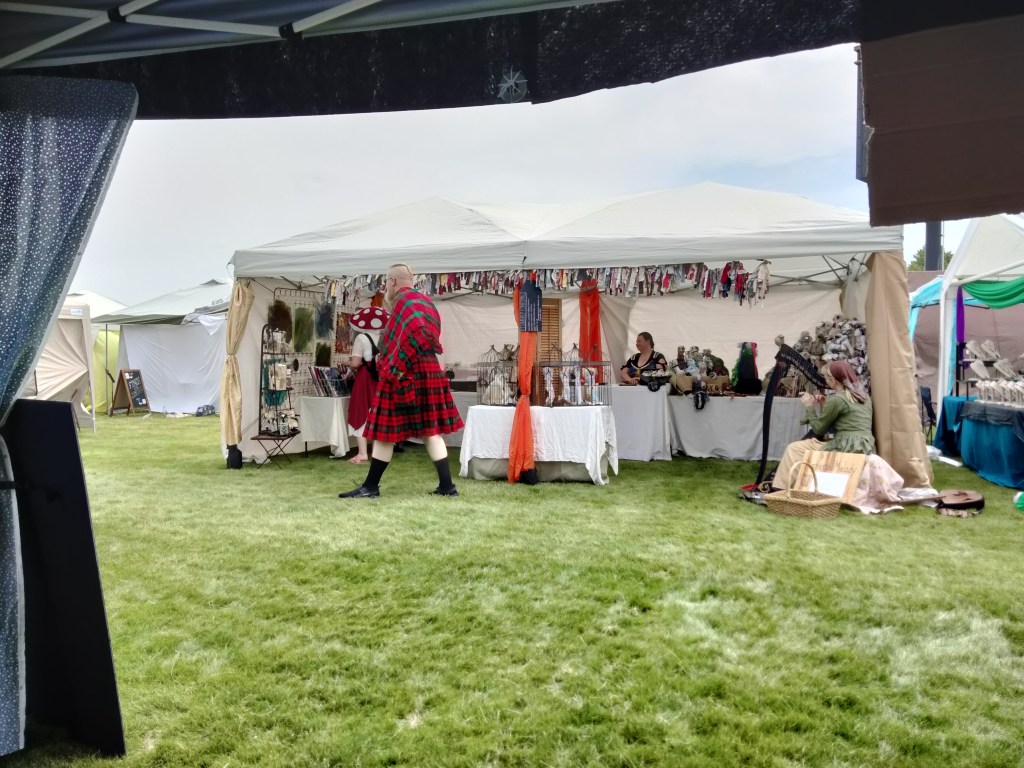
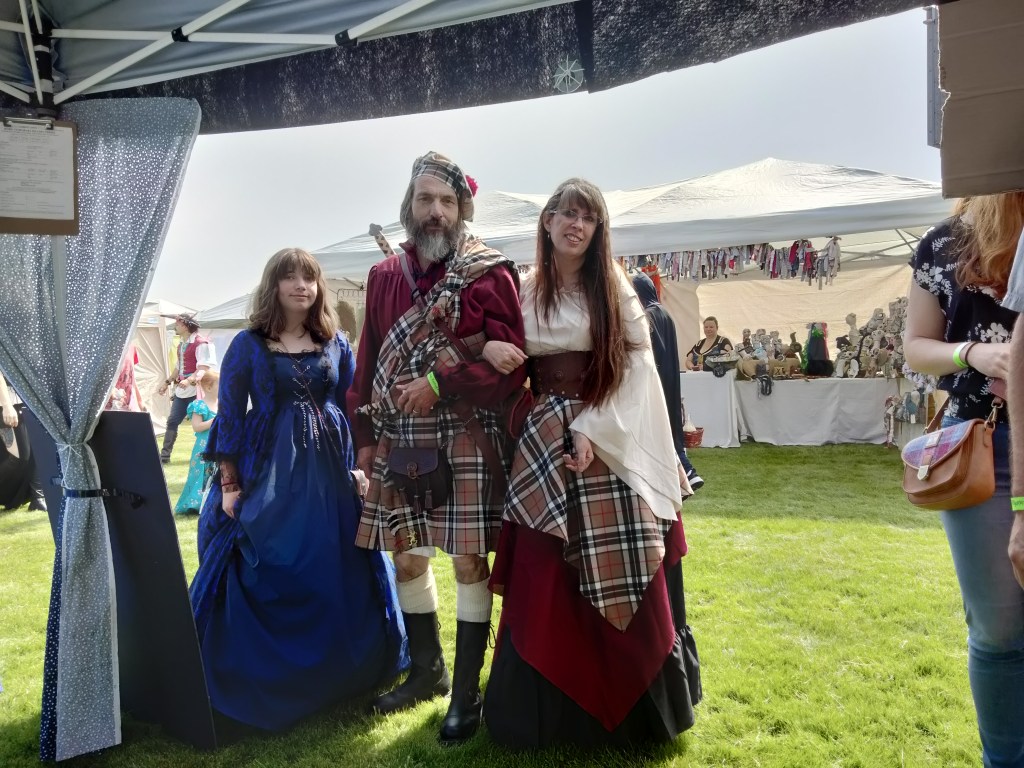
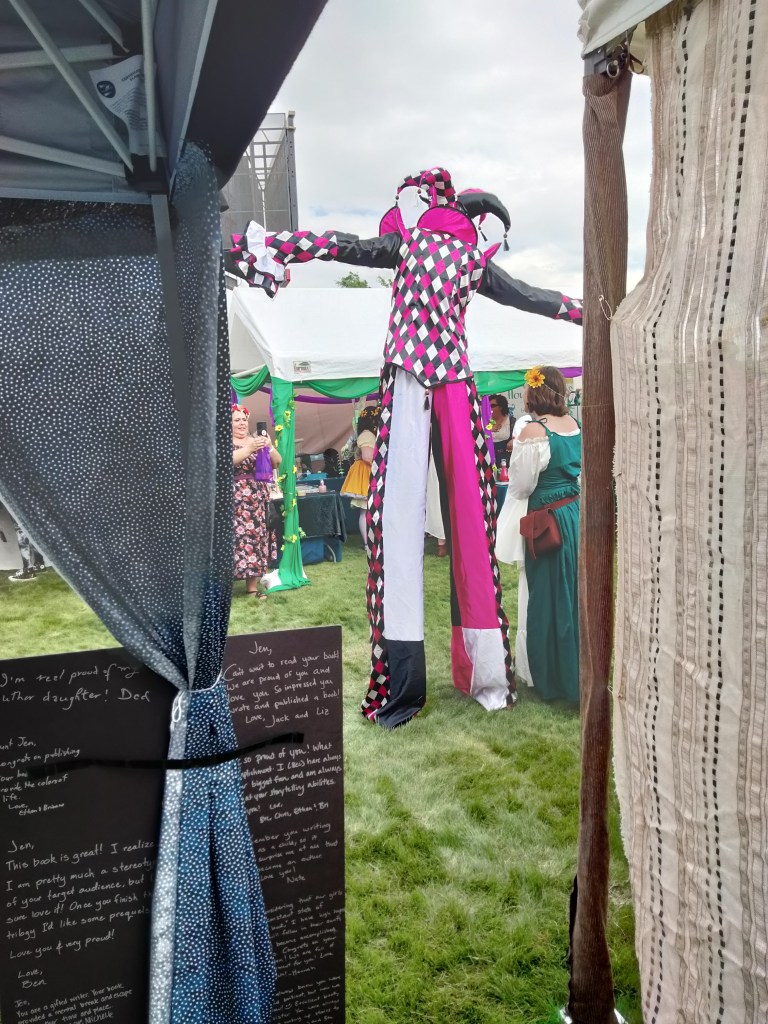
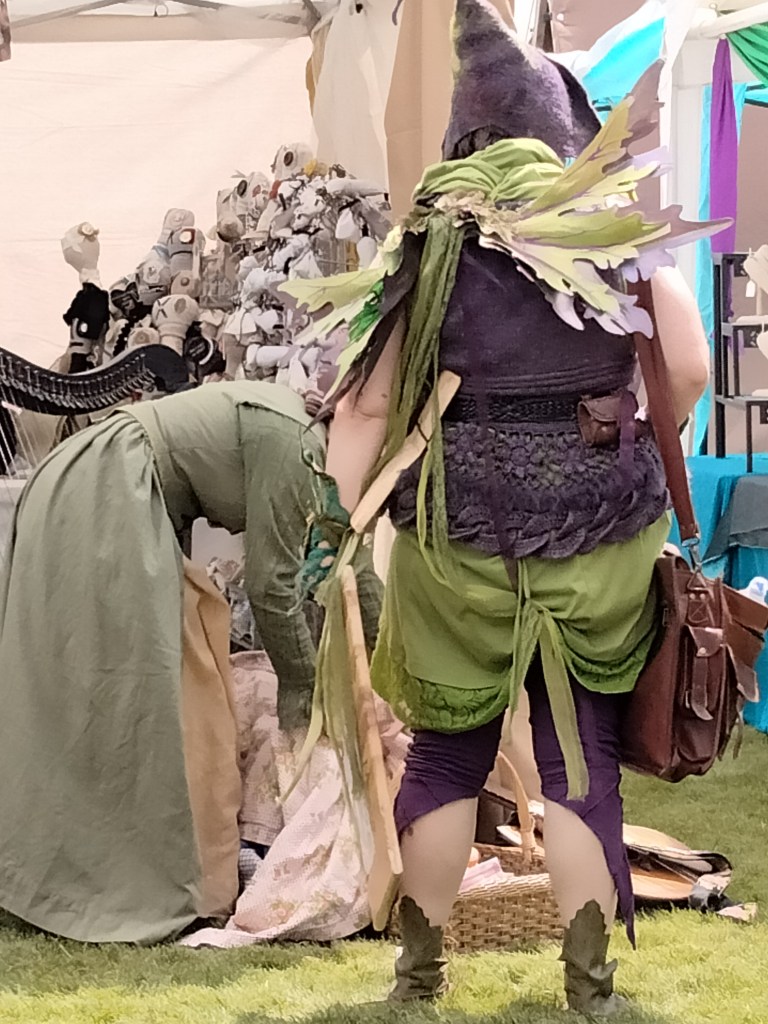
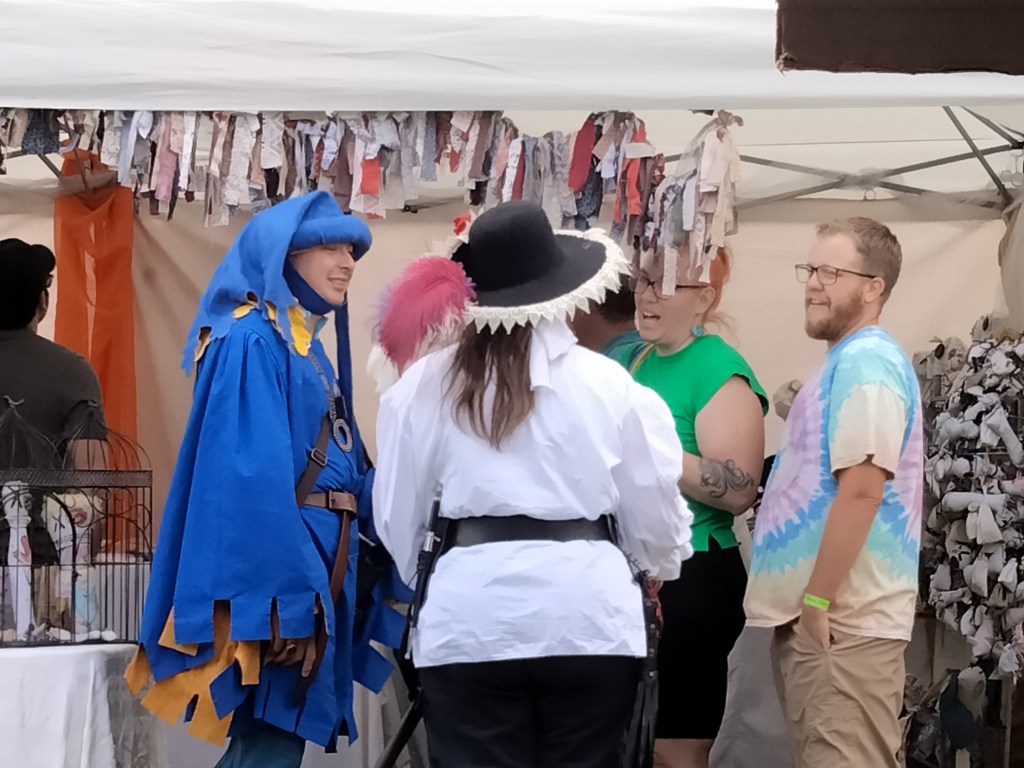
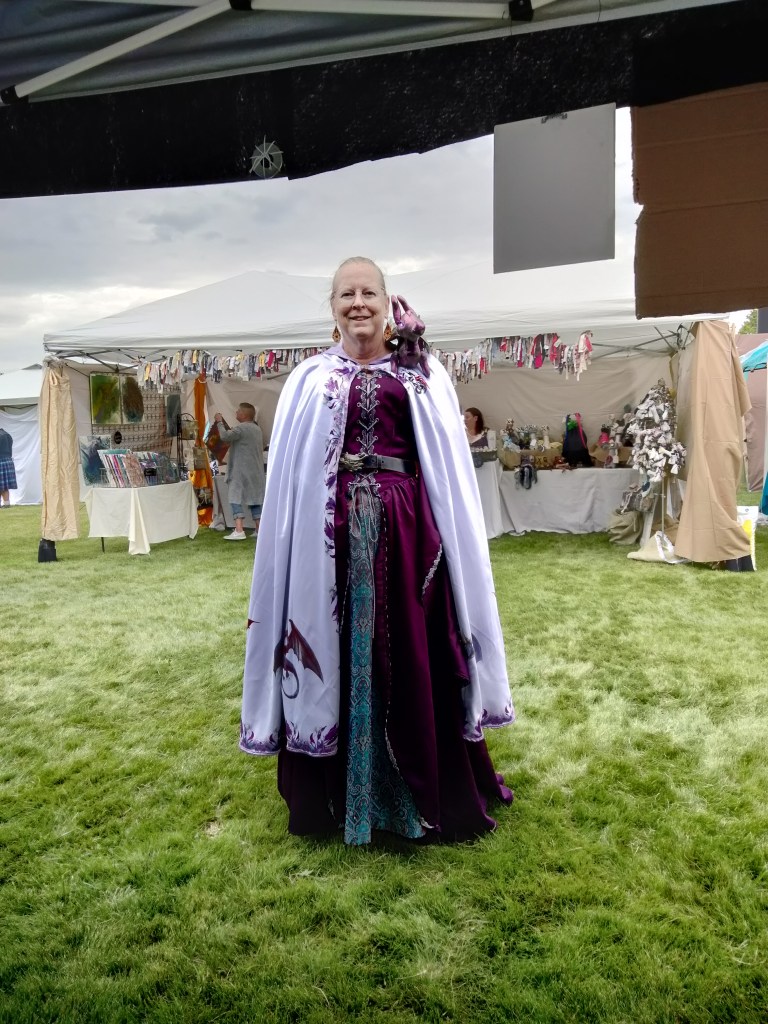
Literally every person who passed by our booth was worthy of a photo essay, so these are just a few highlights.
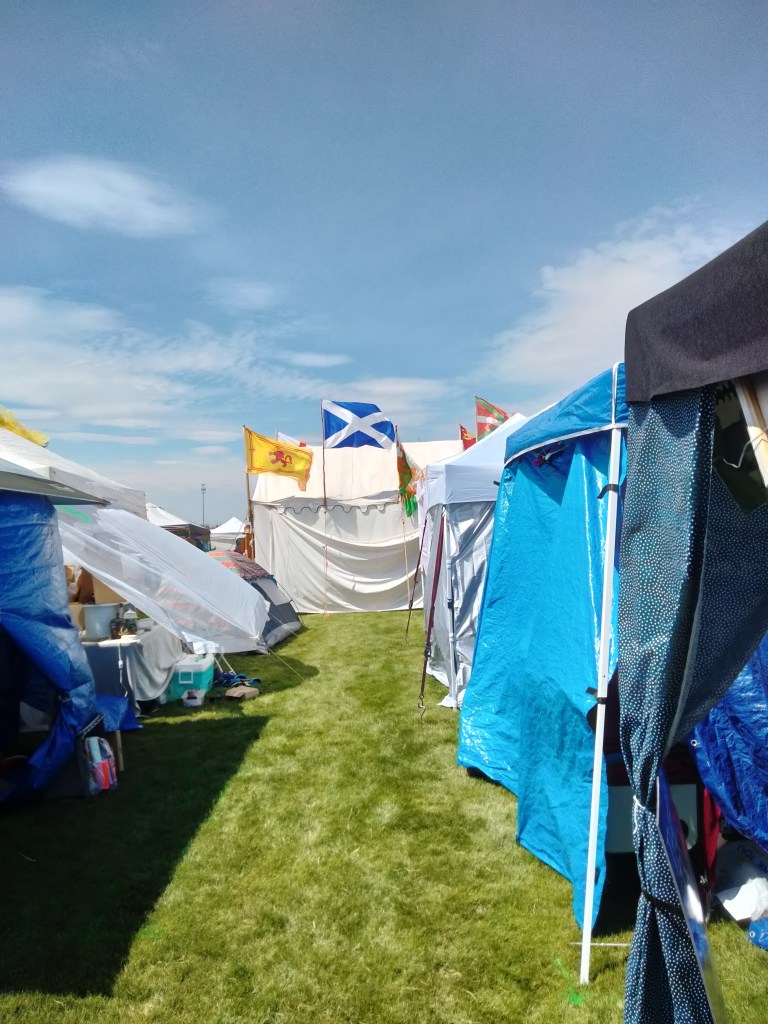
Here’s the alley behind the booths on Saturday. My son said, “It’s beautiful the way everyone shows up and sets up their own booth, and instantly there is a city where there was none before.” He’s eleven.
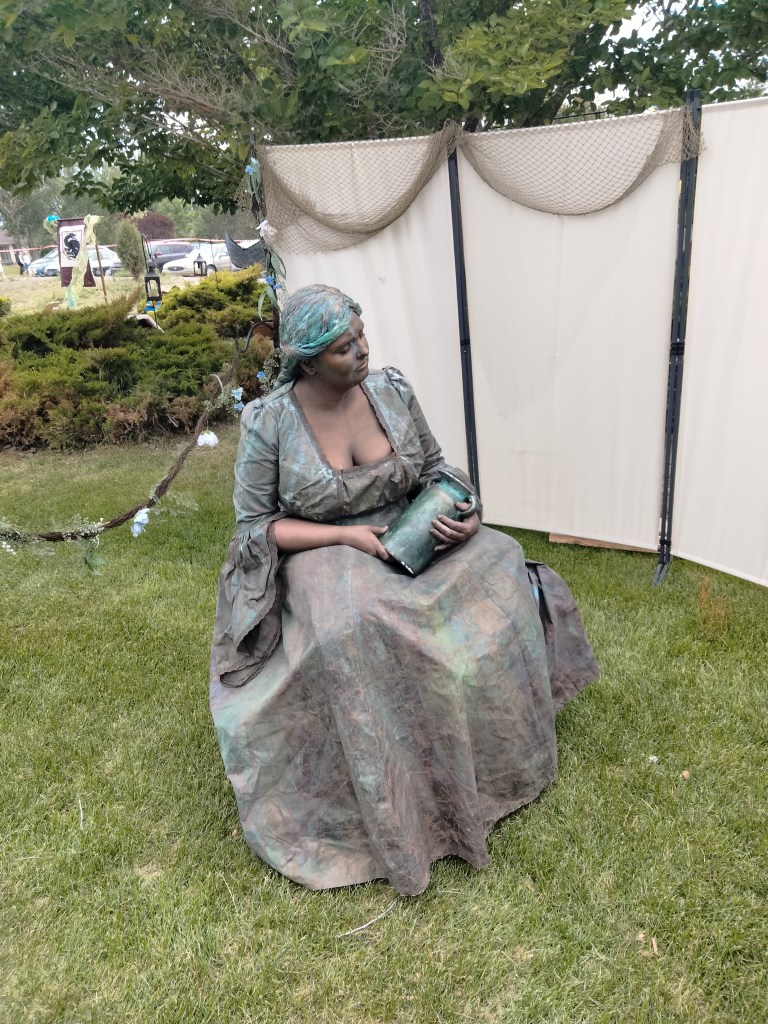
There was this “Enchanted Statue” who, when given a tip, would wink at you.
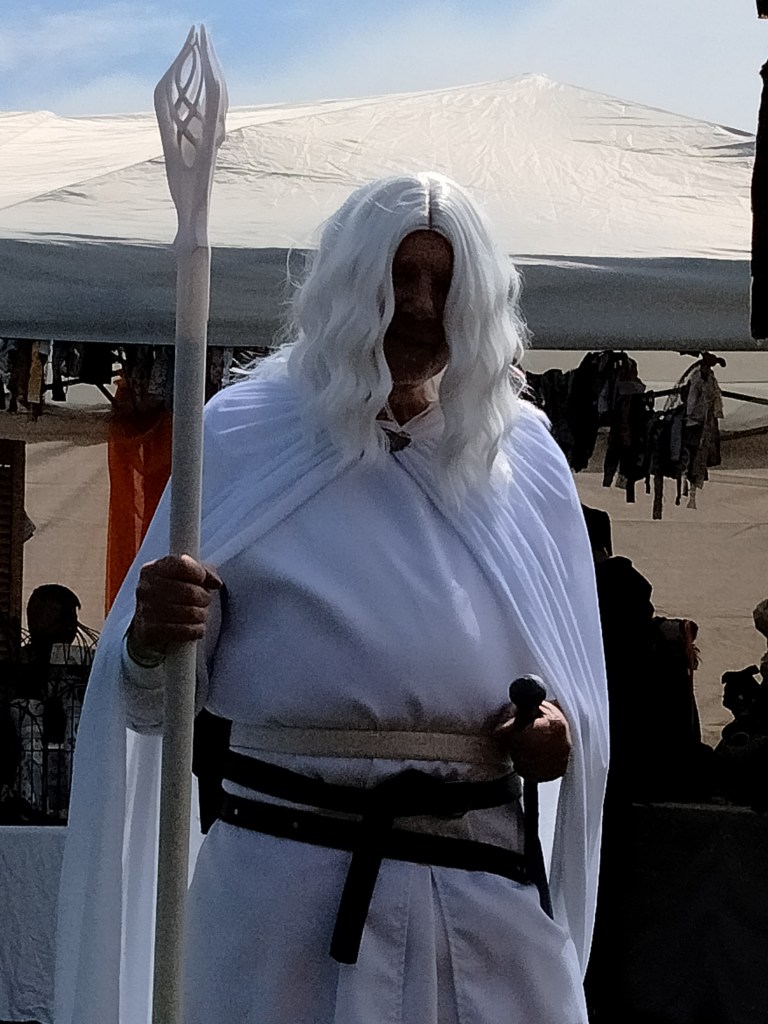
Gandalf the White showed up first thing on Saturday morning.
There were many Scotsmen and a few Scots women.
… one ogre …
… musicians …
… jesters …
… mushrooms …
… elves …
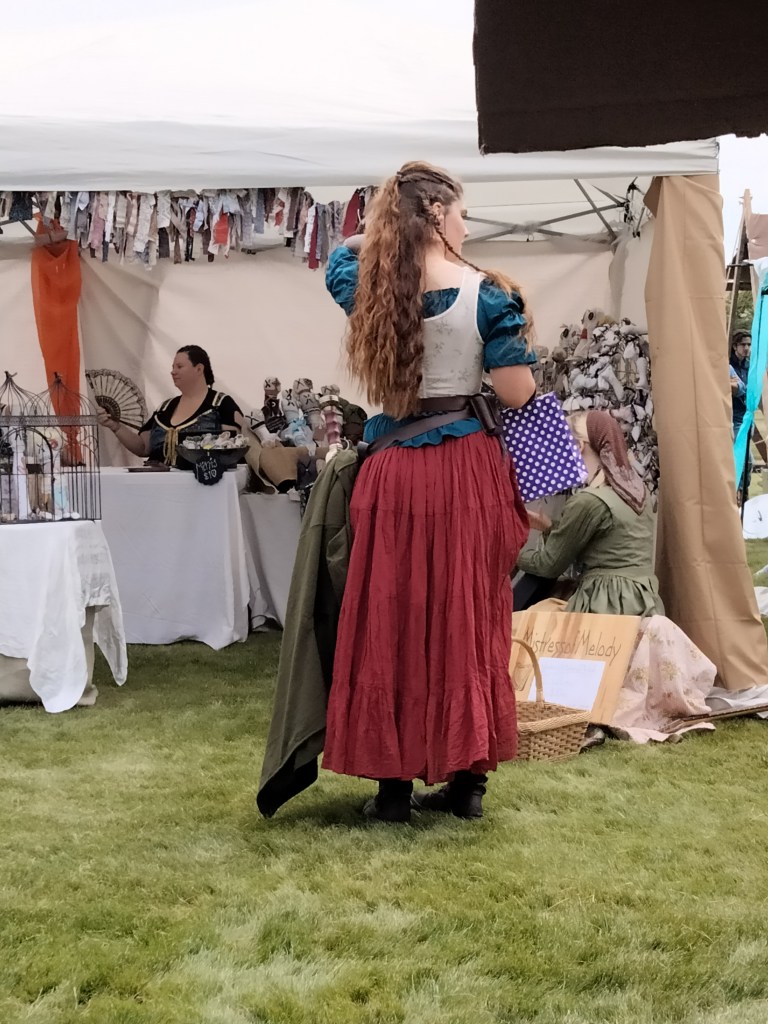
And quite a few pirates. The pirate with her back to the camera would, for $5, “arrest” a victim of your choice and parade them throughout the Faire, calling out “Shame the prisoner!” as they wore a placard stating their crime.
Here she is arresting a lady merchant whose crime was running out of fudge at her booth. The person who put her up to this was my son, who wanted to do everything.
Ensuring that we became friends.
Here’s another friend, from the Pocatello Writers’ Group.
And some more people worth looking at.
One thing I regretfully realized after putting together this post was that I do not have a single picture of a knight or warrior. In fact, there were many of these fellows at the Fantasy Faire. A tall, portly warrior in Viking-style armor bought one of my son’s paintings. Also prominent were the Salt Lake City Crusaders, whose motto is “Real Armor. Real Weapons. Real Athletes.” They had a ring set up in which, twice a day, men in authentic armor battled it out. (I swear that, as I wandered by, I saw one armored guy hitting another armored guy on the helmet with a frying pan.) These warriors would periodically come striding through the Faire, but they always walked so fast that I never got a picture. Plus, I guess, there were so many armored men about that I just took them for granted. But, let the record show that they were there.
I posted the following several years ago in response to some information being released from Navy pilots about UFOs. Making the necessary adjustments, most of what I say below is still relevant to the more recent sensational revelations about aliens, which are getting ignored by everyone except Matt Walsh.
If you want more interesting theories about all this, see also the interviews I’ve done with Jason McLean. I am watching his YouTube channel, SIRU papers, for his reaction to these latest news stories.
So, now for the repost …
Finally Facing the News
You guys may have noticed, there has been a spate of news articles and videos about U.S. Navy pilots sighting what appear to be UFOs.
I’ve ignored these news items for a long time, mostly because I didn’t know what to do with them. Now I’m ready to give my analysis. It will be just as expert as anyone else’s, and no more expert than any comments you may leave.
Problems with all the Possible Theories
This is all just a big hoax by our government, to distract us from the attempted power grab by [fill in your favorite villains]. The problems: First of all, it’s not working if that was indeed the plan. The media have not camped on this nearly as hard as on some other, less sensational things, and even when they have run stories, the public (including me, I might add) seem much more interested in their own problems. The government and media are not using these reports to whip up fear or preparations for an intergalactic war, nor are they trying to turn this into a scandal about past administrations’ lack of preparedness on the space alien issue. They have just kind of thrown out all this newly declassified information with a clunk, a shrug, and a big trombone slide. Secondly, the pilots who were interviewed seemed like sane, professional people. They did not seem like people who “want to believe” in space aliens. Thirdly, some of these reports and videos go back for decades.
These aircraft belong to another world power, such as China, which has developed technology far more advanced than we suspected. Possible but implausible, because again, these sightings go back for decades. It’s hard to imagine a geopolitical rival having advanced millennia beyond us in terms of their technology, and not having already used it to conquer us. Regular earth people don’t have that kind of self-control.
The aircraft belong to a private, independently wealthy genius, like Elon Musk, who does not want to take over the world but just zips over the Pacific Ocean as a hobby. Possible. Very possible. Although again, it would take phenomenal humility and self-control for a private organization to have these capabilities and not try to leverage them for whatever their own pet project is: fame, space travel, stopping perceived climate change, etc.
The aircraft belong to an advanced civilization of space aliens. The first problem with this is that, if this is an invading force, they are taking their time. At the risk of repeating myself: these sightings go back decades. So if these are space aliens, they frankly don’t seem super interested in us. Perhaps they are just here as tourists. The Pacific Ocean would certainly be a worthy destination for tourism, and perhaps it is more interesting to them than humans. But there is another huge problem with the space alien theory; that is, if we are imagining these space aliens as they are usually conceived of: physical beings, designed to live in three dimensions, like us, physically inhabiting a very different ecosystem on a distant planet or planets in a distant solar system. The problem is this: any possible life-supporting planets in our universe are prohibitively distant for vehicles traveling at normal speeds. The time (and, if I may say so, the risks) involved are not at all practical for tourism or warfare, or even for beings not designed for space to survive the journey probably. Of course, there is a that hoary sci-fi trope of hyperspace (going faster than the speed of light). But everything I’ve ever heard about this indicates it’s either not possible, or would almost certainly destroy any object that accelerated to that speed, and would certainly kill any physical being, designed to live in three dimensions, that tried it. All of this makes it impossible for me to swallow a Star Wars or Avatar-like scenario where there are physical aliens living galaxies away, who have traveled through hyperspace to get to Earth. But there is another possibility.
Interdimensional Beings
In the short satirical novel Flatland, the protagonist is a square who lives in a two-dimensional world of geometric beings. These two-dimensional beings are visited by a sphere. The sphere shows himself to them by intersecting his body with the plane of their universe. The way this looks to the two-dimensional beings is that a point appears out of nowhere, then becomes a rapidly growing circle as the sphere inserts more of his diameter into their plane of existence. When he wishes to, the sphere can move out the other side. This looks to the two-dimensional shapes as if the circle shrinks and then vanishes. The sphere can then move to somewhere else on the two-dimensional plane and appear there, again giving the impression that he has appeared out of nowhere. Later, the sphere takes the square on a mystical journey to observe lower dimensions, so as to give him an idea of how higher dimensions might exist. There is a one-dimensional world (a line) where the inhabitants are all line segments. Each can only see the end of his neighbor (he or she looks like a point), but they can hear one another and communicate by harmonizing. The square is also shown a universe that consists of a single point. This point is the only being in its universe and thinks it is God. It is impossible to communicate with this point. If it hears a voice not coming from within its own universe, it imagines that it must be having auditory hallucinations.
Returning to the vehicles in the section above, I’m sure you can see where I’m going with this. If these mysterious vehicles turn out to be piloted by nonhuman beings, it seems most probable to me that they would be creatures designed to live in more dimensions than we do. Creatures in a higher dimension can do things that appear miraculous in lower dimensions, such vanishing abruptly or appearing to defy the laws of physics. Though wild, the “higher-dimensional beings” theory seems to me more plausible than the idea of three-dimensional beings who are subject to the same laws of physics that we are, yet somehow have managed to pull off intergalactic travel and vanishing through “technology.”
And, by the way, notice your own reaction to this. Did you breathe a sigh of relief? Does the phrase “interdimensional beings” sound way more intelligent than “space aliens” or “angels”? I confess it rolls off my tongue much more smoothly. (More syllables = better?) Some people might say that interdimensional beings was what they meant all along by “aliens,” and moving through multiple higher dimensions was what they meant by “technology.” O.K., that’s fair. Such beings would certainly be alien to us. Still, I think it’s a helpful distinction to make, because I don’t think “creatures designed to live in a higher dimension” is the first thing that comes to most people’s minds when they hear “aliens,” or especially “space aliens.” We might think of aliens as having the ability to mess with higher dimensions than we can, but I think most people think of that as a sort of extra, while conceiving of the aliens as primarily creatures like us (perhaps smarter and uglier), who make their primary home on a physical planet and are anchored in the three dimensions (four if you count time).
The Third Circle of Weird
Ready to get even stranger with me? Let’s go.
On this blog, I have in the past reviewedthe excellent, very odd, very mind-blowing Collision Series, which consists of the books The Resolve of Immortal Flesh and The Formulacrum. That series is a lot of things, including a hilarious, Hitchhiker’s Guide-style romp … but more than anything it’s an extended exploration of this idea of interdimensional beings. Human characters in the series get ahold of a vehicle that can travel in higher dimensions. They exploit their access to higher dimensions to move through walls, travel the depths of the sea, and vanish when there’s trouble, and they do it a lot. Of course, the convenience of this is limited by the fact that throughout the books, the human protagonists are at different times being hunted by beings who also have access to these higher dimensions.
A major thesis of these books is that the beings we are used to referring to as angels and demons are actually interdimensional beings whose goals intersect with human life in complex ways. One interesting thing that comes up is that humans do in fact move through some of these higher dimensions, but we do so without knowing it. We experience our interdimensional blunders as intuitions, insights, creepy feelings, etc. This makes sense. After all, in theory there’s nothing to stop a two-dimensional creature from blundering through the body of a three-dimensional creature, right? Anyway, that’s an interesting detail but I’m getting off track here.
Helped by Rich Colburn, the author of The Formulacrum, I am now ready to cap off the weirdness by integrating this interdimensional beings idea into the world view of my own book series.
The Long Guest and The Strange Land both proceed on the premise, taken from Genesis 6, that in ancient times “the sons of God” (interdimensional beings?) walked the earth in some kind of physical form that allowed them somehow to reproduce with human women, thus producing a race of monsters. The resulting chaos was in fact the main reason for the Flood: God was doing triage to save the human race as originally created. This horrifying period in history was also the source of the all the legends and origin stories about gods, giants, and monsters that we find in cultures worldwide. For more on this theory, see my post,here, or the book Giants: sons of the gods by Douglas Van Dorn.
So, yes, strange as it sounds, I am speculating that your “aliens” might be what the ancient world called “gods” … but only if we specify that they were not regular “space aliens” but interdimensional beings who could probably appear as people or animals or whatever they wanted to look like (hat tip to the Greek myths).
So, Why Am I Not Terrified?
I’m not terrified because the gods ain’t what they used to be.
I see the “gods” as having less influence on human life now than ever before. I basically see three phases of this. In the first phase, they were actually here, manifesting physically, demanding worship in person. God put a stop to that with the Flood.
After the Flood, people still remembered the gods, and they seem to have continued to be pretty active on earth, but unable to manifest physically. So, each nation had a god that was responsible for it (or that it was responsible to). They built altars to these gods, identified them with different stars and constellations, and kept trying to get in touch with them physically even though that door had now been closed. “In the past,” Paul says, “God let all nations go their own way.” He picked one people and told them not to worship false gods (gods which were not the Creator and which, in many cases, didn’t even try to hide the fact that they were evil). If we look at legends and even recorded history, it seems to me that often these gods were actual spiritual presences who, though they could no longer manifest physically, could have quite an influence on human life through things like visions, possessions, illnesses, and disasters. For example, in Palestine in Jesus’ day we see many cases, unironically reported, of people being possessed by “unclean spirits.” This is in a region that had been heavily Hellenized, and where people were definitely still worshipping the Roman gods, the Greek gods, and the pre-Hellenistic local deities such as Artemis of the Ephesians. In this second phase, it was truly a dangerous thing to turn from your local deity to worship “the living God,” the God of Israel. Local deities perhaps could actually harm people they took a hate-on to. God spends a lot of time in the Old Testament reassuring the people that if they forsake the fertility and rain gods, and worship Him, He will bless their households and crops and will take care of them.
So, in phase two, God has set some limits on the interdimensional beings but there are still lots of manifestations from other dimensions and lots of communication (or attempts at such) between them and humans.
In phase three, we get Jesus. He opens the way for all human beings to relate directly to the living God. When people turn to Him, they turn away from the worship of the lesser gods. And when people do this in large numbers, a funny thing happens. Paganism no longer works any more. It’s as if the lesser gods have been banished — not partially, but completely now — from their traditional territories. In the Christian era, as worship of the true God spreads slowly but surely throughout the world like leaven, the world becomes less and less spooky. Now, 2000 years later, in many parts of the world, interdimensional/spooky/spiritual manifestations are so rare that we do not have to worry about them and many people don’t even believe that they exist or ever did. If we see a weird thing, we have to find some kind of physical explanation for it, whether it’s a hallucination caused by chemicals in our brain or physical, three-dimensional beings from somewhere else in our physical galaxy.
I’m OK with this change, frankly. It might make the world a little more boring … but, my gosh, it makes it so much less scary! It even means that, if these tic-tac-shaped spacecraft are being driven by interdimensional beings, we probably don’t have to worry. Probably the reason they have not used their capabilities to enslave us is that they aren’t allowed to interact with us in any significant way. Zip around a little, make us scratch our heads, yes. Manifest, show their power, attack us, no. Those days are gone. Christ is the victor. We can all breathe a sigh of relief.
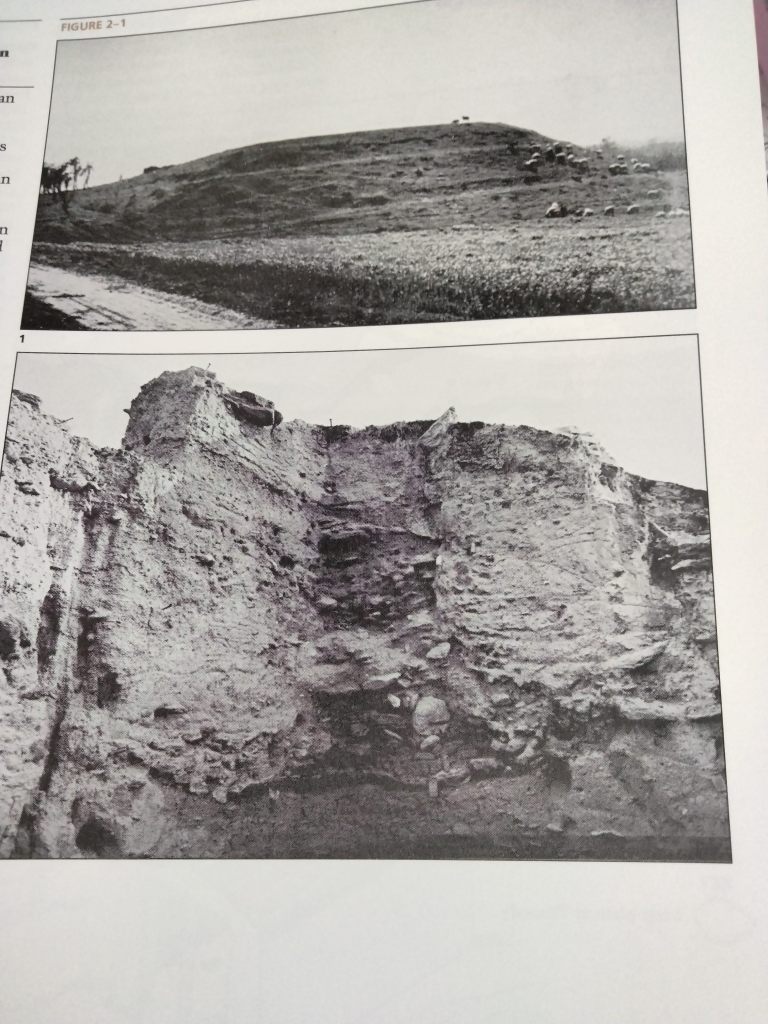
A tell is, essentially, a man-made hill that consists of layers upon layers of ancient ruins.
I first heard about tells in a Biblical Archaeology context. The Levant is filled with tells. Often, the original city was built on a high spot to begin with. Then, as successive generations of the city were destroyed and rebuilt, the tell got higher and higher. In the Levant, you often find a current city still thriving on top of the tell. So there is a modern city on top of a medieval city on top of a Greco-Roman city top of an Israelite city on top of a Canaanite city on top of a city from the time of Sumer. If you dig down carefully through these tells, you will find mosaics, pots, coins, garbage, all kinds of good stuff. Tells are different from grave mounds because they don’t usually contain grave goods carefully selected, but rather the debris of everyday life, and often the ash layers of past battles.
Well, it turns out, the Levant ain’t the only place that gots tells! I am currently reading The Civilization of the Goddess: The World of Old Europe, by Marija Gimbutas, published in 1991. As you can tell (haha!) from the title, Gimbutas has her own spin on the history of Old Europe, about which I will no doubt post later. But today, I am just here to talk about tells. There are many tells in Thessaly, Macedonia, Bulgaria, Yugoslavia, Romania, western Ukraine and southern Hungary (as we call them today) which show that in the 6,000 to 4,000s B.C., the Balkans were a happenin’ place. They revealed tidy planned cities, sometimes of a few thousand people, with hearths, idols, loom weights, and “exquisite” pots. (I love it when archeologists call something like a pot “exquisite.” It means they are really excited about it.)
I have previously postedabout the Vinca Signs, which came from this culture area and may have been an alphabet, though Gimbutas looks like she’s gearing up to treat them as primarily religious symbols. The settlements in this area are all fairly uniform, especially in their earlier stages, which says to me that people spread out quickly, probably from the Levant via Turkey and Macedonia. The climate at the time was rainier than now, which made farming easier. The sea levels were probably also lower, which might have facilitated travel.
Take a look at the photo at the top of this post. It comes from page 13 of Gimbutas’ book. The upper image is labeled “Argisa tell, west of Larisa, Thessaly.” The lower one: “Profile of Sesklo tell, c. 12 m of cultural deposits, with Early Neolithic (Early Ceramic) at the base and classical Sesklo on the top, c. 65th – 57th cents. B.C.”
Twelve meters of cultural deposits! Imagine the riches.
At the time this book was published, a few tells in the Balkan area had been excavated (Sesklo by Gimbutas herself), but most had not. I expect that is still true today. There have been some “hills” in Bosnia that turned out to be pyramids and to have tunnels inside, but really, even archeologists like Gimbutas who realize that Old Europe was much more advanced than previously thought are just getting started. I doubt that everything will be excavated, or the ancient story fully told, in this life. But if you have any interest in such things at all, it’s amazing to think of all the wealth of all those tells sitting there with their meters and meters of secrets.






















 Out of Babel Books