This is a view of my neighbor’s house on a smokey afternoon late last summer. It’s also part of the internal landscape of my mind.
Farmlands are one of my favorite biomes. (Yes, they are a biome. I will die on this hill. They are a part of Naure. They are what nature looks like when people live in it.)
Farms and I go way back. I didn’t grow up on one, but I grew up around farms and farmers.
My early years were spent in eastern Pennsylvania, which is a country of rolling green hills and low mountains. My dad was the pastor of a small country church, and most of its members were dairy farmers. Whenever we visited anybody, which was often, we would first be taken into the cow barn. These were black-and-white milk cows. As soon as you stepped into the barn, your senses would be filled with cow sensations: the chorus of moos, the smell. To this day, when I smell a cattle lot, it doesn’t smell bad to me, just like a clean farm smell.
And even cleaner farm smell was the “milk room,” a little brick building with a large stainless-steel tank of milk in the center, and a drain in the middle of the wet floor. It smelled like coolness, milk, and water.
These are memories from when I was very small. That same family that I have in mind, although they had indoor plumbing, also still had a working outhouse in their back yard. There were bees, and the smell wasn’t so nice, but it was raised up on several steps, not just thrown together but definitely constructed. My brother and I would torment this family’s chickens by pulling backwards on their tails so that they flapped. (Not recommended.) We would sit in corrugated buckets filled with water to cool down in the summer, and drink from the garden hose. This family had Dobermans, and I can remember a black bear hanging up in their barn after the father shot it while hunting. Later, it was stuffed in a scary pose and placed in their study.
The dairy farmers in our church also had fields of crops. Our own house had a yard of about an acre and a half. At the back of this yard was a line of poplar trees, and right beyond them, fields rolling away towards the creek. Beyond that, you could see a mountain. They must have rotated the crops in these fields, but I know that at least one year, they were soybeans. We were allowed to pick the pods, open them, and eat the tiny, hard beans out from inside. There was a lot of milkweed, which was fun to pull open and let the tufty parachutes out when it was ripe. There was a lot of ragweed, which my brother turned out to be allergic to, and one year a plague of tent caterpillars turned the mountainside brown.
My dad had a somewhat free schedule, and he would take my brother and me (and later, our sister) on walks in the countryside. These were probably short walks, given that we were little kids, but I remember them lasting hours. We could walk along the borders of the fields and find new fields, or the creek. This habit set “walking between farm fields” permanently in my mind as a normal thing to do. If it was nighttime during this walk, my dad would sing “Walking at Night,” which, in retrospect, is probably a German hiking song.
When I was eight, we moved to western Michigan. Worse, we moved to a city. I complained hard about this. It was the first remotely tragic thing that had ever happened to me, and I was determined to milk it. By this time, my crush on American Indians was well-developed, and I was keenly aware that it was tragic to be driven off your land.
However, despite that we technically lived in a city, our tiny church there was still about half farmers. There were still many opportunities, on prayer meeting and picnic and potluck nights, to run on vast grassy lawns while the adults sat and talked, to climb trees, walk between fields, and hide in the hay lofts and corn cribs.
The countryside in Michigan was flatter and dryer than it had been in Pennsylvania. Furthermore, my small denomination (the “Michiana Mennonites”) straddled the border between Michigan and its neighbor to the south, Indiana, which is really flat. The summer camp we went to served kids from both states, and we often found ourselves crossing the border for pulpit exchanges and things like that. I have attended church in what was literally a tiny, plain white chapel perched at the edge of a sea of fields with no other building nearby. I have tramped over Indiana farms, again with my brother and usually another farm boy, while the adults sat in the house and talked. And these Indiana farms are truly the farmland biome, because there is nothing there but farms, not even a hill to break up the monotony.
The farmland biome combines the best features of wilderness and human habitation. You can walk for as long as you like in solitude. There is wind, there is the changing sky, there are wildflowers, and flora and fauna on the windrows. You can get lost if you want, and if it’s winter, you can get cold and miserable too. But as the sun goes down, you can see in the distance the lights of houses. Coming back from the walk to the warmly glowing farmhouse provides all the romance that a kid with a big imagination and a copy of The Lord of the Rings could desire.
Farms have always been with us, and, though technology has changed somewhat, the logistics of having fields surrounding clusters of buildings mean that farmlands in every place and time look essentially the same. You have the wide horizon, the walls, canals or windrows carving the space up and giving some sense of distance, and the lights low to the ground. Perhaps one reason I like fantasy, as a genre, is that it naturally includes farms surrounding the town and castle.
Some of my favorite fantasy series start with, and often return to, the humble but honest farming community. O.K., actually I can only think of two, but they are good ones. The Belgariad starts off with Garion growing up on Faldor’s farm in Sendaria. Actually, it starts in one of my favorite parts of the farm, the kitchen. And, of course, The Lord of the Rings. Bilbo is not really a farmer, he’s more of a country squire, but the Shire is definitely a farming countryside. The four hobbits’ journey starts out hiking through the fields, as every journey should. Their first encounter with one of the Nine takes place on an otherwise ordinary country road. Farmer Maggot, a wholesome character, takes the four friends in, feeds them, and gets them safely to the river crossing in his wagon. And, when the journey is over, the four hobbits must come back and rescue from collectivization the ordinary, boring farms that they sacrificed to save. What would we do without ordinary, boring farms, after all? We’d starve, that’s what. And we would go insane, because the farming life, though hard, represents a very basic pattern for the way people were designed to live.
I might be in the process of drafting a book that takes place before the Flood. So that is forcing me to tackle this issue. Besides needing to get it settled in my own mind, this post is meant to test the waters and see how you, my readers, react to this concept. If I even bring it up, will I be kicked out of polite society?
So, this post is a historical survey of sister-marrying. And it starts in Egypt.
Royals did it
Marrying one’s sister, or half-sister, was not unheard of in the royal families of Ancient Near Eastern cultures. See the following two links for some hair-raising proof that it happened in ancient Egypt:
The practice of royal inbreeding continued so long in Egypt that, by the time we get to Tut-ankh-amen, he has a myriad of health problems and is rather strange-looking.
This was such an established part of married love, at least among royals, in the Ancient Near East that calling someone “my sister” became a conventional endearment. Here, for example, is Solomon:
You have stolen my heart, my sister, my bride,
you have stolen my heart with one glance of your eyes,
with one jewel of your necklace.
Song of Solomon 4:9
And why did they do it? The obvious answer is to keep the royal bloodline pure. Most ANE cultures tended to believe that their royal family was descended from the gods (see my post Genetic Engineering in the Ancient World), and to add another layer to this, their myths about the gods also often featured sibling-marriage. Typically, you’d have gods and goddesses all being descended from the same being (Father Sky and Mother Earth, say), and then reproducing with each other to produce all the typically observed features of the cosmos. (Please, for the love of God, take my word for this and don’t read the Sumerian creation myths. I’m begging you–don’t!)
Speaking of Sumerians, here is an article that argues that Abram married his half-sister Sarai (whose name means princess) for the same reason: because their family was some kind of royalty in Mesopotamia before he left on his journey.
My question, however, is this. Did this practice of royals marrying their sisters represent breaking an established taboo for a “good” reason, or was it a case of carrying on a common practice a little longer than most people? My contention is that it’s the latter.
Let’s Go to Genesis
Genesis is, as I have often said, my favorite ancient history book. The more I study all of this, the more I realize that it is by far the most accurate written record we have of really ancient history, and of course it’s the only written record we have for some events that are, nevertheless, corroborated indirectly by archaeology, genetics, and historical traditions from around the world.
So, in Genesis, we have humanity starting out with one single couple. If we take this seriously, we have to conclude that the first generation would have had to marry their brothers and sisters, because there was nobody else around.
Nowadays, this would be an impossible genetic problem, besides being taboo. However, clearly it wasn’t taboo at the time. By producing families, people were obeying God’s command to “be fruitful and multiply, fill the earth, and subdue it.” (Gen. 1:28) Based on the extremely long lifespans recorded in Genesis, we can infer that the newly created people were much healthier than we are, with a much more varied and robust genetic code. They would have had few diseases as yet, and almost no harmful mutations to inherit. Adam and Eve, who didn’t die until they were into their 900s, could have had literally a hundred or more children in that first generation. Furthermore, these children need not all have looked alike, except in the sense of being human. We have to remember that Adam and Eve had within them the potential to produce every genetic variation we see today (and actually more, since most of the variety was lost during the Flood).
By the time Cain kills Abel, there are enough people in the earth that Cain can complain, “I will be a restless wanderer on the earth, and whoever finds me will kill me.” These other people that he is worried about would have been his siblings, nephews and nieces, grandnephews and -nieces, and so forth. If we figure that Seth was born not long after the murder of Abel, then the murder of Abel took place just under 130 years after the Fall. (Genesis 4:25 – 5:3) Apparently, that was enough time for the world to be populated.
In this video, starting at about 20:00, geneticist Nathaniel T. Jeansen discusses how our ancestors had to have been more closely related “than we are usually comfortable with.”
A Detour into Evolutionary Theory
“But wait!” you may say. “All this is nonsense. People didn’t all come from one founding couple, we evolved from several different but related species of hominids.”
Actually, if you think that way, you probably stopped reading this article before you got to this section. But let’s dip a toe into natural selection, just in case there is anyone hate-reading or any readers who are intrigued by what I’m saying about history, but are bothered by the science side of things.
Natural selection, in order to work as a mechanism, has to have a population of creatures already in place, with some genetic variation already in their genome. And–this is critical–they have to be already reproducing. That way, natural selection can operate on the subsequent generations of the population, encouraging variety here, stamping it out there, etc.
This creates a big problem if you want to argue that people evolved from (ultimately) one-celled animals. Now, how one-celled animals reproduce is itself a beautiful, complex mystery, but it’s basically by subdividing, producing clones of themselves. In other words, it’s not sexual reproduction.
How did sexual reproduction come about through natural selection? It would call for a wildly improbable series of (already vanishingly rare) beneficial mutations to the genetic code of two different creatures of the same species, such that one ended up male and one ended up female, with their systems perfectly corresponding to each other for reproduction. And it would have to work perfectly the first time.
If you want several different populations of human species, then you need this miracle to happen not once but several times, in different places. If it only happens once, then you’re back to what Genesis describes, which is just one founding couple.
What I’m saying is that introducing evolutionary theory doesn’t make the believability problem smaller, it makes it bigger.
Stephen Meyer explains why beneficial mutations are mathematically impossible.
Back to Genesis Again
We’ve established that in the pre-Flood world, there was no taboo on marrying one’s sibling (or probably, cousin or niece either), and also no health cost to doing so. Also (probably) it would not necessarily mean marrying someone you had grown up in close proximity with, given the size of the families we are talking about.
Then we get the Flood, in Genesis 6 – 9 and also attested in numerous local histories worldwide. At the Flood, the human population of the earth, previously vast in genetic diversity, gets culled down to just four couples, and the men of these couples are all related to each other. It’s from these four couples (perhaps just three of them?) that all of us today are descended. (We are literally just one big family!)
Think about the implications of this. The most distant relationship that any of Noah’s grandchildren would have had to each other would have been cousin during that first generation. Perhaps they married their cousins, and then their second cousins and so forth, but there is nothing to indicate that the possibility of marrying siblings had been closed to them. In Gen. 9:1 -17, God makes a new covenant with Noah and his sons. He reiterates the command to increase in number and fill the earth. He gives them the animals to eat, institutes the death penalty for murder of humans, and promises never to send another worldwide flood. He does not mention any new rules about not marrying your sister.
Next, in Genesis 11 and 10 respectively, we get the Tower of Babel and the Table of Nations. Though the Table of Nations comes before the account of Babel, the fact that we are told which geographical areas these nations settled in hints that the Table of Nations is at least a partial elaboration of where people went when “the LORD scattered them over the face of the earth.”
In the Table of Nations, the peoples are sorted by father. We see the descendants of Shem, Ham, and Japeth listed by a paternal line, and we see them scattering to found cities, kingdoms, and peoples. This implies, though it does not directly say, that they were having a lot of children per family, and that they were practicing in-group marriage.
Now we get to Abram, who was a Sumerian basically, or was living in that region of the world and in that culture area. As has been covered, he married his half-sister Sarai, whether because theirs was an aristocratic family or because it was still common practice in Mesopotamia at the time. Later, on two separate occasions (Gen. 12:10 – 20 and 20:1 – 18), he “lies” by telling a local ruler that Sarai is his sister. On both occasions, the local king understands this to mean that Sarai is not Abram’s wife and is fair game for his harem. This shows that, probably, most wives were not sisters at the time, at least in Egypt (Gen. 12) and southern Palestine (Gen. 20).
This would be about 2,000 B.C.
In Genesis 24, Abraham asks his servant to get a wife for Isaac from among “my own relatives.” The servant, guided by the LORD (!), finds Rebekah, the daughter of Abraham’s niece (Gen. 24:15). One generation later, Rebekah herself encourages Jacob to marry one of his cousins, daughters of her brother Laban. So by this time, we are practicing in-group marriage, but with cousins, not siblings.
Finally, in Leviticus 18, we get an explicit prohibition on marrying your sister.
Leviticus comprises the details of the giving of the Law, right after the exodus from Egypt, so about 1400 B.C. If you plop your finger onto Leviticus, it looks really early in the Bible. However, it’s 600 years after Abraham and a couple of thousand years after the Flood, so it is coming rather late from this blog’s perspective on ancient history.
The intended recipients of Leviticus are a large population of tribes who have just spent 400 years becoming culturally Egyptian. Since Moses’ parents were both from the tribe of Levi (Exodus 2:1), we can infer that they are still practicing in-group marriage.
Leviticus chapter 18 begins this way:
The LORD said to Moses: “Speak to the Israelites and say to them: ‘I am the LORD your God. You must not do as they do in Egypt, where you used to live, and you must not do as they do in the land of Canaan, where I am bringing you. Do not follow their practices. You must obey my laws and be careful to follow my decrees. I am the LORD your God. Keep my decrees and laws, for the man who obeys them will live [i.e. find life] by them. I am the LORD.
“No one is to approach any close relative to have sexual relations. I am the LORD.”
Lev. 18:1 – 6
There follows a very comprehensive list of close relatives who are off-limits. This list includes everything you can think of, and some things that you perhaps haven’t. It ranges from very sick perversions, to this:
“‘Do not have sexual relations with your sister, either your father’s daughter or your mother’s daughter, whether she was born in the same home or elsewhere. (v. 9)
“‘Do not take your wife’s sister as a rival wife and have sexual relations with her while your wife is living.'” (v. 17)
Verse 9 gives us a clue of what types of family arrangements were possible among the Israelites of 1400 B.C. You might have a half-sister who was raised in a separate household. Verse 17 describes a behavior that Jacob famously engaged in with Rachael and Leah (additionally, both women were his cousins). In fact, the two women’s rivalry was how we got the twelve tribes of Israel. Marrying two sisters at the same time (not to mention their respective maidservants) was apparently something that was normal in the age of the patriarchs, but now, giving the Law 600 years later, God forbids it.
Leviticus 18:24 – 29 makes it clear that “all these things were done by the people who lived in the land before you,” but God considers them to be things that defile a land. I gather that this means the wide variety of disordered sexual relationships described in Leviticus 18 were not unheard-of, probably not just among the Egyptians and Canaanites, but among many or all of the many tribes in the surrounding areas.
We have God to thank for this taboo
So, now we know approximately when marrying your sister became taboo. 1400 B.C. And people didn’t come up with this on their own; God had to enforce it.
The overall picture is one where we start off with is marriages taking place among close family, in sort of a wholesome way, before and immediately after the Flood. Then, instead of branching out and marrying more and more distantly related people as the earth’s population increases, we see cultures in the Ancient Near East curving back in on themselves and coming up with more and more perverse ways to approach this. I gather from Lev. 18 that, once an ANE man had bagged a wife, he seemed to feel entitled, or at least have an eye out for the opportunity, for sexual rights to everyone related to her.
The time of the Israelite patriarchs, enslavement in Egypt, and Exodus also overlaps with the Minoan civilization on Crete, which gave us the legend (?) of the Minotaur, the offspring (allegedly) of Queen Pasiphae and a white bull. That gives us a clue that such horrifying practices were not confined to the Levant. “Do not defile yourselves in any of these ways, because this is how that nations that I am going to drive out before you became defiled.”
Another funny and poignant book by Tana French, set in the Irish village of Ardnakelty.
The humor comes from the way the residents, especially a certain older man named Mart, use the language. Mart is a talker. He and his friends at the pub love to roast each other, and especially Cal, the American ex-cop who has lived there two years now. For example, when they hear Cal is getting married, they try to convince him that there’s a local custom that the prospective bridegroom needs to carry a torch from his house, through the village, around his intended’s house, and then back to his own house … in his underwear.
The poignancy comes from the plot, which I won’t reveal, but suffice it to say that there is plenty of human tragedy.
French has done an amazing job of portraying a close-knit, gossipy, stifling, eccentric small community where communication is indirect, and becomes even more indirect when the stakes become high. Cal is pretty good at reading, and engaging in, this kind of 4D chess that’s played at one remove, but it gets to even him after a while. “The amount of subtlety around here was pretty near to giving him hives.” I have always wanted to write a story set in such a community, but have been unable to because I am woefully literal minded and don’t pick up on cues. I would never survive in Ardnakelty.
There is a small amount of preaching about climate change, but it’s only mentioned directly once that I remember and does not overwhelm the story. This tale takes place during an unusually hot and dry summer in Ardnakelty, which puts everyone on edge. In this way, the weather contributes to the theme and even drives the plot a little bit.
Finally, one thing I forgot to mention on my GoodReads review is that French deserves props for being able to capture the way men think and talk. Cal is the main POV character, and he’s just the quintessential male, both in the way he thinks, how he handles and solves things, and how he banters with the people in the village and deflect questions and comments and barbs when he needs to. This book kind of reminds me of She’s Come Undone, which was the opposite in that it was a well-written book with a female POV character, written by a man.
In the only episode of Black Mirror that I ever watched (“Nosedive “), everyone can rate their interactions with everyone else on a scale of one to five, using an ocular implant that shows them a screen in their field of vision. Citizens’ jobs, housing opportunities, and so forth all depend directly on their composite rating. Of course this episode portrayed a dystopia, and I have no wish to live there. But this week, for the first time, I found myself wishing I could give strangers “five stars” from a distance, just to boost their morale. You know, what the old-timers used to call a compliment, but without the human interaction that makes it weird.
I guess this post will have to do. So, if you were at Silverwood amusement park in mid-June, know that I gave you five stars.
First, to all the beautiful young ladies in bikinis, short jean shorts, and summer dresses. You are lovely. Five stars.
Then, to all the deeply tanned grannies and the middle-aged ladies wearing racerback swimsuits. To the slender elderly ladies in linen pants and hiking shoes, and to the tough-looking older woman with the very short haircut. I want to be you. Five stars.
To the, possibly Mennonite, girls doing the park in long braids and even longer jean skirts, I love your outfits. I love your outfit, woman with a blue polka dot tiered skirt that echoed the shape of your short, pink-tipped ringlets. Five stars.
Now, about hair. I award five stars to all the ladies wearing intricate braids, hippy braids, or beachy buns. Five stars to the lady with the glossy black curls up in a high bun, and to the girl with touseled, Molly-Ringwald style short bob. Skinny girl with amazing natural hair who looks like Zendaya — five stars to you for keeping your hair in that condition. Redheads, young and old, I love your color. I love your hair, chubby American Indian kid with a true-black ponytail so long you can sit on it. Sikh family, your daughter’s forehead bun is awesome. Five stars.
People with tattoos, two stars. Some of you look cool.
Hairy guy with the nipple piercings … um, three stars. Ouch.
I love you, grandpa with the huge smile riding the scooter. Family applying sunscreen to your developmentally delayed adult son, five stars. He is adorable, because you are taking such good care of him. Five stars to your sweet-faced baby passed out in your arms, and to your excited baby with the very expressive feet. And even five stars to the baby who had HAD ENOUGH on the train ride. I hope you got cooled down or whatever you needed.
Five stars to your curly-headed toddler, and to your toddler in a life vest holding your hand. Five stars to the adorable couple where he was big and freckled, and she was slight, sweet, tanned, and Asian. And to the couple where he was big and dark and had dred locs, and she was short and pale and ginger. Five stars to the pregnant woman in a swim suit who looked like the Mona Lisa.
Five stars to mothers and daughters who look exactly alike, especially those who walk through the park holding hands. Five stars to the cool, bespectacled brunette who sold us tickets to the barbeque tent. And five stars to the tanned and muscled guy with his baby on his shoulders, who was dancing to the classic rock played over the speaker system.
And let’s not forget the beards. The guy with the white, squared-off, excuse-me-miss-my-eyes-are-up-here beard gets five stars. So does the guy who looks like he got up that morning as a starved mountain man, took a bath, and put on a T-shirt and some Bermuda shorts.
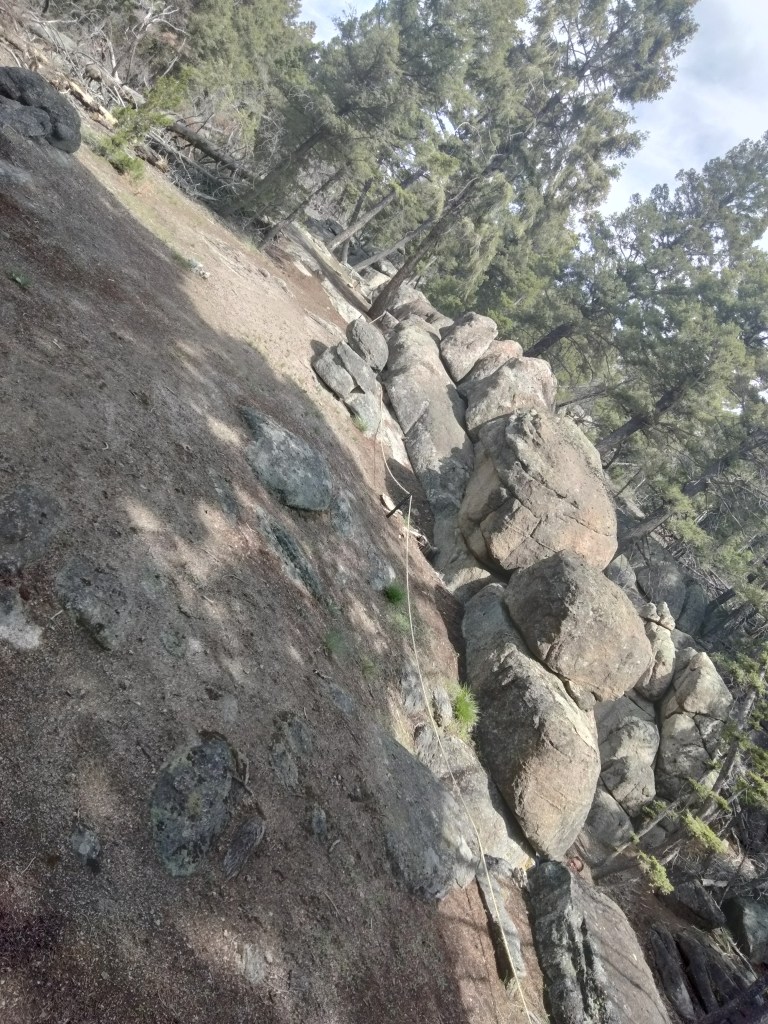
Here I am at Sage Wall, to give you some idea of the scale.
Sage Wall is a possible megalithic site near Butte, Montana. In this post, I am going to thoroughly embarrass my geologist husband by saying that Sage Wall looks manmade to me. But first, how did I come to visit Sage Wall in person?
Getting to Sage Wall
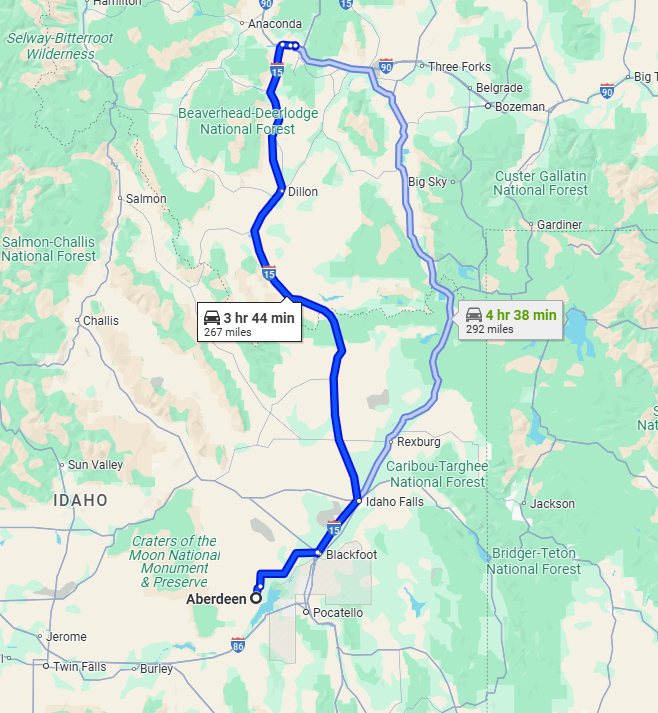
It’s on my bucket list to visit as many archeological sites as a I can, the older the better. Sage Wall was a no-brainer because it’s only a half a day’s drive from my house. It is also a good candidate to visit because looking at photos is kind of ambiguous. To really get a sense of whether it seems manmade or like a natural formation, I felt I had to be there in person.
We drove up into the beautiful Montanan Pioneer Mountains (Idaho has some as well), stayed the night in Butte, and the next day, made our way to Sage Mountain Center, where I had a reservation. We could not have asked for a more beautiful day, weather-wise. Early June in the Butte area is still basically Spring.
Chris and Linda are the property owners at Sage Mountain. About three decades ago, they wanted to move out to the middle of nowhere and build a sustainable house and retreat center. They were not looking for megaliths. Linda stumbled upon the wall on a hike one day, and Chris, who has a background in building, looked at it, said, “Yep. That doesn’t look natural. Well, let’s get back to our projects.” It wasn’t until years later, when they had established a sustainability-themed retreat center and had started to create some hiking trails for their guests, that other people started noticing the wall. Chris and Linda cleared the brush around the wall, roped it off, and had it examined by LIDAR and ground-penetrating radar.
Now, many people are coming to see the wall, seemingly to a point where it is almost becoming a problem. Sage Mountain Center is still on a wind-y, washboard-y dirt road, but now many people, seeking to get away from it all, have built new houses and cabins along that same road. Chris asked us, as we drove out, not to “go too fast past our neighbors. We’re trying not to bother them.” I got the impression that his main desire is still to just run a sustainability B&B in peace, but he’s been saddled with this danged wall.
What Would a Skeptic Say?
I want to give the skeptical geologists their due here. I think what they would say is this: “All these people who are saying Sage Wall is amazing megalithic structure are forgetting one thing: It is right in the middle of the Boulder Batholith! There are big granite rocks everywhere!”
source: formontana.net
They are not wrong. The mountains to the east of Butte, where Sage Mountain Center is located, are strewn with large granite boulders and outcroppings. These tend to fracture into shapes resembling worked blocks of stone.
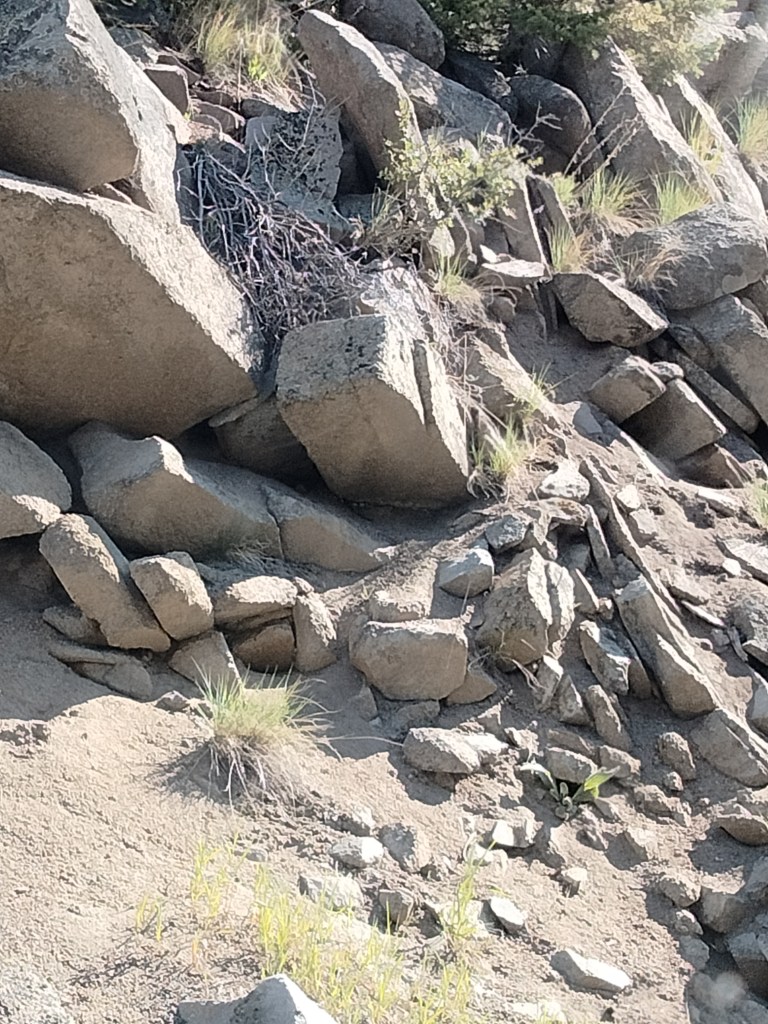
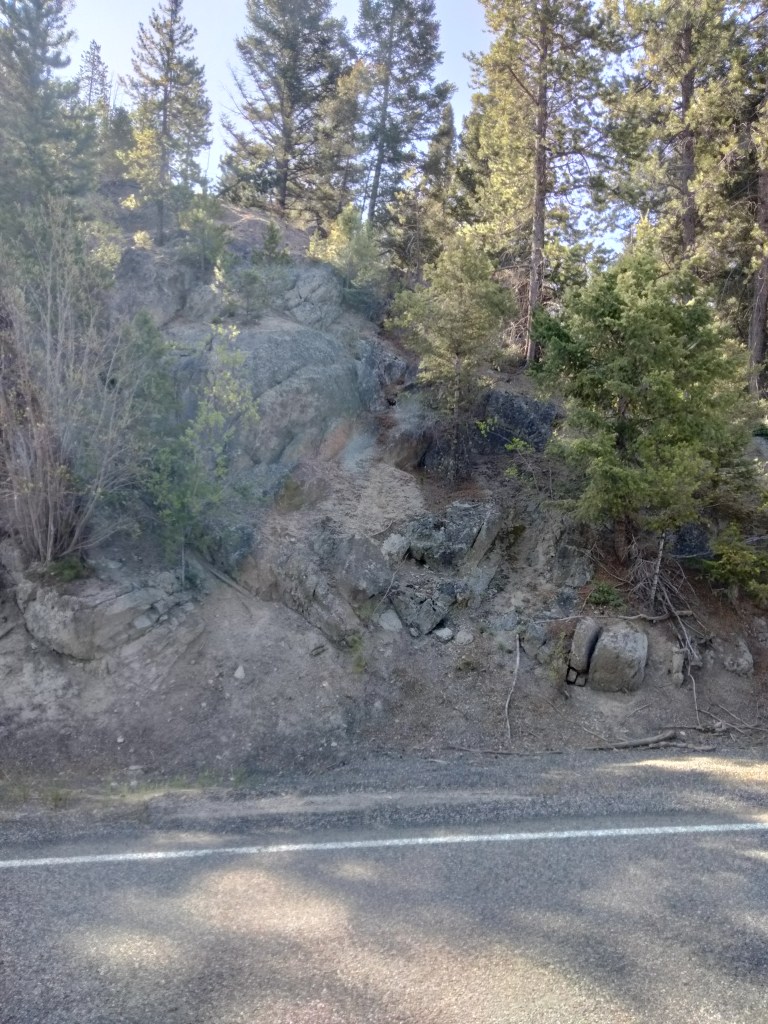
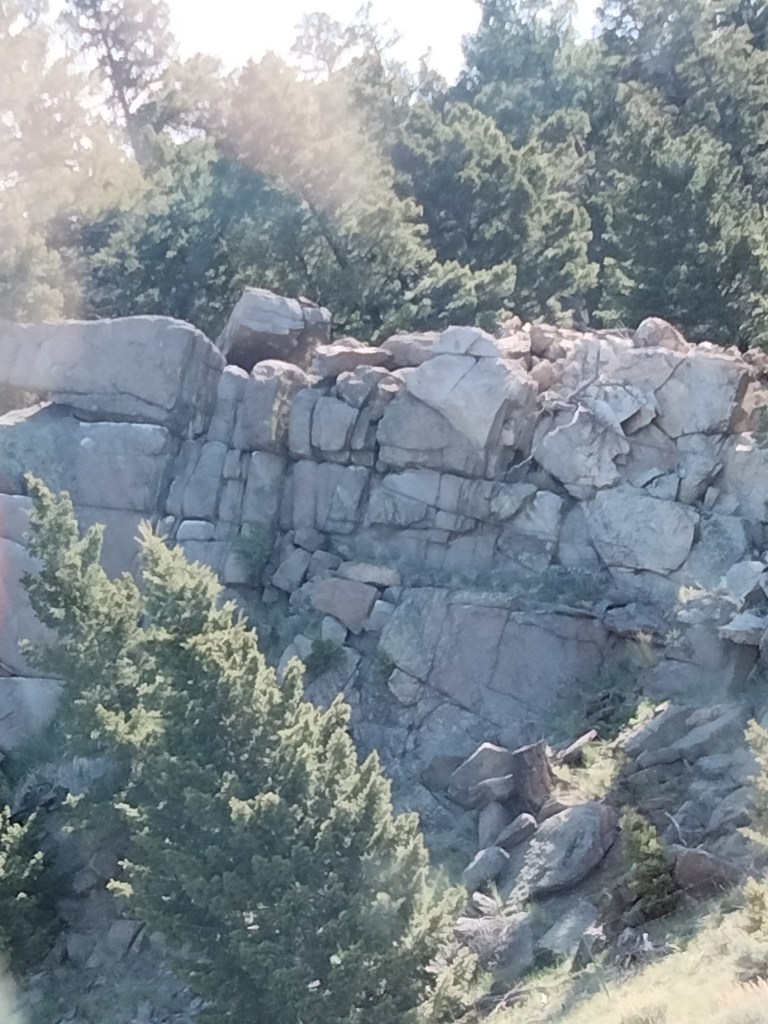
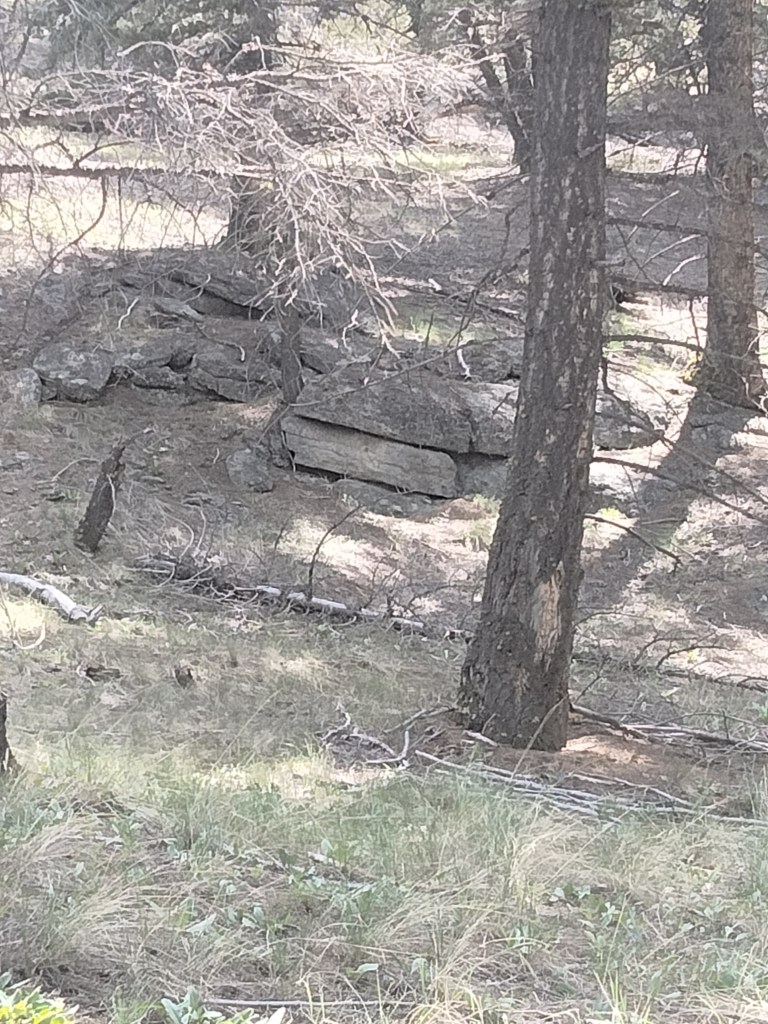
Here are some pictures I took, on the way in, of natural granite outcroppings so you can see how they normally look and how they tend to fracture:
You can see that the fractures are often horizontal and strikingly block-like.
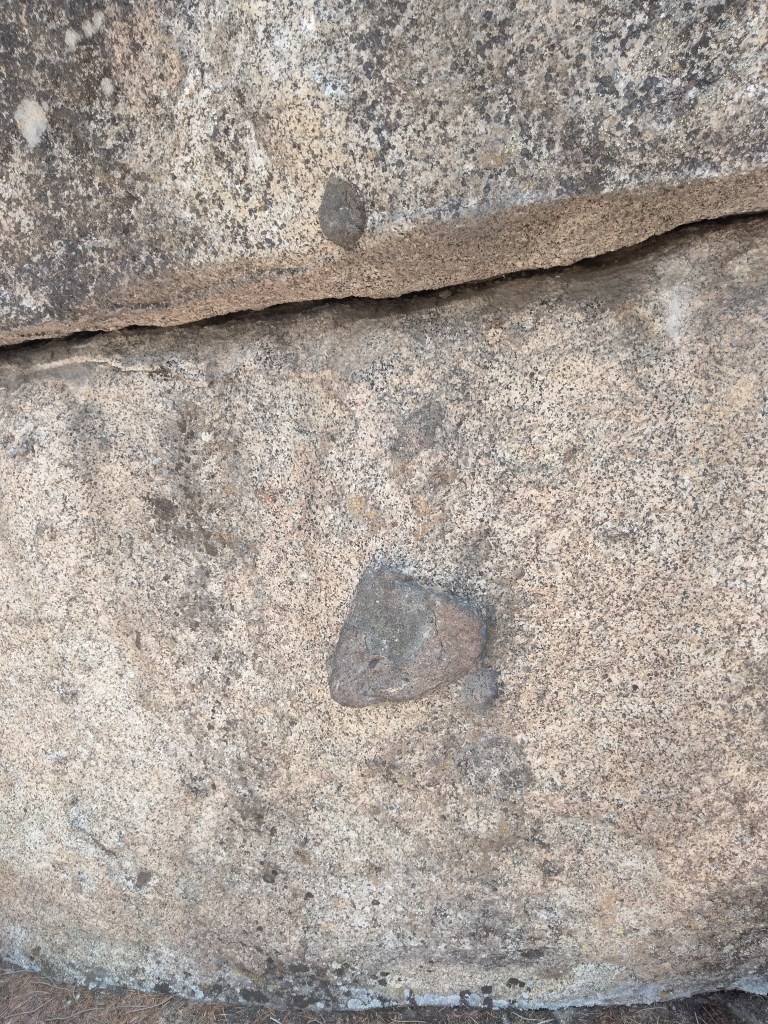
We also saw some pieces of granite that had very large quartz crystals formed in them, which stuck out like chips in a chocolate chip cookie:
And, just for fun, here’s a balanced rock:
I’m not sure whether this balanced rock is natural, but I’m leaning towards no. I’m thinking it was put there to mark the trail.
Anyway, the skeptics are correct that the presence of big, blocky rocks does not an ancient megalithic structure make. This is part of the reason I wanted to see Sage Wall myself. I did not take any videos of it, because I’m not good with video and didn’t have a script ready. But there are now many videos of Sage Wall online, including drone videos. I’ll try to embed some of them at the end of this post.
Why Sage Wall is Likely Man-Made in my Amateur Opinion
So no, the claim is not that this must be a megalithic structure because it is located somewhere that we would not expect rocks. It is definitely surrounded by rocks. However, it looks distinctly different from the more random rock outcroppings around it.
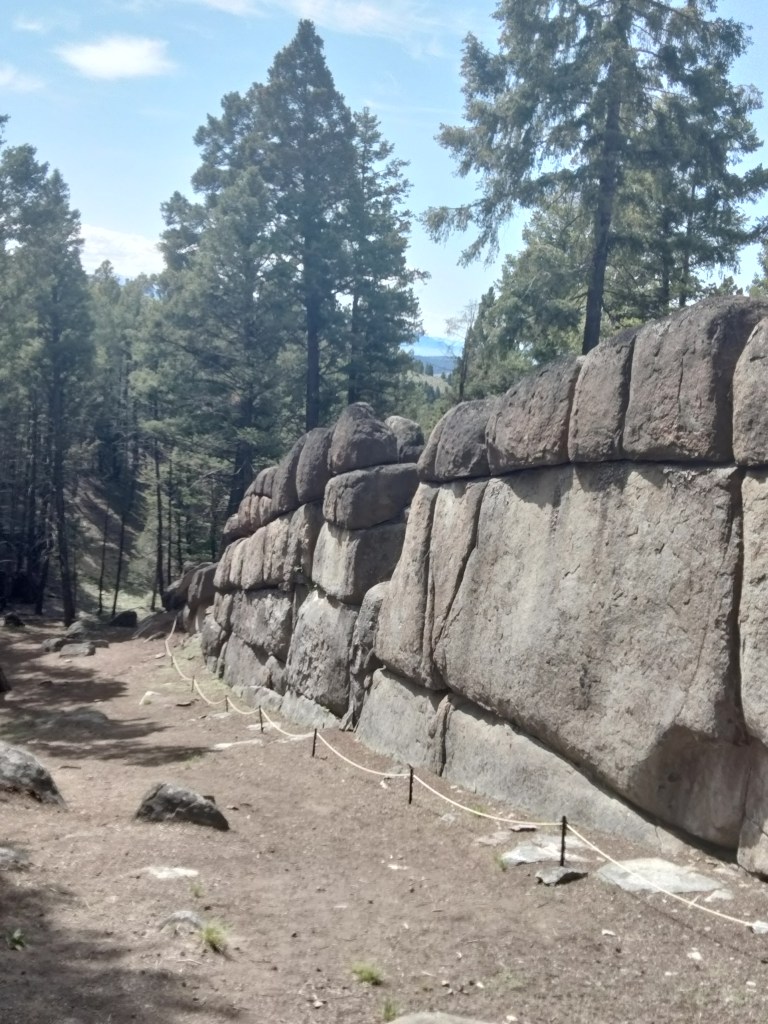
It is very long, and very straight. (The wall extends past the Sage Mountain Center property, but only their section of it has been cleared.)
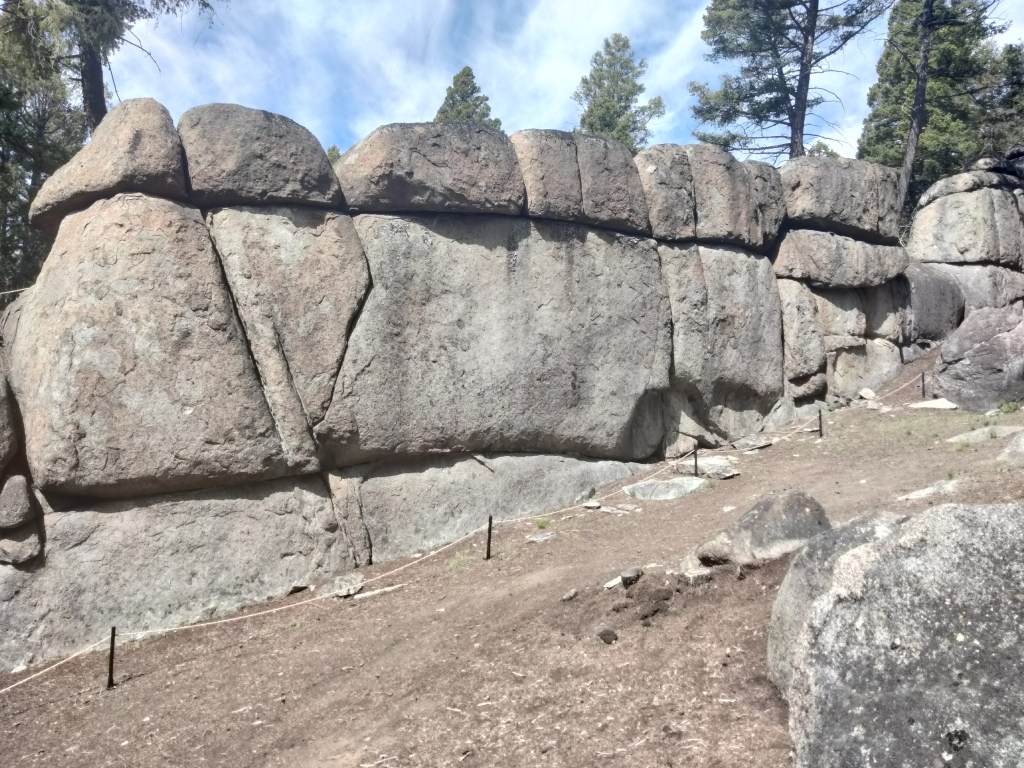
Unlike what we see with other fracturing patterns, the wall consist of very big blocks laid out in what appear to be courses. To my (again, amateur) eye, when we see natural fracturing the blocks tend to fracture into smaller pieces where they are exposed.
In the pictures above (and in the one where I’m posing), you can see a hollow lower down in the wall where a block obviously fell out.
At three different places in the exposed section of the wall, there are gaps in the top similar to doors. Chris told us there had been a lot of speculation about these before researchers realized that they were simply places where boulders had fallen out. In fact, you can see the boulders below them, almost completely buried in dirt and pine duff.
On the picture above, you can also see the remains of a triangular shape. The left side of the triangle is made with shaped blocks, and the right side is incised into the megalith. The triangle happens to frame the gap where a block fell out.
According to Chris, the geophysicist who examined the wall with ground-penetrating radar found that it goes down into the ground about another 20 feet. At the bottom was something that reflected the radar, as it might be a floor or stone foundation.
All of this research is shortly to be posted on the wall’s website, here or possibly here.
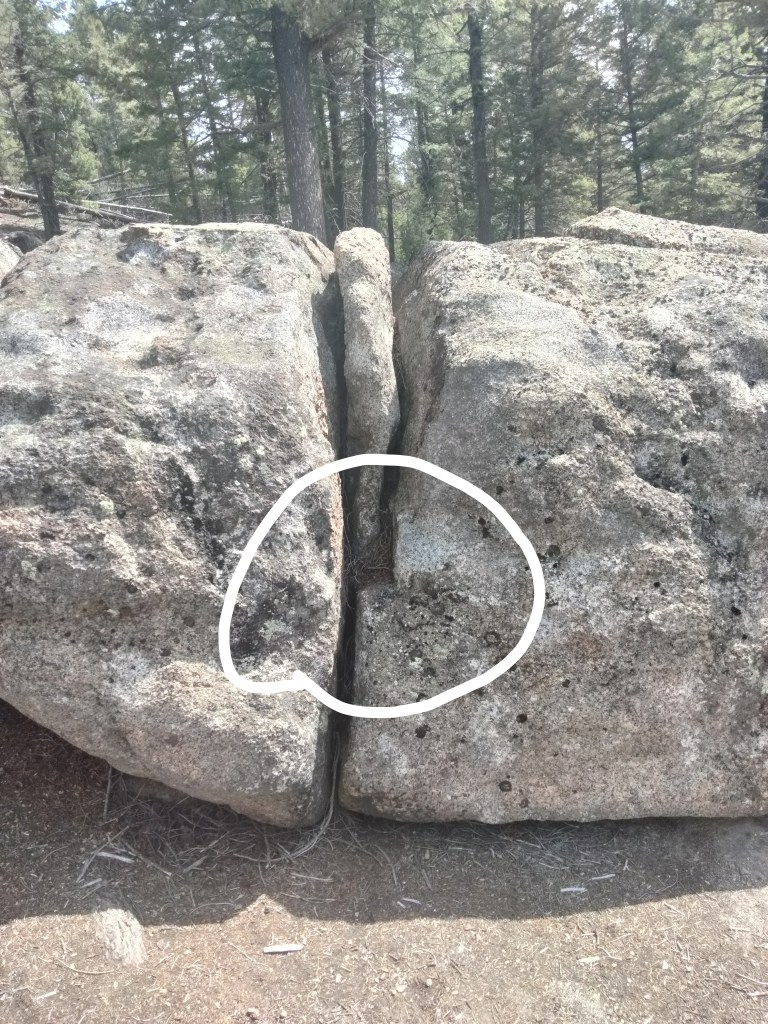
Parallel to the wall are the fallen remains of what appears to be another wall. You can see that it is “fractured” in the same way, and these other blocks also have some of the nub and cup features that we’ll talk about below.
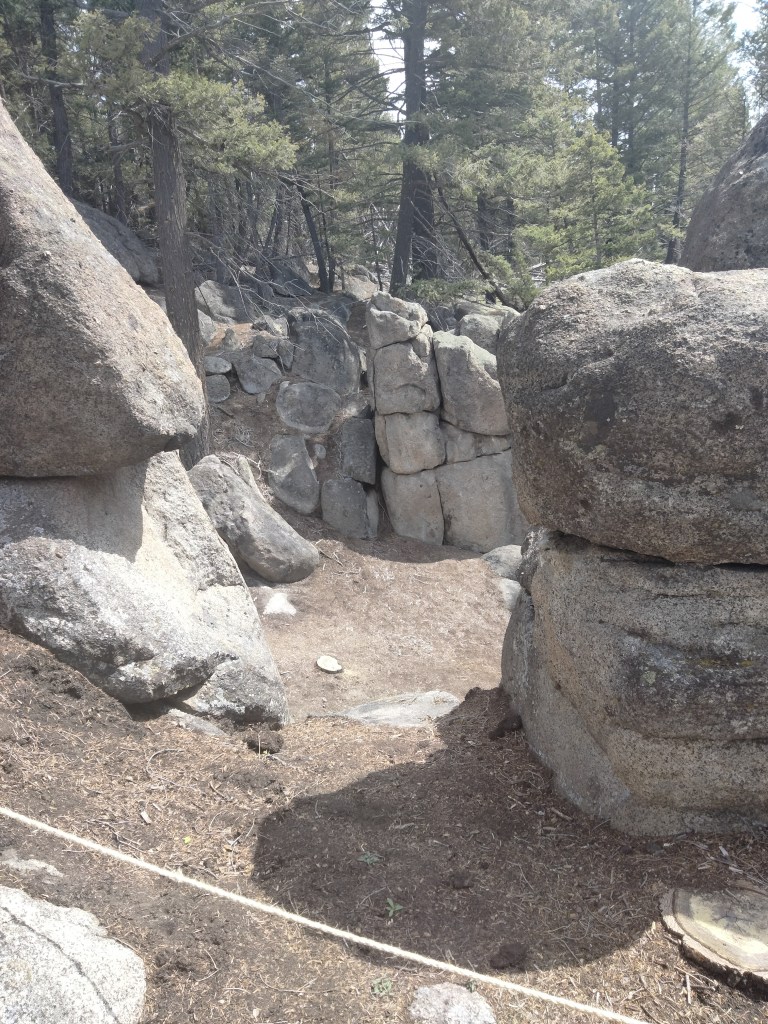
Here’s a bit of the second wall, seen end-on.
Behind the Wall
Here’ a view behind the more intact wall. Chris and Linda have installed a rope that allows visitors to climb up behind the wall. As you can see, the wall is not just part of a cliffside, but it does have earth and rocks filled in behind, either as terraces/a retaining wall, or the ravages of time.
From behind the wall, we look out through a gap left by a fallen stone across the avenue at the remains of the second wall.
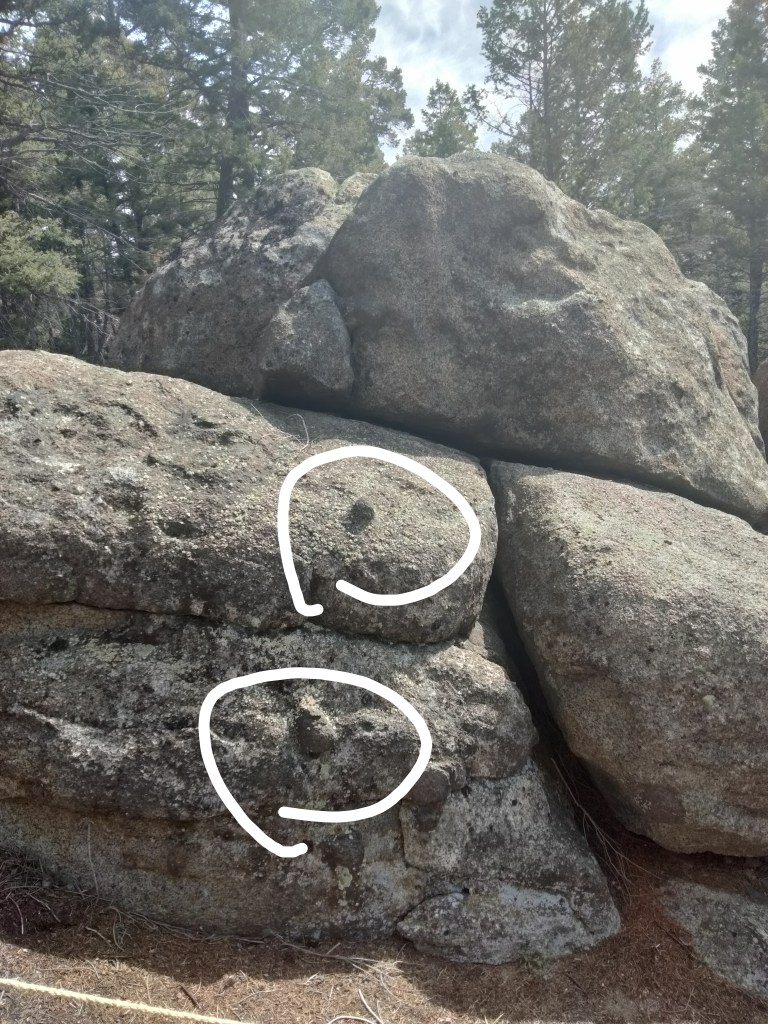
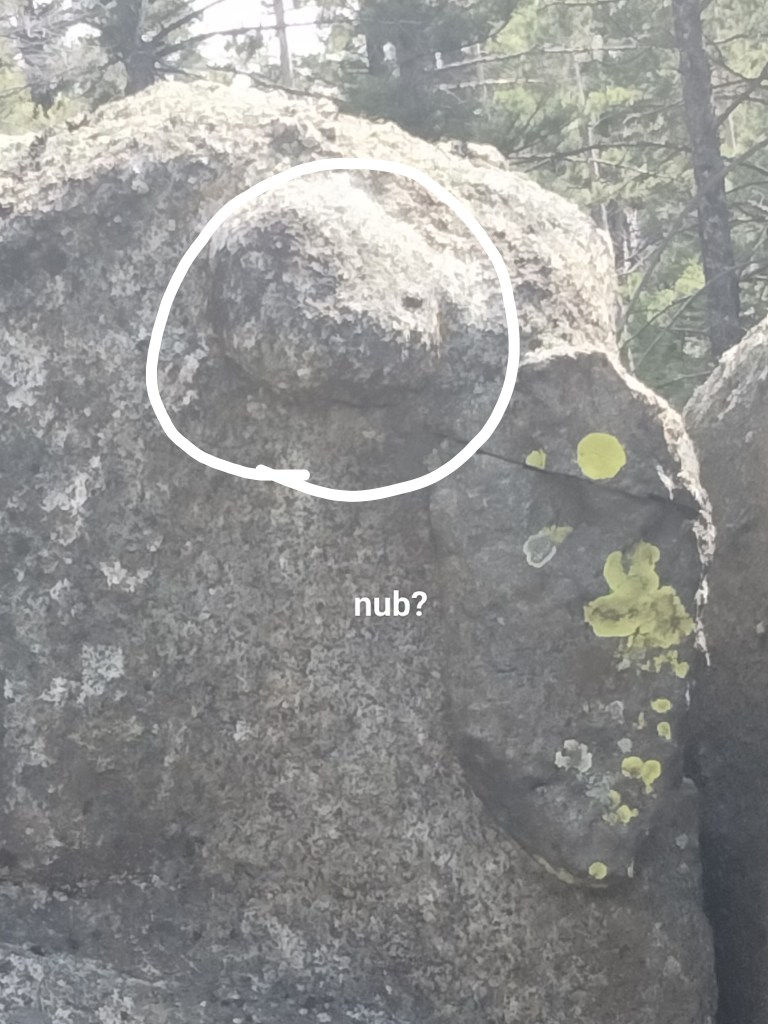
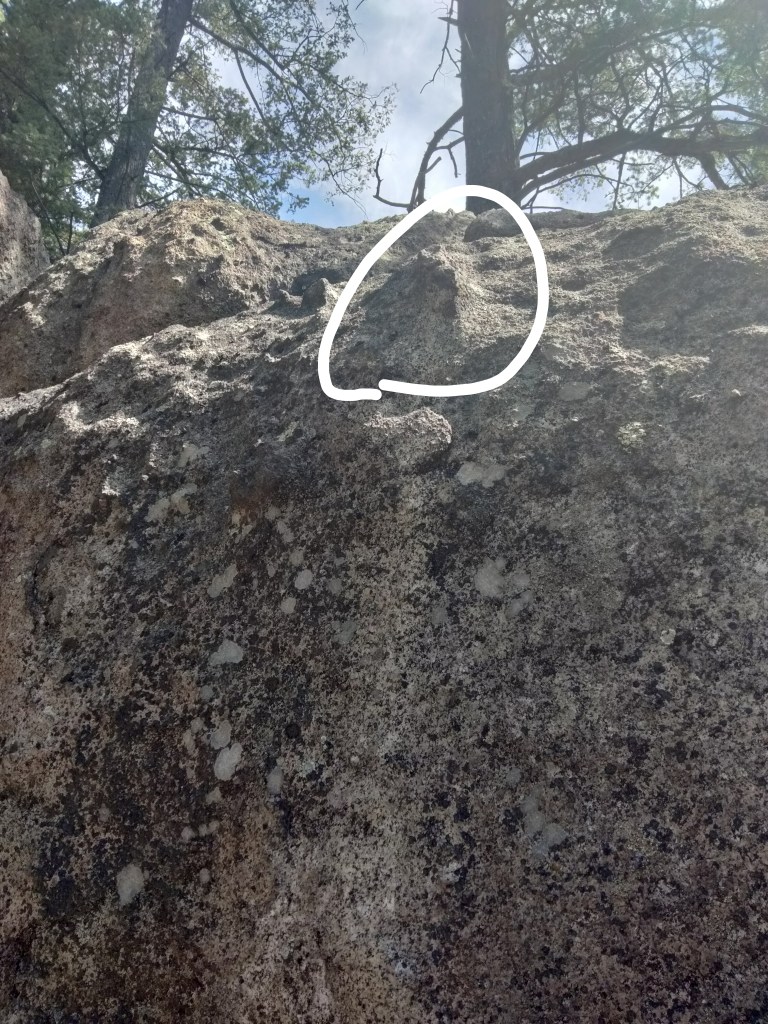
Getting close to the top of the wall allows us to see what might be nubs and cups.
Nubs and Cups
Stone nubs and cups (not necessarily corresponding to each other) are sometimes features of megalithic architecture in other parts of the world.
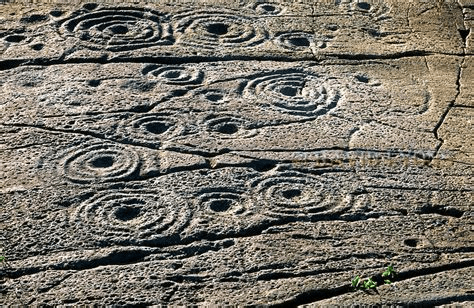
“Cup and ring” markings are apparently found all over the world, but especially in Northern Europe. Here are two articles about them.
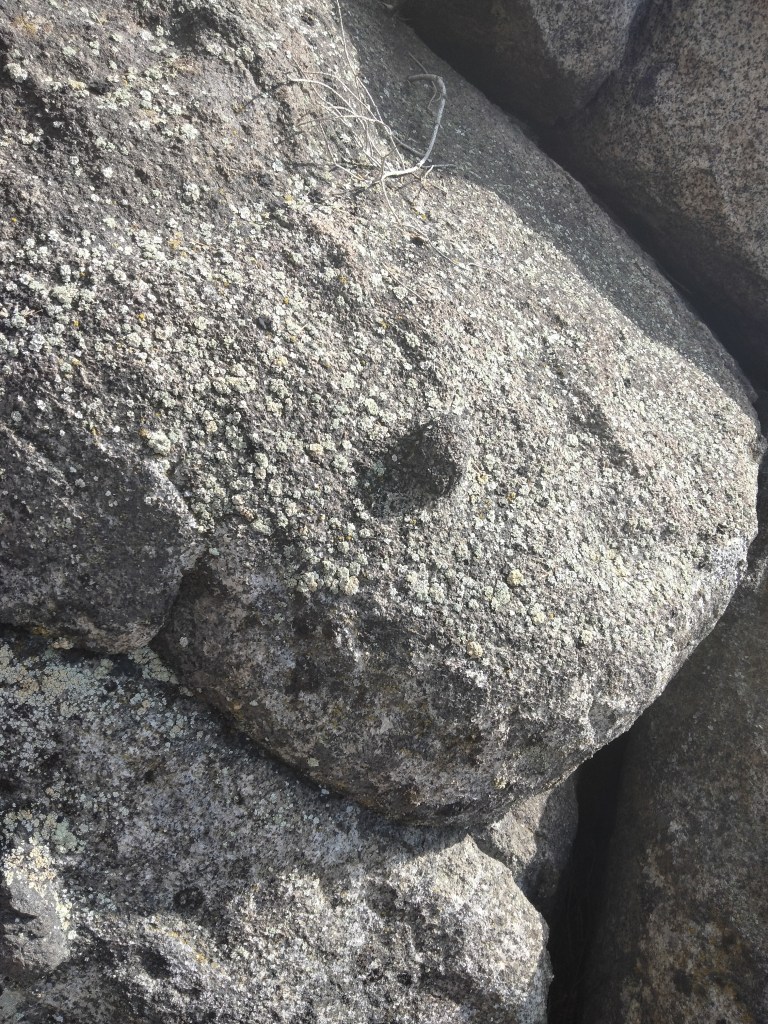
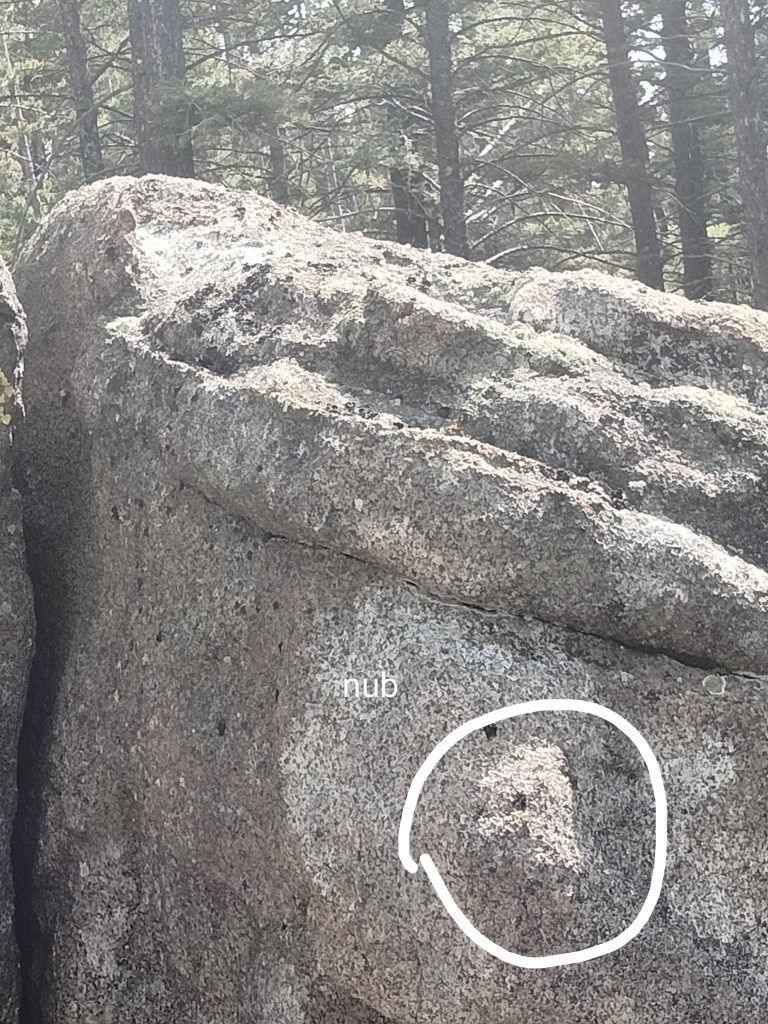
Here are some nubs found on top of the intact wall.
They are not the same as the pieces of quartz sticking out of the natural stone that we photographed earlier.
Because the wall is so weathered, some of them are not certain.
Note the possible incised lines above this last nub.
Here are some other things we saw on the back of the wall:
Incised straight line
Suspiciously square fracture line
On the fallen wall as well, we found some things that look like nubs, and some possible cups. As a nod to the skeptics, yes, these “cups” do look like they could have been caused by water erosion. This would be especially true if they were found under a waterfall or a persistent drip, which they are not, as far as I can see. Some of them are also suspiciously round.
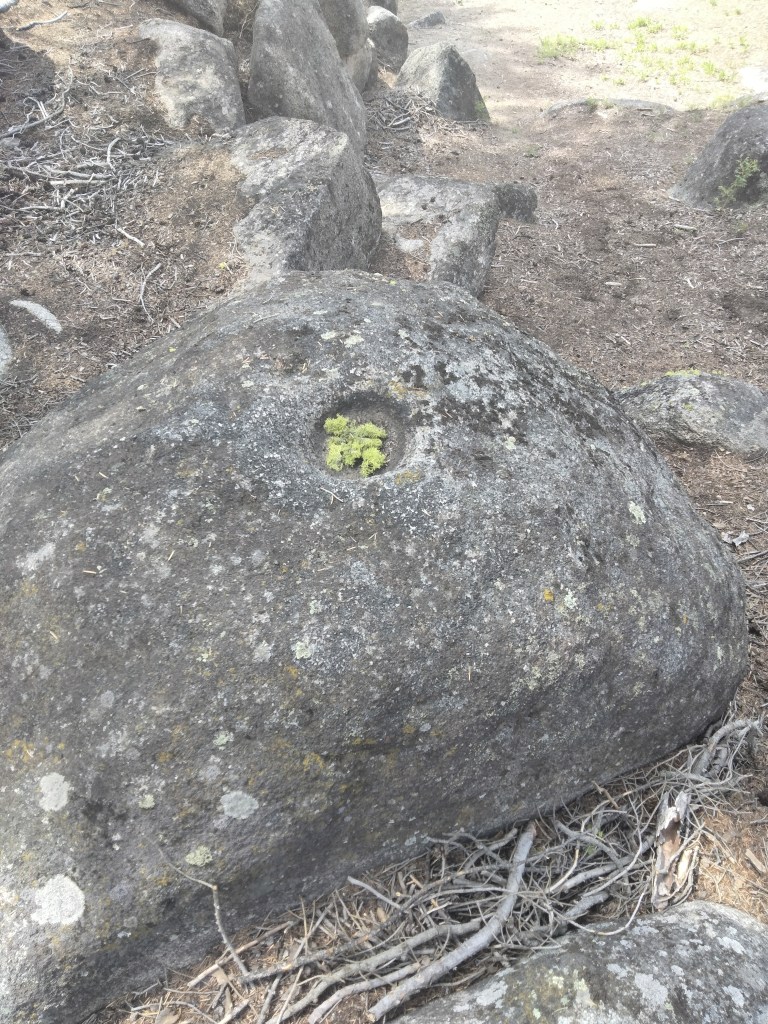
Very round “cup” in which someone has placed some fresh lichen
Some also have very straight lines incised near them. My son suggested they could be a water feature.
Looks like a cup with a spout
False Nub Alarm? Or Another Part of the Complex?
As we hiked away from Sage Wall, I took care to photograph natural rock formations for comparison. Not very far from the walls, I saw something that also looked like nubs.
Did this mean that such nubs are a natural feature of the way granite weathers? Or could this be another part of the same complex as the wall? The formation on which I spotted these nubs certainly looks like the remains of a constructed passage.
A Post-Flood Megalithic Culture
After I left Sage Wall, my husband asked, humoring me, what I thought its purpose had been. My answer is that I have no idea. It is way too old, weathered, and partially buried for me to speculate. (This does not bother Julie Ryder over at Montana Megaliths, so if you want to see some people speculate very confidently, you can visit there.)
What I can say is that, granted this is not a natural formation, it most reminds me of Sacsahuayman and other sites in Peru. You have the same dry stone construction with megalithic blocks that are shaped, but are not in uniform sizes or in a regular pattern. And, of course, you have the nubs. As for scale, it appears that if Sage Wall were excavated down to its foundation, it would be thirty or forty feet high.
Another similarity is that both Sage Wall and the Incan or pre-Incan complexes are built at very high elevations (the Continental Divide runs near Butte).
This suggests to me that they partake of the same culture area.
Sage Wall, of course, has been abandoned much longer than any of the impressive Incan complexes, some of which Europeans got to witness still in use. Consequently, it’s much more weathered, run down, and filled in. But it looks like the same sort of thing.
So, it appears that Sage Wall and any other structures we might find in association with it were built by a group of people who knew how to build with megaliths, and who then had to abandon this site for some reason. It was before recorded history in North America, but that doesn’t mean it was before recorded history was happening elsewhere. Then, they or their descendants or people who partook of the same megalithic culture, moved on towards South America and continued their building there.
I believe there is plenty of evidence–not from Sage Wall, but from other sources–that human dispersion happened very quickly after the Flood, and that when people spread out, they took a megalithic culture with them. Dolmens, pyramids, cities, and inexplicable megaliths have been discovered all over the world. In many cases, as with the Bosnian pyramids, they have been abandoned for so long that they are not immediately recognizable as the work of human hands. You have to know what you are looking at before you can see it. The Bosnian pyramids, first thought to be extremely regular hills, were confirmed as artifacts only when a team dug into them and found tunnels. It looks like something similar happened with Sage Wall.
Immediately after the Flood, the earth would have entered an Ice Age. The climate was in a tailspin: temperatures were low, precipitation at an all-time high. Much of that precipitation quickly got locked up in glaciers. Sea levels fell around the newly configured continents. There were land bridges all over: in Beringia, in Doggerland, in Sundaland. People took advantage of all this newly revealed, very humid land and scattered. But the Ice Age was short, and as glaciers melted, there were sudden catastrophic local floods. People had to abandon their sites. Many of their cities, camps, and settlements are now hidden under water along our coasts. In some cases, such as Gobeklitepe and the Vinca cities, they burned, buried, or otherwise destroyed their sites before moving on. Some of these sites might have been built very quickly and inhabited for only a short time before they were abandoned. Other things being equal, archaeologists tend to overestimate how long it took to build something, and how long ago it appeared. But even very recent sites can be quite mysterious. They have had trouble re-constructing Woodstock, for example.
How Did They Build It?
I don’t know. Obviously they were purty smart. Probably an argument is going to be made that Sage Wall must be a natural formation because “we know” that people in the Stone Age didn’t have the ability to make things like this, despite constant evidence being discovered to the contrary. Or they will argue that “we know” that there were no advanced civilizations in North America, despite Sage Wall itself. Such arguments tend to be self-re-enforcing.
I do know that we do not, currently, have the ability to build with megaliths … at least, not so easily that we consider them our first choice in building material. We might make a monument or a gravestone, but we wouldn’t attempt to build an entire house or city out of megaliths. The effort would just not be worth it. This suggests that the ancients may have had ways that were easier than our current methods.
It is worth noting that there is a well-established oral tradition of giants living in North America. There have also been giant skeletons discovered. In Peru, meanwhile, there is the tradition of the Viracochas, bearded, godlike culture-bringers. No, I’m not suggesting aliens. I do think we should take a closer look at the worldwide oral traditions of apocalypses, floods, gods, and giants, and that we should pay attention to myths that suggest that civilizations were “advanced” right from the beginning. If you want to dig into this more than you already have (and if you are reading this, I assume you already have!), please feel free to look at my page The Research Behind the Books for a suggested reading list.
Disclaimer: None of these pictures are mine. I found them on the Internet. If any of them are yours, and you don’t like them being used in this post, contact me and I’ll be happy to take them down.
This is the Lady of Elche, Spain.
As you can see, her shoulders are hunched up. Some people describe her as having an “elongated head,” but it could just be the hat. Or it could be a hat meant to imitate elongated heads, as we see in many other cultures, but especially Egypt and MesoAmerica, where there was also head binding.
The following two links are my bibliography. You can follow them to check what I’m about to tell you about the Lady.
When I first heard that this Lady had been found buried in Iberia, it freaked me out. That’s because my understanding of pre-Roman Iberia was that it was basically Celtic. I was prepared to find Celtic- or Scythian-style artifacts there, such as images of people with narrow chins, large eyes, and moustaches; men with deer antlers; horses, and spirals, perhaps worked in silver, wood, stone, or even gold.
Celtic portrait, with torque necklace
Kurgan stelae in Kyrgyzstan, closer to the probable homeland of the Celts/Indo-Europeans
That’s what I expected to find in Spain. Or maybe something that looked like Etrusacan art, or like statues from the Archaic period of Greece.
I was not prepared for a massive, highly realistic stone statue that looked more classical Greo-Roman in style and featured attire more reminiscent of … I don’t know. Ancient Mesopotamia? Peru? The Lady of Elche freaked me out because it seemed to suggest a whole different style of civilization in Iberia, previously unknown. I was thinking Stone Age or pre-Flood.
Then, I heard that the Lady was believed to be Carthaginian. She instantly became less mysterious, but no less horrifying.
Carthage was a colony of Phoenicians. Phoenicia was an advanced civilization from the Levant. They inhabited the port cities of Tyre and Sidon, near ancient Israel. This explains why the Lady seems to be dressed like someone from the Ancient Near East. The Phoenicians had a shipping empire, so not surprisingly, they started a colony in North Africa. Carthage was here:
As you can see, they are very close to Europe, including territories in Spain. That explains how the Lady of Elche could have Western European facial features and Carthaginian dress.
Like most advanced civilizations of the Ancient Near East, the Phoenicians practiced atrocities in their pagan worship. This was the group that had the god Molech, to whom babies were sacrificed in the fire.
They were dropped down into, or placed in niches in, the red-hot statue. Drums and horns covered the sound of the infants’ screams. Incredibly, Israelites kept taking part in this practice and God had to keep telling them to stop. There was even an Israelite king who “made his son pass through the fire.”
Given that Carthage was part of an advanced, baby-killing empire, the Lady of Elche at once becomes more horrifying. The blank look on the woman’s face becomes more sinister. Is this just a death mask? Or is it because she is cruel? Or mindwiped by all that she had seen and done?
I don’t have any historical reference for this, but an anonymous commenter on the Internet has asserted that the “ear covers” were worn by priests and priestesses to block out the screams of the victims of more gruesome rituals. The bigger the ear muffs, the worse the ritual. I’d like to pooh-pooh that, but it fits with everything else we know about the ancient world. Christ conquering the nations suddenly sounds much less like a step in oppression and more like a relief. If you know more about the earmuff question, I’d love to hear it I wouldn’t exactly love to hear about it, but I’m curious and please send me your information.
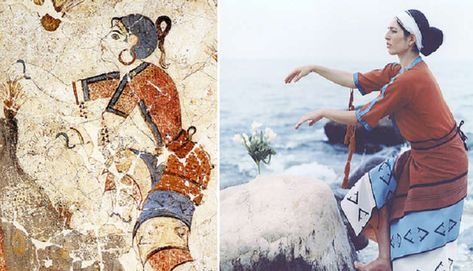
If you know how to indicate your interest in the Lady to the algorithm, you may find people dressed in historical re-constructions of the Lady of Elche’s garb, like these:
These ladies all look significantly happier than the original Lady.
Here is the article introducing yet another large Mayan urban center stumbled upon in the jungle through the use of LIDAR technology.
As the authors say in their Conclusion,
As archaeologists work to document and characterise ancient settlement systems throughout the tropics, local scale ‘dense pasts’ are proliferating. It is increasingly clear that dense palimpsests of human modification are not exceptional in these settings, despite long-standing biases that presumed them to be. The field of archaeology now confronts the twin tasks of understanding how these settlement palimpsests accrued through time, and of charting how they varied across space—the better to appreciate just how crowded tropical antiquity may have been.
Luke Auld-Thomas et. al., published online by Cambridge University Press, Oct. 29 2024
This expectation that, when we see a sparsely populated tropical jungle, it has always been a sparsely populated tropical jungle, is coming from a perfect storm of factors.
For one thing, there is the evolutionary picture of human history, which asserts that people started out, as, essentially, animals, and then became hunter-gatherers before, after a long, agonizing process, we developed agriculture and then all our technology flowed from that. This is over against the picture presented in Genesis, where man develops civilization right away. Christians who take their Bibles seriously might have resisted this false evolutionary picture of human history, but they’ve been few and far between. We were just too intimidated. But archaeological discoveries like this one are continually confirming Genesis.
Secondly, we have the Rousseauian idea of the “noble savage.” Rousseau just comes right out and says that, although history does not show it happening this way, he’s just going to assert that all people started out in a utopian “state of nature,” that only became corrupted when we came up with the horrible, destructive idea of Private Property. (Rousseau is, of course, not the only one who has painted this picture of history.) He also says that people living in a “state of nature,” without clothes, medicine, or a reliable diet due to agriculture, would be stronger and more healthy than people living in civilization. This attractive and totally erroneous picture has led a lot of explorers and anthropologists to expect–nay, hope for–small populations of noble hunter-gatherers, rather than civilizations, in what to them constituted the far-flung corners of the world. (“We don’t have any Noble Savages in Europe, but they must exist somewhere!”)
The third factor is physical. Outsiders (and even locals) didn’t see the Mayan cities because they were literally hard to see. The jungle grows over the ruins and destroys them to boot. Even this LIDAR data wasn’t immediately obvious and had to be looked at by an archaeologist who knew what to look for.
This other article speculates that “climate change” might have been responsible for the downfall of the Mayan civilization. (I guess that’s their interpretation of the original article’s use of the word “drought.”) What we know from history is that the collapse of civilizations is usually owing to a long process and multiple external and internal factors, and that like bankruptcy, it happens gradually, then suddenly. In the case of the Maya, besides the drought and perhaps disease that had filtered its way over from Europe, I might name internal warfare, the neighboring Aztec Empire, and oh yes–the human sacrifice.
Here are some thoughts I had when reading through the book of Mark a while back. Peruse them at your own risk. I hope you find them entertaining, maybe a slightly fresh take on Jesus, but remember this is not authoritative teaching.
Defining “Troll”
Let it be noted that my husband objects to use of the verb “troll” as applied to Jesus.
He was kind of shocked when I brought this up, as a step in my thinking-through-it process. And, I get it. One meaning of “troll” is when someone insults strangers just to be smug, superior and unkind. Obviously, Jesus doesn’t do that. He doesn’t need to cut other people down in order to build Himself up. And He isn’t bitter.
But there’s another definition of trolling, which is: intentionally to violate a social norm, in order to make a point. This is the sense in which trolling can be an art form. And this sense of the word is values-neutral. Trolling in this sense can be mean, or it can be strategic. It depends entirely upon who is the target, and what point you’re making.
I’m in Mark chapters 11 and 12, if you want to join me.
The Triumphal Entry
This in itself is a political powder keg, but we don’t have time to get into all that. I want to focus on the events of the Monday and Tuesday that followed. I just want to note Mark 11:11:
“Jesus entered Jerusalem and went to the Temple. He looked around at everything, but since it was already late, He went out to Bethany with the Twelve.”
The Turning over Tables Incident
The next day (Monday, the second day of their work week), Jesus goes to the outer court of the Temple and starts making a scene. It is obvious that He planned this the night before. I imagine Him sitting on Mary and Martha’s front porch in Bethany, quietly braiding his leather whip and savoring what He’s about to do. He has probably wanted to do it for years.
Also, notice that He didn’t just turn over tables, let the sacrificial animals free, and then leave. He “would not allow anyone to carry merchandise through the Temple courts.” (v. 16) In other words, He essentially barricaded the Temple and sat there all day. I can only imagine the disciples’ mortification. “When evening came, they went out of the city.” (v. 19)
But we still haven’t gotten to the trolling part yet.
The Fallout: The Direct Challenge
Well, Jesus goes right back to the same place the next day (Tuesday), and there are the authorities waiting for Him. “By what authority are you doing these things?” (v. 28) And furthermore, “who gave you the authority to do this?” (also v. 28) You can tell they are mad because they repeat it.
Jesus puts off this direct challenge by posing them a riddle about John’s baptism. This won’t make them any less mad (quite the contrary), and it won’t stop them from killing Him eventually, but it does prevent them from arresting Him right there, because after that great answer He just gave, it would cause a riot. He needs a few more days, partly because He has more teaching to do and partly because His death has to happen on the Passover.
Also, they aren’t mad enough yet.
Jesus Uses the Time He Has Bought to Troll
Mark 12:1 – 12:
Jesus tells what has since been dubbed ‘The Parable of the Tenants,’ in which some ungrateful vineyard tenants refuse to pay their rent, beat or kill bill collector after bill collector, and finally kill (!) the owner’s son.
And then He adds, “What then will the owner of the vineyard do? He will come and kill those tenants and give the vineyard to others.”
Hmm, their top-secret plan to kill Him is not so secret. He just told a thinly-disguised story about it, and wrapped up by saying, “You’ll get what’s coming to you.” This is the ultimate finger in the eye.
The Fallout II: The Obvious Political Trap
Mark 12:13 – 17
Having been stymied in the direct challenge, and still maddeningly unable to arrest Him because of the Jesus mobs, they re-group and send some different people (ooo so tricky!) with some flattery followed by a demand for His position on an impossible political issue.
“Teacher, we know you are a man of integrity. You aren’t swayed by men, because you pay no attention to who they are, but you teach the way of God in accordance with the truth. Is it right to pay taxes to Caesar or not?”
He responds, with an almost audible eye roll, “Why are you trying to trap me?” Which is great, but that’s not enough when a political trap is sprung. You also have to know how to get out of the trap.
“Find me a denarius.” There is then a pause while they hunt one up, because not everybody carries denarii of course, and probably a bigger crowd gathers, wondering what is going on. Finally, they find one.
“Whose portrait is this? And whose inscription?” “Caesar’s.”
“Give to Caesar what is Caesar’s, and to God what is God’s.”
And that, a devastatingly spicy one-liner, is how we get out of a political trap.
(For what it’s worth, I don’t think Jesus was laying out a whole socio-political philosophy here. I don’t think that with “render unto Caesar” He was saying that all of our money rightfully belongs to the State (since they print it), or that there is no such thing as an unfair tax rate, or that the ideal country could have as high taxes as it pleased and still be perfectly just. Nor do I think He was trying to imply that civic government (Caesar) is a completely different realm from the worship of God, and should never be influenced by it. I’m sure that He had some thoughts about civics and religion, and might even have shared them if someone had asked Him in a more relaxed setting. In this situation, He was just answering a sound-bite-length question with a sound-bite-length answer. Ask a snappy, poorly framed question, get an answer that meets it on its own level.)
The Fallout III: The Elaborate Hypothetical Theological Question Trap
Mark 12:18-27
The political sound-bite thing having failed to work out, the Sadducees decide they are going to ask Him a really hard one. They believe “there is no resurrection” – i.e., no afterlife or future life for those who have died. They have been thinking about this a lot, and the implications are just too absurd. For example, Leverite marriage allows (actually requires) a man to marry his brother’s widow if his brother dies childless. In the unlikely (but possible!) event that one woman married seven brothers in succession, how would that work out? “Whose wife would she be at the Resurrection?”
I could be wrong, but I imagine that by the time the Sadducees got done posing this question, many in the audience had glazed over. All that was left were the theology nerds, and the twelve who were desperately trying to keep up. Scholars love this kind of reductio ad absurdum with an elaborate hypothetical, and to lay people, when it’s not boring it’s intimidating.
The question does sort of confuse Jesus, but not for the reason they meant it to. He’s momentarily thrown by the shallowness of their understanding of the Resurrection type of life. His answer is essentially, “Huh? What do you mean? The Resurrection isn’t like that.”
“Are you not in error because you do not know the Scriptures or the power of God?” He then drops a statement that to Him seemed obvious, but which the rest of us have been puzzling and speculating about ever since: “When the dead rise, they will neither marry nor be given in marriage; they will be like the angels in heaven.”
Wait! we cry. What do you mean, no marriage? If we aren’t allowed to pair off, how can the resurrection life be any fun? Also, will we get to be with our family members from this life? What if we don’t want to, though? Also, what age do people appear to be in heaven? What about those who died as babies… do they grow up, or are they babies for all eternity? Do martyrs get to keep their scars? What about …
Jesus does this a lot. “What are you on about? Of course [insert mind-blowing new doctrine that raises a ton more questions]!” He does know how to talk to regular people and relate to us, but, my gosh, He is sooo much smarter than we are and His perspective is so different! And many of the things that cause us to do a double take, aren’t even His main concern when He’s talking to people.
So He gets back to the main point, which is whether there is another life for the dead, and proves it with one reference to a very basic and well-known verse in Exodus.
And now for something completely different: A Sincere Question
Mark 12:28 – 34
Someone who was impressed with Jesus’ answer to the theological question asks Him a sincere one: “What is the most important commandment in the Law?”
Jesus, recognizing the sincerity, gives him a straight answer. (I won’t spoil it. Go look it up.)
And interestingly, the questioner repeats Jesus’ answer back to Him with enthusiasm. “Well said, teacher!”
I don’t think this guy is sucking up to an authority (since Jesus is not exactly persona grata right this moment), and neither can I fault him for his utterance being not very original. I think he has been turning these things over in his mind, is delighted to get his instincts confirmed by Jesus, and is verbalizing it again as a part of his learning process of really nailing it down. (Some of us can’t learn unless our mouths are moving.)
Jesus agrees: “You are not far from the kingdom of God.”
Trolling II: A Riddle
Mark 12:35 – 37
“How is it that the teachers of the law say that the Messiah is the son of David? David himself, speaking by the Holy Spirit, declared,
‘The Lord said to my Lord,/Sit at my right hand/until I put your enemies/under your feet.’
David himself calls him ‘Lord.’ How then can he be his son?” The large crowd listened to Him with delight.
I usually don’t like being presented with puzzling things that I can’t understand, but the crowd’s response is, “Teacher, I have no idea, but I love it!” This shows how ready they are to soak up anything He has to say after yesterday’s and today’s performance.
Notice, the Emperor Has No Clothes
Mark 12:38 – 40
Having just given the severely underdressed Emperor a light smack on the behind, Jesus now wants to make sure that the lay people clearly understand the man is naked.
“Watch out for the teachers of the law. They like to walk around in flowing robes and and be greeted in the marketplace, and have the most important seats in the synagogues and the places of honor at banquets. They devour widows’ houses and for a show make lengthy prayers. Such men will be punished most severely.”
Why was this necessary? For the same reason it’s necessary right now to point out, “Big Pharma is a scam. They collude with government agencies and push expensive, harmful drugs on doctors and patients rather than cheap and effective ones.” When someone has been a trusted authority for a long time, many people might not know about their dirty dealings. They might find it hard to believe. They might believe that what the authority says on the surface (the “lengthy prayers”) is sincere. Exposing it through trollery is good but it’s not enough. Jesus needs to use the cachet He has with the crowd, right now, to let them know about WidowsHousesGate and to let know that God is, in fact, just, and is not pleased with all of this. He won’t be around to shepherd these particular people much longer, so He wants to warn them about the wolves that, in a little while, will be the only voices they’ll hear.
Someone Jesus Will Not Troll
Mark 12:41 – 44
“Jesus sat down opposite the place where the offerings were put and watched the crowd putting their money into the temple treasury. Many rich people threw in large amounts. But a poor widow came and put in two very small copper coins, worth only a fraction of a penny.
“Calling His disciples to Him, Jesus said, ‘I tell you the truth, this poor widow has put more into the treasury than all the others. They all gave out of their wealth; but she, out of her poverty, put in everything — all she had to live on.'”
I love it that, during what is one of Jesus’ last three days to live, He chooses to spend some of it people watching.
I also love it that, even though He is relatively young and has never had to support a wife and kids – that is, He’s not in a demographic that is normally very sympathetic to widows — He immediately recognizes her situation and is aware of her struggle to survive, almost as if He were an older person with years of hard life experience.
This is the last February post dedicated explicitly to stuff I love, and I admit it, I love clothes. When Marie Kondo, writing to the “Visual” person, said, “You tend to like clothes, and have a lot,” truer words were never spoke.
I try not to go overboard on my interest in clothes here at outofbabelbooks unless I can tie to ancient clothing. There are plenty of good fashion blogs out there, including “modest” fashion blogs by Christians, and compared to them, I don’t really have any expertise to offer. I haven’t had much money to spend on clothes until recently, and my tastes are what you might call eccentric. I also have a short attention span, which means I am not good at buying just a dozen “basic pieces” and wearing the heck out of them.
However, lest you think that fashion is by its nature a shallow subject, I present you this interview with Dimitry Toukhcher, a high-fashion men’s suit designer who voluntarily wangled himself into the position of becoming Jordan Peterson’s personal tailor. This man is very smart, and it’s amazing the significance he finds in trends in men’s clothing. (Let alone women’s.) For samples of his analysis, I have posted my transcript of snippets of the interview below.
Triggernometry: How does fashion reflect the people that you design for? And your beliefs and your politics?
DT: Yeah, I’ve thought a lot about this. … The bespoke movement in England actually started after the London Fire … so what happened was, as the luxury consumption started to elevate in England, the society also became more liberal. You saw this during King George IV, Edward VII – I know my clothing history — so a lot of the clothing brands that were built during those years, were built on a vision of moving towards a more liberal society. Tom Ford would be an example of that. Tom Ford’s entire mantra is libertine living.
Triggernomentry: What’s the logic behind that?
DT: Well, the logic is that you’re spoiling yourself. And so, in the 60s and 70s we saw the cultural shift with the Vietnam War. That’s actually when the bespoke tailoring thing kind of fell apart, because everyone was struggling. So everybody moved away from their father’s uniform. You know, it wasn’t cool. The counter-culture was liberal.
But what’s interesting to me — and this is completely serendipitous, not intentional — is today’s counter-culture is not liberal. Today’s counter-culture is a re-awakening. It’s a Renaissance. Today’s counter-culture is seeking iconography … baptisms … rules! And Jordan Peterson has sort of risen as the Internet’s father as a central figure for that. So it wasn’t that I purposely set out to design anything that would invoke society into some kind of a conservative movement, I just happened to work with the suits.
Triggernometry: And do you think the structure of the suit reflects people seeking a more structured way of life as opposed to the chaotic elements that extreme liberalism brings?
DT: I’m very intentional with that. I e-mailed Jordan [Peterson] and I said, “Hey, Jordan. The outfit you’re wearing [to meet] with this prime minister is the wrong outfit. This prime minister has a military background, and you’re wearing an unstructured jacket. … I wanna do a structured, more militaristic-looking jacket in a darker tone, so that you would pay homage and respect to the person with whom you’re sitting.”
I have a book coming out, and part of the book is actually talk [sic] about the evolution of suits through the decades – the 30s, 40s, 50s, 60s, etc. What’s interesting to me is [that] the movement of suits specifically — fashion in general, but suits specifically — today, is kind of moving towards what suits looked like back in the 1950s. Which is a fuller cut suit, which is a more traditionally conservative suit, not a lot of exuberant details. And the 1950s were an interesting era for that. We were coming out of the 40s where things were being rationed, so fabric was difficult to come by, and before that we had the 30s, where we had opulence. The 50s were not a re-emergence of the opulent 30s, but they were a breakaway from the restrictive 40s. And now that I look at the 2020s, what’s happening with clothing [is] it’s coming back to the 1950s. It’s almost like the clothing today is a re-emergence from a war. We didn’t actually have a very big physical war in the West, but we surely had a cultural war.
And the Triggernometry boys nod soberly, with the look of war survivors.
DT: So I do see suits coming back. I see a lot of really cool hats coming back. I have a friend who’s in the hat business, and business is booming. When was the last time you saw a guy wear a hat ten years ago?