I’ve mentioned before on this blog how archaeologists are constantly finding human cultural items that break records for “the oldest”: the oldest city, the oldest stone, temple, etc. Now here’s another one.
Two great things about this cave painting: it’s in Indonesia, and it’s of a pig.
“‘The people who made it were fully modern, they were just like us, they had all of the capacity and the tools to do any painting that they liked,’ [Aubert] added.”
Also, the painting is accompanied by stenciled hand prints that are made by placing your hand on the wall, filling your mouth with powdery dye, and blowing the dye onto your hand and the surrounding area. The last line of the article says that “the team are hoping to try to extract DNA samples from residual saliva.” Wouldn’t it be cool if they could do this and then sequence the DNA? And what if they were able to find a modern person who shares distinctive DNA with that unknown artist who made these hand stencils so many thousands of years ago? If they do, I think it’s a good guess they will find that person living right near the cave. That’s often how it works out. Modern-day relatives of the Ice Man were found living not far from where his body was discovered.
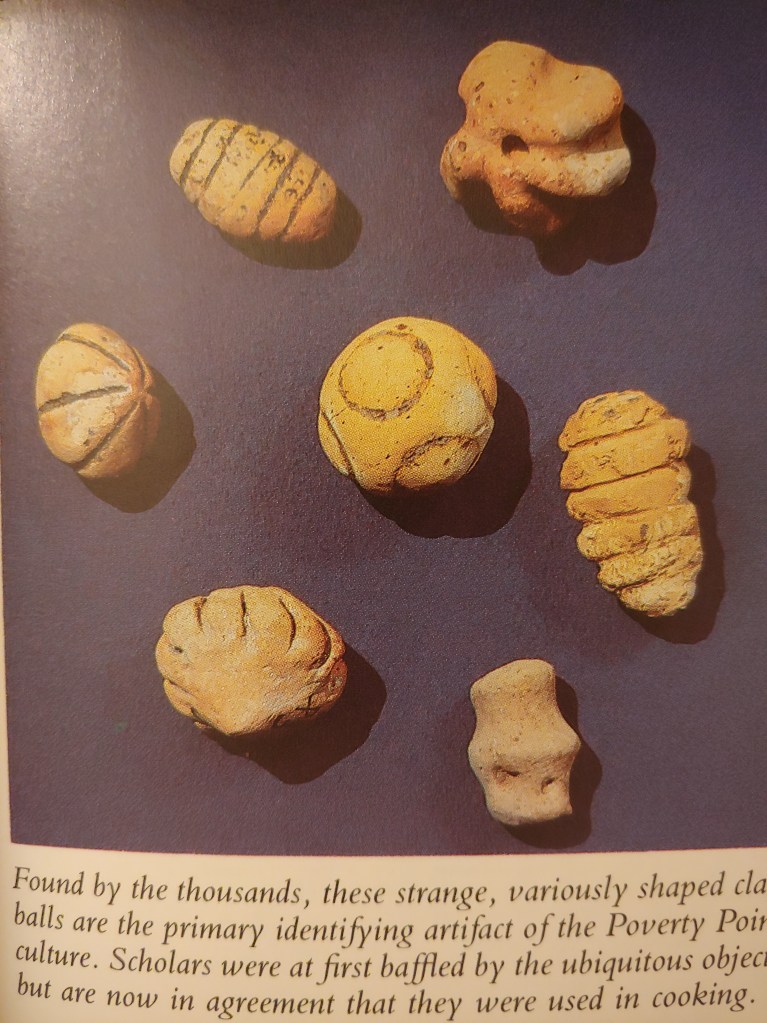
Clay “cooking balls” of the kind used in the Poverty Point culture in what in now Louisiana
Original title: “Cooking with Balls.” I didn’t have the … you know, courage … to go through with that one. But it’s not my fault! “Cooking Balls” is, I promise you, what they are called in the source material.
Although we know little about the Poverty Point people and their extraordinary center on Bayou Macon, we do know a great deal about their cooking habits. The most typical of all the artifacts is — surprisingly enough — a small baked clay ball, only one to two inches in diameter and two to three ounces in weight. The odd-looking balls, most often molded in melon, oblong, cylindrical, spiral, and biconical shapes, were used in cooking. Thousands of them have been unearthed so far. Indeed, so ubiquitous are these tiny finds that they are simply called Poverty Point objects.
The Poverty Point people used them not only more intensively than others [who cooked with heated stones], but also more innovatively, for a new style of cooking: pit-oven baking.
Mysteries of the Ancients Americas, The Reader’s Digest Asscn, Inc., pp. 113 – 114
The Poverty Point people, reconstructers think, would wrap fish, meat, or potatoes in wet leaves, place them on a bed of hot coals, and then cover them with a layer of hot clay balls. You know, they basically made what at camp we used to call a “hobo dinner.” Except we were always eating our hobo dinners half-raw, because we were not as patient as the people at Poverty Point.
In the Out of Babel blog tradition of writing about some ancient practice and then pretending that we are still doing it, I would like to show you my own cooking beads.
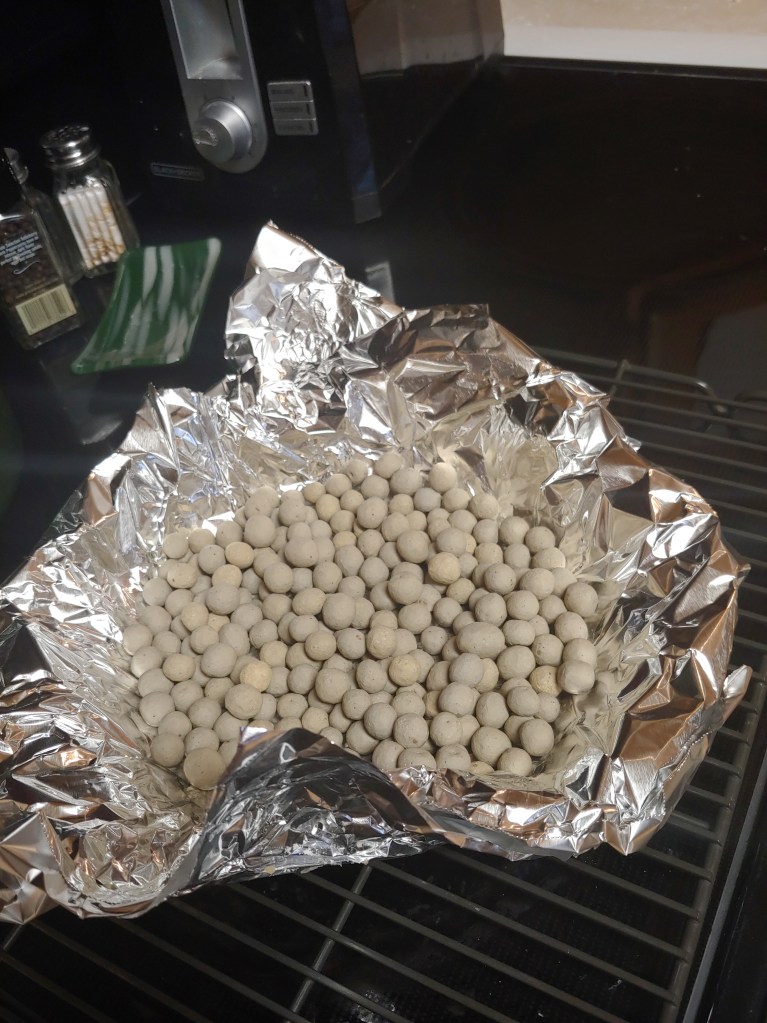
“Cooking balls” of the kind used by the modern mom
Not the greatest lighting on this photograph, but here they are, sitting in a nest of aluminum foil, on my ultramodern, convenient electric stove. The only modern use of clay cooking balls that I am aware of, is to make baked pie crust shells. If you bake the pie crust with nothing in it, it bubbles up, warps, and then it can’t hold the instant pudding later. You have to weight it down with something. You can use just two layers of aluminum foil, but heavier is better. For a while I was using uncooked lentils (per Martha Stewart). They worked OK, but they had a certain legume-y smell when baking and besides, clay cooking balls are so much cooler. I suppose that in a pinch, I could use them for pit cooking. Let’s hope it never comes to that.
According to archaeologists, the Poverty Point cooking balls “could be used about 10 times before they cracked apart.” And yet, they put so much effort into them, making pretty designs and everything! I can imagine that making these little items was a creative outlet as well as a chore. Whereas, my cooking beads are completely plain (and still look like they were a hassle to make in such quantity), and I expect them to last for years. Of course, I don’t use them daily, and certainly not for the two hours it apparently takes to pit-cook food.
The items in this picture come from around the world and from different aesthetic traditions, so it’s surprising that they look so good together. At least, I think they look good. You be the judge.
The prints on the quilt squares come from clothing items actually worn by my husband and me when we lived in Indonesia. Some of them are batik; others are more modern tropical prints. In Indonesia, formal dress for couples goes as follows. The man wears black slacks, a black pillbox type hat called a peci (peh-chee), and a shirt made of a batik print. (Batik can come in many different patterns and color schemes.) The woman wears a long, narrow skirt made of the same batik as her husband’s shirt, and this is topped with a lacy, fitted, tunic-length blouse called a kebaya. The kebaya can be black, white, or in a color that coordinates with the batik.
In a tropical country, you don’t wear your clothes seasonally. You wear them year-round, until they wear out. After several years in Indonesia, I had all these worn-out shirts and pants in unique prints that now had sentimental value. Now we come to the second aesthetic stream: #grandmacore. We happened to be living in a place where there was a sewing room, with a small army of volunteer grandmas who were happy to take on sewing projects to help stressed-out young families who had just landed from overseas or were planning to return there. I brought the batiks to the grandmas and asked whether they could make several small quilts, suitable to hanging on the wall, with them. They did a great job!
Our formula so far goes,
Batik + Grandma
The rest of the stuff on the table is more boring. It was all bought in the U.S.A., and what could be more American than Red Hots in a Mason jar? But put on the batik quilt, it suddenly looks planned.
The orange-and-white ramekin, though boringly bought in an American department store, brings another aesthetic stream into this murky pool. It’s from the collection sold byPioneer Woman, who lives on a ranch in Texas and has monetized her lifestyle with cookbooks, children’s books, and now kitchenware. Most of the kitchenware is colorful and detailed, and would tend to dominate any table it was put on. This ramekin, though a little busy, appeals because the flowers on it look like folk art. And who knew that American-style folk art would play so well with batik? Or maybe it could, because if you look at folk art from around the world, there is a certain similarity.
Batik + Grandma + “Pioneer” + Folk Art = A table I love, and I hope you haven’t hated seeing
In case you’re not picking up that this is self-deprecating humor, this is my version of that popular meme where a bespectacled hipster claims that he or she (or ze) was into some obscure thing long before it became a trend.
I’m not really this big of a jerk in real life. Quite.
But I am half-serious.
Eustacia made a lovely post recently, and it was there that I (for the first time actually) heard the term #cottagecore. Here is a BBC article about it. Since the article is by a major news organization, we can assume that it is late to the trend and gets a few things wrong. Still, this will be my source.
Basically (per the article) “cottagecore” is a visual aesthetic that became popular during the pandemic. It involves pictures of cottages, mushrooms, billowy dresses, rustic picnics, maybe gingham, maybe a gnome here or a fairy there. “It is the equal and opposite reaction to the contamination, helplessness and incoherence of our contemporary mise en scène,” says someone in the article. In other words, it’s sort of the exact opposite of a gritty urban fantasy.
As a lifestyle, cottagecore seems to involve things like gardening, sewing, crafting. Practicing self-sufficiency.
Correction: pretending to practice self-sufficiency.
I love the aesthetic. I do. I also love the idea of living self-sufficient. But it’s not really possible to do that in any thorough way, and if you do, you will be working so hard, and suffering so many privations, that your life will not look like a billowy, gingham-clad escapist fantasy. Hence, I can’t help feeling that anyone who takes this cottagecore thing as more than an interior decorating theme — anyone who tries to pretend it is somehow their lifestyle — is actually a poser. Let’s not fool ourselves, friends. I like mushrooms and sparkles as much as the next person, but they are not going to save us in the apocalypse.
I said as much here. Technically, this post was published before the pandemic started, so before cottagecore became a really big thing on Instagram. However, the article notes that cottagecore (as well as “faeriecore,” “farmcore,” and “grandmacore”) have been around since 2018. So I can’t really pull the hipster I-was-into-it-before-you-were move. Not to mention the Amish. And, you know, real subsistence farmers. They beat me to it a long time ago.
So, we’ve just come through a holiday season, and in the course of the last few months, I have acquired some items that would help me — or you — survive if we were suddenly plopped down in 10,000 BC. It is these that I will share with you today. And by “share with you,” I mean show you pictures. I will not actually give you my swag.
All of these items were gifts to me. (I now have my loved ones trained to give me cave man stuff.) I didn’t buy any of them myself, nor was I sent any of them in exchange for a promotion. Also, outofbabel not be held liable if you should find yourself in a prehistoric situation and these items fail to help you survive. It’s probably a “you” problem.
You Can Talk Good
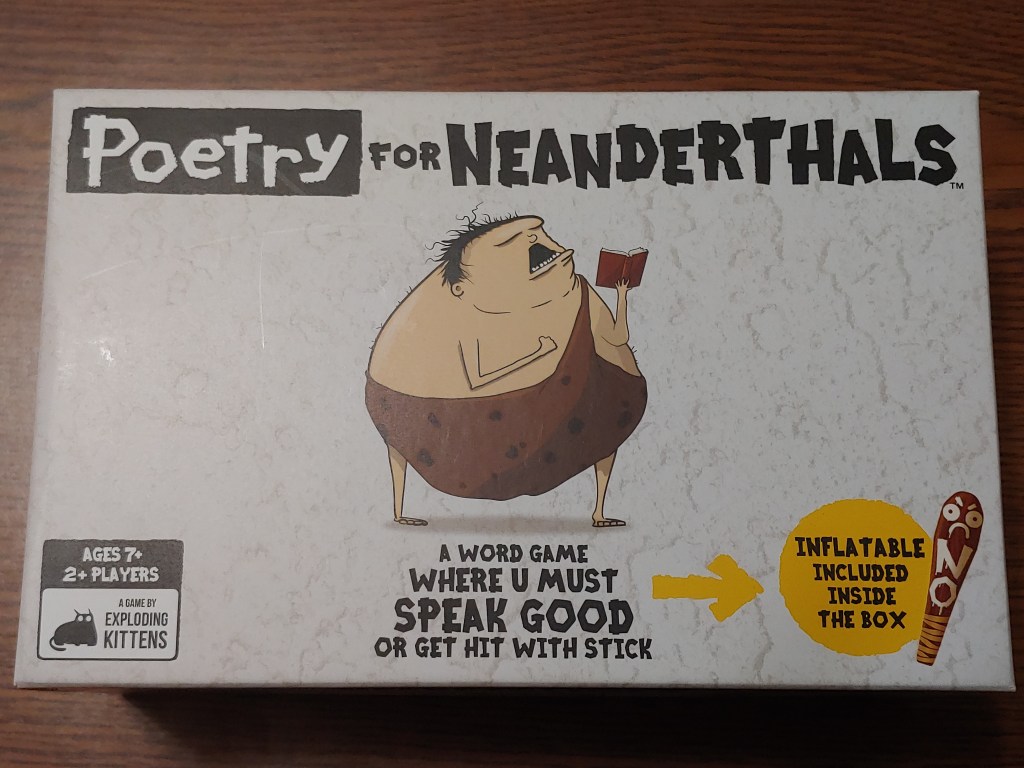
First of all, your most pressing need will be to communicate. This game will help you learn to speak like a Neanderthal. The rules are: words of one syllable only. So, you can say “Angst,” “Eat,” and “Id,” but not “Ego,” “person,” “animal,” or “democracy.”
It comes with a cute little caveman boy who, if you speak a word of more than one syllable, will hit you with the No Stick.
You Can Wear Shoes
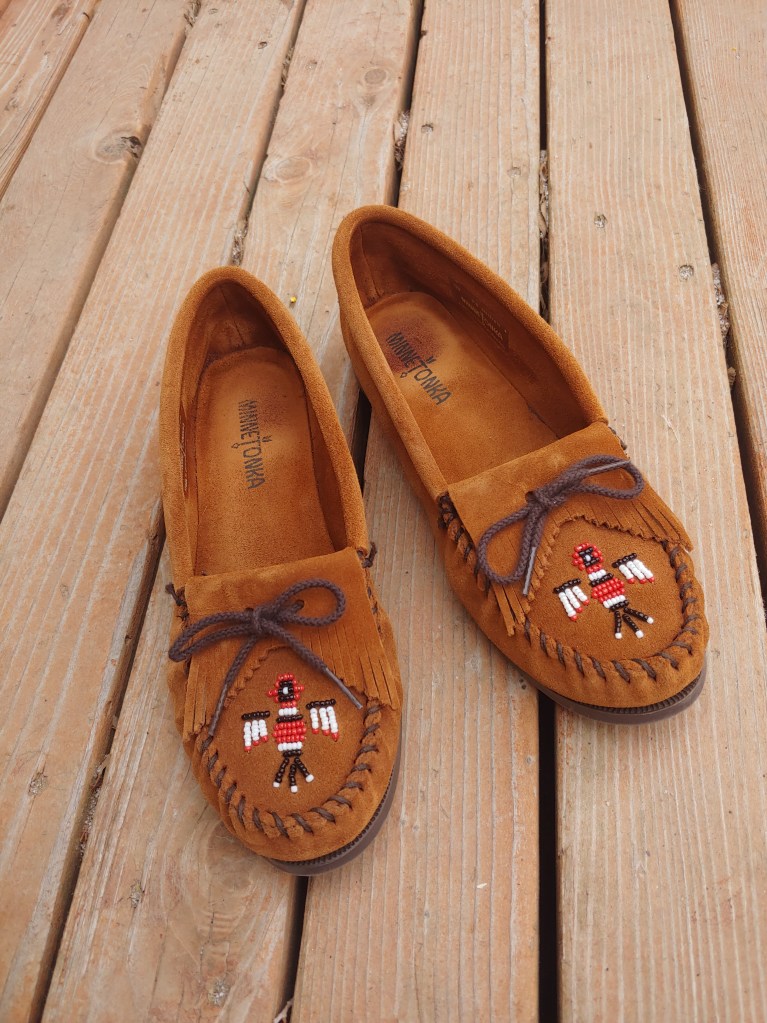
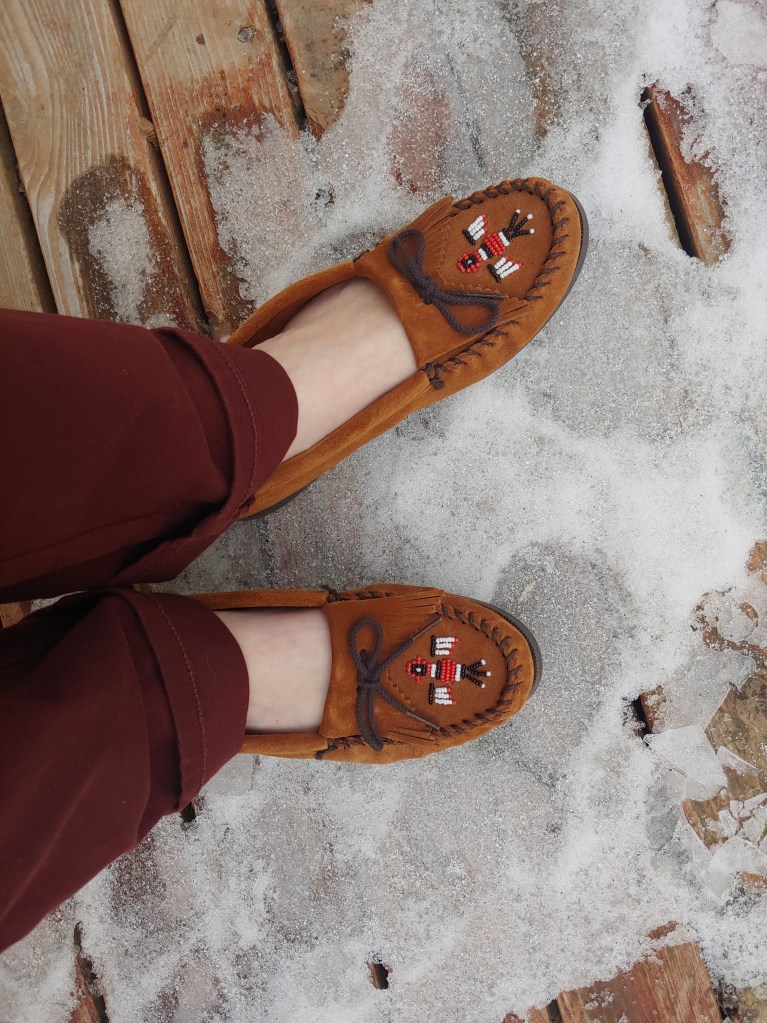
Minnetonka has been making wonderful moccasins for years now. They are modern mocs, suited to our need to be able to walk on pavement; they have rubber soles. Also, for the record, they are NOT as warm as boots on a snowy day!
Here is what they look like on.
You Can Visit Wyoming
This silver ring is supposed to represent the outline of the Tetons near Jackson, Wyoming, which, for the record, exists. It is by far the simplest looking of this gorgeous collection.
There is plenty of evidence that people have had pyrotechnology for many thousands of years.
You Can Drink UP!
Yes, that is exactly what it looks like.
It’s a drinking horn.
The packaging copy says, “GOAT STORY was inspired by the greatest discovery of all time — COFFEE! It was back in the 13th century when a flock of goats stumbled upon a bush of berries that made them go loco! Their obviously bored and adventure-seeking shepherd decided to brew the berries — and thank goats he did! Fast forward to the 21st century: that’s when we kick in. We decided to revolutionize coffee drinking and designed this one-of-a-kind coffee mug you’re holding now.”
I don’t know why we are randomly speaking Spanish (other than that it’s fun), and I’m not cool with the near blasphemy … but other than that, this copy was obviously written by a kindred spirit. I do love the “kick in” pun.
If you were to land unexpectedly in the very ancient world, you would be very very grateful to have with you one last, precious, cup of coffee. This item comes with a longer leather strap (not pictured) so that you can sling the hornful of life-giving liquid across your back and always be prepared lest you stumble upon a time portal.
Check out that carved antler! It is awesome! It reminds me of those amazing mammoth tusks that Chinese artists will spend decades carving into elaborate scenes.
Also, the artist … standing beside a life-sized grizzly that he carved … holding his baby son? I am getting serious The Strange Land vibes here. Oh, wait … most of you haven’t read it yet … soon, soon.
This art is so local that I might be able to visit it in person. If I do, I’ll give you a report.
At the dawn of this new year, I am about to get sentimental on you.
Or am I?
Yesterday, we had a bit of a downer post about the human condition. Today, same topic, but with hope.
The idea of a lost golden age is found in all sorts of cultures, sometimes in some very strange forms. Some cultures and/or religions also add the hope of a future golden age. Of course, you want to watch out for promises of utopia on earth. They usually go wrong quickly and badly. But, the fact that we cannot bring about this future golden age ourselves, does not make the longing for it an illegitimate pursuit. This longing is the universal human recognition that something is wrong with our present world, with our present selves. It expresses the wish for redemption.
So maybe it’s not sentimental to long for a future golden age in which all tears will be dried, even if the song below is a little bit sentimental its instrumentation, coming as it does out of the late 80s/early 90s, when I was a moony teenager. And (*whispers*) I find this song even more moving now than I did as a teen, perhaps because in the intervening years I have seen even more of this broken world.
This semester in Sunday School, my kids have been memorizing John chapter 1. I don’t know if things were planned this way, but the way it has worked out, as we enter the Christmas season, they are memorizing verse 14:
And the Word became flesh and dwelt among us, and we have seen his glory, glory as of the only Son from the Father, full of grace and truth.
John 1:14
John just can’t get over the fact that they saw him.
Whenever I hear this verse, I think of the following song. By the way, all the background music is voices.