
I paid for an honest review of The Strange Land by one of the reviewers over at OnlineBookClub. Reviewers bid to review books in a genre that interests them. I ended up getting E.F. Emmanuel. You can view his review here:

I paid for an honest review of The Strange Land by one of the reviewers over at OnlineBookClub. Reviewers bid to review books in a genre that interests them. I ended up getting E.F. Emmanuel. You can view his review here:
I know this sounds like a book lovers’ blog tag, but actually, this question was asked of me by my reader son. I love that he has reached an age where it’s not uncommon that we will have discussions about books while I chauffeur him to his different activities.
However, feel free to answer it as you would a tag.
I had to think about this one, because I’ve been having emotional reactions to fictional characters probably since before I could read.
I remember weeping buckets over the doomed friendship between Todd and Copper, as experienced by me through the little book accompanied by a 45 record that we had and played on our little record player.

So I guess you could possibly say that Todd was my first fictional crush. I was certainly in love with the woodsy setting as well.
I continued to be drawn to wilderness-dwelling characters who were thin, spry, quick, fey, and solitary. As a little girl, of course, it wasn’t so much that I consciously had a crush on these characters as it was hero worship. I wanted to be them. I remember feeling that way about Peter Pan, and this guy:

At the age of about twelve, I had a thing for Durnik from the Belgariad. He was strong, quiet, capable and practical … everything I wasn’t.

But now we are getting closer to my teenaged years, about which, the less said the better. I’ll give you one more though, which was a literary crush when I was about thirteen: Odysseus. That was the year that I read a simplified version of The Odyssey in school. Odysseus is a beefcake like Durnik (after all, he is the only one who can draw that big bow!), but he’s also clever and quick like my old favorites.
So there you have it.

More from the Scary Book.
America is not lost. It is better to say the United States, as a whole, is lost; the GAE [Global American Empire] has captured it. But parts of America are certainly not lost. Hundreds of counties in the United States have a majority of conservative Christians, as do several states. … [W]e should organize and support Christian political visions for towns, counties, and states. In many places, our success or failure is not a matter of numbers but of whether we have the will for success.
Many claims in this book will worry American conservative Christians. I’ve said that political governments can suppress false religion, establish a church, even require people to attend church. I also wrote about a “Christian prince,” which is not the sort of title one would find in America. I will not walk back these arguments; I affirm my conclusions as good and true principles. But I have demonstrated that Christian nationalism can and should look different in different places, for all principles are applied according to a concrete situation. One application that is righteous in itself is not necessarily suitable for all situations. The means by which a Christian people achieve their good depend on their identity, their experiences, and their way of life.
Ibid, pp. 474 – 475 (Epilogue)

(In case you are not familiar, Shrek was just caught reading the old childhood diary of his now-wife, Fiona. This clip should help you imagine the title of this blog post being delivered in a Scottish accent.)
But, here is the actual book that skeered everybody real bad:

BEHOLD!

And … behold! I have posed it with my scary black nail polish.
In my experience so far, the people who are most alarmed by this book are just reacting to the title. And it is a scary title, because Wolfe is trying to do something that many people try to do, which is take a derogatory term and own it, while of course redefining it somewhat or at least clarifying the definition. In fact, this book is nothing more nor less than one big, extended definition/explanation of what Wolfe means by the term, and what he thinks Christians should mean by it.
Most of the people who reacted to the publication of this book as if their hair were on fire, apparently did not read it, because their definitions of Christian Nationalism are very different and, in many cases, the opposite of the extended definition found in this book. I will demonstrate this with quotations from the book, below.
(To be fair: the other possible problem is that they did try to read it, or else they listened to an interview with Wolfe trying to explain it. I have heard a few such interviews, and I cannot say that Wolfe is the clearest at expressing himself in person. The book, too, is … dry. It sounds like it was written by a lawyer, or a more-than-usually-dry theologian. Combine this with the fact that many of the concepts in this book are entirely foreign to modern Americans, especially those who have not been raised Presbyterian, and I can easily imagine that someone could dip in, get dizzy, and quickly flee … or else fix on a phrase or two and completely misconstrue them. If you want to hear Wolfe’s ideas expressed in a vivid, accessible, and much clearer way, seek out the blog posts of Douglas Wilson.)
But anyway, here are a few of the assumptions people often make when they hear the phrase Christian nationalism, and quotes from the book that show Wolfe’s actual take on the topic:
“Nationalism means imperialism or jingoism“
Several ethnicities can share the same language, of course. But since language is a particular and is necessary for civil fellowship, it follows that at least some particularity is a prerequisite for civil fellowship. Hence, sharing only what is universal — viz., common humanity — is wholly inadequate for a complete social bond. And even a cursory reflection on one’s daily habits and everyday life reveals that more extensive unity in particulars is necessary for living well. We do not, and indeed cannot, live (let alone live well) according to universal rules. Nor can we live well among contrary particulars; there must be a normal to which all conform or assimilate, at least in order for people to live well together. Thus, an instinct for a suitable normal is a good instinct; so too is the moral expectation that people conform to that normal or else face some degree of social separation.
Exclusion [of out-group members] follows not necessarily from maliciousness or from the absence universal benevolence, but from a natural principle of difference that recognizes for oneself and for others the goods provided by similarity and solidarity in that similarity. To exclude an out-group is to recognize a universal good for man — a good made possible only by respecting and conserving difference. Since it is a universal good, you and your people are entitled by nature to a right of difference. This is a natural right, because particularity is necessary to live well according to the nature of man.
pp. 144 – 145
The principle of exclusion does not preclude the reception of foreigners absolutely. Nations ought to be hospitable. At the individual and family levels, hospitality demands generosity to strangers, especially to those in need. A nation, as a sort of corporate person, can and ought to be hospitable as well. But hospitality is subordinate to higher duties: no individual, family, or nation is duty-bound to welcome strangers to the detriment of the good of those most near and bound to it. Furthermore, guests have duties toward their hosts.
p. 167
“Christian nationalism is a code phrase for wanting an all-white America (a.k.a. White Supreme Pizza)“
Nations express Christianity like they express gender through dress — a universal is expressed in a particular way. Christianity perfects the whole not by eliminating earthly particularity, just as any man who comes to Christ does not lose his personality and other unique characteristics. The Christian nation is still a nation as described in the previous chapter, having intergenerational memory and love, degrees and types of loves, and a delight in people and place. Grace sanctifies sinners, but it does homogenize personality; likewise, Christ sanctifies nations but does not eliminate national distinctness.
p. 175
“Christians should not have any loyalty to any particular country or family, because ‘all are one in Christ.'”
Man’s limitedness is expressed in the natural need for a sort of directed gregariousness. That is, he is close at heart with a particular, bounded people, who ground and confirm his way of life in the world and who provide for him his most cherished goods. [Even] Unfallen man is benevolent to all but can only be beneficent (i.e., act for the good of) to some, and this limitation is based not merely in geographic closeness but in shared understanding, expectations, and culture.
Cultural diversity is, therefore, a necessary consequence of human nature, and so it is good for us. It is good that particular practices are made habitual by localized socialization and are “owned” in a sense by a particular place and people. It is good that the particularity of each community distinguishes it from the others. Man’s limitedness was not a divine mistake; neither is cultural diversity, separated geographically, an error. It was God’s design for man and thus a necessary feature of his good.
p. 65
“Christian nationalism” mean getting rid of the First Amendment, and establishing a national church to which every citizen is required to belong.
Althuis states, “Franz Burckhard therefore errs, and the Jesuits with him, who think that the magistrate is not able to tolerate diverse religions.” Burckhard, a Roman Catholic professor at Ingolstadt, is reported to have said, “What more just than to cut off the heads of all these villains of Lutherans!” Burckhard … called for Roman Catholics to rescind the Peace of Passau (1552), which granted religious freedom to Lutherans within the Holy Roman Empire.
This rigid position is natural enough for Roman Catholic theology, which asserted that it is the one true visible church … But in Protestantism the church is essentially invisible and composed of the elect by faith, and belonging to that church is not conditioned on or grounded in one’s outward belonging to a visible, centralized communion. Thus, Protestants of different doctrinal persuasions can mutually recognize their shared faith. This is the basis for principled toleration and religious liberty in Protestant commonwealths. Indeed, the unfolding of Protestant principles — not Enlightenment or Roman Catholic “doctrinal development” — is what led Americans to affirm religious liberty in the 18th century, which I demonstrate in the next chapter. The point here is that a Protestant people have principled flexibility when faced with religious diversity. How a Christian magistrate navigates this complexity requires wisdom, prudence, and resolve.
p.375
The political status of non-Christians in a Christian commonwealth is a matter of prudence. Since civil society is a human institution, it must guarantee equal protection and due process with regard to human things for all people. That is, it must guarantee justice and secure natural rights. But this does not entail equal participation, status, and standing in political, social, and cultural institutions. Thus, they are guaranteed a basic right to life and and property (the absence of which would harm the common good), but they may be denied by law to conduct certain activities that could exploit or harm Christians or the Christian religion.
This position, though fairly standard in the Christian tradition until recently, will be received with controversy today, and few would stomach any legal discrimination on the basis of religion. But even in the absence of legal distinctions, the cultural norms of a Christian nation will require non-Christians to be the exception to the norm.
pp. 392 – 393
“It means that the same person is the leader both of the church and of the country in a civil sense.”
I think that a strictly indirect role for civil leaders in intra-ecclesial affairs is both preferable and most consistent with Protestant principles. There is, I admit, a natural fittingness to Christian nationalism and the [civil leader] as the “head of the Church.” But granting the leader this title would be, in my view, an abuse of power and constitute the usurpation of Christ’s kingship over the church. I offer my reasoning below.
p. 300
It means giving church leaders political power.
God does not (ordinarily) declare by special revelation that this or that person has civil power. Rather, it is “a characteristic property resulting from nature,” writes Suarez. He continues:
‘This [civil power] does not emerge in human nature until men gather in one perfect community and unite politically … Once constituted, this body is at once, and by force of natural reason, the site of this [civil] power.’
The people possess civil power as a necessary and natural consequence of their combination.
One important corollary is that recognizing the true God (or Christ) is unnecessary to possess this power, for having this power is simply a natural consequence of the people’s combination into human society. And they can likewise devolve this power upon those who do not recognize the true God. Hence, true civil authority does not depend on true religion, though certainly in failing to acknowledge the divine source of civil authority, the people and civil ruler are in a perilous situation. It doesn’t bode well for them, but being godless or idolatrous does not itself preclude true political order. Hence, Peter instructs his recipients to “honor the [Roman] emperor.”
pp. 283 – 284
Though we can in principle disobey unjust laws, we should recognize the difficulty in determining whether a law is unjust. It one thing for a law to be unjust and another for you to know that it is unjust. Civil magistrates are necessary, as I’ve said, because of natural epistemic limitations in individuals to determine expedient actions for the common good. … [M]any or perhaps most laws evade a simple evaluation, mainly because civil authorities are typically in a better position than private persons to make judgments about what serves the common good.
Pastors can admonish erring magistrates to correct injustice in the law, but pastors must not mistake their theological training or scriptural knowledge for expertise in jurisprudence. Pastors as pastors are no more competent to analyze or make civil law than any other private person.
p. 274, 275
“People who advocate Christian nationalism think that they can use outer means, such as laws, to compel people to believe.”
Civil power cannot legislate or coerce people into belief; it can only command outward things — to outwardly do this or not do that. No classical Protestant has ever claimed that civil action can itself bring about assent to, let alone true faith in, the Gospel. Though the ultimate purpose of civil action can be the spiritual good of the people, the direct object cannot be the conscience. Spiritual good is a matter of the heart before God in Christ. Thus, civil action for the advancement of the Gospel only indirectly operates to that end.
p.182
As for power over conscience, implicit power can influence beliefs, such as assent to Christian truth, but civil law cannot command belief. It can only direct bodies. It orders outward action. Civil power cannot touch the conscience. Why? Because the conscience is a forum of persuasion and civil power is the power of command. The civil command “believe in Christ” violates a necessary condition of belief, namely, that belief is a matter of persuasion.
p. 253
It means that the entire Mosaic law, including the ceremonial laws, would become the legal code of the land.
[W]hether any civil law is good depends on the circumstances, which requires the discernment of a prudent man. Calvin writes, “[E]ach nation has been left at liberty to enact the laws which it judges as beneficial.” Nothing about this disparages the Mosaic law — a law of God. It is a perfect example of law. But it is not a universal body of law.
Some civil laws in the Mosaic law are universal in a way. But they are universal because they are necessary for any just and commodious human society.
Though not universally suitable, the civil laws of Scripture provide certainty as to their inherent righteousness. They are, therefore, morally permissible in civil law, and the closeness of the circumstances aid in determining whether any of them is suitable.
pp. 267 – 268
We can just have a neutral, secular nation, with no national religion at all.
This “neutral” or “common” space lasted only about twenty years, which shouldn’t surprise us: the most common human arrangements in history for public space are decidedly not neutral. It is a shame that we treated this neutral world as normal and universal.
Experience over the last decades has made evident that there are two options: Christian nationalism or pagan nationalism. The totality of national action will be either Christian, and thus ordered to the complete good, or pagan — ordered to the celebration of degeneracy, child sacrifice (e.g., abortion), mental illness, and idolatry. Neutrality, even if it was real for a time, will never hold, because man by his nature infuses his transcendent concerns into his way of life and into the place of that life. The pagan nationalist rejection of neutrality is correct in principle …
p. 381
For decades, theologians have developed theologies that exclude Christianity from public institutions but require Christians to affirm the language of universal dignity, tolerance, human rights, anti-nationalism, anti-nativism, multiculturalism, social justice, and equality, and they ostracize from their own ranks any Christian who deviates from these social dogmas. They’ve effectively Christianized the modern West’s social creed. The Christian leaders most immersed in the modern West’s [actual] civil religion are those who loudly denounce the “civil religion” of “Christian nationalism.”
p. 5

Three stars.
I picked this up with moderately high hopes. The protagonists are all sixty-year-old ladies who spent their youth as private assassins. I thought there would be more old-lady thoughts, but in the end, they mostly seem like 21-year-olds in 60-year-old bodies. So, the character development and themes disappointed a bit.
What did not disappoint was the research and the plot. Unlike some novels, where the premise is only half-developed, this one takes us on a very thorough ride. We get to see how the ladies got recruited, how they got trained, and to see a number of hits they did in their youth, in exotic locations throughout the world. These interleave with hits they are carrying out now, in their old age, in self-defense. There is not just one but many tense, intricate, detailed climatic action scenes. And it all works together into one big, overarching tale of betrayal. It’s like not just one, but all of the Mission: Impossible movies, in novel form. If this had billed itself just as a thriller, then these factors alone would cause me to give it four or five stars.
But unfortunately, the cover and premise promised not just Thriller, but a study of what it’s like to be a woman of a certain age. Have your goals changed? Do you miss what you were able to do in your youth, or are you content with that and ready to move on to something else? Have you left a legacy? Had any children? Are you ready to go?
No, none of that. One of the four women has married, but the only effect of her recent widowhood is to make her lose her nerve in survival situations. Another has married another woman; another is still chasing younger men at sixty. Meanwhile, the main character, Billie, never married or had children.
He was six years older than me and ready to settle down, build a life, make some babies. And no matter how hard I tried, I couldn’t figure out how to make myself small enough to fit into that picture.
page 309
So, Billie, you think making and raising people is a small life, huh? It is sooo much smaller than your life of traveling around the world killing people. You couldn’t reduce yourself to being a mom.
This quote pretty much encapsulates the book’s shallow yet heavy-handed feminism, and it is the reason I have bumped it down to three stars.

“Jo Marshall, Dashiell Hammett’s only surviving daughter, in 2006 said ‘Yes!’ to a prequel to the The Maltese Falcon. Jo gave me not only her blessings and inspiration but also the idea (and the research) for much of part III of the novel. Vince Emory let me write the introduction to Hammett’s Lost Stories, then shared his vast knowledge of San Francisco and Hammett with me. A history of the coroner’s office from 1850 to 1960 gave me the idea for part II.”
Ten stars. Ten.
This is so well researched and written, so atmospheric. Naturally worked into the story, we find a wealth of details about San Fran in the 20s: how people dressed (including disguises), what they ate, and how much it cost. (They ate well, and for cheap!) There are ferryboats and fishing boats, there are foghorns, there is lots and lots of fog. There are immigrant communities: Greek, “Portugee,” Chinese, and German. Stuff happens that will rip your heart out, and Spade reacts to it in his characteristic hard-boiled way. Twists are many, revenge is sweet. This book covers the years 1921 to 1928.
Ray Kentzler turned to look at Spade. He had a square Germanic head and a pleasant broad-mouthed face with pale, smart, watchful eyes under blond brows.
Spade & Archer: The Prequel to Dashiell Hammett’s The Maltese Falcon, by Joe Gores, p. 112
Sounds like my uncle.
In her silence, Winter’s eye flicked to the gold cross gleaming on her blouse. He began to compose a speech in his head. In the speech, he told Molly Byrne that her husband had had a vision, a drugged vision in the jungles of Brazil. He had seen a god who was both the mind of the universe and somehow his own mind at the same time. In his speech, Winter confessed to her that he did not know anything about God. He did not even know whether or not God existed. But he knew this: if God did exist, He might be many things, but He was not Gerald Byrne. And Gerald Byrne was not God.
He did not make the speech out loud. He didn’t have the nerve.
A Strange Habit of Mind, by Andrew Klavan, p. 205

Here’s what it might look like on their shelf.
Here’s where you can buy it:
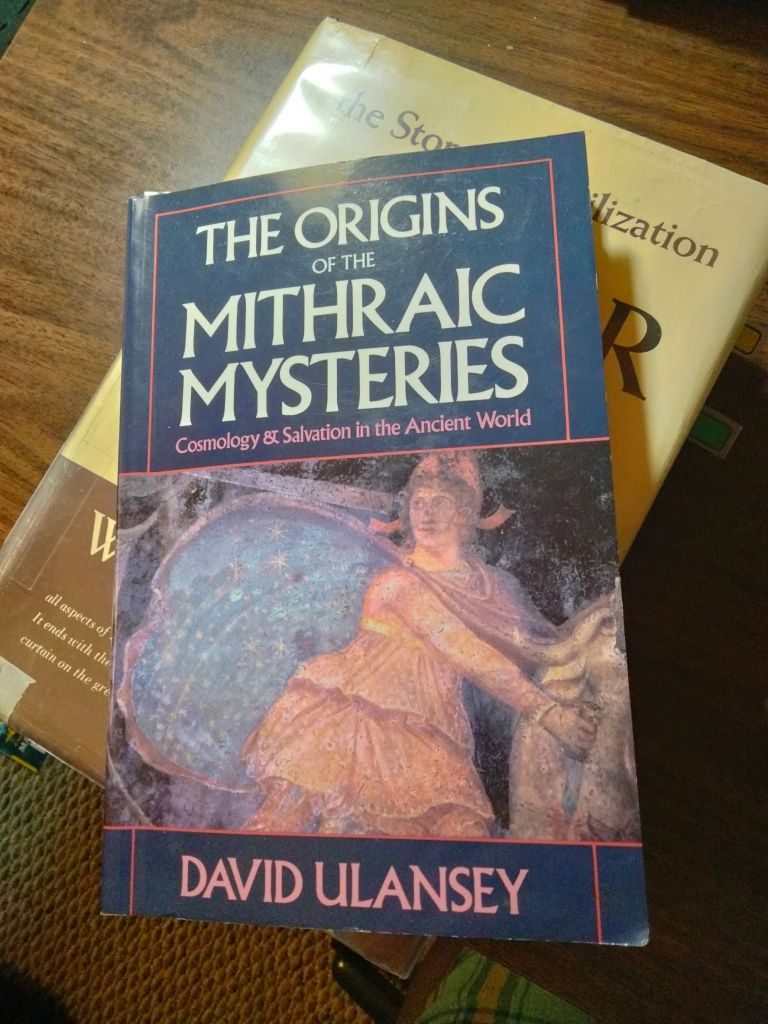
I thought you should know that this book exists.
I don’t even remember where I got it. I have a feeling I got it at a used book store or a library sale, or maybe I stole it from my dad’s library. I know it’s been sitting around my study for a few years, waiting for me to get to it. It was published in 1989.
This is a good, accessible piece of scholarly work that first explains what the cult of Mithros was, then traces the history of scholarly thinking about it, and then advances Ulansey’s theory about what was really behind the cult.
Mithraism began to spread throughout the Roman Empire in the first century C.E., reached its peak in the third century, and finally succumbed to Christianity at the end of the fourth century. At the cult’s height mithraea could be found from one end of the empire to the other, “from the banks of the Black Sea to the mountains of Scotland and to the borders of the great Sahara Desert,” as one authority puts it.
ibid, p. 4
As a result, many of the underground Mithraic temples whose iconography Ulansey shows pictures of are found in Germany or in Italy, although this is a cult that had its origins in Tarsus, in southern Turkey.
For a long time, the accepted theory among scholars was that the god Mithras got his start as the Iranian god Mithra, because they happen to share a name. However, the attributes of Mithras don’t line up very well with those of Mithra, which leaves the door open to other explanations.
The cult was apparently based on a story where Mithras slaughters a bull, and from the bull’s body sprang all the plants that man finds useful, such as wheat, grapes, etc. Because it was a mystery cult, nothing was ever written down about the secret meaning of this story, nor of the levels through which the neophyte progresses as he is initiated deeper and deeper into the mysteries. But in all Mithraic temples, there is consistent iconography. This includes a picture of Mithras slaying the bull, with wheat coming out of the wound. Mithras is typically looking away from the bull (though this is “corrected” in some reconstructions), wearing a distinctive hat which was associated with Persia and with Perseus in the ancient world. Around him are placed other figures which will prove to have significance in unravelling the meaning of the cult. Sometimes, the whole scene is placed under an arch or inside a circle that shows the zodiac. Sometimes, Mithras is also portrayed as standing inside a circle or hoop lined with star symbols.
In unfolding his theory, Ulansey takes us on a fascinating tour of the ancient world. For example, he spends a lot of time establishing how and why Mithras came to be associated with (based on?) Perseus, who was the founder and hero of the city of Tarsus and, in fact, the local god of that whole region. (Mithras’ hat — a “Phrygian cap” — was originally worn by Perseus, and Ulansey contends that he looks away from the bull as he slaughters it because Perseus looked away from Medusa as he slaughtered her.) He gets into the fact that the cult may have originated with pirates of Cicilia, which lies just off the coast from Tarsus:
[T]he Cicilian pirates were far more than a mere band of thieves. Rather, the pirates, who numbered at least twenty thousand, formed what amounted to a small nation which at its height controlled the entire Mediterranean Sea.
ibid, p. 88
Ulansey then quotes Plutarch from Life of Pompey:
“The power of the pirates had its seat in Cicilia at first … then, while the Romans were embroiled in civil wars, the sea was left unguarded … until they no longer attacked navigators only, but also laid waste islands and maritime cities … There were also fortified roadsteads and signal-stations for piratical craft in many places … more annoying than the fear [the pirate fleets] inspired was the odious extravagance of their equipment, with their gilded sails, and purple awnings, and silvered oars … For you see, the ships of the pirates numbered more than a thousand, and the cities captured by them four hundred … Presently men whose wealth gave them power, and those whose lineage was illustrious, and those who laid claim to superior intelligence, began to embark on piratical craft and share their enterprises.”
ibid, p. 88
There are plenty of other fascinating historical nooks in this edifice, such as the figure of a lion-headed man, entwined by a snake, standing on a sphere; the idea of Mithras being born out of the rock; the exact nature of the Gorgon, and many, many others. Every single one makes sense when it comes up in context. That said, there were certainly some bizarre ideas floating around in the ancient world.
So, to get right down to it, Ulansey’s case is that the Mithraic mysteries were a way of encoding astronomical knowledge. Because this is the ancient world we are talking about, this knowledge could equally be considered scientific, cosmological, and religious, as will become clear shortly.
Lately, I’ve been studying the zodiac in a desultory fashion. Don’t worry, I am not planning to take up astrology. Astrology is specifically forbidden to faithful Jews, and to children-of-Abraham-by-faith like myself. But it is of interest to me, because it was so important to the people of the ancient world. They worked it into their monuments and their mythology. The signs of the zodiac, and other constellations, were associated with the gods, and a good case could be made that this association started in pre-Flood days.
The other thing that fascinates me about the zodiac is that it’s so hard to observe. Now that I keep chickens and also work outside the home, I’ve been obliged to get up before dawn to let the chickens out. I live in a rural area with relatively dry weather, so you’d think it would be easy for me to take a quick glance at the horizon while I’m out there, and be able to tell which constellation is in the east, right where the sun is going to rise in an hour or two. As it turns out, it’s not so easy as all that. You not only have to know which direction is due east, you also have to have something that helps you sight where the sun is going to rise … and it moves. Then you have to be able to recognize the constellations. To really figure out the whole zodiac, you’d have to be making these observations daily, throughout all the seasons of the year, until you noticed that the constellations of the zodiac make a notional belt around the earth, and that at different times of year, they take turns “housing” the sunrise. This is already difficult enough that you’d have to have a pretty strong motivation to pursue it. (Stronger than mine is right now.) Ancient people thought this was so worthwhile that they managed to master the very difficult science of astronomy. Many ancient monuments, in fact, were built as observatories, from Stonehenge to many structures in the Americas.
Why were they so motivated to study the stars? That’s a discussion for another time.
According to Ulansey, the Mithraic iconography (and probably the whole cult) was designed to encode the secret of Equinoctal Precession. This is a really complicated phenomenon, so if you don’t know what it is, I’ll let you look it up. Basically, because of an irregularity in the earth’s rotation, the zodiac sign that “houses” the sunrise on the equinox will stay the same for 2,160 years, by which time the sunrise has migrated back to the previous zodiacal sign (hence, precession). (Also, incidentally, Polaris has not always been the the pole star.) Precession has been discovered at different times in the past by different civilizations. Graham Hancock makes a pretty good case that it was known by somebody, before conventional history began. But due to the difficulty of observing it, it has not been known at all times by all peoples. Around the time that the cult of Mithras apparently started, it had recently been discovered, and begun to be talked about, in the vicinity of Tarsus, in the same intellectual circles that were also providing aristocratic pirates.
Now, to you and me, equinoctal precession might fall into the category of “Oh, that’s interesting.” Not so for the ancients. For one thing, this cult probably started among pirates, who use the stars to navigate. The idea that the stars were once different and are not the same all the time would be earth-shattering to them. But this news gets even more ominous when we understand ancient cosmology.
(And when I say “ancient” here, I am talking about the cultures of the Mediterranean, Ancient Near East, and parts of Europe. Though, not to keep mentioning Graham Hancock, but in his book Fingerprints of the Gods he finds similar cosmology in ancient India, Central America, and Scandanavia. So a case could be made that this cosmology was once worldwide.)
This ancient cosmology, then, conceived of the heavens as a huge machine, constructed of two or more intersecting hoops (the zodiac, the celestial equator, and, essentially, the prime meridian/international date line projected into the sky). Sometimes the heavenly machinery is portrayed more as a big edifice with four pillars supporting it. Sometimes it’s a “mill” that turns. Probably some ancient people took this more literally than others; some understood it was notional, but represented something real.
Now, imagine that you think of the universe as a big, finely tuned machine, where the constellations always end up in the place they are supposed to be. If the whole hoop has moved out of its place, this could be conceived of as “breaking” the machine. This is why cycles of a certain number of years (not everyone got the precessional intervals right) were thought to bring cataclysms upon the world. So, we get myths worldwide about a mill being broken, and this causing the stars to fall from their places, the sky to become dark, fire and floods to sweep over the earth, etc. Again, read Hancock to find out more about this than you ever wanted to know.
But the point is, whether the Cicilian pirates thought that precession caused a cataclysm, or whether it just meant the universe was less stable than they had imagined, this would have been a revolution in their scientific, cosmological, and religious thought. (Religious because, in ancient times, science and cosmology and religion were really all a part of one system, especially when you consider that the stars and other heavenly bodies were thought to metaphysically influence events on earth.) So, whether you count it as belonging to three, two, or just one unified field of knowledge, this was a big enough discovery to be kept secret (a “mystery”) and passed on to initiates in a whole new cult religion.

