Book Review: The Mind of the Maker, by Dorothy Sayers

Photo by Ylanite Koppens on Pexels.com

Dorothy Sayers (1893 – 1957) was the author of the Lord Peter mystery series, numerous plays, and a translation of the Divine Comedy. She was part of the Christian literary flowering in the early 1900s which also encompassed T.S. Eliot, Charles Williams, J.R.R. Tolkien and C.S. Lewis. “She explored by-ways of knowledge, delighted in puzzles and enjoyed many a fight which she conducted with wit and good humour. Her formidable presence, magnificent brain and logical presentation put her in great demand as a lecturer.” (About Dorothy Sayers)

Me and Ms. Sayers

This particular book, The Mind of the Maker, turns out to have a personal history for me. I’ve been vaguely aware of it for years as a book “I really should read some time.” I first remember hearing it recommended by C.S. Lewis in one of his short apologetics books, where in the process of pointing out that any thinking about nonphysical things will necessarily be metaphorical, and that this does not mean that the thinker is taking the metaphor literally, he remarks that “anyone who wishes to think clearly about this topic must read The Mind of the Maker by Dorothy Sayers.”

My dad has a large personal library, and last year, while I was poking around in it looking to borrow some other book(s), I came upon TMoTM, and borrowed that one too. And lo and behold! According to the inscription on the inside cover, this very book was actually given to me by my dad, almost 30 years ago. Even back then he knew I was a creative writer, though at the time I was a very immature and inexperienced creative writer, and was apparently not ready for Sayers. I don’t know how TMoTM made it back into his library. Perhaps I left it there when I went off to university, or when I went to move overseas. Anway, now, after having done some living and some creating, I am ready for this magnificent work of Sayers’, and what a sweet reunion it has been.

I should mention that I have also read many of Sayers’ Lord Peter mysteries, which is helpful because she uses them as illustrations sometimes in The Mind of the Maker. I have not read her translation of The Divine Comedy.

A Must-Read for Artists

The first thing to know about this book is that it’s delightfully readable. Sayers was, after all, a good writer, and she had worked for some years in advertising. This book is full of bon mots, terrific quotes, and so forth, and in fact I plan to post quotes from it for a long time on the Thursday quotation post on Out of Babel. So, although the subject matter might seem kind of abstract, the book is not difficult to read or understand. If you want to read it, don’t be afraid: go ahead and read it. Ms. Sayers will not allow you to get lost or even bored.

The thesis of this book is easy to summarize, but hard to believe until you’ve seen it fleshed out. Ms. Sayers, an Anglican, asserts that we can understand the Mind of the Maker (i.e. God) by looking at the dynamics of the creative process in the minds of lesser makers (people, specifically creative artists). God is, after all, the ultimate creative artist. She talks about “the artist” a lot, but inevitably most of her examples are drawn from the art forms she knew best: novels and plays. Her insights about the creative process were instantly recognizable to this novelist.

Diving a little deeper, she maintains that we can understand the orthodox Christian doctrine of the Trinity (yes, the Trinity) by looking at the dynamics of how an artist produces his or her work. The work itself, she says, is present in what you might call three persons. There is what she calls the Idea, which is the work as a whole, as author first envisions it when she “sees the end from the beginning.” Then there is the physical manifestation of the work (its incarnation, as it were), which is the only means by which any other person can know it. This is the physical book or play; and, in the case of a play, the stage, actors, costumes, etc. … the whole event. The process of converting the Idea into this physical form is hard work, and the artist carries it out by means of what Sayers calls Energy or Activity. Finally, there is the work as an experience that the reader or theater goer has as they read or hear the story. This too is the piece of art itself, and this Sayers calls the Power. Each of these states of the play or novel, Idea, Energy, and Power, can be legitimately said to be the entire play or novel, not just a part of it. Yet they can be distinguished from each other. All three have to be present if the reader is to have an experience of the novel, or the audience an experience of the play. In the Trinity, the Idea corresponds to the Father, the Energy to the Son or the Word, and the Power to the Holy Spirit.

I hope this does not sound blasphemous. As we read through the book, it is striking how well the dynamics of bringing a work of creative art into being parallel the doctrines of the Trinity, and help us to understand them. Sayers would say, of course, that this is no coincidence. It is because people are indeed made in the image of God, and when we engage in creative work, there is something in our structure that parallels His structure as a Maker.

There is, as you might expect, an interesting discussion of the process of the author creating characters that in some sense exist independently of herself, and how this relates to human free will.

Even if you are not interested in the Trinity, I recommend this book to any writer who wants to read the insights of another writer who is intimately familiar with reading and writing literature, including the dynamics of plotting and pantsing, and of being asked if your characters’ tastes and opinions are the same as your own and why you can’t “make X character do Y.” There are also some delightful examples of bad writing that Ms. Sayers quotes as she illustrates different ways in which the creative process can break down. I don’t know how relatable this book may be to artists in different media, such as music or visual arts, but I would encourage them to check it out as well.

The Five Points of Calvinism Book Tag

Photo by Aaron Burden on Pexels.com

Back in 2017 (or, you might say, in “eternity past”), Bookstooge put up a request for a “serious” book tag. At that time, I did not even know that Bookstooge existed (hard as that is to imagine). But in the providence of God, I stumbled upon that forlorn request recently, and this is the result.

The Five Points of Calvinism

These five points are not all of Christian theology, or even all of Reformed theology. There is a lot more to it, and it’s all good stuff. These five topics are simply things that Jacob Arminius and his followers disputed in the early 1600s, after the Reformation was well under way and John Calvin had been writing for some time. All of this caused a huge kerfuffle in the Dutch Reformed churches, and eventually, in 1619, the Synod of Dort adopted the Canons of Dort which answered the Arminians’ objections point by point. So, though these five points are not the whole of Reformed theology, they do represent some of the doctrines that people are most likely to have issues with, as demonstrated by Arminius, his followers, and in fact most people down to this day.

Due to their Dutch character, the five points, if put in terms that are somewhat misleading, can be shoehorned into the acrostic TULIP:

T – Total Depravity

U – Unconditional Election

L – Limited Atonement

I – Irresistible Grace

P – Perseverance of the Saints

Because this is a tag, I’m not going to parse or defend these points deeply. I’ll just explain each one in a short paragraph, then apply it to a book tag purpose. Since these things deal with the nature of man and God, they turn out to be fruitful for reminding us of our literary experiences.

T – Total Depravity

Arminius taught that people are free in their will to choose God or reject him. The doctrine of total depravity (or “sin nature”) holds instead that people, if left to themselves, are spiritually dead and will never voluntarily seek God. (Dead people cannot choose things.)

Name a book or a series that you appreciate for its jaundiced or realistic portrayal of human nature.

U – Unconditional Election

Election means that God chooses to draw some people to Himself, making alive their hearts so that they are then able to seek, hear, and trust in Him. Arminians taught that God elects people for salvation in this way on the basis of some quality in them, such as humility, faith, “responding to the light they have,” etc. The doctrine of unconditional election holds that God does not choose people because they are better than other people. He chooses them just because He wants to.

Name a book where someone chooses someone else unconditionally.

L – Limited Atonement

The most confusing of the five points as far as I am concerned, Limited Atonement means that Christ’s death was actually just for “his people” – those God chose to elect – not for everyone generally. If it were for everyone generally, and some people rejected salvation, that would mean that God’s work in salvation was ineffective in some cases, which would throw the determining factor back onto the individual.

This point is confusing for two reasons: 1) Since we don’t know who is going to be saved, we are commanded to proclaim the good news to everyone as if they were all elect. 2) We know that the number of those who believe will be a very great number, enough that Christ can be said to have saved “the whole world.” So, “limited” does not mean a small number of people.

This is one of those fine distinctions that is kind of hard to squeeze down into a two-word phrase, which then fits into a flower acrostic.

Name a book that has a complex, confusing, or seemingly unworkable philosophy behind its worldbuilding.

I – Irresistible Grace

When God chooses someone, He works on their heart, giving them a new heart with a will that is now able to choose Him. This also frees their mind to be able to hear and understand His word (since, as we know, our intellect is embarrassingly tied up with our will). When this happens, they freely choose Him, now that their will has been freed from the sin that bound it. It is never the case that God gives someone a new heart, and they then reject Him. His grace is irresistible.

What book did you find irresistible?

P – Perseverance of the Saints

This doctrine means that once someone has been regenerated, heard God’s word, and begun to believe, they will not ultimately, or permanently, fall away. You cannot “lose your salvation.” This is a very comforting doctrine, for without it, we tend to panic every time we fall into sin (or have some previously unnoticed sin revealed to us that, unfortunately, has been with us all along).

Name one of your favorite redemption arcs in a book or movie.

Go and Read Some More!

I tag Bookstooge (hope this is serious enough for you, Booksty!), and Colin cause I know he digs Reformed theology. Anyone else can do it if they want to.

When Christmas Comes: A Book Review

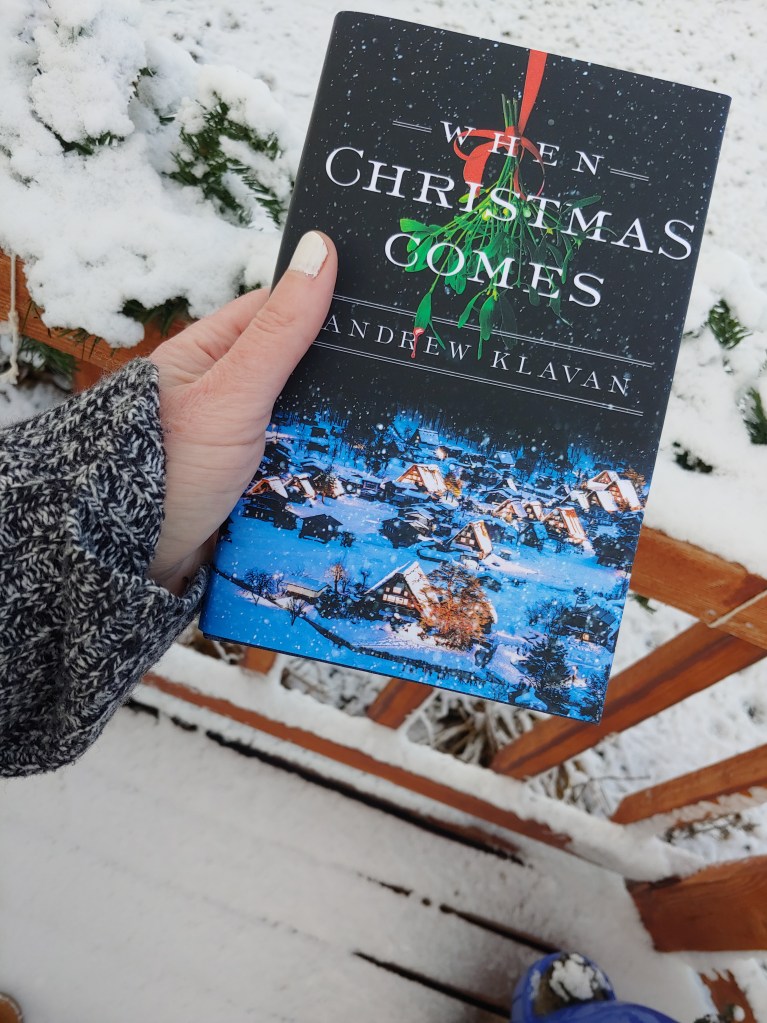
Andrew Klavan brought this novel out in time for Christmas. I got it for a loved one, and of course I had to pre-read it.

The first thing I noticed was the texture. The jacket, and the book cover beneath it, both have a unique velvety feel that makes you want to pet them. I refrained from petting, and in fact tried to touch the book as little as possible. It is supposed to be a gift, after all.

On to the contents.

This is not the best Andrew Klavan novel I’ve read, but it is still very professional … and very Christmassy.

Klavan introduces a new sleuth, Cameron Winter: handsome, lonely, etc., etc., with a tragic back story that is only partly revealed in this book. Winter is a former (spy?), now an English Lit professor. Is Klavan trying to push the buttons on the female reading population or what? On the plus side, it does allow him to put in as many literary references as he wants, without straining credibility. I also learned some new words, like “homunculus.”

I get the impression Klavan is planning to turn out a Winter series. Also, I might have heard him hint at something like this on air. He’s said that he never before invented a sleuth who seemed to have enough depth to carry a series, but now he thinks he has one.

Of course, Winter’s name makes for many thematic puns in this volume. It was a little hard for me to relate to Winter (too perfect?). He does have that intuitive, beneath-the-surface-of-the-mind method of solving crimes that I love because it’s similar to my own thought processes, and that some of Klavan’s other sleuths have also had. But it’s hard to believe of him, because the rest of him seems too Tortured Golden Boy. For example, one of Klavan’s other sleuths who had this intuitive method was a portly, aging, kindhearted private detective with vices. Lots and lots of vices. His shambling presence made his intuitive methods seem more believable, and also made his sharp mind gleam out like a bright jewel in a dark setting. Not so with Winter. But perhaps Winter will grow on me as the series progresses. Yes, I will give him at least one more book to do so. 

I also think that I figured out the setting for this book! Sweet Haven is a little town surrounded by wooded hills, set near a large lake. It is within driving distance of the Big City, which is ALSO set near a large lake … which is, in turn, within driving distance of “the capitol,” which is where the university is where Winter teaches English Lit. At one point, Winter goes to Chicago, so Chicago must be sort of nearby but can’t be the Big City. Throughout the book, the skies are dull and grey, the temps are low, and there is plenty of snow, so we’re probably not in the South.

So, after getting about a quarter of the way through the book, I decided that it is set in Michigan. I think the Big City is Detroit. I pictured Sweet Haven set some way up the coast from Detroit, on the shores of Lake Huron. That would make the capitol Lansing. So naturally I assumed that Winter is a professor at MSU, and the MSU campus is where I pictured him going, including having the awesome fight scene in his tiny on-campus office. Setting this book in Michigan, and especially at MSU, will make it even more of a personal gift for its intended recipient.

Excerpt from a Rabbit Myth

(Frith = the sun, whom the rabbits identify as the creator

El-ahrairah = the father of all rabbits)

So Frith said, “Then come out of that hole and I will bless you.”

“No, I cannot,” said El-ahrairah, “I am busy. The fox and the weasel are coming. If you want to bless me you can bless my bottom, for it is sticking out of the hole.”

Then Frith felt himself in friendship with El-ahrairah, who would not give up even when he thought the fox and the weasel were coming. And he said, “Very well, I will bless your bottom as it sticks out of the hole. Bottom, be strength and warning and speed forever and save the life of your master. Be it so!”

And as he spoke, El-ahrairah’s tail grew shining white and flashed like a star: and his back legs grew long and powerful and he thumped the hillside until the very beetles fell off the grass stems. He came out of the hole and tore across the hill faster than any creature in the world. And Frith called after him,

“El-ahrairah, your people cannot rule the world, for I will not have it so. All the world will be your enemy, Prince with a Thousand Enemies, and whenever they catch you, they will kill you. But first they must catch you, digger, listener, runner, prince with the swift warning. Be cunning and full of tricks and your people shall never be destroyed.”

Watership Down, by Richard Adams, pp. 36 – 37

Cortes and the Aztec Conquest

Photo by NEOSiAM 2020 on Pexels.com

by Irwin R. Blacker, 1965. A book review.

I picked this book up from our local library. “Oh, I only know the outlines of this period of history. I need to know more.” Then I let it sit around for several weeks. As a history book, it is probably boring, right?

Wrong.

Honestly, I would not put any of this stuff in a novel, because no one would believe it. In the first few chapters, at least once per chapter there was an “I can’t believe that just happened” moment. In the second half of the book, there is such a moment every one or two pages.

This book doesn’t pick heroes or villains. It’s a fairly simple, straightforward account of what happened, from Cortez sailing from Cuba, until the fall of Tenochtitlan. Also, perhaps because this book was published in 1965, it does not go in for the excessively dry, boring writing that academic history sometimes strives for. The writing is matter-of-fact, not sensationalist, and moves along quickly.

History is Full of Surprises

I went in to this with certain pre-conceptions. The general impression I had received from my previous exposure to this topic was that Cortez was awful, and the Aztecs were awful, and they deserved each other. I expected to read a story populated by a bunch of scoundrels, and that was what I got. However, as the book progressed I found myself more and more sympathizing with Cortez, because he is the underdog for literally the entire book. (The harsh ruling and enslaving the Indians stuff came later.) In every battle (not just with the Aztecs, but with the Tabascans, and then the Tlaxcalans), he is outnumbered tens of thousands to hundreds. Many of the I can’t believe this moments were caused by How did the Spaniards not die? and by watching Indian lords and generals snatch defeat from the jaws of victory.

Here are a few of the things that surprised me, and might surprise you too:

  • Though the Spaniards had a very early version of a gun (the harquebus), a few light cannon designed for ships, and a handful of horses, these things did not allow them to just roll in and conquer Mexico through overwhelming force of technology. They had only about 16 guns and horses, and about the same number of cannons. The horses were surprising at first to the Indians, but they did lose their shock value. The horses and cannons were difficult to transport through the swamps and mountains, and in every battle, as I said, the Spaniards were outnumbered about 100 to 1. The Mexican armor, which was made of padded and starched cotton, was almost as effective as the Spanish armor, and much lighter and cooler. The Aztecs and the other groups were experienced, hardened warriors.
  • With literally every people group Cortez encountered (whether they were allied with Montezuma or not), Cortez initially tried to parley and trade, and they insisted on going to battle. This is not to say that Cortez was there only to trade, merely that this, his opening move, never got past the first step. As he progresses through Mexico toward Tenochtitlan, we see him again and again forced into battles. Finally, after he defeats the very persistent Tlaxcalan Indians, they ask him to ally with them against Montezuma.
  • As per human nature, both sides were internally divided. The Tlaxcalan army, which had been holding out for years against Montezuma, lost to Cortez because their military captains would not co-operate with each other. Cortez, meanwhile, had left on his expedition without the approval of Velasquez, the governor of Cuba. He had some of Velasquez’s relatives in his fighting force, and had to worry about them fomenting mutiny. At one point, he had to leave Tenochtitlan and go fight a battle against an army representing Velasquez that had landed on the coast. With constantly shifting alliances among both the Spaniards and the Indians, this book read like a spy novel.
  • Cortez did not immediately attack Tenochtitlan, Montezuma’s capital city. He first approached as a visitor, and there was a weird period of several weeks when the Spaniards stayed there as guests? Or prisoners? Montezuma, for his part, was divided in his mind. He was not as confident in his role as priest as he had been in his youth, as a warrior. He wasn’t sure what his gods wanted him to do. Thus, he kept giving Cortez evasive answers, but also ended up giving Cortez much more leeway than he should have. He missed many good opportunities to have the Spaniard killed.
  • The great city of Tenochtitlan makes an amazingly interesting setting for a battle. It was built out over the middle of a shallow, salt lake (deep enough to drown in, however), and was approached from other lakeside cities by four long causeways, each of which had bridges that could be taken up, leaving wide gaps that were impassable for an attacking or fleeing force. These tiled causeways were also slippery and disorienting for horses, and anyone caught on them could be attacked by war canoes. Inside the city, the sections were divided by canals which could also be used to seal off the different sections of the city. There were high rooftops, leading up to the temple at the top, from which defenders could spot approaching or fleeing attackers, rain down missiles, and sound the alarm with conch shells and drums.
  • When the Spaniards finally did destroy Tenochtitlan, it was their Tlaxcalan allies who wanted to commit atrocities on the civilians there. “The Spaniards were too few to control their allies” (page 142).
  • Cortez was accompanied throughout by a young woman whom the Spaniards called Dona Marina. “She was a young, highly intelligent princess who had been sold into slavery by her parents” (page 34) and given to Cortez by the Tabascans after he defeated them. Dona Marina spoke both coastal Mayan and Nahuatl (the Aztec language), and she served as an interpreter. Amazingly, Dona Marina survived the entire conquest.

A True First-Contact Story

For me, the overall impression is that what we have here is the meeting of an Ancient Near Eastern style culture, with city-states, bureaucracies, temples, human sacrifice, and a tyrannical priest-king, with a late medieval/early exploration-age Western European culture. This could not be a purer first contact story if Cortez had gotten hold of a time machine and attempted to loot Babylon.

I would recommend this book to anyone who is interested in military history.

NW Reads a How-To Book

This book, the first in the Crossroads trilogy, takes place 850,000 years ago. I read it because it’s in my genre (sort of), and we indie authors writing about super-ancient times gotta stick together.

In my persona as a cave woman, I was hoping to pick up some tips on raw survival. One main strategy employed by Xhosa’s tribe seems to be Running Away. Me approve, as I am a master at this and so are the characters in my own books.

In Survival of the Fittest, Xhosa and her tribe travel from somewhere in the interior of Africa, north, crossing the Great Rift Valley and then (I think?) the Red Sea, or whatever that used to be 848,000 years ago. Once in the Levant (the Arabian Peninsula? Or did such exist back then?), they meet up with another tribe that is already successfully living there, plus a pair of young misfits, accompanied by their pet wolf, who have come all the way from what is now China.

The book moves fast, covering a lot of territory, both literally and metaphorically. It never really took off for me. There were lots of different episodes, each of which could easily have been its own book. The narrative moved back and forth between different groups quite a bit. With Big Idea novels like this one (and like my own books), the reader has to be at least intrigued by the theory of history that the author is exploring, so perhaps my problem was that this element was missing for me.

Another thing that harmed the verisimilitude for me was what appeared to be inconsistencies in the language. On the one hand, the characters don’t have enough abstract thought to count other than saying, “One, another, another …” On the other hand, they can describe to one another things that the hearer has never seen, such as the sea. They call the Cro-Magnon people Big Heads (which seems fair enough), but occasionally they will talk about things using modern terms, like Lucy (yes, the Lucy) or “tsunami,” which seems like an anachronism to this linguist. To be fair, any time we are writing about people in an ancient time, we are writing in translation, so the modern writer has to decide when to use a “free translation” (using words that modern readers will recognize) and when to use more literal glosses on the characters’ vocabulary, which gives a more atmospheric feel but is also harder for the reader to understand.

However, the author does lay some land mines that I presume will be stepped on in the next book, notably the obvious danger posed by Xhosa’s ambitious head warrior, Nightshade. If you believe that people evolved about a million years ago, started out not wearing clothes or counting past one, and you’re fascinated by what life might have been like during that time, then this series is for you.

There are lot of notes about terminology and the different humanoid groups at the beginning, which were helpful, but one thing I really, really wanted was a map. I tried to picture the characters’ routes, and I was checking modern maps of Africa, but realizing that the land has probably changed a lot since the time this book is set. I wanted to know exactly where they crossed the Great Rift Valley (which is pretty large, after all); what body of water they were crossing; and exactly where in the Levant they ended up. If there had been a map at the beginning of the book, I would have been flipping back and forth to that puppy every few pages, and perhaps would have been more engrossed in the story.

The Dia de los Muertos Book Tag

Jyvur Entropy created this tag with Anna Book Critter, and I got it off Jyvur’s blog.

For a tag, you are given a series of prompts around a particular theme, and you answer the prompts, usually with the names of books you’ve read.

Para que lo sepas, I had to restrain myself from naming one of my own books for almost every one of these prompts. After all, the Scattering Trilogy is multigenerational; life-affirming; about rebirth; includes a fair amount of food, etc. Anyway, that’s en mi opinion. But I will do this tag like a normal person and name books by other people.

Photo by Chait Goli on Pexels.com

The Day of the Dead is all about remembering and honoring past generations.

Name a book with an intergenerational cast or a strong focus on family.

Pavilion of Women, by Pearl Buck. Buck is a master at sliding seamlessly through time in her stories. In the opening scene, Madame Wu is sitting in her chamber on the morning of her fortieth birthday. Her maidservant comes in to comb her hair, and suddenly we are in this same bedroom twenty-four years ago, on the morning after Madam Wu married Mr. Wu, and the same maidservant has come in, and she is nervous as a cat around her new mistress, because she knows that she just had sex for the first time. Now, twenty-four years later again, the servant is much more at ease with Madam Wu, but she does not know that her mistress has decided that as of her fortieth birthday, she will stop living to keep the Wu household running smoothly, and start living for herself. She just has to get through the party.

Dia de los Muertos is an important Mexican holiday. Name a book that takes place in Mexico or includes Mexican culture. 

I’ve been slo-mo bingeing on books about the archaeology of Mesoamerica. Of course, with books like these, which are about as old as I am, you need to supplement them with current articles, since new discoveries and analyses keep being made.

This holiday is often celebrated with vibrant, colorful imagery and sugar skulls. Name a book with a cover as visually-interesting and colorful as a sugar skull.

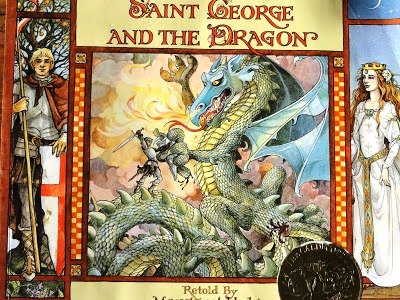
I will never stop promoting the art of Trina Schart Hyman.

Food is an important part of the Dia de los Muertos celebration. Food is set out on altars for the spirits of departed family members.

Tell us a book where food really makes the story!

The No. Ladies’ Detective Agency books. These are written from multiple perspectives, but arguably the main character is Precious Ramotswe, founder of the No. Ladies’ Detective Agency, the only female-run detective agency in Botswana. Mma Ramotswe is fat (“traditionally built”), and while not unusually greedy, she does enjoy her food and thinks about it fairly often. She always likes to visit the formidable Mma Potokwane, who runs an orphanage, because although Mma Potokwane is sure to ask for some kind of favor for her orphans, she always serves Mma Ramotswe a generous piece of cake, sometimes two.

“Some people very clearly and obviously would like to eat more cake. It might as well be printed on their forehead: Greedy person.” Ah yes, that would be me.

Dia de los Muertos is not only celebrated in Mexico, but also in Central and South America. Name a book that takes place in Central or South America or has a Central or South American author. 

I’ve read a lot of missionary stories, but Bruchko is one of the most remarkable. It takes place among the Motilone, who live in the jungle somewhere along the border of Venezuela and Colombia.

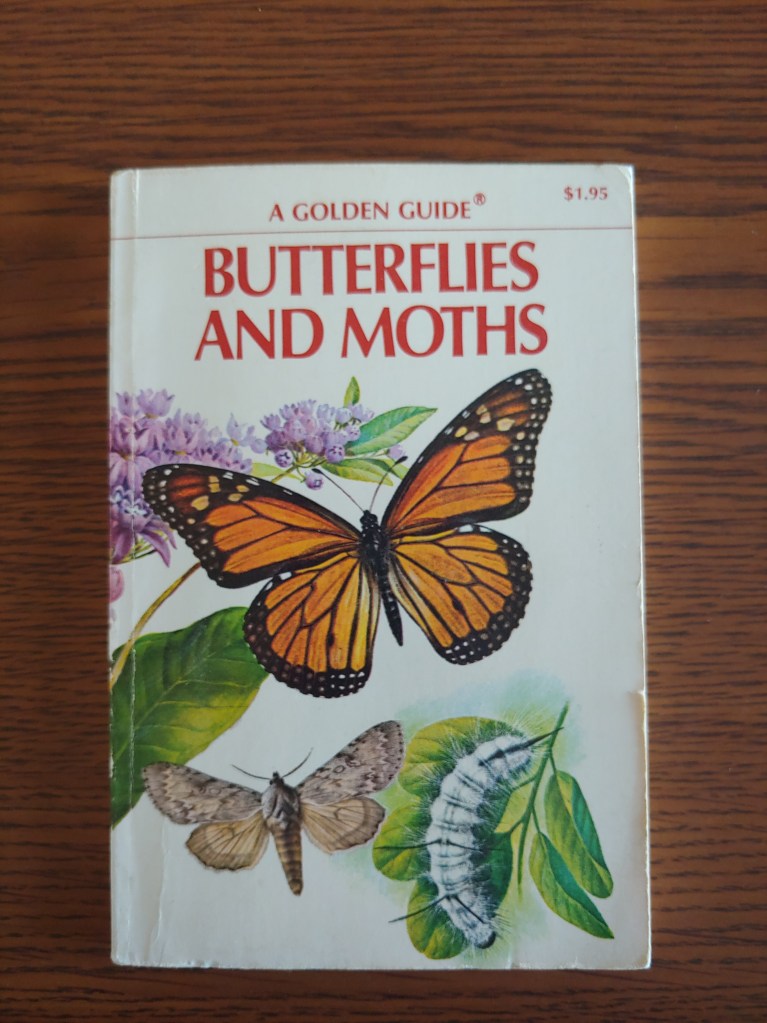
In addition to sugar skulls, flowers and butterflies are also symbols of this holiday. Tell us a book with flowers or butterflies on the cover

Nailed it.

The Day of the Dead is about celebrating life. Name a book that celebrates life. 

The book of Job, in the Bible.

You think I’m kidding? No, listen.

Job isn’t about Job patiently putting up with suffering, proving what a good person he is, and then God rewards him. That’s the caricature, but it’s almost the opposite of the real theme of the book.

The consensus in Ancient Near Eastern wisdom literature was that, since God is just, if anything bad happens to anyone, it must be their fault. This is still, by the way, the essence of human wisdom in many parts of the globe, especially in Hinduism. It is also many people’s instinct when we see a horrible disaster befall someone, to find some way that the unfortunate person brought it upon themselves, or “how this could have been avoided.” It makes us feel a little more in control.

The book of Job exists to subvert this universally accepted bit of “wisdom.”

Job starts out as a model of the good person in the Ancient Near East. He has seven sons (the perfect number!), and three daughters; he offers regular animal sacrifices to God. And he’s rich, as he should be. Everything is making sense, see?

Now we take this model Good Person and visit all kinds of punishments on him. And this must be an expose, right? It must be Justice Falling At Last!

Job’s three “friends” show up, and they proceed to preach some very reasonable, theologically sound sermons just like you could hear in any of the wisdom literature of the day. God is just. He rewards the righteous and punishes the wicked. Therefore you must have deserved this somehow. If you say you haven’t, you are defying God! Beat that!

Their logic is flawless. And God sides with Job against them. “You have not spoken of me what is right, as my servant Job has.”

If that’s not life-affirming, I don’t know what is.

It is also a day of remembering loved ones who passed on. Name a book that was either given to you or reminds you of a loved one who passed away. 

Let me tell you about Alice.

I can tell you all about her now, because she’s with the Lord. No privacy risk or anything like that. I’d post a picture if I had one, but I don’t.

By the time I knew Alice, she was in her late eighties. (I was in my late teens.) She mentored me for a few years before she got dementia. She was a sweet, little old German-American lady, with a sly sense of humor. She could do impressions, but used this skill judiciously. Once she said to me, “You want to know why I never married?” And then, for an answer, she quoted the King James verse, but with different punctuation: “I would not have thee, ignorant brethren.” Props to you if you get that joke.

The “brethren” that she “would not have” were certainly missing out, because Alice was a treasure. Perhaps they overlooked her good qualities because of a facial deformity. She had been bitten on the cheek by a horse as a child, and it wasn’t until she was an adult that she was able to afford corrective surgery.

Anyway, one day when I was at Alice’s house, I picked up the book The Holiness of God by R.C. Sproul. She encouraged me to borrow it. I expected it to be a dry, academic read, because it was on a lofty theological topic. But no, it was written for the layperson, and was very accessible. A page-turner, in fact. To this day I associate that book with Alice.

El flor del Muerto – The flower of the dead. Marigolds are used in massive quantities on the Day of the Dead. These flowers represent the sun and rebirth. Also believe to guide the spirits back home. Name a book about rebirth. 

The Great Good Thing, by Andrew Klavan. Unfortunately, I have lent my copy out, so I can’t show you a picture. This is the story of how Klavan grew up as secular Jew on Long Island, ran away from home, lived as a hobo for several years, became a hard-boiled noir crime writer and a Hollywood success, and then became a Christian at the age of 50. He is now a Christian, Jewish, hard-boiled noir crime writer who also writes YA and fantasy.

If you want to read a novel about rebirth, try Identity Man, also by Andrew Klavan.

Colors are used as a form of symbolism in the decorations and sugar skulls. Some of the colors used in association with Dia de los Muertos are yellow (unity), white (hope and purity), red (blood and life), purple (mourning), and pink (happiness). 

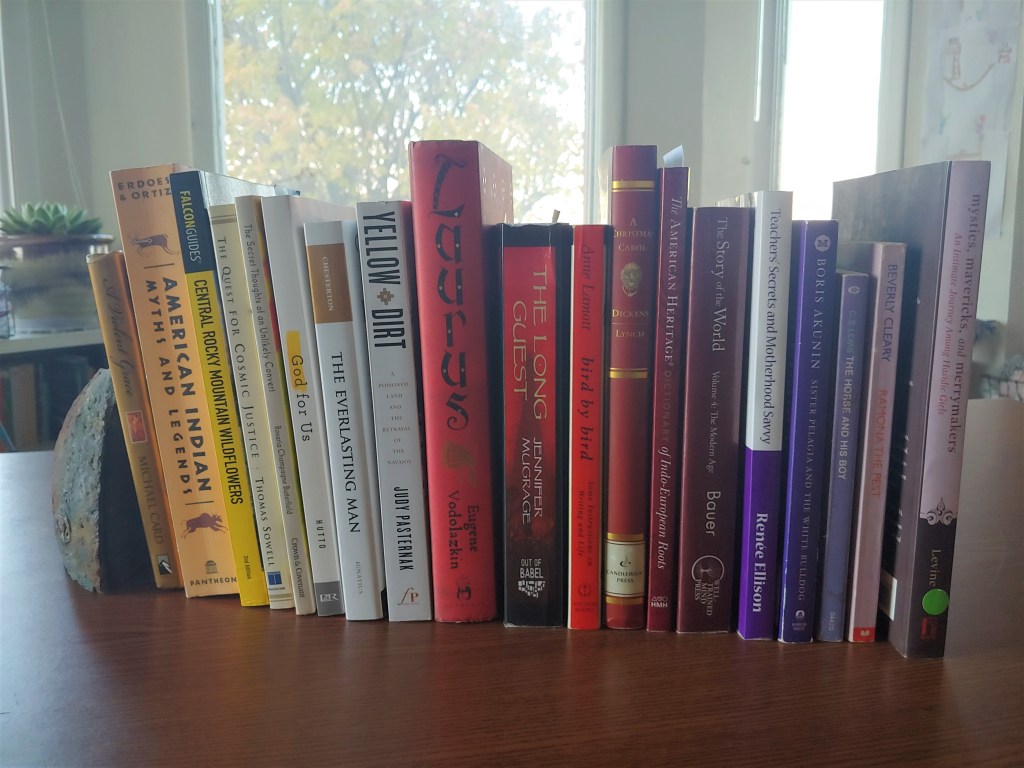
Take a photo of some book spines in the Dia de los Muertos colors!

And a happy Dia de los Muertos to all who celebrate ❤

P.S. Disclaimer about Memorializing Our Dead

If anyone feels uncomfortable with me doing this tag, because, you know, skulls and dead people and paganism, I get it.

Let me reiterate a point I have made before, that pagan practices (especially old ones with deep roots) often fulfill basic human needs that every society needs to fulfill, such as celebration, marking the seasons, etc. In this case, the basic human need is to continue to feel a connection to, and to honor, our loved ones who have died. In a way, it’s part of the mourning process. Modern American society is terrible at this, sorry to say. The only formal time to remember the person is during the funeral and burial, after which the mourners are expected to basically stop talking about the person except to very close friends or relatives. Bringing them up, or continuing to visibly grieve, causes that sin of all sins, social awkwardness. This is pretty harsh, and it does not match well with the way that grieving goes for most people.

There are ways to provide for ongoing grieving, honoring, and remembering that are not ancestor worship. For example, in Indonesia, the Muslims have memorial services at 30 days, 100 days, and a year after the death. The people groups of Kalimantan (pagan and sometimes Christian as well) have a second, larger, funeral ceremony, usually a year later, when they dig up the person’s bones and re-inter them in an ossuary with the bones of the family. The Christians will have about a week or so of viewing services while they wait for people to gather for the funeral; then the graveside service; then that night an additional “comfort” service. Most of these take place at the family’s house, and they mean the house is filled with people, songs, and food. The family is not left alone. The people who attend don’t have to say or do anything special beyond “we share in your grief.” They just have to be physically present. This is also a better social rule than having to come up with something to say.

Christians will also have a vigil at their relatives’ graves on the night before Easter. This might sound creepy – and maybe it is – but sometimes when facing something as awful as death, we have to embrace the creepy and it will actually haunt us less.

So all that to say, while I am not recommending pagan worship, and while Christians are definitely forbidden from trying to contact the dead, I think having something like a Dia de los Muertos is a good idea on a psychological level. And yes, I did get teary-eyed when watching Coco.

Sobering

Photo by Renato Danyi on Pexels.com

I finally finished reading the abridged version of The Gulag Archipelago, by Aleksandr Solzhenitsyn. The abridged version is 470 pages long, and it still gives the impression that we are only scratching the surface of all that happened with the camp system in the century since the Russian Revolution. Solzhenitsyn himself writes with regret about the fact that his account is sadly incomplete:

Those whom I asked to take on particular chapters would not do so, but instead offered stories, written or oral, for me to use as I pleased. What we really needed was a well-staffed office. [But] not only could I not spread myself like this; I had to conceal the project itself, my letters, my materials, to disperse them, to do everything in deepest secrecy. I even had to camouflage the time I spent working on the book with what looked like work on other things.

I must explain that never once did this whole book, in all its parts, lie on the same desk at the same time! In September, 1965, when work on the Archipelago was at its most intensive, I suffered a setback: my archive was raided and a novel impounded. At this point the parts of the Archipelago were already written, and the materials for the other parts, were scattered, and never reassembled: I could not take the risk, especially when all the names were given correctly.

I have stopped work on the book not because I regard it as finished, but because I cannot spend any more of my life on it. Besides begging for indulgence, I want to cry aloud: When the time and the opportunity comes, gather together, all you friends who have survived and know the story well, and write your own commentaries … Only then will the book be definitive. God bless the work!

The full list of those without whom this book could not have been written, or revised, or kept safe cannot yet be entrusted to paper. They know who they are. They have my homage.

pp. 469 – 472

No Triumph Here

There are many words that could be used to describe the experience of reading this book. Horrifying, overwhelming, and in parts, inspiring. But I have chosen sobering because that is the overall impression that it left with me. No book about the systematic arrest, imprisonment, degradation, and murder of millions of people — and the suppression of their stories — can end on a triumphant note. Even when the triumph that has happened is that their stories have finally been told:

We could not foresee what it would be like: how for no visible compelling reason the earth would shudder and give, how the gates of the abyss would briefly, grudgingly part so that two or three birds of truth would fly out before they slammed to, to stay shut for a long time to come. So many of my predecessors had not been able to finish writing, or to preserve what they had written, or to crawl or scramble to safety — but I had this good fortune: to thrust the first handful of truth through the open jaws of the iron gates before they slammed shut again.

Like matter enveloped by antimatter, it exploded instantaneously!

Only too rarely do our fellow countrymen have a chance to speak their mind … and former prisoners still more rarely. Their faith had proved false, their hopes had been cheated so often — yet now they believed that the era of truth was really beginning, that at last it was possible to speak and write boldly!

And they were disappointed, of course, for the hundredth time …

When Krushchev, wiping the tear from his eye, gave permission for the publication of [my novel about the gulags] Ivan Denisovich, he was quite sure that it was about Stalin’s camps, that he had none of his own.

I myself was taken by surprise when I received a stream of letters — from present-day zeks [prisoners]. These letters, too, were a single many-throated cry. But a cry that said, “What about us!!??” And the zeks set up a howl: What do you mean, never happen again? We’re here inside now, and our conditions are just the same!

“Nothing has changed since Ivan Denisovich’s time” — the message was the same in letters from many different places. “Any zek who reads your book will feel bitterness and disgust because everything is just as it was.” “What has changed, if all the laws providing for twenty-five years’ imprisonment issued under Stalin are still in force?”

After reading all these letters, I who had been thinking myself a hero saw that I hadn’t a leg to stand on: in ten years I had lost my vital link with the Archipelago.

pp. 451 – 453

Human Psychology is Universal

Though I have never lived under an oppressive socialist regime, many parts of this book felt familiar because human psychology is the same. For example, in an early chapter Solzhenitsyn describes how common it was for people to be arrested because they had been accused or betrayed by a jealous spouse. A man secretly accuses another man who he suspects is having an affair with his wife. A wife accuses her husband so she can get rid of him and live with her lover. This is the same phenomenon we now see on campuses where bitter exes will use the university’s sexual-harassment reporting system to take revenge on each other. And it’s not just about women vs. men: I recently saw a case where a lesbian used it to take down her ex, who happened to be a professor, after the relationship went sour. The problem is that when you set up a bureaucratic “justice” system that can be easily used to ruin people, the temptation to use it on your personal enemies is almost overwhelming.

Here are some other things that felt oddly familiar: When Solzhenitsyn’s book A Day in the Life of Ivan Denisovich came out, the Soviet newspapers grudgingly praised it: “an explosion of newspaper articles — written with gritted teeth, with ill-concealed hatred and resentment: an explosion of official praise that left a sour taste in my mouth” (p. 451). This, in turn, caused former prisoners to assume that the book was not an actual expose, but rather “controlled opposition” put out by the regime as more propaganda.

“The prolonged absence of any free exchange of information within a country opens up a gulf of incomprehension between whole groups of the population, between millions and millions. We simply cease to be a single people, for we speak, indeed, different languages.” (p. 432)

The mildest and at the same time most widespread form of betrayal was not to do anything bad directly, but just not to notice the doomed person next to one, not to help him, to turn away one’s face, to shrink back. They had arrested a neighbor, your comrade at work, or even your close friend. You kept silence. You acted as if you had not noticed. (For you could not afford to lose your current job!) And then it was announced at work, at the general meeting, that the person who had disappeared the day before was … an inveterate enemy of the people. And you, who had bent your back beside him for twenty years at the same desk, now by your noble silence (or even by your condemning speech!), had to show how hostile you were to his crimes.

p. 323

May God Prepare Our Hearts

Because if we ever face anything like this, our own character will be our downfall.

Those people became corrupted in camp who had already been corrupted out in freedom or who were ready for it. Because people are corrupted in freedom too, sometimes even more effectively than in camp.

If a person went swiftly bad in camp, what it might mean was that he had not just gone bad, but that that inner foulness which had not previously been needed had disclosed itself.

Yes, camp corruption was a mass phenomenon. But not only because the camps were awful, but because in addition we Soviet people stepped upon the soil of the Archipelago spiritually disarmed …

p. 319

When people express vexation, in my presence, over the West’s tendency to crumble, its political shortsightedness, its divisiveness, its confusion — I recall too: “Were we, before passing through the Archipelago, more steadfast? Firmer in our thoughts?”

And that is why I turn back to the years of my imprisonment and say, sometimes to the astonishment of those about me: “Bless you, prison!”

p. 313