Evangellyfish: A Book Review

It’s been a busy week, so instead of the usual exciting rants about prehistory, I’m forced to cross-post this review from Goodreads.

The Amazon Blurb

Chad Lester’s kingdom is found in the Midwest. His voice crawls over the airwaves, his books are read by millions (before he reads them), and thousands ride the escalators into the sanctuary every Sunday. And Saturday. And Wednesday, too. He is the head pastor of Camel Creek – a CEO of Soul. And souls come cheap, so he has no overhead.

When Lester is (falsely) accused of molesting a young male counselee, his universe begins to crumble. He is a sexual predator, yes. But strictly straight (and deeply offended that anyone would suggest otherwise). Detectives, reporters, assistant pastors, and old lovers and pay-offs all come out to play.

John Mitchell is also a pastor, but he has no kingdom to speak of – only smalltime choir feuds. He is thrilled at the great man’s fall, but his joy quickly fades when the imploding Lester calls him – and a lover or two – for help. How low can grace go? Whores, thieves, and junkies, sure. But pastors?

My Review

This book is sort of like one of those treats from Mexico that are, technically, candy, but they also contain chile powder and a ton of citric acid.

In other words, it’s funny, shrewd, and a quick read, but also super misanthropic.

The narrative voice is Douglas Wilson’s own, which is to say, full of sardonic psychological observations, bon mots, and silly but deep metaphors. The plot is P.G. Wodehouse-esque.

My biggest problem with it, and the reason I gave it only four stars instead of five, is that almost all the characters talk kind of alike, both in the dialogue and in their internal monologues. And the way they talk is also very similar to the narrative voice. This isn’t realistic, and it sometimes makes the characters harder to keep track of in a comedy of errors that has a very large ensemble cast. Also, they sound too educated. What teenaged daughter says to her father that Costco was “a perfect madhouse”?

As for the expose part of it, I have been in the evangelical world my entire life but I have never been in a mega-church — at all, really, but certainly not a mega-church like this one, where the pastor originally wanted to run for governor, has never been to seminary, doesn’t read the Bible, seduces all the women he “counsels” and then pays them off, has bestselling books written by ghost writers and sermons written by same. If this kind of thing is truly widespread, that explains why Wilson is always chiding evangelicals. And why, perhaps, I shouldn’t take his chiding personally, as it is apparently not directed at me. 

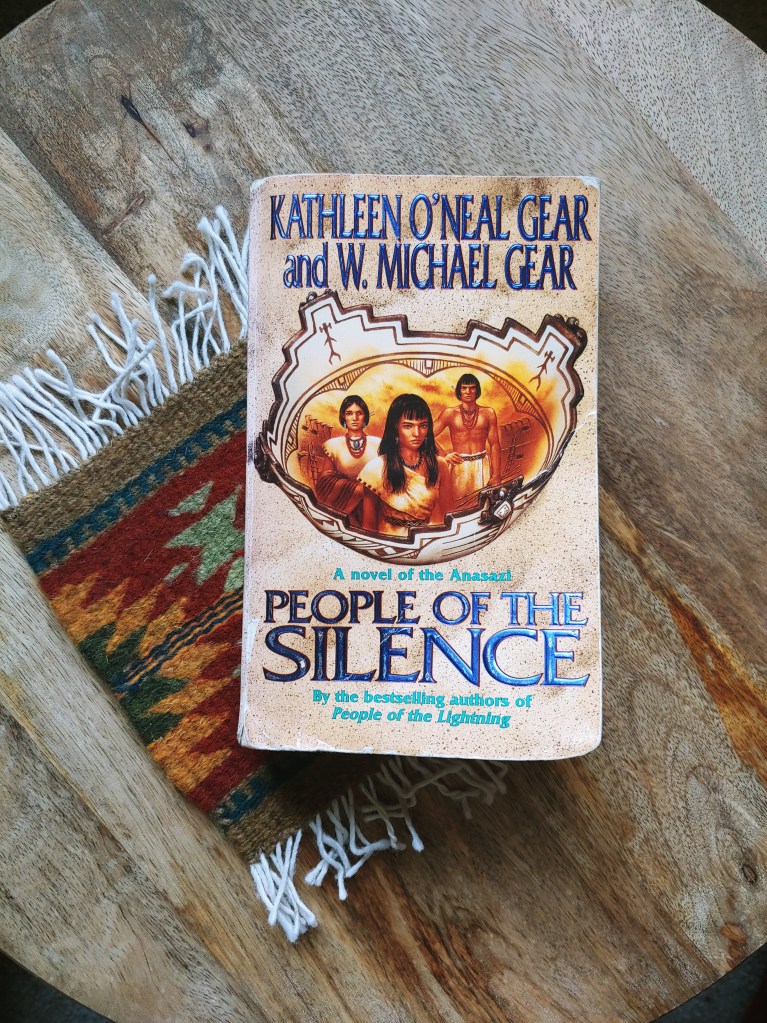
Review: People of the Silence

Husband-and-wife team W. Michael Gear and Kathleen O’Neal Gear write thoroughly researched novels about the different people groups living in North America in pre-Columbian times. This one, about the Anasazi or Pueblo Indian ancestors, is actually set in about 1150 A.D. This culture is “prehistoric” only in the sense that we don’t have a formal, written record of everything that went down, although there is plenty of archaeological evidence and oral tradition.

A Ceremonial City

This book comes with three maps. (I love me some maps!) The first shows North America with the general locations of the people groups who will come into play in the novel: “The Tower Builders,” “The Straight Path People,” the Mogollon, and the Hohokam. A second shows the Four Corners region, including Mesa Verde and Chaco Canyon, New Mexico, where most of the action in this book takes place, including the Great South Road built by the Anasazi and the Straight Path People’s names for all the surrounding features. I flipped back to this map many times throughout the course of the book. A third map shows a closeup of Chaco Canyon, or as the characters call it, Straight Path Wash. It shows the locations of the towns there. These can still be seen today, but the authors have given them names that the ancient Pueblo Indians might have used, such as Talon Town, Starburst Town, etc.

Talon Town (the book’s name for what is now called Pueblo Bonito in Chaco Canyon) is the capital of the Straight Path people’s civilization. It is occupied by their priest/king, the Blessed Sun; his wife, the nation’s Matron; a seer, the Sunwatcher; the nation’s War Chief; a number of warriors; and numerous slaves, mostly people captured from neighboring groups such as the Hohokam, who are there to serve these aristocrats. Talon Town produces almost no goods of its own. Food, clothing, blankets, shells, turquoise, etc. are brought in as tribute from surrounding villages over quite a wide area, or are obtained through trade. This is what the archaeological record seems to show us.

Talon Town has two large plazas, each with a kiva in it, so that it can host religious gatherings such as solstice ceremonies and funerals for important people. Here is the authors’ description of what it might have looked like inside one of the Great Kivas as a young apprentice prepares the Blessed Sun’s body for burial:

Thlatsina [=kachina] masks hung over the small wall crypts, glittering with precious stones. Thirty-six in all, they wore brilliantly colored headdresses of blue, yellow, red, and deep black feathers. Tufts of pure white eagle down crowned many masks. Neck ruffs of buffalo, badger, rabbit, and other hides gave the appearance of beards. But Poor Singer’s eyes lingered on the sharp fangs and polished beaks that glinted in the fire’s amber glow.

The circular kiva stretched at least a hundred hands across, supported by four red masonry pillars and encircled by three bench levels. Each bench had its own sacred color, yellow, red, and blue topped by white walls.

Another body rested on the opposite foot drum, covered completely by a beautiful Death Blanket. Poor Singer couldn’t guess who it might be.

People of the Silence, p. 416

Now, the Plot

Here is the review of People of the Silence I posted on Goodreads a month ago.

Some historical novels or speculative novels set in ancient times seem to cut-and-paste modern concerns onto those supposedly ancient characters. The Gears definitely don’t do that. That is one of my top concerns in historical fiction, so props to them.

It did take me a looong time to finish this. The novel starts with a steep climb through a lot of info dumps about Anasazi cosmology, including an extended vision that happens to a young man whom we haven’t gotten to know yet. All during the vision, I kept trying to figure out what the different elements in the vision represented in the cosmological scheme that had just been presented. Later, it turned out that we weren’t supposed to totally understand the vision at the time, and it would be revealed later. Perhaps, if I had read any other books by the Gears, I would have realized this sooner, but as this was my first one, I didn’t at first have that confidence.

The steep climb continues, as we are introduced to a large cast of characters. For about the first half of the novel, it wasn’t clear to me which characters, if any, I was supposed to sympathize with. In the book, the Anasazi have a brutal caste system based on “First People” and “Made People,” and slaves captured in raids on other tribes. Some of the First People later turn out to be sympathetic characters, but you don’t find that out until about halfway through the novel. Also, some characters who are supposed to be sympathetic are seen committing atrocities when we first meet them. Eventually it becomes clear that this is a very brutal society, and the prevalence and unavoidability of violence is part of the point of the novel; but again, the violence does make it hard to figure out who we are meant be to rooting for.

After the steep climb, which lasts about half the novel, we have a long plateau (a mesa top, if you will) where we are getting to know the characters and the intricate machinations taking place in their dying society. Wheels within wheels! The whole novel also includes a lot of beautiful, lyrical descriptions of the Four Corners landscape. The Gears do a great job giving you a sense of what time of day it is, what the weather and background look like, and details of what people are eating and wearing, and how they are wearing their hair. Almost every dialogue tag comes with a one-sentence description of what the character looks like at the moment (e.g. “Her greying black hair had come loose around her beautiful triangular face, which was covered in smears of reddish dust”). Stephen King would hate this, but I don’t mind it. It helps you keep track of the different characters by forming mental images of them, and it gives that much-coveted visual glimpse into what the Anasazi looked like. (For example, they dressed in bright colors, and their royalty decorated themselves with copper bells and macaw feathers.)

Finally, having scaled and then trekked across the mesa, once you are comfortable in the world and familiar with all the power dynamics, the last hundred or so pages take you on a mad, roller-coaster rush down the other side, as secrets are revealed, violence explodes, and desperate, last-minute measures are tried. This book even turned out to be a rather creepy murder mystery, with an unexpected but satisfying reveal of the murderer.

After the novel, there is an extensive bibliography of all the archaeological and anthropological sources the Gears consulted.

If you liked my book The Long Guest, you will probably like People of the Silence, and vice versa. 

Quote: Stay Edgy

“Don’t water so much, boy. These plants are like people, they need to be a little scared.”

“They need to be scared?”

Black Mesa nodded. “If the seedlings aren’t scared, they won’t sink their roots deeply into Mother Earth. Then when the droughts come they’ll blow away without a fight. If you want to save them, don’t make their lives easy, force them to prepare for the worst.” He nudged Poor Singer with his elbow. “Hurting makes everybody stronger.”

People of the Silence, p. 265

Those Creepy Fates

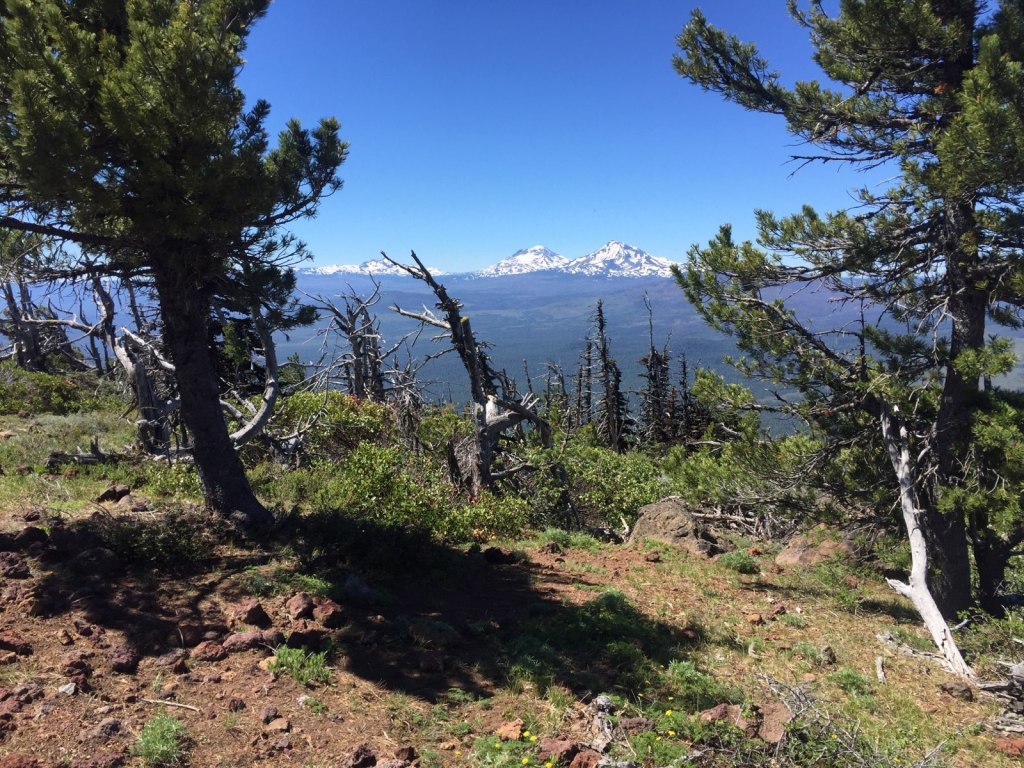
Left to right: Broken Top, South Sister, North Sister

There is a trio of mountains in Oregon called the Three Sisters. In fact, the town of Sisters, OR, is named for them. In this picture, you can only see two of the them (the third is hiding behind).

I use this picture for my illustration because, while there is a lot of great art portraying the Three Fates, it’s a little hard to find a picture that I can use without copyright infringement.

I recently read, with my kids, The Black Cauldron. My imagination was captured by the three swamp-dwelling little old ladies (if human?) who guard the Cauldron: Orddu, Orwen, and Orgoch. As far as I can tell, Lloyd Alexander made up these ladies and imported them into his story. Though triple goddesses are a recurring feature in Celtic mythology, they are not really the same as the three fates and it’s even a falsehood that they always came in the form of maiden, mother, and crone, as you will see if you read the scathing 1-star reviews of the book The White Goddess by Robert Graves.

The Greek fates are named Clotho, Lachesis, and Atropos. Clotho spins the thread of a mortal’s life, Lachesis measures out its predetermined length, and Atropos cuts it. Norse cosmology also has fates, called the Norns … in some versions three, named Past, Present and Future; in some versions a large but unknown number, according to this article. Evidently the idea of fate personified as three or more women (or woman-like beings) goes way back in Indo-European cosmology. It shows up as late as Macbeth’s three witches.

I had ignored the Fates for some time (as one does); but reading The Black Cauldron made me wonder whether you can write a fantasy that draws on Indo-European cosmology and not at least tip your hat to them.

By their very nature, the Fates are creepy. Lloyd Alexander does a great job of making this feeling come through when he introduces Orddu, Orwen, and Orgoch. The heroes of the book, on first seeing the fates’ house (and by the way, the word ‘fates’ is not used), think it is abandoned because it looks so run-down and blends so well into the swamp shrubberies. There’s a loom set up inside the house, on which is a tangled mess of a weaving. (Don’t touch!) Then the ladies show up. Rather like Tom Bombadil in The Lord of the Rings, they seem cavalier about things that ordinary people regard as matters of life and death. Orddu keeps offering to turn the travelers into toads (“You’ll grow to like it”). Orgoch is excited about this because if they were toads, it’s implied she could eat them. Orgoch, the only one of the three who is clad in a black cowl, seems to want to eat everything. As Orddu says, “It’s hard to keep pets with Orgoch around.”

The three ladies light up when they hear that the travelers know Dallben, who it transpires they discovered as a foundling and raised. They refer to him as “little Dallben.” (Dallben is over 300 years old.)

The travelers stay the night in an outbuilding belonging to the three ladies. Taran, the main character, wakes up in the middle of the night and sneaks up to the window of the dilapidated cottage, which is now alight. He returns, reporting, “They’re not the same ones!” Orwen, Orddu and Orgoch now look young and beautiful, and they spend all night working on their weaving. The next morning, however, they appear looking just as they did before, and with the same apparent disregard for human life.

Lloyd Alexander has set a really high bar with this fictional, Welsh version of the fates, and I’m not even sure I could approach it. Here is an article that dives more deeply into an analysis of the fates and of all of Prydain, the fantasy world in which the book is set. Be warned, the article assumes you are familiar with the whole series.

Quote: How Moms “Vacation”

What, oh what, will I do to fill the days that are usually taken up with errands and housecleaning and laundry and Max and Ron and their various time-sucking wants and needs? Don’t for one minute think I don’t absolutely adore my life as a wife and mom. But even the best lives need a vacation and, let’s face it, renting a house with your family at a ski resort is NOT a vacation. It’s basically moving your life from one location to another. Unless someone else is making the beds, doing the laundry, and cooking, it’s just the same old life with the added inconvenience of not knowing where anything is in the kitchen.

from Class Mom by Laurie Gelman, page 219

Quote: The Kindest of Lies

We waltzed slowly around the room, between the rows of booths, past the pool table and the chairs, never hitting anything. I guess the loser had spent so much time in that bar that he knew where everything was. He had the gift of all the best dancers: he led you so that you felt as though there was no leading or following involved … The scar tissue above his empty white eyes was furrowed with concentration, and he smelled of sweat and gin.

“Are you beautiful?” the loser whispered toward the end of the song.

I lied a little. “Yes,” I said. “Very.”

The loser smiled to himself and closed his sightless eyes.

Fulton County Blues, by Ruth Birmingham, p. 52

Props to the Bald Guys

“But … but …,” Taran stammered. “Coll? A hero? But … he’s so bald!”

Gwydion laughed and shook his head. “Assistant Pig-Keeper,” he said, “you have curious notions about heroes. I have never known courage to be judged by the length of a man’s hair. Or, for the matter of that, whether he has any hair at all.”

The Book of Three, by Lloyd Alexander, p. 24

A Weird Post (Because Aliens)

You’ve been warned, friends. If you don’t want to read a post about possible space aliens, you are welcome to leave the room with no hard feelings. Goodbye, and I’ll see you back here next week!

Finally Facing the News

You guys may have noticed, there has been a spate of news articles and videos about U.S. Navy pilots sighting what appear to be UFOs.

U.S. Navy videos declassified last year

60 Minutes interview with Navy pilots

Former head of the Pentagon’s UFO program says they have “exotic material” … what???

I’ve ignored these news items for a long time, mostly because I didn’t know what to do with them. Now I’m ready to give my analysis. It will be just as expert as anyone else’s, and no more expert than any comments you may leave.

Problems with all the Possible Theories

  1. This is all just a big hoax by our government, to distract us from the attempted power grab by [fill in your favorite villains]. The problems: First of all, it’s not working if that was indeed the plan. The media have not camped on this nearly as hard as on some other, less sensational things, and even when they have run stories, the public (including me, I might add) seem much more interested in their own problems. The government and media are not using these reports to whip up fear or preparations for an intergalactic war, nor are they trying to turn this into a scandal about past administrations’ lack of preparedness on the space alien issue. They have just kind of thrown out all this newly declassified information with a clunk, a shrug, and a big trombone slide. Secondly, the pilots who were interviewed seemed like sane, professional people. They did not seem like people who “want to believe” in space aliens. Thirdly, some of these reports and videos go back for decades.
  2. These aircraft belong to another world power, such as China, which has developed technology far more advanced than we suspected. Possible but implausible, because again, these sightings go back for decades. It’s hard to imagine a geopolitical rival having advanced millennia beyond us in terms of their technology, and not having already used it to conquer us. Regular earth people don’t have that kind of self-control.
  3. The aircraft belong to a private, independently wealthy genius, like Elon Musk, who does not want to take over the world but just zips over the Pacific Ocean as a hobby. Possible. Very possible. Although again, it would take phenomenal humility and self-control for a private organization to have these capabilities and not try to leverage them for whatever their own pet project is: fame, space travel, stopping perceived climate change, etc.
  4. The aircraft belong to an advanced civilization of space aliens. The first problem with this is that, if this is an invading force, they are taking their time. At the risk of repeating myself: these sightings go back decades. So if these are space aliens, they frankly don’t seem super interested in us. Perhaps they are just here as tourists. The Pacific Ocean would certainly be a worthy destination for tourism, and perhaps it is more interesting to them than humans. But there is another huge problem with the space alien theory; that is, if we are imagining these space aliens as they are usually conceived of: physical beings, designed to live in three dimensions, like us, physically inhabiting a very different ecosystem on a distant planet or planets in a distant solar system. The problem is this: any possible life-supporting planets in our universe are prohibitively distant for vehicles traveling at normal speeds. The time (and, if I may say so, the risks) involved are not at all practical for tourism or warfare, or even for beings not designed for space to survive the journey probably. Of course, there is a that hoary sci-fi trope of hyperspace (going faster than the speed of light). But everything I’ve ever heard about this indicates it’s either not possible, or would almost certainly destroy any object that accelerated to that speed, and would certainly kill any physical being, designed to live in three dimensions, that tried it. All of this makes it impossible for me to swallow a Star Wars or Avatar-like scenario where there are physical aliens living galaxies away, who have traveled through hyperspace to get to Earth. But there is another possibility.

Interdimensional Beings

In the short satirical novel Flatland, the protagonist is a square who lives in a two-dimensional world of geometric beings. These two-dimensional beings are visited by a sphere. The sphere shows himself to them by intersecting his body with the plane of their universe. The way this looks to the two-dimensional beings is that a point appears out of nowhere, then becomes a rapidly growing circle as the sphere inserts more of his diameter into their plane of existence. When he wishes to, the sphere can move out the other side. This looks to the two-dimensional shapes as if the circle shrinks and then vanishes. The sphere can then move to somewhere else on the two-dimensional plane and appear there, again giving the impression that he has appeared out of nowhere. Later, the sphere takes the square on a mystical journey to observe lower dimensions, so as to give him an idea of how higher dimensions might exist. There is a one-dimensional world (a line) where the inhabitants are all line segments. Each can only see the end of his neighbor (he or she looks like a point), but they can hear one another and communicate by harmonizing. The square is also shown a universe that consists of a single point. This point is the only being in its universe and thinks it is God. It is impossible to communicate with this point. If it hears a voice not coming from within its own universe, it imagines that it must be having auditory hallucinations.

Returning to the vehicles in the section above, I’m sure you can see where I’m going with this. If these mysterious vehicles turn out to be piloted by nonhuman beings, it seems most probable to me that they would be creatures designed to live in more dimensions than we do. Creatures in a higher dimension can do things that appear miraculous in lower dimensions, such vanishing abruptly or appearing to defy the laws of physics. Though wild, the “higher-dimensional beings” theory seems to me more plausible than the idea of three-dimensional beings who are subject to the same laws of physics that we are, yet somehow have managed to pull off intergalactic travel and vanishing through “technology.”

And, by the way, notice your own reaction to this. Did you breathe a sigh of relief? Does the phrase “interdimensional beings” sound way more intelligent than “space aliens” or “angels”? I confess it rolls off my tongue much more smoothly. (More syllables = better?) Some people might say that interdimensional beings was what they meant all along by “aliens,” and moving through multiple higher dimensions was what they meant by “technology.” O.K., that’s fair. Such beings would certainly be alien to us. Still, I think it’s a helpful distinction to make, because I don’t think “creatures designed to live in a higher dimension” is the first thing that comes to most people’s minds when they hear “aliens,” or especially “space aliens.” We might think of aliens as having the ability to mess with higher dimensions than we can, but I think most people think of that as a sort of extra, while conceiving of the aliens as primarily creatures like us (perhaps smarter and uglier), who make their primary home on a physical planet and are anchored in the three dimensions (four if you count time).

The Third Circle of Weird

Ready to get even stranger with me? Let’s go.

On this blog, I have in the past reviewed the excellent, very odd, very mind-blowing Collision Series, which consists of the books The Resolve of Immortal Flesh and The Formulacrum. That series is a lot of things, including a hilarious, Hitchhiker’s Guide-style romp … but more than anything it’s an extended exploration of this idea of interdimensional beings. Human characters in the series get ahold of a vehicle that can travel in higher dimensions. They exploit their access to higher dimensions to move through walls, travel the depths of the sea, and vanish when there’s trouble, and they do it a lot. Of course, the convenience of this is limited by the fact that throughout the books, the human protagonists are at different times being hunted by beings who also have access to these higher dimensions.

A major thesis of these books is that the beings we are used to referring to as angels and demons are actually interdimensional beings whose goals intersect with human life in complex ways. One interesting thing that comes up is that humans do in fact move through some of these higher dimensions, but we do so without knowing it. We experience our interdimensional blunders as intuitions, insights, creepy feelings, etc. This makes sense. After all, in theory there’s nothing to stop a two-dimensional creature from blundering through the body of a three-dimensional creature, right? Anyway, that’s an interesting detail but I’m getting off track here.

Helped by Rich Colburn, the author of The Formulacrum, I am now ready to cap off the weirdness by integrating this interdimensional beings idea into the world view of my own book series.

The Long Guest and The Strange Land both proceed on the premise, taken from Genesis 6, that in ancient times “the sons of God” (interdimensional beings?) walked the earth in some kind of physical form that allowed them somehow to reproduce with human women, thus producing a race of monsters. The resulting chaos was in fact the main reason for the Flood: God was doing triage to save the human race as originally created. This horrifying period in history was also the source of the all the legends and origin stories about gods, giants, and monsters that we find in cultures worldwide. For more on this theory, see my post, here, or the book Giants: sons of the gods by Douglas Van Dorn.

So, yes, strange as it sounds, I am speculating that your “aliens” might be what the ancient world called “gods” … but only if we specify that they were not regular “space aliens” but interdimensional beings who could probably appear as people or animals or whatever they wanted to look like (hat tip to the Greek myths).

So, Why Am I Not Terrified?

I’m not terrified because the gods ain’t what they used to be.

I see the “gods” as having less influence on human life now than ever before. I basically see three phases of this. In the first phase, they were actually here, manifesting physically, demanding worship in person. God put a stop to that with the Flood.

After the Flood, people still remembered the gods, and they seem to have continued to be pretty active on earth, but unable to manifest physically. So, each nation had a god that was responsible for it (or that it was responsible to). They built altars to these gods, identified them with different stars and constellations, and kept trying to get in touch with them physically even though that door had now been closed. “In the past,” Paul says, “God let all nations go their own way.” He picked one people and told them not to worship false gods (gods which were not the Creator and which, in many cases, didn’t even try to hide the fact that they were evil). If we look at legends and even recorded history, it seems to me that often these gods were actual spiritual presences who, though they could no longer manifest physically, could have quite an influence on human life through things like visions, possessions, illnesses, and disasters. For example, in Palestine in Jesus’ day we see many cases, unironically reported, of people being possessed by “unclean spirits.” This is in a region that had been heavily Hellenized, and where people were definitely still worshipping the Roman gods, the Greek gods, and the pre-Hellenistic local deities such as Artemis of the Ephesians. In this second phase, it was truly a dangerous thing to turn from your local deity to worship “the living God,” the God of Israel. Local deities perhaps could actually harm people they took a hate-on to. God spends a lot of time in the Old Testament reassuring the people that if they forsake the fertility and rain gods, and worship Him, He will bless their households and crops and will take care of them.

So, in phase two, God has set some limits on the interdimensional beings but there are still lots of manifestations from other dimensions and lots of communication (or attempts at such) between them and humans.

In phase three, we get Jesus. He opens the way for all human beings to relate directly to the living God. When people turn to Him, they turn away from the worship of the lesser gods. And when people do this in large numbers, a funny thing happens. Paganism no longer works any more. It’s as if the lesser gods have been banished — not partially, but completely now — from their traditional territories. In the Christian era, as worship of the true God spreads slowly but surely throughout the world like leaven, the world becomes less and less spooky. Now, 2000 years later, in many parts of the world, interdimensional/spooky/spiritual manifestations are so rare that we do not have to worry about them and many people don’t even believe that they exist or ever did. If we see a weird thing, we have to find some kind of physical explanation for it, whether it’s a hallucination caused by chemicals in our brain or physical, three-dimensional beings from somewhere else in our physical galaxy.

I’m OK with this change, frankly. It might make the world a little more boring … but, my gosh, it makes it so much less scary! It even means that, if these tic-tac-shaped spacecraft are being driven by interdimensional beings, we probably don’t have to worry. Probably the reason they have not used their capabilities to enslave us is that they aren’t allowed to interact with us in any significant way. Zip around a little, make us scratch our heads, yes. Manifest, show their power, attack us, no. Those days are gone. Christ is the victor. We can all breathe a sigh of relief.