
The second I sat down across from him, he said, “So, Poetry Boy, here you are. And you’ll be awestruck to learn that with a single glance through the glassy surface of your idiot gaze, I can see straight into the black heart of nothingness that is your godless and therefore soulless experience of this our only mortal life. And on that evidence of my own senses, I feel safe in saying you have now become morally dead in the service of your country and are therefore ready for your next government assignment.”
“Uh .. thank you?” I asked.
The House of Love and Death, by Andrew Klavan, pp. 4 -5
Tag: genres
The House of Love and Death: A Book Review

I ordered this and it arrived a long time ago, but I just now got to it. (Look at me! I am powering through my TBR like a good girl!) Once I opened it, I finished in just a few days because it’s that good.
This is the third book in the Cameron Winter series. Winter is a character created by Andrew Klavan, reportedly the first character Klavan has created that he’s felt could sustain a whole series. Winter is a former spy who is now a professor of Romantic English Literature at an unnamed university in an unnamed Great Lake state (but pretty obviously Madison, Wisconsin). So he fits into that beloved mystery trope, a character who looks unprepossessing (in this case, because he’s a slight, blond, pretty-boy academic) and whom people consequently underestimate, unaware of his hand-to-hand combat skills.
It was fortuitous that I read House not too long after reading The Bourne Treachery, which is also a spy story featuring a longstanding character. Winter even has, in this book, some experiences similar to those Bourne has in Treachery. However, the two books couldn’t be more different.
Winter does check many of the same boxes as Bourne, and House checks many of the same action-novel boxes as Treachery. It moves a little slower and is a little less intricate, but not much. But it is way more emotional. This is one of those mysteries where, after you find out whodunit, you have to set the book down and (if you are a soft touch) cry for a while as you contemplate just how tragic the whole thing was. And like any good tragedy, it has the simultaneous feel of “This was so preventable! This should have been easily preventable!” and of inescapability.
Winter has a “strange habit of mind” (also the title of the first book in the series), where sometimes he will go into a “fugue state” and zone out for several minutes while his subconscious, essentially, becomes his conscious and works on a puzzle he is contemplating. As a writer and artist, I recognize this habit of mind and actually don’t find it that strange (although it doesn’t help me solve mysteries, more’s the pity). I assume that Klavan has given Winter this “strange habit” because, as an artist and writer, he also has some version of this habit. Certain kinds of mind tend to do this. Call it what you want – hyperfocus, being “in the zone.” Being an introvert. Not everyone is “on” (in the sense of externally focused) all the time.
It does make a person wonder whether this tendency, which is similar to narcolepsy, disadvantaged Winter as a spy. In fact, it makes one wonder how he ever managed to survive his espionage years. If Jason Bourne were to zone out like that even for a minute, he’d be dead. Once in House, Winter is driving somewhere and keeping an eye out for a tail. He briefly enters the fugue state, and when he comes out of it, sure enough, he is now being followed.
Yet somehow, those of us with the strange habit of mind do manage to survive. Some of us even manage to raise children. I dunno.
Anyway (shakes shoulders) aaahh, good book. Recommend. Very very sad though.
Quote: Sangfroid
“Why do you torment me?” Stan-Stan growled. Then he shouted, “I can’t get your voice out of my head! What do you want from me? I have nothing to do with you! Leave me alone!”
Since this was something a schizophrenic might say to his demons and also something Stan-Stan said to Winter [his contact] almost every time they met, Winter had to admire the subtlety of it.
“I need a favor, Stan-Stan,” Winter said.
The reeking mass of rags and sores leapt at him, jamming his unrecognizable features to within an inch of Winter’s tortured nose.
“Arrrgh-gnarr-ach,” Stan-Stan remarked.
“Be that as it may,” said Winter, struggling not to gag on the stench of him, “It concerns a town called Maidenvale.”
The House of Love and Death, by Andrew Klavan, p. 135
A quote that demonstrates that action can be well written
Lenny Guerrero was Search and Rescue, Truck 48, the first truck. A broad, strong, boyishly handsome man in his mid-thirties, he was at the truck’s side near the curb, near the lawn. The light arrays from the truck and the nearby engine, Engine 39, flashed scarlet and shadow over him as he worked to get himself game ready. Strapping his air pack on, his mask on, his hood on, his helmet.
The House of Love and Death, by Andrew Klavan, p. ix
Look at the poetic use of repetition that doesn’t seem strained.
The Bourne Treachery: A Book Review

by Robert Ludlum, but actually by Brian Freeman
As you might expect from a Ludlum novel written by somebody else, this book has the feel of something made on an assembly line. It has all the parts and doodads that you expect from the genre, and it does what you want it to do (in this case, be thriller), but it has no particular artistry or character. To be fair, this also means it’s lacking some of the flaws that might show up in quirkier, more idiosyncratic books.
Pacing and Action: A+
This is, I gather, the outstanding characteristic of Bourne books. The action is almost constant. Nevertheless, the author does a good job of introducing characters and explaining the setup and the stakes, so that we don’t get the phenomenon of action that we don’t know the significance of. I will say that to a certain degree, tension is inflationary, so the shock and horror isn’t quite as shocking and horrible as it would be with a slower buildup.
Tours of Foreign Cities: A
Traveling the world is one of the things we expect from the Bourne novels. Freeman does a good job of making us feel as if we are familiar with the cities where the action takes place by mentioning particular roads, parks, markets, and squares. He also does a decent job with the weather and atmospherics.
Russians Betraying Each Other: A
Also other spies betraying Bourne, and Bourne possibly betraying other people (who knows, since he lost his memory). The hypocrisy of people in espionage, as well as the messed-up kind of person that years in espionage makes you, is a major theme of this book. Speaking of which:
Character Development: B-
The book tries to do some character development with Bourne discovering his past, wishing he could get out of the espionage game, and realizing that he has been made into the kind of person who probably isn’t capable of anything else. There’s a fair amount of character development given that this is a thriller. But, the thriller distinctives limit the emotional impact of all this, at least for me. The pace is too fast and the writing too matter-of-fact for character development to get really emotional. Speaking of which:
Relationships between Men and Women: C-
Okay, so there is a lot of sex. Including one scene that lasts several pages. But it’s written the way a man would write it, which is to say, the emotional element is minimal. Speaking of which:
Portrayal of Women: D
Hmm, where to start?
Obviously, we are talking about spy women, so that skews the sampling. But these ladies are ruthless killers. They are also … how to put it …? Not overly concerned with monogamy. They can go from killing to kissing, or worse, in no time flat. They don’t seem to get emotionally attached as a result of sexual involvement, the way a normal woman would. They aren’t adversely affected by all the gruesome things they have to do, even as much as Bourne is.
There are two women who don’t appear to be nymphos, but they are both cool as cucumbers. One only cares about science, one about spycraft. You know, like most women you meet.
Also, spy goddess is petite and very athletic, but also has “deep curves.” I dunno. Deep curves (such as wide hips) affect the way a person runs, tumbles, throws, etc. I went through most of the book picturing her as wiry and boyish, and then all of a sudden the author threw these curves at me. Also, their hair is always loose. Not very practical, ladies.
I’m not even trying to be feminist here. I just find these women hella unrealistic and unrelatable, which in turn makes the “romance” (such as it is) tepid.
Russians Talking: F-
This was the thing that annoyed me the most, because it messed with the verisimilitude even more than the Bond-style spy women. Many of the characters in this book are expatriate Russians. Many of them need to monologue to explain their positions. All of them talk exactly like an American explaining something in a business seminar. Listen, Russian sentence structure, word choice, and so on, is very distinctive, even when they are speaking English. It should not have been hard to watch a few movies where this was well done, and then imitate it in this book. If you are going to research foreign cities and bring them to life, why not make the dialogue believable too? I think I would have enjoyed this book a lot more if the Russians had sounded like Russians. And it would have supported the theme. Make them sound like Russians!
Day 2 of the Fantasy Fair
- There is a huge difference between a man wearing a princess dress or a pirate-lass skirt, and a man wearing a skirt made for men, such as a kilt. I have seen many of both today. It is not possible to get them confused.
- Tarot reading is basically counseling with pagan trappings.
- Indie authors, be sure you get your book edited before it’s published. Otherwise, you might publish something like a Mayan priest calling his nephew a “homo-punk.”
- The guy who won the Fair today, in my opinion, was an older man wearing a bedsheet “tunic” over just the front of his jeans and t-shirt, a canvas gardening hat, and a Burger King crown fitted over the crown of the gardening hat. Surprisingly, I did not notice all this until the second look, because his overall silhouette was just like all the other fairgoers.
I’m at the Fantasy Fair
The Mystic Realms Fantasy Fair runs this Friday, Saturday, and Sunday (June 28, 29, and 30) at the Bannock County Fairgrounds in Pocatello, Idaho. My son and I will be there, I selling books, he paintings. I will be dressed as my online avatar, Neanderthal Woman. Our booth is called the Cosmic Tree (his idea). And there are many other amazing vendors and entertainers as well.
I’ll try to upload pictures as the weekend progresses, so this post should get more and more colorful.
UPDATE: Well well well! Before this post goes live, we already have an update. We are known for strong winds here in Idaho. So strong, in fact, that the wind just BROKE OUR 10×10 TENT when my son and I set it up in the backyard for a dry run. It looks as if, tonight, we will be buying something sturdier.
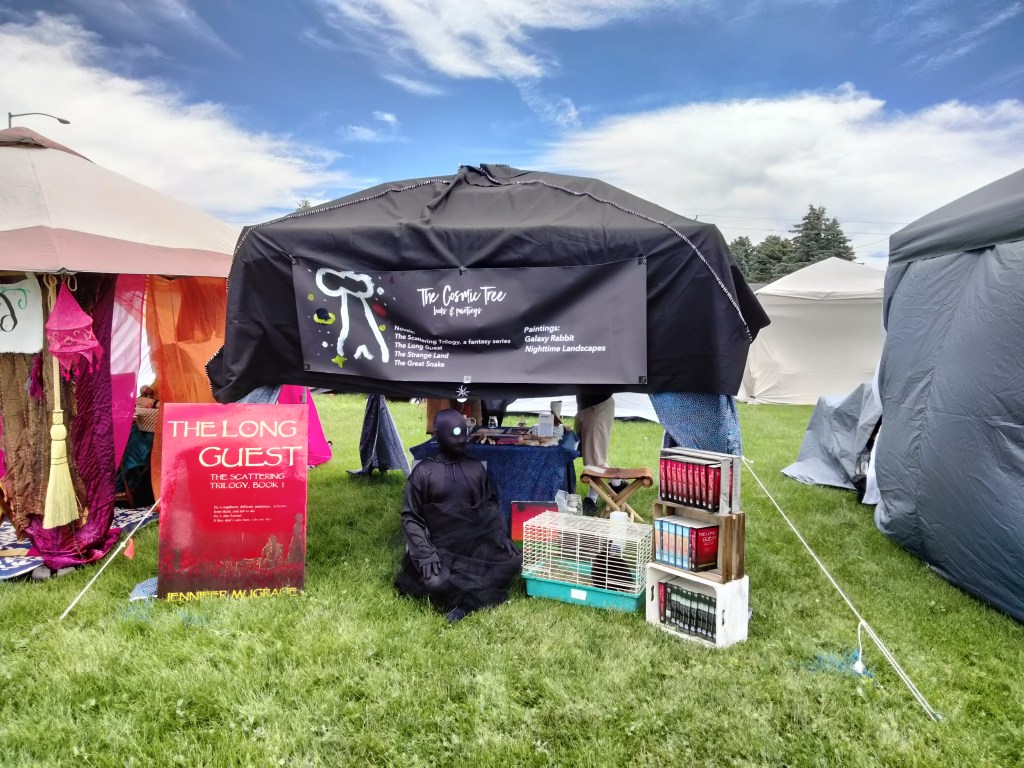
Bought the new tent. Here’s our booth. The event is much bigger than last year’s.
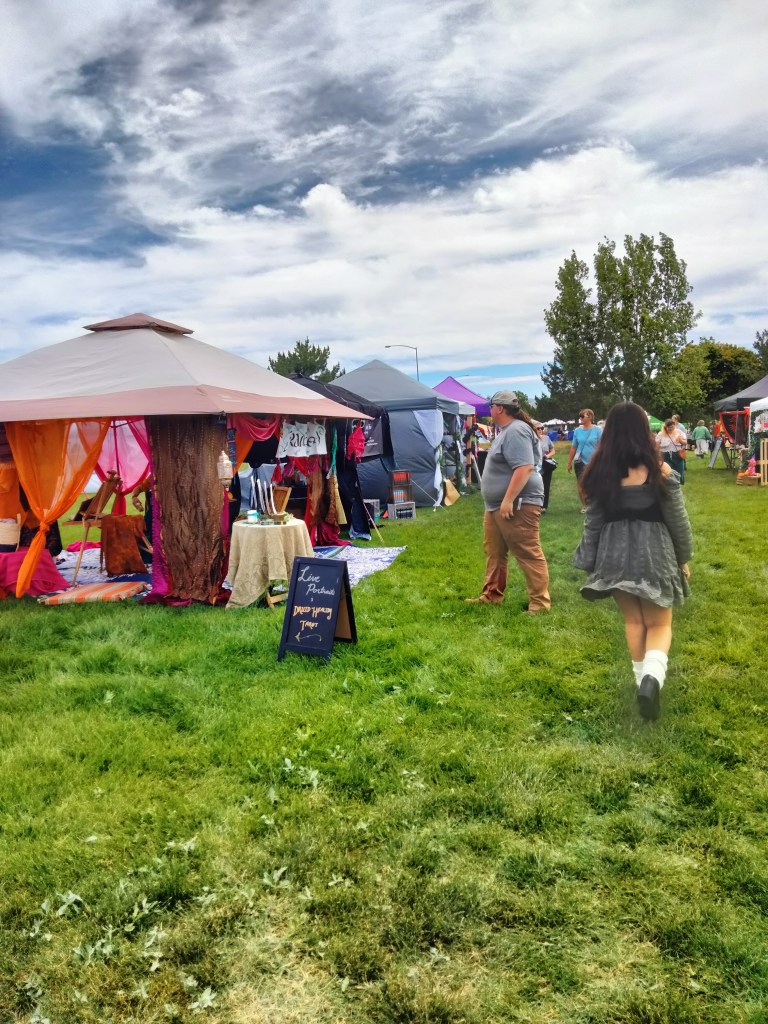
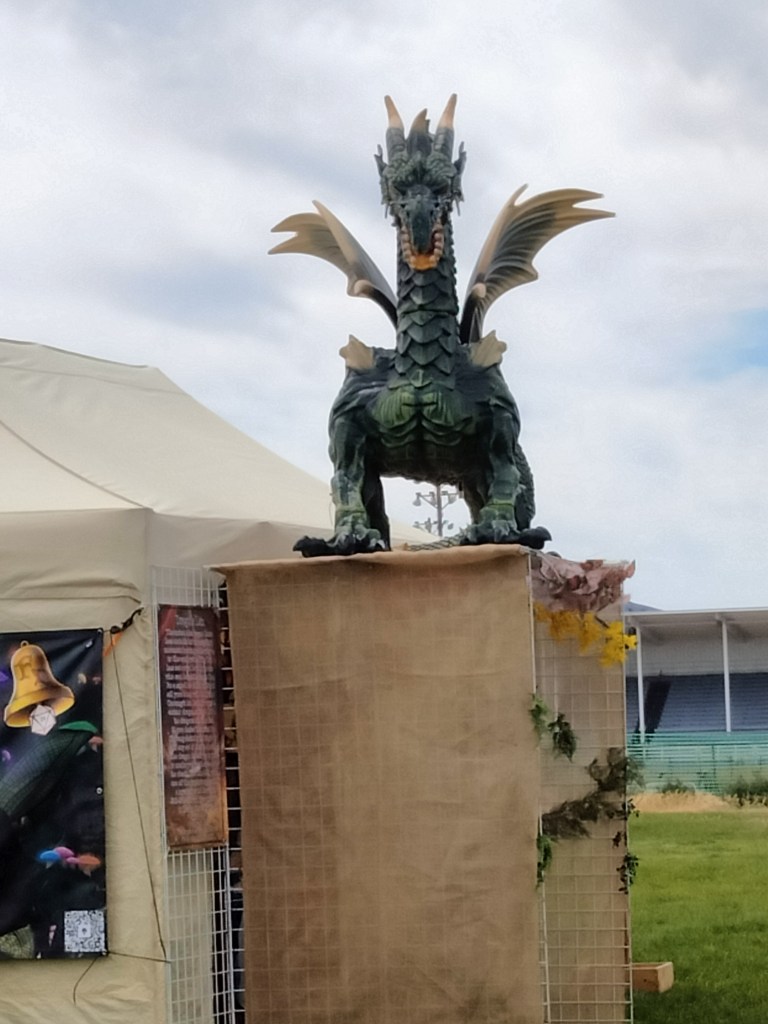

a smith

The position of village idiot is open… think I should apply?
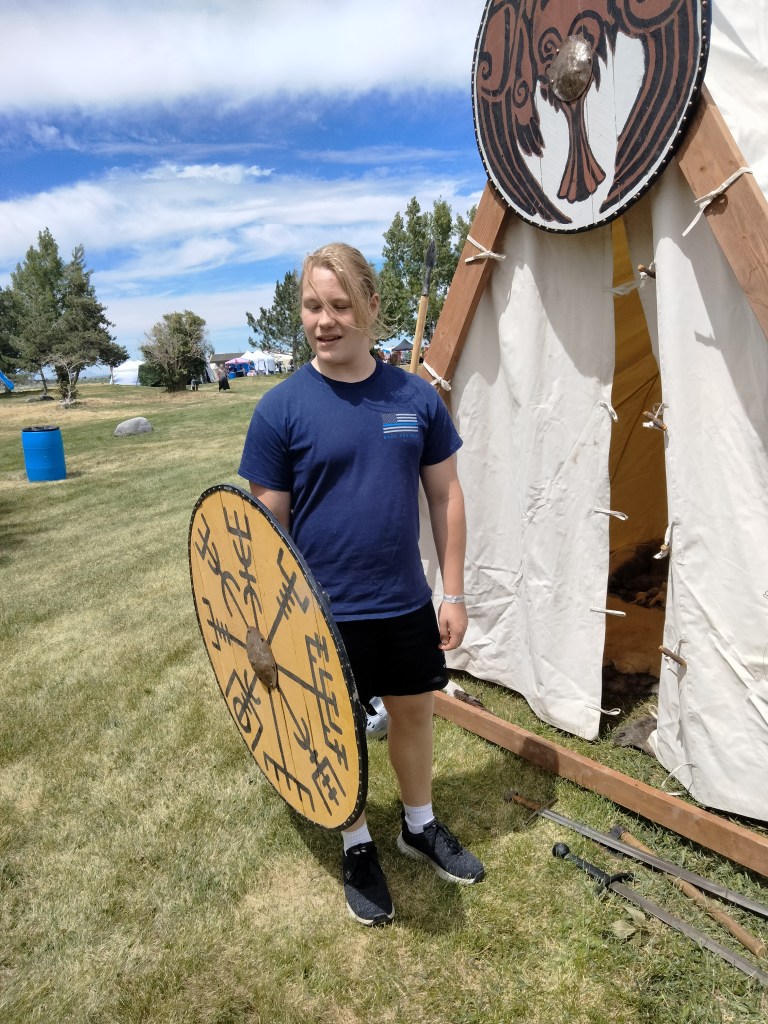
a viking

This man is working a lathe. The top end of that string attaches to the branch of a tree, so he doesn’t need another person on the other side to help him work it. Neanderthal woman is impressed at this technological leap.
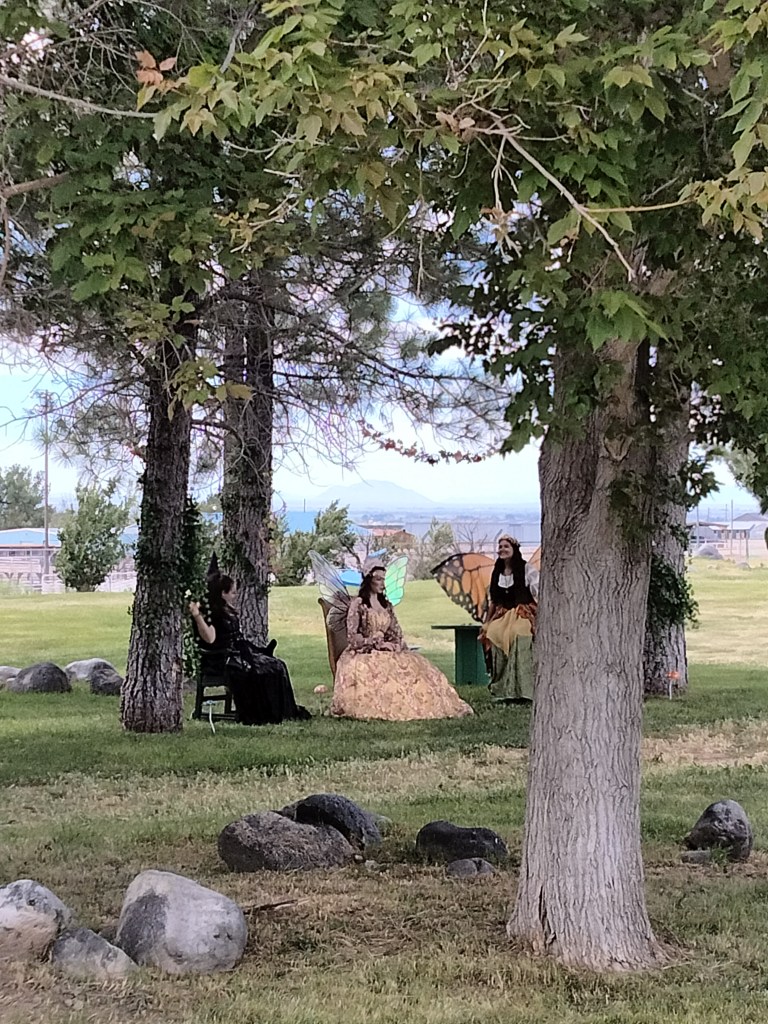
Big Southern Butte in the background of the fairy bower.
Meeting Other Authors
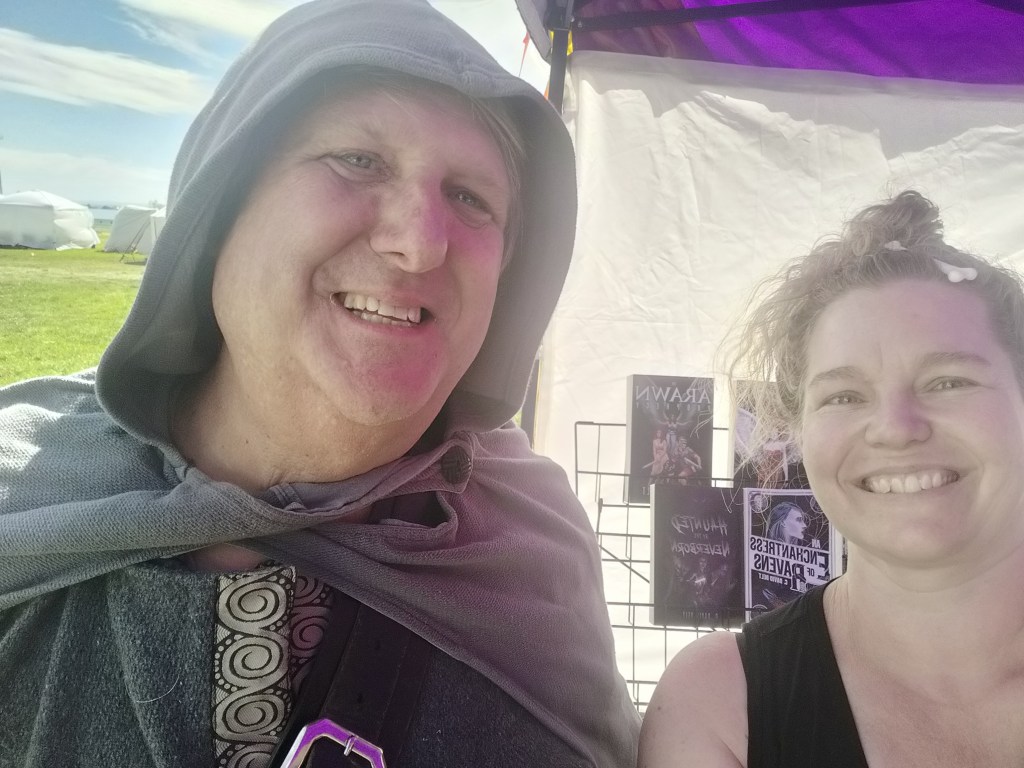
C. David Belt, who is taking his costume in a Scottish direction and was rocking a Scottish accent, is an LDS (Mormon) horror writer. Last year, I bought and reviewed his book The Sweet Sister. This year, I bought his Lilith trilogy. Here he is signing them for me.
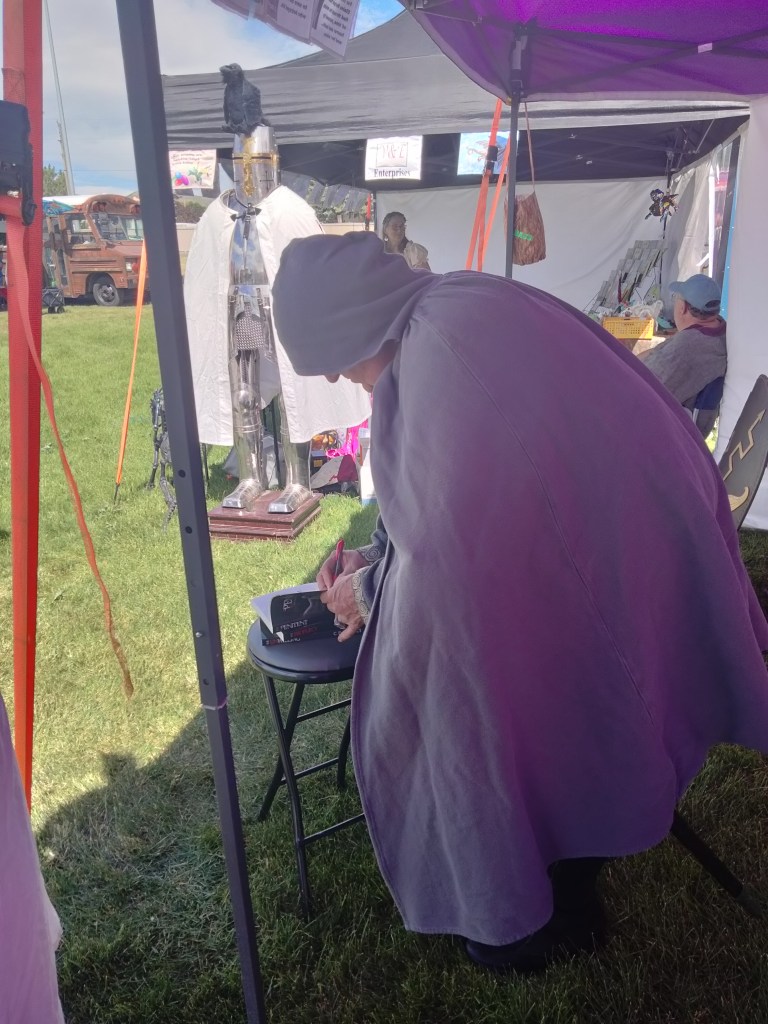

Here’s his booth. This man sat in front of his booth and sang ballads, off and on, for six hours.

J.M. Cullen is a new-to-me writer with a particularly photogenic costume. I bought his duology that involves time travel to the waning days of the Mayan empire. So far, I have bought far more books than I’ve sold. Hopefully, that will come back around to me. But even if it doesn’t, I now have a lot of great summer reading material.
This Meta Mystery has me in Stitches
… Of course, there’s a whole lot of this book to go, and so you already know that means that either Royce is wrong [about who the murderer is], or he’ll be killed before he can tell me. I will refrain from stating my preference on this particular matter.
-Benjamin Stevenson, Everyone on this Train is a Suspect, pp. 130 – 131
Goodbye to the Chubby-Girl Genre

Hi, everyone. I still have a low fever plus the muzzy head and joint aches that go with it, so this post should be … interesting.
Within the last week I finished the book above. If the Shoe Fits is a sort of very loose Cinderella re-telling. The heroine’s name is Cindy. She has a stepmother and stepsisters. They are not hostile to her as in the original story — they are actually quite affectionate — but they are gorgeous, thin Hollywood babes, very much in the T.V. world, and Cindy is plus-sized, so there are some hints that things were a bit rough in high school. The handsome prince is the heir to a fashion empire. Cindy has just graduated from fashion school, with a special interest in shoe design. As you can see on the cover, the author does manage to get her into an outfit that parallel’s Disney’s Cinderella. And yes, there are crystal-covered shoes at one point. (No, she does not lose them, though I was waiting for that.)
O.K., those are the similarities. Now, the differences. This book takes place in the fashion world and in the world of reality T.V. Cindy and Henry must get to know each other while they are both contestants on a show that is obviously The Bachelor (a show whose producer is actually Cindy’s stepmother). So, all of this is pretty different from a fairytale.
A Sensible Story of Chub
If the Shoe Fits was written by Julie Murphy, who is also the author of Dumplin’. I have not read Dumplin’ but I did see the movie. This book, I would say, has the same strengths and weaknesses as the ones I noticed in Dumplin’.
First, the strengths. Both books feature a romantic heroine who is fat. In both cases, the amount of self-pity that gal displays is very low. This is so refreshing. Plus-sized girls need role models who are not whiny and self-obsessed. Dumplin’ is in high school, so she has a few more issues with her weight than Cindy does, and it’s shown how this leads her to be unfair to her naturally thin best friend. Cindy notes that she has gotten catty comments and the like, and it’s hard to find a variety of clothes in her size, especially in the fashion world, but for the most part she’s confident and she displays no envy or hostility to the more Barbie-like women who are also contestants on the T.V. show. Finally, in both books there is an attractive male romantic interest who seems to really like Cindy or Dumplin’, and this is accepted as a matter of course. There’s no insulting discussion along the lines of, “I like you even though you’re fat because …” blah blah blah. Is this unrealistic? Maybe. But remember, this is a romance genre, so it’s a fantasy for women. Also, some guys are attracted to women who would consider themselves fat (correctly or incorrectly). Finally, whenever one person says to another, “I like you even though …,” I would say that’s a red flag. Unless it is Mr. Darcy speaking, it probably means the “even though”-er feels superior to their prospective romantic partner, and expects that they will be able to treat them badly.
The Less Sensible Part
So, those are the strengths of each book. The downside? Both books have a subtext that being fat is just like being gaaay.
In Dumplin’, the heroine has warm memories of “Dolly Parton parties” that she and her beloved aunt used to have. Later, she finds out that her aunt was longtime friends with a whole bunch of drag queens who are also huge fans of Dolly. The drag queens, and their theatre, are a safe space for Dumplin’ and they help her prepare for the beauty pageant. So, a major theme of Dumplin’ seems to be that drag queens are kind, safe people who make great mentors. We have found this not to be true.
In If the Shoe Fits, we have Jay.
“Jay?” Henry calls.
A beautiful person with short, perfectly edged lavender hair, a manicured beard to match, razor-sharp eyeliner, and nude lipstick rounds the corner. Jay wears a flirty skirt with a cropped sweater topped with a trench coat and platform sneakers.
“This is Jay,” says Henry.
“Follow me,” says Jay as Henry helps them down from the stage.
So, Jay is a basically a very lost and confused young man whom the author insists on calling they throughout the entire book.
I realize that what I’m about to point out is well-trodden ground, but I’m going to tread it again.
How do I know Jay is a young man? He has a beard, and he’s “beautiful.” If Jay were a young woman who had been taking testosterone, he would be overweight, balding, with acne, and the beard would be scraggly. So, my instinct is that Jay is a young man. I pictured him that way as soon as the character was introduced, and I continued to think of him as “he” throughout the book.
As a mom, I really feel for Jay. I’d like to just give him a hug and a cup of tea, and introduce him to some genuinely good father figures so he can see there’s nothing wrong with being a man. Jay needs Jesus. And yes, I realize all the real-life Jays out there would howl with indignation if they were to come to this blog and see me say that. They can only interpret “You need Jesus” as a condescending slam, not a genuine expression of love and concern. People have been reacting that way to the name and message of Jesus for 2000 years. I don’t know who needs to hear this, but just because that is your reaction right now, doesn’t mean it has to be that way forever.
Second well-trodden point: go back to the quote above and look at Jay’s outfit. A flirty skirt with a cropped sweater – already sad on a man – but the trench coat and the sneakers take the outfit to a whole new level. That level is chaos. Jay has selected for himself an outfit that screams, “I have no idea what’s going on or what or who I want to be, and I want you to admire this chaos and join me in it.” Yes, this book does take place in the fashion world, which is notoriously in love with the weird … but Cindy describes a number of her own outfits throughout the course of the book, and they all make sense. No matter how creative Cindy gets with her outfits, they are integrated, coordinated, works of art, because Cindy knows what she is: a woman.
Finally (the most well-trodden ground of all) despite the author’s best efforts, it doesn’t really work to use the pronoun they for a character we already know. (They in the singular is fine in English, when it’s referring to an unspecified or unknown individual. When we have already met a character, that person is no longer unspecified.) For example, at one point Jay leads a group of dignitaries into the boutique, and then a little later they hop down from the counter they were sitting on. (Were all the dignitaries sitting on the counter? Or just Jay?)
Just Gotta’ Do It Myself
As someone who wears plus sizes, has a belly, and has in the past been fat, I like the idea of these chubby-heroine books. This is especially true since the majority of women in the U.S. are what the fashion industry considers plus-sized. But sadly, I think I’m done with the genre. The last chubby-heroine book I read tied confidence in a plus sized woman to female empowerment, and female empowerment to abortion, with a side advertisement for “spouse-sharing.” The one before that, a murder mystery, was tame by comparison, but it did include a bunch of little digs at white girls. I’m done.
I guess I will just have to write a chubby heroine into my own books … oh, wait, I already have!
Magya is a short, curvy mother of four who stepped out of the shadows to grab her own romantic subplot in my book The Strange Land. She was pregnant when her husband was tragically killed. Another member of the tribe stepped in to care for Magya and her children, and he found himself falling in love with her as she went through pregnancy and grieving and the hardships of a Siberian winter. He spends the year sitting on his hands so as not to bother her, and by the next year, they are married.
Sari is also a mother of four and a larger lady, but her story, in the same book, is much more tragic.
Don’t go to my novels just for the chubby girls, of course. Go for the survival and the demons and the dinosaurs. But don’t be surprised if you encounter all kinds of women – and men – along the way. That’s what happens when we just write about life.
Nuts to the Grammar Snobs
“You want the difference between pulp and literature? Between a real writer and just a writer? I’ll tell you: adverbs.”
“Adverbs?”
“You use too many of them,” he said, derisively.
-Benjamin Stevenson, Everyone on this Train is a Suspect, p. 68
 Out of Babel Books