
[Ned, the serial killer] went down like a board, as stiff as a 2-by-10. [Pearl, the homeless lady] landed in the middle of his back.
I glanced at Pearl’s face, which was a mask of bruises. One eye was black, one tooth was missing, and a cut at the corner of her mouth oozed blood. She’d positioned herself in the middle of Ned’s back, and the gravity was sufficient to hinder the rise and fall of his chest.
She said, “Sh–. I think I broke my hip again, but right now I’m numb and it doesn’t feel like nothing.”
She bounced a couple of times and I heard an oof of air escape Ned’s lungs. She bounced again, though she winced as she did so. “What’s this here? What I’m doing. You’re a smart girl. I bet you know.”
“As a matter of fact I do. It’s called ‘compressive asphyxia,’ which is mechanically limiting expansion of the lungs by compressing the torso, hence interfering with breathing.”
“Hence. I like that. I’m setting here bouncing on Ned, hence making it impossible for him to draw breath. That’s what he did to them little girls, isn’t it?”
“That was his method of choice.”
Y is for Yesterday, by Sue Grafton, p. 487
Tag: genres
And I love those guys
… the man who serves his God with his whole heart is apt to forget his surroundings, and to fling himself so completely into his work that the whole of his nature comes into action, and even his humor, if he be possessed of that faculty, rushes into the battle.
Spurgeon, from Eccentric Preachers, quoted by Douglas Wilson in A Serrated Edge
Book Review: The Sweet Sister, by C. David Belt
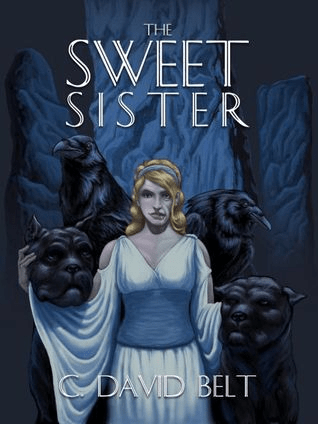
Fun story about how I discovered this book: I was at a Fantasy Faire as a vendor. A fantasy faire is sort of a like a RenFaire, but calling it “fantasy” opens it up to more time periods and more imaginative costumes. This Faire took place in southeast Idaho, so quite a few of the booths were from Utah. As I wandered the booths on the first morning, a banner on one of them caught my eye: “Strangely uplifting LDS horror.” In case you don’t know, LDS stands for Latter-Day Saints, which is the more respectful term for Mormon and what the Mormons usually call themselves. I am not Mormon, but I could not help but be intrigued by this advertising phrase. Horror, written by someone from a community that is mostly known for wanting to keep everything in life PG if not G? That’s going to be some interesting horror. Also, I do like my horror uplifting.
So, long story short, I missed meeting the author, but I bought the book. He has a lot of others, but I went for this one because it was a stand-alone.
The LDS horror did not disappoint. The opening scene takes place at fantasy convention, very similar to the event I was at when I started reading. (Nice.) The main character is LDS, and she is a tall, big-boned, plain-faced 30-year-old woman who has a secret crush on her handsome, also LDS, coworker. In short, a very relatable female lead. Being a lonely, not conventionally attractive 30-year-old woman is tough for everyone, but it’s even worse in the LDS community where there is so much emphasis on marriage.
So, the contemporary main characters are Peggy, whom you met above, and Derek, her crush, who is happy to go to conventions and watch fantasy and sci-fi movies with Peggy, but doesn’t like her “that way” and does not see her worth.
But very soon, we get into the spooky stuff. This is not exactly a time-traveling book, but it has characters who move through time by spending decades in a state of suspended animation brought about by eating an apple-like fruit from a magical tree. So, the mysterious, princess-like young woman on whom Derek gets a hopeless crush really is a woman from millennia ago who doesn’t quite know how to function in the modern world because she has been skipping through time.
I don’t want to give more spoilers than that, but let me just say that the research on this book impressed the heck out of me. The author has taken a deep dive into Celtic mythology, Arthurian legends, British/Roman history, and fairy tales, and he ties it all together. Although the main characters do not travel back in time, the story takes jaunts into the past to reveal to us the sleeping princess’s back story. We see how she gave rise to the “sleeping maiden” fairy tales like Sleeping Beauty and Snow White, but what actually happened was … much creepier. These reveals are tantalizingly done. They are not info dumps, and the whole story is not revealed until the very end.
This author takes a unique approach to paganism, one that I really appreciate. As a Mormon (which he understands to be a version of Christianity), Belt does not endorse the ancient Celtic religion and he doesn’t whitewash it either. He is perfectly willing to portray the darkness and terror and human sacrifice that come with Cernunnos and Morrigan. This is very different from most modern fictional treatments of Celtic paganism, which tend to portray the pagans as harmless, live-and-let-live, nature-loving types whose religion has no down side. However, although Belt mines paganism for horror, he passes the “love test” (the author must love the culture he’s writing about). He writes about the ancient pagans with sympathy and seems to understand their point of view. They are real human beings to him, and their gods are real entities.
And that’s why this horror is “strangely uplifting.” Unlike some horror writers I could name (ahem Stephen King), there are actually good, admirable characters in this book alongside the horror.
If you like fairy tale re-tellings, Arthurian legends, Celtic paganism, or modern-day horror, you might like this book. If you like all four, this book is definitely for you!
Phantasy Phaire Photos
Literally every person who passed by our booth was worthy of a photo essay, so these are just a few highlights.
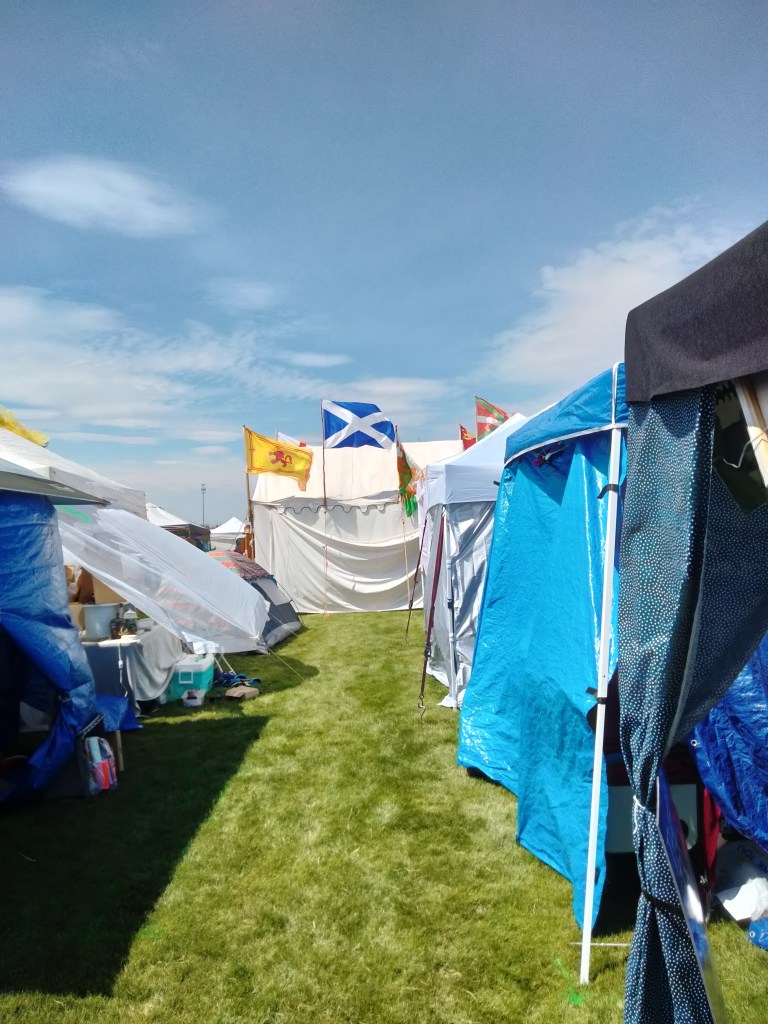
Here’s the alley behind the booths on Saturday. My son said, “It’s beautiful the way everyone shows up and sets up their own booth, and instantly there is a city where there was none before.” He’s eleven.
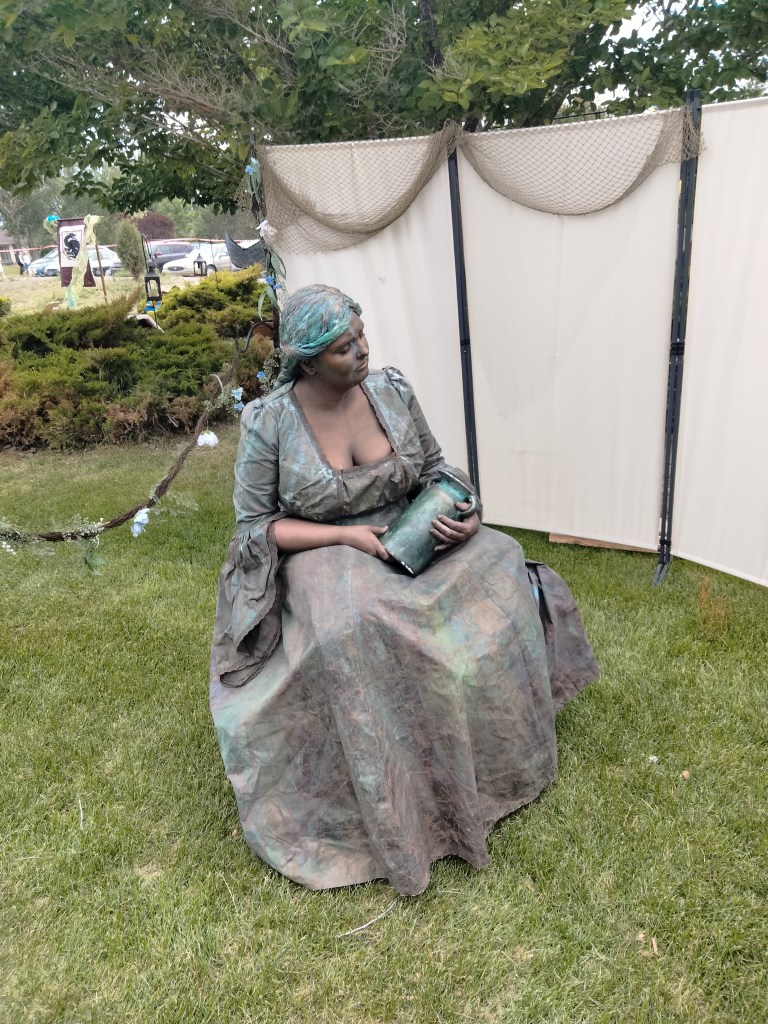
There was this “Enchanted Statue” who, when given a tip, would wink at you.
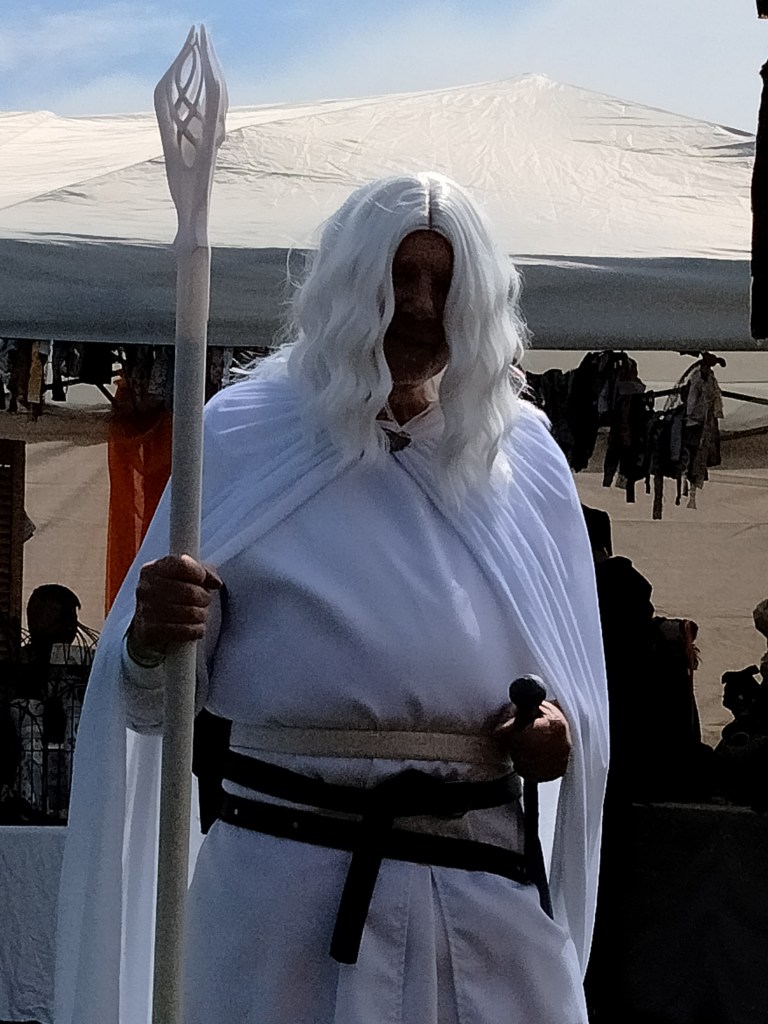
Gandalf the White showed up first thing on Saturday morning.
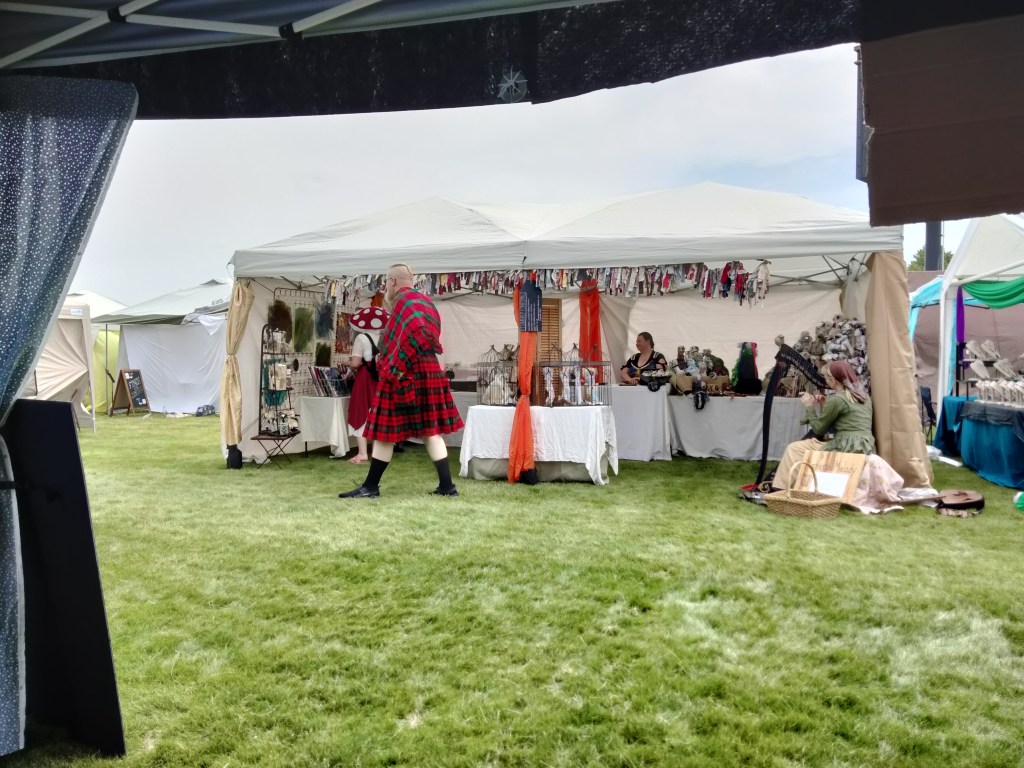
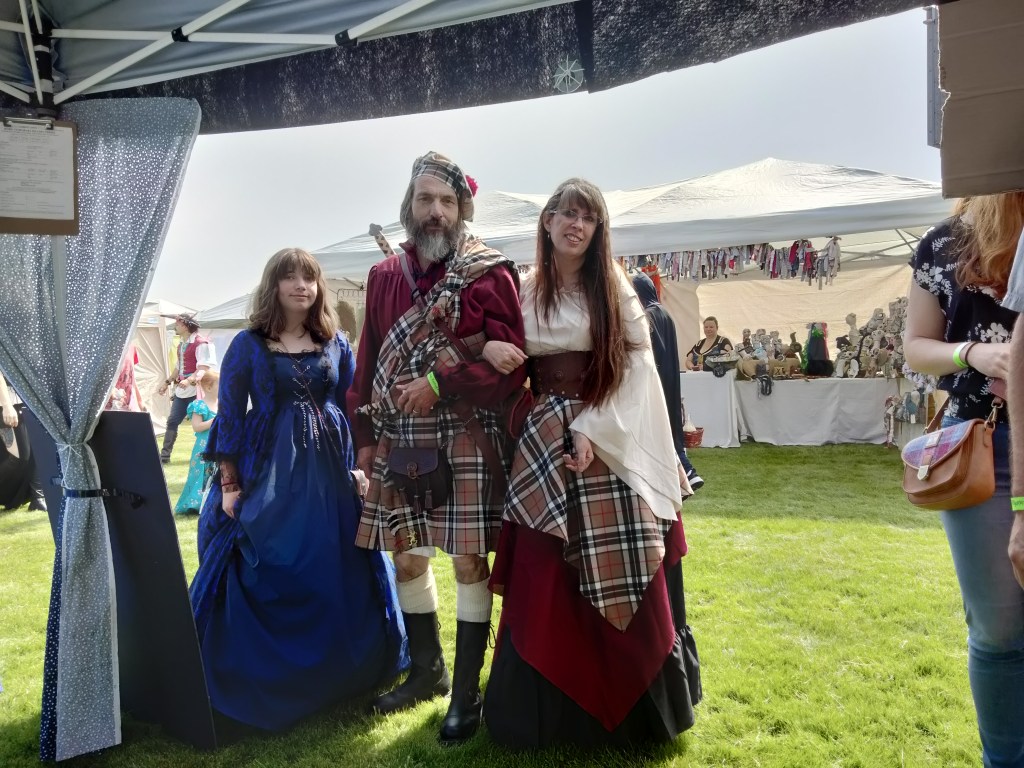

There were many Scotsmen and a few Scots women.

… one ogre …


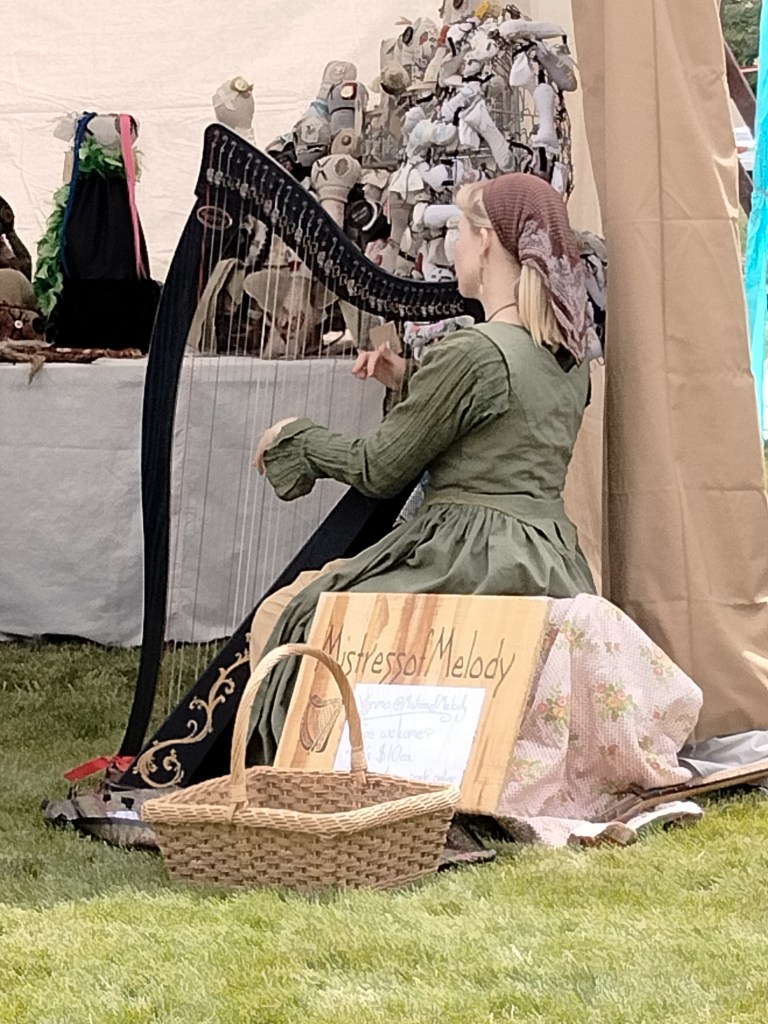
… musicians …
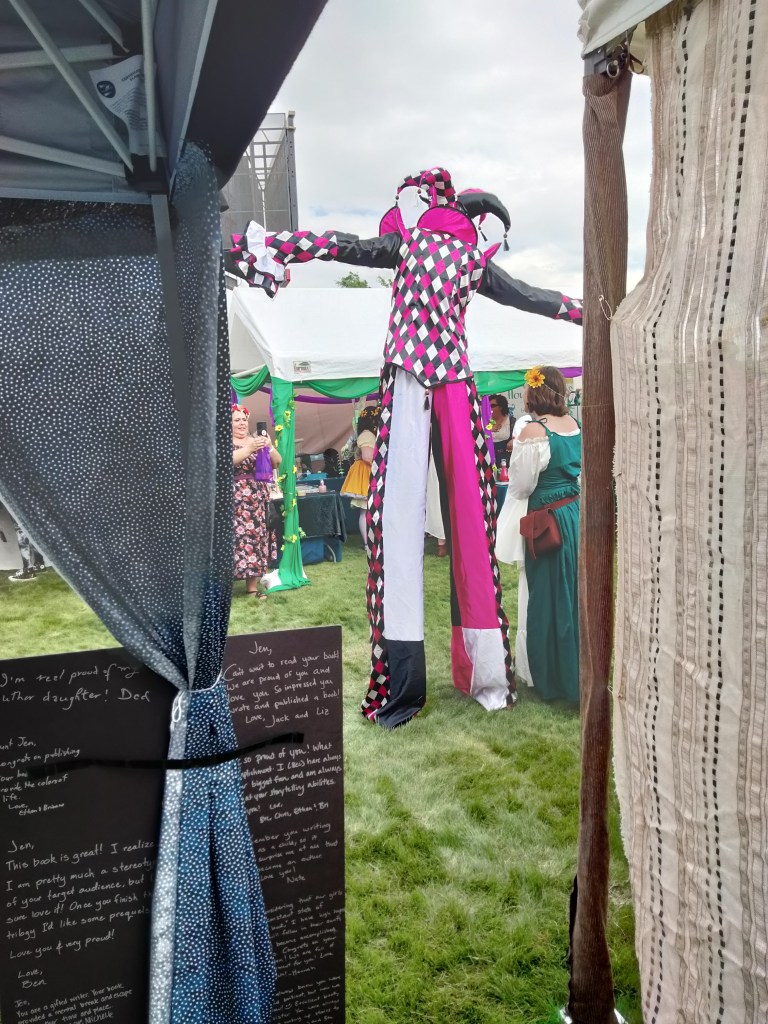
… jesters …

… mushrooms …
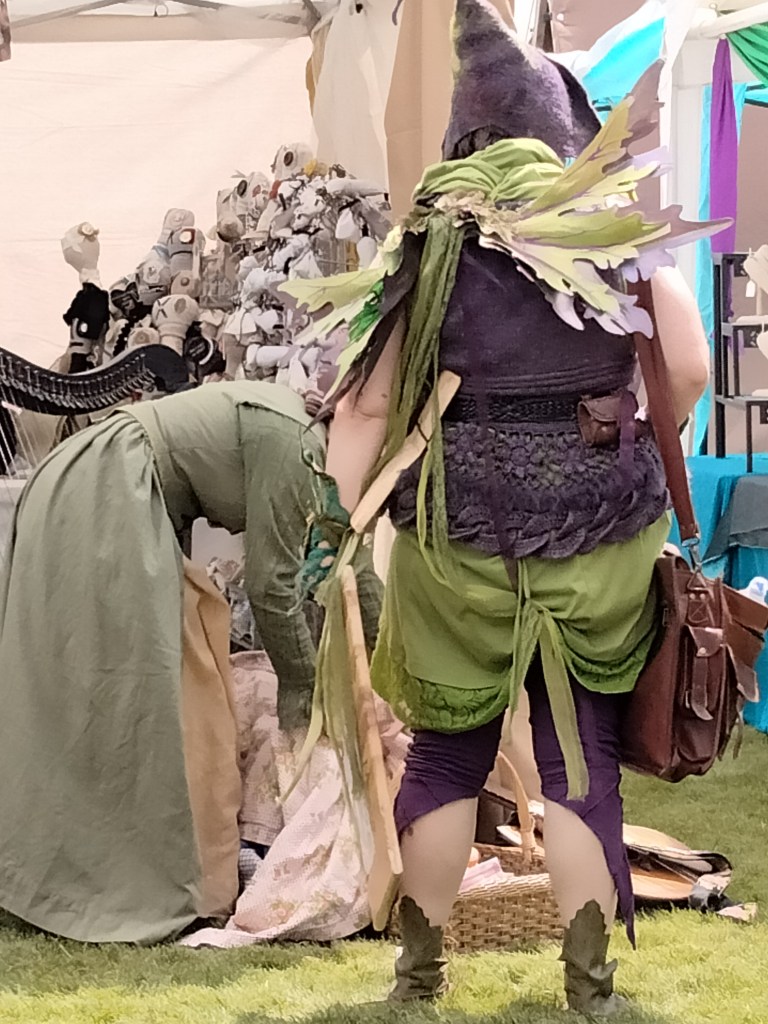
… elves …
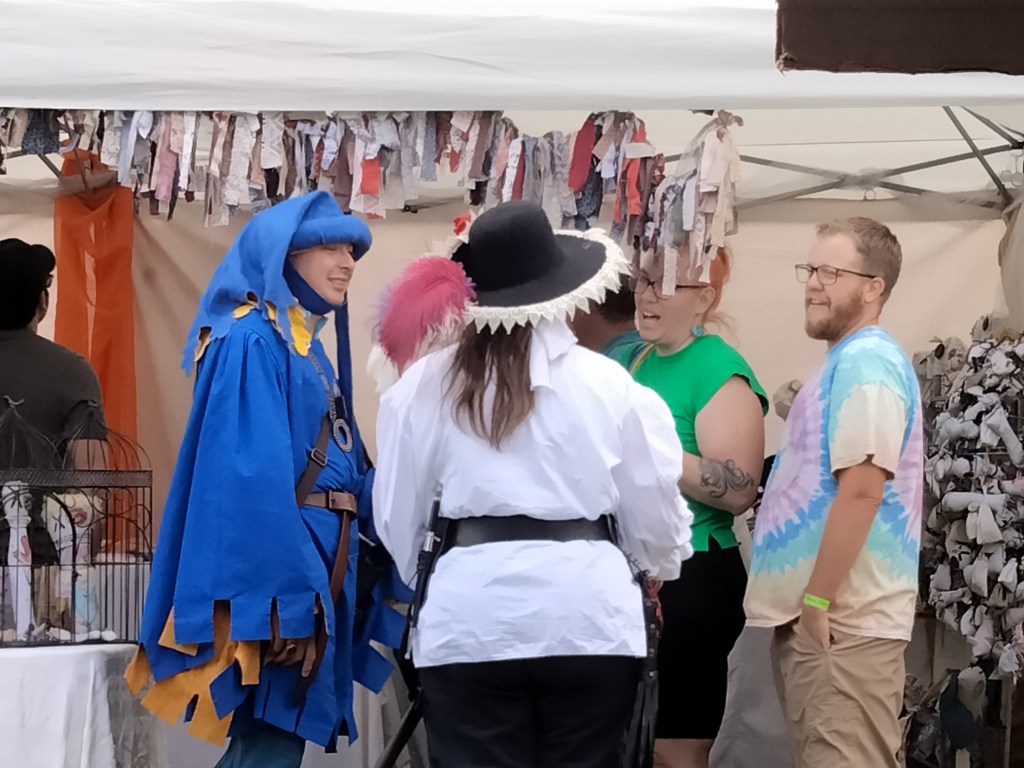
And quite a few pirates. The pirate with her back to the camera would, for $5, “arrest” a victim of your choice and parade them throughout the Faire, calling out “Shame the prisoner!” as they wore a placard stating their crime.

Here she is arresting a lady merchant whose crime was running out of fudge at her booth. The person who put her up to this was my son, who wanted to do everything.
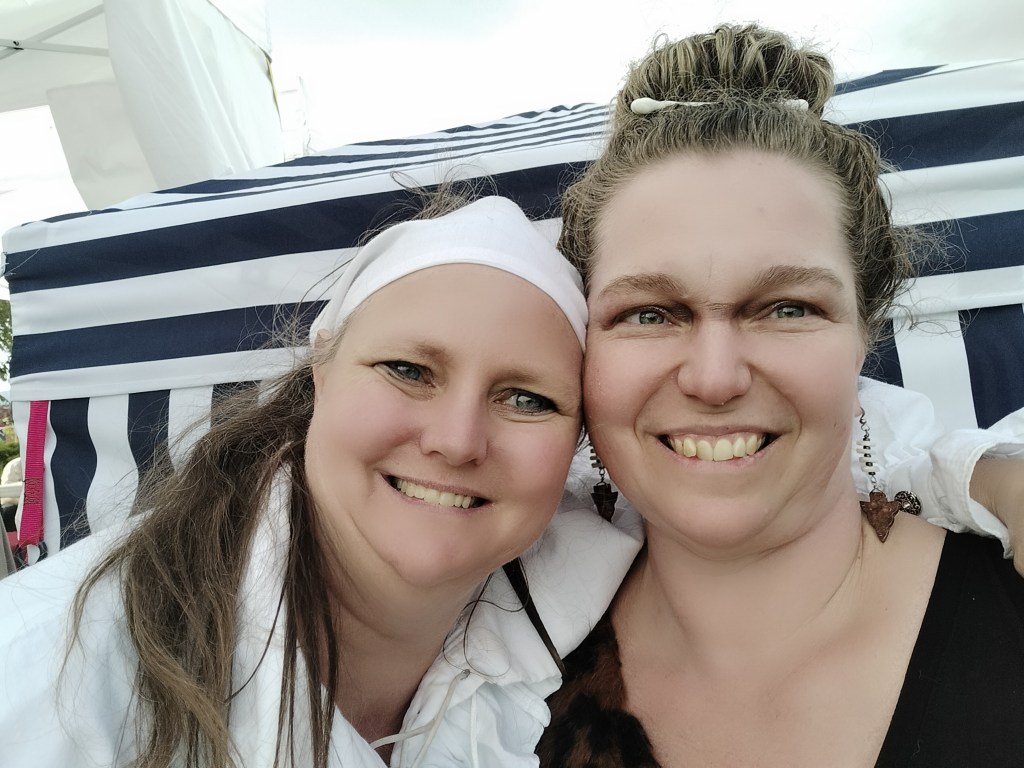
Ensuring that we became friends.

Here’s another friend, from the Pocatello Writers’ Group.
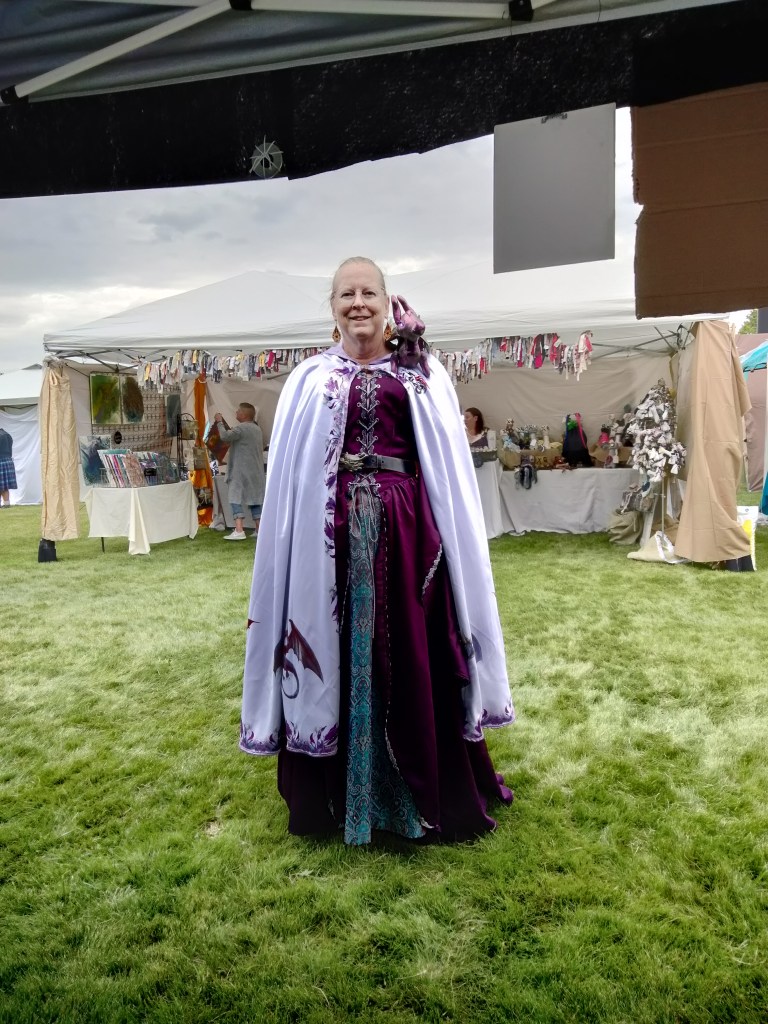
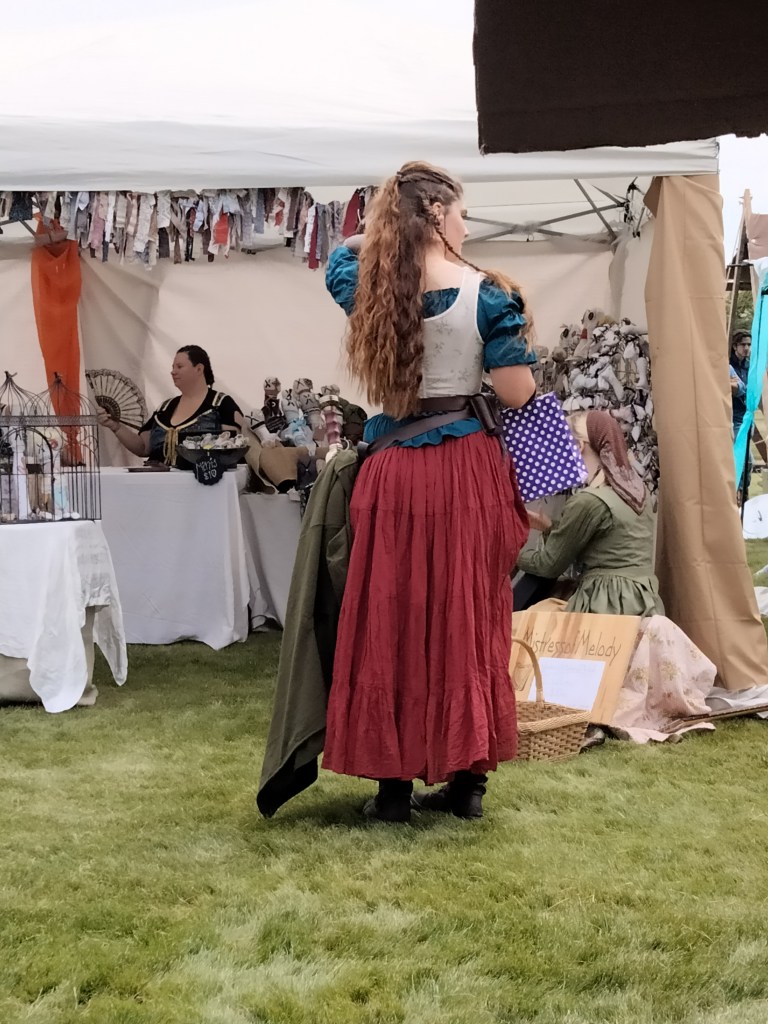
And some more people worth looking at.
One thing I regretfully realized after putting together this post was that I do not have a single picture of a knight or warrior. In fact, there were many of these fellows at the Fantasy Faire. A tall, portly warrior in Viking-style armor bought one of my son’s paintings. Also prominent were the Salt Lake City Crusaders, whose motto is “Real Armor. Real Weapons. Real Athletes.” They had a ring set up in which, twice a day, men in authentic armor battled it out. (I swear that, as I wandered by, I saw one armored guy hitting another armored guy on the helmet with a frying pan.) These warriors would periodically come striding through the Faire, but they always walked so fast that I never got a picture. Plus, I guess, there were so many armored men about that I just took them for granted. But, let the record show that they were there.
Special Summer Event
https://mysticrealmsfantas.wixsite.com/mysticrealmsfair
That’s right, folks, on June 17 and 18, my son and I will be vendors at the Mystic Realms Fantasy Fair at the Bannock County Fairgrounds in Pocatello, Idaho! We’ll have a 10×10 booth, which we are working hard on making its appearance authentic.

Looks pretty modern still. Got a lot of work to do.
My son will sell the Galaxy Rabbit paintings that he has become known for, as well, as other night-sky-themed art:
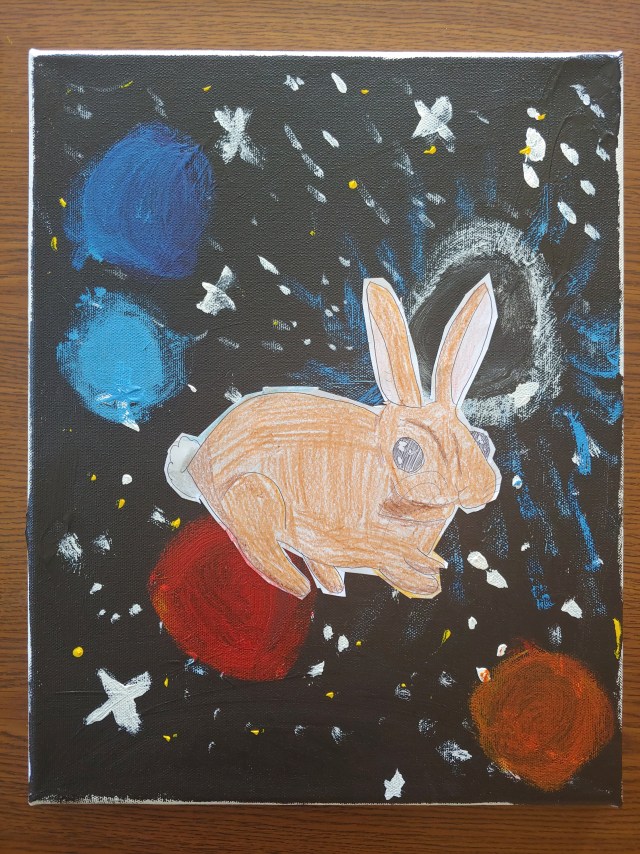

I, of course, will sell hard copies of my trilogy

and the character art that you can see on my Art page.

I don’t own an authentic medieval or Renaissance period costume, but luckily, the organizers have dubbed it a “fantasy” fair rather than a “medieval” or “Renaissance” fair. This leaves wiggle room for vendors to dress as fae, mermaids, pirates, or … ahem … cave women …

Come if you can!
Killers of A Certain Age: A Book Review

Three stars.
I picked this up with moderately high hopes. The protagonists are all sixty-year-old ladies who spent their youth as private assassins. I thought there would be more old-lady thoughts, but in the end, they mostly seem like 21-year-olds in 60-year-old bodies. So, the character development and themes disappointed a bit.
What did not disappoint was the research and the plot. Unlike some novels, where the premise is only half-developed, this one takes us on a very thorough ride. We get to see how the ladies got recruited, how they got trained, and to see a number of hits they did in their youth, in exotic locations throughout the world. These interleave with hits they are carrying out now, in their old age, in self-defense. There is not just one but many tense, intricate, detailed climatic action scenes. And it all works together into one big, overarching tale of betrayal. It’s like not just one, but all of the Mission: Impossible movies, in novel form. If this had billed itself just as a thriller, then these factors alone would cause me to give it four or five stars.
But unfortunately, the cover and premise promised not just Thriller, but a study of what it’s like to be a woman of a certain age. Have your goals changed? Do you miss what you were able to do in your youth, or are you content with that and ready to move on to something else? Have you left a legacy? Had any children? Are you ready to go?
No, none of that. One of the four women has married, but the only effect of her recent widowhood is to make her lose her nerve in survival situations. Another has married another woman; another is still chasing younger men at sixty. Meanwhile, the main character, Billie, never married or had children.
He was six years older than me and ready to settle down, build a life, make some babies. And no matter how hard I tried, I couldn’t figure out how to make myself small enough to fit into that picture.
page 309
So, Billie, you think making and raising people is a small life, huh? It is sooo much smaller than your life of traveling around the world killing people. You couldn’t reduce yourself to being a mom.
This quote pretty much encapsulates the book’s shallow yet heavy-handed feminism, and it is the reason I have bumped it down to three stars.
Puddleglum is a Scottish Presbyterian
“Why the dickens couldn’t you have held her feet?” said Eustace.
“I don’t know, Scrubb,” groaned Puddleglum. “Born to be a misfit, I shouldn’t wonder. Fated. Fated to be Pole’s death, just as I was fated to eat Talking Stag at Harfang. Not that it isn’t my own fault as well, of course.”
The Silver Chair, by C.S. Lewis, chapter 15
Book Review: The Brides of Maracoor
This book was a pleasure to read.
This review was originally posted by me on Goodreads and has been edited for clarity. The book is by Gregory Maguire, the author of Wicked, and is part of the same universe. It is the first book by Maguire that I have read. I gave it four stars.
The prose is almost like poetry, but not purple. Not hard to plough through; it draws you through. The psychology is amazing. So is the portrayal of a sort of ancient-Greece-based world. I picked up this book for the brides, who are sort of like pagan nuns (Vestal Virgins?) living all alone on a remote island, performing bloodletting and weaving rituals in order to guard a sacred artifact.
Every morning, the “brides,” who range in age from ten to about eighty, troop down to the seaside where they use sawgrass to cut crosshatched lines into the soles of their feet. Then they sit with their injured feet in the salt water and tie seaweed into a net. This ritual supposedly “weaves time” so that the world can go on. The brides are almost entirely self-sufficient, keeping gardens, goats, chickens, and an orchard. None of them have ever seen the mainland. They are brought to their island, called Maracoor Spot, as babies. There are always seven brides, so whenever one dies, a baby is brought to replace her.
The way Maguire introduces all this information is magical, as if he were weaving a spell. There are lyrical (but not sappy) descriptions of the island’s weather, the sea, the rain, the clouds, interspersed with descriptions of the brides’ suffering at their morning ritual. This slowly expands to show us their names, ages, personalities, and daily routines. They sleep in the outer part of a small marble temple, the inner room of which houses the terrifying artifact.
By the time Maguire was finished showing us the brides and their way of life, I was hooked. I knew I was going to finish this book.
The moral lessons, at least to which the story seemed to be heading, weren’t ones I could completely get on board with, however. So now let’s to spoiler town (though I should add that there are vast swathes of this book I haven’t addressed, so this is not a complete spoiler).
Rain, who seems to be the character we are most supposed to identify with considering that she is the one who comes from a beloved earlier series, makes the argument that Acaciana (“Cossy”) can’t be tried for murder because she is a 10-year-old child who has been raised in the very restricted environment as a Bride of Maracoor, not having a natural family, not having been given any chance to develop a conscience. She argues that the whole setup with the brides living on an island and ritually mutilating themselves every day, in service of the country’s religion, is inherently unjust and oppressive, and thus Cossy can’t be expected to know right from wrong.
It’s true that there are some troubling things about the “brides,” who are brought to the island as foundling babies and know no other life, being deprived of the chance to marry and have families and live in normal society. However, I can’t tell if this is a critique of ancient pagan customs such as the Vestal Virgins, or of there being traditions or religion at all. Obviously some religious customs are more oppressive than others. The brides are better off on Maracoor than if they had been made into temple prostitutes, for example.
It’s also not entirely true that Cossy was raised without any family at all. Cossy had a grandmother figure in Helia, who did some significant parenting, both good and bad. She had a sister in Scyrilla, and aunts in the other brides. Though there are only seven of them, the brides form a definite human society, with all the benefits and problems that come with that.
This raises the other point that Rain overlooks: no one gets to choose what family, society, or social station they are born into. The brides’ life might be more restricted than most people’s, but no one’s life is completely unrestricted. No one has infinite choices, and everyone has obligations placed upon them that they didn’t choose and don’t at first fully understand. These can be just or unjust, and we can argue that on the merits. But we should remember that they are not unjust simply because they are restrictions, obligations, and unchosen. Since the brides are all foundlings, we can assume that if they had not been brought to the island of Maracoor Spot, they would have either died of exposure (the fate of so many unwanted Greek and Roman babies), or been raised in some kind of institutional environment like an orphanage, where their lives would have been just as restricted, but without any sacred purpose.
Actually, I happen to agree that Cossy isn’t entirely responsible for the murder she committed, but it’s not because she was raised in an odd, isolated environment. It’s because Helia, her beloved grandmother figure, implicitly encouraged her to do it, told her exactly how to do it, and almost physically walked her through the steps. Helia is morally responsible, not only for the death, but also for taking an impressionable ten-year-old girl who is curious about death and making her into a murderer … and then throwing her under the bus. I don’t blame “the system,” I blame Helia.
That said, you can’t argue that Cossy absolutely did not know right from wrong or that she was in no way responsible. Witness how she falls apart after the death. She knows that she has done a terrible thing from which there is no going back. If she herself had not really committed murder, thus really changing her own character, then what Helia did to her would not have been such a terrible thing.
This book ends on a bit of a cliffhanger. There are lots of unanswered questions, such as the nature and fate of the Hammer of Mara, whether Maracoor is going to continue sliding into paranormal chaos, and whether Rain is going to get back to Oz. For me, there are also unanswered questions about Rain’s back story, though I suppose those answers are already known to faithful readers of Maguire’s previous books.
Honor’s Reserve by Michael La Ronn: A Book Review

I’m sorry. This just did not hold my attention.
More than a year ago, I read Phantom Planet, which is the second book in the Galaxy Mavericks series but came out before the first one. Near the end of that, Grayson, the main character in Honor’s Reserve, shows up to rescue Keltie (he’s in the space equivalent of the Coast Guard). At the time, the vibes I got were definitely eyebrow-raise-what-have-we-here-man-in-uniform-potential-romantic-interest-alert. So it’s disappointing to find that Grayson’s back story is, so far, more boring than Keltie’s.

I don’t have a problem with the fact that this space opera takes liberties with science. In fact, the author includes a hilarious disclaimer at the beginning announcing that he is planning to do just that. Some other Goodreads reviewers actually DNF’d this book because of perceived inaccuracies with hyperspace travel and the like. I would just like to remind my fellow science-fiction readers that hyperspace travel, no matter how convincingly it is “explained,” is FICTION. Travel that even approaches the speed of light probably physically destroys the object traveling. All hyperspace travel is fiction. So is evolution. And boy, is there some fictional evolution in Honor’s Reserve!
Scientists think that the nanocraft [carrying a selection of DNA from humans and various animals] collided with an asteroid that had some kind of molecular life on it, and that that asteroid crashed onto an Earthlike planet that supported carbon life. The two life forms mixed, rapidly evolved, and Arguses were born.
Honor’s Reserve, p. 36
Arguses are aliens that basically have human bodies and the heads of pigs. And this entire, intelligent species evolved in … how long? “Nine hundred and fifty years.” Actually less, if you count the transit time for the nanocraft. Wow, that really gives a new meaning to “rapidly evolved.” But frankly, if you look into molecular biology, an intelligent species evolving from bacteria at all is just as unlikely as it evolving in 950 years. So, why not? Remember, this is science FICTION.
I also don’t mind the things in this series that might be considered anachronisms. The year might be in the 3000s, but human nature remains the same. So, Grayson and his fellow crewmembers getting onto a private spacecraft and giving it a bureaucratic-style safety inspection seems refreshingly realistic. I’m sure bureaucracy is not going to decrease with the advance of technology. And, perhaps my favorite moment in the book is when the heroes are trying to jump into hyperspace to escape the villains, and the computer keeps asking them, “Are you sure you want to jump into hyperspace?” and making them click a bunch of permissions, causing them to get caught by the people chasing them.
So then, why did this book keep losing my interest and why did I nearly DNF it at about 40%? Maybe it’s something about the writing. Although I am willing to put up with unrealistically easy jumping into and out of hyperspace, I do like the logistics of my action scenes to be nice and clear, and in Honor’s Reserve, they often weren’t. For example, it was sometimes not clear to me that a character had put their helmet back on (or never taken it off) before, say, the airlock was depressurized. That seems kind of important. There’s a scene near the beginning where Grayson is holding on to the outside of a space ship (or the edge of the airlock door, which is open? Not sure?) where the logistics were just not clear. The scene moved too fast. Show, don’t tell is great, but sometimes with sci-fi we need a little telling, or the scene actually loses drama.
Speaking of losing drama, there was definitely some untapped potential for character development here. I am speaking of Rina, the female villain of the story. [spoilers ahead] She is found to be human trafficking: helping the odious Arguses to kidnap people so they can enslave them. Then we find out that she is doing this in exchange for a promise from the Arguses to protect her and her family. She was at first enslaved, and she has the burn marks to prove it. Well, even if it’s not ultimately excusable, this seems like a pretty understandable motivation. It might bear looking into a little further. Rina has evidently been through some pretty heavy trauma recently and is in a desperate situation. We might want to examine that, no?
No. Rina is consistently portrayed as a sociopath. “You can’t trust anything she says.” She even comes right out and says, “It didn’t really bother me to enslave a bunch of other people, as long as it wasn’t me.” So Rina is thoroughly bad and we can safely hate her and turn her over to the Arguses.
Even this character arc might have been OK if it had been written with a little more complexity: if, say, Grayson had been tempted to feel sorry for Rina when he heard her tragic back story, had tried to turn her, and had then been double-crossed and we find her doubling down on her evil. But that’s not how it goes down. It’s as if Rina is barely a character at all.
To sum up: a bland, one-dimensional villain (and consequently, hero); aliens that don’t seem spooky, just like grosser, evil-er people; and action scenes that sometimes felt rushed and inadequately explained are all the reasons that I found the author’s notes at the end, about his philosophy of space operas, much more interesting than the book itself, and the reasons I am sadly giving this book two stars.
I will say that Phantom Planet, while it had some of these same problems on a smaller scale, was better than Honor’s Reserve. It had some spooky, unexplained things that promised more terror later in the series. I might give this series one more book before I give up on it.
Reminder: The Great Snake goes on sale Next Week
Pre-order your copy on Amazon or Barnes & Noble for a summer beach read.
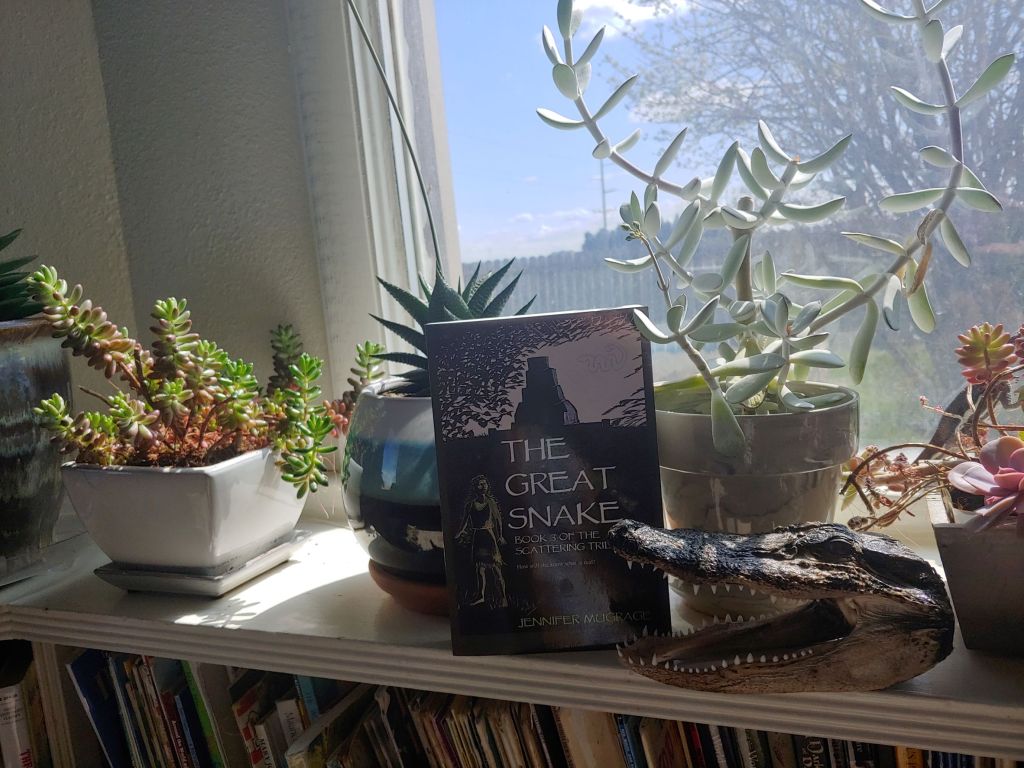
Here is the book in its natural environment.
As you can see, we are going for more of a subtropical vibe here, with succulents and a mini gator’s head from Florida.
Here’s the back cover copy:
As a child, Klee crossed the Land Bridge with her tribe, and she grew to womanhood in ancient North America. Once a teenager, she makes the shattering discovery that she isn’t who she thought she was. The people who raised her are not her real parents, and her birth father, a charismatic, maimed man, wants her to go with him to found a city dedicated to his snake god. After what she has just discovered, how can Klee know whom to trust?
The Great Snake takes up the epic journey that began in The Long Guest, continued through The Strange Land and now wends its way to the evocative and shocking conclusion of the Scattering Trilogy.
 Out of Babel Books