
“I’m telling you this mostly so you won’t try to hang any murders on Kingsley that don’t belong on him. If there is one that does, let it hang.”
“Is that why you’re telling me?” he asked.
“Yeah.”
“I thought maybe it was because you hated my guts,” he said.
“I’m all done with hating you,” I said. “It’s all washed out of me. I hate people hard, but I don’t hate them very long.”
from The Lady in the Lake, 1943, by Raymond Chandler
Tag: genres
Cover Draft for The Long Guest
It’s Monday! Time for some art!
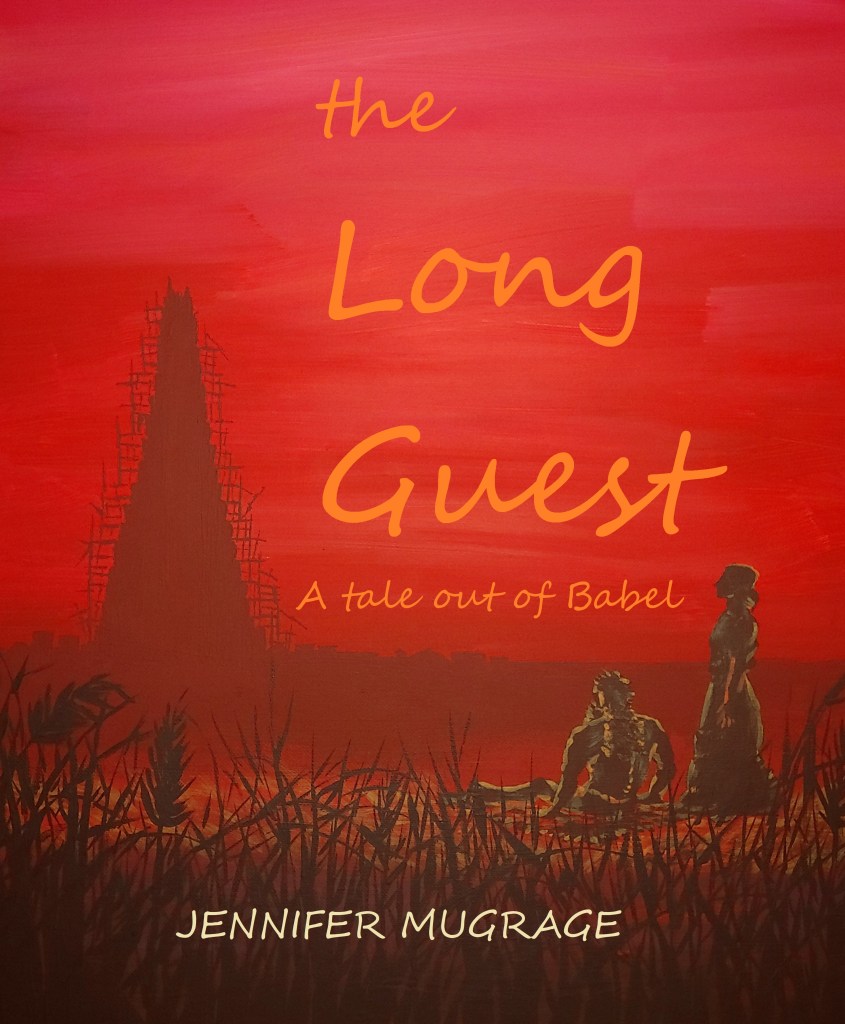
Today I present my mock-up for the cover of The Long Guest.
What is Normal for the Genre
TLG is in a genre of epic sci-fi/fantasy that is light on magic. Often books in this genre have an evocative landscape on the cover, to draw you into the world of the book. For example, this copy of Ursula Le Guin’s Left Hand of Darkness shows the icy landscape through which her characters travel …

On this cover for S.M. Stirling’s A Meeting at Corvallis, there is a lot of detail to show exactly what sort of world is contained in the covers. The broken asphalt and the ruined skyscrapers in the background show that this is a post-apocalyptic world. Meanwhile the horse and buggy, and the main character’s battle axe and chain mail, show that in this world, we use medieval technology. Finally, the man’s battle gear leads you to expect combat.

Often books in this genre will show one or more main characters, usually in only a semi-active pose. This particular one, unlike some of Stirling’s other books, shows the character face-on. I don’t prefer this as a reader, because I prefer to form my own mental picture of the character.
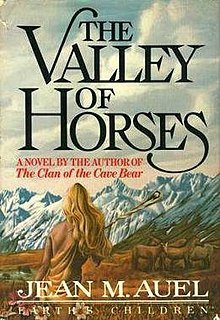
A good example is this copy of Jean M. Auel’s The Valley of Horses, which shows Ayla from behind. We’ve already been told that Ayla is tall and blond, so this doesn’t do too much damage to our mental picture of her. Notice the other hints at the important parts of the plot: the wild horses, the rugged mountains, and Ayla’s sling.

So I would like the cover of The Long Guest to look something like this. Nimri (sitting on the ground) and Zillah look at the unfinished, scaffolding-covered Tower. Grasses in the foreground hint at the steppes they will soon traverse. You get a general sense of what they look like (Nimri’s beard, Zillah’s bun), but are left to imagine their faces.
Obviously, my painting has less detail than the two examples above.
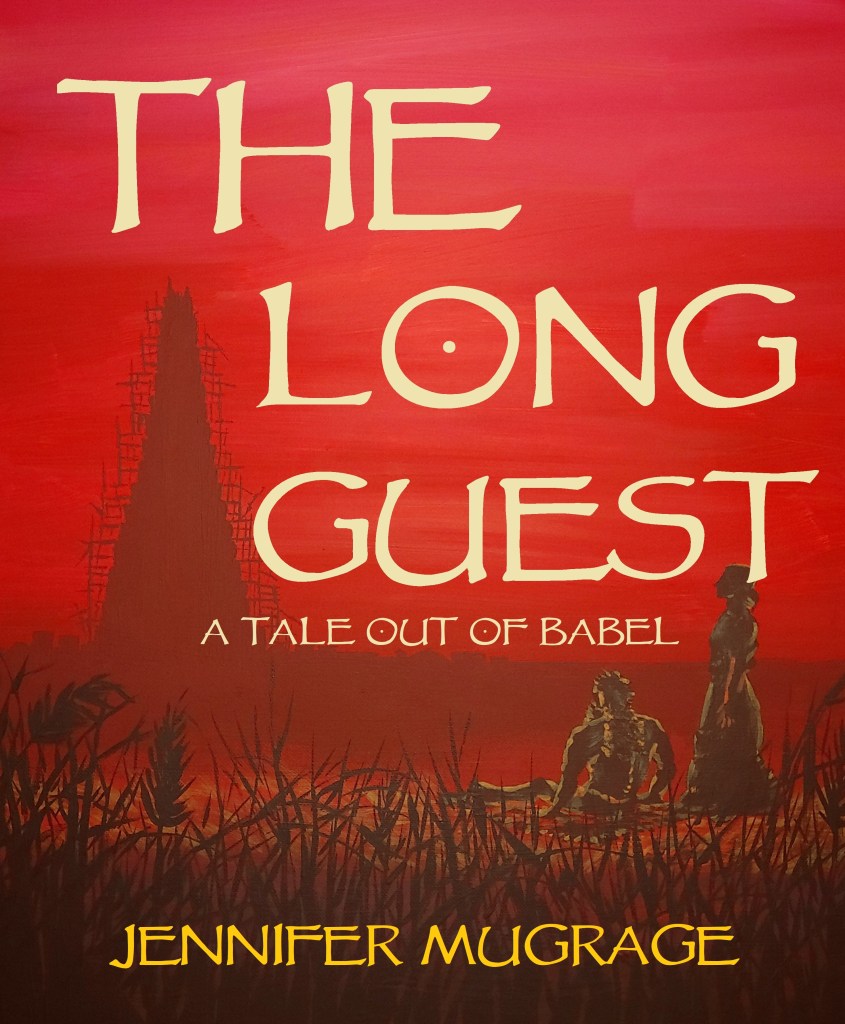
Here it is with a different title font …

And here, courtesy of photoshop tools, is a version with duller colors. I kind of like this one, but am concerned that it makes the book look like a horror story, which it isn’t.

The spine would look something like this.
What do you guys think? What kinds of covers do you expect on your fantasy books?
Postscript: Quick & Dirty Mock-Ups with Other Fonts

Hard-Boiled Quote of the Week
It didn’t bother me none. I don’t bother at all easy.
from The Lady in the Lake, 1943, by Raymond Chandler
Hardboiled P.I. + Grammar = Instant Cuteness
The [hotel] clerk snapped at Degarmo’s back like a terrier.
“One moment, please. Whom did you wish to see?”
Degarmo spun on his heel and looked at me wonderingly. “Did he say ‘whom’?”
“Yeah, but don’t hit him,” I said. “There is such a word.”
Degarmo licked his lips. “I knew there was,” he said. “I often wondered where they kept it.”
from The Lady in the Lake, 1943, by Raymond Chandler
Video: the Author of Ender’s Game Dispenses Writer’s Wisdom
Ben Shapiro interviews an eclectic grab bag of people each week on his Sunday Special. (Their main common factor is that they were willing to come on and be interviewed by him.) The interview embedded below is my favorite of all the ones he’s done so far. It’s super long, but if you are interested in the fiction industry or the writing process or the sci-fi and fantasy genres or identity politics or religion, then it will be worth your while.
Orson Scott Card is the author of the super popular sci-fi novel Ender’s Game. I tried to read this novel when I was way too young and I did not get all the way through it. It was hard for me to keep in mind that Ender and his co-trainees were kids when in some ways they acted like geniuses.
Card is also a Mormon, or LDS (Latter-Day Saint) as many of them prefer to be called. This gives him a unique perspective on religion, specifically on what it’s like to be misunderstood as a religious person.
Highlights:
AT 4:18, Card clears up what exactly counts as sci-fi versus fantasy: “The usual is that science fiction is stuff that has not happened but is possible, and fantasy is stuff that doesn’t happen and isn’t actually possible but we can imagine it. And that almost works except for the fact that it’s considered science fiction if you do things like faster-than-light travel or time travel. And those can’t happen. Time travel especially, because the string of causality is unbreakable. … So it’s arguable. But I learned the practical definition right away. The covers of fantasy books have trees. The covers of science fiction books have sheet metal with rivets. So it’s rivets versus trees. If your story is illustratable with rivets then it’s sci-fi, and if it needs trees to be effective, then it’s fantasy.” (N.b.: This is why my books are fantasy even though they feature no wizards.)
11:35 On the fact that fantasy magic systems have rules too: “You can’t just throw magic on the page and make it fantasy. You have to make it fantasy that would pass muster with a science fiction writer, because that’s who’s writing fantasy now.”
At 15:00, he addresses Pantsing versus Plotting: “I try to think ahead. Mostly milieu development. Then I’ll think of obligatory scenes, things that have to happen. And I’ll have to then set up those scenes so that they mean something. So there’s some planning that goes into it. I know writers who think like screenwriters, and their thought is all on the [outline]. I can’t do that, because anything I wrote for anything after chapter two is going to be discarded as soon as I find out what’s going on in chapter one. The process is pretty flexible, because by the time I’m nearing the end of any novel, the outline is now a relic … And I’ve seen, for example, an early novel by Dean Koontz, where it was obvious to me that after developing an amazing cast of characters that readers cared about, he caught up with the point in the outline where they all go into an alien spaceship together, and at that point he was just following the outline and it didn’t matter who any of the characters were.” (N.b.: Card’s method is plantsing, and it is the method I use as well. )
At 37:00, he starts talking about religions in fiction: “If you are going to create a character that has an existing religion, you have a responsibility to make it plausible. In America, we have two generic religions. If you need a hierarchical religion, you use Catholic. If you need a congregational religion, you use generic-Protestant-but-really-Baptist. Those religions are available and we all have some experience with them by watching movies. Jewish, not so much. I would feel a great deal of trepidation making a character of mine Jewish, especially orthodox, because I’ve known enough orthodox Jews to know how rigorous the demands are, what has to be kept in your head all the time. And I do that as a Mormon. I know all of our rules by heart, I don’t even have to think about them any more. But whenever I watch somebody’s fictional treatment of Mormonism, no one ever gets it right. No one even comes close. Getting somebody else’s religion wrong is a terrible faux pas.”
41:56: “That’s one of my minor messages: people have religion, and the fiction writer who retreats from that is cheating himself and his readers.”
43:51: “There are smart people in Hollywood. There are good people in Hollywood. They just don’t have the power to greenlight a film.”
At 52:00, he starts talking about the move towards identity politics in sci-fi: “And many of them, whom I know, are people who are simply writing their conscience. But their conscience is ill-informed.”
55:20 and following, on race: “When every white person in America knows that they are labelled as racist, that means why keep trying? Because no matter what you do, you are going to be labelled as white privileged and as racist. … But I know that now, all white people are getting more and more nervous that no matter what they say, it’s going to be turned on them and used to call them the ugly name racist. And that is pretty much the ugliest name that we have in our vocabulary right now. If you’re looking for your Tourette’s list of words that you should not speak, words which will wound, the f-word is way way low on the list. We are used to the f-word, we hear it all the time. Compared to racist. Wow! That’s serious. That’s savage.”
Books I Want to Have Read, but Don’t Want to Read
For those uninitiated to book blogging, a tag is when another book blogger assigns you a series of questions or prompts. For each one, you name the book that it makes you think of. And rant about it, if you so desire.
The blogger and author who tagged me was Katie Jane Gallagher.
The Rules:
- Link back to the original tag (this post, and Jami!)
- Complete the questions with books you want to have read but don’t want to read
- Tag some people at the end to do the tag next
OK? OK. Let’s get to the prompts …
The Prompts
A book that you feel you need to read because everyone talks about it
Twelve Years A Slave. Obviously that is going to be a heavy read.
Also, the Federalist Papers. Maybe “everyone” doesn’t talk about them, but people who seem to know what they are talking about keep mentioning them. Obviously there is some very important stuff in there that I need to know.
A book that’s really long

I mean, look at it.
I think there are seven of them now.
But I really need to get to these some time, if only because readers of George R.R. Martin might also be interested in my series some day. And I won’t make you wait decades either!
A book you’ve owned / had on your TBR for too long
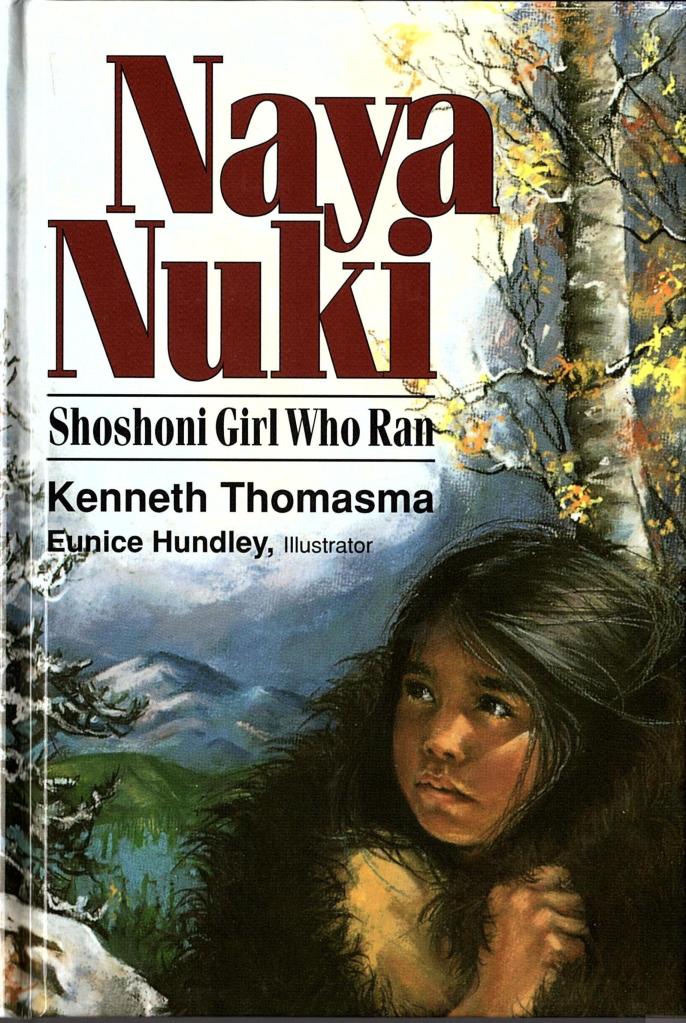
A few years ago, when my boys and I were studying American History, this novel was recommended as supplemental reading. I had all the more reason to want to read it, because Naya Nuki is Shoshone and when I lived in Idaho for a few years during my teens, it was near the Shoshone/Bannock Indian reservation. Our local library didn’t have it. I ordered it through interlibrary loan, but it never came! Must have been a long waiting list.
Fast forward three years. We have now moved back to Shoshone/Bannock country. I go to the local library here, and not only do they have Naya Nuki, they have the entire series by this author! Only problem is, the kids and I now have other required supplemental reading, and we’re working through that. I figure I’ll just zip through it by myself and return it to the library. But the due date approacheth, and I never do.
While still in this uncomfortable situation, my husband brings me home a surprise gift from his travels. It’s my very own copy of Naya Nuki! He thought it looked like something that would interest me. I’ve gone from not being able to get my hands on a copy, to an embarrassment of riches.
So I was free to return the library copy … but you guessed it, my gift copy is still sitting there unread. Why? Why???
A book that is ‘required’ reading (eg, school text, really popular classic – something you feel obligated to read!)
Everything by Freud and Nietzsche.
A book that intimidates you
Maps of Meaning by Jordan Peterson. He spent, what, decades on it? Rewrote every sentence at least 50 times? It sounds like it would be heavy going. A really thorough student of archetypes would read it, but I feel like this was the book where he developed his ideas, and now we can get the highlights of those through his class lectures on YouTube and through Twelve Rules for Life.
A book that you think might be slow

I know this one is slow, because I started it. I still think I might end up really liking it. Actually, I hope I do, because it’s sort of the same genre that I write in. But it requires a lot of attention during the first several chapters, as you have to learn a lot of different characters and figure out to who root for. It’s not the kind of book you can pick up and dive into for 20 minutes while eating your lunch, which is what I need right now.
A book you need to be in the right mood for

Circe. The main reason I haven’t read this is that it hasn’t shown up at the library yet, and I am too cheap to order it online. But there’s another reason as well.
I love the heroic age of Greece. As a teen I spent several years, off and on, immersed in this milieu. At one point I was going around telling people, “The Iliad is taking over my life!” (I also, when reading The Odyssey, had a crush on Odysseus. *blushes* Because who wouldn’t? I mean, the man can shoot an arrow through the centers of 12 ax heads lined up in a row!)
So I’m frankly super jealous of the author for having immersed herself in these books and written what everyone agrees is a fantastic novel that is true to the tradition. If I’m going to read it, it will put my head right back in that space, and I have to be ready for that.
Call, and raise you The Song of Achilles.
A book you’re unsure if you will like
Oh, so many. Pick any YA fantasy with a mermaid, vampire, or young woman on the front. I “ought” to be reading more of these, because they are fantasy and we are supposed to Read Widely In the Genre … but I just don’t find them appealing usually. Especially if the back cover copy deals with how mean everyone is to the young woman, or how she’s a member of an ostracized group.
And lest you misunderstand, I don’t say this dismissively. Probably some of these books are as meh as I expect, but no doubt others are gems. Maybe it’s even half and half. I’m not being superior. I just … can’t … get … interested …
People I Want to Tag but Also Don’t Want to Tag
Honestly, tagging activates my social anxiety. What if you’ve already been tagged for this? What if you don’t want to be tagged? What if I leave someone out? Gaaah!
I’m tagging you anyway. Don’t take it personally. If you hate the tag but want to please me, just do a super perfunctory and sarcastic tag like Bookstooge did that one time.
I’m tagging people who post frequently, because if you want something done, ask a busy person. So, if you post infrequently and didn’t get tagged and want to do this, go for it!
Still Chewing on This One
So I watched this on Netflix a few weeks ago.
It’s a critically acclaimed, independent film, but that’s not why I watched it.
I watched it because I “ought” to, because it has so much in common with my second book. Rugged landscapes, desperate situations, father-son relationships, snow. Even bears.
It’s sort of in the survival genre (if that’s a genre?). You know, as in To Build a Fire, where the story shows just how quickly things can go wrong when you’re out in the wilderness.
And did I mention the sound track is amazing?
Anyway, it’s very well done, and I highly recommend it.
The Seven Heavenly Virtues Tag
The Orangutan Librarian tagged me for this post that applies the “Seven Heavenly Virtues” to the world of our reading.
By the way. The Seven Deadly Sins are easy to remember, in groups of two, three, and two. There’s The World (Envy, Greed); The Flesh (Lust, Gluttony, Sloth); and The Devil (Anger … and the granddaddy, Pride). The seven virtues are the flip side of these.
Once when I was at university, the theme of our homecoming week was the extremely creative “We’ve Got Pride.” I will always love my fellow English majors who named their contribution to the parade “Beyond pride: the seven deadly sins.” They wanted to show that “[our university] also gots Envy, Greed, Lust, Gluttony, Sloth, and Anger.” And of course it was true.
Onward.
CHASTITY: Which author/book/series you wish you had never read?
Hmm. It’s rare that I go on wishing I had never read a book. Usually if it stuns me with some horror, I hate it at the time, but as my mind assimilates the idea, I’m glad to have encountered it in a book so that I can grapple with that aspect of the world.
A good example is Ken Follett’s Pillars of the Earth. A major part of the plot is a sexual assault. It’s described graphically. The creepy lead-up and the lengthy aftermath include scenes from the point of view of both the victim and rapist. When I read this, it was the first time I’d read a rape described in detail (or, at least, the first time I understood what I was reading). It was very traumatic, and it led to lots of crying and praying for women who were real-life victims. So, as you can see, it bore some good fruit almost immediately.
Later I read another book by Ken Follett in a completely different genre, and it also featured a serial stalker and rapist, with many scenes written from his point of view. At that point I decided that I would not read any more books by Ken Follett, nor would I ever get on an elevator with the man.
TEMPERANCE: Which book/series did you find so good, that you didn’t want to read it all at once, and you read it in doses just to make the pleasure last longer?
I don’t usually show temperance when it comes to serious, emotional reads. … OK, I actually don’t have much temperance at all. I once stayed up all night finishing Mary Doria Russell’s The Sparrow.
However, with comic series, I find that if you binge on them they can become wearing, whereas if you read one every once in a while, they are refreshing. For example, P.G. Wodehouse’e Bertie Wooster books and Janet Evanovich’s Stephanie Plum series.
CHARITY: Which book/series/author do you tirelessly push to others, telling them about it or even giving away spare copies bought for that reason?
Well this question will contain no surprises to anyone who knows me or has followed my blog for any length of time.
The Emberverse series by S.M Stirling: I recommend this often because it encompasses a wide range of interests. The first few books are post-apocalyptic, and then it becomes more of a fantasy series. I’ve recommended it to people because it’s set in the Northwest (Idaho, eastern Washington and Oregon, northern California). Recently I recommended it to someone who is interested in retro martial arts such as sword fighting and archery, because there is a ton of that in these books, including descriptions of how the weapons are made and gripping battle scenes. The research on these books is both wide and deep, from ecology to botany to anthropology to martial arts to Celtic mythology.
‘Til We Have Faces: A searing, emotional novel about friendship, identity, divided loyalty, and religion. One of C.S. Lewis’s less famous works.
The Everlasting Man (non-fiction): G.K. Chesterton discusses paganism and why it expresses important things about being human … with the cheery paradoxes that only he can bring.
The Divine Conspiracy(non-fiction): With wit and wisdom, Dallas Willard applies the Gospels in a fresh way (which we all need frequently). This is so well-written that it’s a pleasure to read, and you just sail through it even though it’s quite thick.
Now, go forth and read these!
DILIGENCE: Which series/author you follow no matter what happens and how long you have to wait?
Agatha Christie. She has such a large corpus of work that even though I think I’ve read all her novels, I’m never sure.
Also, the Brother Cadfael series by Ellis Peters.
Also anything by Tony Hillerman or Dick Francis.
It looks like formula mysteries are my genre for this.
PATIENCE: Is there an author/book/series you’ve read that improved with time the most, starting out unpromising, but ultimately proving rewarding?
Watership Down. It is gripping from the first, don’t get me wrong, but it is so long. Then when you get to the end, you discover that the author is doing things with it that only a really long book can do.
KINDNESS: Which fictitious character would you consider your role-model in the hassle of everyday life?

Any strong, quiet, capable character who consistently takes care of others. Durnik in the Belgariad; Precious Ramotswe in The No. 1 Ladies series; Bardia in ‘Til We Have Faces; Sam Gamgee, Aragorn, Gandalf, Aslan. And, of course, Zillah from my own books.
Unfortunately my gifts and personality are almost opposite from all these characters. But I’ve always wanted to be strong, quiet, calm, and capable.
HUMILITY: Which book/series/author do you find most under-rated?
This is a hard one to answer because I don’t always have a real great idea of what other people are reading. How can I know that the gem I’ve “discovered” hasn’t also been discovered by a bunch of others?
Apparently Thomas Sowell has a bunch of great books about economics and society that have helped the people who’ve read them greatly … but I have not read them, only watched videos of him speaking. There are many such examples.
Now, Discuss
I hesitate to tag people because it seems to freak them out. But if you get inspired by any of the questions in this tag, please answer them either at your own blog or in the comments.
G.K. Chesterton Quote of the Week: on Fairy Tales
Oddities only strike ordinary people. Oddities do not strike odd people. This is why ordinary people have a much more exciting time … The old fairy tale makes the hero a normal human boy; it is his adventures that are startling. They startle him because he is normal. The fairy tale discusses what a sane man will do in a mad world.
G.K. Chesterton, Orthodoxy, Chapter 2
I am your Sunshine Blogger
And you are mine.
So, the Sunshine Blogger award is given to bloggers by other bloggers who believe that the recipients spread sunshine. Imagine how surprised and thrilled I was to be given this award by Rachael Corbin at The Crooked Pen. Thanks, Rachael!
The Sunshine Blogger award is also a tag. If you get tagged, you must …
- Thank the person who nominated you and provide a link back to their blogging site.
- Answer the questions.
- Nominate 11 other bloggers and ask them 11 new questions.
- Notify the nominees about it by commenting on one of their blog posts.
- List the rules and display the sunshine blogger award logo on your site or on your post.
So, Numbers 1 and 5 down, 2 through 4 to go.
Here were Rachael’s questions:
- What was the most transformative reading experience you have ever had?
I am going to leave out those times when I’m reading some passage in the Bible and all of a sudden something jumps out and punches me in the gut. Or when it crawls into my head and becomes lembas that I feed on throughout the day. Some of you readers will know what I mean.
Other than that, my most transformative reading experience has been ‘Til We Have Faces by C.S. Lewis. I read it in college. The tortured friendship between Orual and Psyche in the book closely mirrored a relationship that had been toturing me through the previous several years … though of course with a much more tragic yet satisfying ending. Anway, it helped me see that some of the problems we were having were not purely my fault nor purely hers, but built into the nature of reality. Also, Faces is just packed with insights and it’s set in an ancient pagan culture, which I love. C.S. Lewis is under-appreciated for his ability to write horror, and there is plenty of that in this book.
2. What is a book you wish someone would write?
To be honest, it’s probably already been written.
I’m a sucker for well-researched fiction set in ancient cultures. So I would love to read a book set in the heyday of the Anasazi … or Carthage during the Punic Wars … or a Noble Savage book where the noble savage is one of the Gauls during Caesar’s Gallic Wars … or What Was Really Going with Stonehenge.
I have seen people take a stab at some of these, but never as thoroughly as I’d like. But, again, they are probably out there. I just haven’t discovered them yet.
For example, Bjorn Andreas-Bull Hansen has written some novels about Vikings. I think these are exactly the Viking novels I’ve always wanted to read … but they don’t exist in a language that I know! Aargh! (By the way, go to his site. Sign the petition to get his books translated into English.)
But I have, in my possession, waiting to be read, Pompeii by Robert Harris and People of the Silence (about the Anasazi) by Kathleen O’Neal Gear and Michael W. Gear. I have high hopes for both these books.
3. Where is somewhere you really want to go, but have only read about in a book?
It would be shorter to list places that don’t match that description.
I guess my current #1 place would be Mongolia. I had to research it for my first book, and it looks so beautiful. It also resembles my home state a bit in the sense of being vast, treeless, high-altitude, and far inland. And I love the herding culture. The food is gross though. (Follow that link and scroll down to the heading “Exotic Nomad Foods.”) Also, my kids are extremely interested in the Mongolian Death Worm.
4. If you could have a book re-written, which book would it be?
1984. I know, I know, the ending is integral to the book itself, but … still. I would like to see Winston hold firm at the end. Or find out that Julia had.
5. What is a book you dislike that everyone else loves?
1984 and The Great Gatsby. (Or, I guess people love these?)
6. If you had the power to bring any mythical creature to life, which creature would it be?
The Mongolian Death Worm.
Just kidding. I don’t know. Maybe Grendel so I could find out whether he was really a T-Rex.
7. Where is your ideal reading spot?
When I am reading, any spot becomes ideal. (Car, bus seat, middle of a party …) But I prefer to be comfy (plushy chair or sofa) with a view of the outdoors and some place to set my coffee.
8. What is the most disappointing book you have ever read and why?
OK, I am going to pick on one particular book here, but it’s representative of a whole category of disappointing books.
The Sign by Raymond Khoury, 2009. This book was disappointing for many different reasons (see my full review of it here). But the main reason was this: it promised mystical adventures but delivered only international intrigue.
It is not the only book that has this problem. It’s just the only one that I happen to be able to remember the title of.
9. What is your favorite genre of book and why?
Ancient mysteries/historical fiction set in ancient cultures. But I don’t read a lot of this genre for two reasons. Firstly, it’s kind of hard to find. Too often, purported “ancient mysteries” books end up being modern thrillers. (See above.) And when I do find a book that scratches this itch, I have to be careful. If I’m writing my own version of this genre at the time, I don’t necessarily want to be pulled into another world until my own has gelled.
So what I end up reading a lot is mysteries, especially mysteries with an anthropological bent like those by the wonderful Tony Hillerman.
As for why the “ancient mysteries” genre is my favorite (also why I like my mysteries to be anthropological), I can do no better than to quote the following poem from C.S. Lewis, titled, “To Certain Writers of Science Fiction”:
Why did you lead us on like this
Light-year on light-year, through the abyss,
Building, as if we cared for size,
Empires that covered galaxies,
If at the journey’s end we find
The same old stuff we left behind …
Well-worth Tellurian stories of
Crooks, spies, conspirators, or love,
Whose setting might as well have been
The Bronx, Montmarte, or Bethnal Green?
Why should I leave this green-floored cell,
Roofed with blue air, in which we dwell,
Unless, beyond its guarded gates,
Long, long desired, the unearthly waits:
Strangeness that moves us more than fear,
Beauty that stabs with tingling spear,
Or wonder, laying on the heart
That fingertip at which we start
As if some thought too swift and shy
For reason’s grasp had just gone by?
10. If you could make one book required reading, which book would it be and why?
The Everlasting Man by G.K. Chesterton. I almost listed this one as my transformative book because it set me free to love paganism while still remaining a Christian. I think everyone should read it because there is a ton of misunderstanding out there about the pagan roots of all cultures, and this book clears that up in such a beautiful, lyrically written way even though it’s nonfiction.
One major qualifier. Chesterton frequently lapses into anti-Semitism and it’s really jarring, not to mention inconsistent with his usual generous way of viewing the world. (TEM was published in 1925, before the Holocaust.) Also, as this book was written almost 100 years ago, Chesterton can come off as overly focused on the West and a bit insensitive and ignorant about non-Western cultures. Nevertheless, his insights about paganism can be fruitfully applied to any traditional culture, and I think they ought to be.
Other than that, I heartily recommend this book. I am thinking about doing a Hallowe’en post that relies heavily upon it.
11. What is your favorite bookish ship? (noncanonical and crack-ships are acceptable answers)
Haha, so at first I was going to name the Dawn Treader from Voyage of the Dawn Treader because I don’t read a lot of sea stories …
For those who aren’t up on fan fiction terminology (as I barely am), a ship is when you imagine two characters from a book or books getting together as couple. (Short for “relationship.”) Non-canonical ships are pairings that didn’t happen in the original book or series. “Crack” ships are pairings that you would have to be on crack to even think of.
I am not a big noncanonical shipper. I just enjoy the ships as they show up in the books. But, I did always think that rather than going off to live with the dwarfs and eventually get kissed by the Prince, Snow White ought to have run off with the huntsman.
Now, here are my questions for you …
- What kinds of non-fiction are you most likely to read?
- What is your culture crush? If you are a book blogger, you must have at least one. But please feel free to list more than one.
- What one currently living writer would you most like to have lunch, a beer, or coffee with? (Pastors count if they have written a good book or two. Bonus points if it’s a pastor you could have a beer with.)
- What genre do you think is not your favorite, but find yourself picking up again and again?
- Sex scenes: poetic, explicit, or none at all?
- Favorite animal protagonist from a book or series?
- Have you ever stopped identifying with the point-of-view character in a novel, and what caused it?
- Did you then finish the book, or put it down?
- Dream vehicle from real life or fiction.
- If you currently have a Work in Progress (or are pitching a recently finished one out), give us your one-sentence hook for it.
- Post a favorite poem or fragment of poetry. If you don’t read poetry, then song lyrics count.
By the way. Commenters, if one of these questions really pulls your chain, feel free to answer it in the comments.
The following bloggers are my sunshine:
Kathleen Rollins of Misfits and Heroes
R.S. Rook of The Rookery
David of The Warden’s Walk
Black Sheep of Not Sheep Minded
Jen of “Of Time Storms and Tourniquets”
Ed Mooney of Ruinhunter
Jaclyn of Tiny Ticky Tacky
Colin of ColinD.Smith.com
 Out of Babel Books