Yes, I’m a serial reader. If nothing else, I am definitely that.
But this tag is about book series. A book tag is something that comes with a bunch of questions or prompts that the blogger answers. Normally, the blogger is also supposed to “tag” a bunch of other people, like one of those chain e-mails from back in the day, but I don’t usually do that part. I personally got this tag from Fran Laniado. It was most likely created by Dutch blogger, @Zwartraafje in this post.
From which series did you read the spinoff series?
First, I read a number of books in the Emberverse series. The premise of this series is that one day, inexplicably, in the middle of the 90s, a bunch of technology stops working: engines, electricity, and gunpowder. This event, which people begin to call “The Change,” throws the world back into preindustrial technology. Naturally, the first book (Dies the Fire, above) is post-apocalyptic with lots of starvation, hand to hand fighting, and horrendous die-offs in the cities especially. As the series develops, people rebuild a medieval-style world. (Because it turns out that in the absence of gunpowder, you need a warrior class and a peasant class to support them.) Eventually, the young hero goes on a quest to find the source of all the weirdness, which seems to be centered around Nantucket. It turns out that right when The Change happened, modern Nantucket was replaced by an ancient version, from well before Europe colonized the New World.
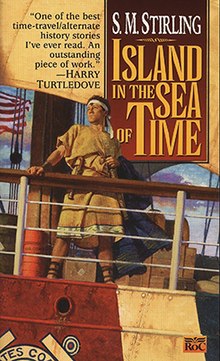
All of that is background to set up the spinoff series. This is called, not surprisingly, the Nantucket series. In the first book, Island in the Sea of Time, the modern island of Nantucket and a ship near it are suddenly transported back into the Bronze Age. The islanders have to learn how to survive without any mainland. Eventually, they make their way to England and meet the original builders (or at least users) of Stonehenge. I’ve read Island. I own the second book in the series, which opens with King Agamemnon realizing how much he loves artillery. I just needed a break from this spinoff series, but I’ll come back to it some day.
With which series did the first book not sell you over from the start?
Sacred Clowns is one book in the “series,” but not the one I had the bad experience with.
Stretching the meaning of “first book” a bit, I’m going to go with Tony Hillerman’s Navajo police procedural series, starring Joe Leaphorn and Jim Chee.
Unfortunately, these books are not labeled as a series, though the contents do have a chronological order. So when I say “first book,” it’s the first one I happened to pick up. I just got unlucky. Unlike most of the Chee/Leaphorn books, most of the action in the one I picked up does not take place in Dinetah (the Navajo homeland in the Four Corners area), but rather in Washington, DC. Also, in that particular book one of the major point-of-view characters was a stone-cold killer with a back story that was just so sad I wasn’t sure I could handle any more by that author. Luckily, later I caved and picked up another of Hillerman’s books.
Which series hooked you from the start?
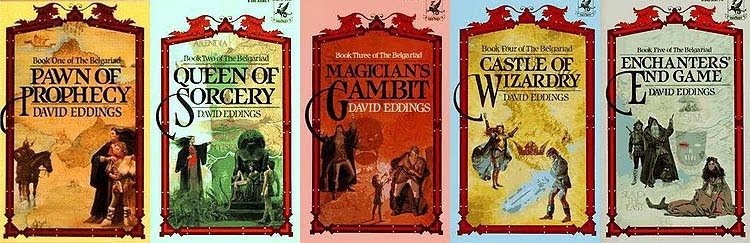
Well, I mean all of them. If I read any distance into a series, it’s usually because it hooked me. But I am going to have to go with The Belgariad. It opens with the hero, Garion, growing up in a big farm kitchen on a hardworking, prosperous, devout farmstead similar to the one in Farmer Boy, but bigger and more medival. Garion’s Aunt Pol, who we later learn is a sorceress, is first introduced as an amazing cook whose dishes can make farmhands from other farms weep. I’m a sucker for this kind of simple, wholesome stuff.
Which series do you have completed on your shelves?
I have The Chronicles of Narnia, because somebody once gave me a nice, thick doorstop where all the books are together in one volume. Also, I just last week acquired a nice hardbound copy of Ursula Le Guin’s Earthsea Trilogy. It was on the sales shelf at the library! I am very excited about this, because it’s a brilliant trilogy and I feel that finding it in hardback is like finding treasure.
Which series have you read completely?
*deep breath*
The Chronicles of Narnia, all the Brother Cadfael books (I think), The Lord of the Rings, Harry Potter, all The Three Investigators books (I think), all of Susan Howatch’s Church of England series except the last one, The Little House books, everything ever written by Agatha Christie (not really a series), the Belgariad & Mallorean (but not the spinoffs), the A Wrinkle in Time trilogy.
Which series do you not own completely but would like to?
Well, this is a tough one. In theory, I would like to own a complete set of every series I like. In practice, until recently I moved house every few years (sometimes much more often), and I have a limited budget. Both of these factors make it difficult to build up a dream library. Also, I have plenty of bookish friends and relatives, so if I want to re-read something, often I can borrow it. I guess if I had to name a series that I would like to own all of, it would all of Tony Hillerman’s Navajo cop books and also all of Ellis Peters’ Brother Cadfael mysteries. I’d also like to own all the Tintin albums and all the Asterix albums, because those are great for kids, table reading, and art inspiration. But that’s one where it’s possible to borrow.
Which series to do you not want to own completely but still read?
Andrew Klavan’s Homelander series. I convinced my librarian to order them and then I read them all.
Which series are you not continuing?
There are plenty of contenders here. Life is short.
The latest series that I started, enjoyed several of, and then broke off was Dean Koontz’s Odd Thomas series. The later books aren’t bad, it was just that once I’d learned Odd’s tricks, it got so that I could take or leave further books.
Which series you haven’t started yet are you curious about?
Which series did others love and you did not?
The Legacy of Orisha series. I read the first book: Children of Blood and Bone.
Here’s a sample of an incident that drove me crazy: the romantic hero, who is also sort of the villain, is the son of a king who has oppressed magicians with harsh purges. He is just starting to discover that he himself has a magical power: he can directly sense others’ thoughts and feelings. He has a terrifying moment when he picks up on a memory of the heroine. It was the lynching of her mother. He is shocked and horrified by what he sees and feels. And then he concludes, “I will never understand her pain.” Even though he literally just did! He literally just lived through it! But that line is a clue that the author is not going to give him a redemption arc or let him out of the role of oppressor. Nor is the author going to let him and his sister off the hook for “not seeing sooner” that their father was an awful tyrant, even though they are about 18 years old and just came of age themselves. So, if you like merciless class war, you’ll love this series.
Sorry, that might not be the most cheerful note to end on, but that’s the way the tag crumbles. Have a great day, everyone!
My upcoming book, The Strange Land, even features … a bear. (Spoiler alert.) (Pray for the book, by the way, if you are interested in reading it. Let’s not allow some petty formatting issues to stand between you and any literary bear.)
But I will never be on about bears as much as author, graphic artist, and funnyman Ethan Nicolle.
Here he is again.
He works for the Babylon Bee. But that is only the beginning of his ursine depths.
His first bear-related book was Bears Want to Kill You.
This is a reminder we all need. But I haven’t read it.
He also has to his credit the following typology:
I was given this for Christmas. Actually, my kids were. And boy, am I glad that someone cared enough to warn us about the existence of the Beaardvark, Bearilla, Bear Crab, and of course the Abearican Eagle.
But I am mainly here to talk about this:
Brave Ollie Possum is the awesomest chapter book/family read-along that I have encountered in a long time. It just so poignant, twisty, tense, funny, and gross. The early chapters gave us nightmares. In the later chapters, some passages were so disgusting that as I read them out loud, I had to suppress a gag reflex. (Perfect for school-aged boys!) Other passages were so funny that we had to stop and laugh it out before we could recover. This is the book for you if you never knew how much you needed to watch a possum use the kitchen of an Italian restaurant to cook a late-night pan of lasagna for his forest friends. Other than that, I won’t spoil the plot except to say, What better animal than a possum for an author to explore themes of cowardice and courage?
So, here’s what this is. Christian novelist Brian Godawa has gotten his hands on a pre-release copy of a commentary on the book of Revelation, The Divorce of Israel, by Kenneth Gentry. The gist of it is that Gentry’s interpretation is preterist, i.e. coming from a point of view that most of the events in Revelation have already happened during the horrible years of Rome’s siege of Jerusalem in 70 A.D. In other words, they were not prophecies of the distant future when John gave them, but rather prophecies of the immediate future. That’s the reason for the frequent warnings that “these things will soon take place.”
But, you say, what about all the stuff in Revelation that definitely sounds like the end of the world: the stars falling, the sky rolling up like a scroll, Jesus coming in the clouds, etc., etc.? Godawa shows, following Gentry, that all of this “collapsing universe imagery” was conventionally used in the Old Testament to describe God’s judgements on nations, usually through a siege, military defeat, and the razing of the countryside.
In the videos linked to above (and the first one embedded below), Through the Black interviews Brian Godawa in a series of 16 videos that are 1 – 2 hours each. That’s how long it takes them to go through Revelation chapter by chapter (and also Matthew 24), answering all the “what about”s that are probably popping into your head if you have ever been exposed to the usual type of modern evangelical teaching on Revelation.
As the Through the Black host says many times on these podcasts, eschatology matters. It can even have life-and-death consequences. Just look at David Koresh. Even mentioning Revelation, outside of Christian circles, nowadays is enough to get you branded as a loon. Inside Christian circles, it can still cause people to run screaming from the room, and who could blame them? Preterism gives us a way to look at this book that is consistent with the rest of Scripture and which doesn’t force us to create elaborate, increasingly self-contradictory systems of thought that will drive us crazy. If you like to listen to podcasts, join me in working your way through this one.
“Why do you think anyone would want to read about you?” I asked.
“I’m a detective. People like reading about detectives.”
“But you’re not a proper detective. You got fired. Why did you get fired, by the way?”
“I don’t want to talk about that.”
“Well, if I was going to write about you, you’d have to tell me. I’d have to know where you live, whether you’re married or not, what you have for breakfast, what you do on your day off. That’s why people read murder stories.”
“Is that what you think?”
“Yes!”
He shook his head. “I don’t agree. The word is murder. That’s what matters.”
Anthony Horowitz, The Word is Murder, 2018, p. 25
The blurb on the back of this book calls it a “meta-mystery,” and that’s a perfect description. It is so, so meta.
Horowitz writes about himself, Anthony Horowitz, the guy who has created the TV series Midsomer Murders and Foyle’s War and who has written a popular series for kids, and is now trying to break into the adult market. He has just published The House of Silk, a Sherlock Holmes novel in the style of Conan Doyle. He’s approached by this ex-detective, Hawthorne, who still sometimes does consulting work for the local police force. Hawthorne’s idea is that Horowitz will follow him around as he investigates, turn the investigation into a crime novel, and make both of them rich and famous. The problem is that the investigation has just begun, and it’s unknown whether Hawthorne will solve it and, if so, whether it will have a satisfying ending. Also, though Horowitz naturally has to be present while Hawthorne interviews suspects, he is under no circumstances supposed to interrupt, ask his own questions, or contribute in any way. If Hawthorne misses something due to one of these interruptions, it’s Horowitz’s fault.
But How Meta Is It, Really?
I still don’t know how much of this novel is truth and how much is fiction. I think the whole thing is made up. But references to Horowitz’s past books and TV shows, and his descriptions of the industry, seem to be real.
There’s a very funny, agonizing scene where Horowitz is in a meeting with Peter Jackson and Steven Spielberg to show them the script he’s written for a planned second Tintin movie. He’s been working on the script for months, and he’s feeling excited as well as startstruck to be in the same room as Spielberg. But Spielberg abruptly tells him that the Tintin book he has turned into a script is the “wrong” book, even though that’s the one he and Jackson had agreed to use. Into this tense moment, Hawthorne bursts in. He fails to recognize Spielberg, but recognizes Jackson and compliments him. He then insists that Horowitz leave with him. The directors insist that Horowitz leave too, saying they will call him back, which they never do.
That sounds awfully realistic, even if it didn’t happen with Hawthorne. Even if there is no such person as Hawthorne. There is also no such person as Damian Cowper, the British movie star, recently relocated to Hollywood, who is at the center of the mystery.
So, on the whole, I think this actually is, as they say, a “fiction novel,” weaving in nonfiction glimpses into Horowitz’s career, modern London, and the conditions in the publishing and movie/TV industry. Horowitz’s insights about writing and marketing his work are enjoyable. And the novel is extremely professionally written. The characters, the writing itself, the clues, and the satisfying nature of the mystery all show that Horowitz has been writing mysteries for many years.
The Tintin Rant
I do have to take one side trip to rant about a rant of Horowitz’s. If you will pardon a long quote:
Tintin is a European phenomenon and one that has never been particularly popular across the Atlantic. Part of the reason for this may be historical. The 1932 album, Tintin in America, is a ruthless satire on the United States, showing Americans to be vicious, corrupt and insatiable: the very first panel shows a policeman saluting a masked bandit who is walking past with a smoking gun — and no sooner has Tintin arrived in New York and climbed into a taxi than he finds himself being kidnapped by the Mob. The entire history of Native Americans is brilliantly told in five panels. Oil is discovered on a reservation. Cigar-smoking businessmen move in. Soldiers drive the crying Native American children off their land. Builders and bankers arrive. Just one day later, a policeman tells Tintin to get out of the way of a major traffic intersection. “Where do you think you are — the Wild West?”
The Word is Murder, p. 148
Side eye.
O.K., Mr. Horowitz.
First of all, I can tell you the exact reason Tintin isn’t popular in the United States: It’s just not available. Oh, sure, it’s available now. Now we can get anything, with the Internet. But when I was a kid, there was just nowhere in the U.S. that you would see Tintin albums for sale. I was first exposed to them because we knew a family who had lived in Europe for a time, and once we knew of his existence, my siblings and I enjoyed Tintin just as much as any kids would. The same goes for Asterix and Obelix, by the way. It’s still kind of difficult to get good-quality A&O albums. When I tried to buy some for my kids, one arrived with the pages falling out.
Secondly, it never occurred to me, reading Tintin in America in the 1990s, that it was a “vicious satire” of America. I just figured it was all the silliest and most extreme stereotypes about America, which is the same treatment that Herge gives pretty much every country he portrays. And, the idea that Americans would be shocked by this portrayal? I don’t know, maybe in the 1930s. But this generation Xer would like to point out that gangster movies are one of our most beloved film genres, and that we are taught from knee-high about the injustices done to the Native Americans (besides many films and books being made about same). And in fact, Herge’s portrayal of the way the Indians talk would not be considered acceptable in America today. So, yeah, Mr. Horowitz, I realize you are very smart British author — and it’s obvious from your craft that you are smarter than I will ever be — but I think you may have overestimated Americans’ provinciality just a tad, while also underestimating our IQ.
The Detective
The best thing about this book, in a way, is the detective, Hawthorne. He is also the most unsatisfying thing. He never does allow Horowitz to get to know him. He really does prove to be brilliant, and Horowitz sort of ends up playing Hastings to Hawthorne’s Poirot. This is all the more frustrating for Horowitz (and for the reader) because Horowitz is not dumb and he knows it. He’s an adult with a good career well underway, and he knows his way around a mystery novel. He just hasn’t had direct experience with real-life investigating.
Hawthorne is the sort of person that all of us have had to work with at one time or another. He comes off as unwittingly controlling, always telling Horowitz his business. He doesn’t like the title “The Word is Murder,” for example. He wants it to be “Hawthorne Investigates.” (Spielberg and Jackson back him up.) He doesn’t like the way that Horowitz sets the scene in the first chapter. Although not a writer, he thinks that Horowitz should methodically introduce every detail that Hawthorne would notice, without any atmosphere or description. He gives advice about choice of words. Whenever Horowitz objects “But I’m the one you asked to write it!”, Hawthorne says something like, “Hey, don’t get all upset! I was just trying to help.”
This is the kind of person that you cannot be around for very long. Unless you are pathologically conceited, all their “help” can’t help but make you doubt yourself. Although we cannot work long-term with such a person, it is nice to see one portrayed in fiction (if this … is … fiction?). It lets us know that even pros like Horowitz have had the same experience.
You’ve seen me complain about characters who are given no physical description. Here is an author who knows how to do it right:
[The] man so exactly suited the image of the funeral director that he could have been playing the part. There was, of course, the obligatory dark suit and somber tie. But the very way he stood seemed to suggest that he was apologising for having to be there. His hands were clasped together in a gesture of profound regret. His face was crumpled, mournful, not helped by hair that had thinned to the edge of baldness and a beard that had the look of a failed experiment. He wore tinted spectacles that were sinking into the bridge of his nose, not just framing his eyes but masking them. He was about forty years old. He too was smiling.
Occasionally comparative linguists are able not only to reconstruct individual words in Indo-European, but also whole phrases … Probably the most famous such phrase is *klewos ndghwhitom, “imperishable fame.” The most ancient texts in Indo-European languages, such as the Vedic hymns of ancient India, the Homeric epics, the Germanic sagas, and Old Irish praise-poetry, all demonstrate that the perpetuation of the fame of a warrior or king was of critical importance to early Indo-European society. The preservation of their fame was in the hands of poets, highly skilled and highly paid professionals, who acted both as the repositors and the transmitters of the society’s oral culture.
The phrase *klewos ndghwhitom, (where *klewos is a noun built on the root kleu-, “to hear,” and can be thought of literally as “what is heard about someone, reputation”) was reconstructed on the basis of the exact equation of Greek kleos aphthiton and Sanskrit sravah aksitam. …
Not surprisingly, “fame” is a recurring element in Indo-European personal names. The name of the Greek poet Sophocles meant “famed for wisdom”; the German name Ludwig means “famed in battle”; and the Czech name Bohuslav means “having the fame (glory) of God.”
The American Heritage Dictionary of Indo-Europeans Roots, 3rd ed., p. 44
Now, let’s look at this same concept running strongly throughout Beowulf, an epic that is written in Anglo-Saxon, but set in Denmark before some of the Danes left there for England:
The Almighty granted him renown. Beowulf, son of Scyld, became famous in Denmark, and his fame spread everywhere. Thus, while still under his father’s protection, a young prince should by his goodness and generous gifts so manage affairs that later on his companions may give him support and his people their loyalty in time of war. For among all peoples it is only through those actions which merit praise that a man may prosper. (page 27)
Beowulf: “They tell me that in his vainglory the monster is contemptuous of weapons. Therefore, as I wish to keep the good opinion of my lord Hygelac, I propose to dispense with any kind of sword or shield during the combat. Foe against foe, I shall fight the fiend to the death with my bare hands. Whichever of us is killed must resign himself to the verdict of God. … If I am killed in combat, send to Hygelac the coat of mail which I am wearing. For it is the best corselet in the world, the work of Weland Smith, and an heirloom that once belonged to my grandfather Hrethel. Fate must decide.” (page 37)
By the close of that bloody fight the wish of all the Danes was fulfilled. It was thus that the resolute, cool-headed man who had come from a distant land purged Hrothgar’s hall and defended it from attack. The Geat prince rejoiced in his night’s work. For he had made good his boast to the Danes and put right their trouble … When the hero set up the talon, arm, and shoulder — Grendel’s entire grasp — under the great gables of Heorot, the evidence spoke for itself. (page 46)
Hrothgar to Beowulf: “By your exploits you have established your fame for ever. May God reward you with good fortune, and He has done up to now.” (page 49)
“Venerable king, do not grieve. It is better for a man to avenge his friend than to mourn him long. We must all expect an end to life in this world; let him who can win fame before death, because that is a dead man’s best memorial.” (page 60)
I didn’t plan things this way. I guess it’s what I get for writing about The Great Snake. I mean, did I expect it to be nice?
So, just a warning to anyone who is planning to read all the way through my trilogy … it’s heading in a sort of horror direction. Sorry if that’s not your thing.
“Just grocery?” [said retired Navajo cop Joe Leaphorn to store owner McGinnis.] “They take anything else?”
“Took the blanket I had hanging on a rack in there, and some ketchup, and …” he frowned, straining to remember. “I believe I was missing a box of thirty-eight ammunition. But mostly food.”
“None of it ever recovered?”
McGinnis laughed. “‘Course not,” he said. “If the burglar didn’t eat it, you cops would have done that if you caught him.”
“You didn’t mention a diamond. How about that?”
“Diamond?”
“Diamond worth about ten thousand dollars.”
McGinnis frowned. Took another tiny sip. Looked up at Leaphorn.