Life on a diet is linear. You begin, you lose weight, and you’re done. Then it’s on to the mythical “maintenance” mode (which is also dieting, but for eternity. Congratulations?).
We call fat people lazy. They’re not. Fat people are zealous. They will cleave and push and fight harder than anyone. No one works harder on anything than a fat person works on a diet they believe will make them thin. They’re not stupid, either… At eighteen, I could have written a thesis on calorie content and ketones and insoluble fiber, in iambic pentameter if you wanted. They’re not fat for lack of knowledge or effort. Some fat people become fat for a reason (medical, emotional, environmental). Others were simply born to be larger than you might like them to be. But all those chronic fat dieters are fatter for the dieting.
Kelsey, Miller, “Big Girl,” pp. 18, 83
Tag: genres
Can You Decipher this Quote from a Sci-Fi Novel?
Contemplation occurred with consequences resulting. Meditation existed on a plane remote from the familiar. By virtue of reflection, resolution simply was. No human, equipped with the latest and most relevant tools, would have recognized the process for what it was. And yet — there were fine points of tangency.
Among the incredibly diffuse but nonetheless vast aggregate worldmind of which the verdure on board the Teacher were an inseparable part, what Was became what Is. Call it thought if it aids in comprehension. The plants themselves did not think of it as such. They did not think of it at all. They could not, since what transpired among them was not thought that could in any sense be defined as such.
That did not mean that what came to pass among them was devoid of consequence. It was determined that, for the moment, at least, nothing could be done to affect what had transpired. Patience would have to be exercised. The disturbing situation might yet resolve itself in particulars agreeable to those whose awareness of it was salient. Their perception of the physical state of existence humans defined as time was different from that of those who inhabited the other, more-remarked-upon biological kingdom.
Alan Dean Foster, Reunion, pp. 110 – 111
Call for ARC Reviewers for The Long Guest

“The year is 10,000 B.C. All mankind was united in one project: to build a great city with a magnificent tower that reached to the heavens. But the tower fell; God confused their languages, and overnight, their world dissolved into unimaginable chaos.
Family groups, still tied by language, salvage what they can and flee to the countryside to survive. On the way, the family group of Enmer stumbles upon a highborn man, who does not speak their tongue. He lies paraplegic and near death, having survived a fall from the tower.
The matriarch of the family insists they save him; he is a human being, is he not? But he is also hateful, demanding, and useless. But if they don’t save him, who are they? And, if they do, he will leave them forever changed.
This sweeping epic starts at Babel and carries the action across the continent of Asia, even to the ends of the earth.”
That’s the official back cover copy. Coming November 1! But you can get the book before then.
ARC means Advance Review Copy or Advance Reader Copy. Here’s how it works. You use the contact button on this blog to send me your snail-mail address. I send you a free copy of the book. If you manage to get through it, you post a review on your blog or on Amazon or Goodreads or wherever else you typically post reviews. If you are a fast reader, your review might even go up around the time that the book is coming out. Either way, you get a free book, I get a review (probably); everyone’s happy!
And yes, sorry, the book is only available in hard copy at this time, not as an e-book. You will want to hold it in your hot little hands, flip back and forth to view the maps and family tree, mark your favorite passages for memorization, etc., etc.
My love to all of you! Especially to advance reviewers!
PSA: In case you didn’t know, Andrew Klavan has a YA series out
PSA … Public Service Announcement
YA … Young Adult

Andrew Klavan is a hard-boiled crime novelist who became a Christian around the age of 50. He is a master storyteller who gets what literature is supposed to do for a person. Consequently, he is not afraid of the dark, so to speak. His characters, particularly in his adult novels, often have major flaws. Some Christian readers don’t like the fact that Klavan’s novels often include sex scenes and a lot of language.
Well, if you want to enjoy Andrew Klavan minus all the adult stuff, look no farther than this series.
Main character Charlie goes to bed in his room one night and inexplicably wakes up strapped to a metal chair in an enclosed room, surrounded by instruments of torture. He remembers who is he (a high schooler with a black belt in karate), but he has no idea how he got here.
That’s the opening to the first book in the series, aptly titled The Last Thing I Remember. Klavan has long been fascinated with characters who have trouble remembering things, distinguishing fantasy from reality, or trusting their own thinking. Charlie is no exception. It will take him a good bit of the first book to realize that he’s forgotten an entire year of his life … and it will take nearly the whole series before he can trust himself again.
I can imagine someone will object: “Wait, because these are YA novels, there is no sex … but the very first scene includes torture?” Yes, there is plenty of violence in the Homelander novels. They are thrillers, after all. But a couple of factors mitigate this. First, sex and violence are not the same in the contexts in which they occur, what their purpose is, or the effect they have on the human mind. So I don’t think it’s necessarily hypocritical if a supposedly “clean” book excludes sex but includes some violence.
Secondly, the way the violence is handled is not exploitative. Charlie wakes up sore, in a torture room, and has obviously been through some stuff, but we don’t actually see him getting tortured. And the violence throughout the rest of the series is handled in a similarly dignified way. Klavan gives us plenty of blow-by-blow descriptions of fight scenes, chase scenes, and escape scenes, in some of which Charlie (or other characters) get hurt pretty bad. He does not give us any detailed blow-by-blows of helpless people being brutalized. And, though there are probably some deeper issues here that I haven’t thought out, this feels like an important distinction. It’s as if he allows the characters to have their choices and their dignity.
The titles of the books are:
- The Last Thing I Remember
- The Way Home
- The Truth of the Matter
- The Final Hour
How Strange Was It?
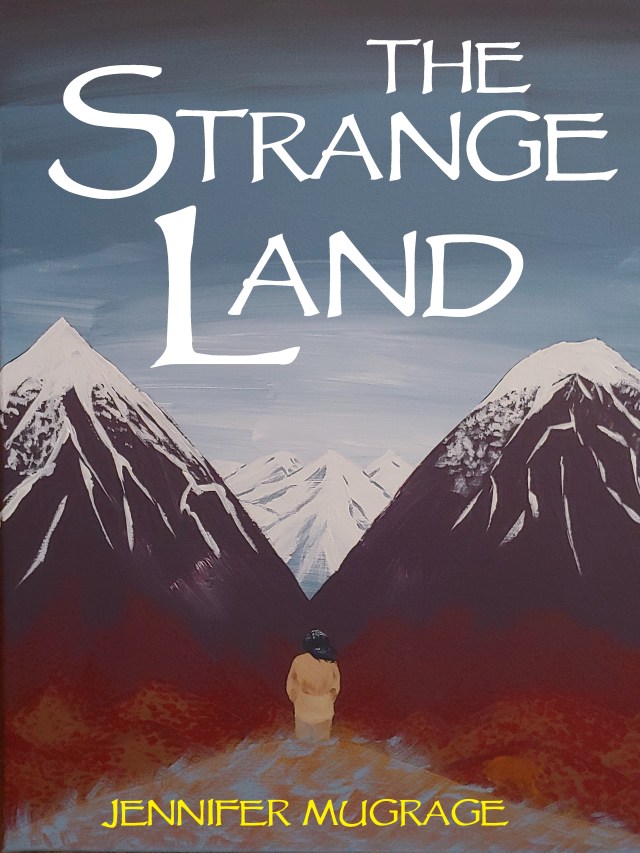
Was it merely dark and ominous, but kind of normal?

Did it have this freaky rainbow pool that you couldn’t even tell what it was?
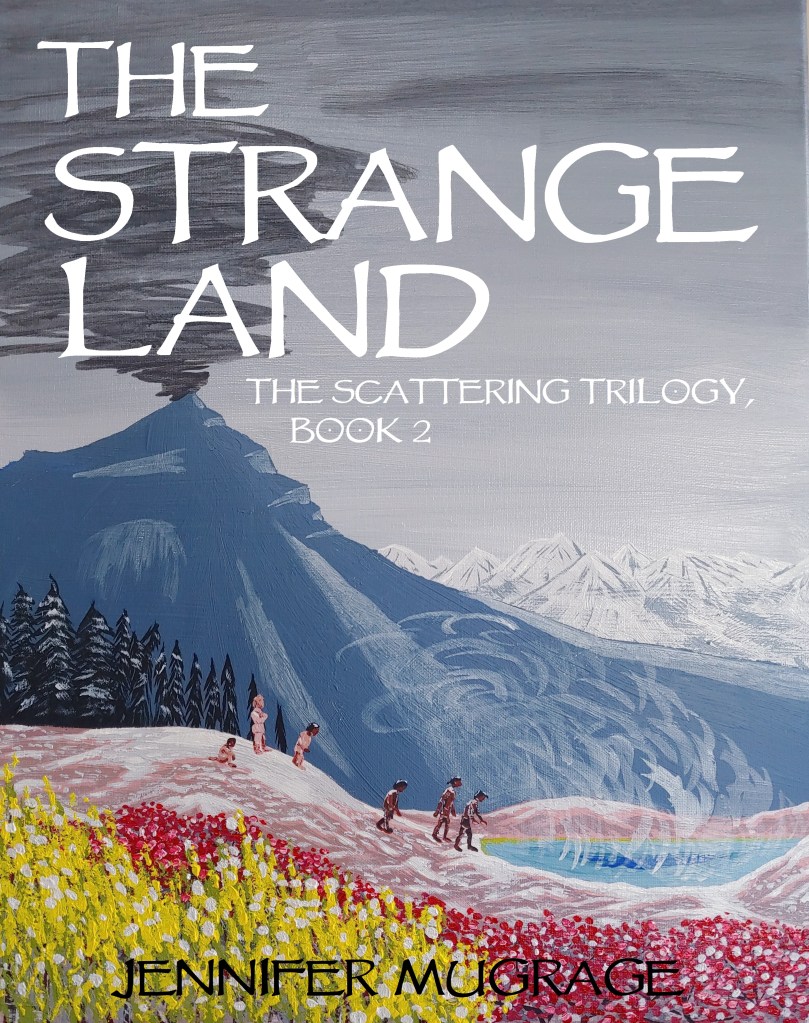
Or was it … both?
Faithful blog readers will know that this is my third (count ’em) cover draft for The Strange Land. And now, I am going to have to stop for while. Between the learning curve of teaching myself how to format The Long Guest for publishing, and the need to start school soon, I am fairly going crazy here.
You may notice that I have put a trilogy name on this cover draft. That’s at the suggestion of a librarian friend. Apparently, multiple interlocking series of books are hard to shelve unless they have distinctive series names and numbers. This would be a problem if I call them all “A Tale out of Babel.” And I’m thinking I don’t need that for this series, since the publishing company is already called Out of Babel.
So, as drafted, the first two books in the series would look like this. I am going to try to make them small so I can show them to you next to one another:
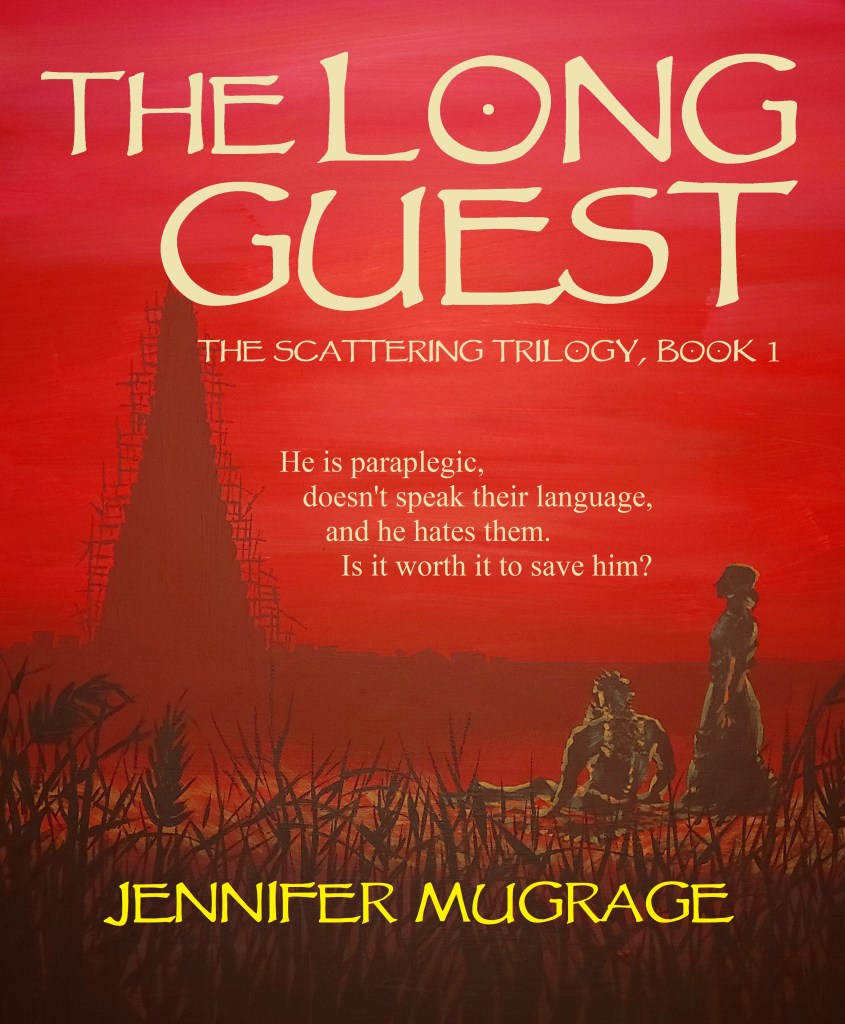
I can’t quite get them to be the same size, but I hope you get the idea.
So, what do you think? I worked hard on this painting, and I really like it, but I can always re-do it. Some day. Should I use a restricted palette like I did for The Long Guest? Maybe mostly greys as TLG was mostly reds?
I’m Late to This Party
Apparently, based on the YouTube comments, the following song has been out for six months. I just discovered it last week, playing the country station on my car radio while running errands, and it quickly became my theme song for the week.
It’s just so doggoned unifying.
Also, I like the phrase “one big …”, as in an earlier Andrew Klavan quote, “It was like the whole country was one big series of bad choices.”
And though this song is upbeat, there is a certain insight to calling life “one big country song,” because country as a genre can be pretty tragic. You know what they say: if you play a country song backwards, you get your wife back, you get your truck back, you get your dog back …
Anyway, enjoy!
Cover Draft for The Strange Land
One early fantasy series that I read was The Belgariad by David Eddings. Here are the covers as they looked on the series when I had it.
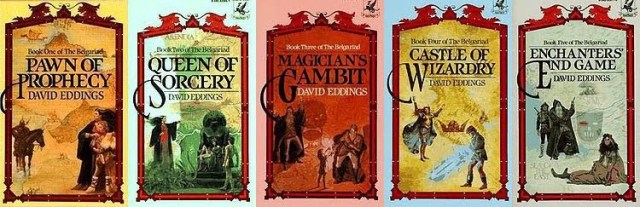
As you can see, the titles are all on theme by being about chess (“pawn,” “queen,” “gambit,” etc.). The covers are all similar, but each cover has a slightly different color scheme to vary your reading experience: mustard, green, rust, blue (harder to see in this image), grey. After all, you’re going to be looking at that cover for a while, as long as you are reading the book and carrying it around. It will form part of the visual landscape of your life. Also, and this isn’t obvious unless you’ve read the series, the color and general look of each cover matches the country to which the adventurers travel in that volume.
Last week, I unveiled my draft for the cover of my book The Long Guest. With the help of blog commenters, the font that we settled on for the title (at least for now) was Goblin Hand:

Now here is the draft for the second book in the series. I’ve kept the font and general title layout, but the color scheme is colder because, after all, we are going to Alaska.

Feedback please.
Raymond Chandler Quote of the Week
He held his hand out. I shook hands with him, but not as if I had been longing for the moment to arrive.
from The Little Sister, 1949, by Raymond Chandler
Words to Live By
“I’m telling you this mostly so you won’t try to hang any murders on Kingsley that don’t belong on him. If there is one that does, let it hang.”
“Is that why you’re telling me?” he asked.
“Yeah.”
“I thought maybe it was because you hated my guts,” he said.
“I’m all done with hating you,” I said. “It’s all washed out of me. I hate people hard, but I don’t hate them very long.”
from The Lady in the Lake, 1943, by Raymond Chandler
Cover Draft for The Long Guest
It’s Monday! Time for some art!
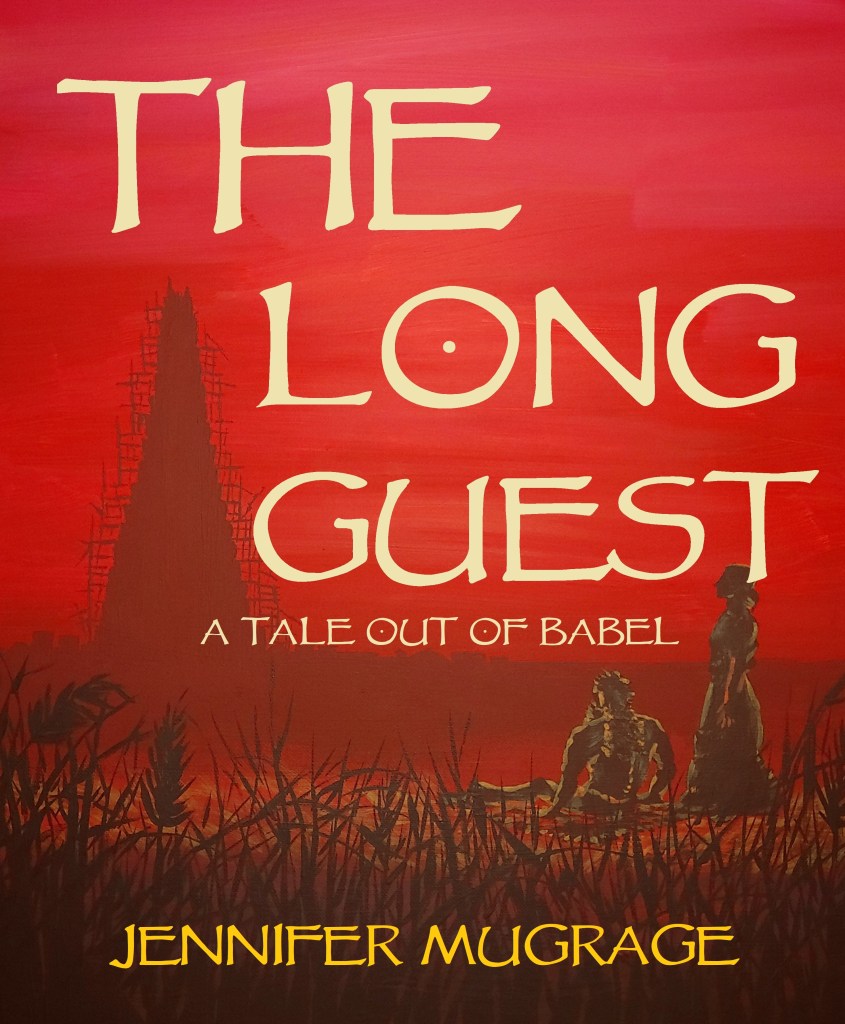
Today I present my mock-up for the cover of The Long Guest.
What is Normal for the Genre
TLG is in a genre of epic sci-fi/fantasy that is light on magic. Often books in this genre have an evocative landscape on the cover, to draw you into the world of the book. For example, this copy of Ursula Le Guin’s Left Hand of Darkness shows the icy landscape through which her characters travel …

On this cover for S.M. Stirling’s A Meeting at Corvallis, there is a lot of detail to show exactly what sort of world is contained in the covers. The broken asphalt and the ruined skyscrapers in the background show that this is a post-apocalyptic world. Meanwhile the horse and buggy, and the main character’s battle axe and chain mail, show that in this world, we use medieval technology. Finally, the man’s battle gear leads you to expect combat.

Often books in this genre will show one or more main characters, usually in only a semi-active pose. This particular one, unlike some of Stirling’s other books, shows the character face-on. I don’t prefer this as a reader, because I prefer to form my own mental picture of the character.
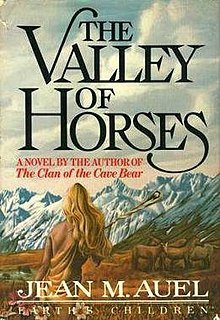
A good example is this copy of Jean M. Auel’s The Valley of Horses, which shows Ayla from behind. We’ve already been told that Ayla is tall and blond, so this doesn’t do too much damage to our mental picture of her. Notice the other hints at the important parts of the plot: the wild horses, the rugged mountains, and Ayla’s sling.

So I would like the cover of The Long Guest to look something like this. Nimri (sitting on the ground) and Zillah look at the unfinished, scaffolding-covered Tower. Grasses in the foreground hint at the steppes they will soon traverse. You get a general sense of what they look like (Nimri’s beard, Zillah’s bun), but are left to imagine their faces.
Obviously, my painting has less detail than the two examples above.
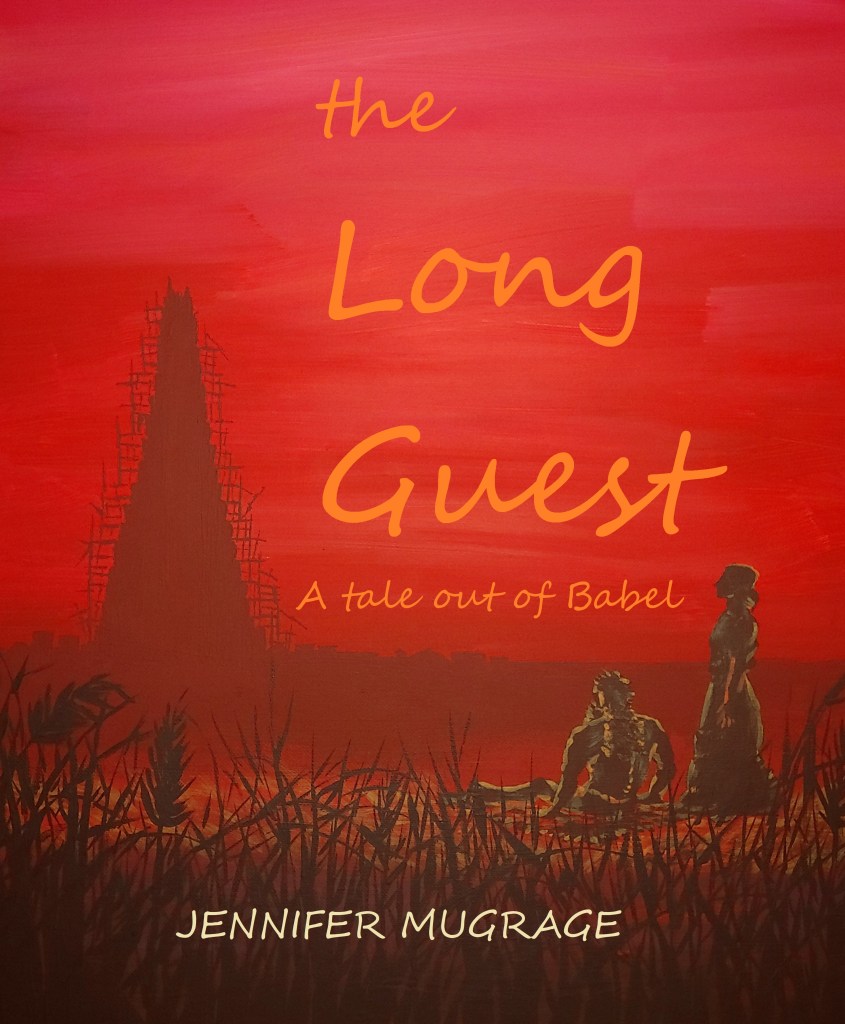
Here it is with a different title font …

And here, courtesy of photoshop tools, is a version with duller colors. I kind of like this one, but am concerned that it makes the book look like a horror story, which it isn’t.

The spine would look something like this.
What do you guys think? What kinds of covers do you expect on your fantasy books?
Postscript: Quick & Dirty Mock-Ups with Other Fonts