When Did We Stop Marrying Our Siblings?

… and why do I care?

I might be in the process of drafting a book that takes place before the Flood. So that is forcing me to tackle this issue. Besides needing to get it settled in my own mind, this post is meant to test the waters and see how you, my readers, react to this concept. If I even bring it up, will I be kicked out of polite society?

So, this post is a historical survey of sister-marrying. And it starts in Egypt.

Royals did it

Marrying one’s sister, or half-sister, was not unheard of in the royal families of Ancient Near Eastern cultures. See the following two links for some hair-raising proof that it happened in ancient Egypt:

https://www.historyskills.com/classroom/ancient-history/egypt-brother-sister-marriage/

The practice of royal inbreeding continued so long in Egypt that, by the time we get to Tut-ankh-amen, he has a myriad of health problems and is rather strange-looking.

This was such an established part of married love, at least among royals, in the Ancient Near East that calling someone “my sister” became a conventional endearment. Here, for example, is Solomon:

You have stolen my heart, my sister, my bride,

you have stolen my heart with one glance of your eyes,

with one jewel of your necklace.

Song of Solomon 4:9

And why did they do it? The obvious answer is to keep the royal bloodline pure. Most ANE cultures tended to believe that their royal family was descended from the gods (see my post Genetic Engineering in the Ancient World), and to add another layer to this, their myths about the gods also often featured sibling-marriage. Typically, you’d have gods and goddesses all being descended from the same being (Father Sky and Mother Earth, say), and then reproducing with each other to produce all the typically observed features of the cosmos. (Please, for the love of God, take my word for this and don’t read the Sumerian creation myths. I’m begging you–don’t!)

Speaking of Sumerians, here is an article that argues that Abram married his half-sister Sarai (whose name means princess) for the same reason: because their family was some kind of royalty in Mesopotamia before he left on his journey.

https://biblicalanthropology.blogspot.com/2011/03/sister-wives-and-cousin-wives.html

My question, however, is this. Did this practice of royals marrying their sisters represent breaking an established taboo for a “good” reason, or was it a case of carrying on a common practice a little longer than most people? My contention is that it’s the latter.

Let’s Go to Genesis

Genesis is, as I have often said, my favorite ancient history book. The more I study all of this, the more I realize that it is by far the most accurate written record we have of really ancient history, and of course it’s the only written record we have for some events that are, nevertheless, corroborated indirectly by archaeology, genetics, and historical traditions from around the world.

So, in Genesis, we have humanity starting out with one single couple. If we take this seriously, we have to conclude that the first generation would have had to marry their brothers and sisters, because there was nobody else around.

Nowadays, this would be an impossible genetic problem, besides being taboo. However, clearly it wasn’t taboo at the time. By producing families, people were obeying God’s command to “be fruitful and multiply, fill the earth, and subdue it.” (Gen. 1:28) Based on the extremely long lifespans recorded in Genesis, we can infer that the newly created people were much healthier than we are, with a much more varied and robust genetic code. They would have had few diseases as yet, and almost no harmful mutations to inherit. Adam and Eve, who didn’t die until they were into their 900s, could have had literally a hundred or more children in that first generation. Furthermore, these children need not all have looked alike, except in the sense of being human. We have to remember that Adam and Eve had within them the potential to produce every genetic variation we see today (and actually more, since most of the variety was lost during the Flood).

By the time Cain kills Abel, there are enough people in the earth that Cain can complain, “I will be a restless wanderer on the earth, and whoever finds me will kill me.” These other people that he is worried about would have been his siblings, nephews and nieces, grandnephews and -nieces, and so forth. If we figure that Seth was born not long after the murder of Abel, then the murder of Abel took place just under 130 years after the Fall. (Genesis 4:25 – 5:3) Apparently, that was enough time for the world to be populated.

In this video, starting at about 20:00, geneticist Nathaniel T. Jeansen discusses how our ancestors had to have been more closely related “than we are usually comfortable with.”

A Detour into Evolutionary Theory

“But wait!” you may say. “All this is nonsense. People didn’t all come from one founding couple, we evolved from several different but related species of hominids.”

Actually, if you think that way, you probably stopped reading this article before you got to this section. But let’s dip a toe into natural selection, just in case there is anyone hate-reading or any readers who are intrigued by what I’m saying about history, but are bothered by the science side of things.

Natural selection, in order to work as a mechanism, has to have a population of creatures already in place, with some genetic variation already in their genome. And–this is critical–they have to be already reproducing. That way, natural selection can operate on the subsequent generations of the population, encouraging variety here, stamping it out there, etc.

This creates a big problem if you want to argue that people evolved from (ultimately) one-celled animals. Now, how one-celled animals reproduce is itself a beautiful, complex mystery, but it’s basically by subdividing, producing clones of themselves. In other words, it’s not sexual reproduction.

How did sexual reproduction come about through natural selection? It would call for a wildly improbable series of (already vanishingly rare) beneficial mutations to the genetic code of two different creatures of the same species, such that one ended up male and one ended up female, with their systems perfectly corresponding to each other for reproduction. And it would have to work perfectly the first time.

If you want several different populations of human species, then you need this miracle to happen not once but several times, in different places. If it only happens once, then you’re back to what Genesis describes, which is just one founding couple.

What I’m saying is that introducing evolutionary theory doesn’t make the believability problem smaller, it makes it bigger.

Stephen Meyer explains why beneficial mutations are mathematically impossible.

Back to Genesis Again

We’ve established that in the pre-Flood world, there was no taboo on marrying one’s sibling (or probably, cousin or niece either), and also no health cost to doing so. Also (probably) it would not necessarily mean marrying someone you had grown up in close proximity with, given the size of the families we are talking about.

Then we get the Flood, in Genesis 6 – 9 and also attested in numerous local histories worldwide. At the Flood, the human population of the earth, previously vast in genetic diversity, gets culled down to just four couples, and the men of these couples are all related to each other. It’s from these four couples (perhaps just three of them?) that all of us today are descended. (We are literally just one big family!)

Think about the implications of this. The most distant relationship that any of Noah’s grandchildren would have had to each other would have been cousin during that first generation. Perhaps they married their cousins, and then their second cousins and so forth, but there is nothing to indicate that the possibility of marrying siblings had been closed to them. In Gen. 9:1 -17, God makes a new covenant with Noah and his sons. He reiterates the command to increase in number and fill the earth. He gives them the animals to eat, institutes the death penalty for murder of humans, and promises never to send another worldwide flood. He does not mention any new rules about not marrying your sister.

Next, in Genesis 11 and 10 respectively, we get the Tower of Babel and the Table of Nations. Though the Table of Nations comes before the account of Babel, the fact that we are told which geographical areas these nations settled in hints that the Table of Nations is at least a partial elaboration of where people went when “the LORD scattered them over the face of the earth.”

In the Table of Nations, the peoples are sorted by father. We see the descendants of Shem, Ham, and Japeth listed by a paternal line, and we see them scattering to found cities, kingdoms, and peoples. This implies, though it does not directly say, that they were having a lot of children per family, and that they were practicing in-group marriage.

Now we get to Abram, who was a Sumerian basically, or was living in that region of the world and in that culture area. As has been covered, he married his half-sister Sarai, whether because theirs was an aristocratic family or because it was still common practice in Mesopotamia at the time. Later, on two separate occasions (Gen. 12:10 – 20 and 20:1 – 18), he “lies” by telling a local ruler that Sarai is his sister. On both occasions, the local king understands this to mean that Sarai is not Abram’s wife and is fair game for his harem. This shows that, probably, most wives were not sisters at the time, at least in Egypt (Gen. 12) and southern Palestine (Gen. 20).

This would be about 2,000 B.C.

In Genesis 24, Abraham asks his servant to get a wife for Isaac from among “my own relatives.” The servant, guided by the LORD (!), finds Rebekah, the daughter of Abraham’s niece (Gen. 24:15). One generation later, Rebekah herself encourages Jacob to marry one of his cousins, daughters of her brother Laban. So by this time, we are practicing in-group marriage, but with cousins, not siblings.

Some groups still do this. See my post on The Iroquois Kinship System.

Finally, A Taboo in Leviticus 18!

Finally, in Leviticus 18, we get an explicit prohibition on marrying your sister.

Leviticus comprises the details of the giving of the Law, right after the exodus from Egypt, so about 1400 B.C. If you plop your finger onto Leviticus, it looks really early in the Bible. However, it’s 600 years after Abraham and a couple of thousand years after the Flood, so it is coming rather late from this blog’s perspective on ancient history.

The intended recipients of Leviticus are a large population of tribes who have just spent 400 years becoming culturally Egyptian. Since Moses’ parents were both from the tribe of Levi (Exodus 2:1), we can infer that they are still practicing in-group marriage.

Leviticus chapter 18 begins this way:

The LORD said to Moses: “Speak to the Israelites and say to them: ‘I am the LORD your God. You must not do as they do in Egypt, where you used to live, and you must not do as they do in the land of Canaan, where I am bringing you. Do not follow their practices. You must obey my laws and be careful to follow my decrees. I am the LORD your God. Keep my decrees and laws, for the man who obeys them will live [i.e. find life] by them. I am the LORD.

“No one is to approach any close relative to have sexual relations. I am the LORD.”

Lev. 18:1 – 6

There follows a very comprehensive list of close relatives who are off-limits. This list includes everything you can think of, and some things that you perhaps haven’t. It ranges from very sick perversions, to this:

“‘Do not have sexual relations with your sister, either your father’s daughter or your mother’s daughter, whether she was born in the same home or elsewhere. (v. 9)

“‘Do not take your wife’s sister as a rival wife and have sexual relations with her while your wife is living.'” (v. 17)

Verse 9 gives us a clue of what types of family arrangements were possible among the Israelites of 1400 B.C. You might have a half-sister who was raised in a separate household. Verse 17 describes a behavior that Jacob famously engaged in with Rachael and Leah (additionally, both women were his cousins). In fact, the two women’s rivalry was how we got the twelve tribes of Israel. Marrying two sisters at the same time (not to mention their respective maidservants) was apparently something that was normal in the age of the patriarchs, but now, giving the Law 600 years later, God forbids it.

Leviticus 18:24 – 29 makes it clear that “all these things were done by the people who lived in the land before you,” but God considers them to be things that defile a land. I gather that this means the wide variety of disordered sexual relationships described in Leviticus 18 were not unheard-of, probably not just among the Egyptians and Canaanites, but among many or all of the many tribes in the surrounding areas.

We have God to thank for this taboo

So, now we know approximately when marrying your sister became taboo. 1400 B.C. And people didn’t come up with this on their own; God had to enforce it.

The overall picture is one where we start off with is marriages taking place among close family, in sort of a wholesome way, before and immediately after the Flood. Then, instead of branching out and marrying more and more distantly related people as the earth’s population increases, we see cultures in the Ancient Near East curving back in on themselves and coming up with more and more perverse ways to approach this. I gather from Lev. 18 that, once an ANE man had bagged a wife, he seemed to feel entitled, or at least have an eye out for the opportunity, for sexual rights to everyone related to her.

The time of the Israelite patriarchs, enslavement in Egypt, and Exodus also overlaps with the Minoan civilization on Crete, which gave us the legend (?) of the Minotaur, the offspring (allegedly) of Queen Pasiphae and a white bull. That gives us a clue that such horrifying practices were not confined to the Levant. “Do not defile yourselves in any of these ways, because this is how that nations that I am going to drive out before you became defiled.”
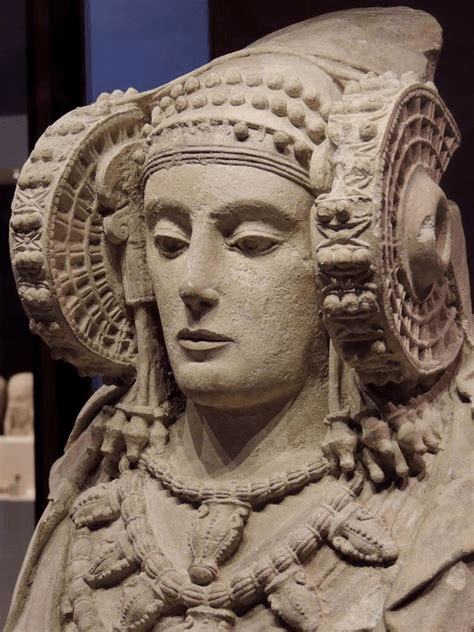
La Dama de Elche / The Lady of Elche

Disclaimer: None of these pictures are mine. I found them on the Internet. If any of them are yours, and you don’t like them being used in this post, contact me and I’ll be happy to take them down.

This is the Lady of Elche, Spain.

As you can see, her shoulders are hunched up. Some people describe her as having an “elongated head,” but it could just be the hat. Or it could be a hat meant to imitate elongated heads, as we see in many other cultures, but especially Egypt and MesoAmerica, where there was also head binding.

The following two links are my bibliography. You can follow them to check what I’m about to tell you about the Lady.

https://www.ancient-origins.net/news-history-archaeology/lady-of-elche-002305

https://www.atlasobscura.com/places/the-lady-of-elche

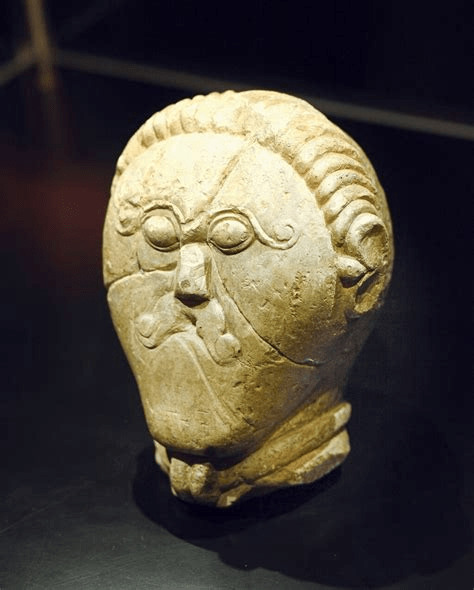
When I first heard that this Lady had been found buried in Iberia, it freaked me out. That’s because my understanding of pre-Roman Iberia was that it was basically Celtic. I was prepared to find Celtic- or Scythian-style artifacts there, such as images of people with narrow chins, large eyes, and moustaches; men with deer antlers; horses, and spirals, perhaps worked in silver, wood, stone, or even gold.

Celtic portrait, with torque necklace

Kurgan stelae in Kyrgyzstan, closer to the probable homeland of the Celts/Indo-Europeans

That’s what I expected to find in Spain. Or maybe something that looked like Etrusacan art, or like statues from the Archaic period of Greece.

I was not prepared for a massive, highly realistic stone statue that looked more classical Greo-Roman in style and featured attire more reminiscent of … I don’t know. Ancient Mesopotamia? Peru? The Lady of Elche freaked me out because it seemed to suggest a whole different style of civilization in Iberia, previously unknown. I was thinking Stone Age or pre-Flood.

Then, I heard that the Lady was believed to be Carthaginian. She instantly became less mysterious, but no less horrifying.

Carthage was a colony of Phoenicians. Phoenicia was an advanced civilization from the Levant. They inhabited the port cities of Tyre and Sidon, near ancient Israel. This explains why the Lady seems to be dressed like someone from the Ancient Near East. The Phoenicians had a shipping empire, so not surprisingly, they started a colony in North Africa. Carthage was here:

As you can see, they are very close to Europe, including territories in Spain. That explains how the Lady of Elche could have Western European facial features and Carthaginian dress.

Like most advanced civilizations of the Ancient Near East, the Phoenicians practiced atrocities in their pagan worship. This was the group that had the god Molech, to whom babies were sacrificed in the fire.

They were dropped down into, or placed in niches in, the red-hot statue. Drums and horns covered the sound of the infants’ screams. Incredibly, Israelites kept taking part in this practice and God had to keep telling them to stop. There was even an Israelite king who “made his son pass through the fire.”

Given that Carthage was part of an advanced, baby-killing empire, the Lady of Elche at once becomes more horrifying. The blank look on the woman’s face becomes more sinister. Is this just a death mask? Or is it because she is cruel? Or mindwiped by all that she had seen and done?

I don’t have any historical reference for this, but an anonymous commenter on the Internet has asserted that the “ear covers” were worn by priests and priestesses to block out the screams of the victims of more gruesome rituals. The bigger the ear muffs, the worse the ritual. I’d like to pooh-pooh that, but it fits with everything else we know about the ancient world. Christ conquering the nations suddenly sounds much less like a step in oppression and more like a relief. If you know more about the earmuff question, I’d love to hear it I wouldn’t exactly love to hear about it, but I’m curious and please send me your information.

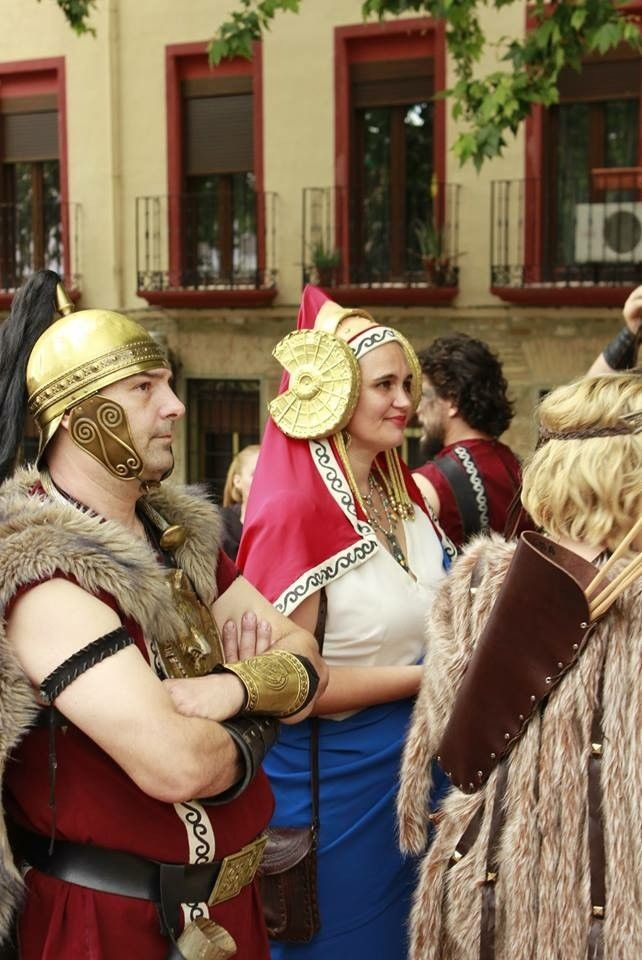
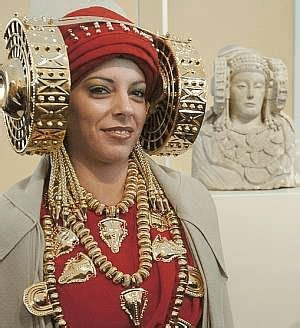
If you know how to indicate your interest in the Lady to the algorithm, you may find people dressed in historical re-constructions of the Lady of Elche’s garb, like these:

These ladies all look significantly happier than the original Lady.

Christmas Trees are Christian, but still Very Ancient

This post is about how we got our Christmas trees. For the record, I would probably still have a Christmas tree in the house even if it they were pagan in origin. (I’ll explain why in a different post, drawing on G.K. Chesterton.) But Christmas trees aren’t pagan. At least, not entirely.

My Barbarian Ancestors

Yes, I had barbarian ancestors, in Ireland, England, Friesland, and probably among the other Germanic tribes as well. Some of them were headhunters, if you go back far enough. (For example, pre-Roman Celts were.) All of us had barbarian ancestors, right? And we love them.

St. Boniface was a missionary during the 700s to pagan Germanic tribes such as the Hessians. At that time, oak trees were an important part of pagan worship all across Europe. You can trace this among the Greeks, for example, and, on the other side of the continent, among the Druids. These trees were felt to be mystical, were sacred to the more important local gods, whichever those were, and were the site of animal and in some cases human sacrifice.

God versus the false gods

St. Boniface famously cut down a huge oak tree on Mt. Gudenberg, which the Hessians held as sacred to Thor.

Now, I would like to note that marching in and destroying a culture’s most sacred symbol is not commonly accepted as good missionary practice. It is not generally the way to win hearts and minds, you might say.

The more preferred method is the one Paul took in the Areopagus, where he noticed that the Athenians had an altar “to an unknown god,” and began to talk to them about this unknown god as someone he could make known, even quoting their own poets to them (Acts 17:16 – 34). In other words, he understood the culture, knew how to speak to people in their own terms, and in these terms was able to explain the Gospel. In fact, a city clerk was able to testify, “These men have neither robbed temples nor blasphemed our goddess” (Acts 19:37). Later (for example, in Ephesus) we see pagan Greeks voluntarily burning their own spellbooks and magic charms when they convert to Christ (Acts 19:17 – 20). This is, in general, a much better way. (Although note that later in the chapter, it causes pushback from those who were losing money in the charm-and-idol trade.)

However, occasionally it is appropriate for a representative of the living God to challenge a local god directly. This is called a power encounter. Elijah, a prophet of ancient Israel, staged a power encounter when he challenged 450 priests of the pagan god Baal to get Baal to bring down fire on an animal sacrifice that had been prepared for him. When no fire came after they had chanted, prayed, and cut themselves all day, Elijah prayed to the God of Israel, who immediately sent fire that burned up not only the sacrifice that had been prepared for Him, but also the stones of the altar (I Kings chapter 18). So, there are times when a power encounter is called for.

A wise missionary who had traveled and talked to Christians all over the world once told me, during a class on the subject, that power encounters tend to be successful in the sense of winning people’s hearts only when they arise naturally. If an outsider comes in and tries to force a power encounter, “It usually just damages relationships.” But people are ready when, say, there had been disagreement in the village or nation about which god to follow, and someone in authority says, “O.K. We are going to settle this once and for all.”

That appears to be the kind of power encounter that Elijah had. Israel was ostensibly supposed to be serving their God, but the king, Ahab, had married a pagan princess and was serving her gods as well. In fact, Ahab had been waffling for years. There had been a drought (which Ahab knew that Elijah — read God — was causing). Everyone was sick of the starvation and the uncertainty. Before calling down the fire, Elijah prays, “Answer me, O LORD, answer me, so these people will know that you, O LORD, are God, and that you are turning their hearts back again.” (I Kings 18:37)

Similar circumstances appear to have been behind Boniface’s decision to cut down the great oak tree. In one of the sources I cite below, Boniface is surrounded by a crowd of bearded, long-haired Hessian chiefs and warriors, who are watching him cut down the oak and waiting for Thor to strike him down. When he is able successfully to cut down the oak, they are shaken. “If our gods are powerless to protect their own holy places, then they are nothing” (Hannula p. 62). Clearly, Boniface had been among them for some time, and the Hessians were already beginning to have doubts and questions, before the oak was felled.

Also note that, just as with Elijah, Boniface was not a colonizer coming in with superior technological power to bulldoze the Hessians’ culture. They could have killed him, just as Ahab could have had Elijah killed. A colonizer coming in with gunboats to destroy a sacred site is not a good look, and it’s not really a power encounter either, because what is being brought to bear in such a case is man’s power and not God’s.

And, Voila! a Christmas Tree

In some versions of this story, Boniface “gives” the Hessians a fir tree to replace the oak he cut down. (In some versions, it miraculously sprouts from the spot.) Instead of celebrating Winter Solstice at the oak tree, they would now celebrate Christ-mass (during Winter Solstice, because everyone needs a holiday around that time) at the fir tree. So, yes, it’s a Christian symbol.

Now, every holiday tradition, laden with symbols and accretions, draws from all kinds of streams. So let me hasten to say that St. Boniface was not the only contributor to the Christmas tree. People have been using trees as objects of decoration, celebration, and well-placed or mis-placed worship, all through history. Some of our Christmas traditions, such as decorating our houses with evergreen and holly boughs, giving gifts, and even pointed red caps, come from the Roman festival of Saturnalia. This is what holidays are like. This is what symbols are like. This is what it is like to be human.

Still, I’d like to say thanks to St. Boniface for getting some of my ancestors started on the tradition of the Christmas tree.

Bonus rant, adapted from a discussion I had …

... in a YouTube comments section with a Hebraic-roots Christian who was insisting that Christmas is a “pagan” holiday:

So, as we can see, the evergreen tree is a Christian symbol, not a pagan one, and has been from the very beginning of its usage. St. Boniface cut down the tree that was sacred to Thor, and that was an oak tree, not a Christmas tree. Sacred oaks are pagan. Christmas trees, which incidentally are not actually considered sacred, are Christian.

Yes, I am aware, as are most Christians, that Jesus was probably not actually born on Dec. 25th. Yes, I am aware that Yule was originally a pagan feast time.

But let’s look at the symbolism, shall we?

For those of us who live in northern climes, and especially before the industrial revolution, the winter solstice is the scariest time of the year. The light is getting less and less, and the weather is getting worse and worse, and all in all, this is the time of year when winter officially declares war on humanity. Winter comes around every year. It kills the sick and weak. It makes important activities like travel and agriculture impossible. It makes even basic activities, like getting water, washing things, bathing, and going to the bathroom anywhere from inconvenient to actually dangerous to do without freezing to death. If winter never went away, then we would all surely die. That is a grim but undeniable fact. Read To Build A Fire by Jack London, and tremble.

Thus, people’s vulnerability before winter is both an instance and a symbol of our vulnerable position before all the hardships and dangers in this fallen world, including the biggie, death. And including, because of death, grief and sorrow.

Yule is a time of dealing with these realities and of waiting for them to back off for another year. After the solstice, the days slowly start getting longer again. The light is coming back. Eventually, it will bring warmth with it. Eventually, life.

Thus, it is entirely appropriate that when the Germanic tribes became Christians, they picked the winter solstice as the time to celebrate Jesus’ birth. He is, after all, the light of the world. A little, tiny light – a small beginning – had come into the bitter winter of the sad, dark world, and it was the promise of life to come. The light shines in the darkness, and the darkness has not overcome it. All this biblical, very Hebrew symbolism answers beautifully the question raised by the European pagans’ concern with the sun coming back.

Our ancestors were not “worshipping pagan gods” at Christmas. They were welcoming Christ (who is the God of Abraham, Isaac, and Jacob) into the heart of their culture. They were recognizing that He was the light, using terms they knew, which were Germanic terms, and this is not surprising because they were Germans.

So, if you want to make the case that no holidays are lawful for Christians except those prescribed in the Old Testament for Israel, be my guest. Try to find some Scriptures to back that up. And maybe you can. But you cannot make that case by accusing people who put up a Christmas tree of worshipping pagan gods. All you’ll do then is reveal yourself to be historically ignorant.

Sources

BBC, “Devon Myths and Legends,” http://www.bbc.co.uk/devon/content/articles/2005/12/05/st_boniface_christmas_tree_feature

Foster, Genevieve, Augustus Caesar’s World: 44 BC to AD 14, Beautiful Feet Books, 1947, 1975, Saturnalia on p. 56 ff.

Hannula, Richard, Trial and Triumph: Stories from church history, Canon Press, 1999. Boniface in chapter 9, pp. 61 – 64.

Puiu, Tibi, “The origin and history of the Christmas tree: from paganism to modern ubiquity,” ZME Science, https://www.zmescience.com/science/history-science/origin-christmas-tree-pagan/

Saturnalia: The Roman Precursor to Christmas

Photo by Heather Smith on Pexels.com

And now to Rome, as always in December, came the Saturnalia.

Io! Saturnalia!” That was the call that ushered in the merriest holiday of the Roman year — that hilarious, glorious, mid-December festival, the Saturnalia.

Io! Saturnalia! Io! Io! Io!” That was the greeting that echoed through the holiday season. For it was in honor of Saturn — good, old, generous Saturn, kindest and most provident of the gods.

During those mid-December days (first three, later seven) no war was ever declared, nor battles fought, no criminals tried or punished. Courts were closed; schools dismissed; even the slave markets were shut down. During those days, all slaves were free [just] as in those golden days of old, all people had been equal. Everyone, rich, poor, young and old joined in a glorious holiday.

The day began with a sacrifice of thanksgiving in the early morning, followed by a public feast at midday, which turned into a wild, hilarious carnival before evening. In red pointed caps and colored costumes, merrymakers went singing and laughing through the streets, showering wheat and barley like confetti, and granting every wish, no matter how wild, ridiculous, or disgusting, made by the lucky one who had been chosen “King of the Saturnalia.”

The weeks ahead were always filled with preparation. Candlemakers and makers of dolls were busy pouring wax, turning out little earthenware images, and setting up booths for the doll fair. Every child would want a doll, and every household would need many candles for the Saturnalia.

Holly branches, with their bright berries, had to be cut and carted into the city, and houses trimmed with evergreen. Gifts for the family and friends must be selected and wrapped. For on the second day, after a family dinner of roast young pig, with all the trimmings, came an exchange of presents!

Augustus Caesar’s World: 44 BC to AD 14 by Genevieve Foster, Beautiful Feet Books, 1947, 1975, pp. 56 – 58

A True Horror Story from the Bible

The following account has been brought to my attention three times in the last forty-eight hours, so I guess I’d better pay attention.

The Gadarene region was Greek, not Jewish, in culture. There were a lot of pigs. There was a lot of paganism. People understood power. They knew there were things out there beyond their control or ken.

Jesus and his disciples landed on these shores in their fishing boat. I am not sure why they made this decision. It’s possible that they were blown there by the recent storm and needed to touch land and regroup.

Almost as soon as they disembarked (“immediately,” Peter says, telling the tale to John Mark), they encounter the scariest sight any of them have ever seen: the town demoniac.

Peter gives us some background, which apparently was well-known to the people in area. This man “had an unclean spirit.” The local people had tried to “tame him,” but they couldn’t do it. With paranormal strength, he would break through any chains put on him. (Demons are quite reckless with the bodies of their human hosts.) He had it so bad that he couldn’t live around people. But he didn’t go far. Night and day, they could hear him screaming in the hills that surrounded the town and in the graveyard, his home base. He was apparently naked (because later, he is “clothed”), and he would cut himself with stones.

It breaks the imagination, what this man must have suffered.

The demons for some reason were attracted to the sight of Jesus stepping on their shores. The man runs up to Jesus, falls on his knees, and screams, “Why can’t you leave me alone, son of the most high God? Swear to God that you won’t torture me!”

Jesus, the only sane person in this story, asks a simple, human question. “What’s your name?”

He was asking the man, but the demons answer: “Legion, for we are many.” (This would later prove to be really really true.)

Jesus, unfazed, tells the demons to come out of the man. And they begin to bargain. I’m not sure why they thought this was possible. Was it because they were gods in their own country? Was it because there were so many of them? At any rate, rather than be banished from that region, the demons get Jesus to agree that they can go into a nearby herd of two thousand pigs.

There were enough of them to possess the entire herd.

The pigs, unable to handle what this poor man had been going through, panicked and “ran violently down a steep place into the sea” and drowned.

The swineherds, understandably horrified, went for help. By the time the people of the region had been summoned from their homes and fields and made their way to the beach, the formerly demon-possessed man was “sitting, and clothed, and in his right mind.” Jesus, still bringing the sanity and relief, had apparently rustled up clothing for him from somewhere. (One of His or His disciplines’ spare cloaks, perhaps, from the boat?) This man’s body no doubt still bore the scars of the harrowing life he had been leading. He was probably still fragile. Did he even remember the months or years he had lost to demon possession? We don’t know. But he was near Jesus.

The Gadarene people were freaked out. There were a bunch of dead pigs washing up on the beach. They were confronted with the disorienting sight of the madman’s face now looking sane. And, though they might not have known exactly what Jesus was, He clearly represented a dangerous power. They pleaded with Him to leave their region.

The delivered man, for obvious reasons, wanted to go with Jesus. But Jesus told him to go back and “tell your friends the great things the Lord has done for you.” Perhaps, during the time it took the swineherds to bring the townspeople, Jesus had been interviewing the man, finding out about relationships he had before disaster befell him fully. And this man was not a Jew, and would find it difficult to live on the west side of the sea. Going back to his old life might be hard, but going anywhere else would be a lot harder. He followed Jesus’ instructions.

This story would have been a very different horror story had Jesus not been present.

This story was re-told from Mark chapter 5.

Even One Tree Hill is not as lonely as Potbelly Hill

I haven’t posted about the buried temple Gobekli Tepe in a while, so let me remedy that:

A Monumental Cover-Up?

For those in the back seats, Gobekli Tepe is an archaeological site in Turkey that I love for many reasons. It clearly partakes of the ancient megalithic culture that seems to have been worldwide (why? and how???). It has been dated to about 9000 B.C., which we must take with the usual grain of salt, but according to the people dating it, this was before the discovery of agriculture, the wheel, etc. Yet it employs circles, equilateral triangles, and other such evidence of having been built by mathematically capable people. For those new to Out of Babel Books, we frequently post about how wrong conventional archaeology appears to be about when and how civilization arose among human beings. If you click through to this article, you will see them struggling with that a bit.

The article also has some entertaining turns of phrase, for example: “In the end, searching for answers concerning motives and reasons from such an ancient time involves a great deal of speculation, since we cannot go back in time and probe the perpetrators.” Yes, that does sound like an unpleasant process for everyone involved.

The main reason I’ve included this link is the new-to-me information that Gobekli Tepe means “potbelly hill,” which I find charming. And it turns out the hill had a “belly button,” which was actually a sign that the hill was not natural, but had this temple buried below. Which I find creepy, like the whole site is creepy.

Besides “have we been completely wrong about the history of agriculture?,” the other question this article raises is “Why was Gobekli Tepe apparently deliberately buried?”

Why does one bury a thing? Particularly, why does one bury a statue, an idol, a god?

While acknowledging that we don’t know, the article references other instances of “de-sacralizing,” such as when an altar is no longer in use and we don’t want to pose a danger to anyone who might blunder upon it. They also reference the defaced and buried giant heads found in the Olmec region. If a statue is defaced, such as those heads are, we can reasonably guess that it, or its people, got conquered or overthrown by someone else, who wanted to humiliate the statue and rob it of its power. There are cases in the Old Testament where a king or someone else leading a reform not only defaces the pagan altars but defiles them (e.g., turning them into public toilets), so that no more honor may go to that god or goddess.

I don’t know whether the large stones at Gobekli Tepe were defaced. In every photograph I’ve seen of them, they appear to be not only intact, but still standing, as if they were buried so as to preserve them. But it’s possible that the archaeologists are the ones who set them upright again. Still, it’s customary when destroying an enemy’s temple to “leave no stone upon another.” So, unless a lot more reconstruction than I realized has been done under Potbelly Hill, I’m thinking the temple was buried for some other reason. I’m with the authors of the article on this one: We can’t tell what went down, but we can infer that it was probably not good.

Happy Columbus Day! Here’s a book review about Indian reservations

How History Goes

You may notice that I have a large tag in my tag cloud called Native Americana. I’ve always been a sucker for American Indians. The second two books in my trilogy are a speculative exploration of what their distant ancestor’s lives might have been like.

This subject comes up every year because of the efforts to change Columbus Day to Indigenous Peoples’ Day. I’m not in favor of this, but I do love all things American Indian. (Traditional things, that is. I’m not a fan of the cultural disintegration brought about by enforced socialism on the rez. For more on this, see the book review below.) Anyway, this is the time of year when I find myself annoyed yet again by Matt Walsh.

Walsh has done yeoman’s work fighting the forces of evil in our culture, but he just doesn’t know very much about American Indians. He’ll portray pre-conquest America as an extremely backwards place, full of “stone-age” people, who “hadn’t even invented the wheel.” This annoys me. There actually had been civilizations in the Americas (howbeit, without wheels), including astronomically aligned earthworks and pyramids, even in North America. The Americas suffered a population collapse about a hundred years before Columbus arrived, as documented by Nathaniel Jeansen of Answers in Genesis and in his book Traced. So, what the Europeans found were the scattered remains of civilizations. (Except Cortez. He found the real thing, and it was terrible to behold.)

Now granted, the American civilizations had not yet been Christianized, so they resembled Ancient Near Eastern pagan theo-states rather than European medieval kingdoms. It was probably this, in fact, that gave the Europeans the intellectual edge and enabled them to conquer the continents. Other things being equal, paganism tends to make people more passive. Fatalism, you know.

So Walsh is right that the Europeans conquered the Americans fair and square, as it were. Just like everywhere else throughout history. Now, the conquerors celebrating and romanticizing those they have conquered is a tradition that goes way back. See Homer writing sympathetically about the Trojans. See the beautiful Roman statue, The Dying Gaul. See the Romans commemorating the abduction of the Sabine women, but also celebrating Romulus and Remus, whose story is enough to curl you hair. So I am all for celebrating indigenous peoples (because I love ’em), but also Columbus (because there is no call to demonize your own culture).

That said, let’s not let sympathy turn into damaging infantilization. That’s what the United States government has done with the American Indians, as documented in the book below.

Book Review: The New Trail of Tears by Naomi Schaefer Riley

Life is very bad on our American Indian reservations.

People on the reservations experience rates of corruption, unemployment, depression, drug addiction, sexual assault and child abuse that are as high or higher than any other place in the nation.

But why?

Those with overly simplistic views of American Indians tend to oversimplify in one of two ways: your average American Indian is seen either as Wise Noble Victim, or Worthless Lazy Drunk. My instincts have always put me in the Wise Noble Victim camp, but I recognize that neither of these oversimplifications explains conditions on the rez. American Indians are people, which means they are sinful but not worthless. As Schaefer Riley puts it, “Indians, just like all people, respond to the economic incentives and political conditions around them” (page 178).

I have occasionally spoken with people who seem to resent all that American Indians receive from the government. Tribal governments are “sovereign.” Tribes have the right to operate casinos on their land (in most states no one else can), and in many cases, tribal governments or even individuals receive direct payments of federal dollars. None of this is false, but what has been the effect of it? It has not led to a cushy life for tribe members; quite the opposite.

The Incentives

Here’s my quick summary of the “economic incentives and political conditions” created by the way the federal government has handled the tribes:

  • Law enforcement on the rez is a nightmare. Since Indians are not considered as being under the jurisdiction of the state in which they live, if there is a serious crime, it is considered a federal crime, and you could have three or four agencies involved. “He became especially concerned ‘with the lack of coordination between the tribal police and the Bureau of Indian Affairs and the FBI and the Justice Department.'” (page 164) Often, other law enforcement agencies defer to the tribal police, who often, because of nepotism, don’t prosecute. This creates a lawless situation on the rez, with high crime. It gives victims the impression that nothing will be done.
  • It is difficult for Indians to own land; or, if they happen to own some, to develop or sell it. Most land is not individually owned, but belongs to the tribe. A combination of tribal politics, environmental concerns, and federal red tape tends to block any attempts at development. This means that it is very hard to create or find jobs on the reservation … except jobs in tribal government.
  • While casinos provide some jobs, the linking of the casinos with tribal membership has introduced all kinds of corruption. Some tribal governments run their casinos essentially as cartels. The effect is that tribal membership is “commodified.” A common political move against a rival would be to get them declared no longer a member of the tribe.
  • Schools on the rez tend to be as bad as the worst inner-city schools. Schaefer Riley profiles a few schools that have bucked this trend, at least for a few years. One is a Catholic school. There are also Teach for American volunteers who are very motivated to give Indian kids a better education. But these people are usually met with mistrust and actively undermined or driven out because they are outsiders and because of the bad experiences that the older generation had with residential schools trying to forcibly assimilate them.
  • While it is important for Indian kids to learn about their traditional language and culture, “this is not a good first step.” Schaefer Riley points out that those tribes that have done the most to preserve their language and culture are those that have done the best economically. When no longer just struggling to survive, they use the money and the energy they now have to create museums and cultural centers.

In short, massive amounts of government money and regulations have had the same effects on the Indian reservations that they always have elsewhere. The red tape is at least tripled compared to the red tape faced by other Americans, which pretty much brings any kind of enterprise to a grinding halt. The infusion of government money through the tribal government incentivizes corruption. The lack of private property and actual employment makes people depressed. The white guilt (and the red tape) have made a lost cause of law enforcement.

Possible Solutions

Schaefer Riley ends with a call for American Indians to be treated like all other American citizens. She points out that American Indians have had very high rates of serving in the military.

Indeed, despite centuries of broken promises from the federal government, despite the bitterness that often pervades Indian communities, and despite years of being told by their own leaders and by Washington’s that they must remain a people apart, American Indians largely see themselves as Americans.

pp. 175 – 176

There has to be a way to ensure that Indian crime victims have the same rights under law as other crime victims … that Indians can own land and start businesses as individuals, not just as members of the tribe … that Indian families have access to a choice of schools that will prepare their kids to succeed. It has been suggested that the larger reservations be made into their own states. Then the people who live there would be considered full citizens who happen to reside in that state. This might not be feasible politically (although I think it would be really cool), but there are a few bands in Canada who are trying to get their tribal lands incorporated as cities. This would allow them to do development that they can’t do now, and the tribal leaders would be like city governments. Failing all this, a good step would be to drastically reform (or, ideally, eliminate) the Bureau of Indian Affairs, which is known for being the one of the most corrupt and inefficient government agencies in a field where the competition is stiff.

I sincerely hope that Schaefer Riley’s book catalyzes a move in this direction. It should, of course, be read by anyone with the slightest interest in American Indians’ living conditions in these modern times. But it should also be read by anyone who is concerned about the effect of government micromanaging of citizens’ lives.

A Cautionary Tale

I see at least three ways in which the federal government’s treatment of Indians serves as a sample of what it would like to do with all citizens:

  • It’s coming from good – or at least utopian – intentions. In the case of the Indians, many people feel that the government owes them lots and lots of money and special rights because of the ways that same government mistreated them in the past. (Turns out, the money and “rights” are a new kind of mistreatment.) There is also an assumption that less development is better, because we don’t want to impact the environment at all. In the same way, there is a strong movement to put all citizens in the same position: “You will own nothing, and you will be happy.” Putting the most charitable interpretation on it, the idealists believe that this would bring about a utopia in which everyone has a high (but more importantly, “equal”) standard of living … there is no family loyalty or private property to cause conflicts … and everyone’s lifestyle is perfectly “green.”
  • It features forced assimilation. Schaefer Riley points out that Indians are in fact assimilating culturally to the United States, but forced assimilation is a very different story. A few generations ago, Indian children were forcibly removed from their homes and sent to boarding schools where they were not allowed to speak their own language. This idea that, if the parents don’t share the government’s value system, the government has a right to separate children from their parents and re-educate them, has not died away. The idealists have not yet gained enough power to practice forced assimilation on all American children, but they are trying.
  • It is collectivist. The degree to which Indians have been denied private property and individual initiative is the exact degree to which they have been brought to poverty and despair. In their case, this has been brought about partly from a sort of Rousseauian “noble-savage” myth about the way the Indians lived before Columbus (spoiler: they weren’t collectivists then either). In the case of other Americans, there has been an attempt to demonize private property, small business, and intact families as the problem with humanity. In fact, these things are key to human flourishing. Sin certainly shows up in them, but that is because it is present in human nature and shows up in whatever humans do.

The Unwilling: A Book Review

Mormon vampires. Need I say more?

Actually, that calls for a lot of explanation, doesn’t it?

The Setup

Carl is a faithful Mormon who is grieving his family. His wife, Sharon, and their three small children were killed by a drunk driver who ploughed over them on the sidewalk. But, Carl knows that if he remains faithful, he will be reunited with his family in the Celestial Kingdom. Per the Mormon promises, they’ll be together forever.

Then, Carl’s sister, who has had a troubled history, is killed by a mysterious woman in an alley. Carl becomes obsessed with finding the killer (the police seem to have given up). He tracks her to what appears to be a sex cult with gothic trappings. Thinking he is just going undercover to collect evidence, Carl takes an oath he doesn’t mean and finds himself becoming a vampire.

He doesn’t finish the ceremony, though. As soon as it becomes clear that he is supposed to drink the blood of an innocent girl, Carl instead breaks free and takes her to the nearest hospital. There, he collapses, and is rescued by Moira. Moira is another well-intentioned vampire (a “Penitent”), who works at the hospital so that she can work nights and have access to blood without having to attack people. Moira shows Carl the ways of surviving as a vampire without doing evil. Incredibly, it later turns out that she too is Mormon. She actually became a Mormon after she was already a vampire, thanks to two very persistent missionaries. For about fifty years, one Mormon bishop after another has handed down to his successor a letter explaining Moira’s special “condition.”

Like I said … Mormon vampires.

Pros and Cons, and Why I Was Crying in Public

(P.S. This section turned out kind of long. Sorry about that.)

C. David Belt (shown here with me at the recent Fantasy Faire) is a fantastic horror writer because he pairs the horror writer’s instincts and penchant for research with a uniquely right-side-up view of the world.

Take, for example, his take on vampires. I don’t usually read vampire books because the vampires are usually presented as like mortals, but better: they don’t age, they’re beautiful, they’re sexy. Mortals who don’t want their blood sucked are prudes and bigots and super intolerant. Not so with Belt. In his books, vampires are actually, you know, evil. Vampirism is actually a horror, like it would be if you encountered it in real life. That’s what I mean by a right-side-up view of the world.

Now, this strong sense of the wholesome can shade into a bit of naivete about the human heart. The whole premise of this series is based upon the idea that Carl took the vampire oath and even allowed his own blood to be drunk … “innocently.” Because he “didn’t mean it” and “didn’t think it was real,” he is blameless. He is, in all of history, the only Unwilling vampire.

This raises two questions. Now, perhaps these will be raised by the author himself later in the series, but I’m taking The Unwilling on its own terms. So here we go.

First, is it really possible to take an oath and not be responsible for it because “you don’t mean it”? That would be an extremely convenient thing, if so. Picture this: you are a follower of the One True God. But you live in a pagan environment, and you’re being pressured to take an oath of loyalty to Kukulkan, or Zeus, or the divine Caesar, or Big Brother is requiring you to “just say” there is no God but Big Brother. I think you see where I’m going with this. Now, granted, in The Unwilling Carl was not clinging to secret reservations just to get out of martyrdom when he took the oath to be loyal to Lilith. We know this because he fled the ceremony room, endangering himself, as soon as he realized what he was really being asked to do. So there are degrees of culpability, and of self-awareness. However, the principle that “I didn’t really mean it” or “I thought it was a game” is a dangerous one to introduce. As G.K. Chesterton has pointed out in The Everlasting Man, there is an element of game to much of pagan worship. It’s not always 100% clear how seriously the pagan followers themselves take all their superstitions. However, God still tells Israel in no uncertain terms not to pour out libations to any foreign god or take up their names in oath. So, “it was a game” or “it was maybe partly a game” is not going to cut it.

This leads directly to the second question. How is it possible that, in all of history, Carl is the first person to take the vampire oath without realizing it is real? Wouldn’t we expect that to be true of almost every person that gets inducted into the vampire cult? Or true of at least 50%? In modern times, most people do not really believe that vampires are an actual thing. Surely, the majority of the people that join this “empowering” gothic sex cult think of it as a sort of cosplay.

After all, this is how people join cults: there are concentric circles. There are the hangers-on or wannabes, then the neophytes, then the journeymen, and so on. Typically only the people in the inner circle know what the cult is really about. By the time someone gets that far in, however, they have so much trauma bonding, Stockholm syndrome, sunk cost fallacy, mental confusion and spiritual deception that they tend not to be repelled by even the most bizarre and obviously evil beliefs.

The only way I can square this circle is to figure that, if there were any other Converted who didn’t take the vampire element seriously, then when it came time to commit the ritual murder, unlike Carl they didn’t balk, but rather went ahead. And this because, we can assume, they were not as strong-minded as Carl, or not as pure of heart and motive.

One downside of having a right-side-up view of the world, where you recognize that good and evil actually exist and that people can choose to do good or evil, is that there’s a tendency to think as though the world consists of some good people and some bad ones. Belt falls prey to this, to a certain degree. I don’t want to overstate this flaw, because on the whole he is quite insightful about human psychology, as any good novelist has to be. But here are some examples of what I mean.

Vampires, it appears, can “smell” when a person is truly depraved, truly far gone in their evil. Such a person’s blood “calls” to the vampire, creating an almost irresistible urge to kill. In this book, occasionally Carl will encounter such a person. One is a crooked cop, who is also molesting his stepdaughter. Another is a random mother we encounter at the Mormon church service. The precise nature of her evil is never revealed, but as Carl puts it when he warns the bishop about this woman, “something is very wrong” in that house.

So far so complex, right? I actually love the scene where Carl and Moira have to restrain themselves from attacking this apparently pious Mormon woman. My beef with this phenomenon is that there are far too few of these people who call to Carl with their rotten/sweet-smelling blood.

Technically, on an orthodox Christain view of the world, the taint is in everybody. “There is none righteous, no, not one. All have turned aside; they have together become corrupt.” But let’s grant that this does not mean (as indeed the doctrine of total depravity doesn’t) that everyone is as bad as they could possibly be. Nevertheless, part of a mature Christain world view is realizing more and more uncomforable truths like the following:

  • Given the intervening steps, anyone is capable of anything.
  • I am far weaker and more sinful than I ever realized, but the grace of God is far deeper and stronger than I ever realized.
  • “I know that in myself lives no good thing.”
  • “Cheer up! You are worse than you think.”
  • “Christ Jesus came into this world to save sinners, of whom I am the chief.”

So, to modify our illustration, if The Unwilling had been written by an orthodox Christian, it would show a world where every single person had this taint in their blood, but some of them were in remission. Nevertheless, the proportion of people who had gone far down the road towards “capable of anything” would be quite large – large enough that Carl would be certain to be distracted by their intoxicating scent every time he went out in public.

But Belt is a Mormon, so although his worldview is basically right-side-up, it doesn’t include total depravity. His picture of the world is basically a bunch of lost, but essentially wholesome and well-meaning people, and a few stinkers. Furthermore, in the Mormon cosmology, salvation is not for the stinkers. It is for the well-meaning people who do their best to save themselves and trust God for the rest.

Take this scene, where Carl and Moira are trying to convince a mortal-turned-vampire to repent of his sins. Things start out well enough:

“You’re Catholic, aren’t you?” I ask him.

He laughs bitterly. “Lapsed.”

“Go to your priest,” I say. “Or go to a Mormon bishop. Only God can help you now.”

So far so good. Carl continues,

“Stop killing. Go to your priest or to a Mormon bishop. Pray. Lean on God. I believe you can find your way back. Atone for your sins as best you can. Put your trust in the Savior to take care of the rest. It’s the only way you can ever find redemption.”

And there we have the difference between Mormonism and orthodox Christianity. Ephesians 2:8 – 9 says, “For by grace you are saved, through faith, and this [faith] is not of yourselves, not of works, lest any man should boast.” The Mormons have a similar verse, but it runs like this: “We are saved by grace, through faith, after we have done all we can.” What this misses is that, if we are “doing all we can,” then one of two things is going on. If we are truly repenting and making restitution, then that itself is a gift and is a sign that the Holy Spirit is already revivifying our heart. Which means that He started this good work in us before we were repentant. The other possibility is that we are “doing all we can” in a cynical way, as a work of our own righteousness, so as to put God in a position where He “has to” forgive us. This is a grievous sin against God, probably far worse than the original bad things we did.

To an orthodox Christian, “Atone for your sins as best you can. Put your trust in the Savior to take care of the rest” is a HUGE insult to the Savior. Did He really suffer torture and the wrath of God to take care of our leftovers? Doesn’t it seem that we could have done a little more and spared Him all that? Or, if there was a portion of our sins that called for torture and death on His part, then doesn’t that suggest that the rest of them were equally bad and probably can’t be dealt with by “doing the best we can”?

These are the things that crossed my mind as I read this book. The psychology is good, and somewhat deep, but it’s not the deepest of the deep. That is reserved for writers like Dostoyevsky and St. Paul.

Finally, I won’t give the background of this because you really should read the book, but there was a certain character whose story had me in tears in the doctor’s office. I had brought this book with me to my son’s doctor appointment, to read in the waiting room, as one does. And – well, it was a really hard to put down part, and so it was that the doctor came in to see us just at the moment when my heart got broke. And I had to knuckle a tear away and say, “Sorry, we are fine. This book made me cry.” Good job, Mr. Belt, good job.

Greys and Nordics and Lizards, Oh My!

Alien Intrusion: UFOs and the Evolution Connection by Gary Bates, A Book Review

The next thing [Bill] knew, he was being levitated above his bed. He then had the sensation he was being suspended by what felt like a pole inserted into his rectum. By this time, he was alive with terror, but he couldn’t scream. The following is an excerpt taken directly from the transcript of Mr. D’s interview:

“I thought I was having a satanic experience; that the devil had gotten ahold of me and had shoved a pole up my rectum and was holding me up in the air… . So helpless, I couldn’t do anything. I said, ‘Jesus, Jesus, help me!’ or ‘Jesus, Jesus, Jesus!’ When I did, there was a feeling or sound or something that either my words that I thought or the words that I had tried to say or whatever, had hurt whatever was holding me up in the air on this pole. And I felt like it was withdrawn and I fell. I hit the bed, because it was like I was thrown back in bed. I really can’t tell, but when I did, my wife woke up and asked why I was jumping on the bed.”

ibid, p. 266

A while back, I posted a link to an interview with Gary Bates, in which I called him “a very sane UFOlogist.” This book confirms my initial impression. It’s 400+ pages, with endnotes to each chapter, appendices, and an index, yet it is accessibly written.

Synopsis of the Chapters

  1. The Invasion Gets Underway deals with the social history of the UFO phenomenon, “the ETH,” or “extra-terrestrial hypothesis,” and its reflection of cultural fears and its symbiotic relationship with sci-fi books and movies. (Gates introduced the term ETH because although technically, a UFO just means any explained light in the sky, the term has actually come to mean “spacecraft filled with aliens from other planets.”)
  2. The Science of Fiction addresses major sci-fi writers who have embraced and promoted the ETH. It also addresses the physical impossibility of ultra high-speed or light-speed travel, which is a necessary prerequisite for the ETH to be true. For example, “To propel an object that weighs one pound to 50% of the speed of light would require an energy source equal to the energy of 98 Hiroshima-sized atomic bombs” (69) and “at one-tenth the speed of light, the impact [of hitting a dust particle] would be equivalent to about 10 tons of TNT” (73).
  3. Is There Life on Other Planets? The short answer is, there doesn’t seem to be. Earlier ideas about alien life had them living on other planets in our solar system. As these have been discovered to be unlivable, the aliens have been moved out to distant galaxies, raising the high-speed travel problem from the previous chapter. So far, earth is the only planet we have found that seems to have even the most basic preconditions for life … and it has them all, perfectly. Additionally, based on the red-shift effect, earth appears to be located at the center of the universe. (Everything else appears to be moving away from us.) This would make sense on an intelligent-design hypothesis, where the earth was designed for life including people, but non-ID astronomers find it unacceptable, and a variety of different universe shapes have been proposed to account for the fact that everything seems to be moving away from everything else. This chapter addresses the precommitments behind a belief that the universe came from a “big bang” which then coalesced into stars and planets.
  4. Did Aliens Create Life on Earth? This chapter summarizes the reasons that natural selection cannot have created complex life forms. Natural selection reduces the amount of genetic information, but never increases it. Other than intelligent design, no explanation has ever been proposed for how the complex information got there in the first place. The discussion in this chapter is similar to Philip Johnson’s in his excellent Darwin on Trial, but it is more succinct. Most people who believe in the ETH, believe that since life evolved here on earth, it must have evolved in other star systems too. There is also a theory that aliens brought life to earth. Given that we see complex genetic information appearing on earth seemingly out of nowhere, perhaps it was brought or “seeded” by an intelligent race from the place where it did evolve. This, however, just pushes the problem of how complex information can appear out of nothing farther back in time and off to a distant planet.
  5. Lights in the Sky — Where Are They Coming From? looks at the history of UFO sightings, including mistaken sightings (the majority of cases are Venus, government planes, and the like), hoaxes, and the small residue of sightings that remain truly unexplained. Interestingly, this is a global phenomenon. For example, the 90s saw a rash of well-documented sightings in Mexico, including in Mexico city, sometimes in broad daylight. This chapter also touches on government cover-ups of their research into the UFO phenomenon. This often because the people involved in the sightings were pilots whose activities had to do with national security, but of course the cover-ups give the public the impression that the government knows far more about aliens than they are telling.
  6. Mysteries, Myths, Mayhem, and Money deals mostly with people who tried to capitalize on the UFO craze. Some of these people are true believers, others are hucksters, and many are both. But even the true believers have to use tortured logic in order to put forth their theories. This chapter discusses in detail Roswell, crop circles, and Erich von Daniken (a major proponent of “ancient astronaut theory”), among others. Interestingly, there was also a major UFO craze in the USSR, near weapons testing sites. Not surprisingly for a people who have been lied to about everything else, the Russian true believers are only able to think conspiratorially and impossible to convince otherwise.
  7. Abducted — Close Encounters of the Fourth Kind is a really interesting chapter. Bates has just spent more than half the book showing that the extraterrestrial hypothesis, at least as it is usually understood, cannot be true for multiple reasons. But now, he turns his attention to the many people who have had alien abduction experiences. And instead of dismissing them as hoaxers (dealt with in the last chapter) or gaslighting them, he believes them. And he has a great deal of compassion for them. This is why I think so highly of Bates. This topic deserves more than a bullet point, so now I’m going to stop the synopsis and discuss in a little more depth.

A “Typical” Alien Abduction Story

According to Bates, drawing on the work of other researchers, here are the elements of “Classic Abduction Syndrome [CAS]”: the abductee is captured, often at night, and often while being seemingly paralyzed. Once on the ship, they are typically undressed and subjected to some kind of invasive and humiliating “medical” examination. Often, this escalates to sexual abuse of various kinds. Then, the aliens “teach” the abductee. This involves being told that they have been chosen for a special mission. Predictions are made about the future of earth or of humanity. The aliens are trying, and they want the abductee’s help, to raise humanity’s consciousness or to save humanity. Often, they say they are engaged in a breeding program, creating human/alien hybrids. Sometimes this is explained as a way for humanity to survive when the earth is destroyed. Abductees may be given a tour of the ship or of other locations, and they may meet a divine being or an entity claiming to be Jesus, the pope (!), or a dead relative. After the abductee is returned to his or her surroundings, they often don’t immediately remember their abduction experience. They may experience “lost time,” and recall the experience only later (sometimes under hypnosis, which raises other issues).

Abductees experience lasting physical and mental aftereffects of their experience, whatever its nature may have been. They have PTSD-like symptoms. They have may bruises, scars, or puncture marks on their body, though these are never of an obvious enough nature to prove their story. They may experience new chronic health problems, commonly with their reproductive system, even including uterine or breast cancer.

On the spiritual side, many abductees come out of the experience with a new openness to the occult and to New Age beliefs. Others, though they initially feel understandable anger and fear towards the aliens, after multiple abductions come to a passive state of appearing to love and be fascinated with their tormentors, almost like Stokholm Syndrome.

Assuming that all these people are not just making up these bizarre and traumatic experiences, it is clear that they have come into contact with entities that do not wish them well.

On their own testimony, the “aliens” can be shown to be unreliable. For example, they tell abductee they are torturing them “for your own good.” They say they are wise and want to help human beings evolve to the next level, yet they subject their human subjects to frightening and degrading sexual practices. Either these beings don’t understand humans very well, or they are traumatizing them on purpose to “break” them. The aliens also seem eager to explain exactly where they are from. In past decades, they would claim to be from Mars or Venus. Now that we know more about those planets, they tend to name a star or star system that is outside of our galaxy.

Aliens tend to appear to humans in whatever form is culturally expected at the time.

Over the decades, we have allegedly been visited by long-haired Space Brothers, stacked Space-Babes, black-eyed and large-headed dwarfs, bipedal reptiles, praying mantis-type creatures, and … well … the list goes on and on. But, they all seem perfectly comfortable with Earth’s gravity, temperature, oxygen levels, etc. Doesn’t that strike you as a bit odd?

Nick Redfern, UFO researcher, quoted in ibid, p. 321

So, we have powerful, apparently deceptive entities, which kidnap and traumatize people, and then unfailingly give them a New Age message to take back to earth, often going out of their way to say that the Bible has “gotten it wrong.” Furthermore, apart from claiming to be from space, these “alien” abduction experiences have a lot in common with abduction stories from past ages where the perpetrators were fairies, demons, or other paranormal entities. It is starting to look as if we are hearing the same song, but a different verse. And in fact, Bates suggests that these “aliens” are probably demonic, or fallen angelic, entities. They are, in short, the “elohim” described by Heiser and identified as “the gods” by Cahn.

Jesus Really Is the Answer

Two UFO researchers, Joe Jordan and Wes Clark, noticed that out of all the abduction cases they had heard of, very few were Christians. They put out a call for anyone who was a Christian and had an abduction experience to contact them. Confusingly, they were contacted by people who said things like “I’m a Christian and I was abducted and saw Jesus on the spaceship.” With further research, they found that while people who identified as Christian but did not “walk the walk,” as the researchers put it, were just as likely to experience abduction and subsequent New Age brainwashing by the “aliens.” However, “walk the walk” Christians had a different experience:

Clark said that many of the respondents claimed to be Christians who told of their own abduction experiences. He felt that they were happy to have someone to talk to; they usually felt uncomfortable talking about their experiences because most UFO investigators had New Age inclinations and ideas that opposed their own beliefs. In addition, the Christian church is not equipped to deal with such reports because the UFO phenomenon has been largely misunderstood and dismissed by organized religions. Clark comments:

“As the number of cases mounted, the data showed that in every instance where the victim knew to invoke the name of Jesus Christ, the event stopped. Period. The evidence was becoming increasingly difficult to ignore.”

ibid, p. 267