PSA: I’m not doing off-the-grid August this year. You guys need a place to come where you can look at wildflowers and read about aliens. (So restful, right?) And I have enough pictures of the West to show you guys aaallll month.
So if I stop posting, it’s either because WordPress has bugged out on me, or the entire Internet has. Which are both things that could happen.
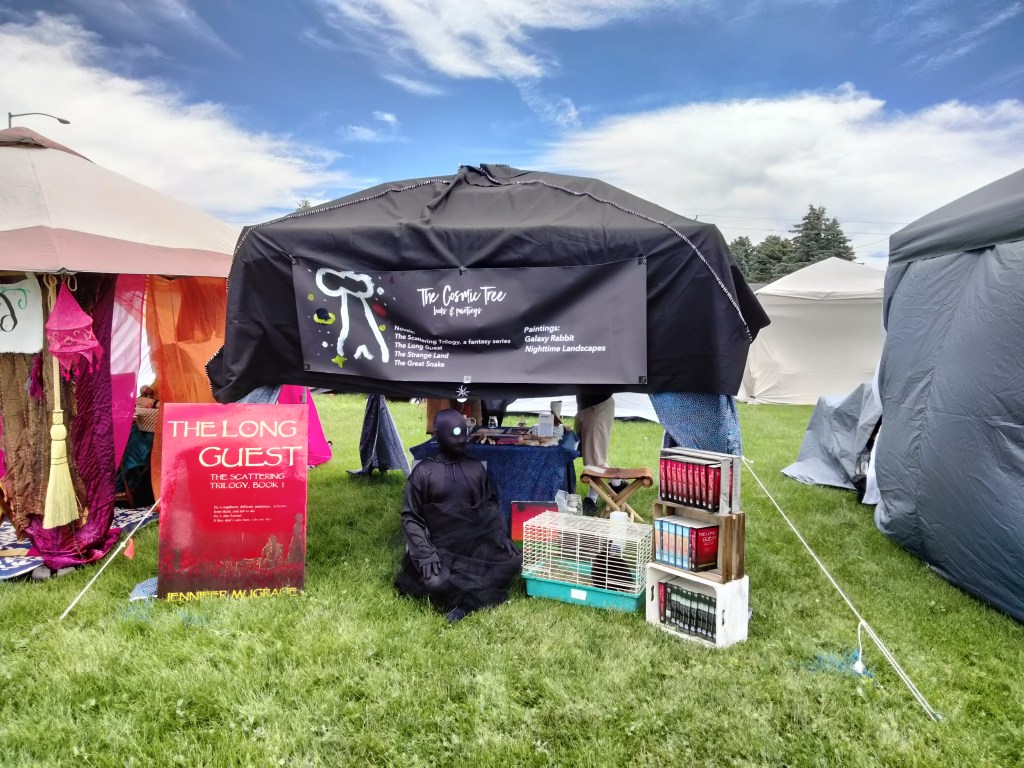
The Mystic Realms Fantasy Fair runs this Friday, Saturday, and Sunday (June 28, 29, and 30) at the Bannock County Fairgrounds in Pocatello, Idaho. My son and I will be there, I selling books, he paintings. I will be dressed as my online avatar, Neanderthal Woman. Our booth is called the Cosmic Tree (his idea). And there are many other amazing vendors and entertainers as well.
I’ll try to upload pictures as the weekend progresses, so this post should get more and more colorful.
UPDATE: Well well well! Before this post goes live, we already have an update. We are known for strong winds here in Idaho. So strong, in fact, that the wind just BROKE OUR 10×10 TENT when my son and I set it up in the backyard for a dry run. It looks as if, tonight, we will be buying something sturdier.
Bought the new tent. Here’s our booth. The event is much bigger than last year’s.
a smith
The position of village idiot is open… think I should apply?
a viking
This man is working a lathe. The top end of that string attaches to the branch of a tree, so he doesn’t need another person on the other side to help him work it. Neanderthal woman is impressed at this technological leap.
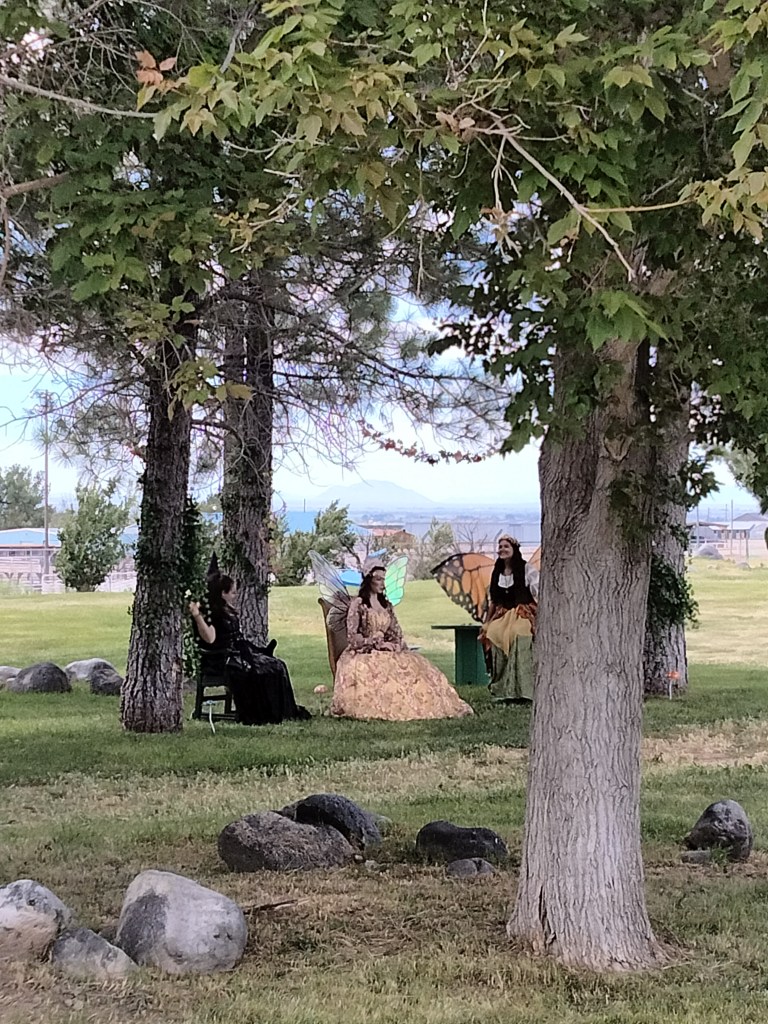
Big Southern Butte in the background of the fairy bower.
Meeting Other Authors
C. David Belt, who is taking his costume in a Scottish direction and was rocking a Scottish accent, is an LDS (Mormon) horror writer. Last year, I bought and reviewed his book The Sweet Sister. This year, I bought his Lilith trilogy. Here he is signing them for me.
Here’s his booth. This man sat in front of his booth and sang ballads, off and on, for six hours.
J.M. Cullen is a new-to-me writer with a particularly photogenic costume. I bought his duology that involves time travel to the waning days of the Mayan empire. So far, I have bought far more books than I’ve sold. Hopefully, that will come back around to me. But even if it doesn’t, I now have a lot of great summer reading material.
When one is trying to get into a house, one seeks openness. One pushes to open its door. So when the gods were seeking to get into the American house and that of Western civilization, the focus was on openness and tolerance. It was never really about either.
The Return of the Gods, by Jonathan Cahn, p. 219
The above book qualifies as my most mind-blowing read of the year so far (as well as I can remember). I’ll work on a review to have up by Friday.
In the meantime, the primary domain of this here Out of Babel blog is now outofbabelbooks.com (note that I have also updated the name on the banner). If you are here, congratulations, you found it!
The old url, outofbabel.com, is still in the process of being transferred to another user. Apparently, this can take a while. When the transfer is complete (perhaps by next week?), the address outofbabel dot com will no longer be associated with me in any way. At that point, some of you may see your shortcuts to my blog stop working. I don’t know. If that happens, keep calm and create a shortcut to outofbabelbooks dot com. Thank you.
Hi all! I am in the process of selling the domain outofbabel dot com. Who knew the name would be so lucrative? Or lucrative at all. Outofbabel will now be the address of a movie, made by someone other than me, that is shaping up to be really really good. I’ll post a link for you guys once it’s up and I get my act together.
In the meantime, the address for MY out of babel site will become outofbabelbooks dot com. I am hoping that if I do the internetting right, you who are my followers won’t notice anything and you will still be directed to my site. But please be patient; I have never done this before. And if I suddenly drop off your notifications screen, and you miss me, try to going to outofbabelbooks dot com and signing up again.
I am traveling this weekend. I’ll be going to a conference, where I hope to personally connect with the proprietors of Haunted Cosmos Podcast. These guys are (I believe) kindred spirits in that they are Reformed Christians with an interest in paranormal ancient mysteries weird stuff. If I can convince them to re-issue my books under their imprint, maybe I will be free no longer need to promote my own books and all our troubles will be over. Anyway, a lot of things are up in the air just now (at least, in my mind they are), so pray for God’s will to be done there. And in the meantime, definitely check out the Haunted Cosmos podcast.
Secondly, I have finally broken down and become a creator on Patreon. Not much happening over there yet (or maybe ever), but please do visit Out of Babel Art and Novels if you are seized with an inexplicable urge to give me money.
Finally, here is the book I’m currently reading.
Obviously, the chilling topic of the old gods and their ongoing activity in this world is one that’s near and dear to my heart. I bought this book because I wanted to see what the Dispensationalists were saying about it. So far, it’s solid and pretty hard to argue with. Here’s a quote:
Since the house is clean, swept, and in order, the spirit brings in seven other spirits to join in the repossession. The implication is that if the house had not been cleansed and set in order, the spirit would not have brought back the other spirits to occupy it.
And therein lies the warning. The house that is cleansed and put in order but remains empty will be repossessed. And if it should be repossessed, it will end up in a worse state than if it had never been cleansed. What happens when we apply this to an entire civilization? … Should a culture, a society, a nation, or a civilization be cleansed, exorcised of the gods and spirits – but then remain or become empty – it will be repossessed by the gods and spirits that once possessed it, and more. And it will end up in a far worse state than if it had never been cleansed or exorcised at all. …
A post-Christian civilization will end up in a far darker state than a pre-Christian civilization. It is no accident that the modern world and not the ancient has been responsible for unleashing the greatest evils upon the world. A pre-Christian civilization may produce a Caligula or a Nero. But a post-Christian civilization will produce a Stalin or a Hitler. A pre-Christian society may give birth to barbarity. But a post-Christian society will give birth to even darker offspring, Fascism, Communism, and Nazism. A pre-Christian nation may erect an altar of human sacrifice. But a post-Christian nation will build Auschwitz.
Hi, everyone. I still have a low fever plus the muzzy head and joint aches that go with it, so this post should be … interesting.
Within the last week I finished the book above. If the Shoe Fits is a sort of very loose Cinderella re-telling. The heroine’s name is Cindy. She has a stepmother and stepsisters. They are not hostile to her as in the original story — they are actually quite affectionate — but they are gorgeous, thin Hollywood babes, very much in the T.V. world, and Cindy is plus-sized, so there are some hints that things were a bit rough in high school. The handsome prince is the heir to a fashion empire. Cindy has just graduated from fashion school, with a special interest in shoe design. As you can see on the cover, the author does manage to get her into an outfit that parallel’s Disney’s Cinderella. And yes, there are crystal-covered shoes at one point. (No, she does not lose them, though I was waiting for that.)
O.K., those are the similarities. Now, the differences. This book takes place in the fashion world and in the world of reality T.V. Cindy and Henry must get to know each other while they are both contestants on a show that is obviously The Bachelor (a show whose producer is actually Cindy’s stepmother). So, all of this is pretty different from a fairytale.
A Sensible Story of Chub
If the Shoe Fits was written by Julie Murphy, who is also the author of Dumplin’. I have not read Dumplin’ but I did see the movie. This book, I would say, has the same strengths and weaknesses as the ones I noticed in Dumplin’.
First, the strengths. Both books feature a romantic heroine who is fat. In both cases, the amount of self-pity that gal displays is very low. This is so refreshing. Plus-sized girls need role models who are not whiny and self-obsessed. Dumplin’ is in high school, so she has a few more issues with her weight than Cindy does, and it’s shown how this leads her to be unfair to her naturally thin best friend. Cindy notes that she has gotten catty comments and the like, and it’s hard to find a variety of clothes in her size, especially in the fashion world, but for the most part she’s confident and she displays no envy or hostility to the more Barbie-like women who are also contestants on the T.V. show. Finally, in both books there is an attractive male romantic interest who seems to really like Cindy or Dumplin’, and this is accepted as a matter of course. There’s no insulting discussion along the lines of, “I like you even though you’re fat because …” blah blah blah. Is this unrealistic? Maybe. But remember, this is a romance genre, so it’s a fantasy for women. Also, some guys are attracted to women who would consider themselves fat (correctly or incorrectly). Finally, whenever one person says to another, “I like you even though …,” I would say that’s a red flag. Unless it is Mr. Darcy speaking, it probably means the “even though”-er feels superior to their prospective romantic partner, and expects that they will be able to treat them badly.
The Less Sensible Part
So, those are the strengths of each book. The downside? Both books have a subtext that being fat is just like being gaaay.
In Dumplin’, the heroine has warm memories of “Dolly Parton parties” that she and her beloved aunt used to have. Later, she finds out that her aunt was longtime friends with a whole bunch of drag queens who are also huge fans of Dolly. The drag queens, and their theatre, are a safe space for Dumplin’ and they help her prepare for the beauty pageant. So, a major theme of Dumplin’ seems to be that drag queens are kind, safe people who make great mentors. We have found this not to be true.
In If the Shoe Fits, we have Jay.
“Jay?” Henry calls.
A beautiful person with short, perfectly edged lavender hair, a manicured beard to match, razor-sharp eyeliner, and nude lipstick rounds the corner. Jay wears a flirty skirt with a cropped sweater topped with a trench coat and platform sneakers.
“This is Jay,” says Henry.
“Follow me,” says Jay as Henry helps them down from the stage.
So, Jay is a basically a very lost and confused young man whom the author insists on calling they throughout the entire book.
I realize that what I’m about to point out is well-trodden ground, but I’m going to tread it again.
How do I know Jay is a young man? He has a beard, and he’s “beautiful.” If Jay were a young woman who had been taking testosterone, he would be overweight, balding, with acne, and the beard would be scraggly. So, my instinct is that Jay is a young man. I pictured him that way as soon as the character was introduced, and I continued to think of him as “he” throughout the book.
As a mom, I really feel for Jay. I’d like to just give him a hug and a cup of tea, and introduce him to some genuinely good father figures so he can see there’s nothing wrong with being a man. Jay needs Jesus. And yes, I realize all the real-life Jays out there would howl with indignation if they were to come to this blog and see me say that. They can only interpret “You need Jesus” as a condescending slam, not a genuine expression of love and concern. People have been reacting that way to the name and message of Jesus for 2000 years. I don’t know who needs to hear this, but just because that is your reaction right now, doesn’t mean it has to be that way forever.
Second well-trodden point: go back to the quote above and look at Jay’s outfit. A flirty skirt with a cropped sweater – already sad on a man – but the trench coat and the sneakers take the outfit to a whole new level. That level is chaos. Jay has selected for himself an outfit that screams, “I have no idea what’s going on or what or who I want to be, and I want you to admire this chaos and join me in it.” Yes, this book does take place in the fashion world, which is notoriously in love with the weird … but Cindy describes a number of her own outfits throughout the course of the book, and they all make sense. No matter how creative Cindy gets with her outfits, they are integrated, coordinated, works of art, because Cindy knows what she is: a woman.
Finally (the most well-trodden ground of all) despite the author’s best efforts, it doesn’t really work to use the pronoun they for a character we already know. (They in the singular is fine in English, when it’s referring to an unspecified or unknown individual. When we have already met a character, that person is no longer unspecified.) For example, at one point Jay leads a group of dignitaries into the boutique, and then a little later they hop down from the counter they were sitting on. (Were all the dignitaries sitting on the counter? Or just Jay?)
Just Gotta’ Do It Myself
As someone who wears plus sizes, has a belly, and has in the past been fat, I like the idea of these chubby-heroine books. This is especially true since the majority of women in the U.S. are what the fashion industry considers plus-sized. But sadly, I think I’m done with the genre. The last chubby-heroine book I read tied confidence in a plus sized woman to female empowerment, and female empowerment to abortion, with a side advertisement for “spouse-sharing.” The one before that, a murder mystery, was tame by comparison, but it did include a bunch of little digs at white girls. I’m done.
I guess I will just have to write a chubby heroine into my own books … oh, wait, I already have!
Magya is a short, curvy mother of four who stepped out of the shadows to grab her own romantic subplot in my book The Strange Land. She was pregnant when her husband was tragically killed. Another member of the tribe stepped in to care for Magya and her children, and he found himself falling in love with her as she went through pregnancy and grieving and the hardships of a Siberian winter. He spends the year sitting on his hands so as not to bother her, and by the next year, they are married.
Sari is also a mother of four and a larger lady, but her story, in the same book, is much more tragic.
Don’t go to my novels just for the chubby girls, of course. Go for the survival and the demons and the dinosaurs. But don’t be surprised if you encounter all kinds of women – and men – along the way. That’s what happens when we just write about life.
I turned out of the introductions and took my first proper look at McTavish. The main thing that struck me was that he didn’t look how I’d expected. Of course, writers can look like anybody … but writers do have a look. … It’s all in the eyes … A writer’s eyes are wide and curious, taking the world and flipping it over, interrogating and interpreting it, regardless of whether it’s for vanity or creativity. But McTavish had none of that: his eyes were giving off the petulant clock-watching of a student waiting out a detention. It was jarring to see my favorite writer in this light.
-Benjamin Stevenson, Everyone on this Train is a Suspect, p. 68
Not sure I agree with this, but it’s a flattering thought.
It becomes funnier when you realize, as the book progresses, that the narrator is not really an experienced writer.
Lisa Fulton: Lisa Fulton’s best-selling debut novel The Balance of Justice shook the foundations of crime fiction on release twenty-one years ago with its white-hot rage and brutal truth, and was long-listed for the Justice in Fiction Award, Women’s Prize, 2003. She is currently working on her long-awaited second novel.
Wait, what? Why the 21-year gap? What happened in the interim?
S.F. Majors: S.F. Majors’s gripping thrillers have captivated the world with their psychological complexity and hair-raising twists and turns. Her books include the New York Times bestselling Twists and Turns …
OMG …
Wolfgang: Winner, Commonwealth Book Prize 2012; short-listed, Bookseller’s Favorites Award 2012; short-listed, Goodreads Reader’s Choice, Literary Fiction, 2012; short-listed, Best of Amazon, 2012; [font becomes smaller] short-listed, Justice in Fiction Award, Women’s Prize (special exemption granted), 2003 …
All these fictional author blurbs are from Benjamin Stevenson’s Everyone on This Train is a Suspect.
Too many Atlantises. An embarrassment of Atlantises. One Atlantis, two Atlantis, red Atlantis, blue Atlantis …
Atlantis is Now Off the Coast of Cuba
This articledescribes an intact granite city, with pyramids, discovered off the West coast of Cuba, about 2,000 feet down, in December of 2001. As our old friend KFM, of Bad Archaeology, points out, the city would be unlikely to survive intact like this if it actually dropped dramatically from what is now sea level, as Plato seems to describe. The article points out that there is another city, the Yonaguni Monument, off the coast of Japan, and Graham Hancock in his book, Underworld, points out that there are submerged megalithic cities in many places around the world, including off the coast of India. (Hancock has cycled through seriously advancing a number of different Atlantis theories, so he will be sort of the workhorse of this post.)
It seems to me that the city off the coast of Cuba is part of a worldwide phenomenon where sea levels were once much lower. We can include in this phenomenon Doggerland (which will make another appearance later in this post), and the land bridges known to have once connected Asia to the Americas and the Indonesian islands to the mainland.
If you are an old-earth believer and have to juggle millions of years, multiple cooling and warming periods, slow but somehow effective continental drift, and some confusing archeological indications that humans were perhaps around well before they should have been … good luck. As someone who believes that the history of the earth is measured in thousands or tens of thousands, but not millions or billions of years, my guess is that this period of low sea levels plus advanced civilization came right after the Great Flood.
You would have a much colder, rainier climate as the earth adjusted to the recent cataclysm (about this more in a minute). You would have had frequent snow and rain storms, with all this precipitation getting frozen in the rapidly forming ice sheets, causing Earth’s water supply to be greatly reduced. Meanwhile, you would have Noah’s children and grandchildren branching out as quickly as possible, building megalithic cities wherever they went, still remembering the techniques and technology (and possibly still assisted by the giants and gods) that they had seen pre-Flood. This period of low sea levels would have had to last long enough for people to disperse and to build, but it need not have been very long. It could have a been a matter of a few hundred to a thousand years. As the climate stabilized, you would have had floods covering settlements and civilizations in different parts of the world. This, I believe, is the reason we have an embarrassment of Atlantises.
There have also been assertions that the reason for the Bermuda Triangle phenomenon is that Atlantis lies underneath it. (Note that the west coast of Cuba is outside of the Bermuda Triangle.) This theory certainly appeals to those who are interested in the potential paranormal effects of the lost city, but I do not know of any actual submerged city found in the Bermuda Triangle area. (If you do, please enlighten me in the comments. I’m always looking for another Atlantis to add to my collection.) This article discusses how ocean-floor mapping technology can create lines that look like city streets.
Atlantis as Antarctica
Graham Hancock makes the case for this in his book Fingerprints of the Gods. He posits that the evidence points to an ancient, advanced civilization which was destroyed by a cataclysm, and asserts that the refugees from it seeded their scientific knowledge, in code form, by creating new religious cults all around the world that featured certain sacred numbers.
If you’ve been reading Out of Babel for a while, you know my assessment of all of this is that it’s right, but not in the way that Hancock thinks it is. Among other things, his scientific materialism and evolutionary beliefs make it impossible for him to imagine that people groups like the Maya, for example, would have come up with advanced mathematics on their own, so he needs to posit a more “advanced” civilization bringing these things from without.
Anyway. For his advanced ancient civilization, Hancock realizes he needs a continent-sized homeland (because, again, his evolutionary beliefs about man require that such a civilization develop gradually, over millennia, from hunter-gatherers to farmers and so on). Antarctica is a good candidate because it’s an entire continent; there is some evidence that it was mapped before it was quite so covered in ice; its general pre-ice outline corresponds roughly to Plato’s description of Atlantis; and there is a theory available for how it could have gone from being in a temperate part of the Atlantic, to being at the South Pole, in a relatively short amount of time. Hancock calls this “earth crust slippage” and posits that it happened about 20,000 B.C.
Now for the version I find more plausible: Creation scientist Dr. Kurt Wise presents his team’s model for “continental sprint” in this video. I find Dr. Wise’s model persuasive as a model of the Great Flood, and as we will discuss, it could explain the Atlantis legend wherever in the world Atlantis proves to have been. However, even if you buy into “continental sprint,” it does not follow that Plato was describing Antarctica when he wrote about Atlantis. If all the land on the earth were breaking up, the ultimate fate of that portion that later became Antarctica would seem like a minor detail.
Atlantis as North America
This one was put forward by Graham Hancock, after he abandoned his Antarctica theory, in his book America Before, a review of which I react to here. Although weak, the theory relies on the fact that there are large structures, either megalithic or earthworks, which align to different astronomical features and/or function as observatories, all around the world, including in North America. For example, the pyramid complex at Teotihuacan appears to be a model of the solar system; the Giza Plateau appears to be a model of Orion, and Serpent Mound in Ohio, which sites towards the sunrise at solstices, may be according to Hancock a model of the constellation Draco.
All that to say, anywhere you can find a large astronomical structure, you can make a case for Atlantis, and Hancock has made that case for North America.
Atlantis as the Cyclades Plateau in the Aegean
This article, which I posted last summer, asserts that Plato’s descriptions of Atlantis are admirably matched by the Cyclades Plateau (now the Cyclades islands), which would have existed when sea levels were 400 feet lower than they are now. The Cyclades Plateau is a rather large formation right in the middle of the Aegean. (If we consider that lower sea levels would have also expanded the coastlines of the rest of Greece, then it would have been even closer to the mainland.) This is an attractive theory in terms of its being what Plato was actually talking about (since he makes Atlantis contemporary with Athens), but it does depend upon this:
Recently, a four year study that included a thorough analysis of Plato’s work established that serious errors by early translators allowed for the mixed messages in the translated document.
Atlantis as Part of Doggerland
Yet another underwater location that used to be inhabited when sea levels were lower, Doggerland was a vast region that stretched between England, France, Holland, and Scandanavia, and is now the relatively shallow southern part of the North Sea. Archaeological discoveries have handily established that this area was once inhabited, here and here among others. As with other now-submerged human habitations, the reader’s preconceptions will determine how long ago you believe it was inhabited, and for how long.
This article describes an entire book which puts forth a detailed theory Plato was describing Doggerland. Apparently, Atlantis had a large, roughly rectangular plain surrounded by “ditches,” which the author thinks could also be translated “dikes.” He imagines the inhabitants of AtlantiDoggerland using these dikes to keep the sea back from a certain region of Doggerland for a period of time. Without some very expensive underwater archeological expeditions (in a notoriously dangerous sea), there is no way to confirm whether the ruins of a large city lie where this theory would predict. The maps are well worth looking at.
Atlantis as the Richat Structure
The Richat Structure, of the “Eye of the Sahara,” is a large (c. 40 km) formation of concentric rings of stone located in present-day Mauritania. Because of its size and remote location, it is hard to spot except from orbit.
Depending upon how you calculate, the structure matches the recorded dimensions of Atlantis quite well. There are also, of course, explanations about how this structure could have formed geologically. I’m not enough of an expert to assess these, but I am more skeptical of geological explanations than I used to be, now that I’ve seen “mountains” that turned out to be pyramids with insides, and geologists’ attempts to explain how a single fossilized tree could cross-cut millions of years’ worth of sedimentary rock layers. In other words, could go either way.
For the Richat structure to be Atlantis, we have to imagine that it was once nearer to coast and was inundated by a tsunami or something of that nature. This theory actually works fairly well with the geological model that Dr. Kurt Wise presents above. “Continental sprint” would have included many earthquakes and resultant tsunamis. Africa, in the model, does not move as much as the other pieces of Pangea, but it would still have undergone earthquakes and, possibly, some uplift.
On this theory, with his tale of Atlantis Plato somehow retained a memory of a pre-Flood incident (and read Athens back into it?). Below is a video of Pastor Joel Webbon discussing the theory with Brian Suave and Ben Garrett of Haunted Cosmos. They get into local lore around the Richat structure, how this dovetails with Greek legends about Atlantis, and how this all could have been plausible in a pre-Flood world haunted by gods and nephilim.
Conclusion
When I first started composing this post, I thought I was going to come out in support of the Richat Structure. Now, I just don’t know. The Haunted Cosmos guys make it sound very plausible, but a few of the other candidates are also plausible (some less so). There does not seem to be any way to “find” Atlantis without sacrificing at least some of what Plato has to say about it. (For example, Athens existed before the Flood? Before there was a Europe?) This makes it really difficult to favor any one theory (although we can probably discard others). What is clear, is that the prehistoric world had many sophisticated cities, lots of things built with megaliths, pyramids on almost every continent, and that there was a period when many human settlements were submerged as sea levels rose. The details are a matter of speculation, of the kind suitable for someone writing a novel.










 Out of Babel Books