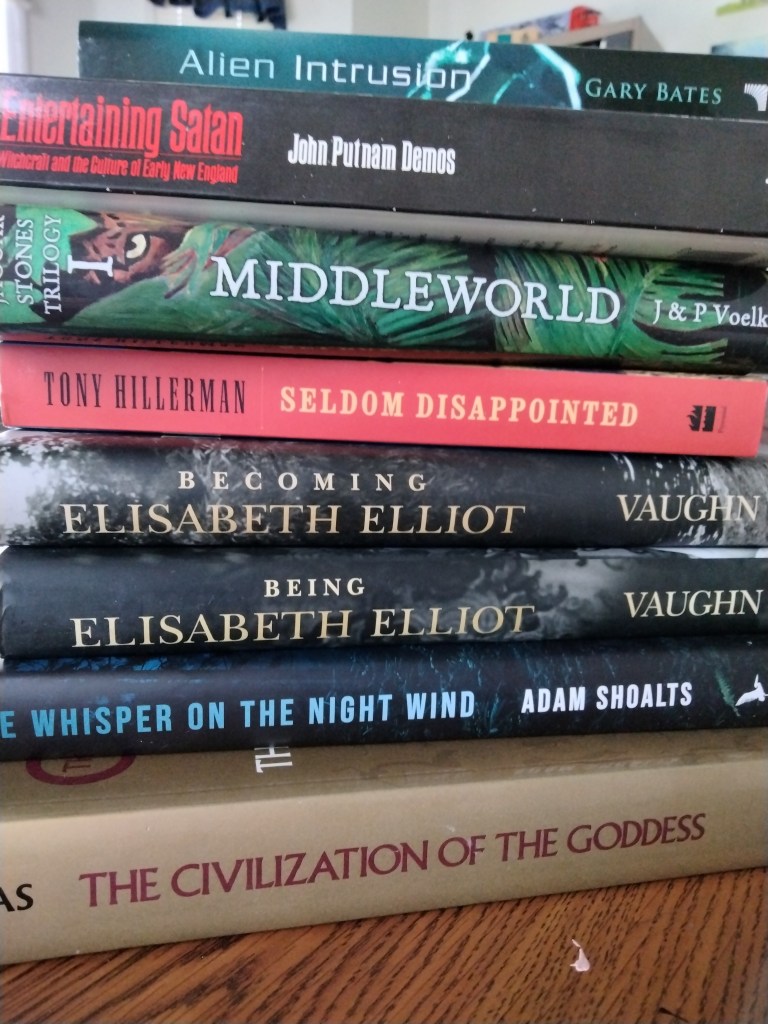
I turned out of the introductions and took my first proper look at McTavish. The main thing that struck me was that he didn’t look how I’d expected. Of course, writers can look like anybody … but writers do have a look. … It’s all in the eyes … A writer’s eyes are wide and curious, taking the world and flipping it over, interrogating and interpreting it, regardless of whether it’s for vanity or creativity. But McTavish had none of that: his eyes were giving off the petulant clock-watching of a student waiting out a detention. It was jarring to see my favorite writer in this light.
-Benjamin Stevenson, Everyone on this Train is a Suspect, p. 68
Not sure I agree with this, but it’s a flattering thought.
It becomes funnier when you realize, as the book progresses, that the narrator is not really an experienced writer.
Lisa Fulton: Lisa Fulton’s best-selling debut novel The Balance of Justice shook the foundations of crime fiction on release twenty-one years ago with its white-hot rage and brutal truth, and was long-listed for the Justice in Fiction Award, Women’s Prize, 2003. She is currently working on her long-awaited second novel.
Wait, what? Why the 21-year gap? What happened in the interim?
S.F. Majors: S.F. Majors’s gripping thrillers have captivated the world with their psychological complexity and hair-raising twists and turns. Her books include the New York Times bestselling Twists and Turns …
OMG …
Wolfgang: Winner, Commonwealth Book Prize 2012; short-listed, Bookseller’s Favorites Award 2012; short-listed, Goodreads Reader’s Choice, Literary Fiction, 2012; short-listed, Best of Amazon, 2012; [font becomes smaller] short-listed, Justice in Fiction Award, Women’s Prize (special exemption granted), 2003 …
All these fictional author blurbs are from Benjamin Stevenson’s Everyone on This Train is a Suspect.
Too many Atlantises. An embarrassment of Atlantises. One Atlantis, two Atlantis, red Atlantis, blue Atlantis …
Atlantis is Now Off the Coast of Cuba
This articledescribes an intact granite city, with pyramids, discovered off the West coast of Cuba, about 2,000 feet down, in December of 2001. As our old friend KFM, of Bad Archaeology, points out, the city would be unlikely to survive intact like this if it actually dropped dramatically from what is now sea level, as Plato seems to describe. The article points out that there is another city, the Yonaguni Monument, off the coast of Japan, and Graham Hancock in his book, Underworld, points out that there are submerged megalithic cities in many places around the world, including off the coast of India. (Hancock has cycled through seriously advancing a number of different Atlantis theories, so he will be sort of the workhorse of this post.)
It seems to me that the city off the coast of Cuba is part of a worldwide phenomenon where sea levels were once much lower. We can include in this phenomenon Doggerland (which will make another appearance later in this post), and the land bridges known to have once connected Asia to the Americas and the Indonesian islands to the mainland.
If you are an old-earth believer and have to juggle millions of years, multiple cooling and warming periods, slow but somehow effective continental drift, and some confusing archeological indications that humans were perhaps around well before they should have been … good luck. As someone who believes that the history of the earth is measured in thousands or tens of thousands, but not millions or billions of years, my guess is that this period of low sea levels plus advanced civilization came right after the Great Flood.
You would have a much colder, rainier climate as the earth adjusted to the recent cataclysm (about this more in a minute). You would have had frequent snow and rain storms, with all this precipitation getting frozen in the rapidly forming ice sheets, causing Earth’s water supply to be greatly reduced. Meanwhile, you would have Noah’s children and grandchildren branching out as quickly as possible, building megalithic cities wherever they went, still remembering the techniques and technology (and possibly still assisted by the giants and gods) that they had seen pre-Flood. This period of low sea levels would have had to last long enough for people to disperse and to build, but it need not have been very long. It could have a been a matter of a few hundred to a thousand years. As the climate stabilized, you would have had floods covering settlements and civilizations in different parts of the world. This, I believe, is the reason we have an embarrassment of Atlantises.
There have also been assertions that the reason for the Bermuda Triangle phenomenon is that Atlantis lies underneath it. (Note that the west coast of Cuba is outside of the Bermuda Triangle.) This theory certainly appeals to those who are interested in the potential paranormal effects of the lost city, but I do not know of any actual submerged city found in the Bermuda Triangle area. (If you do, please enlighten me in the comments. I’m always looking for another Atlantis to add to my collection.) This article discusses how ocean-floor mapping technology can create lines that look like city streets.
Atlantis as Antarctica
Graham Hancock makes the case for this in his book Fingerprints of the Gods. He posits that the evidence points to an ancient, advanced civilization which was destroyed by a cataclysm, and asserts that the refugees from it seeded their scientific knowledge, in code form, by creating new religious cults all around the world that featured certain sacred numbers.
If you’ve been reading Out of Babel for a while, you know my assessment of all of this is that it’s right, but not in the way that Hancock thinks it is. Among other things, his scientific materialism and evolutionary beliefs make it impossible for him to imagine that people groups like the Maya, for example, would have come up with advanced mathematics on their own, so he needs to posit a more “advanced” civilization bringing these things from without.
Anyway. For his advanced ancient civilization, Hancock realizes he needs a continent-sized homeland (because, again, his evolutionary beliefs about man require that such a civilization develop gradually, over millennia, from hunter-gatherers to farmers and so on). Antarctica is a good candidate because it’s an entire continent; there is some evidence that it was mapped before it was quite so covered in ice; its general pre-ice outline corresponds roughly to Plato’s description of Atlantis; and there is a theory available for how it could have gone from being in a temperate part of the Atlantic, to being at the South Pole, in a relatively short amount of time. Hancock calls this “earth crust slippage” and posits that it happened about 20,000 B.C.
Now for the version I find more plausible: Creation scientist Dr. Kurt Wise presents his team’s model for “continental sprint” in this video. I find Dr. Wise’s model persuasive as a model of the Great Flood, and as we will discuss, it could explain the Atlantis legend wherever in the world Atlantis proves to have been. However, even if you buy into “continental sprint,” it does not follow that Plato was describing Antarctica when he wrote about Atlantis. If all the land on the earth were breaking up, the ultimate fate of that portion that later became Antarctica would seem like a minor detail.
Atlantis as North America
This one was put forward by Graham Hancock, after he abandoned his Antarctica theory, in his book America Before, a review of which I react to here. Although weak, the theory relies on the fact that there are large structures, either megalithic or earthworks, which align to different astronomical features and/or function as observatories, all around the world, including in North America. For example, the pyramid complex at Teotihuacan appears to be a model of the solar system; the Giza Plateau appears to be a model of Orion, and Serpent Mound in Ohio, which sites towards the sunrise at solstices, may be according to Hancock a model of the constellation Draco.
All that to say, anywhere you can find a large astronomical structure, you can make a case for Atlantis, and Hancock has made that case for North America.
Atlantis as the Cyclades Plateau in the Aegean
This article, which I posted last summer, asserts that Plato’s descriptions of Atlantis are admirably matched by the Cyclades Plateau (now the Cyclades islands), which would have existed when sea levels were 400 feet lower than they are now. The Cyclades Plateau is a rather large formation right in the middle of the Aegean. (If we consider that lower sea levels would have also expanded the coastlines of the rest of Greece, then it would have been even closer to the mainland.) This is an attractive theory in terms of its being what Plato was actually talking about (since he makes Atlantis contemporary with Athens), but it does depend upon this:
Recently, a four year study that included a thorough analysis of Plato’s work established that serious errors by early translators allowed for the mixed messages in the translated document.
Atlantis as Part of Doggerland
Yet another underwater location that used to be inhabited when sea levels were lower, Doggerland was a vast region that stretched between England, France, Holland, and Scandanavia, and is now the relatively shallow southern part of the North Sea. Archaeological discoveries have handily established that this area was once inhabited, here and here among others. As with other now-submerged human habitations, the reader’s preconceptions will determine how long ago you believe it was inhabited, and for how long.
This article describes an entire book which puts forth a detailed theory Plato was describing Doggerland. Apparently, Atlantis had a large, roughly rectangular plain surrounded by “ditches,” which the author thinks could also be translated “dikes.” He imagines the inhabitants of AtlantiDoggerland using these dikes to keep the sea back from a certain region of Doggerland for a period of time. Without some very expensive underwater archeological expeditions (in a notoriously dangerous sea), there is no way to confirm whether the ruins of a large city lie where this theory would predict. The maps are well worth looking at.
Atlantis as the Richat Structure
The Richat Structure, of the “Eye of the Sahara,” is a large (c. 40 km) formation of concentric rings of stone located in present-day Mauritania. Because of its size and remote location, it is hard to spot except from orbit.
Depending upon how you calculate, the structure matches the recorded dimensions of Atlantis quite well. There are also, of course, explanations about how this structure could have formed geologically. I’m not enough of an expert to assess these, but I am more skeptical of geological explanations than I used to be, now that I’ve seen “mountains” that turned out to be pyramids with insides, and geologists’ attempts to explain how a single fossilized tree could cross-cut millions of years’ worth of sedimentary rock layers. In other words, could go either way.
For the Richat structure to be Atlantis, we have to imagine that it was once nearer to coast and was inundated by a tsunami or something of that nature. This theory actually works fairly well with the geological model that Dr. Kurt Wise presents above. “Continental sprint” would have included many earthquakes and resultant tsunamis. Africa, in the model, does not move as much as the other pieces of Pangea, but it would still have undergone earthquakes and, possibly, some uplift.
On this theory, with his tale of Atlantis Plato somehow retained a memory of a pre-Flood incident (and read Athens back into it?). Below is a video of Pastor Joel Webbon discussing the theory with Brian Suave and Ben Garrett of Haunted Cosmos. They get into local lore around the Richat structure, how this dovetails with Greek legends about Atlantis, and how this all could have been plausible in a pre-Flood world haunted by gods and nephilim.
Conclusion
When I first started composing this post, I thought I was going to come out in support of the Richat Structure. Now, I just don’t know. The Haunted Cosmos guys make it sound very plausible, but a few of the other candidates are also plausible (some less so). There does not seem to be any way to “find” Atlantis without sacrificing at least some of what Plato has to say about it. (For example, Athens existed before the Flood? Before there was a Europe?) This makes it really difficult to favor any one theory (although we can probably discard others). What is clear, is that the prehistoric world had many sophisticated cities, lots of things built with megaliths, pyramids on almost every continent, and that there was a period when many human settlements were submerged as sea levels rose. The details are a matter of speculation, of the kind suitable for someone writing a novel.
Many other book bloggers did “2024 Goals” posts in January. That seems like a nice way to generate a blog post, even if this goal post (haha) is a little late.
Finish woolen knee socks, to be worn with trousers, before Spring (for self)
Wanderer shawl: bias-knit chevron patterns to show off the beautiful striped yarn my sister gave me for Christmas (for self)
Brioche hat: continue to make different editions of this brioche hat, in different color combinations (gifts for various others)
Maybe try to ad lib a brioche bonnet (for sister in law?)
as the Spirit moves
TBSE
To be set up: My classroom in the new school building, which we hope to be moved into by Fall.
TBW
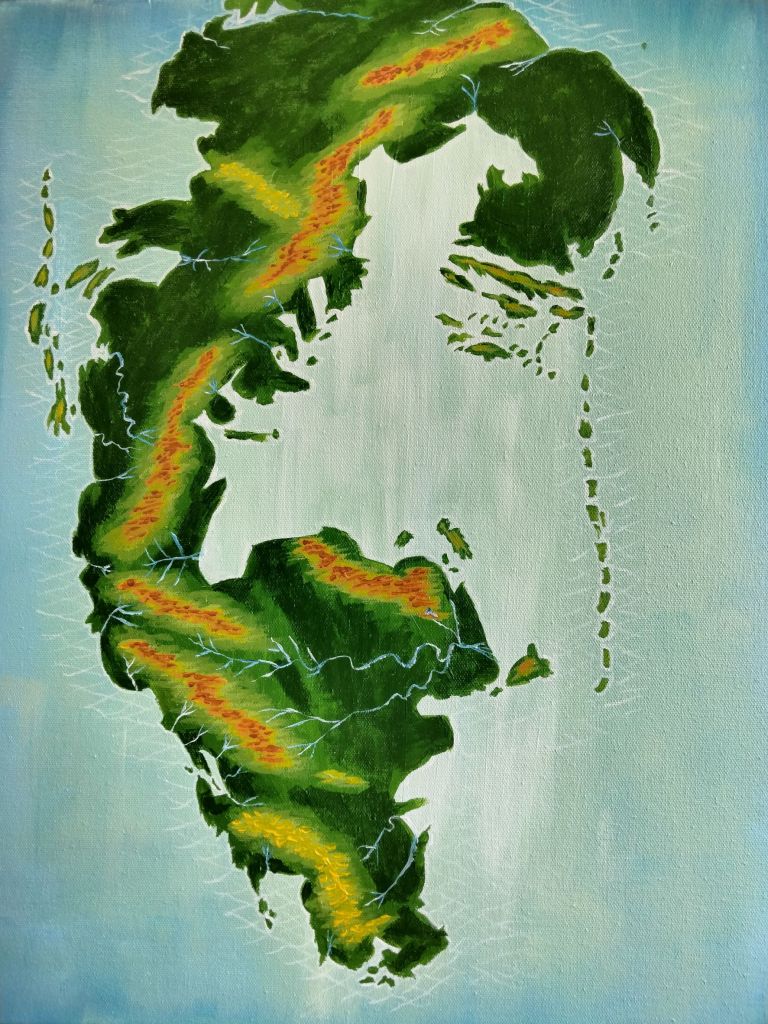
To be wrote: The book that goes with this map:
Last year, I went on a writing retreat in order to make some progress on the draft. At this rate, it looks as if I may have to do the same thing again.
TBC/P
To be cleaned/planted: Clean chicken coop (add more space for hens?), maybe actually plant a garden this year???
TB Top Secret
Various family events with loved ones, which privacy forbids blogging about.
A Caveat
Now listen, you who say, “Today or tomorrow we will go to this or that city, spend a year there, carry on business and make money.” Why, you do not even know what will happen tomorrow. What is your life? You are a mist that appears for a little while and then vanishes. Instead, you ought to say, “If it is the Lord’s will, we will live and do this or that.”
The Altai mountains are in central Asia, north of the Himalayas, around the area where countries such as China, Mongolia, Russia, and Kazakstan meet. They are not too far from the stompin’ grounds of the horse-riding Central Asian tribes such as the Scythians and Parthians, part of the same culture area that gave rise to the early Indo-Europeans with their kurgans, before they moved west into Europe proper. That’s why these guys look sort of European and sort of Asian. People who live here have looked like this for thousands of years.
The Altai mountains are an old range of mountains (left over from Pangea?), not created by whatever event caused the Himalayas. Hence, they are low and rolling. I had to (lightly) research this part of the world when I went to write The Long Guest. My characters called them the Gentle Mountains. They had a lodge there for some years before moving on to the Gobi desert (which possibly didn’t actually exist in the immediate post-flood years in which my story is set, but we will ignore that. Onward!)
I thought this was a perfect video to share on a winter’s day. Are these people cool or what? I love how he warms up for throat singing by making horse noises.
As with many cultures, my imagination is very attracted to their way of life, but I would probably hate it if I had to actually live that way, not being tough enough.
This is an annual sort of Towne Faire event. As far as I can tell, all the little towns in rural Idaho have one. There’s a parade late morning, then booths are set up in the park until about 5 p.m. We have some excellent food trucks that come by, such as Angel’s Tacos and a Navajo Taco stand (Navajo fry bread with ground beef and the fixins!)
Of course, you have to get permission to set up a booth, pay a fee, etc. Luckily, we already had a good-looking booth that we had designed for the Medieval Fantasy Faire earlier in the summer. We added the banner this time, because previously people were confused by the fact that we were selling more than one thing. It was my son’s idea to call our booth Cosmic Tree. He got this from the fact that his paintings are hung up inside the booth, like fruit on a tree, and they are mostly starscapes.
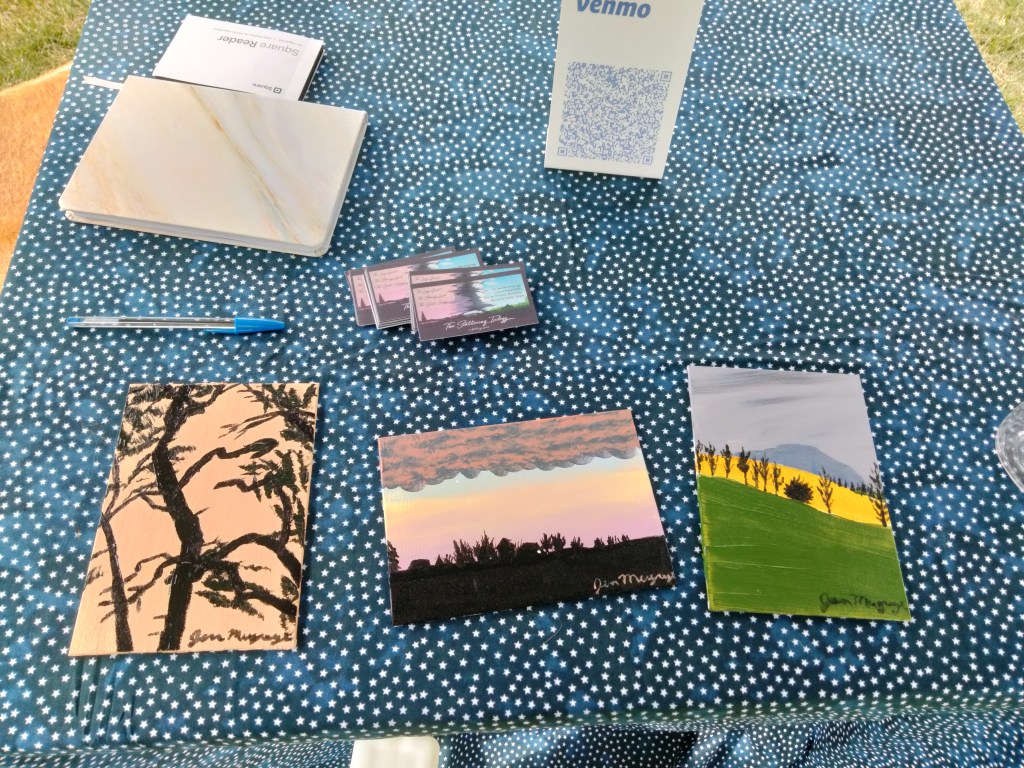
I had also done some paintings of our farm country. Here are some mini ones that I sold. Turns out that farm boys like equipment. They snapped up the paintings that featured such things as grain silos and telephone poles. I like nightscapes (I’ll show you some on the blog later), but most people prefer sunsets.
We’ve been here long enough now that we knew many of the people who passed by our booth. We don’t actually live in American Falls, but we spend enough time there to be considered honorary residents IMO.
The rabbit came along with us to attract attention and to promote my son’s signature Galaxy Rabbit paintings.
Literally every person who passed by our booth was worthy of a photo essay, so these are just a few highlights.
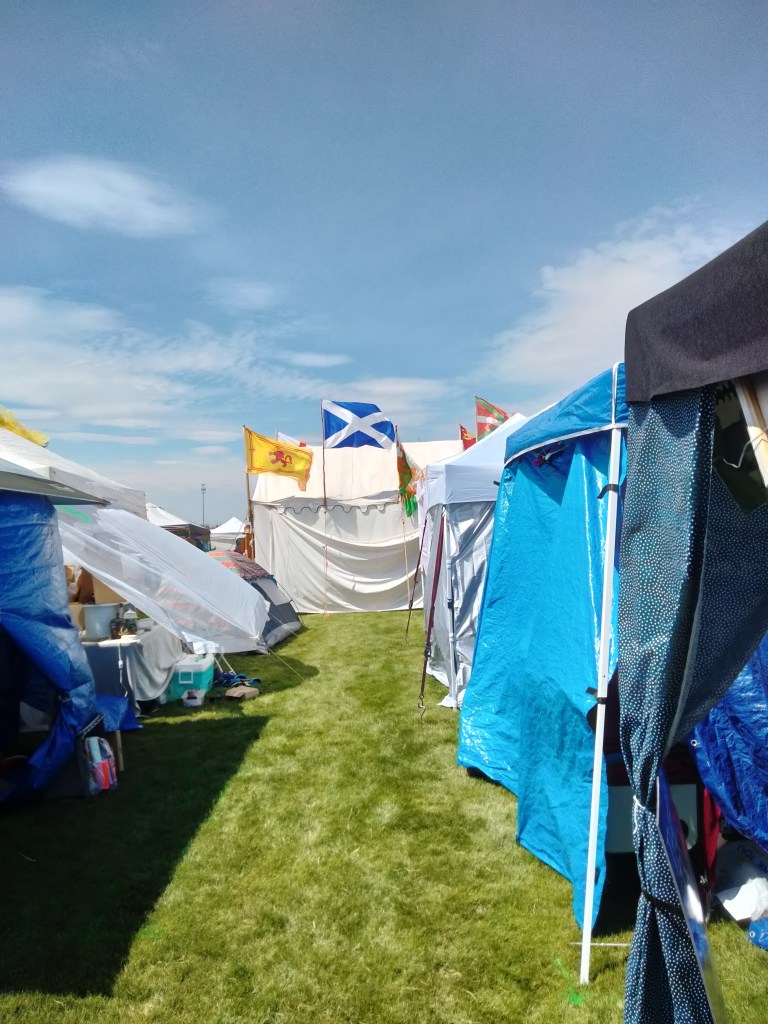
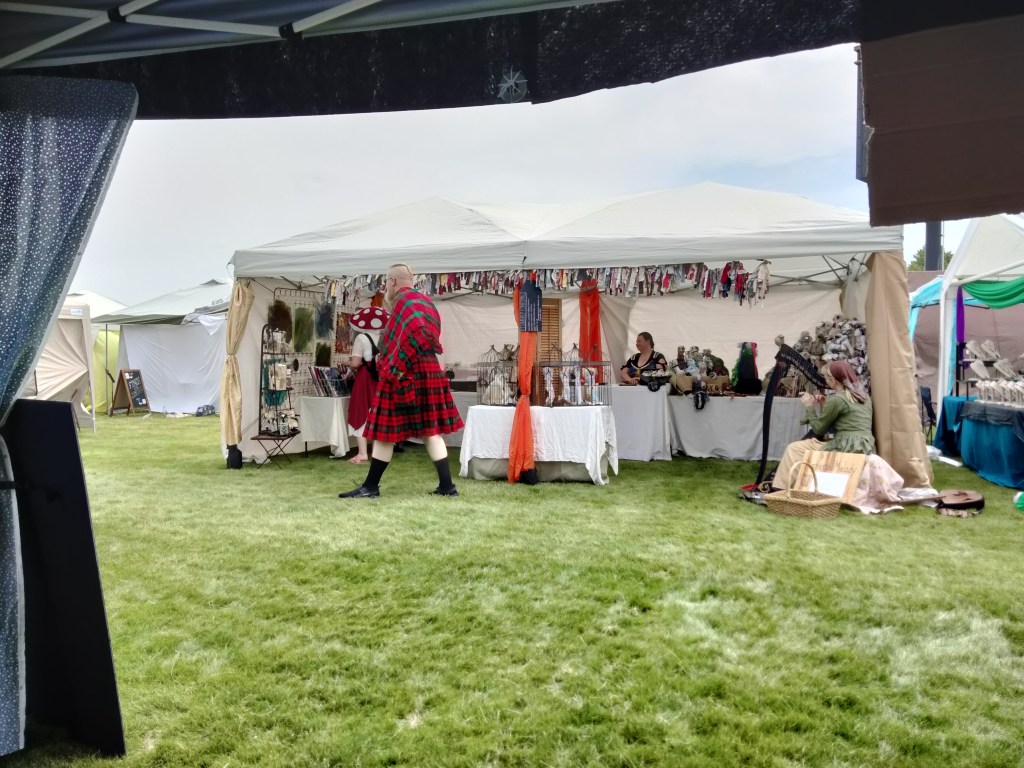
Here’s the alley behind the booths on Saturday. My son said, “It’s beautiful the way everyone shows up and sets up their own booth, and instantly there is a city where there was none before.” He’s eleven.
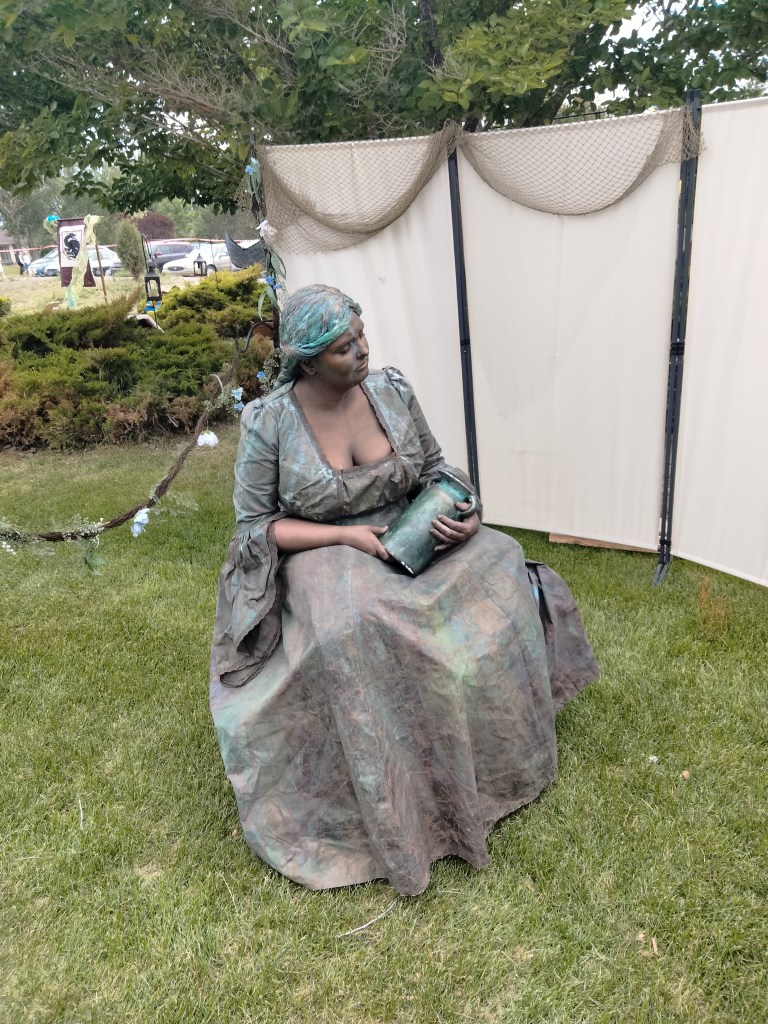
There was this “Enchanted Statue” who, when given a tip, would wink at you.
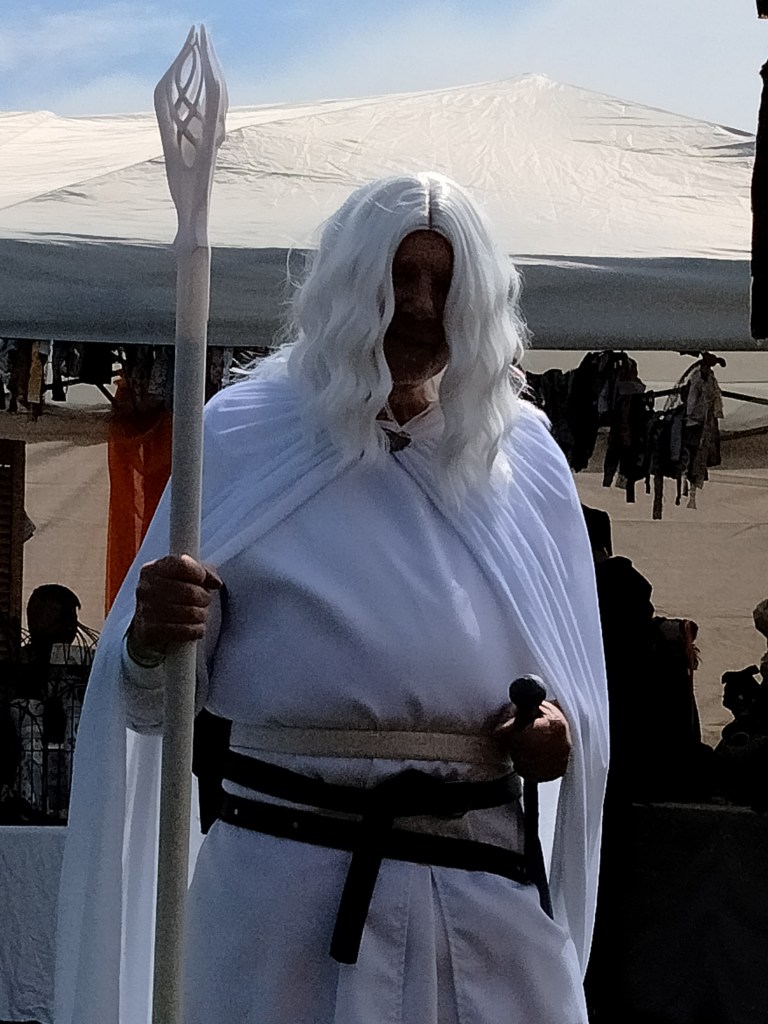
Gandalf the White showed up first thing on Saturday morning.
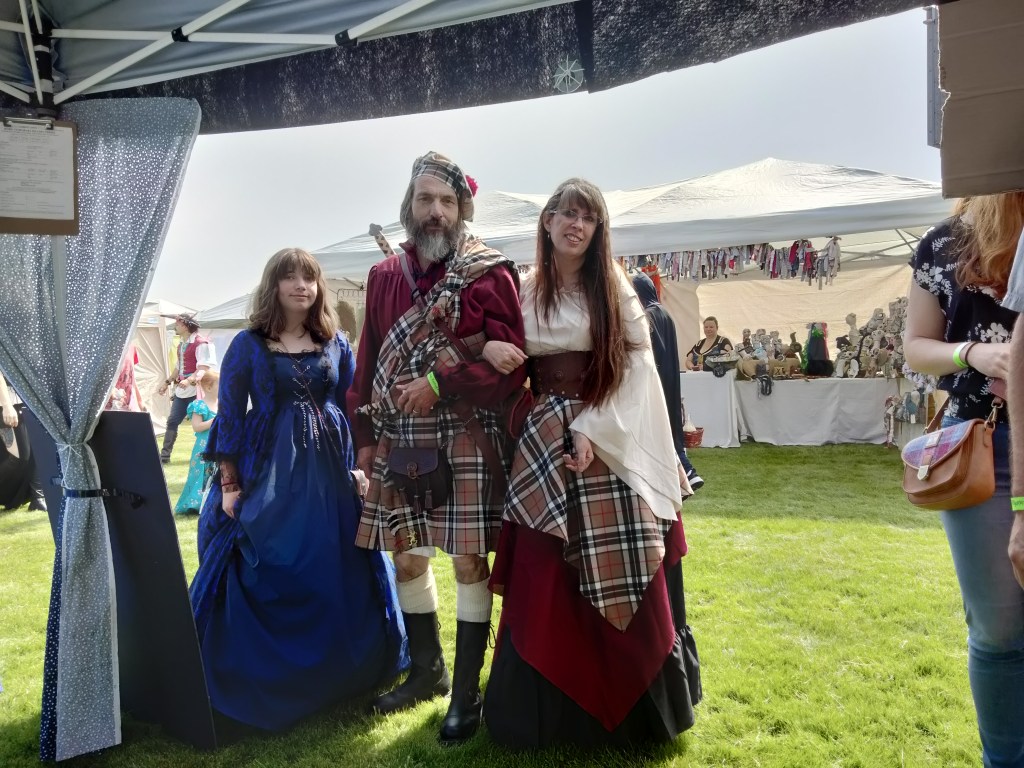
There were many Scotsmen and a few Scots women.
… one ogre …
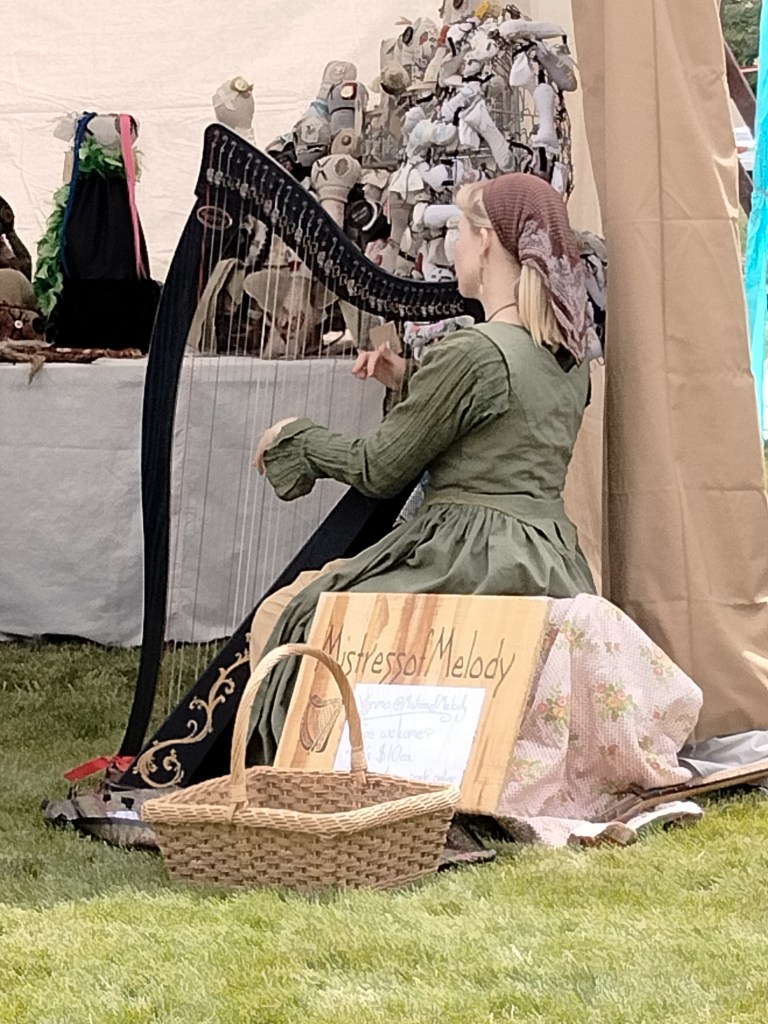
… musicians …
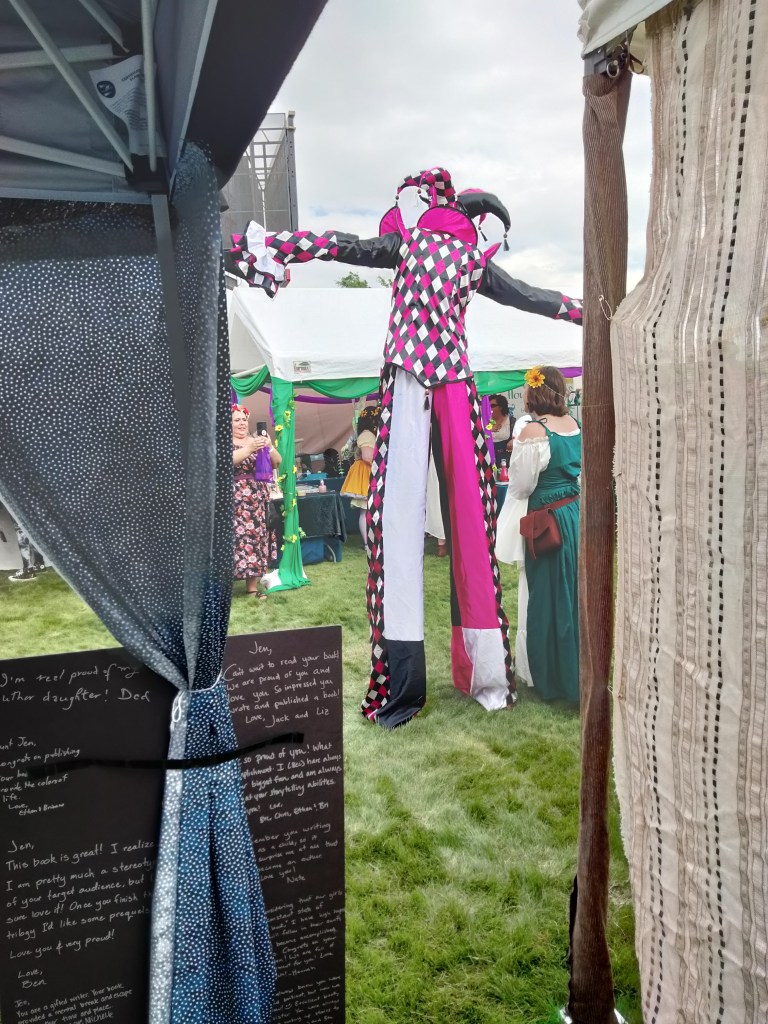
… jesters …
… mushrooms …
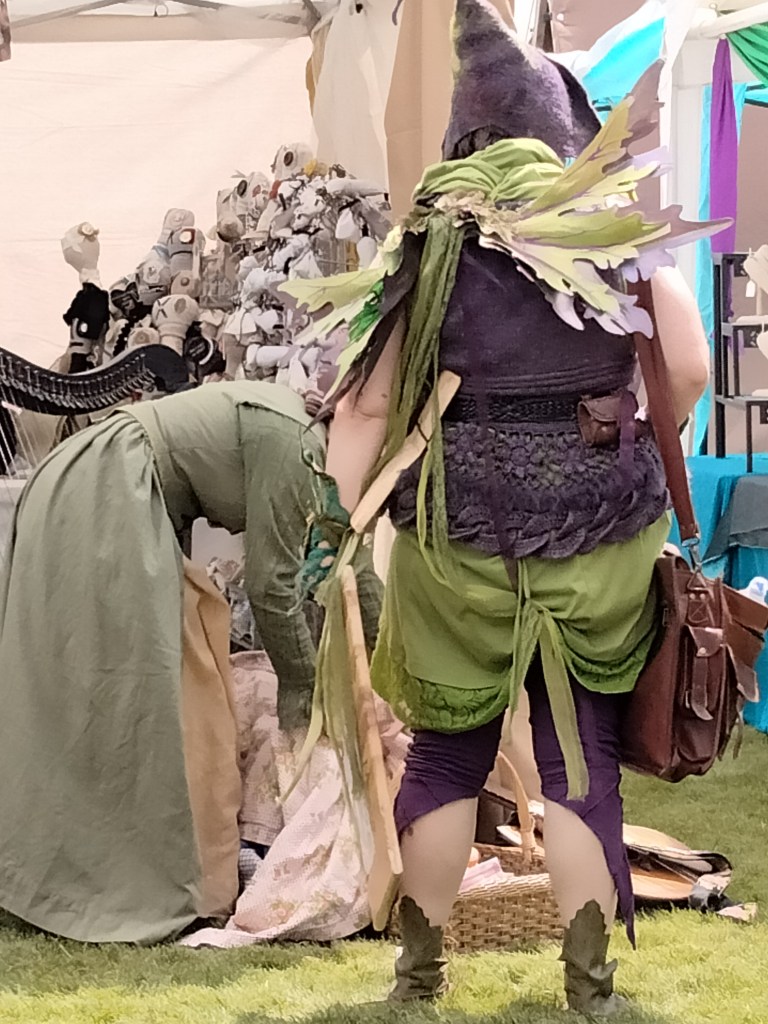
… elves …
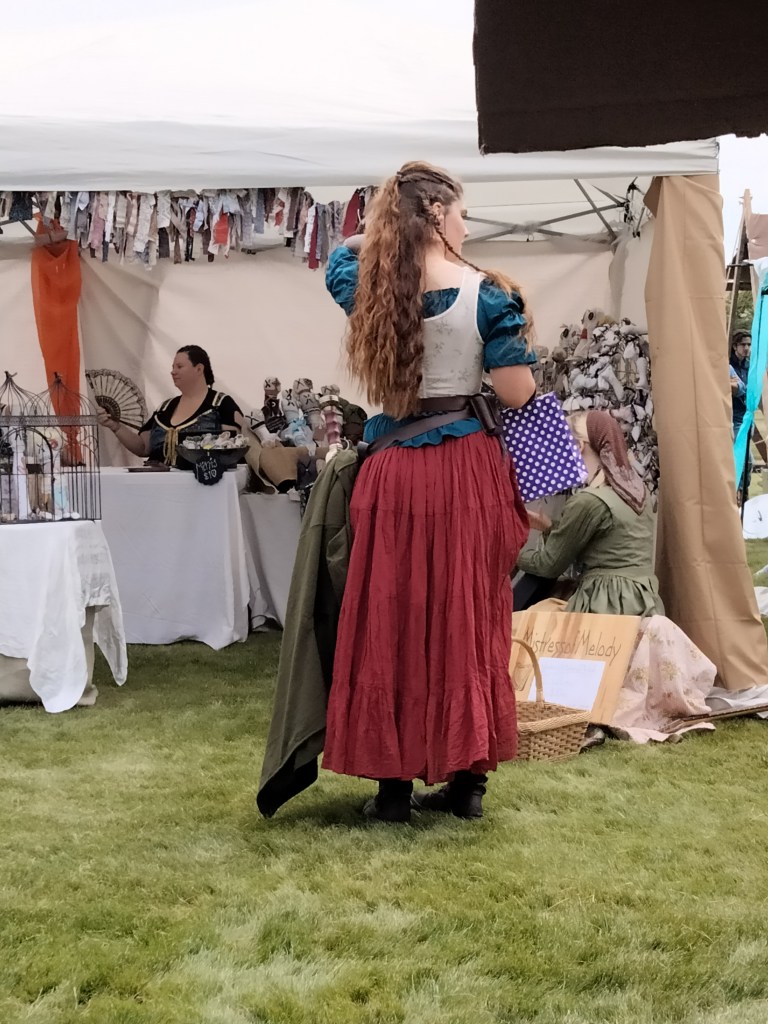
And quite a few pirates. The pirate with her back to the camera would, for $5, “arrest” a victim of your choice and parade them throughout the Faire, calling out “Shame the prisoner!” as they wore a placard stating their crime.
Here she is arresting a lady merchant whose crime was running out of fudge at her booth. The person who put her up to this was my son, who wanted to do everything.
Ensuring that we became friends.
Here’s another friend, from the Pocatello Writers’ Group.
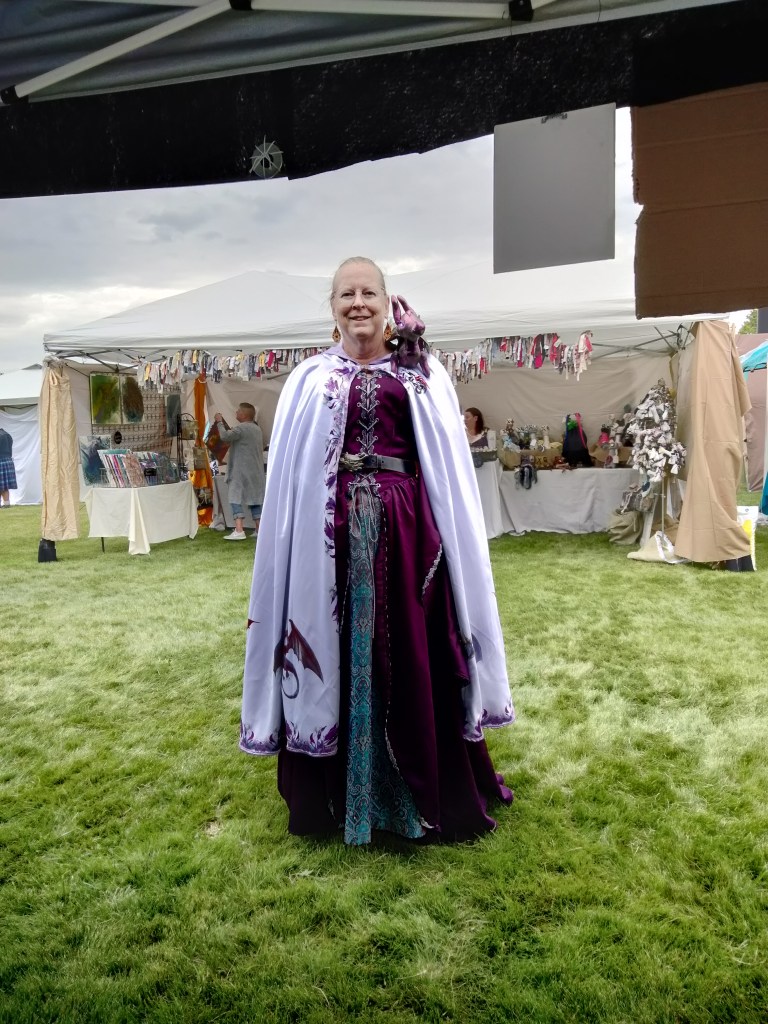
And some more people worth looking at.
One thing I regretfully realized after putting together this post was that I do not have a single picture of a knight or warrior. In fact, there were many of these fellows at the Fantasy Faire. A tall, portly warrior in Viking-style armor bought one of my son’s paintings. Also prominent were the Salt Lake City Crusaders, whose motto is “Real Armor. Real Weapons. Real Athletes.” They had a ring set up in which, twice a day, men in authentic armor battled it out. (I swear that, as I wandered by, I saw one armored guy hitting another armored guy on the helmet with a frying pan.) These warriors would periodically come striding through the Faire, but they always walked so fast that I never got a picture. Plus, I guess, there were so many armored men about that I just took them for granted. But, let the record show that they were there.