
“Maybe you’re right,” [said the main character]. “Sometimes I feel like I’m living out some demented writer’s attempt to package his pet philosophy in an outrageous sci-fi novel filled with contrived, unrealistic events, bad dialogue, and flat characters who use far too many vocabulary words. Have you ever felt that suspicion?”
The Author’s face twitched a little. He seemed a bit put off by the comment.
The Resolve of Immortal Flesh, by Rich Colburn, p. 52
Tag: rants
English Needs a Second-Person Genitive Plural
“Your”? …No, this is plural. When you are addressing multiple children, and you want to indicate that the item belongs to all of them, it had better be clear the first time.
“Your guys’“
“You guys’s“
“All y’all’s” …. Maybe in the South.
Anyone?
Department of Redundancy Department
Arthur [the android] shoves me into the crevice and begins raking dirt and snow over me. He tears off a piece of his shirt and I close my eyes as he lays it over my face. The damp soil and ice fall upon me. I feel like a man being buried alive.
The Lost Colony, by A.G. Riddle, p. 74
Um, James … you are a man being buried alive.
Happy St. Patrick’s Day
Patrick was a Romanized Briton who was kidnapped as a teenager and spent several years as a slave in Ireland, which was then still pagan. Later he went back there as a missionary.
In this video, he appears as a talking icon trying to explain the Trinity to two sarcastic Irishmen.
Oddly Familiar-Sounding Quote of the Week
Facts are stubborn things.
John Adams, spoken to his rabble-rousing cousin Sam, regarding the Boston Massacre
Bookish, Outdoorsy … and Conservative

Disclaimer
The topic below is complex and wide-ranging. Discussing it will require defining some terms, but also making some generalizations. I’ll do my best to honor the nuances of this topic, but it’s not going to be possible for me to cover every subtlety. So please bear with me, assume good intentions, and if I fail to make something sufficiently clear, we can discuss it in the comments.
Defining “Conservative”
This blog (much to my delight) has readers from around the world. That’s a problem for this post, because I will be using the social/political term “conservative,” which means different things in different countries. Because I am posting about attitudes in the United States, I will be using “conservative” in an American sense.
In most places (so I’m told), “conservative” roughly means aristocratic. Conservatives are assumed to be in favor of existing power structures, and that could include a class system or a monarchy.
American conservatism is a bit different because America, from its founding, was anti-royalist and in fact deeply suspicious of all governmental power. America was also populist relative to the rest of the world. Not that we didn’t have wealthy landowners, but one of our basic values was that anyone ought to be able to buy land and live virtually without interference from any kind of overlord. We also didn’t think there ought to be a national religion, and strove to set up barriers to keep governments from interfering with churches.
In other words, in the United States, the term “conservative” basically means those same values that in the 18th and 19th centuries were called “liberal.” This is why some American conservatives call themselves “classical liberals.”
Political conservatism, as I will be using the term, is the belief that national government is very limited in the range of its legitimate authority. It’s basically limited to law and order, national defense, and a few big public works projects such as national highways. Everything else, including religion, health care, commerce, and education, is outside its purview.
Social conservatism means a belief in what used to be called (before the term was mocked out of existence) “family values.” Social conservatives value clean living (no drugs or alcoholism) and traditional sexual morality (an emphasis on intact families and a disapproval of the sexual revolution of the 1960s). They also tend to value community structures such as churches, synagogues, and local clubs and organizations.
Social conservatives may or may not believe that laws are the way to promote all these good things they value. Increasingly, they are realizing that “politics is downstream of culture,” and that the way to promote all these good things is simply to live them.
I happen to be both politically and socially conservative, so I’ll be using the term to mean both. But you will occasionally meet people who are one but not the other. Libertarians, in particular, are often politically conservative but socially liberal. They believe government should be very limited, and this includes not outlawing alcohol, drugs, or any dangerous sexual behavior that does not rise to the level of assault.
OK, I hope that is clear enough to go forward.
Defining Bookish and Outdoorsy
I am bookish. Like many fellow book lovers, I started life socially awkward and found a refuge in fiction. I also have an academic bent. While fiction is my favorite, I enjoy reading just about anything (theology, psychology, philosophy, history, memoir … even popular-level science books, though I am somewhat retarded when it comes to science, especially the more esoteric theoretical stuff). I got this bookishness from my dad, who is a true egghead and reads four languages. Our house growing up was an extremely print-rich environment.
There are millions out there like me.
I am also a little bit outdoorsy. Not athletic, so I’m not a hard-core skier, rafter, or even hiker and camper. But I enjoy being out of doors. I like taking walks (another gift from my dad). In principle, if not perfectly in practice, I approve of living simply: gardening, keeping chickens, being frugal. Not keeping up with the Joneses. Some of this is forced on me by a low budget. OK, I admit it. I am kind of a tightwad. I got this from my Dutch mom, and it too is a gift.
Also millions of people like this out there.
Now, This Is Where It Gets Strange
According to the preponderance of American books, TV, and movies … people like me do not exist. You never, never see the possibility entertained that a person could be bookish, outdoorsy, and also conservative.
You will sometimes see rural conservatives portrayed who like to hunt and fish, but these people are not represented as educated or even, in some cases, literate.
When conservatives are portrayed who are not rednecks, they are typically shown as wealthy businesspeople or heirs and heiresses of the kind who might star in a soap opera. The men wear suits, the women get plastic surgery and wear a ton of makeup. They are less likely to go to the library and more likely to go to the mall or the spa. You would certainly never see them put on old clogs, a kerchief on their head, and go out to weed the garden.
But yet, in real life, I know quite a few conservatives who do just that. They are educated. They aren’t overly concerned with looking like Barbie or with getting a new outfit of clothes every season. They garden. They pinch pennies. They might not even own a TV (rarer these days). I was raised among people like this. Quite a few of them were farmers; others were academics.
Public libraries in the U.S. still haven’t gotten this memo. Based on the activities they offer, the things they post on their bulletin boards, and the types of books they feature prominently, it’s pretty clear that their assumption is, if you’re bookish enough and frugal enough to be coming to the library, you must be a leftist. By which I mean, you are probably in favor of a big, extremely involved “nanny state” style national government. You may be Marxist. You probably approve of the sexual revolution and all its fruits, including the LGBTQ revolution. You might be in to the New Age, but you certainly hate “organized religion” (because what educated person wouldn’t?).
Wendell Berry is a good example of this attitude. He’s a writer and a farmer. A few years ago somebody gave me a book of essays by him (because, hey, he’s a writer and a farmer!). He writes beautifully about farming, about the earth, about the relationship of people to the earth and the spiritual aspects of farming. And then he goes on to assume that his readers are leftists and would vote for leftist candidates.
One Partial Explanation
I’m sure there are plenty of reasons for this widespread assumption that people who are educated and fond of a simple lifestyle are leftist. As I said above, this post touches on several spheres, all of which are complex and can’t be discussed exhaustively. I’m just going to focus on one possible explanation: the conflation of capitalism with consumerism.
Capitalism, as I understand it, has two components. The first is private property. On a socialist or Marxist philosophy, nobody ought to own anything. Everything belongs to everybody, which in practice means everything belongs to the government and if you try to “hoard” something of your own they will take it. Capitalists, on the other hand, are big on private property. So, if you buy some land, it’s your land. If you buy or build a house, it’s your house. You can’t be forced to share or give your house or land to someone else, because it is yours. People tend to take better care of things when they own them. They tend to work harder at a job when they know that its fruits will not be capriciously taken from them.
The second component of capitalism is the free market. This just means that if I want to sell you (let’s take a really woodsy example) a cord of wood off my land, no third party is going to step in and say “You are charging too much” or “You have to give me a percentage of the sale” or “You don’t have a license to sell that.” If I agree to sell it and you agree to buy it, the wood and the money can change hands, and everybody’s happy.
Now, it should be clear from my explanation that neither of these principles has any quarrel with the simple life. Quite the opposite. Farming works better when private property rights exist. So do gardening, making art, selling your work, or building up a personal library.
However, in many people’s minds when they hear capitalism they immediately think of consumerism. They don’t think of private property and unregulated sales for the small farmer, shopkeeper, or artist. They think of huge corporations. They think of advertising, overspending, jockeying for social status by virtue of our possessions. They think of consumerism.
Hence, if they write a book that combats consumerism, such as a book about how to live a simple life, they assume that they must necessarily combat capitalism as well.
I would argue that these people have thrown the baby out with the bathwater. Consumerism is certainly one possible result of capitalism. But it’s really kind of a separate problem. Capitalism might make a consumerist culture possible (any other system prevents the kind of wealth that allows widespread consumerism), but if a culture is very consumerist, it’s really because of other cultural values that they hold. It’s not because somebody told them they could have private property. Private property and a free market, as I have shown, are just as a friendly to a simple, quiet lifestyle as they are to consumerism. And if we stamp out private property in an attempt to get rid of consumerism, we will end up getting rid of quite a few other things as well.
We Are Invisible to Each Other
It’s weird to me when people assume that the wealthy, consumerist lifestyle is characteristically conservative. I was raised by conservatives who lived a simple, bookish lifestyle. All the new clothes and cars, the plastic surgery, the materialist beliefs that I saw were coming from the people I saw in the movies and on TV, who were consumerist and leftist. I figured those two things went together. But apparently … not always. Apparently there were a bunch of leftists out there who were living simple, bookish lifestyles, but because they were not on TV I could not see them, just as they could not see me.
And they still don’t.
Books I Want to Have Read, but Don’t Want to Read
For those uninitiated to book blogging, a tag is when another book blogger assigns you a series of questions or prompts. For each one, you name the book that it makes you think of. And rant about it, if you so desire.
The blogger and author who tagged me was Katie Jane Gallagher.
The Rules:
- Link back to the original tag (this post, and Jami!)
- Complete the questions with books you want to have read but don’t want to read
- Tag some people at the end to do the tag next
OK? OK. Let’s get to the prompts …
The Prompts
A book that you feel you need to read because everyone talks about it
Twelve Years A Slave. Obviously that is going to be a heavy read.
Also, the Federalist Papers. Maybe “everyone” doesn’t talk about them, but people who seem to know what they are talking about keep mentioning them. Obviously there is some very important stuff in there that I need to know.
A book that’s really long

I mean, look at it.
I think there are seven of them now.
But I really need to get to these some time, if only because readers of George R.R. Martin might also be interested in my series some day. And I won’t make you wait decades either!
A book you’ve owned / had on your TBR for too long
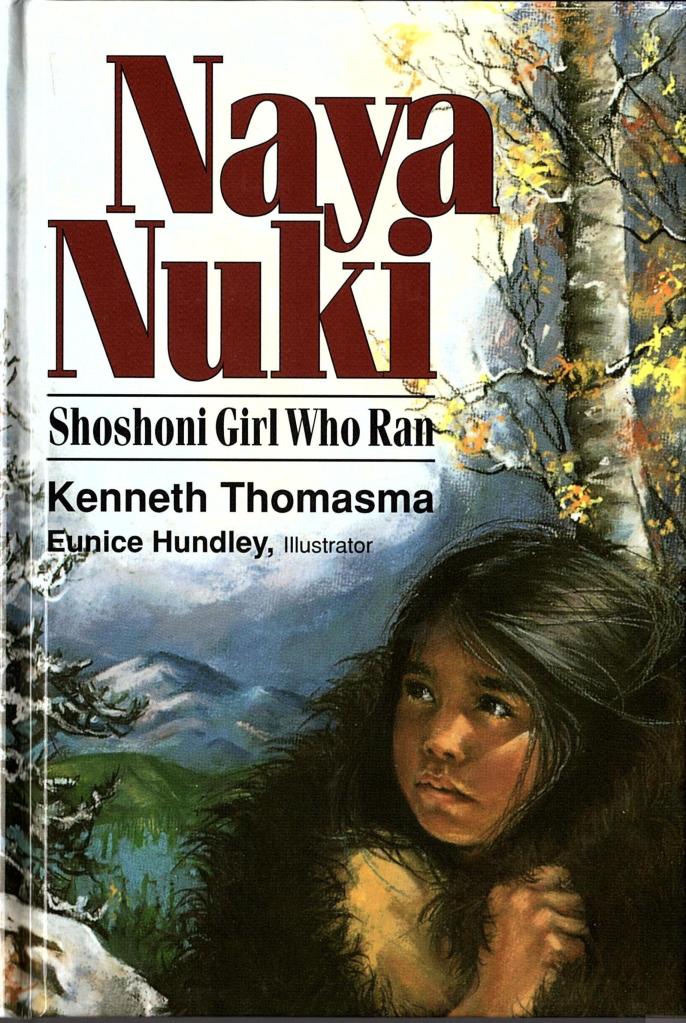
A few years ago, when my boys and I were studying American History, this novel was recommended as supplemental reading. I had all the more reason to want to read it, because Naya Nuki is Shoshone and when I lived in Idaho for a few years during my teens, it was near the Shoshone/Bannock Indian reservation. Our local library didn’t have it. I ordered it through interlibrary loan, but it never came! Must have been a long waiting list.
Fast forward three years. We have now moved back to Shoshone/Bannock country. I go to the local library here, and not only do they have Naya Nuki, they have the entire series by this author! Only problem is, the kids and I now have other required supplemental reading, and we’re working through that. I figure I’ll just zip through it by myself and return it to the library. But the due date approacheth, and I never do.
While still in this uncomfortable situation, my husband brings me home a surprise gift from his travels. It’s my very own copy of Naya Nuki! He thought it looked like something that would interest me. I’ve gone from not being able to get my hands on a copy, to an embarrassment of riches.
So I was free to return the library copy … but you guessed it, my gift copy is still sitting there unread. Why? Why???
A book that is ‘required’ reading (eg, school text, really popular classic – something you feel obligated to read!)
Everything by Freud and Nietzsche.
A book that intimidates you
Maps of Meaning by Jordan Peterson. He spent, what, decades on it? Rewrote every sentence at least 50 times? It sounds like it would be heavy going. A really thorough student of archetypes would read it, but I feel like this was the book where he developed his ideas, and now we can get the highlights of those through his class lectures on YouTube and through Twelve Rules for Life.
A book that you think might be slow

I know this one is slow, because I started it. I still think I might end up really liking it. Actually, I hope I do, because it’s sort of the same genre that I write in. But it requires a lot of attention during the first several chapters, as you have to learn a lot of different characters and figure out to who root for. It’s not the kind of book you can pick up and dive into for 20 minutes while eating your lunch, which is what I need right now.
A book you need to be in the right mood for

Circe. The main reason I haven’t read this is that it hasn’t shown up at the library yet, and I am too cheap to order it online. But there’s another reason as well.
I love the heroic age of Greece. As a teen I spent several years, off and on, immersed in this milieu. At one point I was going around telling people, “The Iliad is taking over my life!” (I also, when reading The Odyssey, had a crush on Odysseus. *blushes* Because who wouldn’t? I mean, the man can shoot an arrow through the centers of 12 ax heads lined up in a row!)
So I’m frankly super jealous of the author for having immersed herself in these books and written what everyone agrees is a fantastic novel that is true to the tradition. If I’m going to read it, it will put my head right back in that space, and I have to be ready for that.
Call, and raise you The Song of Achilles.
A book you’re unsure if you will like
Oh, so many. Pick any YA fantasy with a mermaid, vampire, or young woman on the front. I “ought” to be reading more of these, because they are fantasy and we are supposed to Read Widely In the Genre … but I just don’t find them appealing usually. Especially if the back cover copy deals with how mean everyone is to the young woman, or how she’s a member of an ostracized group.
And lest you misunderstand, I don’t say this dismissively. Probably some of these books are as meh as I expect, but no doubt others are gems. Maybe it’s even half and half. I’m not being superior. I just … can’t … get … interested …
People I Want to Tag but Also Don’t Want to Tag
Honestly, tagging activates my social anxiety. What if you’ve already been tagged for this? What if you don’t want to be tagged? What if I leave someone out? Gaaah!
I’m tagging you anyway. Don’t take it personally. If you hate the tag but want to please me, just do a super perfunctory and sarcastic tag like Bookstooge did that one time.
I’m tagging people who post frequently, because if you want something done, ask a busy person. So, if you post infrequently and didn’t get tagged and want to do this, go for it!
Love of Nature
As we are talking this month about different facets of love, here is confirmed outdoorsman Bjorn Andreas Bull-Hansen talking about his love for nature … and, not unrelatedly, his unlove for what he calls “green facism.”
Complete Nonsense, Delightfully Expressed
Had we but world enough, and time,
This coyness, lady, were no crime.
We would sit down, and think which way
To walk, and pass our long love’s day.
Thou by the Indian Ganges’ side
Should’st rubies find; I by the tide
Of Humber would complain. I would
Love you ten years before the Flood;
And you should if you please refuse
Till the Conversion of the Jews.
My vegetable love should grow
Vaster than empires, and more slow.
An hundred years should go to praise
Thine eyes, and on thy forehead gaze
Two hundred to adore each breast;
But thirty thousand to the rest;
An age at least to every part,
And the last age should show your heart.
For lady you deserve this state;
Nor would I love at lower rate.
But at my back I always hear
Time’s wing-ed chariot hurrying near;
And yonder all before us lie
Deserts of vast eternity.
Thy beauty shall no more be found,
Nor, in thy marble vault, shall sound
My echoing song: then worms shall try
That long preserved virginity:
And your quaint honor turn to dust,
And into ashes all my lust.
The grave’s a fine and private place,
But none I think do there embrace.
Now therefore, while the youthful hue
Sits on thy skin like morning dew,
And while thy willing soul transpires
And every pore with instant fires,
Now let us sport us while we may;
And now, like amorous birds of prey,
Rather at once our time devour,
Than languish in his slow-chapped power.
Let us roll all our strength, and all
Our sweetness, up into one ball;
And tear our pleasures with rough strife,
Through the iron gates of life.
Thus, though we cannot make our sun
Stand still, yet we will make him run.
“To His Coy Mistress,” by Andrew Marvell (1621 – 1678)
Did any of you fellas talk like this when you were dating your lady?
Perhaps you did. This is, after all, just a better-expressed version of the old line, “Do you want to die a virgin?”
That’s why I call it complete nonsense. Come on, Andrew Marvell. Was this girl really expecting you to wait centuries for her? Or was she just hesitating for a few weeks? I’m guessing probably the latter. And you decided to bring the specter of mortality before her in order to guilt her in to your bed immediately.
But I honestly can’t dismiss this poem because, oh my gosh, it is so well expressed! I hope you laughed several times while reading it, because so many of the lines are funny and clever. The AA BB CC rhyme scheme is flawless, and the rhymes, together with the four feet instead of five per line, run through the middle of sentences in order to hurry us along through the poem. We want to get to the next rhyme, just as Marvell wants to get to the next … thing. And many of these images are so evocative that they get quoted frequently: “deserts of vast eternity” … “time’s slow-chapped power” … “all our strength and all our sweetness.”
I think the content of this poem is a huge piece of eye-roll worthy male manipulation. But the form is so terrific that I love the thing despite myself. I almost have it memorized. It’s a 17th century ear worm.
Marvell has taken a quintessential line, and he has elevated it, through the magic of poetry, into something else entirely.
Love Ruins Everything
OK, not everything that Nicholas Cage’s character says in this little seduction speech do I endorse. For example,
“I don’t care if I burn in hell. I don’t care if you burn in hell.”
This recklessness is indeed what we sound like when we’re in the grip of headlong love (or lust), but I still don’t recommend saying it to your significant other.
But.
The way he winds up the speech is just … brilliant.
“Love don’t make things nice. It ruins everything. It breaks our hearts. We are here to ruin ourselves and love the wrong people and break our hearts … and die!”
Right on, Nick! The only thing that loving another guarantees us is heartbreak. No one knows this better than our Lord. He definitely “loved the wrong people” … and it got Him killed. Sure, love wins in the end, but let’s not skip over this part. The stories we tell will ring hollow if we skip the part where love ruins everything.
 Out of Babel Books