A Fall from Grace is a movie that’s out right now on Netflix. This post will contain spoilers, though not for one particular twist. Which shows, by the way, how good of a movie it is, that I can tell you a good bit of the plot and still hold back a twist.
I had a feeling this drama was going to be good as soon as I saw Tyler Perry’s name on it. I haven’t seen all his Madea movies, and of those I have seen, I haven’t liked all of them equally well. But I loved Madea’s Witness Protection. It was obvious, watching it, that there is not just comedy here but some human wisdom as well. I don’t know whether Grace is Perry’s first drama, but it’s the first one I’ve noticed circulating. Something told me that after years of making movies, he would be maturing as a director and ready to make impactful dramas.
I wasn’t disappointed. Grace is a really good drama, in the sense that after watching it, I honestly feel as if I have personally been through Grace’s experience. As of this drafting, I watched it about 24 hours ago, and have been thinking about it more or less continually ever since.
The title character, Grace, is a lonely divorceé with a grown son. When the movie opens, we are told that she has killed “her husband,” and that this is really out of character as she is a Sunday School teacher who bakes cookies for the kids in the neighborhood, etc. But she has confessed to the murder. The young public defender who is assigned to Grace is expected to plea bargain, and it’s expected that this will be easy to do given Grace’s (up until now) stellar character. For different reasons, the public defender starts digging in to what really happened. And from those events flows the title of this post.
In a series of flashbacks, we see Grace fall in to an unexpected romance with a younger man. (It’s hard to tell his age exactly. I first thought he might be about 10 years younger that she is, but it later seems it’s closer to 20.) This man pursues her, and at first she is skeptical. She even asks him flat-out, “You have probably been with many attractive younger women. Why me?”
He answers very wisely, “We tend to do that to ourselves as people. We ask, ‘Why should this good thing happen to me?’ The real question is, Why not you?”
Over a three-month courtship he overcomes her defenses. They talk for hours. Even at this stage there are a few red flags. For example, on their very first date he tells her, “As you get older, you start to get interested in people who have a wise way of looking at the world. You are a woman who sees the world etc. etc.” But at this point he’s only known her for a few hours. He started pursuing her literally after only a few minutes of conversation. He has not had time to find out how she views the world. This is flattery. But it’s done so sincerely.
He also, with remarkable insight, says to her, “There’s this thing you do. You’re judging. Stop it.” Of course, she is judging. She is an upright older woman. She is always judging herself and others. This is how we live. Hence, this young man could probably say this to any older woman and be 100% correct. But at the time, it seems like a sensitive perception. Later it becomes obvious that he was trying to get her to turn off her faculties of judgment for reasons of his own.
After an incredibly romantic proposal scene, Grace marries this man. She’s never been happier. She never felt this loved and understood, even with her first husband who later left her for his secretary.
Then, within a few months of getting married, she finds out that her new husband has: taken out a huge new mortgage on her house (which was previously paid for) … stolen her passwords, forged her signature, and embezzled funds from the bank where she works. She loses her job. The mortgage is unpaid, and she has no way to pay it. She is facing losing her house and possible jail time. She calls the police, but legally her house is now her husband’s and they can do nothing. It becomes obvious that the entire courtship and marriage were a scam.
Even then, she doesn’t kill him. She keeps trying legal ways to get him out of her house, but there are none. She is reduced to repeating emptily, “I want you to give me back my money.”
Finally comes the scene where Young Husband is justifying himself. This man who seemed so understanding and caring is sitting with his back to Grace, sprawled in a chair, saying casually, “Actually, the way I see it, you owe me that money for all the sex and all the joy I gave you. Women your age … you’re low-hanging fruit. In a way, if you think about it, all this is your own f—ing fault for making this so f—ing easy. For being weak.”
By this point in the movie, I already knew she was going to kill him and I was pretty sure this was the scene where it was going to happen. But I was confused. I didn’t see a gun anywhere in the house, and wasn’t sure Grace would even know how to use one.
Then I saw her walking up behind him with a baseball bat, and honestly, my impulse was to jump off the sofa and scream, “Do it! Do it!”
Once she does it, of course, her life is completely ruined. She is now a murderer.
Watching this, we are forced to ask ourselves … “In Grace’s position, would I fall for this?”
I can’t arrive at any answer other than Probably Yes.
Grace is about my age, give or take 10 years. I happen to be happily married. But what if I wasn’t? What if I had a job at a bank and a house that was paid for? It’s quite a blow to the pride to admit to yourself that these things are more appealing to a young man than your very soul. Not to mention your body, which after all was once considered attractive.
Grace isn’t stupid. She’s pretty savvy, actually. And she has been scarred by divorce. Yet she still falls for this extremely cruel scam. Primarily because he puts her in a position where, in order not to fall for it, she would have to decide she is basically worthless as a person.
So I guess you could call this movie a public service announcement.
Mr. Haig-Ereildoun may be like me. Full of charm, winning everyone’s affection, but somehow not quite doing the job. I can say that the advertising agency chose me to fire because I was the youngest … But I know it was more basic than that. I did win awards. But I lost hours, days, weeks, trying to make jewels out of the twenty-five-cents-off coupons ads. Everyone loved me, but in a practical world I wasn’t what they needed. It’s hard, actually scary, being the kind of people Mr. Haig-Ereildoun and I are.
The Diary of an American Au Pair by Marjorie Leet Ford, Anchor Books, 2003, p. 182
I figured out years ago that my own body temp is down in the low 97s. I would feel feverish but couldn’t “prove” it because I was reading 98.6 or 98.5. Later, taking my kids’ temps when they were not sick, I realized their normal temperatures were lower as well. Now, it turns out it’s not just us. It’s pretty much everyone.
Just another example of how a firmly established fact can be slightly wrong … wrong enough to cause us trouble.
What stands out to me in this article is the way the article will begin to approach blaming Jade’s mother for what happened, and then back away.
This little girl didn’t get the flu shot this year!
… But the family is not an anti-vaccination family.
But the flu shot can prevent complications like this from happening!
… But it’s only 40 – 60% effective at preventing the flu.
But you should always get flu shots for your kids!
… But this mother did get her kids flu shots, last March, and mistakenly believed they “were good for a whole year.”
But the flu changes every year!
… And this year was a very bad year for flu for kids, and the complication that happened to this little girl is vanishingly rare.
I understand that they are trying to make this article into a sort of public service announcement reminding parents to get flu shots and other vaccinations for their kids. And that kind of announcement is good. What’s not good is the implication that if you do everything right, you can prevent freak bad things from happening to your child. This is a very rare complication. It didn’t happen because this mom failed to get her kid a flu shot. It happened because we live in a fallen world. In this fallen world, freak bad things happen. People get sick. This is the definition of an imperfect world. This incident is more analogous to a plane falling on your head, than to failing adequately to provide for your child.
Every mom does this to herself, too, by the way. Jade’s mom says of the early days when her daughter had a mild fever,
“She was running around, having fun, eating normally, asking for snacks,” her mother remembers. “It was just — it’s a little bug, she’ll get over it.”
Phillips thinks back to those four days, December 19 through December 23, and wracks her brain for something that might have told her what was about to happen.”There wasn’t any sign that would’ve told me that something was seriously wrong with her,” she said.
Ibid
I once had a similar experience. My then 2-year-old got a fever. All he wanted to do was rest on me. I thought about taking him to the pediatrician, but I knew exactly what they would say. “If the fever hasn’t gone away in three days, call us again.”
On day 3, we had difficulty waking him. It was a Sunday (of course), so instead of the pediatrician, we took him to an urgent care clinic. The clinic said to take him to the ER.
He turned out to have a fairly advanced case of bacterial pneumonia.
He hadn’t even been coughing.
We ended up with a 2-day stay in the hospital and he was fine. But what if he hadn’t been? I’m sure I (and lots of other people) would have been asking, “How could I not have caught this?” But there was no way I could have. It just seemed like a normal fever.
Recently, novelist and screenwriter Andrew Klavan got himself into some trouble. He was reviewing Netflix’s The Witcher, and he commented that he dislikes movies that show a woman who is able to go toe to toe with men in a medieval sword brawl, without the help of magic. It’s unrealistic, he says. Might as well have made that character a man.
Well. Many people did not like this. Some challenged Klavan to a sword fight (he’s almost 70 years old). He even got at least one actual death threat.
Let’s see if I can also get myself cancelled. Here is a list of some of my movie pet peeves. And because there are exceptions to everything, I will also list exceptions.
Two women in an extended, knock-down, drag-out fight. This just feels icky and porn-y. Exceptions: the brief catfight scene in Sense and Sensibility, and Mrs. Weasley taking out Bellatrix LeStrange. Note that neither of these exceptions is actually a brawl.
A woman in an extended brawl with a man. I don’t care which one of them is the villain. This can only go one of two ways: either the woman unrealistically wins, or we get to watch a man beat up a woman (yay!). Exception: Antonio Banderas and Katherine Zeta-Jones’s sword duel in the stables in Zorro. Again, not really a brawl.
When the chase scene or fight scene completely smashes a room or building full of breakable, priceless artifacts. I realize it would be unrealistic to have a chase scene in such a setting and have nothing get broken, but it often seems as if directors delight in destruction. They’re smashing our culture with their philosophy, and in scenes like this they’re symbolically smashing our culture, represented by art or cakes or whatever, just because they can. Exception: Jackie Chan makes amazing use of props in his chase and fight scenes.
When someone is trying to maintain some kind of deception for the duration of the entire movie. I’m not talking about spy movies where you don’t know who’s who and that’s the point. I mean usually comedies where the high jinks flow from the MC trying to hide something from his wife, or from his daughter, or from her parents, or from an entire town. This just stresses me out. Exception: Breaking Bad, where the point of the series is to show a good man’s moral disintegration.
Now, a pet peeve of everyone around me: the fact that I can’t watch a movie without having to analyze the damn thing!
This is how a woman fights evil
They’re actually flirting, not fighting
He also uses banners, baskets, Ming vases, soap …
… appliances …
What are your movie pet peeves? Do you hate any of the same things I hate? Share in the comments below.
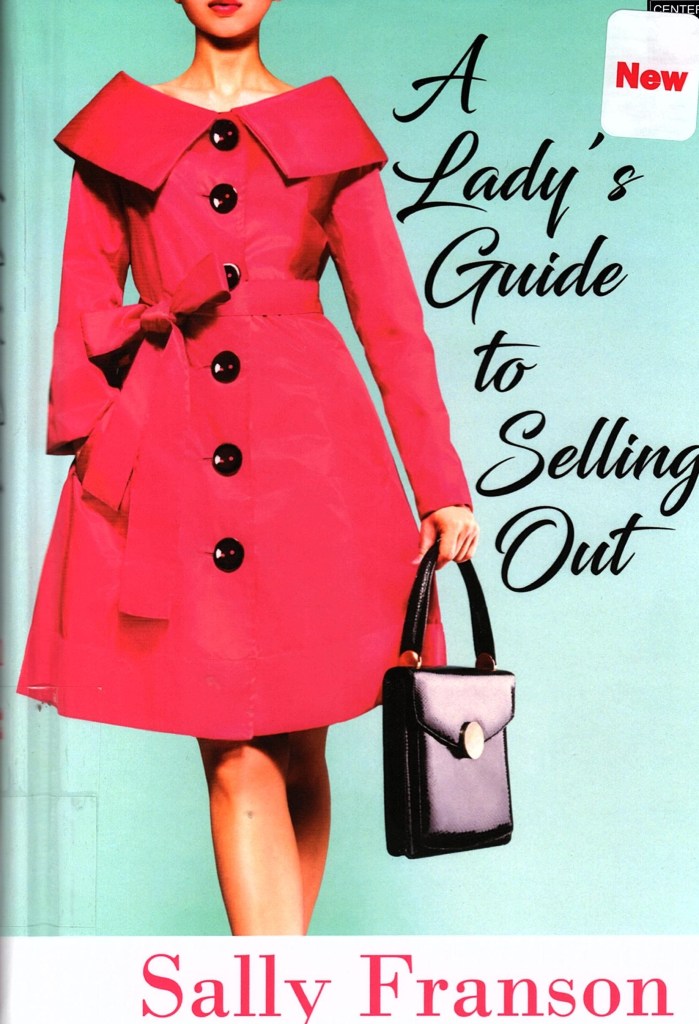
A Lady’s Guide to Selling Out, by Sally Franson, 2018. I read the Center Point Large Print version.
From the jacket:
Casey Pendergast is losing her way. Once a book-loving English major, Casey lands a job at a top ad agency that highly values her ability to tell a good story. Her best friend thinks she’s a sellout, but Casey tells herself she’s just paying the bills – and she can’t help that she has champagne taste.
When her hard-to-please boss assigns her to a top-secret campaign that pairs literary authors with corporations hungry for upmarket cachet, Casey is both excited and skeptical. But as she crisscrosses America, wooing her former idols, she’s shocked at how quickly they compromise their integrity …
When she falls in love with one of her authors, Casey can no longer ignore her own nagging doubts about the human cost of her success. By the time the year’s biggest book festival rolls around in Las Vegas, it will take every ounce of Casey’s moxie to undo the damage – and, hopefully, save her own soul.
How could I not pick up a book that has the former English major main character falling in love with an author? And since Casey was going to “the year’s biggest book festival,” I also hoped this book might teach me something about the industry.
It didn’t.
I enjoyed it, it was a page turner, but in retrospect, most of the colorful characters – including the evil corporations, the evil advertising exec, and even the quirky authors – were kind of … stereotype-y? Also, the book kept smacking me in the face with its politics. It was pretty subtly done, but I guess, as author and an avid reader, I could see the strings moving.
The Good
First, the good part. Casey herself is not stereotype-y. The author had to write a character who was sympathetic, but unaware enough to participate, for most of the book, in activities that – in the world of the book – are considered “selling out.” So Casey is complex. She’s smart and analytical, has mommy and daddy issues (the mommy issues drive her career path), and does a great job documenting her own self-deception.
She is also, though socially vivacious, an empath and an introvert:
Before I met [my writer friend Susan], I’d spent my whole life feeling a few clicks on the dial away from everyone I knew. Not that you could tell necessarily – I was popular and all that growing up, lots of friends, guys buzzing around like big horseflies – but there was this static in the air when I was around other people. Sometimes I’d even cancel plans, feigning illness, in order to stay home and read novels and fiddle with the antenna in my brain, trying to get a clear signal. Sometimes I’d go days, weeks, without it, the dull hissing unceasing. The static only seemed to stop, or my brain could only tune in to the world properly, when I was taking walks or reading novels. In other words, when I was alone.
Oh well, I’d thought then, sucks for me I only get clarity by myself, everyone else seems to be getting on fine. Weirdo. Probably best to pretend the static doesn’t exist.
pp 14 – 15
The “static” is the way Casey can sense other people’s thoughts and emotions.
This is a terrific description of the inner life of an introvert/empath.
It’s also a good example of how, contrary to what you might expect, feeling other people’s feelings does not necessarily endow a person with good social skills. Quite the opposite. Sometimes it can be quite overwhelming, and the empath will withdraw, or will wildly act out the emotion that’s already flying around the room.
The Bad
A number of things bothered me about this novel. Let’s start with the reverse sexism:
In the aftermath of our efforts to hold these men responsible, we realized we didn’t possess the power to do that. We were just a couple of nobodies, a couple of ladies. Men were innocent until proven guilty. Women were crazy until they were believed.
page 352
Yeah, I don’t know any men who have been publicly shamed on the Internet … who have lost their jobs, been called names, received death threats, been unable to get their side of the story out there, or been unable to recover their reputation.
Sure, powerful people exploit less powerful people all the time. People unfairly get their reputations ruined all the time too. But this does not divide neatly along the lines of sex. Social power is so much more complex than that. Interestingly, the book seems to recognize this sometimes, except when it forgets itself and wants to beat us on the head with its Message.
Then there is the book’s incoherent attitude towards money. In trying to convince Casey to get authors to rep dying companies, her boss tells her cynically, “You’d be surprised what people are willing to do when you put enough money on the table.” And, for most of the authors, they agree to the deal realizing that they are being used, but wanting the money for a noble cause (taking care of an ailing mother, opening an animal shelter, etc.).
But then Casey goes to meet her literary hero, also the book’s villain, and hears him speak at a book festival:
Beyond the obvious problems of his sick wife’s medical bills, Julian didn’t appear to be motivated by money — a sure sign that he’d grown up with a fair amount of it.
page 310
So, we are selling out if we need some money and are willing to work for it … but not wanting to make money is also, it’s implied, a sign of culpable privilege. It sounds like we are damned if we do and damned if we don’t. Reminds me of that scene in Time Bandits where Robin Hood and his men are giving bags of gold to a line of poor people. As soon as anyone receives his gold, he takes a few steps crying out, “I’m rich!” … until the next Merry Man punches him in the face and takes the bag away again because, after all, he is now rich, and must be punished.
Speaking of the book festival, when Casey first arrives there,
The crowd at the fair was mixed in the way of gender, and about as mixed in skin color as, say, a gallon drum of vanilla ice cream.
page 294
Now, I have never been to the country’s biggest annual book fair (because it’s for actual, published authors). So maybe this racial critique is true. But it feels made-up.
At the one writer’s convention I attended, we had a mix of races, ages, both sexes. The keynote speaker was a woman of color. She got up and told us that when she got to grad school, she found out that all her favorite books from childhood (which included some of my favorites, such as the Chronicles of Narnia), “were racist.” She then showed us this hurtful graphic:
The stats themselves are disturbing, but so is the presentation. In this picture, the kid that looks most like one of my kids (the kid on right) is a horrible little narcissist, reading books for the sole purpose of seeing himself reflected in them. It’s assumed he identifies with any white character in any book, regardless of whether that character is, say, out in space or living 1000 years ago, as long as the character is white … but he can’t identify with a main character of color. Apparently this kid doesn’t want to read about anyone who isn’t racially like himself. Sounds exciting. I guess he is not making the literary choices that I made as a kid, which was to seek out books about Native American kids and passionately wish I could be one.
Meanwhile, the bunny rabbit is joyfully reading a book about himself. I can’t believe that I have to point this out, but … animals don’t read? So, obviously, animal characters are intended to be relatable all children? So, even if we are going to make a chart showing which races are represented in a given year in children’s books, animals should not be on there? Because they are not an interest group in competition with kids of color? But our keynote speaker thought they were. She noted with an eye roll that there were even “more animals” than black children in 2015 children’s books.
I don’t think the most important thing about a book is the color of its characters, readers, or author. Even so, I can understand why we might want more different colors and cultures in children’s books. A book is more than a mirror, but not less than one.
That said, this information could have been presented in a form that didn’t demonize the white kid or imply that kids only want to read about themselves. It could have been presented as a pie chart. Or the graphic could have had a variety of different children, gathered around, reading all the books that are there. That would have been more like real life. The animal books, if they were included at all, should have gone into each category. Also, there are tons of books with a multiracial cast. I’m not sure how this chart handled those, but I can guess.
As it is, the message I got from the keynote speech (not, thankfully, from the whole conference) was this:
“So that readers of color don’t feel left out, we need more books starring characters of color. [So far so good.] But it’s stupid when we have white writers writing about characters of color. [OK, possibly.] Wouldn’t it make more sense to have people write about their own culture?”
Yes, perhaps, with the caveat that writers usually write far beyond their own experience, and that this is in fact a critical part of the writing process and the reading adventure. Also, it’s a fallacy that no writer can really identify with any person who is not of their own tribe. Taking this logic to its conclusion, the only thing anyone can really write with honesty is autobiography. Say goodbye to fantasy, sci-fi, and historical fiction.
It was a weird feeling being walked through this logic. While I didn’t disagree with the intermediate steps, after doing the math, the unavoidable conclusion is that I am not allowed to write anything any more because I am the wrong color. There are already way too many characters “like me” out there, and I am not allowed to write about anyone who’s not “like me.” (Bwa ha ha … of course, little do they know how weird I am! There is no one like me in the world!)
So, yeah, my experience of a writer’s conference was emphatically not a tub of vanilla ice cream. More like a “Stop writing, white author.”
About Forgiveness
Ahem. Back to A Lady’s Guide.
Susan says forgiveness is just a philosophical construction anyway, a con put in place by those in power against those who have no power, so that the responsibility of coming to terms with bad shit keeps falling to the latter.
So instead I believe in forgiverness, which to me means waiting for these a**holes who f*cked me up to take some responsibility for their actions. And I, in order to make this practice copacetic, will have to in turn approach those with whom I grievously f*cked, bowing my head and admitting that I, too must take responsibility, and no, I don’t want their forgiveness; I’m just coming around to own up to what I did. If they forgive me, great. But that’s not the point.
page 406
What a strange mixture of insight and incoherence.
First, note the assumption that there are only two kinds of people in this world: those who “have power,” and those who don’t. That these categories never shift. That sin is never committed by those who have less power.
But the really odd thing is that this book, and even this passage, does seem to understand the need for forgiveness. Casey realizes that she has wronged other people. There are several relationships in the book where, indeed, she does need to be forgiven in order for the relationship to proceed.
I think at the bottom of this passage is a misunderstanding of what forgiveness means. Susan (and Casey) seem to think it means passing over wrongdoing, doing nothing about it, not calling the person to account. Offering forgiveness to those who have not repented. That is not what it means, at least not in Biblical categories.
Casey realizes that forgiveness without repentance won’t do, because in the very next paragraph she describes her own need to repent to those she has wronged (she calls it “taking responsibility.”) But then she adds, “I don’t want their forgiveness.” This might be true in the case of some people, who are enemies, whom, after repenting, she might have no desire to see again. But I can’t believe it’s true about her best friend, or about her love interest. The whole point of forgiveness is so that the relationship can continue. This is why it’s not just about power. Every person, powerful or not, has intimate relationships that they need to continue long-term. Every person wrongs people within those intimate relationships. Therefore, every relationship has to proceed on forgiveness if it’s not going to stall out.
And In Conclusion
So, I’m not quite sure how to land this plane. Lady’s Guide was a fine book, well-written, lots of insight about the little things plus some big lies about the bigger ones. I went back and forth between feeling that the book loved me (I’m a woman, an author, an introvert) and that it hated me (I’m white though not wealthy, a Christian, and a social conservative).
I guess the best way to sum it is up is that my reaction, on nearly every page, was,
Newt had always suspected that people who regularly used the word “community” were using it in a very specific sense that excluded him and everyone he knew.
Good Omens, by Neil Gaiman & Terry Pratchett, p. 211



 Out of Babel Books