A Roundup of Atlantis Theories

Photo by Pixabay on Pexels.com

Too many Atlantises. An embarrassment of Atlantises. One Atlantis, two Atlantis, red Atlantis, blue Atlantis …

Atlantis is Now Off the Coast of Cuba

This article describes an intact granite city, with pyramids, discovered off the West coast of Cuba, about 2,000 feet down, in December of 2001. As our old friend KFM, of Bad Archaeology, points out, the city would be unlikely to survive intact like this if it actually dropped dramatically from what is now sea level, as Plato seems to describe. The article points out that there is another city, the Yonaguni Monument, off the coast of Japan, and Graham Hancock in his book, Underworld, points out that there are submerged megalithic cities in many places around the world, including off the coast of India. (Hancock has cycled through seriously advancing a number of different Atlantis theories, so he will be sort of the workhorse of this post.)

It seems to me that the city off the coast of Cuba is part of a worldwide phenomenon where sea levels were once much lower. We can include in this phenomenon Doggerland (which will make another appearance later in this post), and the land bridges known to have once connected Asia to the Americas and the Indonesian islands to the mainland.

If you are an old-earth believer and have to juggle millions of years, multiple cooling and warming periods, slow but somehow effective continental drift, and some confusing archeological indications that humans were perhaps around well before they should have been … good luck. As someone who believes that the history of the earth is measured in thousands or tens of thousands, but not millions or billions of years, my guess is that this period of low sea levels plus advanced civilization came right after the Great Flood.

You would have a much colder, rainier climate as the earth adjusted to the recent cataclysm (about this more in a minute). You would have had frequent snow and rain storms, with all this precipitation getting frozen in the rapidly forming ice sheets, causing Earth’s water supply to be greatly reduced. Meanwhile, you would have Noah’s children and grandchildren branching out as quickly as possible, building megalithic cities wherever they went, still remembering the techniques and technology (and possibly still assisted by the giants and gods) that they had seen pre-Flood. This period of low sea levels would have had to last long enough for people to disperse and to build, but it need not have been very long. It could have a been a matter of a few hundred to a thousand years. As the climate stabilized, you would have had floods covering settlements and civilizations in different parts of the world. This, I believe, is the reason we have an embarrassment of Atlantises.

There have also been assertions that the reason for the Bermuda Triangle phenomenon is that Atlantis lies underneath it. (Note that the west coast of Cuba is outside of the Bermuda Triangle.) This theory certainly appeals to those who are interested in the potential paranormal effects of the lost city, but I do not know of any actual submerged city found in the Bermuda Triangle area. (If you do, please enlighten me in the comments. I’m always looking for another Atlantis to add to my collection.) This article discusses how ocean-floor mapping technology can create lines that look like city streets.

Atlantis as Antarctica

Graham Hancock makes the case for this in his book Fingerprints of the Gods. He posits that the evidence points to an ancient, advanced civilization which was destroyed by a cataclysm, and asserts that the refugees from it seeded their scientific knowledge, in code form, by creating new religious cults all around the world that featured certain sacred numbers.

If you’ve been reading Out of Babel for a while, you know my assessment of all of this is that it’s right, but not in the way that Hancock thinks it is. Among other things, his scientific materialism and evolutionary beliefs make it impossible for him to imagine that people groups like the Maya, for example, would have come up with advanced mathematics on their own, so he needs to posit a more “advanced” civilization bringing these things from without.

Anyway. For his advanced ancient civilization, Hancock realizes he needs a continent-sized homeland (because, again, his evolutionary beliefs about man require that such a civilization develop gradually, over millennia, from hunter-gatherers to farmers and so on). Antarctica is a good candidate because it’s an entire continent; there is some evidence that it was mapped before it was quite so covered in ice; its general pre-ice outline corresponds roughly to Plato’s description of Atlantis; and there is a theory available for how it could have gone from being in a temperate part of the Atlantic, to being at the South Pole, in a relatively short amount of time. Hancock calls this “earth crust slippage” and posits that it happened about 20,000 B.C.

Now for the version I find more plausible: Creation scientist Dr. Kurt Wise presents his team’s model for “continental sprint” in this video. I find Dr. Wise’s model persuasive as a model of the Great Flood, and as we will discuss, it could explain the Atlantis legend wherever in the world Atlantis proves to have been. However, even if you buy into “continental sprint,” it does not follow that Plato was describing Antarctica when he wrote about Atlantis. If all the land on the earth were breaking up, the ultimate fate of that portion that later became Antarctica would seem like a minor detail.

Atlantis as North America

This one was put forward by Graham Hancock, after he abandoned his Antarctica theory, in his book America Before, a review of which I react to here. Although weak, the theory relies on the fact that there are large structures, either megalithic or earthworks, which align to different astronomical features and/or function as observatories, all around the world, including in North America. For example, the pyramid complex at Teotihuacan appears to be a model of the solar system; the Giza Plateau appears to be a model of Orion, and Serpent Mound in Ohio, which sites towards the sunrise at solstices, may be according to Hancock a model of the constellation Draco.

All that to say, anywhere you can find a large astronomical structure, you can make a case for Atlantis, and Hancock has made that case for North America.

Atlantis as the Cyclades Plateau in the Aegean

This article, which I posted last summer, asserts that Plato’s descriptions of Atlantis are admirably matched by the Cyclades Plateau (now the Cyclades islands), which would have existed when sea levels were 400 feet lower than they are now. The Cyclades Plateau is a rather large formation right in the middle of the Aegean. (If we consider that lower sea levels would have also expanded the coastlines of the rest of Greece, then it would have been even closer to the mainland.) This is an attractive theory in terms of its being what Plato was actually talking about (since he makes Atlantis contemporary with Athens), but it does depend upon this:

Recently, a four year study that included a thorough analysis of Plato’s work established that serious errors by early translators allowed for the mixed messages in the translated document.

Atlantis as Part of Doggerland

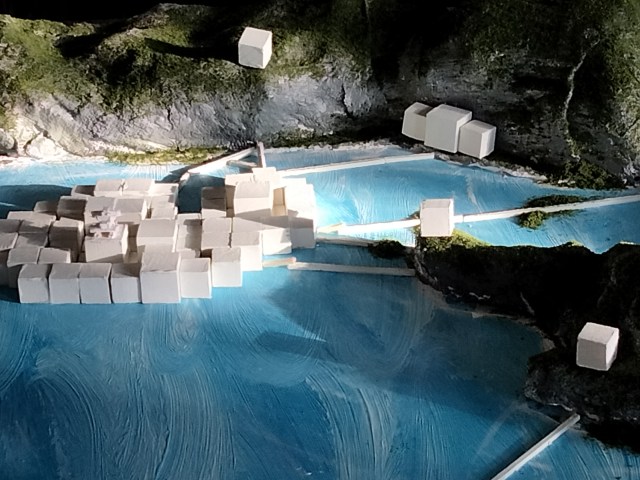
Yet another underwater location that used to be inhabited when sea levels were lower, Doggerland was a vast region that stretched between England, France, Holland, and Scandanavia, and is now the relatively shallow southern part of the North Sea. Archaeological discoveries have handily established that this area was once inhabited, here and here among others. As with other now-submerged human habitations, the reader’s preconceptions will determine how long ago you believe it was inhabited, and for how long.

This article describes an entire book which puts forth a detailed theory Plato was describing Doggerland. Apparently, Atlantis had a large, roughly rectangular plain surrounded by “ditches,” which the author thinks could also be translated “dikes.” He imagines the inhabitants of AtlantiDoggerland using these dikes to keep the sea back from a certain region of Doggerland for a period of time. Without some very expensive underwater archeological expeditions (in a notoriously dangerous sea), there is no way to confirm whether the ruins of a large city lie where this theory would predict. The maps are well worth looking at.

Atlantis as the Richat Structure

The Richat Structure, of the “Eye of the Sahara,” is a large (c. 40 km) formation of concentric rings of stone located in present-day Mauritania. Because of its size and remote location, it is hard to spot except from orbit.

Depending upon how you calculate, the structure matches the recorded dimensions of Atlantis quite well. There are also, of course, explanations about how this structure could have formed geologically. I’m not enough of an expert to assess these, but I am more skeptical of geological explanations than I used to be, now that I’ve seen “mountains” that turned out to be pyramids with insides, and geologists’ attempts to explain how a single fossilized tree could cross-cut millions of years’ worth of sedimentary rock layers. In other words, could go either way.

For the Richat structure to be Atlantis, we have to imagine that it was once nearer to coast and was inundated by a tsunami or something of that nature. This theory actually works fairly well with the geological model that Dr. Kurt Wise presents above. “Continental sprint” would have included many earthquakes and resultant tsunamis. Africa, in the model, does not move as much as the other pieces of Pangea, but it would still have undergone earthquakes and, possibly, some uplift.

On this theory, with his tale of Atlantis Plato somehow retained a memory of a pre-Flood incident (and read Athens back into it?). Below is a video of Pastor Joel Webbon discussing the theory with Brian Suave and Ben Garrett of Haunted Cosmos. They get into local lore around the Richat structure, how this dovetails with Greek legends about Atlantis, and how this all could have been plausible in a pre-Flood world haunted by gods and nephilim.

Conclusion

When I first started composing this post, I thought I was going to come out in support of the Richat Structure. Now, I just don’t know. The Haunted Cosmos guys make it sound very plausible, but a few of the other candidates are also plausible (some less so). There does not seem to be any way to “find” Atlantis without sacrificing at least some of what Plato has to say about it. (For example, Athens existed before the Flood? Before there was a Europe?) This makes it really difficult to favor any one theory (although we can probably discard others). What is clear, is that the prehistoric world had many sophisticated cities, lots of things built with megaliths, pyramids on almost every continent, and that there was a period when many human settlements were submerged as sea levels rose. The details are a matter of speculation, of the kind suitable for someone writing a novel.
A Retired French Mining CEO and His Theory that Doggerland was Atlantis

Some day, we are going to have to do a long post about Doggerland. Right now is a busy time of year, so I don’t have the time for that at the moment, but long story short, Doggerland has everything.

Doggerland was an area that you probably know as “the bottom of the North Sea.” Apparently, there is a shallow area there, with evidence that when sea levels were lower, it was once not only exposed but inhabited. This vast area of land would have joined England and Ireland to what is now Holland and Denmark. The proximity to Holland, plus the theory that Doggerland is the setting for The Lord of the Rings, are what I mean when I say this place has everything.

For now, let’s put a pin in this article. Jean Deruelle, the French guy with the theory, has detailed ideas about exactly what the inhabitants of Doggerland got up to. He assumes (reasonably, I think) that they were part of the Old European megalithic culture. The article also includes lots of cool speculative maps of Doggerland in various stages of submersion by the sea. We can argue about the exact timing of it all, later.

Yay Neanderthals!

What’s the most entertaining thing about this story? Is it …

  • the neat little tidbits about Neanderthal genetics?
  • the big reveal that Neanderthals, Denisovans, and so-called “modern humans” are all actually the same species?
  • the total blindness to the way this fact contradicts the evolutionary narrative?
  • the researchers’ discovering that close kin used to intermarry in the distant past, just like we’re told in Genesis?
  • their attempts to minimize this same fact?

Goals

Many other book bloggers did “2024 Goals” posts in January. That seems like a nice way to generate a blog post, even if this goal post (haha) is a little late.

TBR/TBF

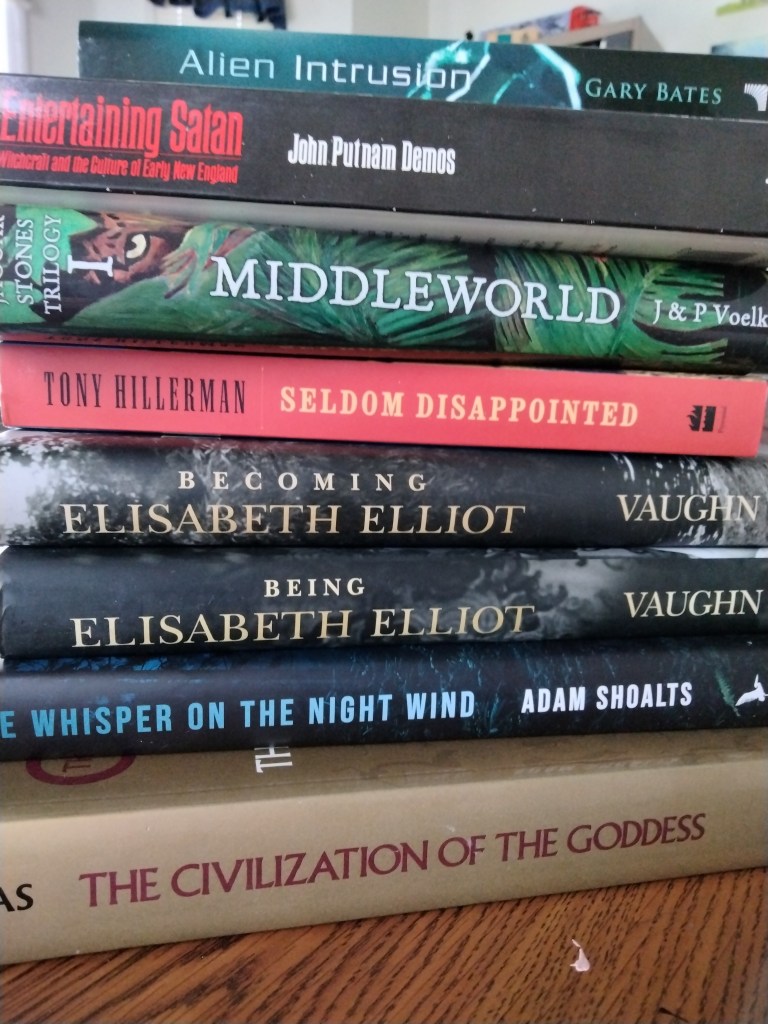
Books to be read or, if already begun, finished:

TBA

Events to be attended:

https://mysticrealmsfantas.wixsite.com/mysticrealmsfair

https://www.newchristendompress.com/conference

TBK

Items to be knitted:

  • Finish woolen knee socks, to be worn with trousers, before Spring (for self)
  • Wanderer shawl: bias-knit chevron patterns to show off the beautiful striped yarn my sister gave me for Christmas (for self)
  • Brioche hat: continue to make different editions of this brioche hat, in different color combinations (gifts for various others)
  • Maybe try to ad lib a brioche bonnet (for sister in law?)
  • as the Spirit moves

TBSE

To be set up: My classroom in the new school building, which we hope to be moved into by Fall.

TBW

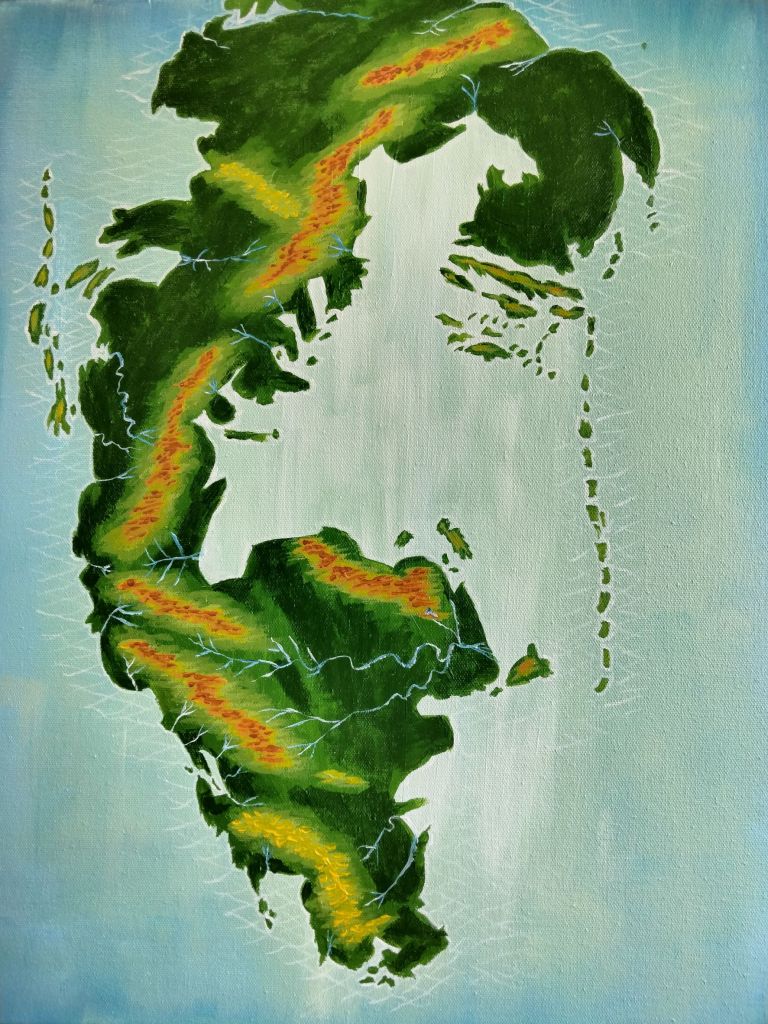
To be wrote: The book that goes with this map:

Last year, I went on a writing retreat in order to make some progress on the draft. At this rate, it looks as if I may have to do the same thing again.

TBC/P

To be cleaned/planted: Clean chicken coop (add more space for hens?), maybe actually plant a garden this year???

TB Top Secret

Various family events with loved ones, which privacy forbids blogging about.

A Caveat

Now listen, you who say, “Today or tomorrow we will go to this or that city, spend a year there, carry on business and make money.” Why, you do not even know what will happen tomorrow. What is your life? You are a mist that appears for a little while and then vanishes. Instead, you ought to say, “If it is the Lord’s will, we will live and do this or that.”

James 4:11 – 15

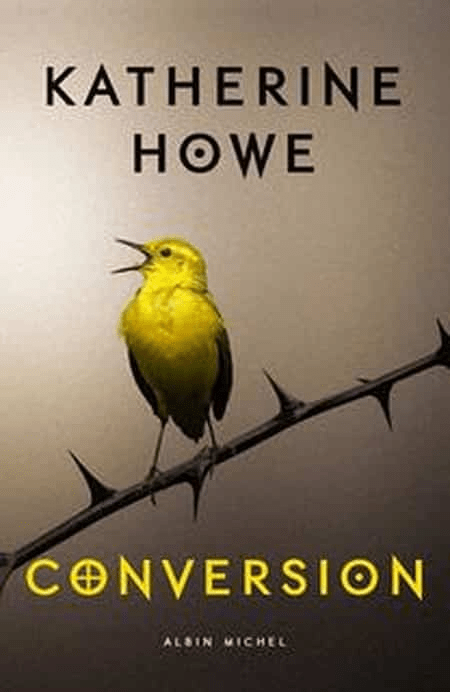
Conversion: A Book Review

My vision is crowded with whispers and movement and strange shapes narrowing in. I feel my heart thudding in my chest, the sweat flowing freely in my hair, under my arms.

Something inside me breaks. I close my eyes and open my mouth, and a piercing scream tears out of me. The scream relieves the pressure in my head, and it feels so good that I scream again.

“It’s there!” I jabber, lurching in my seat. “I see it there! Goody Corey’s yellow bird sits on Reverend Lawson’s hat! I see it plain as day, the Devil’s yellow bird sits on the Reverend’s hat!”

Conversion, p. 362 – 363

I picked up this book from the public library, among a few others, to have fiction to read over Christmas break. After one false start (a high-school drama that was unable to hold my attention), I cracked open Conversion, and it was a winner.

Here’s the blurb from Howe’s website:

A chilling mystery based on true events, from New York Times bestselling author Katherine Howe.

It’s senior year, and St. Joan’s Academy is a pressure cooker. Grades, college applications, boys’ texts: Through it all, Colleen Rowley and her friends keep it together. Until the school’s queen bee suddenly falls into uncontrollable tics in the middle of class. 

The mystery illness spreads to the school’s popular clique, then more students and symptoms follow: seizures, hair loss, violent coughing fits. St. Joan’s buzzes with rumor; rumor erupts into full-blown panic.

Everyone scrambles to find something, or someone, to blame. Pollution? Stress? Are the girls faking? Only Colleen—who’s been reading The Crucible for extra credit—comes to realize what nobody else has: Danvers was once Salem Village, where another group of girls suffered from a similarly bizarre epidemic three centuries ago . . .

Inspired by true events—from seventeenth-century colonial life to the halls of a modern-day high school—Conversion casts a spell. 

The story goes back and forth between modern St. Joan’s and 17th-century Salem. The excerpts from Salem are fairly long. I would say they take up a quarter to a third of the book. The Salem storyline is told from the perspective of Ann Putnam, one of the “afflicted” girls who, years later, made a public apology which stated that she now thought the people accused of witchcraft had been innocent.

Coming into this, I wasn’t sure I would finish it. Books about the Salem witch frenzy, after all, can easily go sideways into facile Christianity / patriarchy bashing. And at first, it did look like Howe was implying that: It’s suh-sigh-uh-tee! These girls had no pow-er! Some of them were servants! The first person they accused was a slave! However, Howe never veered into caricatures. She painted a fairly complex picture, held the girls also responsible, and the writing was good enough that I ended up finishing the book.

I do think Howe’s interpretation of what went down would be more feminist than my own. In the Salem scenes, the men are, to a person, cold, harsh, and uncaring as fathers. (Also, the women can’t read.) However, in the Danvers scenes, Colleen has loving, involved parents who are still married, a kindly younger brother, an apparently goodhearted boyfriend, and a priest at her school who seems like a good egg. The pressure on the Danvers girls comes more in the form of an academically competitive environment where they are all hoping to get into Ivy League colleges. In fact, the fact that none of the girls’ parents seem to be divorced is striking.

Spoiler Town

Howe’s diagnosis of the St. Joan’s girls – and, apparently, of the Salem girls also – is a medical phenomenon called conversion, whereby intense mental stress is “converted” into bizarre physical symptoms.

In the case of the Salem girls, as Howe tells it, it begins with one little girl who genuinely takes sick with what used to be called a nervous breakdown. It’s implied, but never drawn out, that she has been abused by her father. The phenomenon is then taken up by a servant girl living in the same house who is clearly faking at first, for attention and to get out of being worked hard. She even bites herself on the arm to manifest mysterious wounds. The phenomenon then spreads through a combination of this particular girl enjoying the attention; other girls being unwilling to speak up but just saying what they think the adults want to hear; possible suggestion as the girls work themselves into a genuine state; and simmering resentments in the town, as the girls and their parents use the trials to get revenge on those they envy.

In the case of the St. Joan’s girls, Howe is able to offer medical explanations for even the most bizarre physical phenomena. For example, one girl who has been coughing up pins turns out to have pica (a mineral deficiency that causes a compulsion to eat things that are not food, such as dirt). You see, there is a medical explanation for everything!

This book was published in 2014 and the modern-day story is set in 2012. Now, since the Plandemic, Howe’s trust of the medical establishment struck me as naive and dated. The Department of Public Health is the voice of sanity in the St. Joan’s hysteria, and it’s they who figure out that conversion (not the HPV vaccine or environmental pollution) is what’s causing it. Near the end of the book, when the phenomenon has been taken care of by these experts, Colleen narrates that “We are all on the same antidepressant.” This is a red flag to anyone who’s familiar with the research about how harmful behavioral meds can be to kids and teenagers, and how they have been chronically overprescribed, often for way too long at a time, and what a huge moneymaker they are for pharmaceutical companies. I have only a very basic, passing familiarity with this stuff, and even I was concerned. But Howe seems to believe in The Science just as firmly as the Puritains believed in The Devil.

Nevertheless, Howe draws back from explaining away the strange phenomena completely. There’s an odd scene near the end of the book when Colleen’s best friend’s mother, who is always described as pale blonde, ghostly, suffering from migraines, and almost never leaving her house, pulls Colleen into a dark corner and whispers creepily that her daughter is “like me.”

“She’s prone to spells. But it can be managed. Helps to have the family close by. I’m only telling you so you don’t have to worry.”

My mouth went dry.

“But how did you –” I stopped, because it almost seemed as though her eyes were glowing faintly red.

“Anyhow,” Mrs. Blackburn said, her smile widening, a tooth glinting in the darkness under the stairs, “They said what caused it, in the news. Didn’t they.”

“Y — yes.” I swallowed.

“Good. So there’s no problem.”

The hand released my wrist.

ibid, p. 393

I’m not sure what the purpose of this creepy scene is. Is Howe trying to buy back the “mystery” element of her book, even though by that point in the story, all the explanations have been offered? If she is trying to keep the story somewhat paranormal, I’d say the attempt is not successful. Nothing else that happens in the book, not even the scenes in Salem, hint that any actual paranormal activity might be going on. It is all just the girls’ minds deteriorating. Or is Howe trying to imply that Mrs. Blackburn is displaying Munchhausen by Proxy and is somehow making her own daughter sick? If that’s the theory, it’s way too late in the novel to introduce it, and it never gets further explored. There does seem to be a longer version of this book (“not condensed”) out there. Perhaps the Mystery of Mrs. Blackburn is explained in the longer version, but in the book I read, it just comes off like the author wants to add complexity even though she clearly believes the Harmless Medical/Societal Pressure Explanation.

When Witchcraft Was a Thing

I do not know enough about the Salem witch trials — or witch trials in general — or even the Puritains, although I have read some of them — to speak authoritatively about the degree to which Howe’s explanations are correct. Howe has done a lot of research about the Salem trials, and even includes long excerpts from the transcripts in her novel. It’s not clear, however, whether she has done much research about other witch trials in New England (or Old England), or about Puritan theological beliefs.

Fortunately, I have a book by someone who has.

When you read a lot, serendipities sometimes happen. I bought this book many, many years ago, at a used book shop in Kansas City, when I was there for a vacation with extended family. My dad has Used Bookstore Radar, and he always likes to visit the used bookstores whenever he is in a strange city. So I went with him and bought my own armload. This book was an impulse buy that survived several rounds of elimination, because Salem was one of those historical topics that I “really needed to learn more about.” Well, now the time has come.

John Putnam Demos, interestingly, found out only after he had begun witchcraft research that he is descended from the Putnams, the family who were instrumental in many of the witchcraft convictions in Salem.

I’ve only begun the book, but here is what I can tell you. Although Salem has become famous for cases getting out of hand, witchcraft (“entertaining Satan”) was a recognized crime during the 1600s, on both sides of the Atlantic. As with other crimes under English common law, any accusation had to be first investigated informally, and many of these were settled without going to court, which means we have no official records of them. If the stage of going to court was reached, there were still legal proceedings, evidence presented, and so forth, and the magistrates could and often did acquit the accused or void the case on a technicality. People who had been accused of witchcraft could also sue their accuser for slander. Some countries, and some regions of each country, prosecuted people for witchcraft far more often than others. 

It is this background of which Demos wants to draw a detailed picture. He tells us that he is going to look at the biographical details of certain accused and accusers. He is going to look at this from a sociological, psychological, and historical point of view. I am sure I will learn a lot from him. But, when it comes right down it, Demos is still studying witch trials as a sociological phenomenon. He is not examining whether the paranormal may have played an actual role.

The Dominant Narrative

Possibly the most annoying scene in Conversion is when Colleen’s teacher, Ms. Slater, tells Colleen that a good historian should “look beyond the dominant narrative” about Salem. I’m not certain what Slater thinks the “dominant narrative” about the Salem witch trials is. Surely, in modern times, most people see nothing more than a story of injustice and superstition played out in an overly rigid, hierarchical society. That’s certainly not the narrative that was dominating in Salem at the time. The only way I can detect that Slater’s preferred emphasis differs from the dominant modern narrative, is that she wants us to have more sympathy for the teenaged girls who were doing the accusing, for the pressure they were probably under.

This is actually a new thought. If I may speak from my own experience, when we read accounts of the trials, the girls definitely come off as the villains of the piece: screaming accusations, making their adult victims cry. The tendency is to attribute malice. I wouldn’t say that comes from listening to a narrative told by people in power, though; rather, it’s the immediate first impression that we get from just observing their behavior.

By contrast, here’s how Ann Putnam’s experience went down in Conversion:

“Oh, Annie, tell them how we suffer!” Abigail beseeches me.

“I … I …” I stumble over my words, terrified. If I continue the lie, I’m sinning in the eyes of God. A vile, hell-sending sin. If I speak the truth, I’ll be beaten sure, and all the other girls will, too. My mouth goes dry, and bile rises in my throat.

At length, I whisper, “I cannot say whose shape it is.”

page 221

And here:

I’m beginning to panic, and I want to get up and run away [from the courthouse] and hide in the barn behind our house, but everyone is there and everyone is watching me, and my father is there and I have to stay strong and do what they want me to, and so I stay where I am, making myself small on the pew, and soon enough the tears are springing from my eyes, too.

page 258

The picture here is of a girl trapped in a story she knows there is something wrong with, but afraid to out her friends and to displease the adults. This is also very plausible. It reminds me of so-called “trans” children, trapped in an even more harmful delusion foisted upon them by the adults in their lives and by their peers, manipulated into believing this is what they themselves want and have chosen. This could have been one of many factors operating in Salem. This is how social contagions work. There is a big lie; there are vulnerable, confused children or teenagers; there are culpable adults and confused adults; there is social pressure; there is mass deception.

Multiple Causes

So let’s look at some factors, remembering that many things can be true at once.

  • Hysterical Teenaged Girls: Teen and pre-teen girls tend to be stressed out in every society. Their bodies are changing, they are noticing boys, hormones are making them nervous and emotional and edgy. No, they don’t have much social power, but we need to consider whether it is actually a good idea to give teen girls a lot of social power. I think most girls hate themselves at thirteen (the age of Ann Putnam when the story takes place). Teen girls are also known to be susceptible to fads, suggestion, and yes, physical symptoms of stress. The fact that they are not very mentally stable is not an indictment of them or even necessarily of their society; it’s more of a fact that we all have to deal with. This is also the age when, unless guided, girls develop an interest in the occult. So yes, it does seem very natural that the accusers at Salem should have been a bunch of teen girls, and it’s very believable that they were not just “faking,” but had worked themselves into an actual altered state. This created a perfect storm at Salem, because the evidence to be examined a witch trial generally consisted of eyewitness testimony. These were not very reliable witnesses. But the fact that teen girls’ testimony was accepted as evidence actually argues against Salem being a sexist hellhole.
  • Vengeance / Scapegoating: Already in Demos’ book, it has become evident that people who got accused of witchcraft tended to be those who had annoyed their neighbors in some way. Maybe they were the sort of person who is always arguing with everyone, or maybe they were upper-class or especially pious and so the target of envy. It’s pretty clear, even to someone not deeply familiar with the records, that accusers saw in a witch trial a way to get revenge on someone who they had perceived wronged them. Envy, resentment, and scapegoating are actually very common in human life, especially in village settings (say as opposed to city settings). If the culture in question believes in magic, then people are likely to suspect their enemies of sabotage by magic, in whatever magical idiom is local to the culture. People find it hard to accept that things can just go wrong for them. They prefer to blame someone when something goes wrong.
  • Superstition: If by “Superstition” we mean “There’s no such thing as witchcraft,” then we will get to that in a moment. But if by superstition we mean, “If the New Englanders had not believed in witchcraft, the injustice of the Salem witch trials would never have happened,” then that is manifestly untrue. Of course, they would not have happened in the same way. But what scares us about Salem is not the suggestion of the paranormal so much as the purge-like quality of the proceedings, where an accusation is tantamount to a conviction, and it’s impossible for the accused to prove their innocence. Something has gone wrong with way rules of evidence are applied. A moment’s reflection will show that it is completely possible to conduct a purge in the absence of belief in witchcraft. Purges have been conducted on charges of capitalism, communism, being a heretic, being a Christian, sympathizing with the enemy in wartime, abusing children in daycare centers, date rape on college campuses, racism, not taking the government vaccine, and being insufficiently supportive of the trans agenda. If the purge mentality is present, then any superstition will do. That’s why it is foolish for us to feel superior to the Salem townspeople, as if, not being Puritans, we could never be subject to this common human practice.
  • Medical Causes: I have heard theories that there may have been some physical factor, such as a particular kind of mold in their diet, that caused the girls to develop delusions and hallucinations. This seems to me like a modern materialist grasping at straws. We don’t want to believe that a bunch of teenaged girls could be so wicked as to deliberately send their neighbors to their deaths, and we certainly don’t want to consider the paranormal as a real possibility, so it must be the mold. It’s true that certain medical conditions can cause irrational behavior (even heat stroke or fever can do it), because we are embodied people. However, in a case like that I wouldn’t expect the affliction to spread like a fad among just the teen girls in a community … the very ones who are vulnerable to delusions and drama for a bunch of other reasons already covered.
  • Actual Occult Activity: Not being a strict materialist, I can’t rule this possibility out. Modern Western materialists don’t believe that a spiritual world exists at all, so when it comes to interpreting things that happened in the past, we have some blind spots. We are quick to accuse people who we know to be otherwise intelligent of making ridiculous things up out of whole cloth, or of believing ridiculous things completely without evidence. But it is actually possible that there was a lot more paranormal activity in the past than now. Paranormal activity tends to manifest itself in forms that make sense to the culture where it is manifesting; so, people in Ireland have encounters with fairies, American Indians might encounter the Windigo, and modern Americans are more likely to be abducted by aliens. This doesn’t mean that nothing spiritual is going on, just that malevolent spiritual forces know how to make themselves intelligible to humans. If we accept that there was actual paranormal (dare I say, demonic) activity happening in Salem, this does not mean that we have to accept that every person who was accused – or even every person who confessed – was in fact a witch in league with the devil. There have been cases before where people confessed to things they didn’t do, because they were worn down by interrogation, eager to please, or easily manipulated. However, there could have been some people practicing the occult in Salem. The girls themselves could have gotten involved in some occult practice, which could have left them open to demonization. And in fact, even if their symptoms were entirely faked, the kind of mob/purge mentality that they displayed is always the work of the devil in the sense of being the fruit of envy, deception, and a false ideology. When people get involved in occult practice or philosophy, one tragic result is often that they lose their ability to think clearly. That certainly seems to have happened in Salem, in some form or other. The devil certainly got a lot of publicity during those months, and I’m sure he was loving it.

The “Oldest Dutch Art”

… is zigzags carved onto a possibly 13,500-year-old bison bone retrieved from Doggerland.

Retrieved by Dutch fishermen.

“The oldest Dutch art,” haha, get it?

Doggerland was a fertile area inhabited by people when sea levels were much lower. It lay under what is now the North Sea. Unlike the map in the linked article, some maps show it being a vast lowland area essentially joining England with what is today Scandanavia. These maps also often show England joined to France and Ireland. Europe’s current rivers are just the headwaters of a larger river system. Of course, no one knows exactly what it would have looked like, but it’s fun to speculate.

On an evolutionary timescale, Doggerland was inhabited over millennia, millennia ago. On a young earth/catastrophic flood timescale, it could have been settled over decades or centuries by people dispersing after the flood, when the climate was cool and rainy, large glaciers formed rapidly, and sea levels were consequently much lower, exposing land bridges all over the world that facilitated humanity’s dispersion. There could have been a relatively short period of time (a few centuries?) before the climate stabilized, the glaciers melted, and sea levels rose, marooning people wherever they had ended up.

As a Dutch person myself, I think it’s incredibly clever that they call this the “oldest Dutch work of art.” I mean, given that the Dutch have reclaimed a good part of their country from the sea, why don’t we just go ahead and let them have as much of Doggerland as they can manage?

However, I disagree with some of the experts in the article that the only possible use we can imagine for zigzags is artistic or “ritual.” Following Richard M. Rudgley, other possible are uses are a calendar, music, or some other kind of scientific notation.

Altai Throat Singing

The Altai mountains are in central Asia, north of the Himalayas, around the area where countries such as China, Mongolia, Russia, and Kazakstan meet. They are not too far from the stompin’ grounds of the horse-riding Central Asian tribes such as the Scythians and Parthians, part of the same culture area that gave rise to the early Indo-Europeans with their kurgans, before they moved west into Europe proper. That’s why these guys look sort of European and sort of Asian. People who live here have looked like this for thousands of years.

The Altai mountains are an old range of mountains (left over from Pangea?), not created by whatever event caused the Himalayas. Hence, they are low and rolling. I had to (lightly) research this part of the world when I went to write The Long Guest. My characters called them the Gentle Mountains. They had a lodge there for some years before moving on to the Gobi desert (which possibly didn’t actually exist in the immediate post-flood years in which my story is set, but we will ignore that. Onward!)

I thought this was a perfect video to share on a winter’s day. Are these people cool or what? I love how he warms up for throat singing by making horse noises.

As with many cultures, my imagination is very attracted to their way of life, but I would probably hate it if I had to actually live that way, not being tough enough.

Whatever Was Going On in Saudi Arabia?

Consider this article:

“Spectacular Images Reveal Mysterious Stone Structures in Saudi Arabia”

It’s on the Ancient Origins website, which compiles and presents a lot of fascinating stuff, but which also has many annoying ads. Sorry about that!

So, to answer my own question, I think that many of these structures could have just been houses. Particularly when we get circular or triangular structures facing or intersecting each other, they don’t look so different to me than the pit houses and kivas of Mesa Verde. The only difference would be that they are much older.

Consider: Saudi Arabia was once much more verdant than today (as was Egypt, evidenced by the erosion channels on the Sphinx). These structures seem to be very old (evidenced by the fact that some of them have been partially covered with lava flows). They could be habitations dating back to a time when the area was actually rainy (immediately post-Flood?). The stone walls, now fallen, could have been topped with domed or conical roofs made of a more perishable material.

“But they think the cairns in them contain burials!” True. It’s interesting that they only think this. Apparently, they haven’t been allowed to show up in person so as to excavate/investigate. These are sites I’d like to visit … except, of course, I’d rather the demons didn’t get me. Anyway … if the cairns do turn out to be burial mounds and not something more prosaic like ovens, even that wouldn’t be completely unprecedented. It might seem a little odd to have Grandpa buried right there in your family housing complex, but it has been done before, at least with ossuaries (bone boxes). The cairn would become a sort of ancestral shrine. It’s not unheard of in human history.

Let’s Learn Nahuatl

Nahuatl was the language spoken by the Aztecs. According to my source (see below), the Aztecs actually called themselves the Mexica. So, yes, the whole country is named for them. We call them Aztec after Aztlan, their name for their original homeland.

Here are some vocabulary words gleaned from my source. Most of them are names of places, rulers or gods:

tlalli = earth

Huitzilopochtli = the hummingbird of the left [hand]

Huitzilhuitl = hummingbird feather

Quetzalcoatl = green-feather serpent

Coatepec = hill of the serpent

Chapultepec = hill of the locust

Coatlicue = Huitzilpochtli’s mother (I don’t know the meaning of her name, but apparently some kind of serpent.)

Xiuhcoatl = serpent of fire (a weapon)

Itzcoatl = serpent of obsidian

Cihuacoatl = woman snake (title for an advisor to the ruler)

coatepantli = serpent wall

Chicomecoatl = seven serpent (i.e., corn)

Chicomoztoc = seven caves

Therefore:

chicom-  = seven (might have an underspecified vowel as its final sound)

coatl = serpent (l drops when followed by e)

huitzil = hummingbird

tepec = hill

Source: The Aztecs, by Brian M. Fagan, W.H. Freemand and Company, New York, 1984