The Maya Microcosm of Humanity

The Maya flourished between approximately 1000 BC and 1500 AD in Central America. Their civilization was centered in the Yucatan Peninsula and the lowland and hilly regions south of it. Their sites are found in what are now the countries of Mexico, Belize, Guatemala, and Honduras.
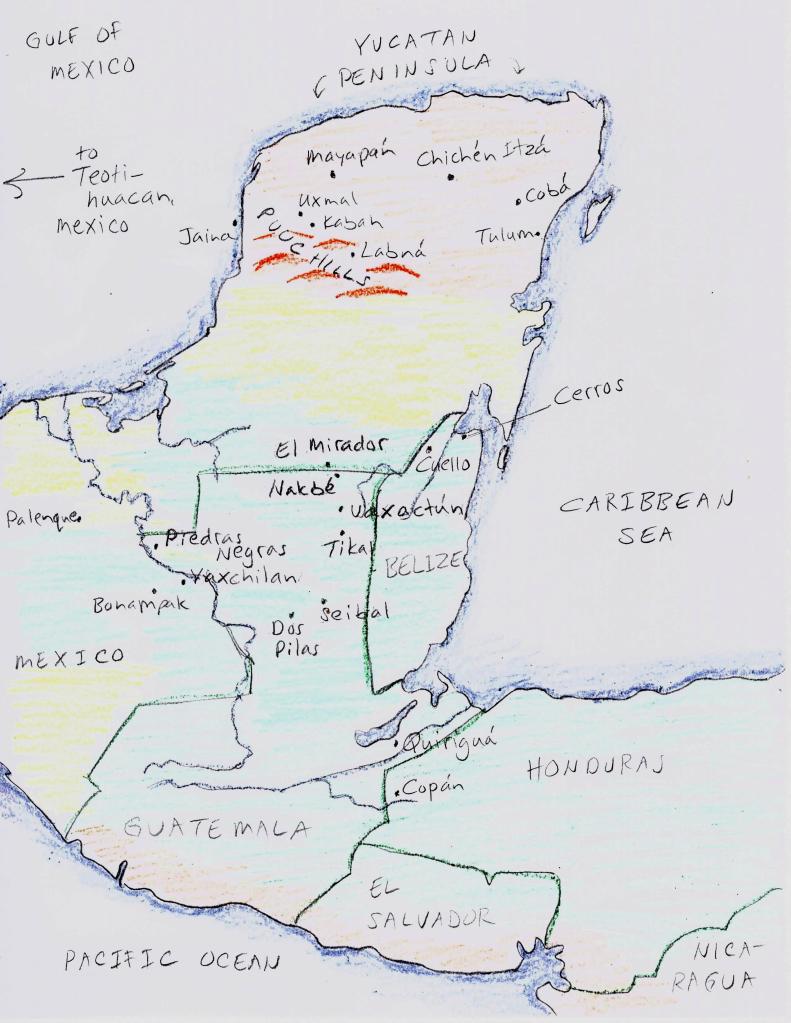
There is so much to learn about the Maya. I have barely dipped my toe in it. As always when learning about a new culture or civilization, I was met with the thrill of the exotic followed by a creeping feeling of familiarity. Though the Maya are very unique, in their own distinctly Mayan way they also epitomize certain things about human beings. In some sense, the more unique they are, the better they epitomize it.

They Are Surprising to Other People

I don’t know why, but people always get excited when they discover other people. (Animals get excited too: “Oh goody! A person!”)  And we are always discovering other people, in the most remote corners of space and time, where for some reason we did not expect to find them, though you would think we’d have learned our lesson by now.

The Maya were particularly hard to find because of the geography of the region they inhabited. Jungle is not kind to the preservation of buildings or artifacts. It destroys things quickly, grows over things and hides them, and can make the region impassable.

Tree destroying a stone arch. From Mysteries of the Ancient Americas, p. 165

A really thick jungle allows no roads through it, and once they arrived, here is what some of the archaeologists found:

“The rain was incessant,” Charnay complained. “The damp seems to penetrate the very marrow of our bones; a vegetable mould settles on our hats which we are obliged to brush off daily; we live in mud, we are covered in mud, we breathe in mud; the ground is so slippery that we are as often on our backs as on our feet.” Once Charnay awakened to find 200 “cold and flat insects the size of a large cockroach” in his hammock, 30 of which clung to his body and bit him painfully.

The Magnificent Maya, p. 22

They Got Romanticized

In the early 1500s, during the Spanish conquest of the region, Spanish priests managed to preserve some Mayan cultural data – vocabulary lists, transcriptions of myths, and a few codices (books) – at the same time they were brutally wiping the culture out. These records remained obscure until, 300 years later, there was a resurgence of interest in the Maya. Explorers, hobbyists, and artists who happened to have the time, money, and fortitude to brave the jungles started unearthing Mayan ruins and making sketches and watercolors of them. In some cases, these sketches are the only record we have, since the jungle has continued its destructive work in the 200 years since.

Once European academics started getting interested in the Maya, they realized there was a very elaborate system of numbers and pictographs that they could not read.  Thus began a long, haphazard process of rediscovering old codices and cross-checking them with symbols found on the monuments, as recorded in photographs and drawings. The number system was easier to decipher – dots for ones and bars for fives, for example – and so the first thing that got decoded were dates and astronomical cycles,

… which led many experts to conclude that Maya writing was limited to such matters. As late as the 1950s this was still the most prevalent view, and its chief spokesmen were the American archaeologist Sylvanus G. Morley of the Carnegie Institution in Washington, D.C., and J. Eric S. Thompson, a British archaeologist also affiliated with Carnegie. Thompson drew a picture of the Maya as a peaceful, contemplative people, obsessed with the passage of time, and guided by priests who watched the movements of celestial bodies and discerned in them the will of the gods. Maya cities were ceremonial centers, he believed, not bastions of the worldly power.

The Magnificent Maya. p. 33

Over the next few decades, through the work of several brilliant code breakers, about 80 percent of Mayan glyphs were deciphered. Turns out they are a combination of ideograms (an image representing an idea) and phonetic units (an image representing a sound).  As this work went on, researchers have been able to read more and more of the Mayan myths and history, which in turn has helped us better to interpret their art. They started to discover that the 19-century “noble savage” characterization of the Maya was badly mistaken.

They Were Shockingly Cruel

First of all, the Mayan society was indeed hierarchical, with battles for succession and kings of city-states engaging in (perhaps ritual?) warfare. Discoveries during the 1990s confirmed that this hierarchy was present hundreds of years earlier than previously guessed.  (Archaeologists’ preconceptions might have had something to do with these inaccurate guesses. See my post about Serpent Mound for a critique of the 19th-century idea that civilizations always develop along certain lines, from hunter-gatherers, to villages, to cities.)

from The Magnificent Maya, p. 108

But warfare was only the beginning. There was also the bloodletting, the torture, and the human sacrifice.

Apparently, Mayan royalty were expected to offer blood to their gods. During these bloodletting rituals, they would have visions. There are pictures and statues of both men and women doing this. Women would draw a stingray spine through their tongue to produce the blood. Men would draw blood from their tongue, earlobes, or genitals. (Yikes.) They would allow the blood to be absorbed by sheets of bark paper, which was then burned, the smoke being a way of getting the blood to the gods.

If a culture is going to have a painful ritual, it’s good that it should be done by the royalty. That’s certainly better than having a royalty that is unwilling to suffer for their duty and their people. If this were the only painful ritual the Maya had, I’d kind of admire it. But it wasn’t.

The Maya were big on human sacrifice. Decapitation was popular, or they might throw the victims into a sacred cenote (large natural limestone hole filled with water) if one was available. High-born victims, captured in war, would be mutilated and displayed before the community before being offed. Later, perhaps under the influence of the feathered-serpent cult of the Toltecs, Mayan priests would cut out the victim’s heart, offer it (and its steam – ew!) to the sun, and then kick the body down the steps of the temple. This ritual was still being conducted at Uxmal in the 1500s, which is why we know about details like the kicking of the body (Magnificent Maya, 139 – 140).  Chacmools, which were obviously built to hold something, may have been made to hold human hearts.
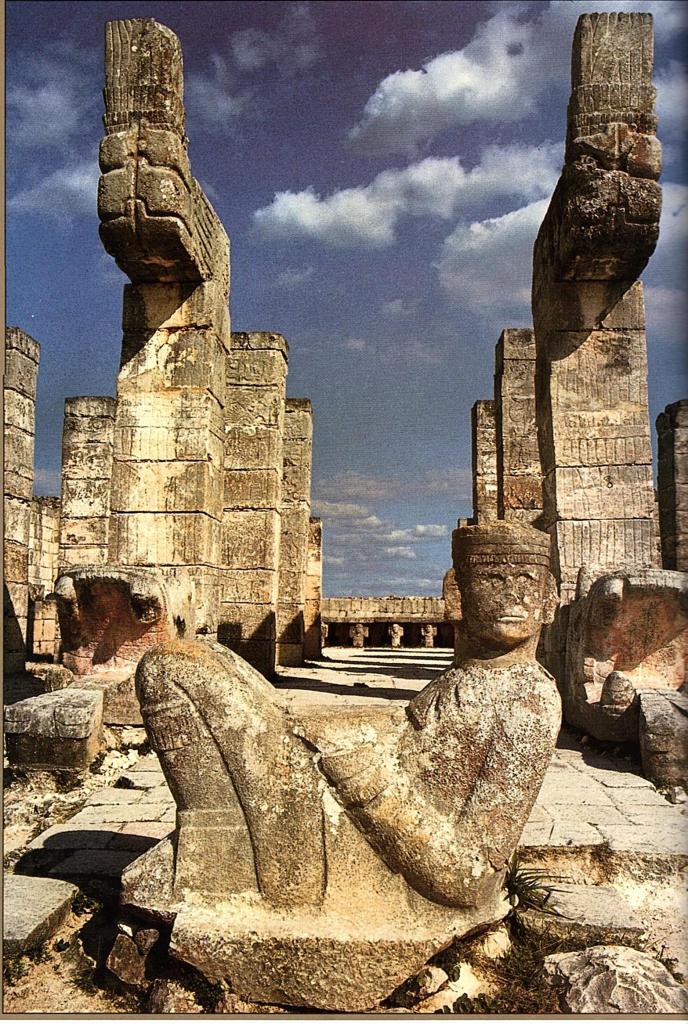
The Magnificent Maya, p. 136. Temple of the Warriors at Chichen Itza. The reclining statue holding a bowl is the chacmool.

Then there were the ball games. Did I mention that the Maya were big sports fans? Like, really big. You have probably heard of this game, where the players would use their hips and buttocks to bounce a large, heavy rubber ball off the sloping walls of the court. Apparently, the Maya took their sports so seriously that the losers of this game might be sacrificed, either by one of the methods above, or by being trussed up and used as the ball until they died (94 – 95).  This very ball game features in the Mayan creation story, the Popol Vuh, where the Hero Twins play the game against the inhabitants of the Underworld. The reason they are obliged to do so? The rulers of the Underworld “covet [the brothers’] sporting gear and want to steal it” (56 – 57). This story, too, features a lot of torture.

Cruelty is always shocking, which is why the heading for this section says “shockingly cruel.” But it should not shock us to discover that a previously unknown civilization featured widespread, institutionalized atrocity. Every single human culture has something like this. Cultures can have good historical moments when the human evil is comparatively restrained, and they can have bad historical moments when it is encouraged. You could argue that in the case of the Maya, it had really gotten out of hand, and I think you’d be right. But I don’t think that makes the Maya different from any other people in their basic humanity. In their uniqueness, they epitomize what human beings are capable of. People are extremely creative, and they have often used their creativity to dream up ways to torture one another. This is why we have the expression, “Man, the glorious ruin.”

They Were Jaw-Droppingly Smart
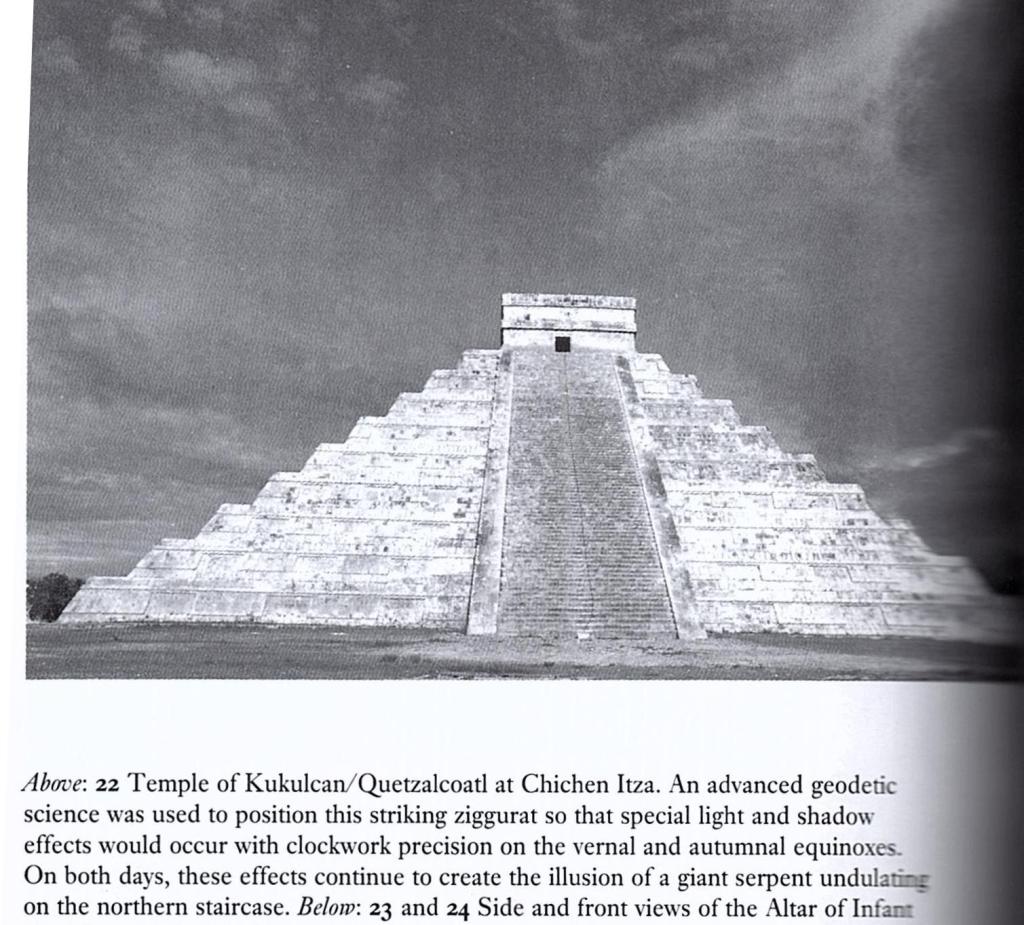
from Fingerprints of the Gods, photo plate between pages 134 – 135. I have no idea how this light and shadow serpent effect was accomplished, but if true, it’s an amazing piece of engineering.

And now we get to the glorious part. No matter how depraved, broken, fallen, or ruined they may be, human beings never stop being made in the image of God, which means they will keep on being creative and clever and productive. It has long been a theme on this blog that ancient people were smarter than modern people expect. This is because they were people, and people are always surprising other people – because the other people are proud – with their cleverness.

The Maya were advanced mathematicians. They had the concept of zero, and the idea of place value, which the Romans did not have. They had calculated the solar year at 365.2420 days (the modern calculation is 365.2422), and the time of the moon’s orbit at 29.528395 days (modern figure is 29.530588). They had figured out the average synodical revolution of the planet Venus (the amount of time it takes for Venus’s orbit and the earth’s orbit to sync up so that Venus is rising in the exact same spot in the sky). This average happens to be 583.92 days, and they had figured out how to reconcile this with their “sacred year” (13 months of 20 days each) and with the solar year, by adding days every certain number of years, similar to our leap year.  Bringing all these interlocking calendars into sync then allowed them to calculate mind-blowingly distant dates without losing accuracy.

All the above information is from Graham Hancock in Fingerprints of the Gods. Hancock then quotes Thompson, the romanticizer whom we met a few sections ago. Studying the Mayan calendar, Thompson had reason to be impressed:

As Thompson summed up in his great study on the subject:

“On a stela at Quiriga in Guatemala a date over 90 million years ago is computed; on another a date over 300 million years before that is given. These are actual computations, stating correctly day and month positions, and are comparable to calculations in our calendar giving the month positions on which Easter would have fallen at equivalent distances in the past. The brain reels at such astronomical figures.”

Hancock, Fingerprints of the Gods, p. 162

Hancock, being a bit of a snob, questions why the Maya “needed” to develop these calendrical and mathematical tools. He speculates that the Maya had inherited “a coherent but very specific body of knowledge … from an older and wiser civilization.”

“What kind of level of technological and scientific development,” Hancock asks, “was required for a civilization to devise a calendar as good as this?” (158 – 159)

Of course, he is asking these questions because he’s heading in the direction of civilization having dispersed from a “mother-civilization.” That’s fine with me, but in asking these questions he also betrays a worship of science and technology that is distinctly modern and that, when applied to ancient peoples, makes us shortsighted. Why should mathematical genius exist only in the service of technology? The Maya were smart, and they wanted to make these calculations about the celestial bodies and about dates in the distant past and future. Isn’t that enough? Furthermore, they actually recorded why they were so obsessed with these calculations. Their cosmology held that time proceeded in predictable cycles of disasters, and they were pretty concerned with knowing when the next one was coming. That was the purpose of the Long Count calendar, as Hancock himself points out on page 161. It was a doomsday clock. That may also have been a big part of the reason for the horrifying sacrificial system.

The Long Count calendar is what everyone was talking about when they were saying the Maya had predicted a cataclysm for Dec. 23, 2012.  It didn’t happen – phew! – and, frankly, for obvious reasons I don’t completely buy in to their cosmology. Although we do need to consider the possibility that in converting the dates, we made a mistake in interpreting their extremely complex system.

Bottom Line, the Mayans are People

I can’t say that I find the Mayan – or the Toltec, Aztec, or Olmec – myths or aesthetic particularly attractive. I dipped my toe in because as part of the research for my books, I need to at least know my way around the ancient Mesoamerican mindset. As the research proceeds, I find myself becoming increasingly fascinated with these people. But I still wouldn’t want to have lived as one. This has been true of virtually every ancient culture I’ve studied.

So, taking it in reverse order, here is what we have learned about the Maya, and here is what we have learned about humans.

Humans are smart.

Humans are evil.

Humans are wonderful.

Humans are everywhere.

Sources

Hancock, Graham, Fingerprints of the Gods. 1995, Three Rivers Press, Random House, Inc., New York, New York.

Reader’s Digest books, editors, Mysteries of the Ancient Americas. 1986, The Reader’s Digest Association, Inc., Pleasantville, New York.

Time-Life books, editors, The Magnificent Maya. 1993, Time-Life Books, Alexandria, Virginia.

The Diamond-Shaped Face

Who is this handsome fellow? He is Lord Pacal (or Pakal), denizen of the most spectacular tomb ever discovered from the Mayan civilization. This is the tomb at Palenque, the excavation of which reads like an archaeological thriller. The limestone slab covering Lord Pacal’s coffin is the location of the famous Mayan “astronaut” carving, the actual cosmological significance of which is explained here.

This watercolor of him is my own interpretation, done from a photograph of a sculpted head of him, reproduced below.

The Magnificent Maya, p. 85

Though I did my best, in the sculpture his face is even longer, leaner, more angular, more … well … Mayan. I took a guess about skin, hair, and eye color. I also had to interpret his hairstyle and headdress, after staring for some time at the textures in the statue. As near as I can tell, his hair has been arranged to cascade upward and forward over some sort of cone-shaped crown, which I imagined to be jade, a stone the Maya valued. The hair style is apparently meant to accentuate the tall, narrow shape of the head, which was a head shaped valued by the Maya if we go based on their other art. The headband I rendered as a buff-colored woolly material, again based on its texture, though given Pacal’s status it could have been red or gold.

I spent maybe an hour or two on this watercolor, but no doubt the sculptor spent much, much longer on his or her rendering of Lord Pacal, which was probably the most important work of his or her lifetime.

You can see that it’s a dramatic face. You can see why I wanted to paint it.

In my watercolor, Lord Pacal came out looking surprisingly sensitive and gentle. In real life, he probably wasn’t, at least not by the time he reached the age of his death. He was buried with six teenaged human sacrifices, and he came from a culture that produced statues of torture victims.

But my main concern here is with the shape of his face. I am fascinated by the wildly varying types of shape that can and do work as recognizable, and indeed attractive, human faces. Lord Pacal’s face is almost a perfect diamond. It’s widest at the brows and cheekbones, narrowest at the chin and forehead.

As I went to draw this face, I was reminded that I had once drawn another face with a similar shape.

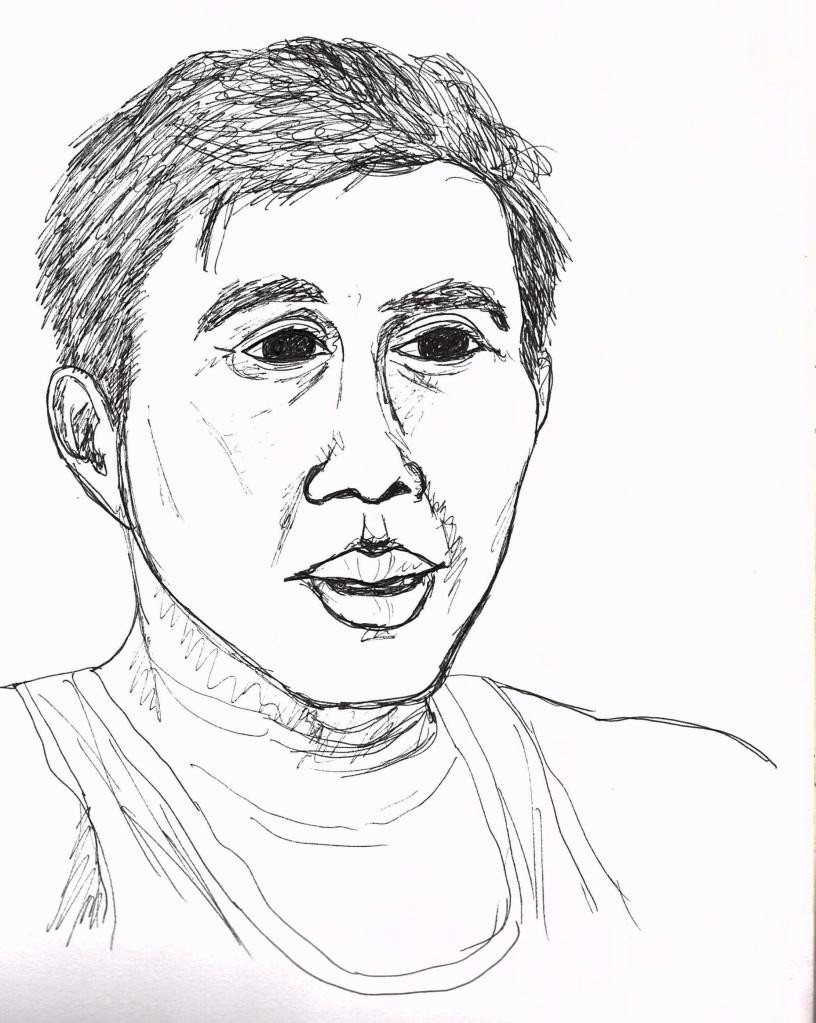
Here is a pen portrait I did from life. This man’s jaw is a touch wider than Lord Pacal’s, but the main difference between the two faces is the nose. This model has a small, rather flat nose with a very low bridge, unlike Lord Pacal’s knifelike nose with its very high bridge, extending all the way up into his forehead, which seems to have been a convention in Mayan portrait art. Whether it this was an ideal of beauty or a real-life physical feature, I don’t know. I do know that low nose bridges are not valued in the culture that the second portrait came from … though I think both kinds can be perfectly beautiful.

And my second model for a diamond-shaped face came from … Borneo. Land Bridge, baby!

Source

The Magnificent Maya, Lost Civilizations series, by the editors of Time-Life Books, Alexandria, Virginia, 1993.

(Much more has been discovered about the Mayan civilization since the publication of this book. In particular, Lidar and UAV aerial imaging have revealed that the Mayan cities were much larger and more numerous than was known in 1993. However, though the context for their interpretation might have changed, the artifacts documented in The Magnificent Maya have not ceased to exist, so I am using the book as an introductory source.)

Quote of the Week: Brilliant Native American Botanists

Matthew Stirling, Chief of the American Bureau of Ethnology, [says] ‘Among the plants developed by these ancient botanists are maize, beans (kidney and lima), potatoes, and sweet potatoes, now four of the leading foods of the world. Manioc, extensively cultivated by the natives of tropical America is now the staff of life for millions of people living in the equatorial belt. Other important items, such as peanuts, squash, chocolate, peppers, tomatoes, pineapples and avocados might be added. In addition, the Indian was the discoverer of quinine, cocaine, tobacco and rubber …’

Kenneth Mackoman adds to this list, the custard apple, strawberry, vanilla bean, chickle, and cascara, besides a number of others less familiar. His whole list of important plants made up by Indian’s agriculture is impressive, for it contains 50 items, not one of which is an Old World species … The Indian devised a useful method for extracting a deadly poison (cyanide), from an otherwise useful plant, manioc, without losing the valuable starch it contained.

M.D.C. Crawford gave a list of vegetables which were cultivated by the American Indians prior to 1492, which adds the following: Aloe, Alligator Pear, Arrowroot, Star Apple, Cacao, Chili pepper, Jerusalem Artichoke, Cotton, Pineapple, Prickly pear, Pumpkin.

‘The pineapple … originated in America and was the unknown to the people of the Old World before its discovery.’ Just where the Indian found the original plants which they improved upon to produce modern pineapples, we do not know. None of the existing [wild] varieties compares with the domesticated plant … This was … a deliberate and intelligent breeding process … we cannot now retrace the steps by which it was first accomplished.

Arthur C. Custance, Noah’s Three Sons, Zondervan 1975, pp. 166 – 168

Three Words: Neanderthal. Sea. Food.

“Cave find shows Neanderthals collected seafood, scientists say”

You guys, I don’t know where to start. I love everything about this article. I love seafood. And you already know my feelings on Neanderthals.

Neanderthal. Sea. Food.

For starters, the researcher’s name is Prof. João Zilhão. How great is that?

That’s because these huge deposits of Neanderthal-collected seashells were found in Portugal:

The team say the dearth of other huge shell deposits in Europe could be down to a lack of preservation: shellfish could not be transported far from the coast, and hence many such deposits in northern Europe would have been destroyed as polar ice caps advanced, while elsewhere they may have been submerged as the sea rose to today’s levels.

The stretch of Portuguese coast where the new find was made is perhaps the only location locally where such deposits could have been preserved, they say. South Africa, by contrast, experienced an uplift of the land, meaning many such deposits have been preserved.

Ibid

Yet another example of how much we don’t know because the vicissitudes of time did not see fit to preserve it.

According to a Neanderthal researcher who was not involved in the study,

“We have increasingly recognised the sophistication of Neanderthal behaviour, but one thing that continued to mark out the behavioural evolution of modern humans in Africa was the appearance of systematic collection of marine resources, and this marked a difference between the two populations.”

Dr. Matthew Pope

But not any more. And, best of all, this quote:

“I feel myself uncomfortable with the comparison between Neanderthals and Homo sapiens, because the bottom line is Neanderthals were Homo sapiens too. Not only was there extensive interbreeding, and such interbreeding was the norm and not the exception, but also in every single aspect of cognition and behaviour for which we have archaeological evidence, Neanderthals pass the sapiens test with outstanding marks.”

Prof. João Zilhão

Yet More Proof that Ancient People …

… Were not as dumb as modern “smart people” thought.

“This 7,000-year-old well is the oldest wooden structure ever discovered, archaeologists say”

Its design shines a light on technical skill researchers didn’t think Neolithic people possessed.

“The design consists of grooved corner posts with inserted planks. This type of construction reveals advanced technical know-how,” the authors wrote.

Ibid

Spear vs. Grindstone

The grindstone: approved usage

Another post in the series on The Lost Civilizations of the Stone Age by Richard Rudgley. (You don’t really need to see another image of the book cover, do you?)

A great deal of emphasis has been placed on the role of hunting in the Old Stone Age … Hunting has been given an inordinate status both by archaeologists and by hunting peoples themselves. In the latter case this is largely due to the fact that it is the men who do most of the hunting and they therefore pride themselves on their own achievements and tend to play down the considerable contribution of women. Prehistorians are presented with an archaeological record that contains far more information on hunting than on gathering activities … owing to the poor survival of botanical specimens.

Rudgley, p. 158

Of course, hunting is also more glamorous, riskier, and it generates better stories than “that time we found all those berries.”

According to Rudgley, in the case of modern hunter-gatherers, up to 80% of a community’s diet can consist of “gathered foods,” which includes edible plants but also such things as eggs and shellfish. We can’t assume that ancient people’s diets were exactly the same. The world has changed quite a bit (there is less big game, for example). Still, this is suggestive that people were processing and eating plants long before the supposed advent of agriculture.

The Noble Savage Myth and the Wild Yam Question

Speaking of modern hunter-gatherers, there is actually some question as to whether it is possible for people to survive on pure hunting and gathering. It is extremely difficult to find a modern hunter-gatherer group that does not get some of their calories from trade with nearby agricultural peoples, and/or “paracultivation.” Paracultivation is practiced by the Central African Pygmies, who re-plant the tops of rain forest yams (a main source of starch for them) after they harvest them, and by people in Central Borneo who depend on the sago palm for starch, who will cultivate patches of palms that they can return to and “gather” later. The so-called Wild Yam Question, first raised by Thomas Headland, postulates that in tropical rain forests there is not enough naturally occurring food for people ever to have survived there without at least paracultivation. This has been hotly debated among anthropologists. You can read an overview of the debate here: “Could ‘Pure’ Hunter-Gatherers Live in a Rainforest? : A 1999 review of the current status of The Wild Yam Question”

Was Agriculture Really a Revolution?

Implements normally associated with agriculture – mortar and pestles, sickles, grain storage – are found in the Natufian culture of the Levant (c. 10,500 to 8000 BC). I can’t resist pointing out that this is the exact time period which, in my books, comes right after the Tower of Babel and only a few hundred years after the Flood. In that, possibly true, alternate universe, these “first farmers” could have been people to whom the knowledge of agriculture was not new, but who were having to resettle the earth after a series of society-shattering disasters.

Could there have been farming before the Flood and before the Neolithic “agricultural revolution”? Mortars and pestles have been found that are at least (with the usual caveats about dates) 80,000 years old (California); 43,000 to 49,000 years old (South Africa); 30,000 years old (Australia); 44,000 years old (Ukraine); and 40,000 years old (Spain). Various stone artifacts from even farther back (Lower Palaeolithic sites, including Olduvai Gorge) have been speculated to be pounding stones, also used to process seeds or grains. (Rudgley p. 159 – 160)

The Oft-Under-Appreciated Grindstone

The grindstone may not be as glamorous as the spear and spear-thrower, but it can be used as a weapon in a pinch:

Abimelech son of Jerub-Baal went to his mother’s brothers in Shechem and said to mother’s clan, “Ask all the citizens of Shechem, ‘Which is better for you: to have all seventy of Jerub-Baal’s sons rule over you, or just one man?'”

The citizens of Shechem were inclined to follow Abimelech. They gave him seventy shekels of silver, and Abimelech used it to hire reckless adventurers, who became his followers. He went to his father’s home in Ophrah and on one stone murdered his seventy brothers. Then all the citizens of Shechem and Beth Millo gathered beside the great tree at the pillar in Shechem to crown Abimelech king.

[Things go bad between Abimelech and the people of Shechem, and he ends up razing their city.]

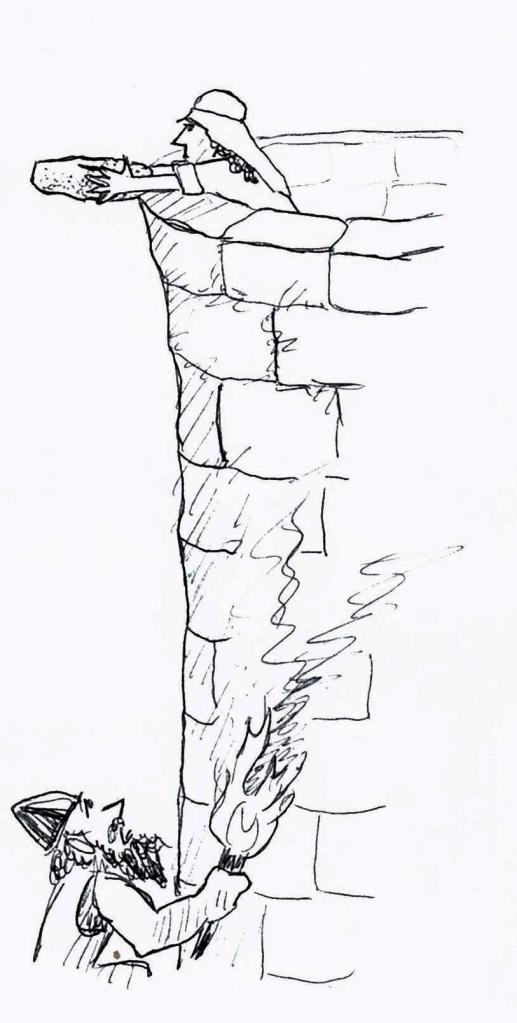
Next Abimelelch went to Thebez and besieged it and captured it. Inside the city, however, was a strong tower, to which all the men and women – all the people of the city – fled. They locked themselves in and climbed up on the tower roof. Abimelech went to the tower and stormed it. But as he approached the entrance to the tower to set it on fire, a woman dropped an upper millstone on his head and cracked his skull.

Hurriedly he called to his armor bearer, “Draw your sword and kill me, so that they can’t say, ‘A woman killed him.'” So his servant ran him through, and he died.

Judges 9:1 – 6 and 50 – 55

But we all know she did.

The grindstone: alternate usage.

To Build A Fire

Another post in the series taken from this book

Building a fire is really stinkin’ hard. Even with matches. When I was 11, I attended an environmentally-focused school that taught (or attempted to teach) survival and camping skills. For one project, we had to build our own fire, using grass for tinder, and keep that fire going long enough to boil a 2-minute egg in a coffee can. (Remember coffee cans?) We were allowed matches, but even so, it was a challenge.

Fire-Building in Books

I think I could do it now, assuming there isn’t a ton of wind, or wet, or any other thing that makes fire-building really difficult. In Jack London’s classic short horror story To Build A Fire, the man is equipped with matches but not with brains, and he ends up freezing to death. The moral seems to be, Don’t go out in the Yukon when it’s 75 below.

Without matches, it’s a whole different ball game. The two main ways to do it are by striking sparks (the “percussion method”), or with a bow and drill. For both, you need a pile of tinder and good dry kindling handy. In the YA survival classic Hatchet, the 13-year-old hero Brian figures out by accident that he can strike sparks by throwing his hatchet against the wall of the cave in which he’s sheltering. Even then, it takes him a long time to get the sparks to catch in his “spark nest” of tinder. Once he does get a fire going, he realizes that his best bet is to keep it going at all times. That is how many people handle it. I’ve been told that some Native Americans used to carry a live coal in a small leather bag rather than try to start a fire from scratch, which is frankly genius. In my books, I have my characters do the same because I don’t have time for them to be unable to start a fire whenever they pick up and move camp. And also, they’re not stupid. That’s part of the point.

Bow and Drill

A drill, of course, is even harder. The drill may be rotated by the use of a thong, or a thong attached to a bow.

The thong-drill is rotated by a cord passed round it in a simple loop. The two hands of the operator pull on the thong in such a way that the [drill] stick repeatedly changes its direction of rotation … Obviously there is a necessity for the drill to be held upright in firm contact with the hearth [the bottom piece] by pressure from above, and a small socketed holder of wood, bone, or stone, or even the cut end of a coconut shell, is provided for this purpose. This socket-piece may be held down on the top of the drill by an assistant, or if its shape is suitable, as it usually is in the Eskimo appliance, it may be gripped in the mouth of the fire-maker.


H.S. Harrison, quoted in Rudgley, p. 161

The White Man has not introduced a single item of environmental protection in the Arctic which was not already used by the natives, and his substitute products are not yet as effective as native ones… Eskimos are described as very ‘gadget-minded’ and are able to use and repair machinery such as motors and sewing machines with almost no instruction.

Dr. O. Solandt and Erwin H. Ackerknecht, quoted in Custance, p. 159

If the thong is attached to a bow, it becomes possible to hold the drill on top with one hand and rotate it with the other hand by pulling the bow back and forth. If all goes well, the drill will produce on the hearth (bottom wood piece) “a little pile of wood-dust which smoulders and can be blown upon to make it glow, at which point it can ignite the tinder” (Rudgley p. 160).  Obviously not an easy process.

Fire in the Stone Age and Before

Both these methods – percussion, and wood friction – are attested in Stone Age times, as noted by Richard Rudgley. A site in Yorkshire has yielded flint and iron pyrites from Neolithic times. Various kinds of bows and drills, because made of wood, are less likely to be preserved for millennia than stone artifacts. However, the bow-and-drill’s wide distribution around the world indicates that it was a very old invention (or that people, wherever they go, are clever, and that the same thing was invented multiple times). An intact bow and drill was found in the tomb of Tutankhamen, though he is comparatively recent on the time scale we are discussing.  The Maglemosian culture, a culture from Mesolithic Scandinavia, has left stone and antler hand-rests from fire drills, as well as a fire-bow made from a rib. Also, many Stone Age objects have been found with drill-holes in them, so clearly Stone Age people were familiar with the drilling process. (Rudgley 161 – 162)

In Europe, objects reported to be lamps have survived from the Upper Paleolithic onwards. Examples get more numerous as we come forward in time. As with the Venuses of a previous post, we don’t see an evolution from “cruder” to “more sophisticated” lamps; rather, both kinds exist together, with the simpler ones being more common (146). By 25,000 years ago, there is evidence of different kinds of pyrotechnology, from hardening spear points in a fire, to oxidizing ocher, to heat treating flint to make it easier to work with, to metallurgy, to pottery.

For Palaeolithic man to have used such pyrotechnology [heat-treating flint] successfully he would have had to master a number of skills. Detailed knowledge of a range of materials, as well as a very accurate sense of timing and temperature control and maintenance, would have been essential. In these three fundamental aspects of Stone Age pyrotechnology one can see key elements that are found in the subsequent industrial activities of firing pottery and smelting metals.

Rudgley p. 149

In other words, as I’ve been saying, ancient people were a heck of a lot more capable than me, and probably than you as well.

There is evidence from Dordogne, France, that Neanderthals had fire about 60,000 years ago. “The Neanderthals seem to have deliberately chosen lichen as their fuel.” Rudgley adds, “At this site there is no evidence that any cooking took place … The indications are that the cave was used only as an occasional haven from the outside world, as signs of long-term use were lacking. Compared to the rock-lined hearths and excavated fire pits that were made by Upper Palaeolithic people, these fireplaces are rather basic” (p. 145). However, it seems a little hard on the Neanderthals to assume that they had no hearths and did not use for fire for cooking, just because there is evidence of neither at what Rudgley admits was probably a campsite.

Going even farther back, sites have been found with traces of human habitation and of fire that are believed to be 400,000 years old (Suffolk, England); 1.42 million years old (Chesowanja, Kenya); 1.8 million years old (Xihoudu, China); and 500,000 years old (Zhoukoudian or Choukoutien, China). For me personally, when the dates invoked are this ancient, the imagination fails and skepticism about the dating methods starts to set in. But regardless of the exact dates, I can accept that these are some of the oldest human sites that have been found, and that they seem to have used fire. Of course, sites from this far back (or even half this far back) are by their nature so fragmentary, and their interpretation requires so much conjecture, that if you don’t believe early “hominoids” had fire, it’s extremely easy to cast doubt on whether these ashes were caused by people.

The Binfordian hypothesis of minimal cultural capacities for Pleistocene hominids [proceeds by] imposing impossibly rigorous standards of evidence on archaeological assemblages and postulating elaborate natural alternatives (lightning-caused cave fires, spontaneous combustion, chemical staining).

Geoffry Pope, quoted in Rudgley, p. 144

But in Zhoukoudian (the supposedly 500,000-year-old, Homo erectus site), “the case is seen to be particularly strong, as burnt bones and stones, ash and charcoal have been found in each and every layer of the site” (Rudgley p. 144).  As someone who believes that people have always been people and never merely “hominids,” I have no problem with the idea that the use of fire goes back to the very beginning of mankind.

Pyrotechnology in Ancient America

It’s an old saw that whenever archaeologists don’t know what a find was used for, they attribute to it some religious function. This proved to be the case with a mound near Indian Creek, Illinois, at the base of which was a “deposit of 6,199 flints … covered with a stratum of clay, 10 inches in thickness, and on this a fire had been maintained for some time” (Rudgley 150 -151). Most of these flints are unfinished. There was speculation, at first, that they had been buried as grave goods or, for some reason, to hide them from enemies. But it is now believed that this is a large-scale example of heat-treating flint.  “It has now become clear that the use of heat treatment in aboriginal North America can be traced back to the Palaeo-Indians … This, in conjunction with the fact that the practice is known from the upper Palaeolithic period in France, and has been reported from Aboriginal Australia, South America and Japan, shows that it is of … considerable antiquity” (151) and that the story of the world is that of an outward spread of already sophisticated peoples.

Sources

Custance, Arthur C. The Doorway Papers I: Noah’s Three Sons. Zondervan, 1975.

(The Doorway Papers can be found online at: https://custance.org/library_menu.php

My blog post that gives a very brief summary of Custance’s thesis: Two Views on the Sons of Noah )

Rudgley, Richard. The Lost Civilizations of the Stone Age. Touchstone, 2000.

The Massacre that Wasn’t

By 1768, one out of every ten people in Boston was a redcoat, a lobsterback … a British soldier. These soldiers took American colonists’ jobs at the docks, pressed them into service in the British Navy, and had the power to send them back to Britain for trial. Although the colonists were also British, it no longer felt like the soldiers were their countrymen. The soldiers didn’t like being there either. Colonists would openly insult and even assault them, and the soldiers, aware that they could be punished for doing so, did not use force to defend themselves against unarmed civilians. Until.

On a snowy night in March 1770, some kids started throwing snowballs at some redcoats. When one of them poked a redcoat, the soldier hit him with the butt of his gun. This looked like police brutality, and the soldiers quickly found themselves surrounded by an angry mob of adult colonists. Henry Knox, a bookseller who would later be in charge of munitions in the Continental Army, was there and tried to calm the mob down. He also warned the British captain not to let his men fire. The captain was saying “hold your fire” and yelling at the mob to disperse. The mob, meanwhile, was yelling, “Fire! Fire! Fire if you dare!” When the captain got hit in the face with a brick, he also yelled “fire.” Five colonists were killed (those that were standing toe to toe with the soldiers).  Three died on the spot, and two died later.

As far as Samuel Adams was concerned, British soldiers had deliberately shot down innocent people in the streets.  He wanted them hung.  He went to silversmith Paul Revere and had him make an engraving of what he called “The Boston Massacre.” Here is copy of the engraving. As you can see, it shows the British soldiers lined up in formation, firing at the civilians (who, in the picture, are just standing there) as if on a field of battle. That is not the way things went down, but this image was circulated to stir up outrage against the British. It was an early political meme, and it was successful. The event is called The Boston Massacre to this day.

John Adams, second cousin to Samuel, believed in due process. “You know, Sam, facts are stubborn things. Regardless of our wishes, we cannot change the facts or the evidence. The law commands what is good and punishes what is evil in all, whether rich or poor, high or low. We dare not bend it to suit our opinions or the demands of the people.”

John Adams agree to serve as defense attorney for the redcoats who had been at the “massacre.” Two of them, charged with manslaughter, had their thumbs branded, but none were hung. John Adams was aware that defending the soldiers would make him unpopular, but he thought it was the right thing to do. This despite the fact that a few years later, in his measured way, he would conclude that the colonies needed to break away from Britain. Perhaps it was the presence of people like John Adams that kept our revolution from going the way that revolutions usually do, descending into purges and mob rule.

Sources

Description of the details of the Boston Massacre and the statistic about redcoats in Boston are taken from the children’s graphic novel Nathan Hale’s Hazardous Tales: One Dead Spy, Amulet Books 2012, pp. 120 – 127, where it is narrated by Crispus Attucks, who was shot directly in the chest at the massacre.

Material about Samuel Adams and Paul Revere, and the image of the engraving, is taken from George Washington’s World by Genevieve Foster, expanded edition 1997, Beautiful Feet Books, pp. 169 – 170.

Material about John Adams, including quotations, is taken from In God We Trust: Stories of Faith in American History by Timothy Crater and Ranelda Hunsicker, My Father’s World, 1997, pp. 64 – 65.

Writer: The World’s Third Oldest Profession

Today’s post comes from chapters 4 and 5 of this book.

Writing is a human practice.

Of course it is possible to have a human society without writing, but the impulse to devise a writing system, looked at historically, may have been the rule rather than the exception.

This is counter-intuitive, of course. “Symbolic logic” seems like it ought to be unnatural to humans, especially if we are thinking of humans as basically advanced animals, rather than as embodied spirits. But if we think of mind as primary, everything changes. It’s telling that reading and writing are one of the learning channels that can come naturally to people, in addition to the visual, the audio, and the kinesthetic. But I’m getting ahead of myself.

Welcome to the third post taken from Lost Civilizations of the Stone Age by Richard Rudgley. Call this the writing edition. This post hits the highlights of Rudgley’s chapters 4 and 5, pages 58 through 85.

Nah, Ancient People Didn’t Write, They were Barbarians!

The idea of writing as an exception in human history has become dogma:

The proposition that Ice Age reindeer hunters invented writing fifteen thousand years ago or more is utterly inadmissible and unthinkable. All the data that archaeologists have amassed during the last one hundred years reinforce the assumption that Sumerians and Egyptians invented true writing during the second half of the fourth millennium. The Palaeolithic-Mesolithic-Neolithic progression to civilisation is almost as fundamental an article of contemporary scientific faith as heliocentrism. Writing is the diagnostic trait … of civilisation. Writing, says I.J. Gelb, ‘distinguishes civilised man from barbarian.’ If the Ice-Age inhabitants of France and Spain invented writing thousands of years before civilisation arose in the Near East, then our most cherished beliefs about the nature of society and the course of human development would be demolished.

Allan Forbes and Thomas Crowder, quoted in Rudgley, p. 75

Of course, the demolishing of our most cherished beliefs about the course of human development is exactly what, Rudgley is arguing, is going to have to happen.

In the last few chapters I have selected only a small number of the complex sign systems that have been preserved from prehistoric times. My concentration on the Near East and more particularly on Europe should not be taken to imply that such systems did not exist elsewhere in the prehistoric world. Far from it; investigations of numerous collections of signs are being undertaken in places as far afield as the Arabian peninsula, China and Australia. Millions of prehistoric signs across the continents have already been recorded, and more and more are being discovered all the time. … It no longer seems sufficient to retain a simplistic evolutionary sequence of events leading up to the Sumerian [writing] breakthrough some 5,000 years ago.

Rudgley, p. 81

Let’s look at these complex sign systems that Rudgley has mentioned.

The Vinca Signs

I was an adult before I ever heard the phrase “Old Europe.” I was doing research for a planned book, and I was surprised to learn that in southeast Europe (between the Balkans and the Black Sea), as early as 4,000 or 5,000 BC, there were not only cities but a writing system (undeciphered) known as the Vinca signs. It turns out that these cities and this writing system were probably part of a culture that obtained over much of Europe before the coming of the Indo-Europeans, which is called Old Europe. This is the culture that Marija Gimbutas believes was “the civilization of the goddess.”

Just as a reminder, these dates for the Vinca culture are before the very first human cities and writing are supposed to have arisen, in Sumeria in Mesopotamia, about 3,000 BC.

Perhaps I didn’t hear about the Vinca signs in school because they were only discovered in Transylvania 1961. (I was born in 1976, but we all know how long it takes new archaeological findings to get interpreted, integrated into the overall system, and eventually make it into school textbooks.) After being discovered, the signs were assumed to be derived from Mesopotamian cultures such as Sumer and Crete, because it was accepted dogma that writing was first invented in Mesopotamia. Later, the tablets on which the Vinca signs were discovered were carbon-dated and found to be older than the Mesopotamian writing systems. This led to a big disagreement between those who wanted to believe the carbon dates, and those who wanted to believe the more recent dates for Old European archaeological sites, which were then conventional.

Then, in 1969, more, similar signs were discovered on a plaque in Bulgaria and dated to be 6,000 – 7,000 years old. By this time, archaeologists were beginning to accept the carbon dating of these Old European sites. But since they still did not want to admit that writing might have been invented before Sumer, most of them decided “[the signs] could not be real writing and their apparent resemblance was simply coincidental.” (Rudgley p. 63)

An archaeologist named Winn analyzed the Vinca signs and while he is not willing to go further than calling them “pre-writing,” he concludes that they are “conventionalised and standardised, and that they represent a corpus of signs known and used over a wide area for several centuries.” (Rudgley 66)

Meanwhile, Marija Gimbutas and also Harald Haarmann of the University of Helsinki both feel the Vinca signs are true writing and that they developed out of religious or magical signs, not out of economic tallies like the Sumerian alphabet.

Haarmann notes that there a number of striking parallels between the various strands of the pre-Indo-European cultural fabric – especially those related to religious symbolism and mythology. Among these common features is the use of the bull and the snake as important religious symbols. In the case of the snake it is a form of the goddess intimately intertwined with the bird goddess motif in both Old European and later Cretan iconography. The bee and the butterfly are also recurrent divine attributes, and the butterfly is represented by … the double ax. Haarmann sees the goddess mythology of Old Europe echoed in these motifs that also feature prominently in the ancient civilisation of Crete. He then traces the links between the Old European script – as found in the Vinca culture – and later systems of writing, particularly those of Crete.

Rudgley, pp. 68 – 69
Rudgley’s Figure 15 (p.70). On the left are the Vinca signs, on the right is Linear A from Crete.

Ice Age Signs

There are quite a number of symbols that appear on artifacts or are associated with paintings from the Neolithic and even the Palaeolithic period. These include crosses, spirals, dots, “lozenges” (ovals), and the zigzag, which is very common and seems to have been used to represent water. (By the way, note the zigzags among the Kachina Bridge petroglyphs.) “The discovery in the early 1970s of a bone fragment from the Mousterian site of Bacho Kiro in Bulgaria suggests that the use of the signs may date back to the time of the Neanderthals. This fragment of bone was engraved with the zigzag motif …” and apparently on purpose, not accidentally in the course of doing some other repetitive task. (Rudgley 73)

“The single V and the chevron (an inverted V) are among the most common of the recurrent motifs in the Stone Age.” (Rudgley p. 74) Gimbutas, of course, interprets the V as a symbol for the female genitals and/or Bird Goddess, but it could be just … you know … a symbol.

Archaeologist André Leroi-Gourhan has interpreted the many signs found at various Palaeolithic cave art sites not as a form of hunting magic (contra previous interpretations), but as a symbolic system. “Leroi-Gourhan admitted to us shortly before his death, ‘At Lascaux I really believed they had come very close to an alphabet.’” (Rudgley p. 77)

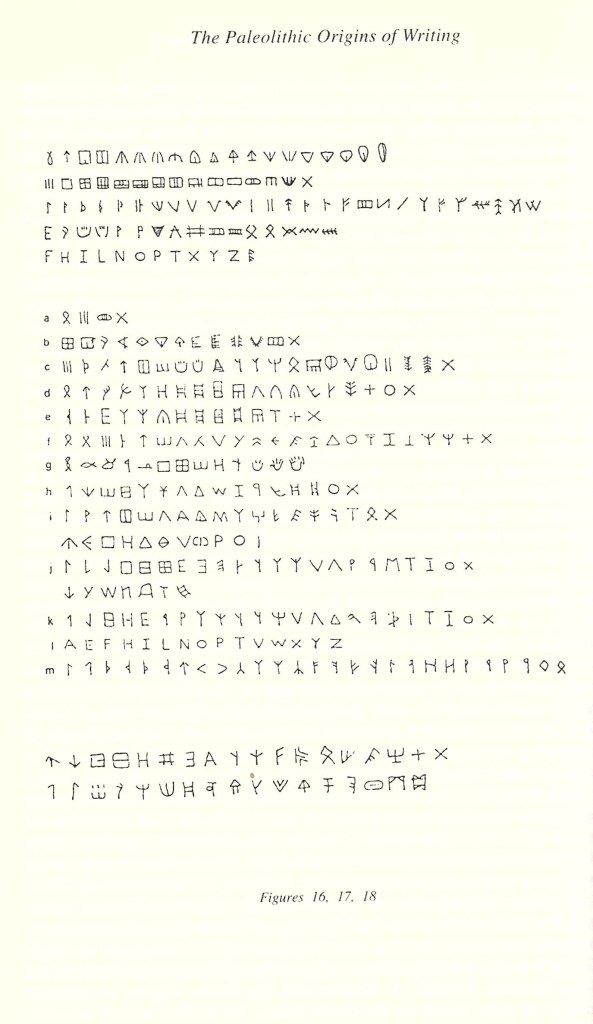
Rudgley’s Figures 16 – 18 (p. 78). Top paragraph: some of the Franco-Cantabrian (Stone Age) signs. Middle paragraph: a – hieroglyphic determinatives; b – Sumerian pictoral writing; c – Indus Valley; d – Linear A; e- Linear B; f – Cypriote; g – Proto-Sinaitic; h- Phoenician; i – Iberian; j – Etruscan; k – Greek (Western Branch); l – Roman; m – Runic. Bottom paragraph: some of the signs found on oracle bones in very ancient China.

But Can You Prove It’s Writing?

Every time some symbols are discovered that are so ancient they strain belief, anyone who doesn’t want to accept them as writing can easily go in to a number of calisthenic moves to cast doubt on this. If the item the signs are found on is in poor condition, they can question whether the marks were even intentional. Perhaps they were accidental scratches, the product of some other activity. If the marks are undeniably made by people, they can be dismissed as doodles. The Vinca signs, when first found, were speculated to have been copied randomly from Mediterranean signs by people who believed these things had mysterious power, but did not understand their meaning. Rudgley also notes that the Old European signs have been interpreted as purely magic symbols, as if a magical intent were to make them non-writing.

In short, any time we are presented with a complex system, there are always a million ways to get out of attributing it to a mind. This is doubly true if we aren’t able to interpret its meaning, but you will even see people do this with messages that they ought to be able to understand. Of course, it can also work the other way, where people see meaning in complex patterns where it wasn’t intended. Often what it comes down to is whether we want there to be a meaning there. Do we, or do we not, want to be in contact with another mind? If for whatever reason we don’t, we can always find a logical way to avoid that contact.

So in the case of apparent writing systems that we haven’t cracked and probably never will, our attitude towards them is going to depend heavily on what we believe about ancient people’s minds. Were they basically like ours, or were they different, animal? We will see more writing systems if we are expecting that they came from people. If we are not expecting to encounter people, then nothing is going to convince us that these are writing systems.

Was Adam a Writer?

My mind was blown, while taking an Old Testament Backgrounds course years ago, when I read an essay that asserted that Adam was able to write and in fact had left a written record for his descendants.

This idea seems completely loony on the face of it … until you realize that the only reason it seems loony is that we are assuming that writing is a recent, unnatural development, the product of tens of millennia of human cultural evolution, and not a characteristic human activity that is, so to speak, wired in.

The essay interpreted the early chapters of Genesis in this way. There will be a short historical record, followed by the phrase “the book of [name],” indicating that the passage immediately preceding was by that author.

PassageRecountsCloses with
Genesis 1:1 – 4:26Creation (in poetry), fall, Cain and Abel, some of Cain’s descendants, SethGen. 5:1 “the book of Adam”
Gen. 5:1b – 6:8Recap of creation of Adam, Seth’s descendants up to Noah and his sons, Nephilim, God’s resolve to wipe out mankind, God’s favor on NoahGen. 6:9a “the book of Noah”
Gen. 6:9b – 11:9Building of the ark, the Flood, emerging from the ark, the Table of Nations, the Tower of BabelGen. 11:10 “the book of Shem”
Gen. 11: 10b – 11:26Genealogy from Shem to Terah and his son AbramGen. 11:27 “the book of Terah”
Gen. 11:27b – 25:18 Terah moves his family to Haran, Terah dies, a whole bunch of stuff happens to Abram, death of Sarah, Isaac finds a wife, Abraham dies, genealogy of the IshmaelitesGen. 25:19 “the book of Abraham’s son Isaac”
Gen. 25:19b – 37:1Jacob’s entire life, death of Isaac, genealogy of EsauGen. 37:2 “the book of Jacob”
In Genesis, the author’s name comes after the notes he left.

I realize this might be a lot to accept. It’s just food for thought. It does explain why it says “the book of _________” (or, in my NIV, “this is the account of __________”), after the bulk of that person’s story.

Get it? Get it?

(By the way … for those wondering about the title of this post … prostitution is referred to as “the world’s oldest profession.” Erma Bombeck, mother and humorist, has published a book hilariously titled Motherhood: The Second Oldest Profession. The title of this post references those two, because the post is about the fact that writing is very, very old. I don’t mean to imply that a writer’s life has any necessary connection to the other two professions, although of course this does invite all kinds of clever remarks.)