How do I love thee, cattails? Let me count the ways.
I didn’t actually love thee, not at first.
I was just writing this story, see, and in it there’s a young Native woman living all by herself near a stream. And she has a guest come to visit, and I know she’s eating game, but I wondered what she could serve him for a vegetable. Had a vague memory that maybe you could eat cattails. Put down “cattail roots” with an asterixis that let me know I needed to look it up later.
And when I did … boy howdy! My young lady had just hit the jackpot!
According to this article, cattails can provide nearly everything that a human being might need.
First of all, yes, you can eat them.
In spring and summer the young shoots can be picked, stripped of the outer leaves and eaten cooked or as a raw vegetable. The green immature flower stalks can be boiled and eaten like corn on the cob. Later in the summer months, pollen from the brown mature flowering stalks provide a nutritious flour supplement for cakes and flat breads. During fall and winter when there is no longer any foliage the roots may be boiled down for a starchy broth rich in carbohydrates. Cattail is very low in Saturated Fat. It is a good source of Iron and Phosphorus, and a great source of Fiber, Vitamin K, B6, Calcium, Magnesium, Potassium and Manganese.
“Cattail,” by Henry Holly in the The Northwest Forager, ibid
Secondly, first aid. “Ash from the burned leaves [is an] antiseptic,” and the roots and sap have also been used in first aid. Now, my character did not need any first aid, at least not at that point in the story.
Thirdly, shelter. The leaves can be woven to make such things as hats, rain cloaks, baskets, mats, and for rain runoff on a roof. (This is similar to how coconut-palm fronds are used in Southeast Asia.) And – get this! – the “seed fluff” can be used for pillows, bedding, insulation inside moccasins, wound dressing, and even … diapers. Wow! My girl’s little shelter just turned into a palace with a water-shedding roof and a comfortable bed made of a cattail mat over cattail fluff. Bonanza!
Of course, having learned all this stuff, I had to try it. As you know,I’m a Luddite, although most of the time just a pretend one.
We have plenty of cattails here in Idaho. Here is some proof, with cattails growing along an irrigation canal and the mountains in the background:
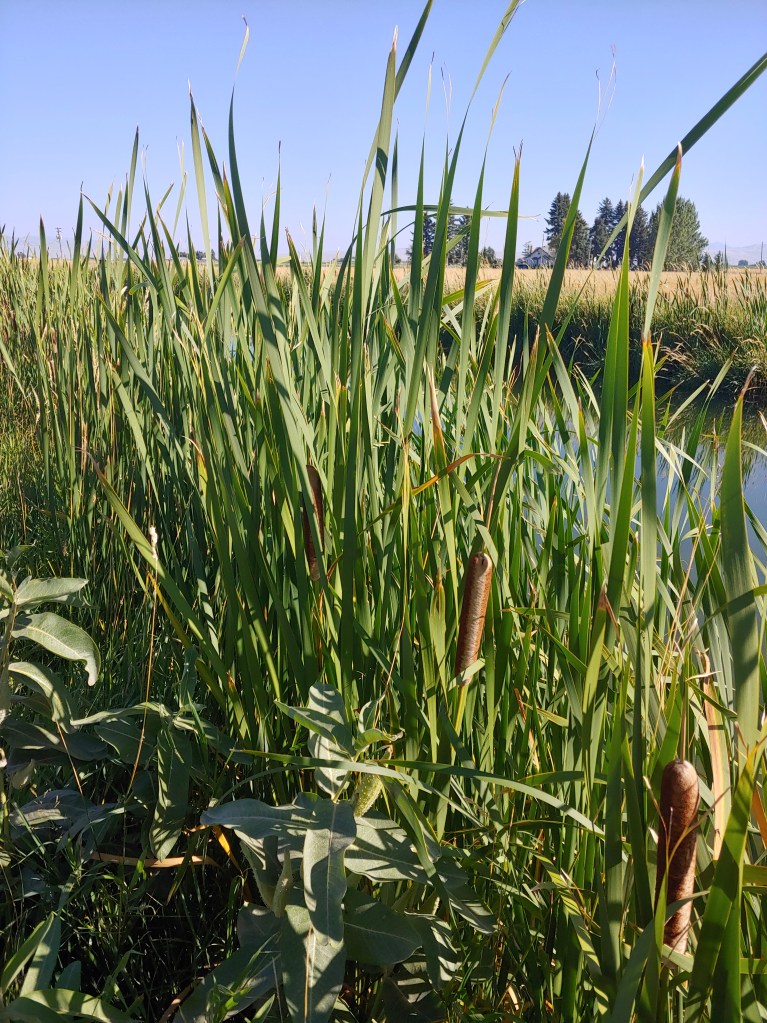
According to this article, the cattail roots can absorb pollutants in the water. Also, digging up the roots, drying and roasting them, and pounding them into flour sounded like a lot of work for someone who’s only a Luddite part-time. Actually, even digging up the shoots sounds like it would involve getting my feet wet. All in all, the simplest project for a beginning cattail forager sounds like it would be using the seed fluff. Even I can find the seed heads. Here they are:
I cut a few off with my garden clippers, and soon had a small basket full.
That ought to be enough for at least one diaper, right?
Then it was time to pull apart the seed heads. This is easy, though messy.
Luckily, the seed fluff didn’t cause any itchy symptoms. (I guess it wouldn’t be so useful if it did.) In the end, those dozen or so seed heads gave me a pile of fluff that looked like this:
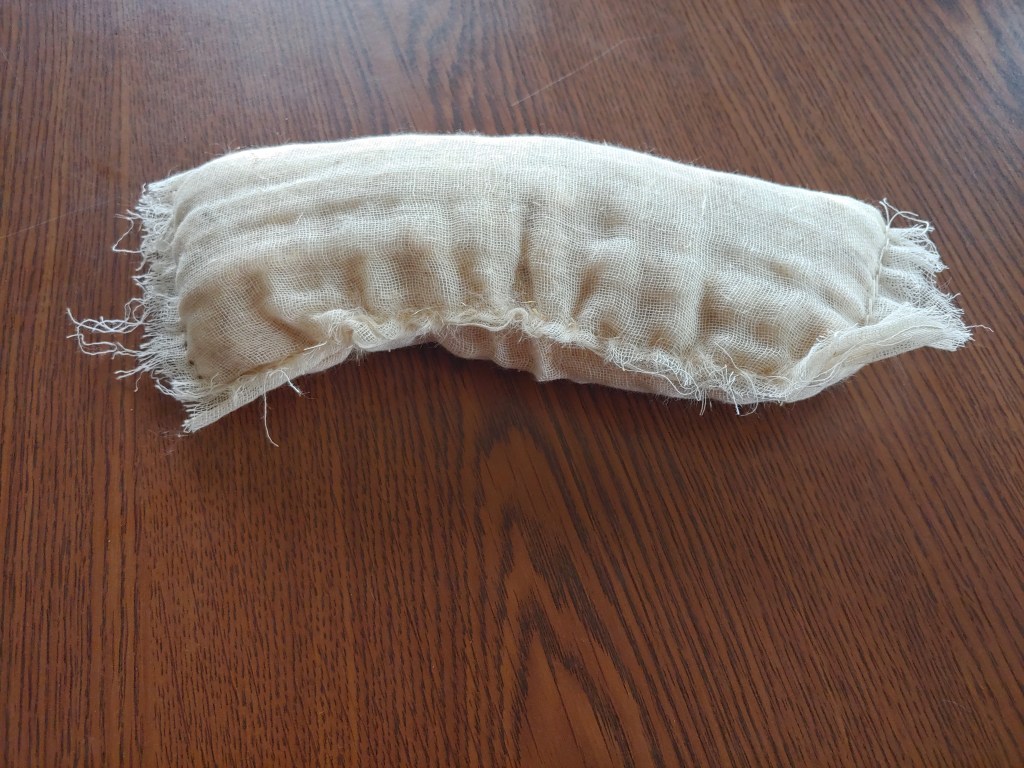
It was very fluffy and I worried that it would compact so much that it wouldn’t really be useful for bedding. But, as it turns out, it does not compact infinitely (just more than polyester stuffing from the craft store). Here’s a sample “diaper” that I made by sewing a little fluff into cheesecloth:
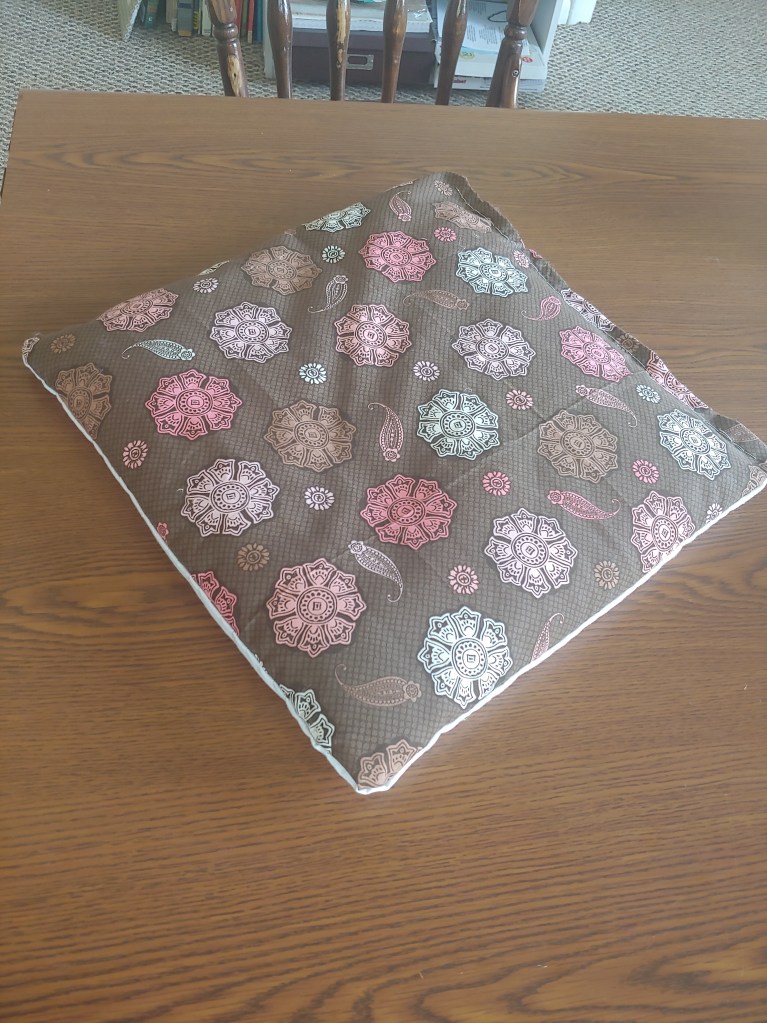
The sewing part only took me about 20 minutes. It would have taken less if I had ironed the cheesecloth first. I still had enough fluff left that I decided to make a small pillow. Out came the scrap cotton, and when the pillow was done, I stuffed it.
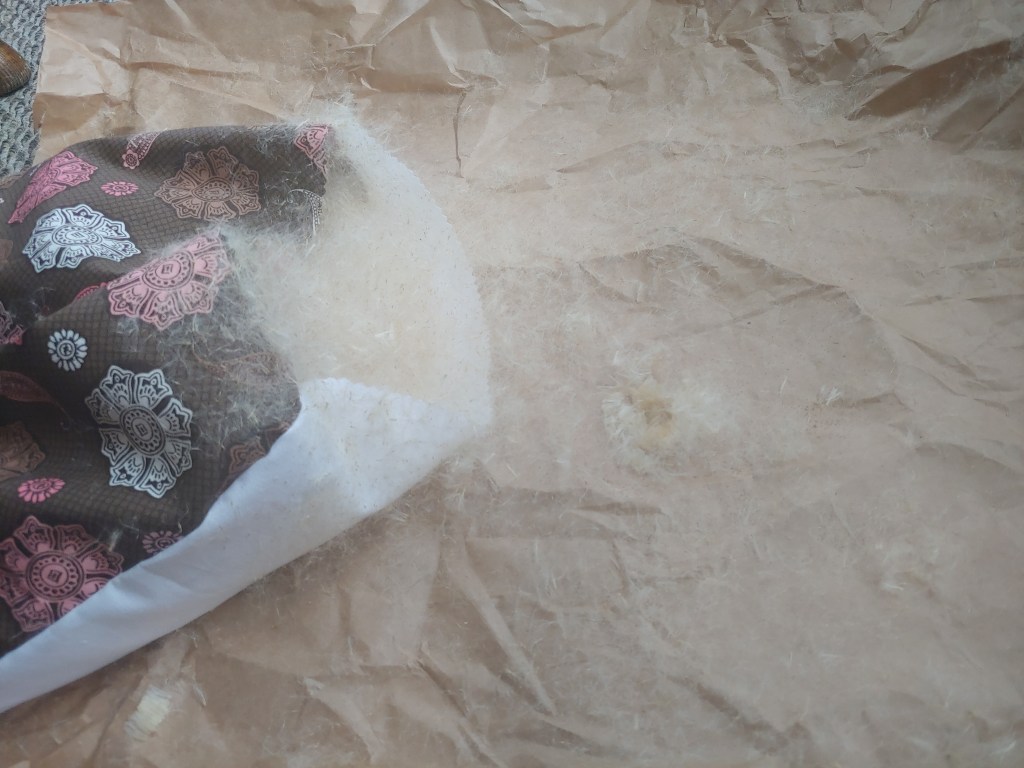
The seed fluff really tends to fly up in the air and then stick to stuff (that’s what it’s designed to do, after all). The pillow, once stuffed and pinned shut, ended up looking like this:
I used a lot of tape to get all the cattail lint off it.
And here is the finished product. Not super high, but a definite pillow. We’ll see how long the fluff lasts or whether it compacts a lot over time. Luckily, there is more where that came from!
This has been “researching books and pretending to be a forager” with Jen.
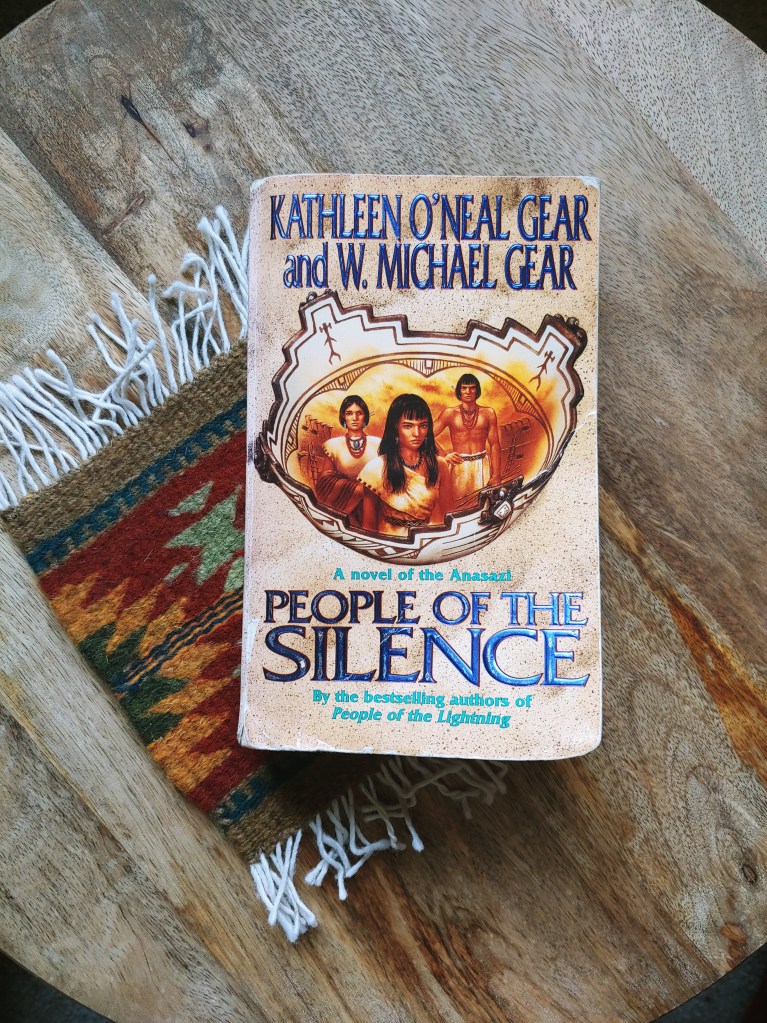
Husband-and-wife team W. Michael Gear and Kathleen O’Neal Gear write thoroughly researched novels about the different people groups living in North America in pre-Columbian times. This one, about the Anasazi or Pueblo Indian ancestors, is actually set in about 1150 A.D. This culture is “prehistoric” only in the sense that we don’t have a formal, written record of everything that went down, although there is plenty of archaeological evidence and oral tradition.
A Ceremonial City
This book comes with three maps. (I love me some maps!) The first shows North America with the general locations of the people groups who will come into play in the novel: “The Tower Builders,” “The Straight Path People,” the Mogollon, and the Hohokam. A second shows the Four Corners region, including Mesa Verde and Chaco Canyon, New Mexico, where most of the action in this book takes place, including the Great South Road built by the Anasazi and the Straight Path People’s names for all the surrounding features. I flipped back to this map many times throughout the course of the book. A third map shows a closeup of Chaco Canyon, or as the characters call it, Straight Path Wash. It shows the locations of the towns there. These can still be seen today, but the authors have given them names that the ancient Pueblo Indians might have used, such as Talon Town, Starburst Town, etc.
Talon Town (the book’s name for what is now called Pueblo Bonito in Chaco Canyon) is the capital of the Straight Path people’s civilization. It is occupied by their priest/king, the Blessed Sun; his wife, the nation’s Matron; a seer, the Sunwatcher; the nation’s War Chief; a number of warriors; and numerous slaves, mostly people captured from neighboring groups such as the Hohokam, who are there to serve these aristocrats. Talon Town produces almost no goods of its own. Food, clothing, blankets, shells, turquoise, etc. are brought in as tribute from surrounding villages over quite a wide area, or are obtained through trade. This is what the archaeological record seems to show us.
Talon Town has two large plazas, each with a kiva in it, so that it can host religious gatherings such as solstice ceremonies and funerals for important people. Here is the authors’ description of what it might have looked like inside one of the Great Kivas as a young apprentice prepares the Blessed Sun’s body for burial:
Thlatsina [=kachina] masks hung over the small wall crypts, glittering with precious stones. Thirty-six in all, they wore brilliantly colored headdresses of blue, yellow, red, and deep black feathers. Tufts of pure white eagle down crowned many masks. Neck ruffs of buffalo, badger, rabbit, and other hides gave the appearance of beards. But Poor Singer’s eyes lingered on the sharp fangs and polished beaks that glinted in the fire’s amber glow.
The circular kiva stretched at least a hundred hands across, supported by four red masonry pillars and encircled by three bench levels. Each bench had its own sacred color, yellow, red, and blue topped by white walls.
Another body rested on the opposite foot drum, covered completely by a beautiful Death Blanket. Poor Singer couldn’t guess who it might be.
People of the Silence, p. 416
Now, the Plot
Here is the review of People of the Silence I posted on Goodreads a month ago.
Some historical novels or speculative novels set in ancient times seem to cut-and-paste modern concerns onto those supposedly ancient characters. The Gears definitely don’t do that. That is one of my top concerns in historical fiction, so props to them.
It did take me a looong time to finish this. The novel starts with a steep climb through a lot of info dumps about Anasazi cosmology, including an extended vision that happens to a young man whom we haven’t gotten to know yet. All during the vision, I kept trying to figure out what the different elements in the vision represented in the cosmological scheme that had just been presented. Later, it turned out that we weren’t supposed to totally understand the vision at the time, and it would be revealed later. Perhaps, if I had read any other books by the Gears, I would have realized this sooner, but as this was my first one, I didn’t at first have that confidence.
The steep climb continues, as we are introduced to a large cast of characters. For about the first half of the novel, it wasn’t clear to me which characters, if any, I was supposed to sympathize with. In the book, the Anasazi have a brutal caste system based on “First People” and “Made People,” and slaves captured in raids on other tribes. Some of the First People later turn out to be sympathetic characters, but you don’t find that out until about halfway through the novel. Also, some characters who are supposed to be sympathetic are seen committing atrocities when we first meet them. Eventually it becomes clear that this is a very brutal society, and the prevalence and unavoidability of violence is part of the point of the novel; but again, the violence does make it hard to figure out who we are meant be to rooting for.
After the steep climb, which lasts about half the novel, we have a long plateau (a mesa top, if you will) where we are getting to know the characters and the intricate machinations taking place in their dying society. Wheels within wheels! The whole novel also includes a lot of beautiful, lyrical descriptions of the Four Corners landscape. The Gears do a great job giving you a sense of what time of day it is, what the weather and background look like, and details of what people are eating and wearing, and how they are wearing their hair. Almost every dialogue tag comes with a one-sentence description of what the character looks like at the moment (e.g. “Her greying black hair had come loose around her beautiful triangular face, which was covered in smears of reddish dust”). Stephen King would hate this, but I don’t mind it. It helps you keep track of the different characters by forming mental images of them, and it gives that much-coveted visual glimpse into what the Anasazi looked like. (For example, they dressed in bright colors, and their royalty decorated themselves with copper bells and macaw feathers.)
Finally, having scaled and then trekked across the mesa, once you are comfortable in the world and familiar with all the power dynamics, the last hundred or so pages take you on a mad, roller-coaster rush down the other side, as secrets are revealed, violence explodes, and desperate, last-minute measures are tried. This book even turned out to be a rather creepy murder mystery, with an unexpected but satisfying reveal of the murderer.
After the novel, there is an extensive bibliography of all the archaeological and anthropological sources the Gears consulted.
If you liked my book The Long Guest, you will probably like People of the Silence, and vice versa.
First of all, the tongue twister. Shaman’s snake stick. Say that five times fast! The stick was a carved wooden snake, found in a lake (stop me before I rhyme again!) or swamp, so … possibly released there on purpose?
Secondly, an adorable picture of Finns digging in the mud. They look so happy. (As anyone should when they get to dig in the mud and find archaeological artifacts.)
Thirdly, this quote: “[S]nakes are loaded with symbolic meaning in both Finno-Ugric and Sámi cosmology, and shamans were believed to be able to transform into snakes.” Add these remote people, living at the far northern edge of the world, to the long long list of the world’s peoples who find spiritual and/or cosmological significance in snakes.
This link even has a book tie-in for me! Yes, it does! The upcoming third book in my trilogy will be called The Great Snake. And yes, ithas snake cosmology. And no, this is not very original, but it is based in research. TGS is not available for pre-order yet, but you can get ready for it by buying and reading The Strange Land if you haven’t already done so. TSL is where the serpent makes its debut, at least in my books.
If you can bear with me, we are going to do one more Mesa Verde post before we start mixing it up again.
As mentioned last week, when I went to Mesa Verde this July, we did not visit the famous Cliff House (which was closed), but instead the lesser-known Wetherill Mesa. Last week I showed you a smaller cliff house, called Step House, that is part of the Wetherill Mesa area. This week, I am going to show you a pit house.
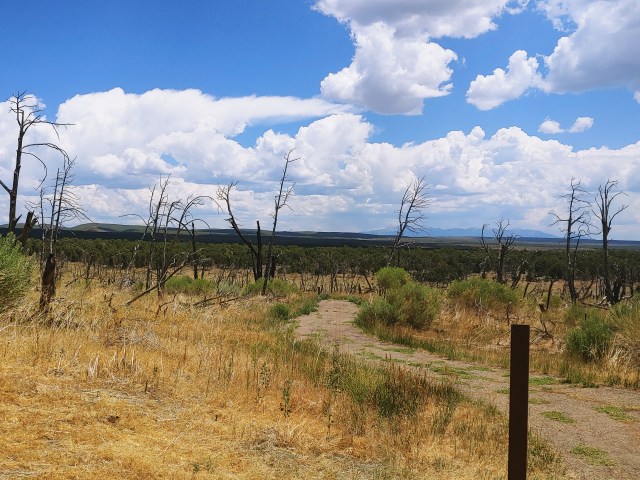
Here’s part of the path to it.
The ruin sites that have been excavated on top of Wetherill Mesa have had sheds built over them that are open on one or two sides. I imagine this protects the excavated ruins, but it’s also great for the tourists. It is so hot out there in the Four Corners desert that, were these sites not shaded, no one would stop for very long to look at them. As it is, you come over the blistering trail, and that shed represents a welcome oasis of shade where you can cool down, take a breath, and then spend some time studying the ruins.
A Pit House
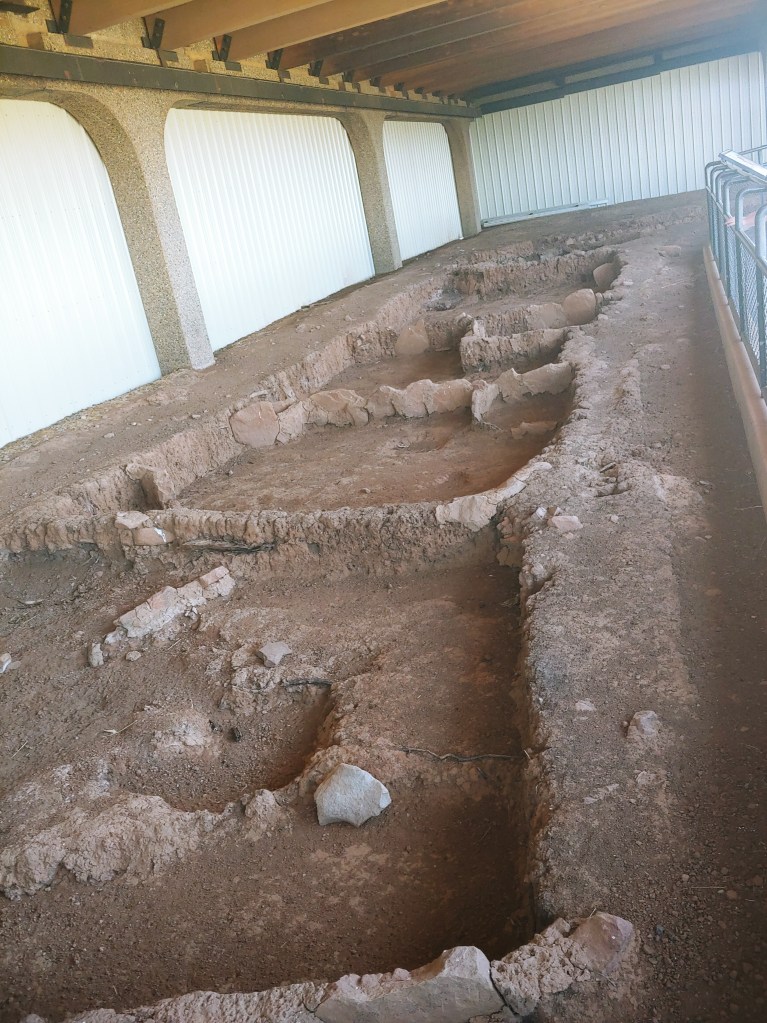
Here we are standing at the entrance to Badger House, viewing it through the first two anterooms, towards the inner room at the back. The inner room has a bench around the edge of it, a narrow little door leading into it, and a big slab of stone sitting right in front of that door, blocking our view in. When in use, this pit house would have had walls extending a little way up from ground level and then a roof. All of this would have been made with wood posts for the basic structure, and then adobe applied in a wattle-and-daub manner. These pit houses had the people living partially but not completely underground. This kind of housing is super practical in a desert, because it insulates the inhabitants from the wild swings of temperature that come not only seasonally, but also between day and night.
Here’s a view of the inner room of Badger House, taken from the side. As you can see, in the foreground there is a little stone closet area (for grain storage?). Opposite it, on the other side, is another stone half-wall (for privacy?). On the left, there is a line of three post-holes for wooden posts that would have helped hold up the roof. (The holes in the bench are also thought to have been put there so that wood beams could be rested in them.) The star of the show is the sunken fire-pit, with the upright slab of stone standing between it and the door that leads from the anteroom.
When I first saw this slab of stone, which seemed to me to be randomly and inconveniently placed, my thought was, “What the heck?” Then my mind immediately went to privacy for people in the inner room, or a Feng-shui type arrangement for blocking bad spirits or energy that might try to enter, or even a physical barrier to make it easier to corral pets and toddlers. But the actual explanation may be even simpler. It’s to protect the fire from drafts. I hadn’t considered this explanation at first, because I expected such a stone to be placed right next to the fire. (A Native friend once told me that if you build a fire right next to a stone, the stone will cause the smoke to draw upward.) But apparently, this is how the Anasazi people dealt with drafts. The informational posters at the site call it a “deflector stone.” If this is where they needed to deflect drafts, that also gives us clue about how the air was flowing through this pit house. The builders were aware of the need for ventilation, as we will see in a moment when we look at a kiva.
The small hole just to the left of the fire pit may be a sipapu. Every kiva has a sipapu, and we know from modern Four-Corners area Indians (the descendants of these builders), that the sipapu symbolizes (or is an iteration of) the hole through which people’s ancestors emerged in their origin legends. In Navajo origin legends, for example, people start out living in a world that in some ways resembles ours, but is four levels down under the earth. Through a series of disasters, they have to abandon each level and flee to the one above it. If I remember correctly, the final level is destroyed by a flood, and then the people finally emerge onto the bare surface of the earth.
So, this is a pit house that shares some characteristics with a kiva. This articleexplains (or at least introduces the topic) of how, before the Anasazi started using adobe brick to build structures aboveground, they apparently lived in pit houses that also functioned as kivas. When they started building aboveground dwellings, they would then build a kiva for every settlement, but in pit house dwellings, the distinction between kiva and living area is not as clear. So, in Badger House (this is my own thinking now), it’s possible that the three rooms we see are anteroom, then the living area in the middle, and then the more elaborate room at the back is the kiva.
A Kiva
Farther along the path on Wetherill Mesa, we see complexes like these, which are called pueblos. Though still partially dug (again, practical) these are not pit houses but little villages or apartment complexes that are laid out in a row and employ adobe brick. In the first photo, you can see multiple layers of brick walls laid down at different times and not quite square with each other. Once you start getting pueblos like these, each comes with a proper kiva.
It was difficult to get a wide enough angle to properly photograph this small kiva, but here are my attempts.
As you can see, there is a bench around the edge just as in the kiva area of the pit house. There is a fire pit with a deflector stone. There is a deep recess on one side (second photo), and there is also a raised platform area in the wall behind the deflector stone. Under this comes the ventilation. You can see the little hole at the bottom of the platform, which is the ventilation shaft. The other end of the ventilation shaft is aboveground, here.
When my kids first saw this, they speculated that it was for pouring water into; but no, it is for air.
The kiva would have been covered with a roof, and of course the interior would have looked much smoother than this, perhaps with plaster, paint, etc. After all, this thing is about 1000 years old.
This poster has some good information about the kiva, although the drawing on the right cracks me up. It shows that the artist didn’t really know how the kiva was decorated, what kinds of clothes the Anasazi wore (so they just gave them almost none), or what they did in the kiva. (Weaving? Wouldn’t that be done in a house? Oh, what do I know …) More detailed, colorful, and elaborate speculation about all these things shows up in the novel People of the Silence, which I will soon review.
A Great Kiva
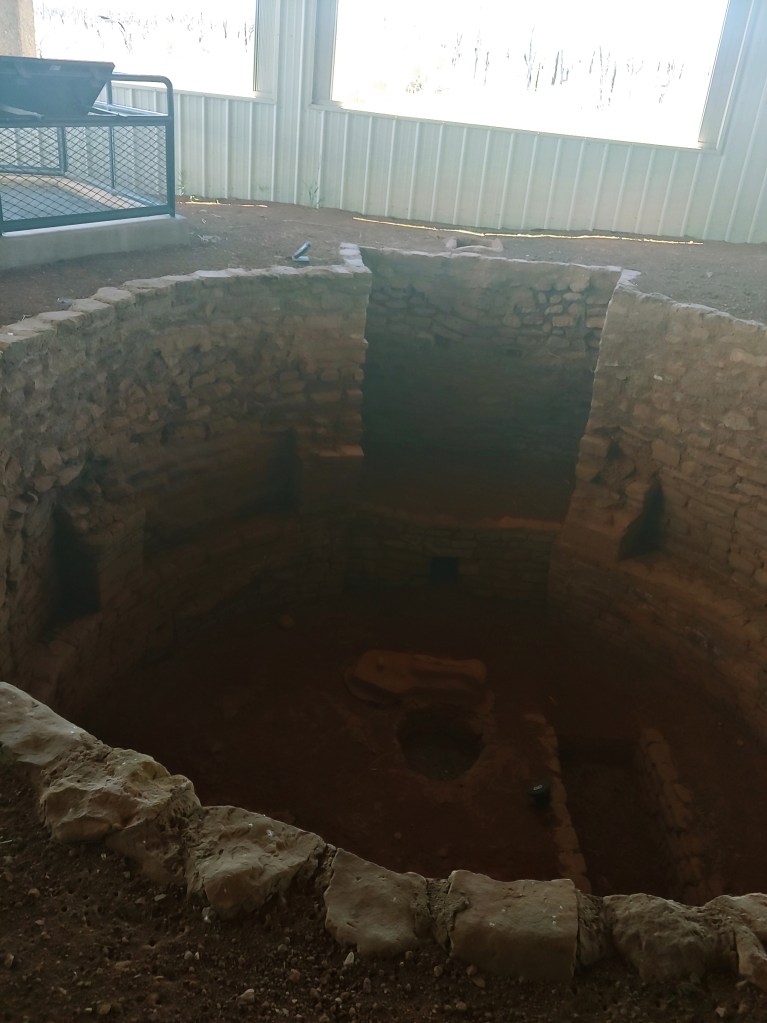
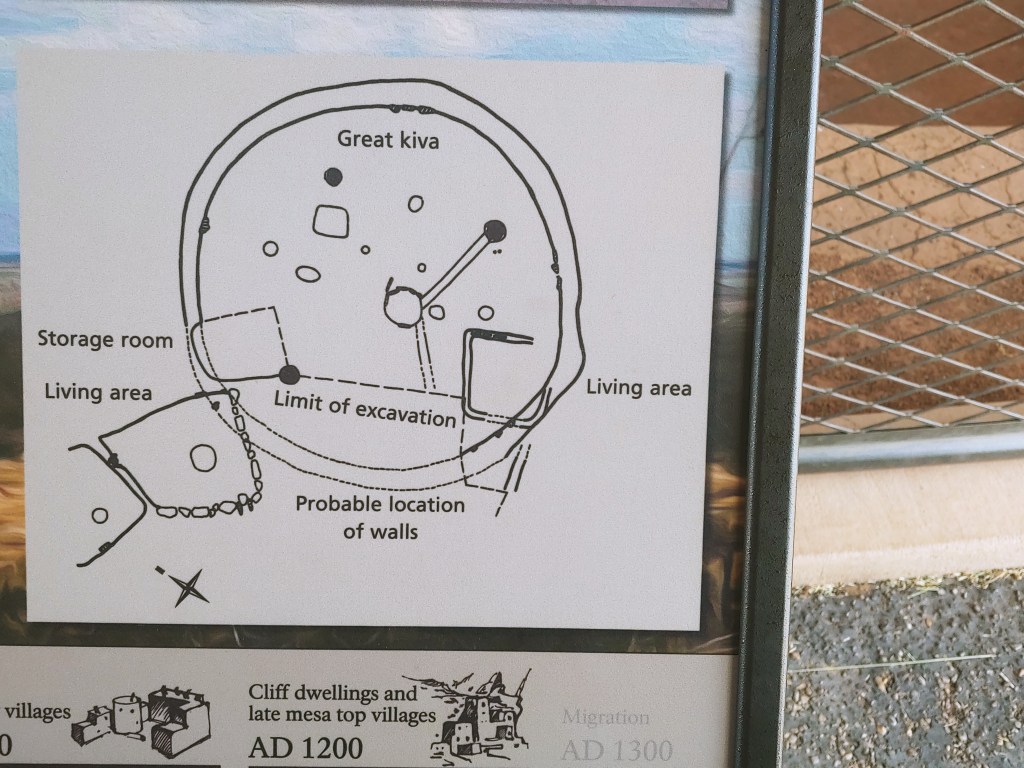
Here, near one of the pueblo sites on Wetherill Mesa, is a partially excavated Great Kiva, a kiva big enough to serve a whole community (or a larger community). I’m a little confused by this excavation, because if I understand the informational poster correctly, its total circumference is much bigger, and it looks to me liked it would overlap with pueblo ruins that it shares the site with. So it’s a little hard to picture how this complex looked in real life.
Here’s a poster that explains the excavation. It almost looks like the Great Kiva was filled in, and then a pueblo built over it.
The ruins at Chaco Canyon, where People of the Silence is set, include not only large towns with many rooms, but multiple Great Kivas, well-preserved, in each town. Unlike this rather confusing site, things were planned out so that the town was built in a semicircular shape, people lived in rooms around the edges, and the kivas were in the plaza in the middle. This was a large culture area that extended over what are now four western States.
Other Cool Stuff
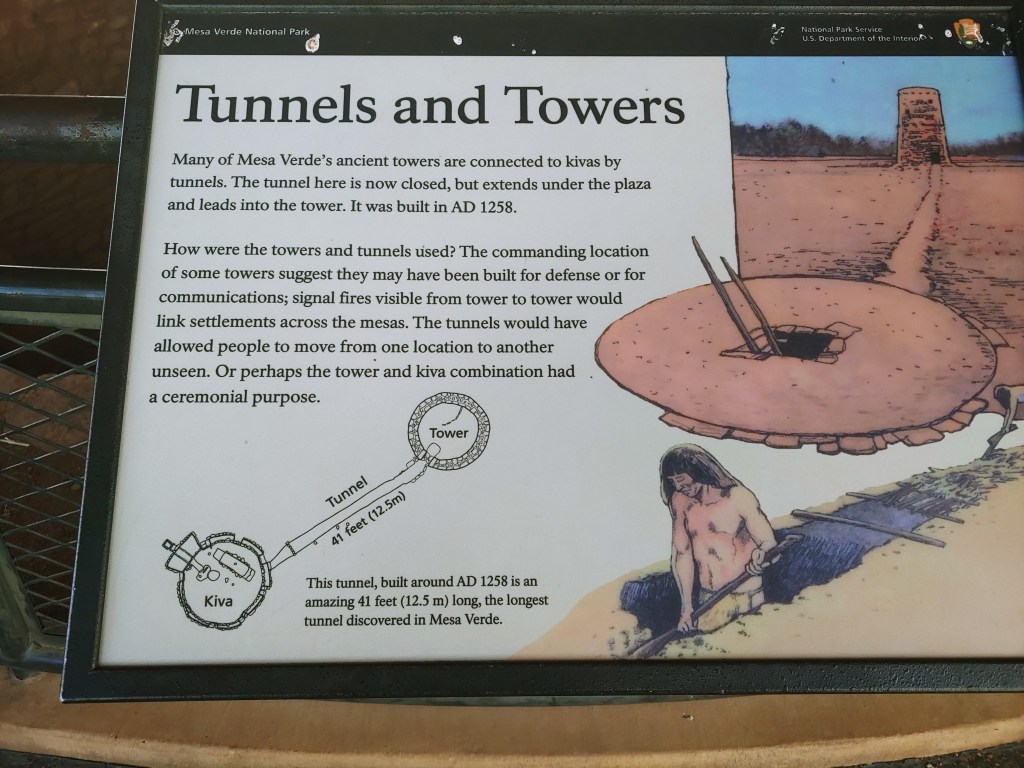
This tunnel-tower arrangement is apparently connected to the smaller kiva that I showed you earlier. What I called a “deep recess” was actually the entrance to the tunnel!
Again, I love how the illustration shows nothing but the kiva, tunnel, and tower in the middle of a desert. No people, no fields, no animals, no other buildings. Maybe they had strict instructions not to go beyond what is proved.
I don’t know whether this tunnel and tower were constructed for war, but in Chaco Canyon, we see archaeological evidence that the people started fortifying their previously accessible town, sealing up the entrances and even windows, until there was only one small door leading in and out. All around this region, we find massacres.
I can’t now find the map I photographed, but as I mentioned last week, these excavated sites are not the only ones on this mesa. There are other known sites that have not been excavated (which we walk by on our way to these convenient shelters), and there are probably many undiscovered sites as well. This is not wild and unsettled country, and it has not been for millennia.
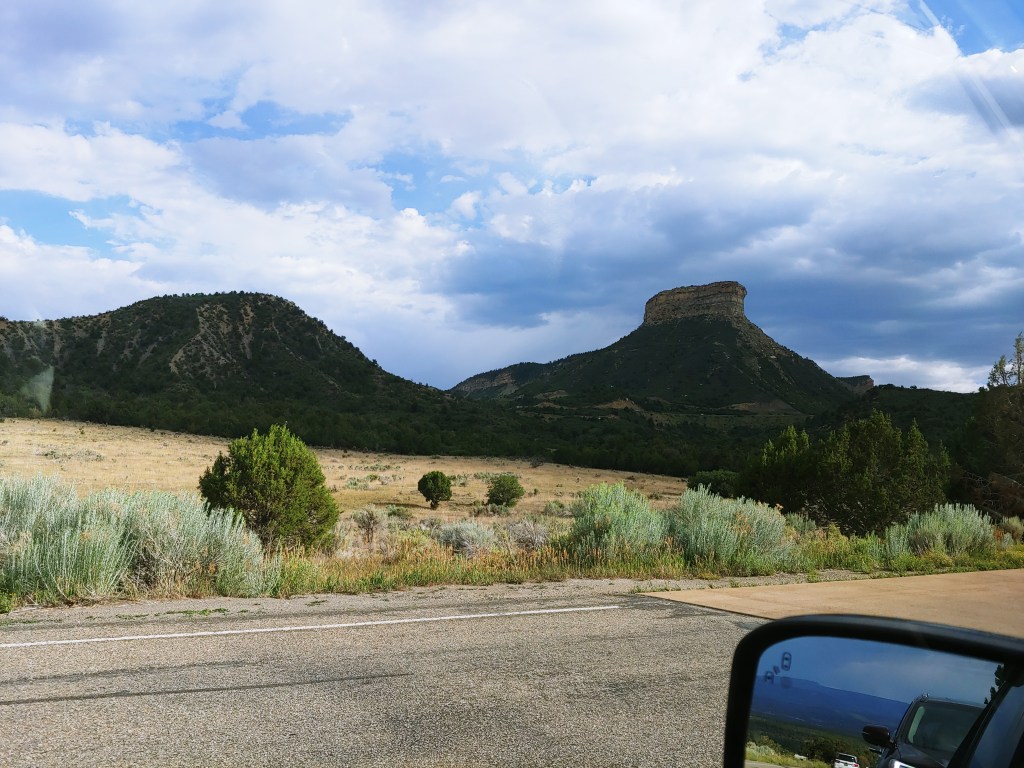
Here is a small part of the Mesa Verde formation, seen from the North, as we head west along Highway 160 towards the town of Cortez. My boys and I “camped” at Mesa Verde last month, but we didn’t really camp camp. We just slept in a tent. We drove into town to get our meals, so I don’t call that camping. There were some much more hard-core campers in the sites near ours, including a family who had come all the way from Maine.
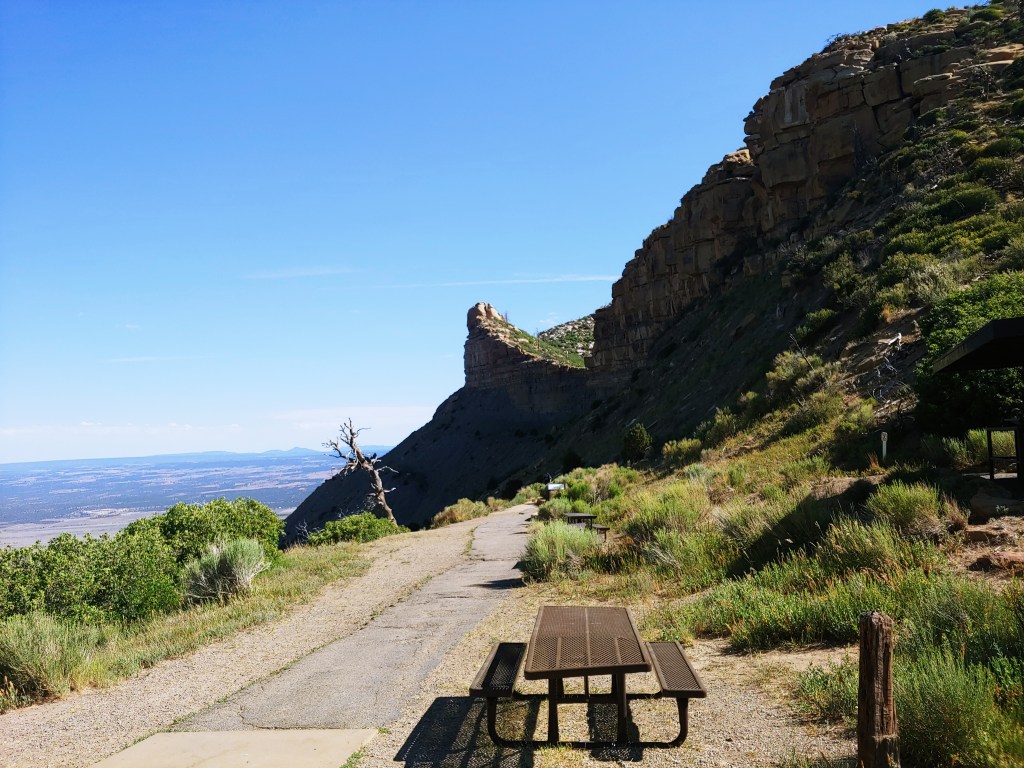
Once you have entered the park and the road has begun to climb, you can stop at an overlook and look out towards the East, over Mancos Valley.
The most famous cliff house in Mesa Verde is called Cliff Palace. It’s the one that you usually see pictures of. To get to it, you take a short but steep hike down into a canyon with a ranger for a guided tour. I’ve done this once in the past, but this year, Cliff Palace Loop road was closed for maintenance. So, we (along with every other visitor) went instead to “the quieter side of Mesa Verde” (per the brochure), namely Wetherill Mesa.
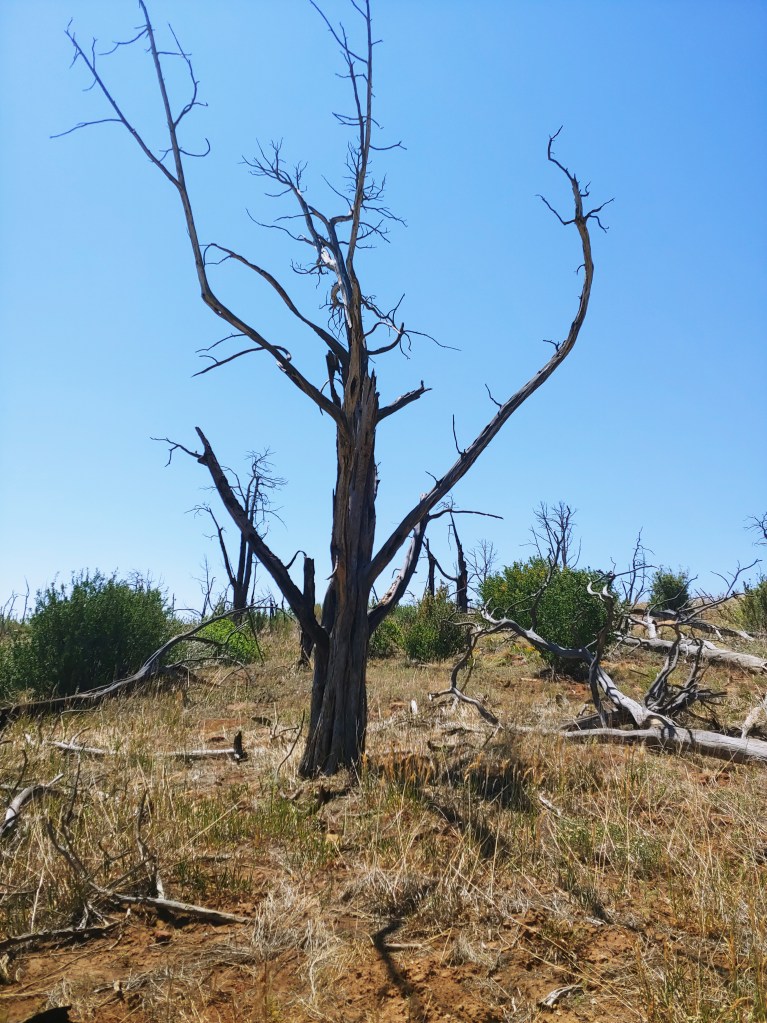
Here’ a view from the top of Wetherill Mesa. As you can see, it’s at a very high elevation, with views in the distance of some of Colorado’s majestic mountains. Notice also the many burned trees. The climate is so dry here that you can see the skeleton forests left by many generations of past forest fires.
Wetherill Mesa is a very large area. There are several different sites of ruins that you can visit, including a couple of “overlooks” from which you can see cliff dwellings but not walk to them. As noted last week, my boys and I did one cliff dwelling hike on Wetherill Mesa, to a site called Step House. Unfortunately I don’t have a picture of the whole complex from a distance, just close-ups of its features. It is not a large ruin, but here are the steps that made it famous:
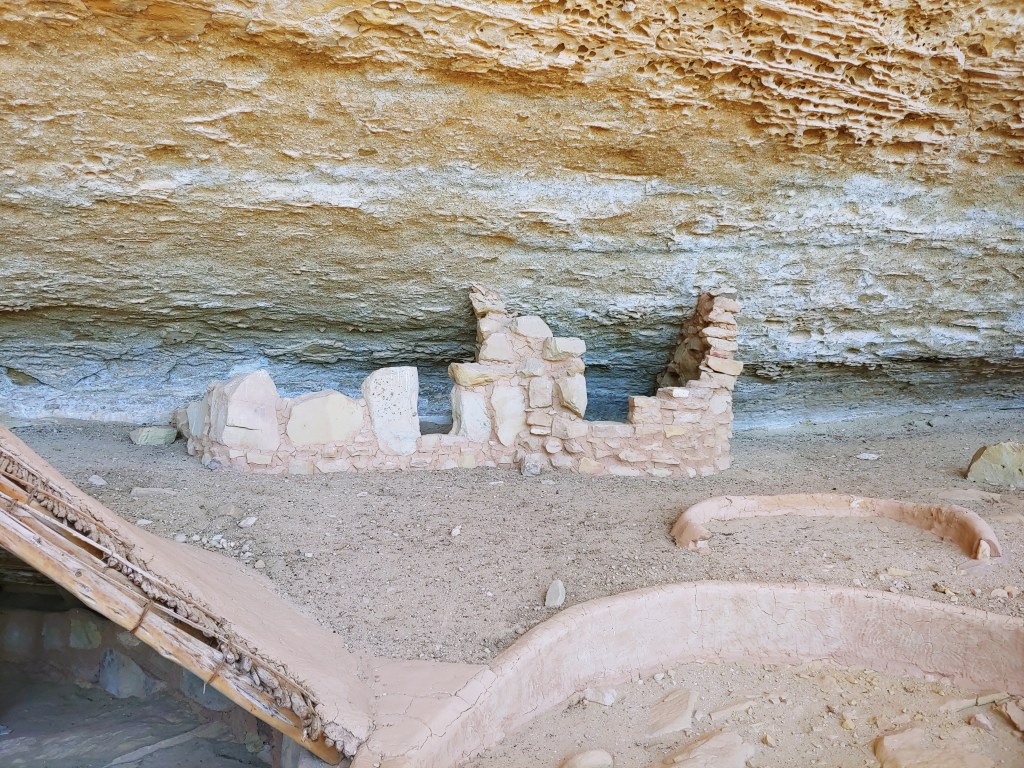
They look like scattered rocks, but if you look closely, you can see that they have been fitted into steps. To the right is the edge of the “proto-kivas” found at Step House. Farther to the right of that, you would find the dwelling itself, and in front of it a proper kiva (though still smaller than those at some other sites).
This proto-kiva has burned wood still as it was left about 800 years ago, much as that blows the mind.
Some small rooms behind the proto-kivas (the one on the lower left has a reconstructed roof on it).
Here’s the proper kiva, which is in front of the dwelling part of pueblo.
And here are the walls of the pueblo, rising up from the edge of the kiva in the foreground to the underside of the overhang.
The other place we visited on Wetherill Mesa was a series of dwelling sites that were not cliff houses, but were built up on top of the mesa. A few of these sites were pueblo-style (square buildings made with stones, and attendant kivas), but one was an earlier pit house (cool!). I’ll show you pictures of this stuff another time, and give you some basic archaeological information as well, but for now I’ll close because this post is getting pretty long already. I do just want to add that, as we were informed by a sign, as you walk from the parking lot to get to the excavated dwellings, you are walking past other sites that have not yet been excavated. Mesa Verde, and in fact the Four Corners region in general, is literally covered with archaeological sites, some known, some unknown! You think of people in, say, Jerusalem as people whose daily lives are literally lived atop layers of history, but the more I learn, the more it seems this is true everywhere you go in the world. They are even finding ancient human settlements in the Amazon rainforest now.
O.K., that’s enough archaeological nerding out for one day. I hope you enjoyed the tour! Have a great weekend!
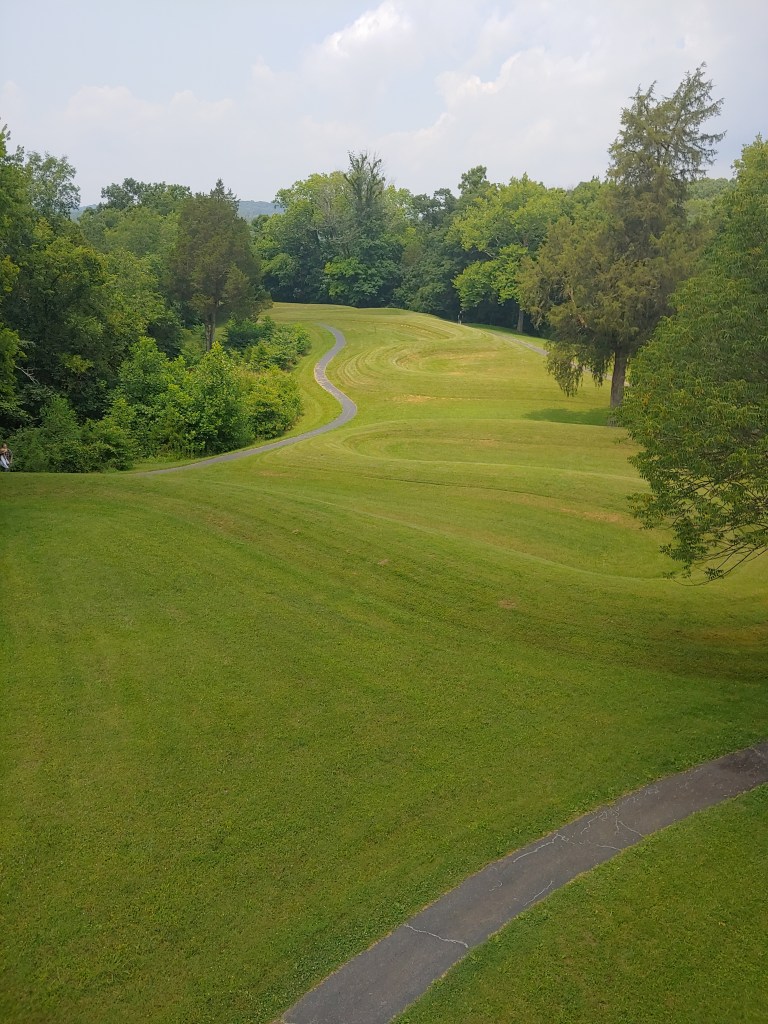
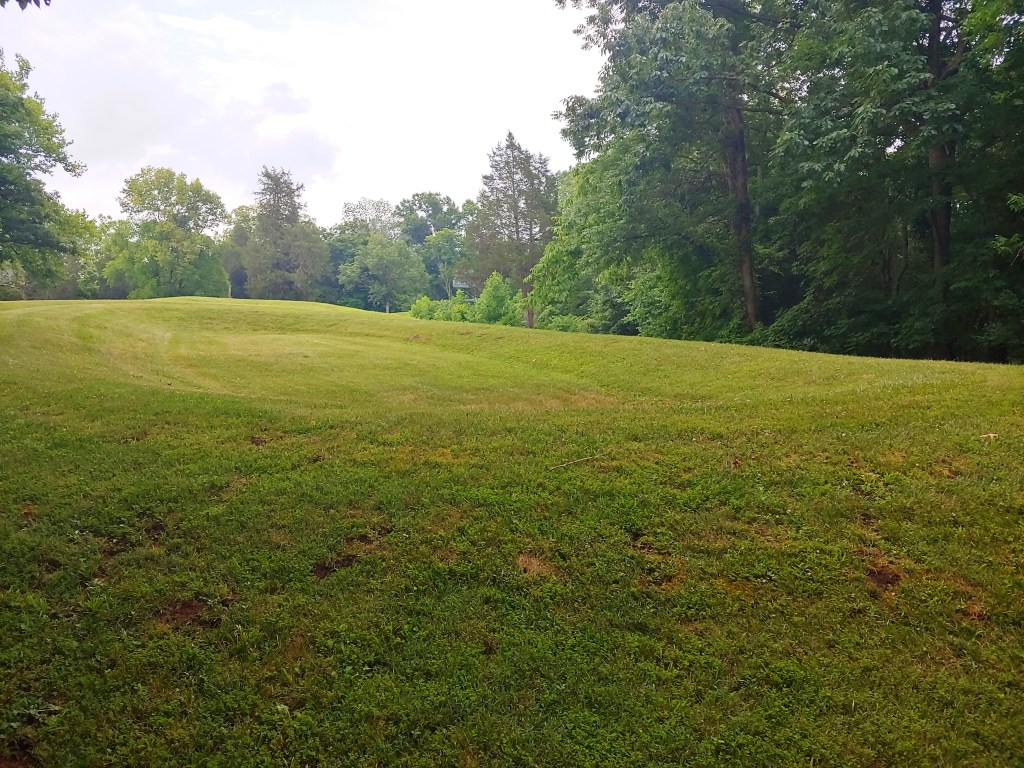
Body of the serpent seen from the viewing tower, looking North
This post originally appeared on this site on July 19, 2019.
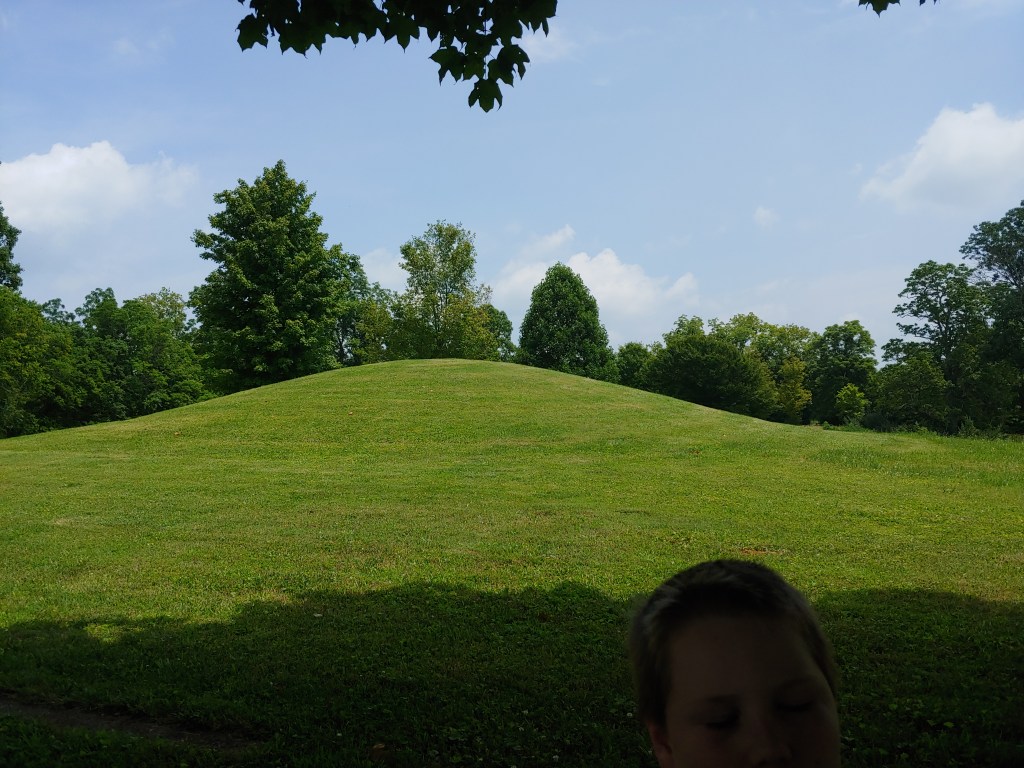
Ohio’s serpent mound was first discovered by white people in about 1846. It was difficult to survey or even to find due to being covered in trees and brush. When the brush was partly cleared, it became obvious that the mound, perched on a cliff at the confluence of a creek (which cliff itself resembles the head of a serpent), was a really remarkable earthwork and was designed to be visible from the nearby valley.
The following article will draw on the book The Serpent Mound by E.O. Randall, published in 1905, which is a compilation of maps, surveys, and speculation about the mound by archaeologists of the time; and on my own visit to the mound. One advantage in using these older sources is that we get a variety of voices, we can learn what the Mound looked like when it was first (re)-discovered, and we get an archaeological perspective that is different from the modern one. For example, one source in Randall’s book says the mound appears to be “not more than 1,000 years old, nor less than 350 years” (p.50). This is not very precise, but I actually prefer it to a super-confident proclamation about the mound’s age based on dating methods and assumptions that might be suspect. In fact, the uncertainty of this early source is echoed by the informational video in the mound’s museum. It features an archaeologist saying that we could get “a million different carbon dates” from the mound because the earth was that used to build it was already old and had been through multiple forest fires, etc. He adds that it’s basically impossible to carbon-date earthworks.
On the Road to Serpent Mound
Walking south along the serpent (viewing tower in background)
To get to Serpent Mound (at least
from where we are), you get in your car and head south over the Ohio highways. You leave behind the urban build-up and
progress into farm country. Eventually, the
landscape becomes less Midwestern and more Appalachian. Hills and hollers take
the place of open farmland. Finally,
after hopping from one rural route to another, you find yourself winding
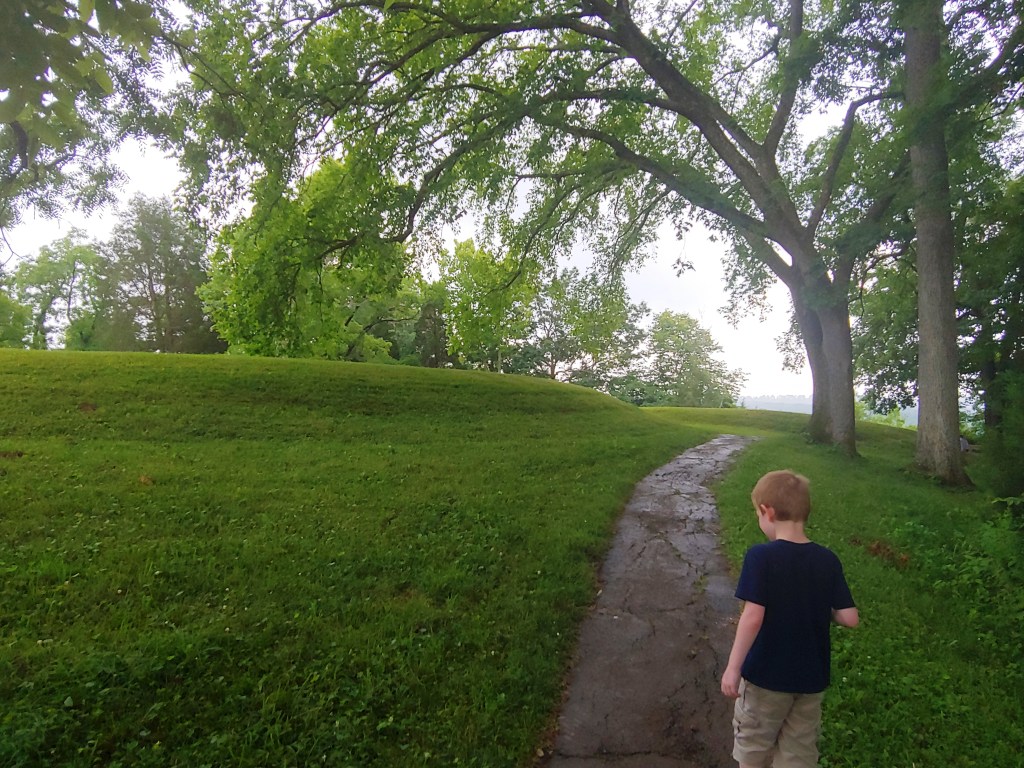
through thickly wooded hills in southern Ohio. You approach the Mound from the South. Though it stands on a bluff overlooking Brush
Creek, the area is so heavily wooded that you can’t catch a glimpse of the
Mound on your way in.
Large burial mound some ways south of the serpent
This land was purchased in
1885. At that time, the land was owned
by a farmer and the Mound was “in a very neglected and deplorable condition”
(Randall 106). To save the Mound from “inevitable
destruction,” a Prof. F.W. Putnam arranged to have it bought by the Trustees of
the Peabody Museum,
Cambridge,
where he was Chief of the Ethnological and Archaeological Department. Putnam later worked to have a law protecting
it passed in Ohio, the first law of its kind
in the United States
(Randall 108). Today the Mound is a
National Historical Landmark. Besides
the Serpent itself, the area includes some additional burial mounds, a picnic
shelter, and a tiny, log-cabin-style museum.
You disembark in the parking lot. The heat, the humidity, the strong sweetish green smells, and the variety of insect life remind you of your Appalachian childhood. They also remind you why you are planning to move out West.
The Serpent Mound Itself
An old drawing of the serpent as it would look if there were no trees around it (Randall p. 8)
Serpent Mound is difficult to
describe in words, so please see the associated maps and photographs. It is 1335 feet long (winding over an area of
about 500 feet), varies from three to six feet high, and slopes downward from
the spiral tail to the jaws and egg which stand on the tip of the
overlook. The head faces West towards
the sunset at Summer Solstice. The body
includes three bends which may sight towards the sunrises at Summer Solstice,
Equinox, and Winter Solstice (short lines of sight and the gentle curves of the
Serpent make it difficult to tell whether these alignments were intended for
astronomical viewing).
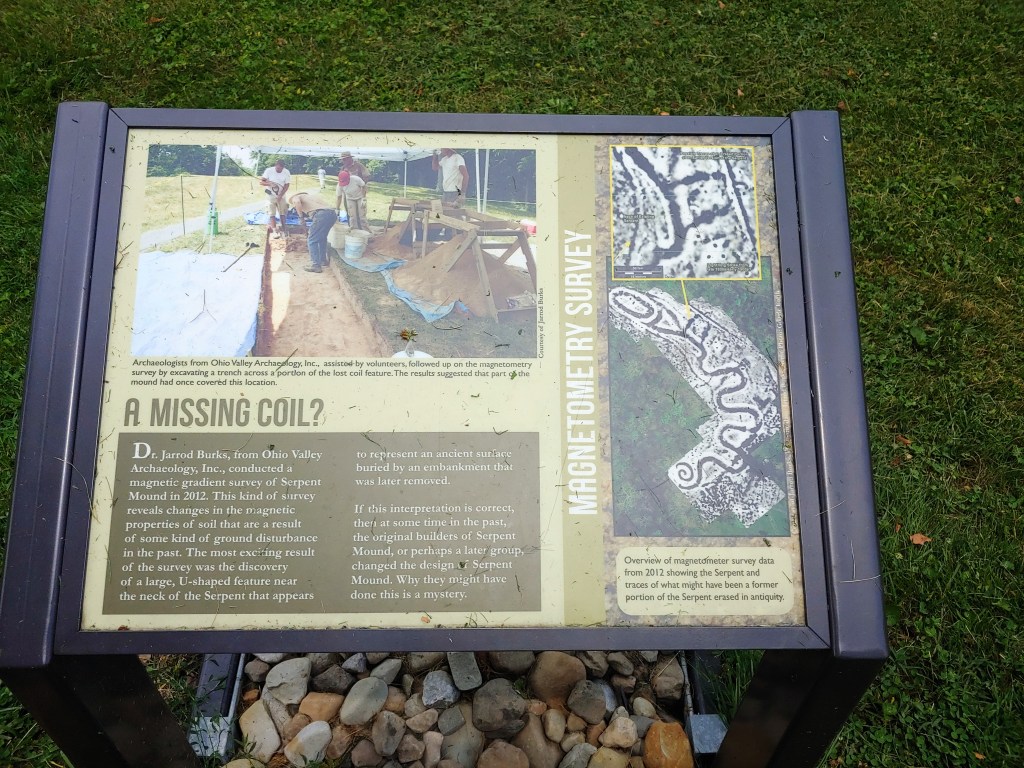
Archaeologists have discovered the serpent once had a fourth coil near the head, which was deliberately dismantled.
It was made apparently by hand on a
base of clay, followed by rocks, more clay, dirt, and then sod. Though it cannot be carbon-dated, there is
evidence that it is not as ancient as some megaliths elsewhere in the world. The bluff it sits on and the creeks that
surround it cannot be older than the retreat of the glaciers. The
burials near it date to the Adena period, which runs 600 B.C. to 100 A.D., though
there is no way to tell if the burials are contemporaneous with the Serpent or
were added later. There has even been
speculation that the Mound could have been built by the Fort Ancient
culture, which flourished around 1000 A.D.
The “egg” which the Serpent
contains in its jaws (or, the Serpent’s eye) used to have in its center a stone
altar which bore traces of fire. (In the
largest burial, too, the corpse was placed on a bed of hot coals and then
covered with clay while the coals were still smoldering.) We
assume, then, that the Serpent was the site of ceremonies, but we have no way
of knowing anything about their nature.
A close up view of the oval “egg.” It once contained an altar.
The Serpent, despite its name, does
not give a spooky or “wrong” feeling. The
scale of it is very human and does not overwhelm. The shapes and proportions of the curves are
pleasing and give a sense of calm and beauty.
The Serpent is, in fact, inviting to walk on. One is tempted to walk along the curves,
climb down into the oval of the egg, step into the middle of the spiral tail. One cannot do this, of course, as it is
strictly forbidden.
The only problem with Serpent aesthetically (if this is a problem) is that it’s impossible to view it all at once. This is mostly because of the bend in the tail. In modern times an understated observation tower has been placed next to the Serpent, right near the tailmost curve. But even from the top of this tower it is impossible to take in the entire Serpent with either eye or cellphone camera. Looking to the left, we get a view of the spiral tail. Looking to the right, we see the undulations stretching off into the distance and falling away with the slope of the hill, but even then we cannot see the entire head because it takes its own slight curve and is blocked by trees.
Approaching the tail spiral. In the background, the cliff drops away into a wooded vista.
I can’t help but think this effect
is intentional. This monument is not
designed to be taken in all at once, looking along a line of sight, and to
overwhelm the viewer. Instead, it’s
apparently designed to draw us on, tantalizingly offering small charming vista
after small charming vista. There is no
one best place to view it. Perhaps the
architects among us can explain what this says about the minds and intentions
of the people who designed it.
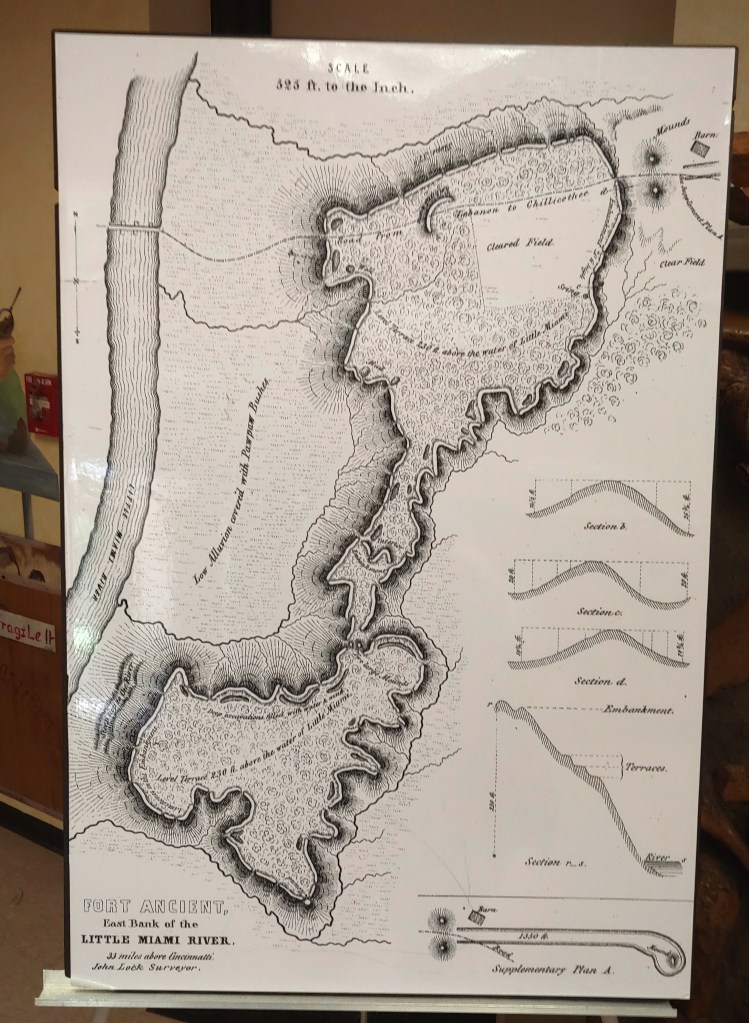
Fort Ancient, another hill-and-plateau complex in southern Ohio, is also sprawling, hard to view, and offers the same “please explore me” effect.
Fort Ancient is a plateau surrounded by man-made hills with gaps in them, overlooking the Little Miami River, Ohio. It has man-made mounds on it as well.
“Effigy Mounds” in North America
The Serpent is definitely not the
only large animal-shaped mound in North America. There are many of them, called by
archaeologists “effigy mounds” (not the usual meaning of the term effigy).
“The effigy mounds appear … in
various parts of … the Mississippi
Valley. They are found in many of the southern
states; many appear in Illinois, but Wisconsin seems to have
been their peculiar field. Hundreds of
them were discovered in that state … In Wisconsin they represent innumerable
animal forms: the moose, buffalo, bear, fox, deer, frog, eagle, hawk, panther,
elephant, and various fishes, birds and even men and women. In a few instances, a snake. In Wisconsin
the effigies were usually situated on high ridges along the rivers or on the
elevated shores of the lake. Very few
effigy mounds have been found in Ohio
– though it is by far the richest field in other forms of mounds.” (Randall
31)
There are, of course, large animal-shaped terraforms in other parts of the world, such as the Uffington and Westbury White Horses in Britain and the Nazca Lines in Peru.
So Ohio’s serpent mound is not unique. It is, however, impressive and well-done, and tends to strike people as mysterious and significant.
The Serpent Mound is a Giant Rorschach Blot
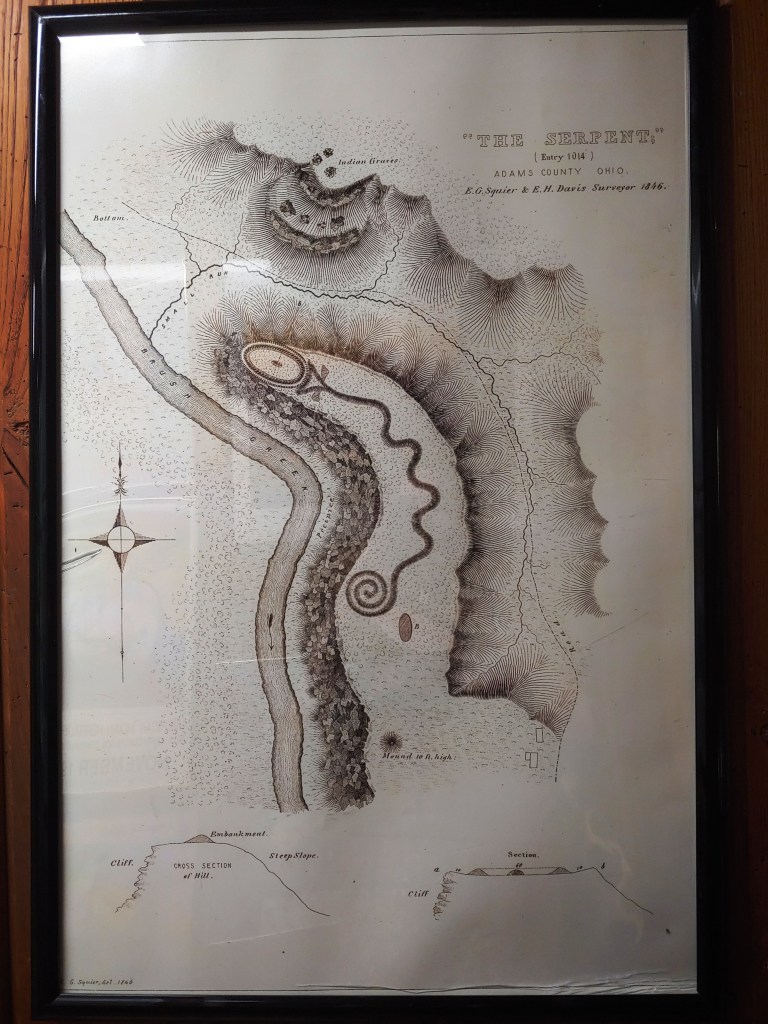
Map of the serpent found in the museum
Whatever else it might be, the Serpent Mound reliably functions as a giant Rorschach blot. It appears significant but ambiguous. Everyone who is not content to admit that we don’t know its purpose tends to bring their own interpretation.
Here are four examples.
One example, roundly mocked in
Randall’s book, is the “amusing and ridiculous” “Garden of Eden fancy” (p. 93).
This theory, put forward by a Baptist minister of the day, is that the
Mound was built by God Himself to commemorate the eating of the forbidden fruit
and to warn mankind against the Serpent.
The oval object, which many people take to be an egg, is on this view the
forbidden fruit itself, which the Serpent is taking in its jaws as if to eat or
offer. Furthermore, the three streams
that come together nearby represent the Father, the Son, and the Holy
Spirit. “Pain and death are shown by the
convolutions of the serpent, just as a living animal would portray pain and
death’s agony … America is, in fact, the land in which Eden was located” (pp
99, 101).
Now, here’s another interpretation,
based on the accepted anthropology of the day: “Students of anthropology,
ethnology and archaeology seem to agree that among the earliest of religious
beliefs is that of animism or nature worship.
Next to this in the rising scale is animal worship and following it is
sun worship. Animism is the religion of
the savage and wilder races, who are generally wanderers. Animal worship is more peculiarly the
religion of the sedentary tribes … Sun worship is the religion of the village
tribes and is peculiar to the stage which borders upon the civilized. ‘Now judging from the circumstances and
signs,’ says Dr. Peet, ‘we should say that the
emblematic mound builders were in a transition state between the conditions of
savagery and barbarism and that they had reached the point where animal
worship is very prevalent’” (pp. 37 – 38).
This theory of the slow development
of man’s religion as they rise out of “savagery” into “barbarism” and finally
into “civilization” is reported with much more respect than the Baptist
pastor’s theory, but it is in fact just as fanciful. It is based on an overly neat-and-tidy and,
frankly, snobby view of the history of religion that was popular for many years
but that actual history does not support.
But, again, Rorschach blot.
Many other observors have linked
the Mound with its oval to the “egg and
serpent” origin mythology that crops up in many places in the world,
including Greece and India.
This theory receives many pages in Randall’s book.
We got rained on while at Serpent Mound. Coincidence? I think not!
To take just one more out of many other examples, on this very blog we learned from a book review that Graham Hancock’s latest book prominently features the Serpent Mound as part of his latest theory that North America is, in fact, the source of the Atlantis legends. He believes that the Mound is meant to represent the constellation Draco and was built during an era when Draco was ascendant. Or something like that.
I, too, have taken the Serpent Mound Rorschach test and here is what I see. I see more evidence that serpent mythology (with or without eggs) and the strong motivation to build large, long-lasting religious monuments are both universal in human culture. I personally think that these things didn’t arise independently in every corner of the world but were carried distributively and that they represent distant memories of certain events in human history, which are hinted at but not fleshed out in the early chapters of Genesis. However, I am not fool enough to think that the existence of Serpent Mound “proves” any of this. It is, as I said, a Rorschach blot.
Other Serpent Mounds Around the World
Otonabee Serpent Mound sits on the
north shore of Rice
Lake, not far from the city of Toronto, Ontario (Randall 114). It
is 189 feet long. The head faces “a few degrees north of east,” with an oval
burial mound in front of the head which could represent an egg (115).
In Scotland, there is the stone
serpent of Loch Nell:
“The mound is situated on a grassy
plain. The tail of the serpent rests
near the shore of Loch Nell, and the mound gradually rises seventeen to twenty
feet in height and is continued for 300 feet, ‘forming a double curve like the
letter S’ … the head lies at the western end [and] forms a circular cairn, on
which [in 1871] there still remained some trace of an altar, which has since
wholly disappeared, thanks to the cattle and herd boys. … The mound has been formed in such a
position that worshippers, standing at the altar, would naturally look eastward,
directly along the whole length of the great reptile, and across the dark lake
to the triple peaks of Ben Chruachan. This position must have been carefully
selected, as from no other point are the three peaks visible. General Forlong … says, ‘Here we have an
earth-formed snake, emerging in the usual manner from dark water, at the base,
as it were, of a triple cone – Scotland’s Mount Hermon, – just as we so
frequently meet snakes and their shrines in the East.’” (Randall pp. 121 – 122)
Speaking of Mount Hermon. This large, lone mountain sits at the northern end of the Golan Heights in Israel. It is so high that it is home to a winter ski resort. In ancient times, this region was called Bashan. It was known for its large and vigorous animals (the “bulls of Bashan”), and for its humanoid giants. Down to Hellenistic times, Bashan was a center for pagan worship (the Greek god Pan had a sacred site there). And guess what else it has? A serpent mound.
“The serpent mound of Bashan has ruins on its head and tail. The ruins are square (altars?) on top of small circular mounds” (Van Dorn 144).
The Ohio serpent’s spiral tail, which evokes a stone circle. Viewing tower in the background.
This serpent mound is less than mile from a stone circle called Gilgal Rephaim (“Wheel of the Giants”). (Stone circles, as sacred sites, are also found throughout the world.) “The Wheel contains some 42,000 tons of partly worked stone, built into a circle 156 meters in diameter and 8 feet high on the outer wall. It is aligned to the summer solstice. The area is littered with burial chambers … If you go due North of the Wheel, [sighting] through the serpentine mound [and proceed] for 28 miles, you will run straight into the summit of Mt. Hermon” (Van Dorn 145).
Serpent, altar, circle, and sacred mountain. I don’t know about you, but the site in Golan sounds a lot scarier to me than Ohio’s Serpent Mound. However, it also makes me wonder whether people in Ohio – and Scotland – were trying to re-create this arrangement.
Sources
Giants:
Sons of the gods by Douglas Van Dorn, Waters of Creation Publishing, Erie, Colorado,
2013.
The
Serpent Mound: Adams County, Ohio:
Mystery of the Mound and History of the Serpent: Various Theories of the Effigy
Mounds and the Mound Builders, by E.O. Randall (L.L., M., Secretary Ohio
State Archeological and Historical
Society; Reporter Ohio Supreme Court), Coachwhip
Publications, Greenville Ohio, 2013.
First published 1905. This book
is a compilation: “The effort has been made not merely to give a description,
indeed several descriptions, of Serpent Mound, but also to set forth a summary
of the literature concerning the worship of the serpent. … It is hoped that
this volume, while it may not solve the problem of the origin and purpose of
the Serpent Mound, will at least add to its interest and give the reader such
information as it is possible to obtain.” (page 5)
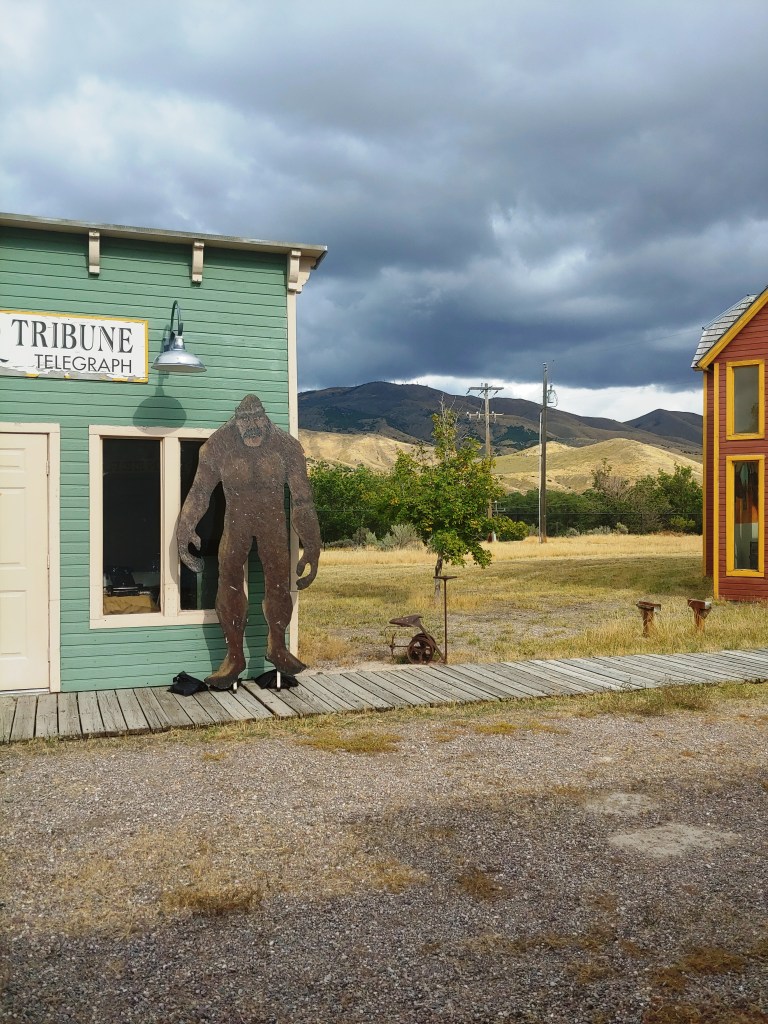
This is a re-post from 2019, but let’s face it: Bigfoot never gets old!
Cryptids Large and Small
Bigfoot is a cryptid, which means “hidden animal,” i.e. an animal whose existence has not been proved. Cryptid is a big category. Some cryptids, when researched, turn out not to exist (for example the Loch Ness Monster, as far as we can tell). Others eventually get moved from the category of cryptid to that of actual animal. (Europeans did not believe in the existence of gorillas until the corpse of one was brought to Europe.) Other cryptids are 100% hoax (the Fiji mermaid, constructed by sewing a preserved monkey torso onto the preserved tail of a large fish). This post will argue that Bigfoot is in the gorilla category. In fact, he is almost exactly like a gorilla: a large, elusive primate native to the deep forests of North America.
My Sources
Obviously I did not research all
this stuff myself. My source is the research done by Jeff Meldrum, Ph.D.,
associate professor of anatomy and anthropology at Idaho State
University. He has
written a lot of stuff, but the source I am using is his book Sasquatch: Legend Meets Science (Tom
Doherty Associates, 2006).
By the way, I had already read the
book, but last month I got to attend a Bigfoot conference in Pocatello
(home of Idaho State University)
and hear Meldrum give a talk. Turns out he’s a very nice guy, with none of that
defensiveness that we might expect from a cryptid researcher. The pictures in
this post are from that event.
It’s hard for a blog post adequately to cover a scientific topic like this one. (And yes it is scientific: detailed analysis of footprint casts, human and primate gaits, fossils, local legends, and more.) I’ll just try to summarize some of Meldrum’s main arguments, but obviously, if you want to delve deeper, you can buy the book yourself.
Many Casts of Prints
Bigfoot is often reported in places
that are conducive to taking casts of footprints, such as a muddy forest floor
at a logging site. Many casts have been taken of footprints in such places.
Some are up to 17 inches long. None of
them match the stiff, narrow, 15-inch wooden fake feet supposedly used by Ray
Wallace and his family to fake all(!) of the Bigfoot tracks in the Northwest.
Some have a step length of 50 – 60 inches and a depth that indicates whatever
made them weighed more than 800 pounds (Sasquatch
chapter 2). There is even an instance of
a very large club foot (page 238), a few knuckle and hand prints (105 – 111),
and a hilarious butt print where the sasquatach apparently sat in the mud, then
leaned on its left forearm to reach for a fruit (111 – 115).
Large, deep tracks with a 65 – 70 inch stride have also been photographed in the sand on the Oregon coast, after a sighting the previous evening (190).
“Patty,” the Lady Bigfoot
The famous October 1967 Patterson
film “was shot during the day, in full sunlight, out in the open on 16mm
film. Independent researchers examined
the location immediately after the encounter, and footprint casts and countless
measurements and photos were taken … and yet this film remains controversial,
written off as an obvious hoax by
many” (134 – 135).
Not surprisingly, the star of the
video, dubbed “Patty,” has had everything about her analyzed, from her gait, to
her saggital crest, to the speed of the film, to the color of the soles of her
feet. The book covers this in more detail over several chapters. The upshot is that experts, when asked to
view the Patterson film, tend to be very impressed at first, then panic, back
off, and start thinking the film is a fake is because if it isn’t, they would
have to “believe” in Bigfoot. One typical protest is that this film is suspect
because it was shot by someone who was specifically looking for evidence of
Bigfoot. It’s hard to imagine, though,
how we could get such a film from anyone else.
It’s also hard to imagine how the
creature on the film could have been faked. Consider:
The Bigfoot in the Patterson film appears to have breasts, and as it walks, you can see its muscles moving underneath the hair. An experienced Hollywood costume designer who has designed many ape costumes opined that it does not look like a man in a suit. He felt that instead of a suit it would have to have been a minimum ten-hour makeup job in which the hair was glued directly to the actor’s skin (158). (The actor would then have to have been delivered to the film site and just as quickly spirited away, without leaving any vehicle tracks.) A computer graphics animator adds that “the boundaries of the human form do not even fit within the form of the creature” (176). Six-foot men have tried to re-create “Patty’s” walk in the same spot, and have found it difficult to match her stride and impossible to make footprints as deep as the ones she made.
Native American Knowledge of Bigfoot
Many Native American tribes, all
over the continent, have Bigfoot legends. This is particularly true in the
Northwest, where you can see stylized carved stone heads, masks, and statues of
the buk’wus (a Kwakiutl word), or his
female counterpart, the dsonoqua.
Their faces look ape-like and distinct from similar carvings of bears. (In
the picture below, some of the souvenirs are adapted versions of this native
art.) The Northwestern tribes seem to have more zoological detail in their
legends about Bigfoot and have testimonies of sightings right down to the
present day. They also, of course, ascribe spiritual qualities to the creature,
as they do to other animals.
The earrings, which do not look like Native art, are based on “Patty” from the Patterson film.
As we move farther East, Bigfoot
becomes a more purely spirit-like figure.
This may imply that the creatures died in out first in the eastern part
of the continent, where they are remembered only as a myth.
On Painted Rock, in central California, there is a
large (2.6 meter high) pictograph of Hairy Man with tears streaming from his
eyes. According to the local creation story, Hairy Man is crying because people
are afraid and run away from him.
At any rate, these legends definitely pre-date Ray Wallace, who supposedly “created” Bigfoot all by himself. The descriptions of Bigfoot’s behavior in the Northwestern native traditional knowledge match well with what has been reported in sightings and surmised from the behavior of other great apes.
Great Ape Behavior
Much of the Bigfoot behavior that is sometimes reported in sightings has parallels in the intimidation behavior of other primates. This includes grimacing, throwing things, banging wood on trees, pushing snags of dead branches at an intruder, hair bristling, emitting a pungent stink when agitated (male mountain gorillas do this), and vocalizing (chapters 9 and 10). There are also behaviors that resemble that of other primates but are not intimidation behaviors, such as making sleeping nests from branches. Of known primates, the one that Bigfoot most seems to resemble is Gigantopithecus (89 ff).
But Isn’t It Really Just a Bear?
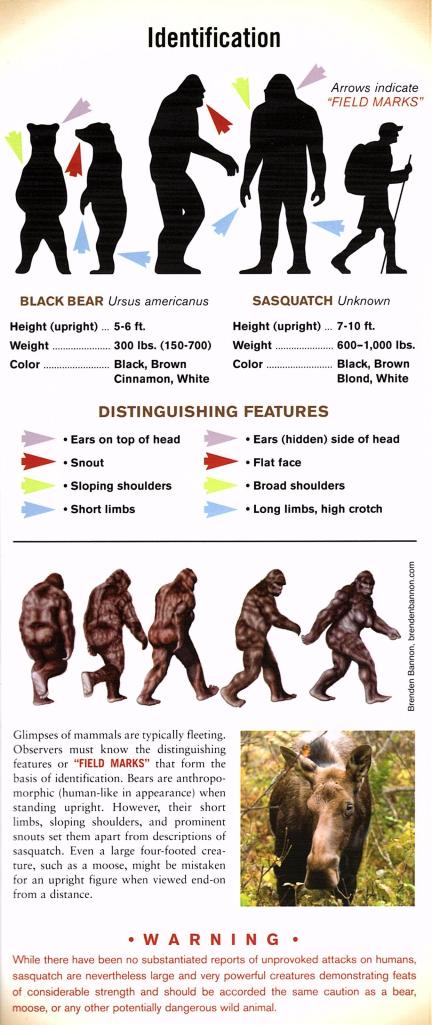
A page from Meldrum’s “Sasquatch field guide,” showing differences between Bigfoot and bears
Bigfoot’s range, as determined by footprints
and reported sightings, overlaps almost perfectly with the range of the
bear. To a believer, this means the two
animals share a similar habitat: temperate forests and rainforests. To a
skeptic, this means that all “Bigfoot” sightings are actually bears.
This was the subject of the lecture
by Jeff Meldrum that I attended. It is
certainly true that photographs of black bears have been put forward as
photographs of Bigfoot, only to be exposed later. Meldrum showed a series of
bear photos which, at first glance, can look surprisingly humanoid, especially
if the animal is skinny and is standing on its hind legs. However, he went on to point out, telling the
difference between a bear and a huge, bipedal ape “isn’t rocket science.” Bears do not have a clavicle, so when
standing, they don’t have protruding shoulders. Their legs are much shorter in
proportion to their body. And, of course, there are the prominent round ears.
Bear tracks don’t resemble Bigfoot
tracks at all, except in cases of multiple, overlapping, unclear bear tracks. A bear’s inside toe is its shortest, their
feet are shorter and very narrow at the back, and they leave claw marks. Their stride is, of course, very different,
although when a bear is walking quickly its footprints can overlap, “giving an
impression of elongated footprints spaced in a two-footed pattern.”
Skeptics have also raised the
question of whether two large animals can fill the same niche. Bigfoot, if it
exists, is probably a fructivore like the other large primates and like Gigantopithecus,
whose jaw and teeth are designed for grinding, not for predation. Bears, while
also ominivores, have a very different shaped set of chompers. So even if the
two animals share a range, they would not be occupying exactly the same
ecological niche.
(Fun near-fact: based on his estimate of how many Sasquatch compared to bears a given region of wilderness can support, Meldrum estimates there could be as many as 175 individual Bigfoot in the state of Idaho.)
Bigfoot Outside the Great Northwest
It turns out that, despite usually having much less wilderness than the Great Northwest, nearly every state in the Union has its own version of the Bigfoot legend. I’ll let you make up your mind about these on a case-by-case basis. In Ohio, until recently my home state, we have “the Grassman.” Here is a Hubpages article about him. If you follow the link and read the comments, you will no doubt see many personal testimonies about Grassman sightings.
Update: another WordPress blogger, The Traveling Maiden, had an experience while camping in the Great Northwest that may have been Bigfoot. Read about it here.
This is actually just a person in a tunnel, but imagine that it’s Polyphemus, blocking your way out of his cave.
How creepy, on a scale of 1 to 10, do you find the idea of giants?
I must confess, I was never particularly bothered by them. They have never struck me as uncanny. Just extra-large people, right? This might be partly because of portrayals like Disney’s, where the giants(s) are not too malevolent and certainly not too bright.
Then there is Fezzik from the Princess Bride. A wonderful, slightly large human being.
and the Jolly Green Giant.
And the Iron Giant, and Gulliver when he was in Lilliput. In all of these cases, the fact of a person being huge creates some interesting logistical problems, but it certainly isn’t horror in the same category as anything unnatural, undead, or even as really depraved human evil.
All that to say, if I had set about, unguided, to pick a force of evil for my story, giants would not be the first place I would have gone.
Nevertheless, giants ended up in my first novel because they are featured in Genesis.
[The] story is told succinctly in Genesis 6:1 – 4, one of the most enigmatic and misinterpreted passages in the Bible. Here is how it reads in the oldest surviving copy … the Greek Septuagint:
“And it came to pass when men began to be numerous upon the earth, and daughters were born to them, that the sons of God having seen the daughters of men that they were beautiful, took to themselves wives of all whom they chose. … Now the giants were upon the earth in those days; and after that when the sons of God were wont to go in to the daughters of men, they bore children to them, those were the giants of old, men of renown.”
[In this book], we will proceed upon the premise that this passage tells of a time in the remote past when heavenly beings entered the abode of humans, and through our women were able to spawn a race of half-breed children, giants that all cultures throughout the world remember as powerful and often wicked, ruthless demigods.
Douglas Van Dorn, Giants: sons of the gods, pp. 2 – 3, emphasis in the original
In other words, that there were once, in actual history, giants that were half human, and that could in some sense be called demigods.
In the rest of the book, Van Dorn looks in detail at this passage and others, and answers arguments about whether this passage, and other passages that seem to assume the same background, should be interpreted to be talking about literal giants or about the people of God versus humans who had rejected God. He also delves into Hebrew terms for other demonic and paranormal creatures, terms that often get rendered as various animals in modern translations.
I am not going to get into the exegetical discussion in this post. But I am going to touch on how Van Dorn’s thesis – that this stuff actually happened, way back in the mists of human history – is backed up by what is usually called mythology.
It is a really strange fact that every culture has stories about giants, gods, and various other supernatural creatures (including chimeras, but that’s another topic). This fact does not strike us as strange – at least, it didn’t me – precisely because these stories are so old and so universal. We just accept it as a given that human “legends” and “myths” deal with threatening creatures that we do not see today. We don’t look for an explanation of why this should be. I am sure that Jung could give you a psychological explanation for the universality of giant stories. Jordan Peterson could give you a Jungian, evolutionary explanation.
And certainly, the idea of a giant as a large and threatening presence is deeply embedded in the human mind. But why? How did this idea get there? Why aren’t our symbols of evil just bears and saber-toothed tigers, if those were the only threats our ancestors were dealing with?
If you go to Bali, you can see sculptures of an ugly, bearded giant being attacked by an eagle as he attempts to carry off a beautiful girl with an elaborate crown and hair that falls to her ankles. This is an illustration of a scene from the Ramayana, an ancient Indian epic that, in the millennia since it entered Indonesia, has there acquired its own flavor. In the Indonesian version, the beautiful girl is Sinta, bride of the prince Rama. The giant (raksasa) captures her through deception, carries her off, and is able to fly to get her back to his castle. The heroic eagle (garuda) attacks him in the air. This is a favorite scene for sculptors and illustrators, who still exist in great numbers in Bali and are insanely talented. The story is also told in shadow-puppet plays and operas.
In Borneo, where I had the privilege to live for a few years, they have their own local legends. One common theme in these is that you should not marry outside your clan, because if you marry a girl from an unknown people, she might turn out not to be human. In one story, a young man marries a foreign girl. When she goes down to the river to bathe, he goes to spy on her and is shocked to see her take off her head.
One area, where we lived for about a year, had a large local mountain with a distinctive jagged top. As the story went, this mountain once reached the clouds. A giant used to climb down it in order to eat the people down below. Then a female hero used a machete to hack off the top of the mountain. The giant, now trapped in the clouds, looks down upon the people but cannot eat them anymore. It drools, and the drops of drool become the bloodsucking leeches that live in the jungle on the slopes of the mountain. Still trying to eat the people, you see.
These few stories from island southeast Asia illustrate features that show up associated with giants again and again: kidnapping/rape, and eating people. (I mean, that is virtually all the giants and demigods do in the Greek myths, for example.) I mention these stories from Bali and Borneo to show just what a wide geographical area the human consensus on giant behavior seems to cover.
Given all this, giants are starting to look more like what we in our house would call a “horror creature.” To review: based on Genesis and numerous myths worldwide, the giants:
are not fully human, but are some sort of human/supernatural hybrid
are nevertheless fully physical and present in actual history
seem to like kidnapping human women
seem to like eating people
are smart enough to practice deception
Ok, now this is starting to get scary. If we accept that these myths are historical memories, then all of a sudden, hearing giant stories is sort of like hearing about atrocities committed by people during the Holocaust, or the Communist takeover of Cambodia, or any other of humanity’s many periods of pure, unrestrained, depraved evil. But it’s scary in another way too. Given the purported origin of these giants, it’s like hearing about a successful genetic experiment, or like finding out that demon possession is real.
I’ve always kind of longed to live in the really ancient ages of the world. But, the more I learn, the more relieved I am to be living in modern times. We slam the door to the giants shut behind us, and lean against it, panting.
How appropriate that just as I am starting to do a bunch of posts about publishing, the orangutan librarian should tag me with this bunch of questions about the writing process! The original idea was created by the Long Voyage- so definitely check out the original here!
This tag asks writers about whether they have ever engaged in a number of (mostly disreputable) behaviors. The headings will say the behavior, and then I’ll comment about whether it applies to me.
“Never Have I Ever …“
. . . started a novel that I did not finish.
I have started, and not finished, a number of novels. You know that whole idea that an artist can create a complete work in his or her head and then it’s irrelevant whether they ever put it on paper or canvas or whatever? That’s baloney. The actual process of enfleshing the work forces you to include so much more detail than you do in your head when you see the end from the beginning.
. . . written a story completely by hand.
(gets dreamy look)
As teenagers, my BFF and I used to write stories together. We would pass a notebook back and forth. Each of us controlled certain characters. We would write notes to each other and argue with each other in the margins.
My parts of those particular stories were the worst tripe ever written. We all have to write our awful tripe on the way to becoming writers.
. . . changed tenses midway through a story.
What?
. . . not researched anything before starting a story.
It’s never possible to do enough research.
But the experts don’t agree.
Also, if you research too long, you can end up talking yourself out of the premise for your story, at which point you’ve ripped out its heart.
So far, my stories have been inspired by cool theories (“research”) about the ancient world. So, I take the premise from the research. (See the ‘ancient world’ tag on my blog for all the stuff that interests me.) I have, so far, avoided setting my stories in really well-documented periods of ancient history (such as Rome) because of the sheer amount of research that would be required so as not to make glaring errors about the details of daily life.
Anyway, see the Bibliography page of this blog for a constantly slightly outdated, constantly growing tally of my sources.
. . . changed my protagonist’s name halfway through a draft.
I like stories that feature someone assimilating to a foreign culture. A total or partial name change is often part of this. So my protagonist Nimri starts out being called Nimri, which is basically Sumerian, but as they get to know him, the people around him eventually start calling him Nirri and that’s how he finishes the story. This is kind of an inconvenient feature, actually, because it makes it difficult to refer to him in summaries.
As for changing a name completely, just for the heck of it, I haven’t done so yet. But Find & Replace will make it easy to do if someone ever comes to me and says, “This name means [dirty word] in [major world language].”
. . . written a story in a month or less.
Short stories, yes.
. . . fallen asleep while writing.
What?
. . . corrected someone’s grammar irl / online.
Scene: Husband and I have been married less than a year, visiting a friend of his.
Friend: I need to go get some groceries. [Names several cleaning supplies, none of which are edible]
Me: Those things are not normally included in the core definition of ‘groceries.’
Friend: Well, excuuuuse me!
Me: (laughing) You are talking to a linguist.
Friend: That’s not the word that I thought of.
. . . yelled in all caps at myself in the middle of a novel.
No.
. . . used “I’m writing” as an excuse.
More like finding other tasks as an excuse not to write.
. . . killed a character who was based on someone I know in real life.
Mmm sooo …. I used to create characters based on my crushes and then kill them off. Yes, I was a sick puppy. Putting the best possible construction on it, I had figured out that killing off a character was the most poignant thing you can do in a story and I was overusing that tool sort of like a kid constantly dropping a new vocabulary word.
. . . used pop culture references in a story.
I avoid these because I am certain to use them clumsily, plus they will soon become dated. It’s part of the reason that my novels are set in the distant past, and that I may never try a “contemporary” novel.
. . . written between the hours of 1am and 6am.
Only at university, when finishing a paper due the next day. (Fun fact: if I stay up all night, I throw up!)
. . . drank an entire pot of coffee while writing.
While writing papers in college, yes, remembering that my “pot” only made two or three cups at a time. Also, vending machine brownies. Good times!
. . . written down dreams to use in potential novels.
Only once, age eleven.
. . . published an unedited story on the internet / Wattpad / blog.
No, but I have turned in a crummy first draft of a devotional essay to a church magazine. I believe the editor used his discretion and didn’t run it.
. . . procrastinated homework because I wanted to write.
Well, this gets into the whole topic of my work habits, which I’d rather not discuss …
. . . typed so long that my wrists hurt.
Not that I recall. I tend to take pauses for thinking.
. . . spilled a drink on my laptop while writing.
No, but that’s probably just dumb luck. I don’t take care of my equipment nearly as well as I should.
. . . forgotten to save my work / draft.
No, and I have even been known to send copies of Word documents to relatives so that copies exist out there in case my house burns down.
. . . finished a novel.
Two and counting.
. . . laughed like an evil villain while writing a scene.
… Um … I don’t think so? Not aware of the sounds I make while writing. Possibly grunts.
. . . cried while writing a scene.
Even in real life I am more likely to cry when angry, frustrated, or humiliated, rather than when sad. I’m not sure what that says about me. Nothing good, probably.
But I have certainly given myself the sads with my writing.