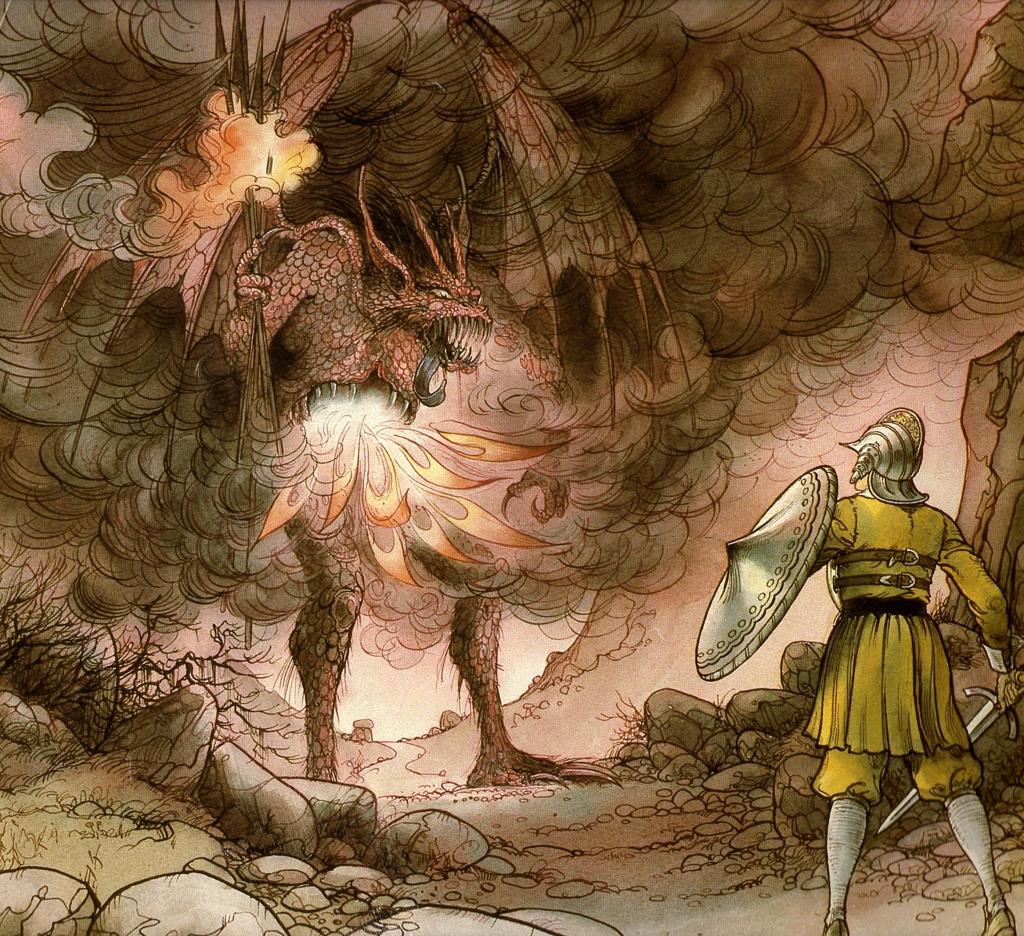
Apollyon does NOT like people. He is the ultimate misanthrope.
art by Alan Parry in Dangerous Journey
Apollyon: Where have you come from?
Christian: From the City of Destruction.
Apollyon: By this I perceive that you are one of my subjects. For I am the Prince of that city. Why then are you running away from your prince?
Christian: I was indeed born in your dominions. But I have given my allegiance to another, who is the King of Princes. How can I now, with fairness, go back on this? … Besides, to tell you the truth, I like his service better than yours.
Apollyon: You have already been unfaithful to him. You fell in the Slough of Despond. You slept, and let fall your parchment. And in all you say and do, you are inwardly desirous of vain-glory.
Christian: Too well I know it. Yet the King whom I serve is merciful and ready to forgive.
Apollyon: I am the enemy of this King. I hate his person, his laws and his people. Give him the slip, and work for me, and your wages shall be doubled.
Christian: I know your wages, you destroying Apollyon. They are not such as a man can live on.
Adapted from Dangerous Journey, US. ed., Eerdmans, 2012
n.b. “Perfect,” as I will use it below, doesn’t always mean perfect but rather perfect in its context or else merely “really terrific.” Especially when used of actual, historical people. As we all know, perfection isn’t perfect, right?
The Perfect Genre
“Pick a book that perfectly represents its genre.”
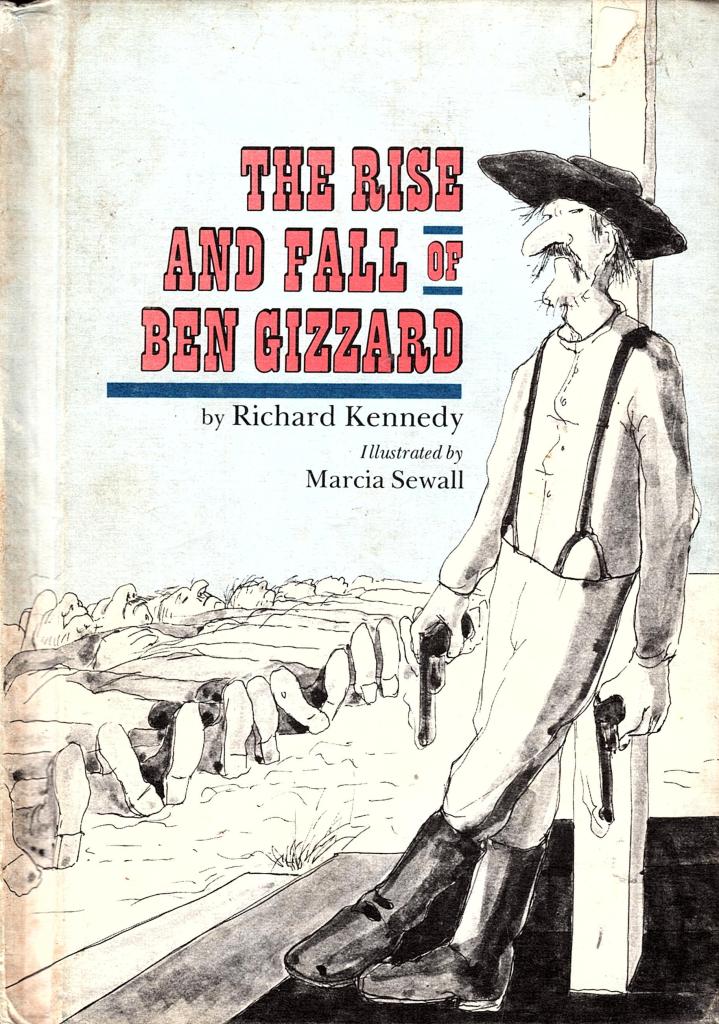
The Rise and Fall of Ben Gizzard is the perfect Western.
“Ben Gizzard would die on the day he saw a white mountain upside down and a black bird talked to him, but not before. An old Indian he cheated out of some furs told him this.
“This was good news to a man as mean and crafty as Ben Gizzard. He settled in treeless, birdless Depression Gulch and cheated, robbed, and killed his way to riches. How his life seemed charmed in that place where there were neither mountains nor birds!
“But one day a young artist arrived in town with a large black bird sitting on his shoulder. Oh, Ben Gizzard!
“Our slithering villain comes to his end when he least expects it, and the world is a better place without him, and a better place for the telling of his story, which is both funny and awesome.”
The Perfect Setting
“Pick a book that takes place in a perfect place.”
Gosh, there are so many books that I love for their setting. There is Pearl Buck’s Pavilion of Women (an aristocratic household in pre-Mao China), Susan Cooper’s The Grey King (Wales, with magic), and Alexander McCall Smith’s No. 1 Ladies’ Detective Agency series (modern-day Botswana).
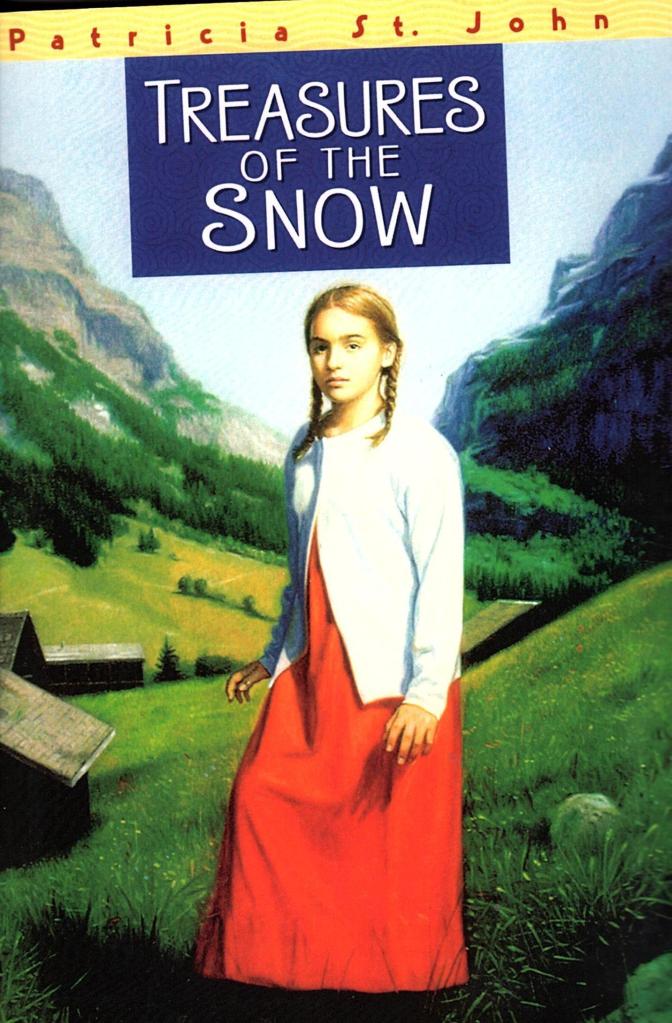
But my top pick would have to be Treasures of the Snow by Patricia St. John. It takes place in a beautiful, sensuously described version of Switzerland (example: the children picking fresh strawberries and eating them with cream for lunch) and, of course, the fact that everything is so mountainous is crucial to the plot.
The Perfect Main Character
“Pick the perfect main character.”
I’m gonna have to go with Bilbo Baggins here. His combination of humility and spunk cannot be beat.
The Perfect Best Friend
“Loyal and supportive, pick a character that you think is the best friend ever.”
Sam Gamgee would be an obvious choice, but there are class issues there, so instead, let me name Mr. Tumnus from The Lion, the Witch, and the Wardrobe.
Reason: Tumnus just met Lucy an hour or two ago and she has not done anything special for him … and yet he’s ready to put his own life on the line to protect her from the Witch’s secret police. “Greater love has no one than this, that he lay down his life for his friend.”
The Perfect Love Interest
“Pick a character you think would be an amazing romantic partner.”
Playing “mad dog” with his children.
Charles Ingalls from the Little House series.
On the down side, he will drag you and your children across the American frontier, where you will almost lose your lives in every. single. chapter.
But on the plus side! The man can build a livable house, single-handed, in a few weeks. He can dig a well, provide food, and make friends with the Indians. He’s never met a stranger. He is gentle and kind with Caroline and his daughters, and he is unflaggingly cheerful, even when starving. (Read The Long Winter and watch him effusively praise the dehydrated cod gravy that Caroline breaks out to put some variety in the family’s totally inadequate diet.) And he can fiddle, sing, and dance! What more could you ask for?
This guy is a ball of energy and good cheer. There would be no better person to have by your side in the hairy situations that he will surely get you into.
The Perfect Villain
“Pick a character with the most sinister mind.”
“Amazing Amy” from Gone Girl. I don’t think it will be too much of a spoiler, by now, to tell you that she fakes her own death and frames her husband for it, then fantasizes about “him getting butt-raped in jail.” It’s never clear what Nick did to deserve such a fate, other than fail to think she is sufficiently amazing. And that trick she pulls at the end of the book … well …!
Since I was a little hard on the Dutch on Friday, let me rehabilitate them a bit. My “perfect bookish family” is a Dutch family, and they actually lived: the ten Boom family of Haarlem, circa 1935.
Corrie ten Boom’s book The Hiding Place describes how the family took in Jews during the occupation until they were turned in and went to concentration camps themselves. Even though the book is about the Holocaust, it is heartwarming and includes many laugh-out-loud moments. The heartwarming part is Corrie’s description of the family’s life in their tiny, ramshackle house/watch shop. The laughing out loud comes mostly from the personality of her father, Casper ten Boom, a true character and an amazing man of God whom I look forward to meeting some day. Corrie’s mom was also amazing, and I think it was her warm personality (and Casper’s) that offset the natural sternness of the Dutch of that time, making the ten Booms … the perfect bookish family.
The Perfect Animal or Pet
“Pick a pet or fantastic animal that you need to see on a book.”
There are a few books with a chicken protagonist. The Book of the Dun Cow, by Walter Wangerin, Jr., is one. There is also a Russian fairy tale where a rooster saves two poor children:
“I, the cock, have a crimson comb / And the wicked czar has nothing like it! / He took away their fortune / from two poor little orphans / And he dines in style / while they go hungry!”
Not only would I add this without thinking, I actually wouldn’t think of writing a novel where it did not happen. To me, spiritual transformation is a critical part of a novel.
(Not that I don’t enjoy books where this trope doesn’t take place. Mystery series, particularly, do well if the detective MCs are fairly static.)
There are a few novels where the transformation is almost the only thing that happens. I give you The End of the Affair by Graham Greene, and all the Church of England novels by Susan Howatch. But much more commonly, the MC’s spiritual transformation happens as a result of a lot of other action in the plot, as in The Hobbit (fantasy), Identity Man by Andrew Klavan (crime thriller), and many, many others.
The Perfect Cover
“Pick the cover that you would easily put on your own book.”
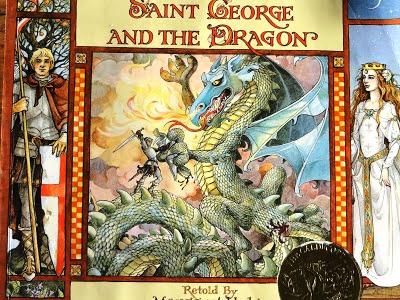
My book is not St. George and the Dragon, but this is the artist I would have wanted to do my covers: Trina Schart Hyman. She’s gone now, but her art lives on. I have been trying my whole life to draw and paint like she did. I’ll bet she would have made the ruined Tower of Babel look amazing.
It’s the ultimate happy ending. We feel Scrooge’s childlike joy when he realizes he is being given another chance at life. Also, Tiny Tim is not dead after all and Scrooge has a chance to save him. “The spirits did it all in one night!” There is a strong sense of death and re-birth, not just of Scrooge but of his entire world.
I realize that everyone knows how the book ends and you might think of it as a cliche at this point, but really, if you read the entire book, hanging in there through Scrooge’s sad childhood, slow hardening, the horrific descriptions of poverty, etc., and then you get to the end and it doesn’t move you, well, I don’t know what to do for you, really.
A fellow blogger, Never Not Reading, made this delightful post: More Religious Characters Please. She points out that devout religious characters, particularly Christians, are extremely rare in fiction compared to their distribution in the general population.
I Have my Doubts about the Concept of Representation
She comes at this from the “representation” point of view, which is predicated on the idea that every kind of person ought to be able to find someone like them in fiction, and that if they can’t, this is somehow unfair or discriminatory. I don’t actually buy in to the assumptions behind this view. There are philosophical problems with the concept of “someone who is like me” that, if we parsed them, I suspect we would never get to the bottom of. I also think there are some other faulty assumptions packed in to the idea of representation: assumptions about what fiction means to the author and what fiction is meant to do for the reader. So, I find the whole idea of representation suspect.
Is This Persecution?
However, Never Not Reading is right about one thing. Religion plays a large role in life for very many – perhaps the majority – of people. It does not play any role in the characters’ lives in much of the fiction that is out there. This is even true of fiction set in historical periods such as the Middle Ages.
When religion does play a major
role in a story, it is often portrayed as a force for evil. That goes double for Christianity.
What is the reason for this?
Never Not Reading goes out of her way to emphasize that she is not saying this lack of religious characters is a form of persecution. I agree. I think there are many complex reasons for it, which we will explore below.
Possible Reasons Non-Christian Authors Don’t Portray Devout Christian Characters
They don’t know any Christians in real life. Although polls will tell you that the majority of U.S. citizens identify as Christian, there are large pockets of society that are very secular. One of these is New York City, home to the publishing industry in America. Another is L.A., home to Hollywood. If you are an artist or writer, you are likely to move to one of these places to launch your career. There, it is easy to live your life without ever interacting with anyone who is openly Christian. It’s easy to get the impression that most people are secular, at least most normal people. And if your mental image of Christians is some variety of kook, it’s possible that some of your acquaintances are believers and you don’t realize it because they seem so normal.
It’s easier to portray madness than sanity, evil than good. Most people are bored by portrayals of virtue. A story with no evil in it is going to come grinding quickly to a halt. So if you are going to put religion into your story, it is easier to make the religious person the villain. The villain in Stephen King’s Misery, Annie, is a beautifully drawn portrayal of a crazy person who at first seems normal. Nothing beats the creepiness of the moment when, after torturing the hero, she starts to tell him that she has been talking to God.
Religion is also a great way to add punch, depth, and believability to your villain/cult leader. Christian-type religions, when they go bad, go really terrifyingly bad. This is easier to portray than the comparatively sane boring version, especially if you don’t actually know any sane and boring Christian groups.
They may actually hate them. Writing fiction is unavoidably a spiritual practice. Fiction is about how we see the world, people, the problem of evil, the cosmos … in short, about how we see reality. The only instruments we have with which to perceive and portray these things are our own eyes, ears, mind, and heart. These are the tools with which we write fiction.
Fiction will therefore reflect the author’s personal spiritual state as well as his or her unique personality. If a person has rejected God, their heart may actually be at war with God and with His people. This may come out in their writing, particularly if their writing is deep and heartfelt.
Stephen King, again, is a great example of this. He is a brilliant writer. I love his work. I tried to read Insomnia, and I couldn’t get through it because the pro-life character was also a despicable wife-beater (and was showing signs, when I stopped reading, of maybe being possessed by something or other. After all, it’s a Stephen King novel.)
Again, I am not saying this phenomenon is persecution. It is a natural consequence of the nature of fiction. It is always possible, when reading an author, to tell what he or she loves and hates. And some authors do hate Christians.
Possible Reasons Christian Authors Don’t Portray Devout Christian Characters
They wish to have wide appeal. Christian authors are aware that religion of any kind, but particularly Christianity, is Kryptonite to many people. It is enough to make people put down a book. That’s a shame, particularly if the story we are telling can be told without overt Christianity. After all, our first duty is to entertain the reader. We are not preachers, we are storytellers, so the story itself is supposed to be what we bring to the reader.
They fear being defensive. If we do put Christianity in to our book, aware that some readers will be skeptical or hostile, we could fall into making the book an apology or defense of our religion. Good authors don’t want to write a thinly veiled philosophical or political rant. (Hi there, Ayn Rand! Hello, Dan Brown!). They just want to tell a story. This is really, really tricky to do if we are feeling defensive, on account of the whole author’s-spiritual-state-comes-out-in-the-writing thing. So to avoid preachiness, it can be easier simply to avoid the whole topic.
They fear being unoriginal. As an author who grew up in the church, when I first started writing I wanted my writing to be interesting and new. Anything drawing on the Bible would be, I felt, tame and derivative. (Of course, that didn’t stop 12-year-old me from shamelessly ripping off Tolkien.)
Unfortunately, if you want to be wise it does not do to turn away from the font of all wisdom. In the years since, I have discovered that the Old and New Testaments are an incredibly rich source of story, history, myth, emotion, insight and symbolism that literally never runs dry. Some of my favorite pieces of art draw openly from the Bible. But surprisingly, instead of making them tired and derivative, this gives them their power. An example is Johnny Cash’s When the Man Comes Around. The lyrics are literally just a series of random quotes from the Old Testament prophets (plus a few quotes from Jesus), and the song still gives me goose bumps every time.
Religion is just too big to control in our writing.
This, I think, is the #1 problem for both Christian and non-Christian writers. If we are going to write about true religion (as opposed to the fake and hypocritical kind), then we are writing about God. We have just unleashed God into our book. This is sort of like blithely grabbing on to a blasting fire hose. It immediately introduces all these deep, destructive, hard-to-portray realities that are just too much for most writers to corral.
What kind of book we are capable of writing depends on our wisdom and maturity as a writer and as a person. I have made the mistake of trying to write about God when I was an immature writer, and I was not. Ready. For it. Trying to “include” God threw off all the dynamics of the book and basically destroyed it. My writing about the other characters wasn’t deep or wise enough to keep up. I wasn’t yet good enough at writing about the human heart, about suffering, about betrayal. My characters were paper dolls and God was a firehose.
Dostoevsky can do it. Mary Doria Russell did a great job in The Sparrow. But for us ordinary writers, if we choose to stay away from making religion a serious part of our plot, I think it might just be a sign of knowing our limits.
A few weeks ago, I posted an awful contemporary Christian song that makes “you” the hero instead of Christ. So I think it only fair to post this one, in which we find out after everything is over that it was he who was calling us. The technical term for this is sovereign grace.
The only problem is, I couldn’t find the version of this song that I like. My first introduction to it was in the form of an arrangement that sounds a bit peppy, like a folk song. In the arrangement, the words of the last verse are used as a fast-moving refrain. But I can’t for the life of me find said arrangement anywhere on YouTube. So, I have posted the original hymn with the lyrics handily printed out. The hymn has a very different sound – almost like plainsong. It’s okay, but I like the energy of the arrangement. So if you can find the arrangement, please post it in a comment.
He doesn’t know it, but crime novelist Andrew Klavan is a mentor of mine.
Klavan grew up as a secular Jew on Long Island. After his bar mitzvah, he threw away hundreds of dollars of expensive gifts because he realized that neither he nor his parents believed the Hebrew Scriptures that he had just professed. He proceeded to do some time as a journalist and to write a bunch of hard-boiled crime novels. He liked noir because it takes an unflinching look at life in all its grittiness … a perspective that he thought was the opposite of that taken by religion.
Becoming a Christian always solves some problems but causes others. As he realized that he was about to become a Christian, one of Klavan’s fears was that he would no longer be able to write hard-boiled fiction. He remembers pleading, “Please, God, don’t let me become a ‘Christian novelist’!”
Of course, by ‘Christian novelist’ he did not mean the likes of G.K. Chesterton, George McDonald, T.S. Eliot, J.R.R. Tolkien, C.S. Lewis, or Flannery O’Connor. He meant someone who writes novels (or movies) in which nothing seriously bad ever happens.
Klavan does a great job of articulating a philosophy of fiction that has also become my own. No, the sex and violence in my novels isn’t as explicit as in his. (We all have to find our own ‘ew’ threshold.) But I do believe that, if you are going to have real characters, they should be flawed. And if you are going to have a real plot, then – you can’t get away from it – at some point ‘the worst’ has to happen.
Klavan explains how a Christian can even dream of writing about sex, violence, and cussing in the five-minute video below.
Do you feel uncomfortable with Romans at your back?
 Are you thinking this is not exactly what you’d planned?
 Are you thinking, This looks bad, but someday soon He’ll see
 I was right to use my knowledge of Gethsemane.

 Possible you don’t recall what, months ago, He said:
 that the Christ must first be killed and then rise from the dead.
 In the sacred city He’d be turned in to the priests,
 then to the Gentiles to be killed – do you not feel unease?

 Just hours ago He broke the news that He would be betrayed.
 You’re certain He did not mean you … but why are you afraid?
 If you would only think it through!  But you’re set on your track,
 although you look uncomfortable with Romans at your back.

 Don’t think about it, Judas.
 You’ve begun – now see it through.
 There’ll be time for thinking later when you’re swinging from a noose.
Again He took the twelve aside and told them what was going to happen to Him. “We are going up to Jerusalem,” He said, “and the Son of Man will be betrayed to the chief priests and teachers of the law. They will condemn Him to death and will hand Him over to the Gentiles, who will mock Him and spit on Him, flog Him and kill Him. Three days later He will rise.” Mark 10:32-34
As soon as Judas had taken the bread, he went out. And it was night. John 13:30
Here is a much more comprehensive article about the destruction of historic buildings: throughout history, but particularly, recently in the Middle East.
Let’s all have a moment of silence for Notre Dame cathedral.
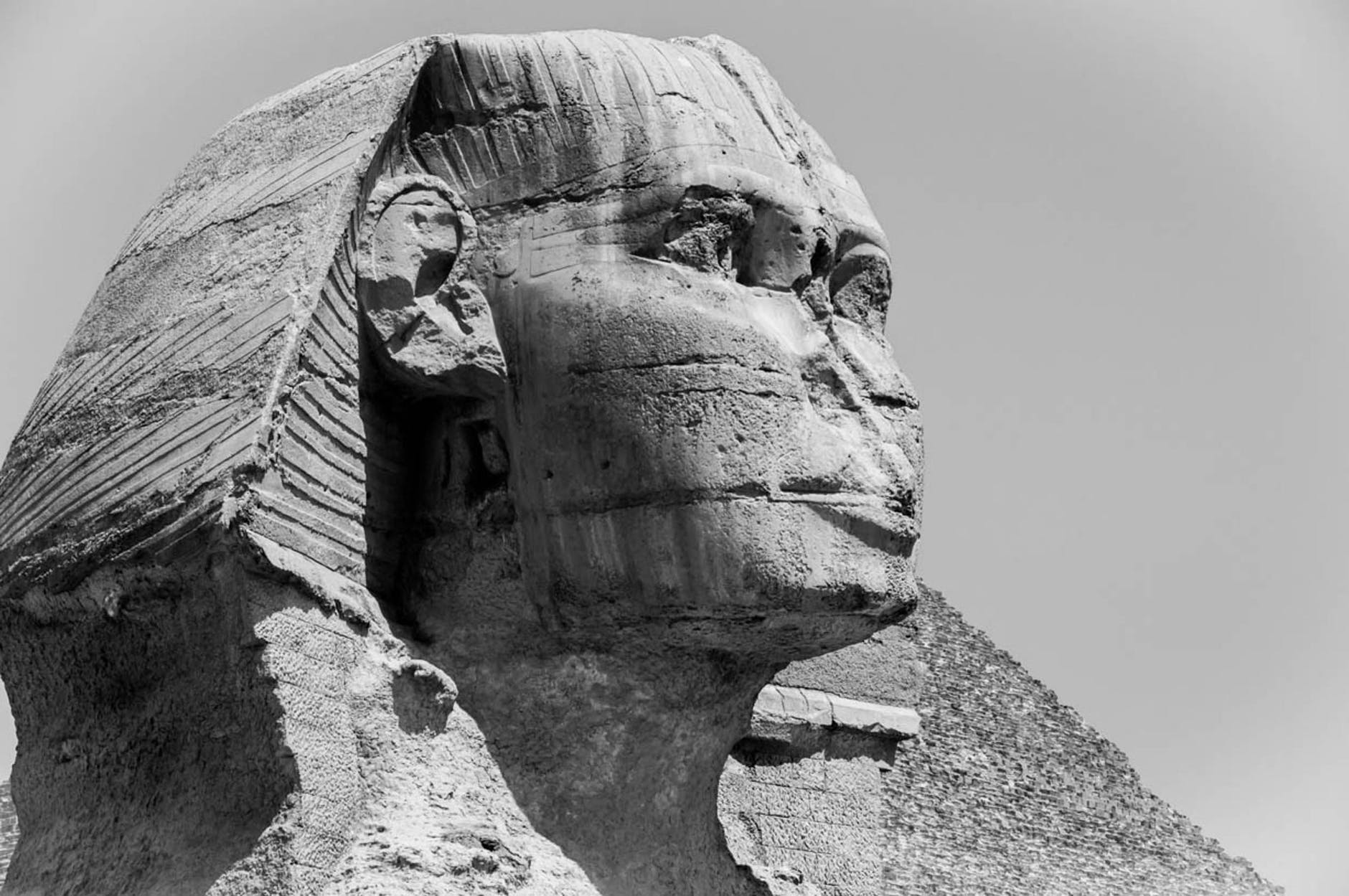
The reason there’s a picture of the Sphinx on this post is that watching Notre Dame burn feels similar to watching the Sphinx’s nose get knocked off.
And during Easter Week, too.
“Heaven and earth will pass away, but my words will never pass away.” Matthew 24:35
“God is our refuge and strength,/an ever-present help in trouble./Therefore we will not fear, though the earth give way/and the mountains fall into the heart of the sea.” Psalm 46:1 – 2
Orual is a princess, but she’s anything but spoiled. She is strikingly ugly, and her father treats his daughters with the same thoughtless cruelty with which he rules his pagan kingdom. Orual eventually learns to stand up to her father, but she’s terrified of the royal priest, who wears a bird’s head on his chest, and of the deity he serves, a spooky, faceless mother-goddess.
Orual’s younger half-sister Psyche
is kind and beautiful, and Orual adores her.
As Psyche grows older, the two girls prove to be best friends. But everything changes when Psyche is offered
as a sacrifice to the son of the mother-goddess, who lives on the haunted
mountain … and she actually seems happy about it.
‘Till
We Have Faces is a re-telling of the myth of Cupid and Psyche, seen from
the point of view of Psyche’s supposedly jealous and evil older sisters. Like me, you will probably pick it up because
when you see the words “an ugly princess and a beautiful princess,” you
immediately go into the book expecting to identify with the ugly one. And you do.
But see whether, by the end, you don’t identify with Psyche as well.
This book is a perfect addition to
the genre of novels that write ancient pagans sympathetically, but look at
their beliefs with a critical eye.
That’s what I try to do in my books.
Mine were inspired in part by ‘Till
We Have Faces, but they will never rise to its level.
Anna Karenina by Tolstoy (1878)
If you read the back of the book,
you will be told that it is the story of Anna, a beautiful upper-class Russian
woman (pre-Revolution) who has an extramarital affair and is eventually
destroyed by society’s judgment on her sexual freedom. Well, not quite. For one thing, Anna is destroyed by the
affair itself more than by the social condemnation. For another thing, Anna is
only half of the novel.
The other half is about Levin, a
wealthy young farmer who has a spiritual crisis and loses, then regains, the
girl he loves. His long, slow upward
trajectory is the flip side of Anna’s long, slow downward one.
The writing in this novel is
amazing (assuming that you get a good translation). The psychology is beautiful. It’s also an example of a successful
omniscient narrator.
The Pilgrim’s Progress by John Bunyan (1678)
This book was first published in
1678. The language, therefore, is more
modern than Shakespeare, slightly less modern than Jane Austen, but just as
elegant and succinct as either one.
It is an allegory of one man’s
spiritual journey. It is anything but
boring!
Take the incident where Giant
Despair throws Christian and Hopeful into the dungeon in Doubting Castle. He beats them, he starves them, he tells them
they will never get out. It is
Christian’s fault they are there (he led them on a shortcut across the giant’s
lands), and he immediately begins to blame himself and apologize to
Hopeful. The giant encourages the two
men to kill themselves and even provides them with a variety of means to do
so. He also shows them the skulls of
past prisoners to emphasize that their fate is sealed.
All in all, if you have ever been
through depression (your own or a loved one’s), you will recognize this as a
precise description of the effects it has upon mind and body. This giant and his wife literally sit up at
night thinking of ways to make the prisoners’ lives miserable.
When the two prisoners finally make their escape, the giant begins to chase them. But when he comes out into the sunlight, he falls into an epileptic type of fit.
The Miss Marple books by Agatha Christie (1930s through 1960s)
Hercule Poirot is the more famous
of Christie’s sleuths, but my favorite is Miss Marple. All the other characters, being British,
consistently underestimate Poirot because he a foreigner. All the younger and more worldly characters
underestimate Miss Marple because she is an old maid who has lived in a village
all her life. They think she is likely
to be naïve and narrow in her views and experience. In fact, Miss Marple has seen quite a lot of
human nature in her 60+ years of life. As
she points out, her village may look as stagnant and sleepy as a pond, but like
a pond, is it actually alive with all kinds of vicious microscopic creatures.
Miss Marple’s method of crime
detection is to rely on her knowledge of human nature. People she meets remind her of other people
that she has once known. She can
recognize the essence of their character and even make guesses about what they
will do based on these past people’s behavior.
She never makes a point directly; her method is usually to tell a little
story about someone she once knew and then surprisingly tie it to the present
situation. Her method of thinking about
crimes is a bit more intuitive than Poirot’s.
Rather than crunching data, she recognizes stories. You could say that Poirot is a plotter and
Marple a pantser. But they both get
their man in the end.
Miss Marple is also aided by her
fantastic British manners. She is an
amazingly good listener. She is
excellent at drawing people out. People
cannot lie all the time; if you let them talk long enough, eventually they will
tell you the truth.
Miss Marple might be a little old
lady, but she is dangerous to criminals.
In one book, she wraps a pink scarf around her head before she goes out
and then introduces herself to the murderer as “Nemesis.”