Welcome to February! This February, instead of doing a bunch of posts about the gooey stuff (after all, we already read a Barbara Cartland), I’ll be doing posts about stuff I love. I hope you will love it too, and that these posts and the resources they direct you to, will bring joy to your bleak February.
If you have not seen the debate below, you are missing a treat. It may be the most entertaining debate in history, at least for those who have any interest in the Bible, ancient history, or textual criticism.
It’s two hours long, but you could just watch the first hour and be entertained. Or, you could watch it in half-hour snippets for your nightly giggle. Then it would be sort of like watching a reality show, if one of the participants on the reality show was an adult who knew what they were talking about.
Billy Carson, a prominent YouTuber who pushes a Gnostic/neopagan version of the Bible, monologues until fact-checked by an extremely patient Wes Huff, an actual New Testament textual scholar. The moderator interrupts periodically to ramble about how much he loves Jesus because Jesus got rid of all the old sexism.
No matter who has just spoken or how long a turn they have taken, Huff manages to give them a response that is calm, respectful, and adds actual biblical knowledge to what they have just said.
To recap, I joined a readalong with Bookstooge of a book with a cover that looks like this:
and whose author looks like this:
… which gives you a better sense of what the book is like than the cover does, really.
Barbara Cartland turned out a book every two weeks for the last twenty years of her life. Keep that in mind.
So, I finished this book pretty quickly. I was expecting a formulaic romance, and that’s what I got. The book does not drag. I can’t say I was super invested in it emotionally, but that’s because I’m a cynical middle-aged woman. And when Richard thinks to himself,
Oh, God, he loved her so much.
page 109
… I believed him. Behold the magic of Barbara Cartland!
Now, this book remains a first draft, and there are some first draft-y things in it, such as a shawl starting out as “lace” in one chapter, and getting transformed into “green silk” in the next. My favorite of these “first draft” moments is this one:
But now — how can I bear to be his wife knowing that he is already be in love with someone else?
page 106
I mean, I can relate. The most comical and confusing typos always show up in my most emotional scenes … and I always get so carried away when re-reading the scenes, that I can never catch them myself.
So, all in all, this was a not-terrible romance novel that read sort of like an outline, because it basically was an outline. If the book had been re-written to be much longer, then I feel certain that many of the minor plot holes/historical vaguenesses would have been ironed out, plus the potential emotional heft might have been successfully deepened to actual emotional heft. But, every author has to say “done” at some point, and in Cartland’s case, that was after whipping up the first draft, because that was her business model. She let readers take care of the historical details and the emotions, handling them with suspended disbelief and imagination. And that’s fair.
There was only one thing I did not like: the angry almost-kiss. (“Almost” because the couple are interrupted by a maid, so they don’t actually kiss except once at the very end of the book.) Anyway … “angry” and “kissing,” they do not go well together, no precious, they do not. I do not want Tiana’s marriage to be the kind of relationship where Richard ever kisses her angrily. And in fact, in most of the book, that is quite out of line with his character. It just happens in one scene, where they both lost their tempers “horribly” (actually quite mildly), and then were nearly overcome with passion. I don’t know why this is a romance trope. I guess I’ve missed something during my four decades of living. But, tip for you guys, in the middle of a fight is not the greatest time to start kissing your beloved.
I catch my reflection in a glass door and jolt at my frizzy brown hair and puffy eyes. I may be entitled to compensation for that. It’s not that I’m a terrible-looking person, but I haven’t slept well this week, and I always seem to look my worst when I don’t expect myself.
from I Hope This Finds You Well, by Natalie Sue, p. 4
Actually, that calls for a lot of explanation, doesn’t it?
The Setup
Carl is a faithful Mormon who is grieving his family. His wife, Sharon, and their three small children were killed by a drunk driver who ploughed over them on the sidewalk. But, Carl knows that if he remains faithful, he will be reunited with his family in the Celestial Kingdom. Per the Mormon promises, they’ll be together forever.
Then, Carl’s sister, who has had a troubled history, is killed by a mysterious woman in an alley. Carl becomes obsessed with finding the killer (the police seem to have given up). He tracks her to what appears to be a sex cult with gothic trappings. Thinking he is just going undercover to collect evidence, Carl takes an oath he doesn’t mean and finds himself becoming a vampire.
He doesn’t finish the ceremony, though. As soon as it becomes clear that he is supposed to drink the blood of an innocent girl, Carl instead breaks free and takes her to the nearest hospital. There, he collapses, and is rescued by Moira. Moira is another well-intentioned vampire (a “Penitent”), who works at the hospital so that she can work nights and have access to blood without having to attack people. Moira shows Carl the ways of surviving as a vampire without doing evil. Incredibly, it later turns out that she too is Mormon. She actually became a Mormon after she was already a vampire, thanks to two very persistent missionaries. For about fifty years, one Mormon bishop after another has handed down to his successor a letter explaining Moira’s special “condition.”
Like I said … Mormon vampires.
Pros and Cons, and Why I Was Crying in Public
(P.S. This section turned out kind of long. Sorry about that.)
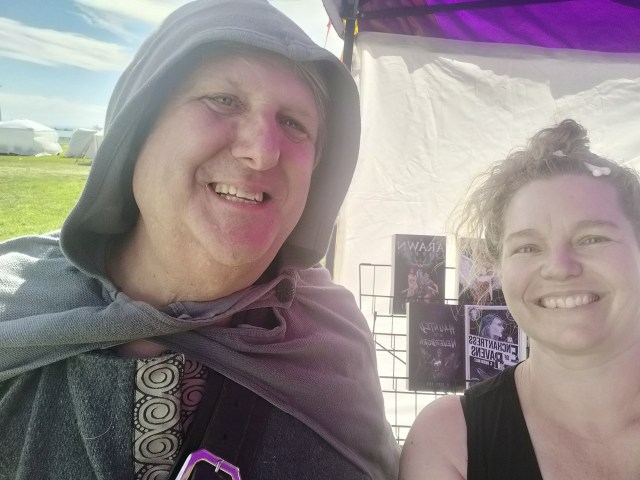
C. David Belt (shown here with me at the recent Fantasy Faire) is a fantastic horror writer because he pairs the horror writer’s instincts and penchant for research with a uniquely right-side-up view of the world.
Take, for example, his take on vampires. I don’t usually read vampire books because the vampires are usually presented as like mortals, but better: they don’t age, they’re beautiful, they’re sexy. Mortals who don’t want their blood sucked are prudes and bigots and super intolerant. Not so with Belt. In his books, vampires are actually, you know, evil. Vampirism is actually a horror, like it would be if you encountered it in real life. That’s what I mean by a right-side-up view of the world.
Now, this strong sense of the wholesome can shade into a bit of naivete about the human heart. The whole premise of this series is based upon the idea that Carl took the vampire oath and even allowed his own blood to be drunk … “innocently.” Because he “didn’t mean it” and “didn’t think it was real,” he is blameless. He is, in all of history, the only Unwilling vampire.
This raises two questions. Now, perhaps these will be raised by the author himself later in the series, but I’m taking The Unwilling on its own terms. So here we go.
First, is it really possible to take an oath and not be responsible for it because “you don’t mean it”? That would be an extremely convenient thing, if so. Picture this: you are a follower of the One True God. But you live in a pagan environment, and you’re being pressured to take an oath of loyalty to Kukulkan, or Zeus, or the divine Caesar, or Big Brother is requiring you to “just say” there is no God but Big Brother. I think you see where I’m going with this. Now, granted, in The Unwilling Carl was not clinging to secret reservations just to get out of martyrdom when he took the oath to be loyal to Lilith. We know this because he fled the ceremony room, endangering himself, as soon as he realized what he was really being asked to do. So there are degrees of culpability, and of self-awareness. However, the principle that “I didn’t really mean it” or “I thought it was a game” is a dangerous one to introduce. As G.K. Chesterton has pointed out in The Everlasting Man, there is an element of game to much of pagan worship. It’s not always 100% clear how seriously the pagan followers themselves take all their superstitions. However, God still tells Israel in no uncertain terms not to pour out libations to any foreign god or take up their names in oath. So, “it was a game” or “it was maybe partly a game” is not going to cut it.
This leads directly to the second question. How is it possible that, in all of history, Carl is the first person to take the vampire oath without realizing it is real? Wouldn’t we expect that to be true of almost every person that gets inducted into the vampire cult? Or true of at least 50%? In modern times, most people do not really believe that vampires are an actual thing. Surely, the majority of the people that join this “empowering” gothic sex cult think of it as a sort of cosplay.
After all, this is how people join cults: there are concentric circles. There are the hangers-on or wannabes, then the neophytes, then the journeymen, and so on. Typically only the people in the inner circle know what the cult is really about. By the time someone gets that far in, however, they have so much trauma bonding, Stockholm syndrome, sunk cost fallacy, mental confusion and spiritual deception that they tend not to be repelled by even the most bizarre and obviously evil beliefs.
The only way I can square this circle is to figure that, if there were any other Converted who didn’t take the vampire element seriously, then when it came time to commit the ritual murder, unlike Carl they didn’t balk, but rather went ahead. And this because, we can assume, they were not as strong-minded as Carl, or not as pure of heart and motive.
One downside of having a right-side-up view of the world, where you recognize that good and evil actually exist and that people can choose to do good or evil, is that there’s a tendency to think as though the world consists of some good people and some bad ones. Belt falls prey to this, to a certain degree. I don’t want to overstate this flaw, because on the whole he is quite insightful about human psychology, as any good novelist has to be. But here are some examples of what I mean.
Vampires, it appears, can “smell” when a person is truly depraved, truly far gone in their evil. Such a person’s blood “calls” to the vampire, creating an almost irresistible urge to kill. In this book, occasionally Carl will encounter such a person. One is a crooked cop, who is also molesting his stepdaughter. Another is a random mother we encounter at the Mormon church service. The precise nature of her evil is never revealed, but as Carl puts it when he warns the bishop about this woman, “something is very wrong” in that house.
So far so complex, right? I actually love the scene where Carl and Moira have to restrain themselves from attacking this apparently pious Mormon woman. My beef with this phenomenon is that there are far too few of these people who call to Carl with their rotten/sweet-smelling blood.
Technically, on an orthodox Christain view of the world, the taint is in everybody. “There is none righteous, no, not one. All have turned aside; they have together become corrupt.” But let’s grant that this does not mean (as indeed the doctrine of total depravity doesn’t) that everyone is as bad as they could possibly be. Nevertheless, part of a mature Christain world view is realizing more and more uncomforable truths like the following:
Given the intervening steps, anyone is capable of anything.
I am far weaker and more sinful than I ever realized, but the grace of God is far deeper and stronger than I ever realized.
“I know that in myself lives no good thing.”
“Cheer up! You are worse than you think.”
“Christ Jesus came into this world to save sinners, of whom I am the chief.”
So, to modify our illustration, if The Unwilling had been written by an orthodox Christian, it would show a world where every single person had this taint in their blood, but some of them were in remission. Nevertheless, the proportion of people who had gone far down the road towards “capable of anything” would be quite large – large enough that Carl would be certain to be distracted by their intoxicating scent every time he went out in public.
But Belt is a Mormon, so although his worldview is basically right-side-up, it doesn’t include total depravity. His picture of the world is basically a bunch of lost, but essentially wholesome and well-meaning people, and a few stinkers. Furthermore, in the Mormon cosmology, salvation is not for the stinkers. It is for the well-meaning people who do their best to save themselves and trust God for the rest.
Take this scene, where Carl and Moira are trying to convince a mortal-turned-vampire to repent of his sins. Things start out well enough:
“You’re Catholic, aren’t you?” I ask him.
He laughs bitterly. “Lapsed.”
“Go to your priest,” I say. “Or go to a Mormon bishop. Only God can help you now.”
So far so good. Carl continues,
“Stop killing. Go to your priest or to a Mormon bishop. Pray. Lean on God. I believe you can find your way back. Atone for your sins as best you can. Put your trust in the Savior to take care of the rest. It’s the only way you can ever find redemption.”
And there we have the difference between Mormonism and orthodox Christianity. Ephesians 2:8 – 9 says, “For by grace you are saved, through faith, and this [faith] is not of yourselves, not of works, lest any man should boast.” The Mormons have a similar verse, but it runs like this: “We are saved by grace, through faith, after we have done all we can.” What this misses is that, if we are “doing all we can,” then one of two things is going on. If we are truly repenting and making restitution, then that itself is a gift and is a sign that the Holy Spirit is already revivifying our heart. Which means that He started this good work in us before we were repentant. The other possibility is that we are “doing all we can” in a cynical way, as a work of our own righteousness, so as to put God in a position where He “has to” forgive us. This is a grievous sin against God, probably far worse than the original bad things we did.
To an orthodox Christian, “Atone for your sins as best you can. Put your trust in the Savior to take care of the rest” is a HUGE insult to the Savior. Did He really suffer torture and the wrath of God to take care of our leftovers? Doesn’t it seem that we could have done a little more and spared Him all that? Or, if there was a portion of our sins that called for torture and death on His part, then doesn’t that suggest that the rest of them were equally bad and probably can’t be dealt with by “doing the best we can”?
These are the things that crossed my mind as I read this book. The psychology is good, and somewhat deep, but it’s not the deepest of the deep. That is reserved for writers like Dostoyevsky and St. Paul.
Finally, I won’t give the background of this because you really should read the book, but there was a certain character whose story had me in tears in the doctor’s office. I had brought this book with me to my son’s doctor appointment, to read in the waiting room, as one does. And – well, it was a really hard to put down part, and so it was that the doctor came in to see us just at the moment when my heart got broke. And I had to knuckle a tear away and say, “Sorry, we are fine. This book made me cry.” Good job, Mr. Belt, good job.
This painting is me in twenty years. I hope. Note my cottage in the background.
Our Friend Mary Harrington
I want to talk about another lovely gift that I have been given by reactionary feminist author Mary Harrington. I reviewed her book, Feminism Against Progress, here.
In the video below, Jordan Peterson interviews Harrington. She gets to talk a lot. I don’t know whether this is because Peterson is mending his monologuing ways, or because Harrington is confident, articulate, and not afraid to take long turns, but in any case, we definitely get to hear her thoughts. They are not the exact same thoughts as the ones she expressed in Feminism Against Progress. You can see that her thinking is still developing, particularly the terms she likes to use to describe things.
It’s a very long video, and well worth the listen if this topic interests you, but for your reading pleasure I have transcribed the section that I want to talk about. Here it is:
At about 46:24, Peterson says, “The thing about women is that their mythological orientation is multidimensional and complex.” He mentions Beauty and the Beast, and Woman and Infant, as two possible hero myths for women, but notes that “our society does not hold sacred the image of Woman and Infant as a fundamental unit of female identity” (so we’re really only left with Beauty and Beast, which gets us into trouble).
Then at about 49:00 he asks Harrington, without asking a direct question, what she thinks is the woman’s Heroic Journey. And she’s got an answer for him!
After a detour into why she felt lonely as a young mother, Harrington answers at 51:45,
“In my observation, there is a hero’s journey for women, it just doesn’t follow the same track as the male one. And in fact, it has three parts, which correspond to a very ancient female archetype, which is the Maiden, the Mother, and the Matriarch. The triple goddess. And anecdotally, it stacks pretty closely to me with actually what a majority of normal women’s lives look like.
“You know, as the Maiden, you’re free, you do have more of a warrior aspect. The Mother is more oriented towards home and the domestic sphere, and probably bluntly just doesn’t care about [outside] work as much.
“But then, later on – and this was something I found very interesting when I did therapy training in the late aughts and early tens, was just how many of the trainees on that course were women in their 50s and 60s. So these were women who had pretty much done the motherhood arc, and they were moving into a new phase of life. They were moving into the Matriarch space. I mean the classic, three-part-goddess term for this is Crone. But they were some way from cronehood. These were lively, vital, energetic, public-spirited women who had some life experience. They had a lot of connections, they had a rich social life, they had met lots of people, and they were ready to give something back.
“And in my observation, there are a huge number of women who reach the end of the Mother part of that journey, and will then re-train. And those women are a huge, rich force for deepening reflection in the culture, for public service, for all manner of incredibly productive, usually quite self-effacing, but incredibly productive, life-giving contributions to the social fabric. And they’re incredibly marginalized. They’re almost completely invisible in terms of the liberal feminist narrative, which really centers the Maiden. And it wants to foreground the Maiden and to tell women that the hero’s journey means essentially being the Maiden for their entire life. At best, if the Mother is noticed, it’s as a problem to be solved. And the Matriarch doesn’t really get a look-in at all, and if she does, it’s only so that she can be denounced for being a TERF, or in some other way spat on for being a dinosaur or obsolete or old-fashioned or out of touch, or in some other way irrelevant or ridiculous.
“And in fact, these [older] women are the backbone of the social fabric. I mean, those are the women who are making weak cups of tea for slightly traumatized new mothers like I was in small-town England. (laughs) And telling me I’m doing fine. And really, that mattered a lot at the time. I mean, those are the women who are running Brownies groups for no money every Wednesday because they can and because they want to give back. Those are the women who are re-training as counselors and helping traumatized people for free. Those are the women who keep things going. (laughs again) And yet, somehow, the liberal feminist version of the hero’s journey just doesn’t see them at all.”
About that word “Crone”
I love what Harrington has to say here. But I must make a note of how she shies away from the word “crone” in favor “matriarch.” Based on the qualifications she puts around even mentioning the word, it’s apparent that Harrington thinks crones are women at the very end of their lives, who are listless and isolated: the opposite of “having a lot of energy” and “lots of connections” and “a rich social life.” The word crone in Harrington’s mind apparently conjures up a bedridden hospice patient who enjoys her only social interaction when the pastor visits once a month.
I got a similar reaction out of my editor when I went to describe Zillah (one of the main characters of my trilogy) as a crone. The word crone, said Editor, reads “old and ugly.” I convinced her to leave it, because I wanted to broaden the meaning of the word, or perhaps recover some of its original meaning.
Zillah, in my series, is in her sixties when we meet her in The Long Guest. I’m cheating a little with having a protagonist in her 60s, however, because my books are set in the immediate post-Flood era, when people lived into their 250s, and a woman in her sixties could still be fertile. Zillah has grown children in The Long Guest, but she still looks like a young woman, and in fact she gets her own romance arc.
In later books, Zillah gets older. By The Great Snake, when I was calling her a crone, she was over one hundred. By the standards of the time, this is only middle-aged, and in fact she is strong enough to hike all day, do dryland farming, and so forth. However, her role in the community is definitely what Harrington describes above as Matriarch. She practices emergency medicine and herbology, innovates in farming maize, counsels her family through crises, and brings potential problems to the attention of the patriarch (who is not her husband but her son). She can’t do everything, and in fact she has had some costly failures. But my trilogy would be much darker without Zillah.
I’m not saying my books anticipated what Harrington is saying, but … my books anticipated what Harrington is saying.
Hats off to Grandma! Or are they?
Of course, she is not the only one saying it (though she may be saying it the most eloquently, and with the biggest platform), and she is not the only one thinking it. Every woman is thinking through these things, whether she realizes it or not, and most women come to some kind of resolution. You have to, if you don’t want to live your life with a pathological fear of aging. This is not an attractive look, and most people figure this out and make some kind of effort to “age gracefully,” that is, to embrace their status as an older person.
This task is made more difficult in modern Western society, where we as a culture don’t value our elders at all and don’t really have any special role for them in the community. This is true of old men, to a lesser degree, but it’s really true of old women. Has anyone heard the phrase, “old women of both sexes”? It’s usually used in the following context: “I want to do bold plan XYZ, but when I said so, it really upset the old women of both sexes.” Old women, we learn, are fragile, risk-averse, set in their ways, and prudish. Probably bureaucrats. Also, they are not athletic or healthy (two other things our culture really values).
Our culture’s disdain for old women traces back to its disdained for motherhood and family life. If you don’t value mothers as such, then you are less disposed to respect your own mother when she is old. Further, if a culture does not have a lot of young moms who need help at home, then there really is no job for the old ladies to do other than go to work in an office, where the hours, tasks, and working conditions are often uncongenial to their nature and where admin would really like to push them out before they develop a bunch of expensive health problems.
On the other hand, if your culture prioritizes a large, thriving household of the kind described in Feminism Against Progress and in Proverbs 31, then there is plenty of useful work for Grandma to do. Furthermore, it’s exactly the kind of work she has spent decades becoming good at. She’s baking her famous dessert, she’s sewing outfits for the little kids, she’s quilting, she is babysitting. She’s answering Mom’s panicked questions about how to garden, get that stain out, and how in the world do I manage everything. This is work that is actually useful and needed (which is the kind of work that keeps people alive and happy). But it’s not like going to work in a shop or office in your fifties. There is more variety, and the schedule is freer. There is room for Grandma to go home and be by herself for a few days. There is room for her to take a nap. And unlike admin at the office, your grown children will not fire you and wash their hands of you when you develop health problems (not ideally, anyway).
Of course, all this is the ideal, and we all know that reality is different. Not every family relationship is a happy one that would allow this kind of close community (especially 60 years after the Sexual Revolution began its relentless campaign to break up families). And even in ideal circumstances, we can get on each other’s nerves. That’s why, in the painting, I am living in a cottage in the woods, where I can garden, paint, and keep a library. Ya gotta’ know your limits. But there is a world of difference between having some tension with your children in a context that values and honors older people for their wisdom and experience, and having to get a 9 to 5 job that really calls for a younger person, just to prove you’ve still “got it” and to justify your existence. This is the difference between Zillah’s world and ours.
Looking forward to being a Crone
I have been fortunate that I was a given a husband and children. I’ve moved through the stages and am now standing on the threshold of matriarchy/cronehood. And I’m liking the view.
Don’t get me wrong … I’m frightened as well. What scares me most is the prospect of chronic pain or disability — my own, or a loved one’s. But I’m not scared of aging itself. I like the idea of less pressure to look beautiful, of a lightening of parenting responsibilities (in exchange for others), and of time to keep getting better at my various crafts.
As a Christian, I am surrounded by a world that despises motherhood, families, and old women … but I have access to a world that honors them. I am in the world but not of it.
Also, I realize that I need to do a better job appreciating the older women who have surrounded me since I was small, my own mother included. I didn’t ever like being taught new things, because of the amount of correction it involved, but now I see how much we must listen to these ladies, honor them, eat the food they cook for us. Send in the crones!
Zach arrived on schedule. He stood about six foot two, lean and wiry from triathlon training and mixed martial arts, thirty-five years of age, bearded and chewing tobacco. After losing his bid for mayor’s office, he’d taken up fighting for money, a common enough career path.
The Whisper on the Night Wind, by Adam Shoalts, p. 17
“When Kath and her boyfriend arrive at a remote cabin, they find a mysterious young couple already there. But when her boyfriend disappears with the young woman, Kath becomes obsessed with finding an explanation with the help of an unlikely supporter.”
I checked this 2022 film out of the library so I’d have something to watch while knitting in the evening. I like Winona Ryder, although her character in this film is very different from the beloved Joyce of Stranger Things. As you can see from this cover, she doesn’t look at all like the same person.
This is a mystery/thriller. I won’t give away the plot, except to say that it is disturbing. Instead, I want to talk about the movie’s theme: aging and the way our culture fears it.
Gone does a fabulous job of working the theme into almost every scene. (And, now that I think about it, it’s even arguably present in the title … you wake up and your youth has “gone in the night.”) Some things are very subtle: for example, when the boyfriend (I think his name is Max) gets out of the car to retrieve his hat, the camera lingers on Kath, sitting in the driver’s seat. She opens the mirror on the sun visor and looks at her reflection, then wrinkles her forehead and touches the lines there.
Max is having a beer with a young couple. The woman is flirting with him. She asks how old he is, and he jokingly replies, “Fifty.”
“Fifty? You look good for fifty,” she responds. “You look like you work out.”
“Oh, God, no, I was kidding! I’m not fifty!”
In fact, Kath and Max are both probably closing on 40, or perhaps in their early 40s. They don’t have grey hair or use a walker. They are not old enough to be grandparents. They are middle-aged. Kath seems OK with this. She would be happy to live with “my books, my plants, and have it quiet … forever.” Max, on the other hand, seems to be trying to cling to lost youth. He wants to go to raves and concerts, hike up mountains, and do all the things done by adrenaline junkies in their 20s. He and Kath, since they are not married and don’t have children, are still sort of trying to live in youth culture, but they keep getting messages that they don’t belong.
“How long have you been married?” the twenty-something woman asks Kath.
“What makes you think Max and I are married?”
“Oh! It’s just that people like you are usually either married or alone.”
“What do you mean, ‘people like me’?”
Awkward silence.
In another scene, Kath is following someone. The person leads her to what appears to be a rave happening in an old warehouse. Kath says to bouncer, “I need to get in for a minute. I can pay whatever.”
The bouncer, who is eating a snack, eyes her up and down and then says through a mouthful of food, “Dyahavakidinere or somethin’?”
“What?”
With an eye roll, he clears his mouth, and then articulates very clearly, “Do – you – have – a – kid – in – there?”
Fear of aging – and ultimately, of death – ends up being highly relevant to the plot of Gone. And, really, unless you happen to be a Christian with the certain hope of the resurrection of the body and the life everlasting, how could you not fear it? As Kath says, in a memorable line, “We are all scared.”
As you might expect from a Ludlum novel written by somebody else, this book has the feel of something made on an assembly line. It has all the parts and doodads that you expect from the genre, and it does what you want it to do (in this case, be thriller), but it has no particular artistry or character. To be fair, this also means it’s lacking some of the flaws that might show up in quirkier, more idiosyncratic books.
Pacing and Action: A+
This is, I gather, the outstanding characteristic of Bourne books. The action is almost constant. Nevertheless, the author does a good job of introducing characters and explaining the setup and the stakes, so that we don’t get the phenomenon of action that we don’t know the significance of. I will say that to a certain degree, tension is inflationary, so the shock and horror isn’t quite as shocking and horrible as it would be with a slower buildup.
Tours of Foreign Cities: A
Traveling the world is one of the things we expect from the Bourne novels. Freeman does a good job of making us feel as if we are familiar with the cities where the action takes place by mentioning particular roads, parks, markets, and squares. He also does a decent job with the weather and atmospherics.
Russians Betraying Each Other: A
Also other spies betraying Bourne, and Bourne possibly betraying other people (who knows, since he lost his memory). The hypocrisy of people in espionage, as well as the messed-up kind of person that years in espionage makes you, is a major theme of this book. Speaking of which:
Character Development: B-
The book tries to do some character development with Bourne discovering his past, wishing he could get out of the espionage game, and realizing that he has been made into the kind of person who probably isn’t capable of anything else. There’s a fair amount of character development given that this is a thriller. But, the thriller distinctives limit the emotional impact of all this, at least for me. The pace is too fast and the writing too matter-of-fact for character development to get really emotional. Speaking of which:
Relationships between Men and Women: C-
Okay, so there is a lot of sex. Including one scene that lasts several pages. But it’s written the way a man would write it, which is to say, the emotional element is minimal. Speaking of which:
Portrayal of Women: D
Hmm, where to start?
Obviously, we are talking about spy women, so that skews the sampling. But these ladies are ruthless killers. They are also … how to put it …? Not overly concerned with monogamy. They can go from killing to kissing, or worse, in no time flat. They don’t seem to get emotionally attached as a result of sexual involvement, the way a normal woman would. They aren’t adversely affected by all the gruesome things they have to do, even as much as Bourne is.
There are two women who don’t appear to be nymphos, but they are both cool as cucumbers. One only cares about science, one about spycraft. You know, like most women you meet.
Also, spy goddess is petite and very athletic, but also has “deep curves.” I dunno. Deep curves (such as wide hips) affect the way a person runs, tumbles, throws, etc. I went through most of the book picturing her as wiry and boyish, and then all of a sudden the author threw these curves at me. Also, their hair is always loose. Not very practical, ladies.
I’m not even trying to be feminist here. I just find these women hella unrealistic and unrelatable, which in turn makes the “romance” (such as it is) tepid.
Russians Talking: F-
This was the thing that annoyed me the most, because it messed with the verisimilitude even more than the Bond-style spy women. Many of the characters in this book are expatriate Russians. Many of them need to monologue to explain their positions. All of them talk exactly like an American explaining something in a business seminar. Listen, Russian sentence structure, word choice, and so on, is very distinctive, even when they are speaking English. It should not have been hard to watch a few movies where this was well done, and then imitate it in this book. If you are going to research foreign cities and bring them to life, why not make the dialogue believable too? I think I would have enjoyed this book a lot more if the Russians had sounded like Russians. And it would have supported the theme. Make them sound like Russians!
Over the past several years, my research and reading has led me more and more to the conviction that the entities that people often call the old gods were not “mere mythology.” They were and are real.
Several threads of my thinking have re-enforced each other in coming to this conclusion.
First of all, as a Christian, I reject the Enlightenment-era, materialist notion that there is no spiritual world, that matter is all that really exists. I reject both the strong version of this, in which not even the human mind is real, and the weak version of it, in which we accept that human beings exist as minds, but we try envision as them as “arising” out of matter, and we disbelieve in any other spiritual beings, whether spirits, angels, demons, ghosts, or the one true God. This view, the one I reject, has held sway for most of our lifetimes. Even people such as myself who would not call themselves materialists will lapse into this sort of thinking by default, looking for a physical or mechanical process to explain what is “really” going on behind any claimed spiritual phenomenon.
Another thread in the tapestry has been my interest in the ancient world. Anyone with a passing familiarity with archaeology quickly comes to realize that ancient people were much smarter than they have gotten credit for, at least during the Golden Age of Scientific Triumphalism, the late 1800s and early 1900s. All the good, old-fashioned scientific materialists from this era took it as an axiom that human beings started out as apelike hunter-gatherers, and slowly “ascended,” developing shelter and clothing, “discovering” fire, slowly and painfully inventing various “primitive” tools, and then finally moving on to farming, language, and religion. By hypothesis, ancient people were stupid compared to us now.
Genesis, my favorite history book, tells a very different story. It shows people being fully human from the get-go, immediately launching into writing, herding, weaving, art, music, and founding cities. And in fact, archaeology confirms this. Every year, we discover a more ancient civilization than the evolutionists told us existed. Some recent examples: the Antikythera mechanism is an ancient computer. The Vinca signs are an alphabet that pre-dates Sumeria. Gobekli Tepeis a temple complex that uses equilateral triangles and pi, and dates to “before agriculture was invented” (as is still being claimed). The Amazon basin turns out to have been once covered in cities.
Evolutionists’ dogmatism about early man being stupid has allowed them to ignore all the data that ancient history presents us about the existence of a spirit world. Why should we believe claims (universally attested) about heavenly beings that come to earth to visit, rule over, and even mate with humans? These are primitive people’s attempts to explain purely scientific phenomena that they didn’t understand. But if, as a Christian, I choose to respect ancient people and take seriously their intelligence, then I also have to grapple with their historical and cosmological claims.
Moving on to the third thread. The Bible itself confirms that there were entities called gods (“elohim”), some of whom, at one point in very ancient times, actually came to earth and reproduced with human women, creating a race of preternatural giants, “the heroes of old, men of renown” (Gen. 6:4). The story is told in Genesis ch. 6, but it is assumed and referenced throughout the rest of the Bible and in Hebrew cosmology. This idea is also attested in oral and written traditions worldwide, which universally have gods and giants. A Bible-believing Christian can take seriously the bulk of pagan history, cosmology and myth, whereas a strict materialist evolutionist has to reject it all as primitive superstition.
Part of the Biblical understanding of the gods is that they are created entities who were supposed to help the one true God rule the cosmos. In the course of redemption history, the fallen gods were first banished from appearing physically on earth (in the Flood). At Babel, the gods were each given a nation of men as their “portion” to rule over (Deut. 32:7 – 8), which they did a pretty poor job (Psalm 82). Then God called Abram to make a people for Himself, with the ultimate goal of making all the nations His portion (Ps. 82:8, Ps. 2, Matt. 4:8 – 9). When Christ came, He began to drive the gods out of their long-held territories (Mat. 12:28 – 29). Whenever a region was Christianized, the old gods would first fight back, then become less powerful, and eventually go away altogether. Sometimes, their very names were forgotten. This disappearance of lesser spiritual entities from more and more corners of the earth is the only reason any person could ever seriously have asserted that there is no spirit world.
As a Christian, I am immensely grateful to have grown up in a civilization from which the old gods had been driven. It has been a mostly sane civilization, in which everyday life is not characterized by spooks, curses, possession, temple prostitution or human sacrifice.
This, then, is the background that I brought to Cahn’s book. This mental background helped me to accept many of his premises immediately. If you do not have this background – if you are, for example, a modern evangelical Christian but still a functional materialist – Cahn’s book might be a bit challenging. He dives into the deep end right away. He moves fast and covers a lot of material.
Who is Jonathan Cahn?
In his own words,
Jonathan Cahn caused a worldwide stir with the release of the New York Times best seller The Harbinger and his subsequent New York Times best sellers.
n.b.: I had seen The Harbinger on sale, but I assumed it was fiction in the style of the Left Behind series and avoided it.
He is known as a prophetic voice to our times and for the opening up of the deep mysteries of God. Jonathan leads Hope of the World … and Beth Israel/the Jerusalem Center, his ministry base and worship center in Wayne, New Jersey, just outside New York City.
To get in touch, to receive prophetic updates, to receive free gifts from his ministry (special messages and much more), to find out about his over two thousand messages and mysteries … use the following contacts …
From page 239 of this book
In other words, Jonathan Cahn swims in the dispensational or charismatic stream of Christianity. He calls himself a prophet. That’s a red flag to me, as a Reformed Christian. I believe that the prophetic age ended with John the Baptist (Matt. 11:11 -14). The prophets and apostles were the foundation of the church, and they died out with the first generation of Christians (Eph. 2:19 – 22). This exegesis of Scripture finds confirmation in daily life. I have met Christians who sensed God speaking to them (and have experienced it myself), but I have never met anyone who claimed to be a modern-day prophet, receiving authoritative words from God, who wasn’t a charlatan.
To make matters worse, Cahn asserts that he can “open up the deep mysteries of God” and that we can “find out about his over two thousand messages and mysteries.” This is a direct claim to have exclusive spiritual knowledge that is not available to all in the already-revealed Word of God. If he were just talking about knowledge already found in the Bible, he would call it “exegesis” or “Bible teaching,” not “messages and mysteries.” This claim reveals him to be part of the Gnostic or Hermetic stream of Christianity. Yes, I am using the words “Gnostic” and “Hermetic” loosely. They are big terms with somewhat flexible definitions. However, both are characterized by an emphasis on secret or esoteric knowledge which can only be accessed through a teacher (or, in this case, a prophet) who has been enlightened somehow. To see my posts about Hermeticism and why it is it antithetical to orthodox Christianity, click here,here, here, and here.
What was my approach to this book?
I knew when I picked up this book that Cahn was dispensational, a “prophet,” and therefore fundamentally a false teacher. So, I approached the book not as I would an exegesis by a trusted or mostly trusted, orthodox teacher or scholar like Michael Heiser or Douglas Van Dorn, but rather with curiosity. My interest in the topic of the old gods is such that I can’t ignore what anyone claiming the name of Christ had to say about it. I already knew there was a resurgence of interest in this topic in the Reformed world, and now I wanted to see what the Dispensationalists were saying. I picked it up prepared for anything up to and including rank heresy, but as it turned out, the most heretical thing in the book was the “About Jonathan Cahn” section that I just showed you. The rest was, for someone with my cosmology, mostly pretty hard to disagree with.
The Parable of the Empty House
Cahn spends four very short chapters (Chapters 2 – 5; pages 5 – 22) establishing the ideas I attempted to establish above: that the gods of the ancient world were real spiritual entities who ruled over nations and received their worship. He demonstrates briefly that this was assumed in the Bible and in Hebrew cosmology. He uses the word shedim, a Hebrew word for demon or unclean spirit, which is sometimes used in the Old Testament to describe the gods. He doesn’t get into the idea of elohim, Watchers, or other different names for spiritual entities, or many details of how they fell. Entire books can be (and have been) written about this (see Michael Heiser). However, Cahn wants to move on and see what is going on with these entities in the modern day.
Moving at treetop level, he reviews how the coming of Christ progressively drove the gods out of more and more regions of the earth, in a process that took centuries. He describes civilizations as being “possessed” by the gods they serve. I don’t think he means that every person in a pagan civilization is demon possessed, but as a group, their thinking and behavior is shaped and to some extent controlled by whatever god they serve. As someone who has studied the Aztecs, I can’t disagree. Cahn also points out that it was common, indeed routine, for priests, priestesses, and prophets of the pagan gods to experience actual possession, such as the Oracle of Delphi, the girl with the “python spirit” in Acts 16, or worshippers going into a “divine frenzy.”
Having introduced the concept of possession, Cahn moves on to a parable Jesus told about the dynamics of possession in an individual.
When an evil spirit comes out of a man, it goes through arid places seeking rest and does not find it. Then it says, “I will return to the house I left.” When it arrives, it finds the house unoccupied, swept clean and put in order. Then it goes and takes with it seven other spirits more wicked than itself, and they go in and live there. And the final condition of that man is worse than the first. That is how it will be with this wicked generation. Matt. 12:43 – 45, NIV
Typically of Jesus, this parable works on three levels. The house which is cleansed, left empty, and then re-occupied stands for a person who has been demon-possessed, has been delivered, and then ends up in a worse state than before. And the person, Jesus says, can stand for “this wicked generation.”
Cahn takes this parable and applies it to entire civilizations. He has already established that pagan civilizations were possessed, sometimes literally, by a variety of old gods, to their sorrow. When the Gospel came to them, Christ showed up in person, delivered and cleansed them, and lived in their house. Now, says Cahn, what might happen if a civilization rejects Christ, drives Him out? The house (the post-Christian civilization) has been “swept clean and put in order” by its centuries of Christianity, but it is now “empty,” having driven out Christ. It is now a very attractive vessel for “seven other spirits more wicked than the last.”
I honestly don’t think this is an abuse of Scripture. Cahn seems to be applying the parable in one of the senses in which Jesus meant it. Furthermore, he is not the first to point out that the many wonderful benefits of modern Western civilization are an aftereffect of about 1500 years of Christianity. Some commentators have said that “we are living off interest.” Others have compared us, as a society, to someone sawing off the branch he is sitting on. Doug Wilson has mourned that “we like apple pie, but we want to get rid of all the apple orchards.”
A post-Christian society, say Cahn and many others, for various reasons is vulnerable to much greater evils than a pre-Christian one. In the rest of the book, Cahn will show how the old gods have indeed come back. His focus is on the United States, because he’s an American, but also because the United States has a been a major exporter of culture to the world, and in recent years that culture has been of the demonic variety. Cahn’s book is so persuasive because he is not, as “prophets” often do, sketching a near-future scenario and trying to convince us of it. Instead, he is describing what has already happened.
Which gods, though?
When Cahn first started talking about “the gods” coming back, it occurred to me to wonder, “Which gods?” When Americans or Europeans become openly neo-pagan, I’ve noticed they often go for the gods their ancestors worshipped. So, many people research the Norse gods and cosplay as Vikings … except it’s not just cosplay. Other people are more attracted to the Celtic pantheon. These are the Wiccans. Interestingly, in S.M. Stirling’s Emberverse series, we have a very literal return of the gods when technology vanishes from modern society. Creative anachronists suddenly find that their skills are useful. A Wiccan busker becomes the leader of her own little witch community. Other people get into reviving the Norse religion. It’s a neopagan’s fantasy.
But there are a couple of problems with this. For one thing, neopagans’ version of the ancient religion often looks very different from the actual beliefs of the ancient pagans (many of which have been lost to history). Also, modern neopagans are happy to mix elements of different traditions from opposite sides of the globe: wicca, Tibetan Buddhism, or their kooky version of American Indian religions (probably also not very authentic). I once commented to a neopagan friend of mine (back when we were still friends) that her religion resembled a “personal scrapbook”. And she happily acknowledged this as one of its good points. A DIY paganism, popular with modern individualists, is not the sort of the thing that can become the state religion of a whole society. Finally, actual, hardcore neopagans are not small in number, but they are nowhere near the majority in the United States. Neopaganism does not appear, at this moment, to be the manner in which an entire postChristian society comes under the control of the old gods. And, in fact, that’s not exactly what Cahn has in mind.
America is not made up of any one ethnicity or people group but many, almost all. In many ways America is a composite and summation of Western civilization. So then what gods could relate not to one nation or ethnicity within Western civilization but to all of them or to Western civilization as whole? … The faith of Western civilization come from ancient Israel. The Bible consists of the writings of Israel, the psalms of Israel, the chronicles and histories of Israel, the prophecies of Israel, and the gospel of Israel. The spiritual DNA of Western civilization comes from and, in many ways, is the spiritual DNA of ancient Israel. … The gods, or spirits, that have returned to America and Western civilization are the same gods and spirits that seduced ancient Israel in the days of its apostacy. … If a civilization indwelled by Israel’s faith and word should apostacize from that faith, it would become subject to the same gods and spirits of Israel’s apostacy.
ibid, pp. 34 – 35
The dark trinity
I have a feeling that Cahn, coming from the worldview he does, is setting up this principle as a hard-and-fast rule, and I don’t feel he has really established it as such from Scripture. However, I’m open to it as speculation. Though it’s not, in my opinion, closely argued, his line of reasoning becomes more convincing when we see the gods that he identifies as having returned to America.
He calls them the “dark trinity”:
Baal (“the lord”): the god of rain in the Ancient Near East, he was often portrayed as riding on a bull and brandishing a thunderbolt. Controlling the rain meant that Baal controlled crops, and hence fertility, wealth, and prosperity. Thus, he was the god of power and wealth, and was a ruler.
Ishtar/Ashera (Sumerian Inanna): goddess of sex, alehouses, and the occult. Among the Canaanites, Ashera was considered the consort of Baal and “Ashera poles” were the site of orgies.
Moloch/Molech: The dark god of human sacrifice, particularly child sacrifice. His name means “king.”
Once these gods are identified, we can see that it does not seem so arbitrary that they should be the ones to return. For one thing, they and the God of the Israelites were personal enemies, as it were, battling for control of the same territory, for many centuries. But secondly, these pagan gods come close to being universal.
Baal is your basic male sky god. His name means “lord,” and his essence is basically that of taking power for oneself, rebelling against the Creator. Once we look at him this way, we can see that every pantheon has a Baal. In Ugarit, an ancient Semitic civilization, Baal was understood to be the Creator’s chief administrator over the earth, head of the divine council (credit: Michael Heiser). Baal was actually translated as Zeus in Greek and Jupiter in Rome.
Ishtar, a dangerous female sex goddess, shows up as Inanna in Sumer, one of the most ancient civilizations whose records we can actually read. Cahn spends much of the book delving into Inanna’s characteristics and history, for reasons that will become clear. But, through a process of cultural exchange, she showed up as Ishtar in ancient Babylon (leading to the words Ostara and Easter), Ashera among the Phoenicians (a.k.a. Canaanites), and Aphrodite among the Greeks (Venus among the Romans).
Molech was called Chemosh in Moab. Greek historian Diodorus Siculus translates his name as Kronos (Saturn), the god who devoured his own children. Many many cultures throughout the world have practiced infant sacrifice.
These three gods, then, not only show up by different names in nearly all the cultures of the Ancient Near East right down to Christian times; they not only are the types of entities that show up in nearly every pantheon worldwide, even in the Americas; they also appear to date back to ancient Sumer, which is still a source that is sought by modern neopagans and Hermetic believers. They are not, unfortunately, out of date or obscure. Suddenly, it no longer seems as if they are irrelevant to modern America.
How it went down
Briefly, Cahn argues that cultures (not just America) first let in Baal, who ushers in Ishtar, who ushers in Molech. And he argues that in our culture, this has already happened.
Baal represents the motivation for rebelling against the one true God that seems reasonable. Human beings want prosperity, they want security, they want to do their own thing. They want a god who can reliably make the rain come, the crops grow, the city flourish. They want to have independent, personal power, and not have to humble themselves before or depend upon the Creator. Baal is the god of prosperity, money, and success. Cahn says that America first welcomed Baal. He points to the actual bronze statue of a bull at Wall Street as a literal, though unintentional, idol to Baal, right in the financial center of arguably the most powerful and influential city in our nation.
Once you have Baal, he ushers in his consort, Ishtar. Ishtar is a much more unstable character. As the prostitute goddess, she likes people to engage in sexual chaos. In her instantiation as Inanna, she is emotionally unstable and vengeful, notorious for taking lovers and then killing them (which is why Gilgamesh tried to turn her down). As the patron of the alehouse, she is also the goddess of beer. And she presides over the occult, and with it, drugs. So, Ishtar’s influence began to surge in the 1960s, with sex, drugs, and rock ‘n’ roll, accompanied by a rising interest in the occult and a rising sense of rage. Cahn will have more to say about Ishtar.
Finally, Ishtar ushers in Molech. In the early 70s, after the worship of money and immediately after the Sexual Revolution, American’s highest court legalized the killing of infants. This practice has been defended with religious fervor by its followers ever since. Just as with the Phoenician worshippers of Molech, killing babies has been called not just a necessary evil but a moral good, and opposing this killing has been called a moral evil. Just as when Molech reigned in the Ancient Near East, babies have been killed in their thousands and then in their millions.
We started out just wanting to get ahead, and now here we are, in the darkest place imaginable. But unfortunately, with the gods things can always get worse.
Now, here is where it gets weird
So far, Cahn’s claims have presented themselves to me as insightful, not completely new. Adjusting for his dispensational worldview, what he says makes good sense to anyone who has a passing familiarity with the Old Testament and modern American history. To someone who has had a special interest in the ancient world, they make even more sense. Everything that he has said so far has been hard to argue with, though of course it is still a terrible sight.
Now, however, we are moving into the part of the book that caused me to put Mind: Blown in the title of this post. Cahn spends a good half of the book (pages 115 – 207, out of 240 total) delving into Inanna/Ishtar, and how precisely her characteristics map onto the social changes that have recently been taking place in the United States.
I can’t go into detail about this, but quickly, here are some characteristics of the Sumerian goddess Inanna and her cult. I’ll let you make the applications yourself:
Inanna had the power to metamorphose and transform: people into animals, men into women and vice versa. (She was obviously not the only old god with this ability.) She liked to blur the boundaries between kinds.
As a female goddess, she behaved like a fierce male warrior and could also manifest as a young man. Her female followers carried swords. She was known for being bloodthirsty rather than nurturing.
She could curse human beings by making their men behave like women and their women behave like men.
But this was sometimes considered a good thing. She had several different kinds of cross-dressing priests, who would curl their hair, tie it up in colorful cloths, dance, and sing in the female dialect.
In some places, such as in her cult in Turkey, male worshippers would work themselves up into a frenzy and the castrate themselves in her honor. (My note: this may be what the Apostle Paul, who grew up in Tarsus in modern-day Turkey, had in view when he said he wished the Circumcision fanatics would “go the whole way” [Gal. 5:12].)
Inanna was associated with the rainbow, “stretching herself like a rainbow across the sky.”
She wanted absolute submission. When spurned or disrespected in any way, she would fly into a rage and seek to destroy the one who had not submitted to her.
In the ancient world, it was common for gods to be honored with annual festivals. Inanna’s took place in the month of Tammuz, which roughly corresponds to June. It consisted of a large parade, starting at the gate of the city and proceeding to her temple. These parades would feature music, dancing, multicolored cloths and of course her cross-dressing priests and priestesses.
Mind even blown-er
Cahn spends nine chapters (pp. 143 – 172) arguing that the infamous Stonewall riot was, in many ways, the exact night that Ishtar battered down the gates of America. In June 1969 a crowd outside Stonewall, a gay bar in New York City, turned on the police who had raided the place. The police eventually withdrew into the bar, and the crowd, ironically, was now trying to get inside, battering at the doors and even trying to set it on fire. Symbolically, they were trying to get in, just as Inanna famously insisted on being let in to the gates of the underworld. They threw bricks, just as she stood on the brick wall of the city of Uruk to unleash her fury on the whole city because of Gilgamesh.
Cahn argues that New York City is symbolically the gateway of America. As the gay crowd battered at the door of the Stonewall bar, Inanna was simultaneously battering to be let in. As they felt enraged at not being considered mainstream, Inanna too was enraged at, for many centuries, having been driven out.
“If you do not open the gate for me to come in, I shall smash the door and shatter the bolt, I shall smash the doorpost and overturn the doors.”
Myths from Mesopotamia, quoted in ibid, p. 166
Cahn is trying to cover a lot of ground, so he goes over all this at treetop level. I particularly would like to have heard more about the details of the Sumerian sacred calendar, how it relates to the month of Tammuz celebrated by the Israelites, and how its dates in relation to the modern calendar are calculated. Cahn finds significance, for example, in the date June 26, which was the date of the Supreme Court decisions Lawrence vs. Texas (2003), which legalized homosexual behavior; United States vs. Windsor (2013), which overturned the Defense of Marriage Act, and Obergefell vs. Hodges (2015), when the rainbow was projected onto the Empire State Building, Niagara Falls, the castle at Disney World, and the White House, in a clear statement that our nation had declared it allegiance to Inanna. Cahn asserts that June 26 has significance in the commemoration of Inanna’s lover Tammuz, who was ritually mourned every year.
In 1969 the month of Tammuz, the month of Ishtar’s passion, came to its full moon on the weekend that began on June 27 and ended on June 29. It was the weekend of Stonewall. The riots began just before the full moon and continued just after it. The Stonewall riots centered on the full moon and center point of Tammuz.
ibid., p. 170
The day that sealed Stonewall and all that would come from it was June 26, 1969. It was then that deputy police inspector Seymour Pine obtained search warrant number 578. … On the ancient Mesopotamian and biblical calendar, [the warrant] took place on the tenth day of the month of Tammuz. Is there any significance to that day? There is. An ancient Babylonian text reveals it. The tenth of Tammuz is the day given to perform the spell to cause “a man to love a man.”
ibid, p. 171
This does seem really striking at first blush. Note, though, that in the typical manner of esoteric gurus, if the date June 26 doesn’t fall on exactly the beginning of the Stonewall riots, Cahn takes something significant – or that he asserts is significant – that happened on a date near by the riots, and points to that. Why are we considering the obtaining of the warrant to be the event that “sealed” the riots? Because otherwise, the dates don’t work out quite right.
The timing of the Supreme Court decision had nothing to do with the timing of Stonewall … it was determined by the schedule and functioning of the Supreme Court. And yet every event would converge within days of the others and all at the same time of year ordained for such things in the ancient calendar… So the ruling that legalized homosexuality across the nation happened to fall on the anniversary of the day Stonewall was sealed. The mystery had ordained it.
ibid., p. 203
I must say, if Graham Hancock were covering this subject, he would devote several lengthy chapters to the calendar aspect of it. Whole books have probably been written about this. It did make me want to study in more depth ancient Sumeria, with the same terrible fascination with which I have scratched the surface of studying the Aztecs and the Mayas. I’m not super good at the mathematical thinking required to correlate calendars or unpack ancient astronomy, though I do enjoy reading other people’s work.
Not being a dispensationalist, I am less concerned with exact numbers and dates being the fulfillment of very precise prophecies, and more concerned with the general, overall picture of nations turning toward or away from God. I don’t think we need the repeated date of June 26 to match up with the Sumerian calendar perfectly in order to see that America has rejected heterosexuality, and indeed the whole concept of the normal, in a fit of murderous rebellion against the Creator, and that this is entirely consistent with the spirit of this particular goddess.
Nevertheless, I have only named a few striking parallels between the Stonewall riots and the myths and cult of Inanna. Cahn weaves it into a compelling story, and hence the title of this blog post.
Now, about times and seasons I do not need to write you
I’m also a little concerned with the amount of power that Cahn seems to be granting here to Inanna, and to the whole Sumerian/Babylonian sacred calendar. I have no doubt that this ancient entity would prefer to bring back her worship in the month it used to be conducted, around the summer solstice every year. I realize that every day in the Babylonian calendar was considered auspicious or inauspicious for different activities, due to the labyrinthine astrological bureaucracy that the gods had set up. No doubt, the gods would prefer to bring back as much of that headache-inducing system as possible. However, this does not mean that they are always going to get their way. It is not “ordained” in the same sense that the One God ordains things by His decretive will. He is in charge of days, times, and seasons, and of stars and solstices. He is the one who made these beings, before they went so drastically wrong.
Then Daniel praised the God of heaven and said,
“Praise be to the name of God for ever and ever; wisdom and power are His.
He changes times and seasons; he sets up kings and deposes them.
He gives wisdom to the wise and knowledge to the discerning.
He reveals deep and hidden things; He knows what lies in darkness, and light dwells with Him.”
Daniel 2:19 – 22
To his credit, Cahn, after scaring the pants off anyone who is not on board with bringing back full-on Sumerian paganism, gives a nice, clear Gospel presentation at the end of his book. His last chapter, The Other God, points his readers to Yeshua:
Even two thousand years after His coming, even in the modern world, there was still none like Him among the gods. There was none so feared and hated by them. … He was, in the modern world, as much as He had been in the ancient, the only antidote to the gods — the only answer. As it was in the ancient world, so too in the modern — in Him alone was the power to break their chains, pull down their strongholds, nullify their spells and curses, set their captives free.