A Murder Is Announced: A Reread

Photo by Ylanite Koppens on Pexels.com

A long review, but with no spoilers! That’s how much is going on in this book!

This is about my third time to read this book. The first instance was many, many years ago, when I knew very little about life or about postwar England. At that time, the characters, their life circumstances, their personalities didn’t give me clues about the mystery, but rather were just another part of the exotic setting through which I stumbled, gaping and blinking.

I remember that I reread the book at least once in the interim, but I can’t remember the occasion. Probably I was so busy immersing myself to escape the stresses of everyday life that I didn’t absorb much except “how fun to read an Agatha Christie book.”

And then there’s this trip round. Third time’s the charm?

Lock Up Your Daughters Christies!

I bought this book in response to the news that Christie’s books are now going to be edited before they are published. New editions will remove language that could be hurtful, such as references to class, race, nationality, or people’s personal appearance. In other words, all the distinctive parts of the British world-view in the 30s through 60s that make the books interesting period pieces, that Christie often conveys subtly and sympathetically, and that often figure as important factors in the psychology of the murder mysteries. When I heard this news, my immediate thought was that I’d better build up my own library of older editions of Christie. Her whole corpus has always been widely and cheaply available in libraries and bookstores, but precisely because of this availability, it never occurred to me to build up a collection. I purchased A Murder Is Announced and then at once had occasion to lend it to a young person who had never heard about Christie, so that was my good deed for the month I guess. She finished it in a night or two, and when I got it back I of course re-read it.

It’s not hard to see, in this book, what parts would go on the sensitivity editor’s chopping-block.

Through the door surged a tempestuous young woman with a well-developed bosom heaving under a tight jersey. She had on a dirdl skirt of a bright colour and had greasy dark plaits wound round and round her head. Her eyes were dark and flashing.

She said gustily:

“I can speak to you, yes, please, no?”

Miss Blacklock sighed.

“Of course, Mitzi, what is it?”
Sometimes she thought it would be preferable to do the entire work of the house as well as the cooking rather than be bothered with the eternal nerve storms of her refugee “lady help.”

ibid, p. 21

Wow! Just look at that English stereotype of a foreigner. Mitzi wears bright colors, her hair is “greasy,” she is too curvy (body shaming!), and she is subject to “nerve storms.” Later in the story, we learn that Mitzi is dramatic, boastful, and “a liar.” What could be worse? Surely the sensitivity editor should get rid of this entire character. Unfortunately, Mitzi is rather important to the plot. She also embodies one of the themes in this book: the new conditions of life in the British countryside immediately after WWII.

Post-War Britain

“Helps to find out if people are who they say they are,” said Miss Marple.

She went on:

“Because that’s what’s worrying you, isn’t it? And that’s really the particular way the world has changed since the war. Take this place, Chipping Cleghorn, for instance. It’s very much like St. Mary Mead where I live. Fifteen years ago one knew who everybody was. … They were people whose fathers and mothers and grandfathers and grandmothers, or whose aunts and uncles, had lived there before them. If somebody new came to live there, they brought letters of introduction, or they’d been in the same regiment or served in the same ship as someone there already. If anybody new–really new–really a stranger–came, well, they stuck out–everybody wondered about them and didn’t rest till they found out.”

She nodded her head gently.

“But it’s not like that anymore. Every village and small country place is full of people who’ve just come and settled there without any ties to bring them. The big houses have been sold, and the cottages have been converted and changed. And people just come–and all you know about them is what they say of themselves. They’ve come, you see, from all over the world. People from India and Hong Kong and China, and people who used to live in France and Italy in cheap little places and odd islands. And people who’ve made a little money and can afford to retire. But nobody knows any more who anyone is. People take you at your own valuation. They don’t wait to call until they’ve had a letter from a friend saying that So-and-So’s are delightful people and she’s known them all their lives.”

And that, thought Craddock, was exactly what was oppressing him. He didn’t know. They were just faces and personalities and they were backed up by ration books and identity cards–nice neat identity cards with numbers on them, without photographs or fingerprints. Anybody who took the trouble could have a suitable identity card–and partly because of that, the subtler links that had held together English social rural life had fallen apart. In a town nobody expected to know his neighbor. In the country now nobody knew his neighbor either, though possibly he still thought he did …

ibid, pp. 126 – 127

The postwar conditions that Miss Marple is describing are pretty much what it’s like everywhere in America … at least, everywhere that I have lived. The idea that you might not visit someone, or get to know them, until you’ve had a letter of introduction from someone you do know, strikes an American as stifling. (In Indonesia, by the way, when you come to visit a new place you need a letter of introduction not from a mutual friend but from some kind of bureaucrat.)

Many of these “people” from overseas that Miss Marple describes would have been Englishmen and Englishwomen who had been living abroad before the war. One such person is Miss Blacklock, a main character in this mystery, who came to Chipping Cleghorn only two years ago. Her friend, Dora, and her niece and nephew, Julia and Patrick, who live with her, also came recently. But many others would have been not English but foreigners. Apparently, England had to digest a large influx of postwar refugees and this fact forms the background to many of Christie’s stories, this one in particular. Besides Mitzi, another character is a young Swiss man who works at a nearby hotel and who might not be entirely honest with money.

Christie is not entirely unsympathetic to foreigners. One of her sleuths, Hercule Poirot, is Belgian. English people tend not to take him seriously because he is a “dapper little man with an egg-shaped head” and a French accent, and this tendency to underestimate him often works in Poirot’s favor, just as the fact of her being an unprepossessing old maid works in Miss Marple’s. For example, here is a passage from another of Christie’s books:

Fortunately this queer little foreigner did not seem to know much English. Quite often he did not understand what you said to him, and when everyone was speaking more or less at once he seemed completely at sea. He appeared interested only in refugees and post war conditions, and his vocabulary only included those subjects. Ordinary chitchat appeared to bewilder him. More or less forgotten by all, Hercule Poirot leant back in his chair, sipped his coffee and observed, as a cat may observe, the twitterings, and comings and goings of a flock of birds. The cat is not yet ready to make its spring.

Funerals Are Fatal, pp. 167 – 168

In A Murder Is Announced, English characters make frequent references to the possibility that they themselves, or others, might be unjustly prejudiced against foreigners. And we get passages like this one:

“Please don’t be too prejudiced against the poor thing because she’s a liar. I do really believe that, like so many liars, there is a real substratum of truth behind her lies. I think that though, to take an instance, her atrocity stories have grown and grown until every kind of unpleasant story that has ever appeared in print has happened to her or her relations personally, she did have a bad shock initially and did see one, at least, of her relations killed. I think a lot of these displaced persons feel, perhaps justly, that their claim to our notice and sympathy lies in their atrocity value and so they exaggerate and invent.”

She added, “Quite frankly, Mitzi a maddening person. She exasperates and infuriates us all, she is suspicious and sulky, is perpetually having ‘feelings’ and thinking herself insulted. But in spite of it all, I really am sorry for her.” She smiled. “And also, when she wants to, she can cook very nicely.”

ibid, pp. 59 – 60

This is a really interesting speech. One the hand, it represents Miss Blacklock (and, presumably, Agatha Christie) trying to be fair to Mitzi. On the other hand, from my perspective it still doesn’t give Mitzi enough credit. Any European refugee from WWII was quite likely to have actually lost their entire family, and to have seen and suffered many real atrocities which would sound unbelievable if they were not documented. It was one of the most harrowing periods in modern history. Such people were likely to have severe PTSD which would, in fact, make them “suspicious” and jumpy. For example, when Mitzi is being interviewed by the police in the wake of the murder, she predicts that they will torture her and take her away to a concentration camp. There is no reason to think this is melodrama.

Other parts of Mitzi’s character, such as her boastfulness, emotionalism and tendency to get insulted, may be cultural differences that have nothing to do with the war. Nearly every culture is boastful and demonstrative compared to the Brits, and people tend to get insulted and sulky in shame-based cultures such as we find in Asia (and perhaps some parts of Eastern Europe).

Another aspect of postwar Britain is the increase in bureaucracy. Identity cards have already been mentioned–a sort of top-down attempt to keep track of people bureaucratically now that the older system of everybody knowing everybody has disintegrated–but there is also bureaucratic control of all aspects of the economy, even down to whether people barter:

Craddock said, “He was quite straightforward about being there, though. Not like Miss Hinchcliffe.”

Miss Marple coughed gently. “You must make allowances for the times we live in, Inspector,” she said.

Craddock looked at her, uncomprehendingly.

“After all,” said Miss Marple, “you are the Police, aren’t you? People can’t say everything they’d like to say to the Police, can they?”

“I don’t see why not,” said Craddock. “Unless they’ve got some criminal matter to conceal.”

“She means butter,” said Bunch. “Thursday is the day one of the farms round here makes butter. They let anybody they like have a bit. It’s usually Miss Hinchcliffe who collects it. But it’s all a bit hush hush, you know, a kind of local scheme of barter. One person gets butter, and sends along cucumbers, or something like that–and a little something when a pig’s killed. And now and then an animal has an accident and has to be destroyed. Oh, you know the sort of thing. Only one can’t, very well, say it right out to the Police. Because I suppose quite a lot of this barter is illegal–only nobody really knows because it’s all so complicated.”

ibid, pp. 214 – 215

I didn’t even notice this aspect of the book during the previous times I read it. This time, it jumped out at me, because somewhere I had seen an essay about how in the postwar years, England continued rationing as a sort of experiment in socialism and this kept people poor for longer than they otherwise would have been. C.S. Lewis, for example, like many in England, relied on care packages from friends in America for such things as ham. Having been sensitized to this aspect of it, on this go-round I realized how much this Christie book really is a time capsule.

And … “nobody really knows because it’s all so complicated” is truly the essence of bureaucracy!

The Fun of Being a Woman

But the Christie goodness doesn’t stop there. (Really, there is so much going on in this book!) There is the delightful Mrs. Goedler. She is actually a very minor character … the widow of Miss Blacklock’s financier employer. Miss Blacklock stands to inherit if Mrs. Goedler predeceases her, which is very likely to happen because Mrs. Goedler has had poor health for years and is now likely to die within a few weeks. Inspector Craddock visits her, and Mrs. Goedler has this to say:

“Why, exactly, did your husband leave his money the way he did?”

“You mean, why did he leave it to Blackie? Not for the reason you’ve probably been thinking.” Her roguish twinkle was very apparent. “What minds you policemen have! Randall was never in the least in love with her and she wasn’t with him. Letitia, you know, has really got a man’s mind. She hasn’t any feminine feelings or weaknesses. I don’t believe she was ever in love with any man. She was never particularly pretty and she didn’t care for clothes. She used a little makeup in deference to prevailing custom, but not to make herself look prettier.” There was pity in the old voice as she went on: “She never knew any of the fun of being a woman.”

Craddock looked at the frail little figure in the big bed with interest. Belle Goedler, he realized, had enjoyed–still enjoyed–being a woman. She twinkled at him.

“I’ve always thought,” she said, “it must be terribly dull to be a man.”

ibid, p. 169

Now, that’s awfully inspiring to a gal like me. But Belle Goedler is not finished giving us advice on how to live:

She nodded her head at him.

“I know what you’re thinking. But I’ve had all the things that make life worth while–they may have been taken from me–but I have had them. I was pretty and gay as a girl, I married the man I loved, and he never stopped loving me … My child died, but I had him for two precious years … I’ve had a lot of physical pain–but if you have pain, you know how to enjoy the exquisite pleasure of the times when pain stops. And everyone’s been kind to me, always … I’m a lucky woman, really.”

ibid, p. 171

Go and do likewise.

Here’s What I’ve Been Consuming Lately

Three book and two movie reviews:

Battle for the American Mind

by Pete Hegseth with David Goodwin, 2022

I don’t usually go for books with an American flag on the cover. Fairly or unfairly, I expect them to have been written in six weeks with a shallow diagnosis of the problem (and the solution usually being “free-market economics”). But this one is different. The author began to win my trust when he said that a few of his earlier books were, in fact, just like that. Also, the intro is by David Goodwin, who has been in Christian classical education for years.

It’s pretty depressing to read how what Hegseth calls the Western Christian Paideia (WCP) was ripped out of American schools a few years before my parents were born (and how, in fact, the public school system was set up primarily to do this). It was replaced by a shallow new religion, a blend of Hegelianism with some nationalism thrown in to make it palatable to my grandparents’ generation. The goal of this new paideia was to populate a brave new, progressive, technocratic world with obedient and easily manipulated citizens, not with educated, critically-thinking grown adults. So, that kid on the cover looking at the American flag in a pose that looks suspiciously like worship? That’s not what the author is promoting. It’s what he’s criticizing.

First-Time Investor

by Larry Chambers and Dale Rogers, 2004 (3rd ed.)

Investors don’t get much more first-time than yours truly.

The big insight from this book – if I can summarize what I’ve read so far – is that it’s not possible to “pick stocks.” Stocks go up and down in a truly random way. (Which is gratifying to hear, since that’s certainly how it looks from the outside!) So, say the authors, the way to make money long-term on the stock market is to pick the right balance of kinds of stocks. And the kind that do the best, on average, are the companies that appear the least promising.

There. You got that for free.

The Plot

by Jean Hanff Korelitz, 2021

Here’s my Goodreads review:

Hoo boy. Hokay. So.

This book is about a struggling author who “steals” a story that someone once told him, years later, after he finds out the person is deceased. Said story is so sensational that it catapults the author to success: the book becomes a phenomenon. The rise and fall of this author is the outer onion layer of this book.

The inner onion layer is the sensational story itself. It’s about a girl who, at fifteen, becomes pregnant by a random guy, an older married man to whom she intentionally loses her virginity, essentially as a big middle finger to her parents. Her parents force her, not only to carry the baby to term (horror of horrors!), but to raise it in their home. When the baby, which turns out to be a precocious girl, is sixteen and ready to go off to college, the mother kills her. This is the Big Twist that shocks readers and is responsible for the book’s success.

I have three thoughts. One, obviously this book is really well written and makes a compelling read. I finished it in four days, despite my busy life. Hence the four stars.

Two. Every single main character is this book is a sociopath. I include not only the mother, but the daughter (as far as we can tell), the struggling-to-famous author, and a couple of side characters as well. The mother is a smart sociopath with the courage of her convictions, and the author is a dumber, more cowardly sociopath. There isn’t a character we get to know well who is manifestly decent.

Three. Despite being a book about a mother who kills her teenaged daughter, this book somehow manages to be pro-abortion. The fictional pregnant teen is resentful that her parents won’t take her to go get an abortion. They don’t love her or the baby, she opines, they are making her raise it to punish her. Abortion is presented as a solution, as if it would have prevented this very tragedy rather than just anticipating it by sixteen years. The parents also, though “Christian,” forbid their daughter to adopt the baby out, again to punish her. This is the classic straw-man scenario used by abortion promoters, but I don’t think it’s actually very common, let alone widespread. The impression I get is that grandparents often end up raising their daughters’ out-of-wedlock children. Furthermore, Korelitz clearly has no love for pro-life counseling clinics, which are actually places that will give girls in crisis pregnancies assistance in adoption and will give them plenty of other kinds of support when those are lacking at home. These places, when mentioned in the book, are always called abortion “counselors,” with scare quotes, as if the fact they will encourage you not to have your baby killed makes them somehow less professional.

This abortion problem, plus certain things in the tone of the book, gave me the distinct impression that Korelitz is trying to make this kind of sociopathy relatable. For example, one character asserts that it’s sexist of the reading public to find it more shocking when a mother kills her child than when a father does the same. Truly, women’s lib has reached its zenith when women aren’t expected to have any motherly tenderness for their own children, but rather to be just as violent and sociopathic as men are “allowed” to be. And then we can all be good worshippers of Moloch. Yay? It is for this reason that I can’t give the book five stars. No matter how well plotted or rendered, my enjoyment of a story as a story is marred when I find its background assumptions this repellant.

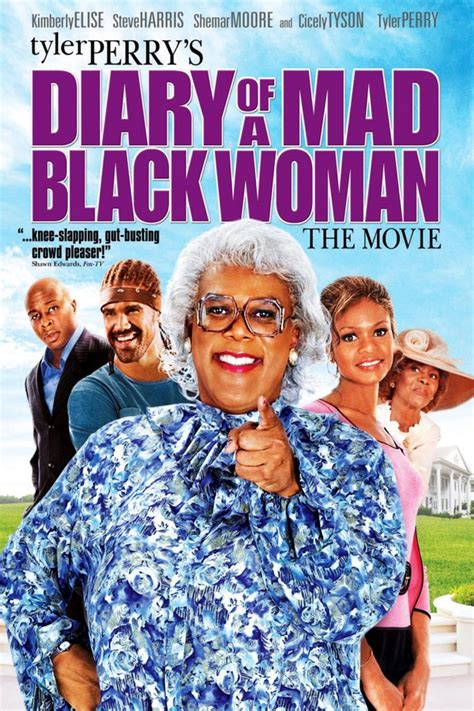
Diary of a Mad Black Woman

I know this is not a new movie, but I’d never seen it before. All I can say is, Tyler Perry really “gets” women. (Far more than Jean Hanff Korelitz does, now that I think of it.)

I did expect Madea to bring more action/solutions and not just comic relief, but interestingly, in this movie the solutions come from … God. I’m fine with that. Now before you go thinking that the frequent references to God mean this movie has an unrealistically rosy outlook on human nature … it’s also a revenge fantasy. Also, it’s got the usual Tyler Perry crude jokes, including Perry playing, not just cousin Brian and Madea, but also Madea’s pervy octogenarian brother.

The Last Stand

This film is very violent, very shooty-shooty-bang-bang. If you can tolerate that, it’s a great movie. It starts out looking like a crime/thriller flick. I didn’t realize until about 3/4 of the way through that it’s actually an updated Western. There is a noontime shootout on Main Street and everything, except instead of just the sheriff on one side and the outlaw on the other, there’s about a dozen people on each side.

There’s also a bonnet-wearing Texas granny who pulls a shotgun out of her knitting basket, which as you can imagine, I loved.

Me & Nora Ephron

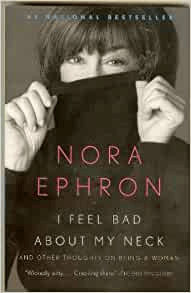
So, I finally read Nora Ephron’s iconic (?) I Feel Bad About My Neck. I bought it because it was on sale at the library table for $1 and, when I started browsing through, it did not fail to charm me.

IFBAMN came out, according to the cover flap, in 2006. At that time, I had been married for about five minutes and had no interest in crepey necks. Now, the topic is of mild interest because I am older and wiser. (So old! So wise!) It’s fitting that I picked up this book during the week before my birthday. Perhaps we can call this my I-am-within-sight-of-turning-50 post.

Ephron and I do not have a lot in common. Unlike me, she …

  • is at least ten years older than my parents
  • wrote the screenplays for Silkwood, When Harry Met Sally, Sleepless in Seattle, You’ve Got Mail (basically she wrote the screenplay for Meg Ryan’s career, it appears), Hanging Up, and Bewitched, among others
  • has been married three times
  • lives in New York City, and if this book is to be believed, pays money for things like manicures, pedicures, Botox, a semiweekly wash and blowdry, and hair color every six weeks

All of this puts our worlds pretty far apart.

(However, I would be remiss if I did not point out that Nora Ephron and I also have quite a few things in common:

  • both writers
  • both have been through labor
  • both kind of goofy
  • and somewhat cheap
  • and somewhat disorganized — me somewhat, her very, again if this book is to be believed)

Anyway, all that to say, even with our experiences being so far apart, I find this book of collected essays enjoyable and funny. I can only imagine how hilarious it must be to Ephron’s fellow New Yorkers.

And no, it is not all about necks. That is only the first essay. I am really glad, because there is no way anyone could sustain an entire book about their neck. The second essay, for example, is about how every time Ephron tries to get a new purse, the interior of it instantly becomes a disorganized Bermuda Triangle of Tictacs and Kleenexes and things, and it was this essay that really won my heart and convinced me that this New Yorker and I are kindred spirits.

Killers of A Certain Age: A Book Review

Three stars.

I picked this up with moderately high hopes. The protagonists are all sixty-year-old ladies who spent their youth as private assassins. I thought there would be more old-lady thoughts, but in the end, they mostly seem like 21-year-olds in 60-year-old bodies. So, the character development and themes disappointed a bit.

What did not disappoint was the research and the plot. Unlike some novels, where the premise is only half-developed, this one takes us on a very thorough ride. We get to see how the ladies got recruited, how they got trained, and to see a number of hits they did in their youth, in exotic locations throughout the world. These interleave with hits they are carrying out now, in their old age, in self-defense. There is not just one but many tense, intricate, detailed climatic action scenes. And it all works together into one big, overarching tale of betrayal. It’s like not just one, but all of the Mission: Impossible movies, in novel form. If this had billed itself just as a thriller, then these factors alone would cause me to give it four or five stars.

But unfortunately, the cover and premise promised not just Thriller, but a study of what it’s like to be a woman of a certain age. Have your goals changed? Do you miss what you were able to do in your youth, or are you content with that and ready to move on to something else? Have you left a legacy? Had any children? Are you ready to go?

No, none of that. One of the four women has married, but the only effect of her recent widowhood is to make her lose her nerve in survival situations. Another has married another woman; another is still chasing younger men at sixty. Meanwhile, the main character, Billie, never married or had children.

He was six years older than me and ready to settle down, build a life, make some babies. And no matter how hard I tried, I couldn’t figure out how to make myself small enough to fit into that picture.

page 309

So, Billie, you think making and raising people is a small life, huh? It is sooo much smaller than your life of traveling around the world killing people. You couldn’t reduce yourself to being a mom.

This quote pretty much encapsulates the book’s shallow yet heavy-handed feminism, and it is the reason I have bumped it down to three stars.

Finally Have that Five-Decade Plan

My ageProfessionClarification
early 20sMoronI still practice this profession on & off to this day.
late 20s to early 30sMissionaryLeast said, soonest mended.
31 onwardsMomAnother one that I haven’t given up.
early 40sMmmnovelistAnything for alliteration.
late 40sMagistrai.e., Latin teacher
old age (planned)Morticia Adams(A long-haired witchy-looking older woman that you don’t mess with)

What’s YOUR five-decade plan?

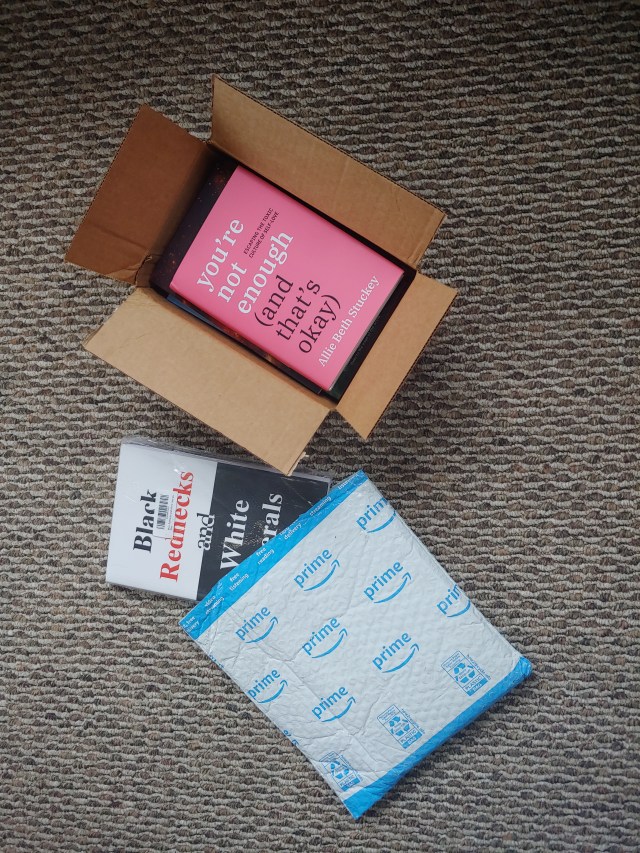
You’re Not Enough and That’s Okay

“If your self is the problem, how can your self also be the solution?”

Allie Beth Stuckey is a podcaster who speaks mostly to Millennial and Gen-Z aged women from a reformed Baptist perspective. She wrote this book to counteract the essentially Gnostic messages that are constantly being sent from all quarters to this demographic.

When Allie became a mom, it became obvious to her that young moms struggle with feeling inadequate as mothers and as people. There are a lot of reasons for this. One is that in our culture, motherhood is denigrated as a calling. Simply being a mother is not considered enough to make you an interesting, capable, intelligent person. Mothers are criticized no matter what they do. Another reason is that they are, in fact, inadequate. No one is really adequate to care for small children well while also maintaining a good relationship with a husband, and this problem is made worse by the fact that young women rarely receive any training in the domestic arts. Finally, we tend to feel overwhelmed when we are hormonal and sleep-deprived.

In response to this, a cottage industry has arisen that exists to affirm moms as follows: You are already doing great! This message comes from both secular and Christian sources. (Nominally Christian, though of course their theology leaves something to be desired.) Obviously, it’s a good business model to tell people they are already doing great. People like to hear that, and when the dopamine hit from the message inevitably wears off in the face of reality, they will come back for more, sometimes several times a day.

Allie uses her own experiences (being a mom, before that struggling with bulemia, and talking with hundreds of women) to apply some good Reformed theology to the following five myths. (She calls them myths, which is sort of polite. I would call them lies.)

  • “You Are Enough”
  • “You Determine Your Truth”
  • “You’re Pefect the Way You Are”
  • “You’re Entitled to Your Dreams”
  • “You Can’t Love Others Until You Love Yourself”

Obviously, these lies are not directed only at young women in our culture, and it’s not only young women that they are damaging.

Allie systematically shows how each of these creedal statements promises comfort and power, but ultimately, if we buy into it and try to implement it, delivers despair. She does so in her signature kind, personable way that is perfectly suited to her target audience. She quotes pertinent passages of Scripture (of which there are many) and shows us how the belief that we are enough in ourselves will trap us in an endless cycle of self-improvement and prevent us from turning to the one who is enough and who has the power to save and transform us, namely Christ.

Quote: Overheard During Labor

As the next contraction starts building, I grip onto Kate again. I’m starting to feel overwhelmed by wave after wave of pain, each one getting bigger and longer and stronger.

An eternity passes, then [labor nurse] Ann comes in again, this time accompanied by a male student midwife.

“Hmm. Still only four centimeters dilated,” she says to the student after examining me. “Minimal progress. Of course, there’s a much greater risk of a long and difficult labor with older ladies. The muscles of the womb don’t work so well.”

“Is everyone deliberately trying to undermine me?” I shout. “Has anybody got any positive words of encouragement here?”

“You’re doing a great job,” Ann says, unsmilingly.

The Cactus, by Sarah Haywood, p. 361