What’s your stereotype of “indie” (independently published) books? Is it a tame memoir that would interest only the author’s family? A bitter rant where the author finally gets to have their say? An amateurish sci-fi filled with cringe-inducing grammatical errors?
I’ve read all of these types. (And, for the record, my opinion is not the same about all of them. The family memoirs, in particular, will be valuable historical records one day.) But in case you didn’t know it, there is so much more to the world of indie books. Here are two indie authors I’ve discovered, both worth reading and each weirder than the last.
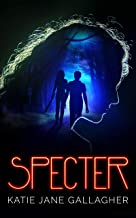
Specter by Katie Jane Gallagher
I discovered Katie right here on WordPress. She likes horror, which I didn’t think was really my speed, but I just had to buy her book to see the results of her self-publishing. The book is, in a word, professional. The cover, the formatting, the editing … it all looks and reads just like any high-quality YA paranormal book you’d pick up in a bookstore (or, in my case, a library). And no, it’s not a paranormal romance where the ghost is the girl’s love interest. (Thank God.) It just features a normal, smart high schooler who starts seeing ghosts. And, refreshingly, her parents are all right, unlike in so many YA books where the parents are either dead, clueless or part of the problem.
And the horror? Well, there are some horrible revelations at the end … but they didn’t turn out to be anything I couldn’t handle. Perhaps I’ve been toughened up by watching Stranger Things.
The Collision series by Rich Colburn
Full disclosure: I knew Rich before he wrote these books. He’s weird. (I honestly don’t think he’ll be offended if he reads that.) When, having not seen him for years, I heard that Rich had indie published a couple of books, I eagerly bought them. They are exactly the kind of books I would have expected from him, which makes them a little hard to describe.
From the Amazon blurb: “What if the spirit world was rampant with technology sophisticated beyond anything mankind has imagined? What if a sociopath got his hands on a powerful piece of this technology? What if you couldn’t die no matter how much damage your body sustained?
“Join a reluctant hero on his quest to discover what the heck he should do with his time now that he has unlimited power and the world as he knew it collides with the unseen world. Will demon-possessed biomechanical monsters kill everyone? Will there be enough coffee to last through to the end of the world? Will that play into our hero’s decision whether or not to bother saving it? These are questions we’ve all wondered about. Explore these and other important philosophical questions as you follow the adventure that was contrived to do just that.
“The Collision series offers a technological explanation for the supernatural. Human psychology, questions of life and death, and the nature of the supernatural play a critical role in the story of a man who becomes aware of the technology used by beings existing in higher modes of reality.”
The Collision books are slightly less professional than Specter. They could have used a second pass with an editor. But they are a joy to read because they are just so darned clever. To take a sampling of the chapter titles from Resolve:
Chapter 34: When an Unstoppable Force Meets an Immovable Object, It’s Best If They Avoid Eye Contact
Chapter 35: Omnipotence: It’s There When You Least Expect It
Chapter 36: I Love the Java Jive but the Java Jive has Found Me Wanting
Chapter 37: Seriously? Another Plot-Thickening Thread?
Chapter 41: It Came From My Parents’ Basement
Believe it or not, these titles are not just one-liners. All of them make sense when you read the chapter. I really don’t think a traditionally published book could have gotten away with chapter titles like this.
So now you are probably thinking that the Collision series is like the Hitchhiker’s Guide to the Galaxy. And it sort of is, if that book had been written by a Christian. But it’s not just metaphysics and humor. The book also becomes surprisingly poignant (in the context of all the weirdness), and also very horrifying and tense. Especially the scene in the parents’ basement. Also, be it noted that the monster made out of corpses in Stranger Things was familiar to me because an even more horrifying version had already roamed the pages of Formulacrum.
This man, his wife, their 2-year-old and their 6-month-old baby survived a tornado that took their entire house … except the concrete room where they were sheltering … which room they had recently bought the house for.
They had been in the house with the safe room mere weeks.
The dad had been in the safe room 20 seconds before the tornado hit.
“I’m just going to let the insurance handle it and trust in the good Lord,” says Andrew Philips.
You may be a prepper, but you’ll never be a prepper like this guy.
My boys and I have been memorizing the book of James. The whole second half of chapter 2 is taken up with a blistering discussion about how “faith” means nothing if it doesn’t express itself in actions.
Here is the beginning of it:
What good is it, my brothers, if a man claims to have faith but has no deeds? Can such faith save him? Suppose a brother or sister is without clothes and in need of daily food. If one of you says to him, “Go, I wish you well; keep warm and well fed,” but does nothing about his physical needs, what good is it? In the same way, faith by itself, if not accompanied by action, is dead.
But someone will say, “You have faith; I have deeds.”
Show me your faith without deeds, and I will show you my faith by what I do.
James 2:14 -18
Now, here it is translated into modern parlance by the musical genius Rich Mullins:
They say you should seek help if you’re depressed for two weeks or more. If you’ve never been depressed for two weeks, you haven’t been paying attention!
Andrew Klavan
(P.S. Don’t worry, Klavan is actually very supportive of people seeking help for mental health issues. Just the other day, on his show, he advised a letter writer to seek professional help because it sounded like the letter writer had an anxiety disorder.
Klavan himself has also benefited from professional counseling.
His only point is that two weeks is kind of a low bar. Of course, it depends upon the type and severity of the depression. But I take his point that this is a fallen world, and anyone who takes a serious look at it will be tempted to despair.)
Patrick was a Romanized Briton who was kidnapped as a teenager and spent several years as a slave in Ireland, which was then still pagan. Later he went back there as a missionary.
In this video, he appears as a talking icon trying to explain the Trinity to two sarcastic Irishmen.
Today’s post comes from chapters 4 and 5 of this book.
Writing is a human practice.
Of course it is possible to have a human society without writing, but the impulse to devise a writing system, looked at historically, may have been the rule rather than the exception.
This is counter-intuitive, of course. “Symbolic logic” seems like it ought to be unnatural to humans, especially if we are thinking of humans as basically advanced animals, rather than as embodied spirits. But if we think of mind as primary, everything changes. It’s telling that reading and writing are one of the learning channels that can come naturally to people, in addition to the visual, the audio, and the kinesthetic. But I’m getting ahead of myself.
Welcome to the third post taken from Lost Civilizations of the Stone Age by Richard Rudgley. Call this the writing edition. This post hits the highlights of Rudgley’s chapters 4 and 5, pages 58 through 85.
Nah, Ancient People Didn’t Write, They were Barbarians!
The idea of writing as an exception in human history has become dogma:
The proposition that Ice Age reindeer hunters invented writing fifteen thousand years ago or more is utterly inadmissible and unthinkable. All the data that archaeologists have amassed during the last one hundred years reinforce the assumption that Sumerians and Egyptians invented true writing during the second half of the fourth millennium. The Palaeolithic-Mesolithic-Neolithic progression to civilisation is almost as fundamental an article of contemporary scientific faith as heliocentrism. Writing is the diagnostic trait … of civilisation. Writing, says I.J. Gelb, ‘distinguishes civilised man from barbarian.’ If the Ice-Age inhabitants of France and Spain invented writing thousands of years before civilisation arose in the Near East, then our most cherished beliefs about the nature of society and the course of human development would be demolished.
Allan Forbes and Thomas Crowder, quoted in Rudgley, p. 75
Of course, the demolishing of our most cherished beliefs about the course of human development is exactly what, Rudgley is arguing, is going to have to happen.
In the last few chapters I have selected only a small number of the complex sign systems that have been preserved from prehistoric times. My concentration on the Near East and more particularly on Europe should not be taken to imply that such systems did not exist elsewhere in the prehistoric world. Far from it; investigations of numerous collections of signs are being undertaken in places as far afield as the Arabian peninsula, China and Australia. Millions of prehistoric signs across the continents have already been recorded, and more and more are being discovered all the time. … It no longer seems sufficient to retain a simplistic evolutionary sequence of events leading up to the Sumerian [writing] breakthrough some 5,000 years ago.
Rudgley, p. 81
Let’s look at these complex sign systems that Rudgley has mentioned.
The Vinca Signs
I was an adult before I ever heard the phrase “Old Europe.” I was doing research for a planned book, and I was surprised to learn that in southeast Europe (between the Balkans and the Black Sea), as early as 4,000 or 5,000 BC, there were not only cities but a writing system (undeciphered) known as the Vinca signs. It turns out that these cities and this writing system were probably part of a culture that obtained over much of Europe before the coming of the Indo-Europeans, which is called Old Europe. This is the culture that Marija Gimbutas believes was “the civilization of the goddess.”
Just as a reminder, these dates for the Vinca culture are before the very first human cities and writing are supposed to have arisen, in Sumeria in Mesopotamia, about 3,000 BC.
Perhaps I didn’t hear about the Vinca signs in school because they were only discovered in Transylvania 1961. (I was born in 1976, but we all know how long it takes new archaeological findings to get interpreted, integrated into the overall system, and eventually make it into school textbooks.) After being discovered, the signs were assumed to be derived from Mesopotamian cultures such as Sumer and Crete, because it was accepted dogma that writing was first invented in Mesopotamia. Later, the tablets on which the Vinca signs were discovered were carbon-dated and found to be older than the Mesopotamian writing systems. This led to a big disagreement between those who wanted to believe the carbon dates, and those who wanted to believe the more recent dates for Old European archaeological sites, which were then conventional.
Then, in 1969, more, similar signs were discovered on a plaque in Bulgaria and dated to be 6,000 – 7,000 years old. By this time, archaeologists were beginning to accept the carbon dating of these Old European sites. But since they still did not want to admit that writing might have been invented before Sumer, most of them decided “[the signs] could not be real writing and their apparent resemblance was simply coincidental.” (Rudgley p. 63)
An archaeologist named Winn analyzed the Vinca signs and while he is not willing to go further than calling them “pre-writing,” he concludes that they are “conventionalised and standardised, and that they represent a corpus of signs known and used over a wide area for several centuries.” (Rudgley 66)
Meanwhile, Marija Gimbutas and also Harald Haarmann of the University of Helsinki both feel the Vinca signs are true writing and that they developed out of religious or magical signs, not out of economic tallies like the Sumerian alphabet.
Haarmann notes that there a number of striking parallels between the various strands of the pre-Indo-European cultural fabric – especially those related to religious symbolism and mythology. Among these common features is the use of the bull and the snake as important religious symbols. In the case of the snake it is a form of the goddess intimately intertwined with the bird goddess motif in both Old European and later Cretan iconography. The bee and the butterfly are also recurrent divine attributes, and the butterfly is represented by … the double ax. Haarmann sees the goddess mythology of Old Europe echoed in these motifs that also feature prominently in the ancient civilisation of Crete. He then traces the links between the Old European script – as found in the Vinca culture – and later systems of writing, particularly those of Crete.
Rudgley, pp. 68 – 69
Rudgley’s Figure 15 (p.70). On the left are the Vinca signs, on the right is Linear A from Crete.
Ice Age Signs
There are quite a number of symbols that appear on artifacts or are associated with paintings from the Neolithic and even the Palaeolithic period. These include crosses, spirals, dots, “lozenges” (ovals), and the zigzag, which is very common and seems to have been used to represent water. (By the way, note the zigzags among the Kachina Bridge petroglyphs.) “The discovery in the early 1970s of a bone fragment from the Mousterian site of Bacho Kiro in Bulgaria suggests that the use of the signs may date back to the time of the Neanderthals. This fragment of bone was engraved with the zigzag motif …” and apparently on purpose, not accidentally in the course of doing some other repetitive task. (Rudgley 73)
“The single V and the chevron (an inverted V) are among the most common of the recurrent motifs in the Stone Age.” (Rudgley p. 74) Gimbutas, of course, interprets the V as a symbol for the female genitals and/or Bird Goddess, but it could be just … you know … a symbol.
Archaeologist André Leroi-Gourhan has interpreted the many signs found at various Palaeolithic cave art sites not as a form of hunting magic (contra previous interpretations), but as a symbolic system. “Leroi-Gourhan admitted to us shortly before his death, ‘At Lascaux I really believed they had come very close to an alphabet.’” (Rudgley p. 77)
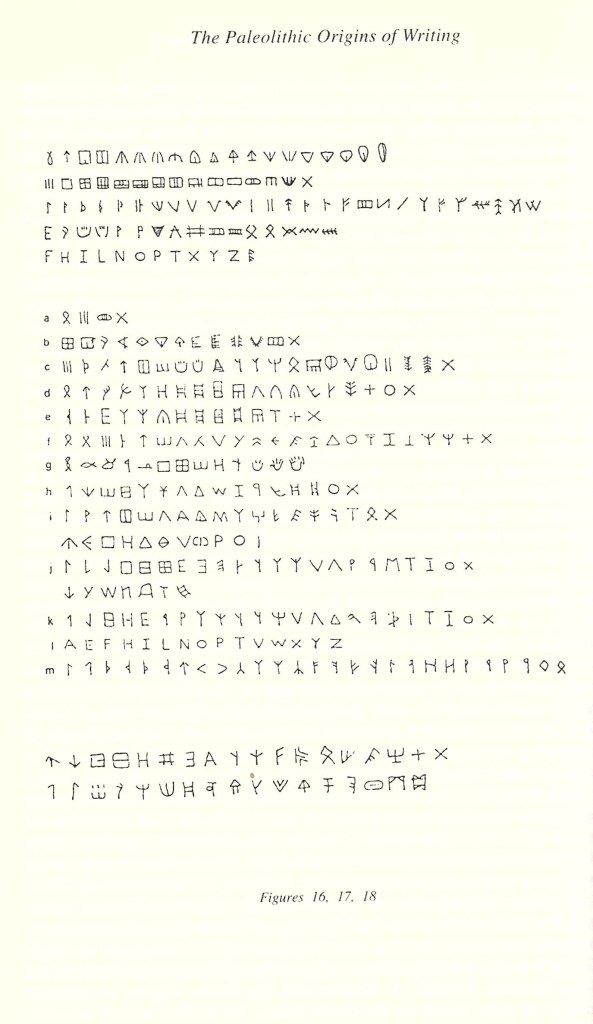
Rudgley’s Figures 16 – 18 (p. 78). Top paragraph: some of the Franco-Cantabrian (Stone Age) signs. Middle paragraph: a – hieroglyphic determinatives; b – Sumerian pictoral writing; c – Indus Valley; d – Linear A; e- Linear B; f – Cypriote; g – Proto-Sinaitic; h- Phoenician; i – Iberian; j – Etruscan; k – Greek (Western Branch); l – Roman; m – Runic. Bottom paragraph: some of the signs found on oracle bones in very ancient China.
But Can You Prove It’s Writing?
Every time some symbols are discovered that are so ancient they strain belief, anyone who doesn’t want to accept them as writing can easily go in to a number of calisthenic moves to cast doubt on this. If the item the signs are found on is in poor condition, they can question whether the marks were even intentional. Perhaps they were accidental scratches, the product of some other activity. If the marks are undeniably made by people, they can be dismissed as doodles. The Vinca signs, when first found, were speculated to have been copied randomly from Mediterranean signs by people who believed these things had mysterious power, but did not understand their meaning. Rudgley also notes that the Old European signs have been interpreted as purely magic symbols, as if a magical intent were to make them non-writing.
In short, any time we are presented with a complex system, there are always a million ways to get out of attributing it to a mind. This is doubly true if we aren’t able to interpret its meaning, but you will even see people do this with messages that they ought to be able to understand. Of course, it can also work the other way, where people see meaning in complex patterns where it wasn’t intended. Often what it comes down to is whether we want there to be a meaning there. Do we, or do we not, want to be in contact with another mind? If for whatever reason we don’t, we can always find a logical way to avoid that contact.
So in the case of apparent writing systems that we haven’t cracked and probably never will, our attitude towards them is going to depend heavily on what we believe about ancient people’s minds. Were they basically like ours, or were they different, animal? We will see more writing systems if we are expecting that they came from people. If we are not expecting to encounter people, then nothing is going to convince us that these are writing systems.
Was Adam a Writer?
My mind was blown, while taking an Old Testament Backgrounds course years ago, when I read an essay that asserted that Adam was able to write and in fact had left a written record for his descendants.
This idea seems completely loony on the face of it … until you realize that the only reason it seems loony is that we are assuming that writing is a recent, unnatural development, the product of tens of millennia of human cultural evolution, and not a characteristic human activity that is, so to speak, wired in.
The essay interpreted the early chapters of Genesis in this way. There will be a short historical record, followed by the phrase “the book of [name],” indicating that the passage immediately preceding was by that author.
Passage
Recounts
Closes with
Genesis 1:1 – 4:26
Creation (in poetry), fall, Cain and Abel, some of Cain’s descendants, Seth
Gen. 5:1 “the book of Adam”
Gen. 5:1b – 6:8
Recap of creation of Adam, Seth’s descendants up to Noah and his sons, Nephilim, God’s resolve to wipe out mankind, God’s favor on Noah
Gen. 6:9a “the book of Noah”
Gen. 6:9b – 11:9
Building of the ark, the Flood, emerging from the ark, the Table of Nations, the Tower of Babel
Gen. 11:10 “the book of Shem”
Gen. 11: 10b – 11:26
Genealogy from Shem to Terah and his son Abram
Gen. 11:27 “the book of Terah”
Gen. 11:27b – 25:18
Terah moves his family to Haran, Terah dies, a whole bunch of stuff happens to Abram, death of Sarah, Isaac finds a wife, Abraham dies, genealogy of the Ishmaelites
Gen. 25:19 “the book of Abraham’s son Isaac”
Gen. 25:19b – 37:1
Jacob’s entire life, death of Isaac, genealogy of Esau
Gen. 37:2 “the book of Jacob”
In Genesis, the author’s name comes after the notes he left.
I realize this might be a lot to accept. It’s just food for thought. It does explain why it says “the book of _________” (or, in my NIV, “this is the account of __________”), after the bulk of that person’s story.
Get it? Get it?
(By the way … for those wondering about the title of this post … prostitution is referred to as “the world’s oldest profession.” Erma Bombeck, mother and humorist, has published a book hilariously titled Motherhood: The Second Oldest Profession. The title of this post references those two, because the post is about the fact that writing is very, very old. I don’t mean to imply that a writer’s life has any necessary connection to the other two professions, although of course this does invite all kinds of clever remarks.)





 Out of Babel Books