Some time ago, Rachael requested in the Comments section of my Dinosaurs post that I post a picture of the Leviathan. At the time, I thought that I didn’t have time to do one. (I’ve gotten away from drawing and painting in favor of home schooling, knitting, and a writing career.) But then I realized I had on hand a watercolor that I had done years ago which includes the Leviathan.
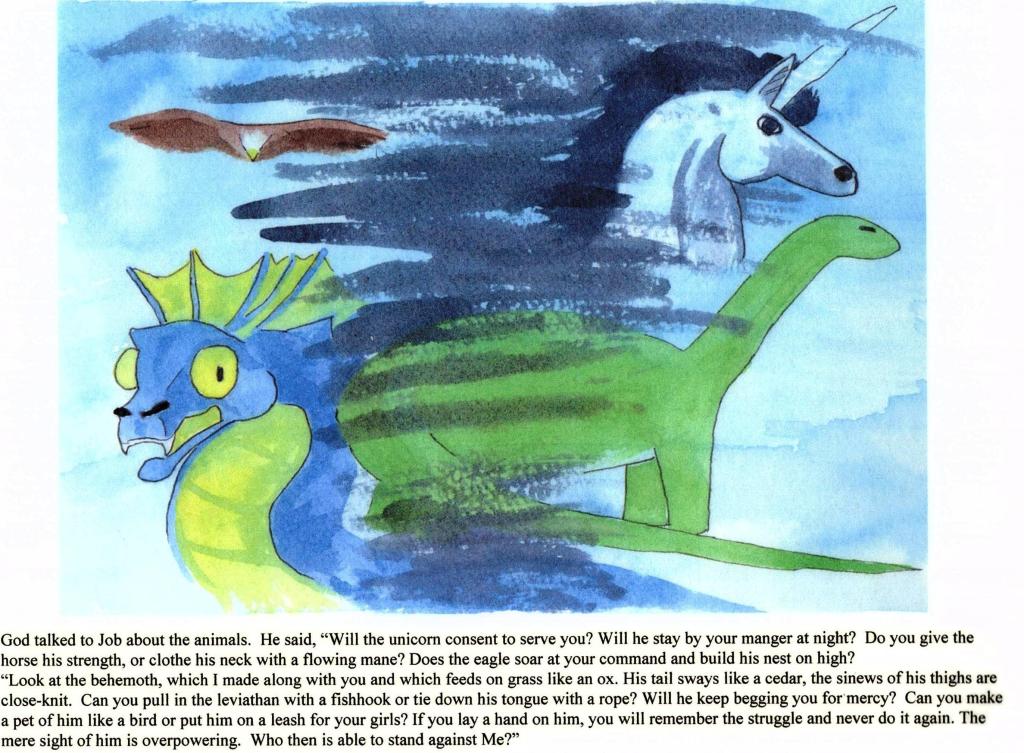
The image below is from a version of the Book of Job that I did for my kids when they were little. I made it because there simply were no children’s books that accurately summarized the Book of Job. It’s not a popular topic in the first place, and even when it is dealt with, it tends to be handled very moralistically as being all about Job’s patience and righteousness. But that’s a rant for another day.
The reason the animals are portrayed as being in a tornado is that God “spoke to Job out of the whirlwind.” My son, at the time, was equal parts fascinated and terrified by the idea of tornadoes. The animals shown are unicorn, eagle, behemoth (the sauropod) and, in the lower left corner, Leviathan. (I include a unicorn because the Septuagint, the Greek translation of the Old Testament, mentions “monoceros” or “unicorn” where some English translations render “wild donkey” or “wild ox.”)
I must admit this Leviathan owes more to C.S. Lewis’s description of the sea monster in The Voyage of the Dawn Treader. I’ve portrayed it as a deep-sea creature. There is no hint of fire breathing or scales bumpy enough to leave an impression in the mud. Sorry, folks.
Do you feel uncomfortable with Romans at your back?
 Are you thinking this is not exactly what you’d planned?
 Are you thinking, This looks bad, but someday soon He’ll see
 I was right to use my knowledge of Gethsemane.

 Possible you don’t recall what, months ago, He said:
 that the Christ must first be killed and then rise from the dead.
 In the sacred city He’d be turned in to the priests,
 then to the Gentiles to be killed – do you not feel unease?

 Just hours ago He broke the news that He would be betrayed.
 You’re certain He did not mean you … but why are you afraid?
 If you would only think it through!  But you’re set on your track,
 although you look uncomfortable with Romans at your back.

 Don’t think about it, Judas.
 You’ve begun – now see it through.
 There’ll be time for thinking later when you’re swinging from a noose.
Again He took the twelve aside and told them what was going to happen to Him. “We are going up to Jerusalem,” He said, “and the Son of Man will be betrayed to the chief priests and teachers of the law. They will condemn Him to death and will hand Him over to the Gentiles, who will mock Him and spit on Him, flog Him and kill Him. Three days later He will rise.” Mark 10:32-34
As soon as Judas had taken the bread, he went out. And it was night. John 13:30
Let’s all have a moment of silence for Notre Dame cathedral.
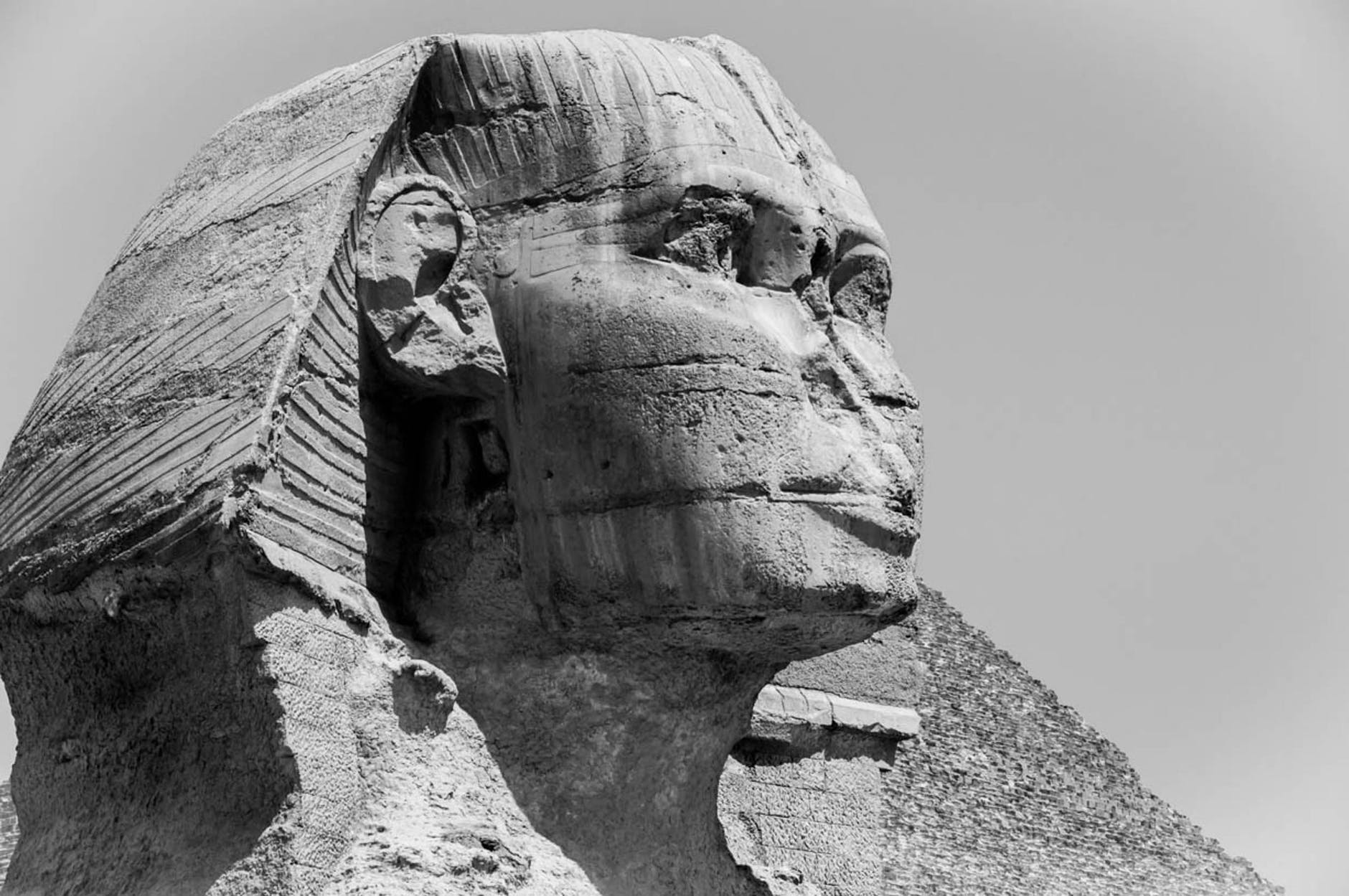
The reason there’s a picture of the Sphinx on this post is that watching Notre Dame burn feels similar to watching the Sphinx’s nose get knocked off.
And during Easter Week, too.
“Heaven and earth will pass away, but my words will never pass away.” Matthew 24:35
“God is our refuge and strength,/an ever-present help in trouble./Therefore we will not fear, though the earth give way/and the mountains fall into the heart of the sea.” Psalm 46:1 – 2
Another WordPress blogger, BlackSheep, was posting last week about “weird coincidences.” He posed the question, “Do you think the universe reveals things to us serendipitously, or are the things that happen to us just due to mathematical chance?”
When I thought about this question,
I realized that such coincidences happen to me regularly. This is especially strange because I don’t believe in them.
In fiction, I expect thematic
unity. If coincidences happen, I expect
there to be a good narrative reason for them and I expect them to move the
story forward. But this is not fiction,
this is real life. Coincidences don’t
happen, and events don’t organize themselves according to theme.
Except that they do, and … they do.
I have come up with the following handy taxonomy of weird coincidences for your enjoyment. Afterward, we’ll talk about possible causes.
1. Striking But Trivial
Often, like BlackSheep’s example
with the pizza, coincidences might be striking but they seem trivial and they
lead nowhere in particular.
For example, once I was passing
through Yellowstone and I knew I’d be seeing
my sister soon. On a whim, I bought her
a stuffed raccoon. There was absolutely
no history involving raccoons between her and me; I just thought it was cute.
When I saw my sister, I said to
her, “I have a gift for you in the car.”
And she said, “Is it a raccoon?”
You can’t tell me that wasn’t
weird.
Nor could you convince me that it
means anything. (Other than that maybe my sister is a mind reader. But why did she read my mind about that, and
not about much bigger things that I’d rather have had her instantly understand?
Who knows?)
2. Foreshadowing Life Events
Perhaps, while reading above, you
objected to the phrase “trivial.” “How
can we know which events are trivial?”
you ask. Well, good point. Sometimes a seemingly minor coincidence looks
more significant (though still kind of baffling) in retrospect because of how
things turn out.
When I was young and eligible, I
met this guy. He heard I was from Idaho (a relatively
rural state with a relatively low population).
He said, “Oh, you’re from Idaho? Do you know ____________?”
And just as I was preparing to say,
“Not all Idahoans know one another, you know,” he said the name.
And it was of a writer I admired and had actually met.
Furthermore, I ended up marrying
the guy who asked the question.
And his first name is the same as
my father’s.
Now, the tricky thing about these
foreshadowing coincidences is this. They
don’t tell you as much as you’d think.
They don’t serve very well as
guidance from God, at least not if they are your sole source of it, because
they don’t happen often enough to guide you through every important decision in
your life.
They are not a substitute for
wisdom. You still have to take into
account Reasons. I’d’ve been a fool to
have married the guy on the spot.
Sometimes these coincidences do,
along with a host of other factors, seem to confirm you are taking the right
path. But even then, it is possible to start down the right path and at the
same time be making serious mistakes that will come back to bite you
later. And the stupid coincidences don’t
give you any warning about your blind spots.
At least not in any form that you can use.
So what are these foreshadowings
for? I don’t know. Perhaps their occurrence is not intended but
is more of a natural law analogous to the laws of physics … “Future events cast
backward shadows” or something like that.
But that’s getting into causes, and I’m getting ahead of myself.
3. When a Theme Emerges (over a short period of time)
This is when your attention keeps
getting drawn to a particular theme, but it’s coming from different sources
that are unrelated to each other. For
example, you are reading (or writing) a novel that has a particular theme, and
then you also hear a radio broadcast on the same topic, and a friend also
brings up the theme over lunch.
Granted, you are the missing link between all of these. Maybe the reason the theme keeps coming up is
that you keep bringing it up, or seeking it out. But I think we’ve all had experiences where
the theme keeps pursuing us, as it were, from the outside.
Christians will tell you that this
happens a lot with Scripture. The Bible
has a lot of verses and a lot of themes, as anyone who studies it
knows. So it does seem striking when,
say, you have been memorizing a passage with your kids one week, and then on that
Sunday, the sermon includes a quote from that
very verse. But this happens often.
The Psalms, by the way, are great for this. There are 150 Psalms, most of them short. This means that if you read five a day, you can read through all of them in a 30-day month (skipping most of Psalm 119, the really long one). And I can tell you that if you do this, on about 25 days of that month (or possibly all 30), one of the Psalms you read will have a direct bearing on a situation you are in. And this is not because the Psalms are filled with a lot of vague language that could be applied to anything. I mean, some of them are worship, some are laments, some are imprecatory (calling down vengeance on one’s enemies), some are historical or prophetic. Many are cries for help. But these different types are not evenly distributed throughout the book in such a way that you’d be sure every day to get one of each.
4. When People Become Magnets for Certain Events
This can be a really tragic
one. We’ve all heard anecdotally that
once someone is struck by lightning and survives, they are more likely to get
struck again – and again. I don’t know
whether that’s been verified, but I do
know of two families each of whom experienced two or more horrible,
life-changing car crashes within a few years.
And it wasn’t because they were drunk driving or anything like that. And
they lived in rural, non-high-traffic areas.
You often hear about this
phenomenon in cases where someone repeatedly runs into abusive situations –
say, at home, then in another home, then at church, then at work. Or at job after job. The temptation is to seek the reason for this
recurrence in the behavior of the victim: to say “She keeps marrying the same
kind of guy” or “He has problems with authority.” And there might be something to that,
sometimes, sure. But after looking at
the families with the car crashes, I think there might be more going on. It’s as if there is such a thing as a luck
switch, and God help you if yours gets flipped in the wrong direction.
Unfortunately, all the examples I
could think of for people being “event magnets” were bad ones. Does anyone know of a case where a particular
person seemed to attract a particular kind of event that was either good,
neutral, or just funny?
Causes for Weird Coincidences
Ok, now back to the question asked
by BlackSheep.
“Do you think the universe reveals things to us serendipitously, or are the things that happen to us just due to mathematical chance?”
Mathematical Odds plus Pattern Recognition
We all know that the human mind is
predisposed to detect patterns. This is
useful, as patterns occur in the actual world and we couldn’t act if we
couldn’t detect them. In fact, experts on culture crossing will tell you that
it is difficult to really see an object unless you know what you are looking
at, and it is difficult to repeat back a string of sounds unless you know what
they mean. Our very perception is tied
up with patterns. We literally can’t
function without them.
But equally, we all know that this urge to detect patterns is so strong that it sometimes leads us astray. Every pattern that we perceive also forces us to ignore data that don’t fit it. Everyone has heard of Confirmation Bias. Thomas Kuhn in The Structure of Scientific Revolutions points out that even scientists, supposedly very data-driven, will not give up on a previous theory unless they have been presented with a compelling alternative. In other words, we’re not willing to say “there’s no pattern here” once we have seen one. Instead, we will refuse to abandon a previous pattern unless there is a new one for us to hang our data on.
In some cases, our expectation of a
pattern will actually cause us to perceive data that isn’t there, simply
because it fits the pattern. This is
especially true when interpreting our spouse’s tone of voice.
I think pattern recognition plus mathematical odds might account for some of the weird coincidences we’ve discussed, particularly the thematic ones. Once our minds have been awakened to a topic, we start to notice it more often, or even read it into things that are only tangentially related to it. Perhaps such “coincidences” were happening around us before, but we didn’t perceive them.
Pattern Recognition Ain’t the Villain, Though
However, let’s not go crazy with
assuming that pattern recognition can only
serve to deceive us as to the nature of the world. It can start to sound like this whenever
people get talking about Confirmation Bias.
It’s as if this weird quirk of the human mind keeps us from seeing the
world “as it really is.” But actually,
pattern recognition often helps us to
perceive things, as when we notice that our kid is always grumpier when he’s
hungry or that the sun always rises in the East. Just because the drive to perceive patterns
sometimes deceives us, does not mean that the world does not operate according
to regular rules. It is not a completely
random world we live in. So, our
pattern-recognizing minds are not alien to this world, but are designed to
operate well within it.
Also, despite our strong predisposition to see only what we expect and understand, we also have minds that are designed to meet and grapple with the unknown. (Jordan Peterson has a lot to say about this. According to him, the left brain basically handles the known, and the right brain the unknown.) We know that we are capable of learning surprising new facts, and sometimes we even seek out this experience. In fact, that is almost the definition of the “weird” in “weird coincidences.”
The Universe is Mind, Not Matter
Let’s review two facts: our minds are capable of moving out into the unknown, and our minds are predisposed to seek patterns. This opens up the possibility that our experiences, including weird coincidences, might represent previously unknown patterns. That is, patterns not coming from our own minds but from somewhere else.
Now, this will be hard to swallow
if you believe that the only real thing is matter. On this view, all of matter is controlled by
random movements at the quantum level. On
this view, the universe really is a random place and patterns are not real
EXCEPT in the human mind.
All of us who have received a modern Western education believe that at some level. That’s why I said above that coincidences happen to me “even though I don’t believe in them.” I got a normal public-school education, so there are some materialist assumptions baked into my thinking.
So that’s one level of our thought.
But on another level, none of us
really believe the materialist/randomness/mathematical odds explanation. We know
that minds are real. This is confirmed
by our daily experience.
If this is a universe in which
human minds exist, then it must be a universe in which mind is a real
thing. Therefore patterns are real. Therefore themes are real. Even if they exist “only” in human minds,
they are still real. They are in the
universe.
I would go so far as to say that
the basic unit of reality is not molecules, but mind. (That alliterates, which is why I chose it
rather than “not atoms but mind” or “not quarks but mind.” Or whatever tinier thing down from quarks has
since been discovered.)
In the video below, you can see Stephen Meyer make this case to Ben Shapiro. (It’s an hour long, but well worth watching. If you don’t have the time, he makes his point about mind in the teaser in the first few seconds of the video.) Our genes are, essentially, extensive libraries of information, digitally coded. In all our experience, nothing has ever produced a digitally coded message – let alone a library’s worth of messages – except for a mind.
Now, Christians would say that the ultimate mind – the Mind behind all minds – the medium in which the universe exists – is the Mind of God. I think, for many different reasons, that this is a better explanation than trying to say that “the universe” itself has some kind of emergent mind. But for the purposes of our discussion about coincidences, it’s doesn’t really matter whether you call the Mind God. It’s enough that you accept that mind is a real feature of the universe.
Because if you accept that, then it follows that embedded in the universe itself could be things like: themes, goals, purposes, design, patterns, intent. Stories. Maybe even jokes, which is what some of these weird coincidences resemble more than anything.
I said above, “This is real life, not a novel.” But – surprise! – real life is actually a lot like a novel after all. It has mind and meaning. It might even be one big story, too big for us to perceive. So maybe that’s why things sometimes happen to us that, if you saw them in a movie, you wouldn’t believe them.
Of course you doubt yourself. All grown people do. In fact, I don’t entirely trust you if you don’t.
Here is the latest thing that made me doubt myself. It starts out with Jordan Peterson classroom footage, but ignore that. At 9:30, Dave Rubin and Jordan Peterson start discussing archetypes in movies. At about 13:15, Peterson says, “The artist shouldn’t be able exactly to say what it is he’s doing.”
That gave me pause. Sure, I’m a pantser, but this isn’t about pantsing versus plotting. It’s about whether you are primarily telling a story, or primarily illustrating an idea. And anyone, plotter or pantser, can do either. This made me ask myself, I am too heavy on theme? Are any of my characters behaving less like people and more like embodiments of an idea that I love or hate? Good questions to ask.
What have you doubted lately and how are you dealing with it?
We will have our regularly scheduled post on Friday as usual, but I wanted to let you know about some cool resources I’ve discovered before I move on to my next book or theology crush and forget about these.
Brian Godawa writes novels that are sort of similar to mine, but sort of … really different. They are based on some of the same research and like mine are speculative, but they are much more cinematic, featuring lots of action scenes and witty banter.
In the link above, you can find a five hour (!) Youtube interview in which Godawa explains preterism. Preterism is an approach to Biblical prophecy that holds that most if not all of the predictions found in Matthew 28 and in the book of Revelation were predictions about Rome’s destruction of Jerusalem in AD 70, and were actually fulfilled then. This is an exegesis that many people haven’t heard of, because usually the people who talk the most about prophecy are coming from a Dispensationalist perspective.
You don’t have to listen to the whole five hours, but it is not boring. I have been listening my way through it while I do various chores. Godawa explains how preterism can be true even though Revelation uses terms like “the great tribulation,” “the end of all things,” “coming in the clouds,” etc. The video is especially fun because Godawa has come late to preterism. As he explains, he himself has held just about every other view of biblical prophecy that is out there. The host, Josh Peck, is a futurist not a preterist but he is extremely humble and enthusiastic, which makes the interview fun to listen to.
J.K. Rowling spent a long time planning out the entire Harry Potter series before she wrote it. She used a lot of symbolism and was influenced by some of the Great Books. John Granger’s (no, not that Granger’s!) delightful book Harry Potter’s Bookshelf walks us through the layers of meaning in the Harry Potter series. Would you believe that Harry Potter bears similarities to The Divine Comedy, Jane Austen’s Emma, and Jonathan Swift’s Gulliver’s Travels? In addition to many others? If this interests you, go out and get a copy of this book.


 Out of Babel Books