OK, that might be an exaggeration. The “endorsed” part, I mean. Not the “great.”
Andrew Klavan writes hard-boiled crime novels. Sometimes they have supernatural elements in them too. I recently discovered Klavan and have started reading through his work. Within the last week, I read Damnation Street. And it is pretty hard-boiled, let me tell you. Lots of violence, lots of language. A keen sense of human sin nature and human limitations.
The hero detective in Damnation Street, however, has a deeply buried romantic heart. And he is very intuitive in his approach to detective work. Here is a passage that describes how he operates:
[The detective, Weiss] wasn’t even sure he was trailing the right guy. It was just one of his Weissian hunches that had brought him here. And while his hunches were almost always right, he almost never trusted them. They were too vague, too unscientific. He wished he could write out the facts on a whiteboard or something and look them over and tap the pen against his chin and reach his conclusions through logic and deduction. But he never could. He just knew what he knew, so he never felt certain he knew it. (pp 77 – 78)
In fact, Weiss is trailing the right guy. And later, on page 91, we get this line:
The truth came to him in that flashing way the truth had.
That’s when he realizes he’s been wrong in certain of his assumptions about the man he was trailing.
OK, so maybe this is not endorsement of pantsing, but it’s certainly a great description of it.
Damnation Street, by Andrew Klavan, published 2006. Harcourt, Inc.
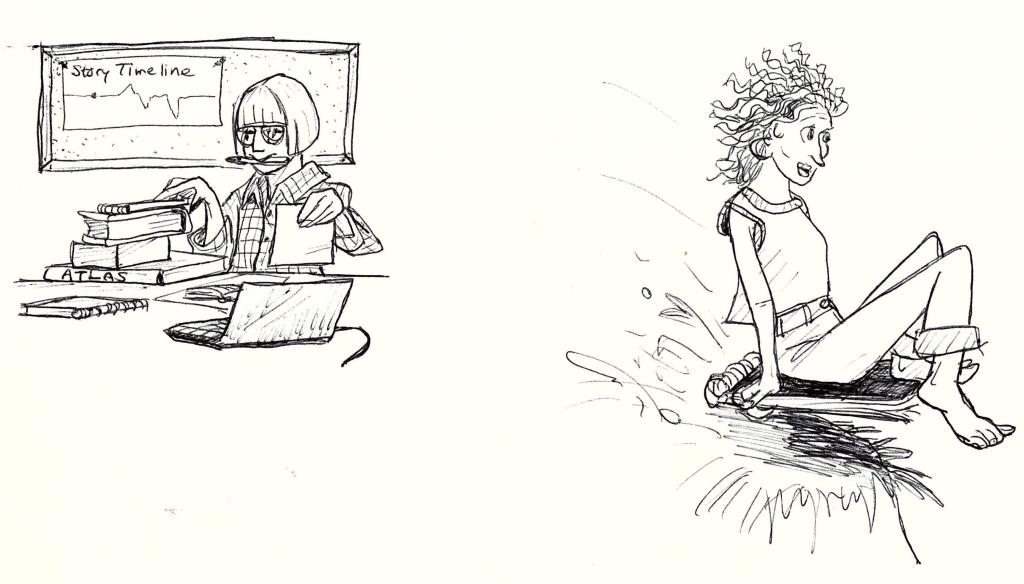
Behold these awful stereotypes of a plotter and a pantser!
Of course there’s no one right way to do it.
If you hang around writerly sorts, you will hear them talking about plotting and pantsing. Plotting means you plan out your entire novel before starting to write it. You make an outline. You decide what’s going to happen chapter by chapter. Obviously, you do any necessary research before starting to write. The term pantsing comes from the phrase “fly by the seat of your pants.” With pantsing, you might have done some research and you might have a general idea where the story is going to go. But you don’t outline. You just dive in, let the story and characters take over, and record what you see happening. You are just along for the ride, like the lovely lady above on the right side of the picture.
Both methods have their advocates. Both methods even have a book which will tell you how to do the method. I have read neither of these books, but have heard them recommended by other authors. For pantsing, there is Writing Into the Dark, by Dean Wesley Smith; and for plotting, there is Take Off Your Pants! by Libbie Hawker. (How can you not love that title?)
There’s No Right Way, but This Is the Right Way
Perhaps anyone can learn to plot … or to pants. Nevertheless, I think that a strong preference for one or the other is a consequence of the way a person’s brain is wired. This explains why people’s reaction when they hear about the other method (whichever the other method is), tends to be something like, “You mean there are people who live this way?”
Pantsers, for example, tend to sound as if they think pantsing is inherently spiritual. It’s about sensitivity to your characters; it’s about trusting your subconscious and the story itself. It’s about listening to reality, for crying out loud! Writers are people who listen! They don’t impose!
I am thinking here of two of my favorite writers: Anne Lamott and Stephen King. I love Lamott’s book Bird by Bird, and King’s On Writing. Bird by Bird does contain some passages that make it sound (unintentionally, I am sure) as if writers are more mystical or wise or something than the general population. King, meanwhile, believes strongly that you have to let your characters lead. He never plots; he thinks of an intriguing or difficult situation, puts his character in it, and then sits back and lets it play out. Because he doesn’t plan a rescue for his characters, horror usually follows.
I haven’t read as much writing advice by plotters, so I’m not as familiar with their besetting misconceptions. It seems to me, based on little comments that I have seen here and there based on a “how to write a novel” book, written by an editor, that I read many years ago, that plotters have the impression that if you don’t outline, you won’t have a good plot. Nothing will happen in your story. As one person put it, no amount of revision can make a book good if it was a weak story to begin with.
In short, and to make a huge generalization that I will no doubt regret later, diehard pantsers tend to feel that plotting is immoral, whereas diehard plotters tend to feel that pantsing is incompetent.
But Is There Such a Thing as “Pure” Plotting or “Pure” Pantsing?
Probably not.
I can only speak from the pantsing side (in case you haven’t guessed). I am an incurable pantser. But this doesn’t mean I never do any research or plan anything out. When at the writing desk, I tend to look more like the gal on the left. I don’t outline, but to keep things consistent I am forced to make timelines, name and age charts, and so on. I keep research notes and maps handy. It’s just that these things are following the story, not preceding it.
In the same way, I imagine that even those who thoroughly plot spend time listening to their characters so that the emotions ring true. Who knows, perhaps they even change their outline from time to time in response to a character’s wishes or the changing currents of the story.
So the supposed down side of each of these methods is mitigated by the fact that writing is an iterative process and that writers mix in elements from each.
Why Am I A Pantser?
I just am. I am constitutionally unable to make a book outline first and then have that outline actually be the way the story goes.
I might have a general idea of what I think is going to happen (and sometimes it does). But half the time, by the time we get there, things don’t go down that way. The characters have been changed by their experiences and they don’t react the way I expected. Or, they react much more strongly than I expected and do some fool thing that the story then has to accommodate.
This doesn’t make me more spiritual or, God forbid, smarter than the plotters. If anything, it might be the reverse. When my story surprises me, it’s because my subconscious is working out plot points that my better organized fellows are able to do intentionally, with their conscious brains. It may be true that plotting results in twistier, more intricate plots. I’d do it if I could, but I can’t.
In fact, I’m not even able to write a non-fiction piece from an outline. If an outline is required, I do some discovery drafts, let the structure emerge, and then outline it afterward. That’s how pantsy I am.
Luckily, Stephen King is there to remind me that it is possible to be a competent and prolific writer by pantsing.
Now, how about you? Even if you don’t write novels, I’ll bet you plot or pants your way through life. And I’ll bet that whichever you do, the other way seems just wrong.
Also, when you are reading a book can you tell which kind of writer the author is?
No, authors don’t kill off your favorite character just for kicks. It’s usually because the story demands it. But why? Why should any story demand such a thing? Unfortunately, it has to do with the spiritual structure of reality.
Jessica McAdams explains why in this recent article at Tor.com. “The defining feature of fantasy is the reality of the supernatural within the narrative …” If, like me, you think that’s a super compelling first line, then follow the link and read the rest.
I say this without any snark. This line – “I like to write about misfits” – has been used by some writers I really respect. They are not stupid. They are good writers. But I don’t think it’s a helpful way to describe your work, because it tells me so little.
Common “Misfit” Tropes in Fiction:
the girl who is plain or fat
the boy who is small, weak, or nerdy
the orphan or stepchild
the sensitive, misunderstood artist
the misunderstood villain (or werewolf or vampire)
the unremarkable teenager who discovers s/he has secret powers
the person who stands out because of their race
the gifted cop/soldier/agent who is forced to go rogue
the courageous person who goes against received wisdom (whether that is political, scientific, religious, artistic, or whatever)
the drag queen
That’s just off the top of my head.
When you tell me that your writing is unusual because you write about about misfits, my mind immediately goes to these tropes. There’s nothing wrong with these tropes (I like them), but stories featuring a “misfit” are not unique.
Using the word could even mask the uniqueness of your writing. For example, my eyes glazed over when a fellow writer described his novels as having misfit main characters. I was not expecting what he said next … that one of his books has a dragon as a main character, and another has a teddy bear. (These are books for adults.) The word “misfit” actually alienated me, for reasons I will describe below. The phrase “teddy bear main character” got my attention.
We Are All Misfits
Listen up, fellow writers: Everyone feels like a misfit!
It is rare to meet someone who has always felt comfortable in their own skin. That goes double for writer types.
In fact, that’s the reason that misfit characters are so appealing. Because the vast majority of people don’t feel as if they belong, misfit characters make them feel understood. But this isn’t just about people’s inner feelings: misfits feature in many stories because belonging and exclusion are major, enduring problems in this fallen world.
So, telling me that you are a misfit – as if this is unique to you – can be unintentionally, subtly insulting. The implication seems to be that you are pretty that sure I, your interlocutor, have never struggled with this. It’s similar to when people say they have a special concern for “justice,” as if this is something that most people don’t care about.
To be fair, I don’t think anyone who says this means to be insulting. They may honestly feel as if they are uniquely excluded. That’s the nature of feeling like you don’t belong. But trust me, if I am a fellow writer, then no matter how I may appear on the outside, I do know what it’s like not to fit in.
Characters Who Are Comfortable in Their Own Skin
In thinking about this, it occurred to me to wonder whether there are any novels that feature a main character who is comfortable in his or her own skin. And if there are, does this destroy the dramatic tension?
The first one I thought of was Where the Red Fern Grows. Then I started to realize that there are, in fact, many more. While there are many, many books for for both adults and children that explore themes of exclusion and belonging, there are also many that don’t. Often, a simple adventure story doesn’t need this dynamic.
Talking of characters who are comfortable in their own skin, I was reminded one of my own main characters, Nimri. Outwardly, he is certainly in a “misfit” situation: he paraplegic, and is being cared for by a group of people with whom he can’t at first communicate. Nevertheless, though he might bemoan his situation, Nimri is still happy to be Nimri. He is comfortable in his own skin. He is just not the personality type to experience much angst.
Outward vs. Inward Misfittedness
This brings up the distinction between being in an outcast or disadvantaged position, and feeling like we don’t belong. Which of these makes a character a “misfit”?
Of course, most people and characters have feelings that match their position. But not always. This can be a function of personality. Bilbo Baggins, for example, is a character who is small, weak, and has trouble getting the dwarves to take him seriously. Yet he is spunky and comfortable in his own skin. On the other hand, we can think of characters (often teenagers in coming-of-age-stories) who “never felt like they belonged,” even though outwardly there might not be much visible reason for this. This second option mirrors the experience of many authors.
I am not taking sides here, by the way. I like both kinds of story. I am fine with adventure stories where the hero or heroine never seems to experience any doubt (as long as the rest of the story is good), and I can identify with characters who don’t feel as if they fit. In my opinion, the really brilliant novels combine the two, and the main character’s inner turmoil becomes important to the outward plot. A really great novel of this kind is ‘Til We Have Faces by C.S. Lewis.
So what about you? Is being comfortable in your own skin something you once struggled with, or is it an ongoing issue? On a scale of 1 to 10, how much patience do you have with fictional characters who experience identity crises, exclusion, and angst? (10 = I won’t read a book unless the main character struggles with belonging; 1 = I have no time for that touchy-feely stuff in my adventure stories)