
“You read people’s books, and you think you know them. They’re having a conversation with you for hundreds of pages, and there’s an intimacy there that you develop on your own. I really loved Henry McTavish. And then I got here, and the drinking, the excess, the look in his eyes as he handed me the key … Maybe now I think my picture of him was wrong.”
-Benjamin Stevenson, Everyone on this Train is a Suspect, p. 155
Tag: writing process
The Eloquence vs. Coherence Alignment Chart

This was inspired by me leaving comments in a feverish state, and realizing that such a chart probably existed and I was in the wrong quadrant possibly. Characteristically, when I made the chart I forgot to put “fever” on it, but clearly “I have a fever” would go in the upper left quadrant, which is by far the fullest.
I hasten to point out that this is all in fun. Except for the dig at Karl Marx.
“Writers Do Have a Look”
I turned out of the introductions and took my first proper look at McTavish. The main thing that struck me was that he didn’t look how I’d expected. Of course, writers can look like anybody … but writers do have a look. … It’s all in the eyes … A writer’s eyes are wide and curious, taking the world and flipping it over, interrogating and interpreting it, regardless of whether it’s for vanity or creativity. But McTavish had none of that: his eyes were giving off the petulant clock-watching of a student waiting out a detention. It was jarring to see my favorite writer in this light.
-Benjamin Stevenson, Everyone on this Train is a Suspect, p. 68
Not sure I agree with this, but it’s a flattering thought.
It becomes funnier when you realize, as the book progresses, that the narrator is not really an experienced writer.
Nuts to the Grammar Snobs
“You want the difference between pulp and literature? Between a real writer and just a writer? I’ll tell you: adverbs.”
“Adverbs?”
“You use too many of them,” he said, derisively.
-Benjamin Stevenson, Everyone on this Train is a Suspect, p. 68
I love this parody already!
Lisa Fulton: Lisa Fulton’s best-selling debut novel The Balance of Justice shook the foundations of crime fiction on release twenty-one years ago with its white-hot rage and brutal truth, and was long-listed for the Justice in Fiction Award, Women’s Prize, 2003. She is currently working on her long-awaited second novel.
Wait, what? Why the 21-year gap? What happened in the interim?
S.F. Majors: S.F. Majors’s gripping thrillers have captivated the world with their psychological complexity and hair-raising twists and turns. Her books include the New York Times bestselling Twists and Turns …
OMG …
Wolfgang: Winner, Commonwealth Book Prize 2012; short-listed, Bookseller’s Favorites Award 2012; short-listed, Goodreads Reader’s Choice, Literary Fiction, 2012; short-listed, Best of Amazon, 2012; [font becomes smaller] short-listed, Justice in Fiction Award, Women’s Prize (special exemption granted), 2003 …
All these fictional author blurbs are from Benjamin Stevenson’s Everyone on This Train is a Suspect.
Stone Age Alphabets

Originally Posted as, “Writer: The World’s Third Oldest Profession”
Writing is a human practice.
Of course it is possible to have a human society without writing, but the impulse to devise a writing system, looked at historically, may have been the rule rather than the exception.
This is counter-intuitive, of course. “Symbolic logic” seems like it ought to be unnatural to humans, especially if we are thinking of humans as basically advanced animals, rather than as embodied spirits. But if we think of mind as primary, everything changes. It’s telling that reading and writing are one of the learning channels that can come naturally to people, in addition to the visual, the audio, and the kinesthetic. But I’m getting ahead of myself.
Welcome to the third post taken from Lost Civilizations of the Stone Age by Richard Rudgley. Call this the writing edition. This post hits the highlights of Rudgley’s chapters 4 and 5, pages 58 through 85.
Nah, Ancient People Didn’t Write, They were Barbarians!
The idea of writing as an exception in human history has become dogma:
The proposition that Ice Age reindeer hunters invented writing fifteen thousand years ago or more is utterly inadmissible and unthinkable. All the data that archaeologists have amassed during the last one hundred years reinforce the assumption that Sumerians and Egyptians invented true writing during the second half of the fourth millennium. The Palaeolithic-Mesolithic-Neolithic progression to civilisation is almost as fundamental an article of contemporary scientific faith as heliocentrism. Writing is the diagnostic trait … of civilisation. Writing, says I.J. Gelb, ‘distinguishes civilised man from barbarian.’ If the Ice-Age inhabitants of France and Spain invented writing thousands of years before civilisation arose in the Near East, then our most cherished beliefs about the nature of society and the course of human development would be demolished.
Allan Forbes and Thomas Crowder, quoted in Rudgley, p. 75
Of course, the demolishing of our most cherished beliefs about the course of human development is exactly what, Rudgley is arguing, is going to have to happen.
In the last few chapters I have selected only a small number of the complex sign systems that have been preserved from prehistoric times. My concentration on the Near East and more particularly on Europe should not be taken to imply that such systems did not exist elsewhere in the prehistoric world. Far from it; investigations of numerous collections of signs are being undertaken in places as far afield as the Arabian peninsula, China and Australia. Millions of prehistoric signs across the continents have already been recorded, and more and more are being discovered all the time. … It no longer seems sufficient to retain a simplistic evolutionary sequence of events leading up to the Sumerian [writing] breakthrough some 5,000 years ago.
Rudgley, p. 81
Let’s look at these complex sign systems that Rudgley has mentioned.
The Vinca Signs
I was an adult before I ever heard the phrase “Old Europe.” I was doing research for a planned book, and I was surprised to learn that in southeast Europe (between the Balkans and the Black Sea), as early as 4,000 or 5,000 BC, there were not only cities but a writing system (undeciphered) known as the Vinca signs. It turns out that these cities and this writing system were probably part of a culture that obtained over much of Europe before the coming of the Indo-Europeans, which is called Old Europe. This is the culture that Marija Gimbutas believes was “the civilization of the goddess.”
Just as a reminder, these dates for the Vinca culture are before the very first human cities and writing are supposed to have arisen, in Sumeria in Mesopotamia, about 3,000 BC.
Perhaps I didn’t hear about the Vinca signs in school because they were only discovered in Transylvania 1961. (I was born in 1976, but we all know how long it takes new archaeological findings to get interpreted, integrated into the overall system, and eventually make it into school textbooks.) After being discovered, the signs were assumed to be derived from Mesopotamian cultures such as Sumer and Crete, because it was accepted dogma that writing was first invented in Mesopotamia. Later, the tablets on which the Vinca signs were discovered were carbon-dated and found to be older than the Mesopotamian writing systems. This led to a big disagreement between those who wanted to believe the carbon dates, and those who wanted to believe the more recent dates for Old European archaeological sites, which were then conventional.
Then, in 1969, more, similar signs were discovered on a plaque in Bulgaria and dated to be 6,000 – 7,000 years old. By this time, archaeologists were beginning to accept the carbon dating of these Old European sites. But since they still did not want to admit that writing might have been invented before Sumer, most of them decided “[the signs] could not be real writing and their apparent resemblance was simply coincidental.” (Rudgley p. 63)
An archaeologist named Winn analyzed the Vinca signs and while he is not willing to go further than calling them “pre-writing,” he concludes that they are “conventionalised and standardised, and that they represent a corpus of signs known and used over a wide area for several centuries.” (Rudgley 66)
Meanwhile, Marija Gimbutas and also Harald Haarmann of the University of Helsinki both feel the Vinca signs are true writing and that they developed out of religious or magical signs, not out of economic tallies like the Sumerian alphabet.
Haarmann notes that there a number of striking parallels between the various strands of the pre-Indo-European cultural fabric – especially those related to religious symbolism and mythology. Among these common features is the use of the bull and the snake as important religious symbols. In the case of the snake it is a form of the goddess intimately intertwined with the bird goddess motif in both Old European and later Cretan iconography. The bee and the butterfly are also recurrent divine attributes, and the butterfly is represented by … the double ax. Haarmann sees the goddess mythology of Old Europe echoed in these motifs that also feature prominently in the ancient civilisation of Crete. He then traces the links between the Old European script – as found in the Vinca culture – and later systems of writing, particularly those of Crete.
Rudgley, pp. 68 – 69

Ice Age Signs
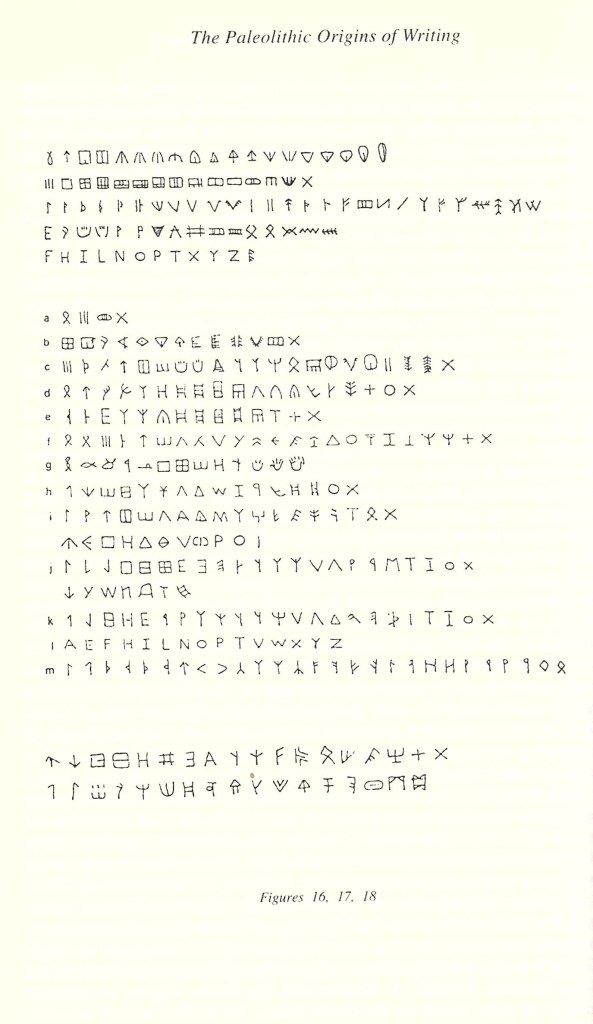
There are quite a number of symbols that appear on artifacts or are associated with paintings from the Neolithic and even the Palaeolithic period. These include crosses, spirals, dots, “lozenges” (ovals), and the zigzag, which is very common and seems to have been used to represent water. (By the way, note the zigzags among the Kachina Bridge petroglyphs.) “The discovery in the early 1970s of a bone fragment from the Mousterian site of Bacho Kiro in Bulgaria suggests that the use of the signs may date back to the time of the Neanderthals. This fragment of bone was engraved with the zigzag motif …” and apparently on purpose, not accidentally in the course of doing some other repetitive task. (Rudgley 73)
“The single V and the chevron (an inverted V) are among the most common of the recurrent motifs in the Stone Age.” (Rudgley p. 74) Gimbutas, of course, interprets the V as a symbol for the female genitals and/or Bird Goddess, but it could be just … you know … a symbol.
Archaeologist André Leroi-Gourhan has interpreted the many signs found at various Palaeolithic cave art sites not as a form of hunting magic (contra previous interpretations), but as a symbolic system. “Leroi-Gourhan admitted to us shortly before his death, ‘At Lascaux I really believed they had come very close to an alphabet.’” (Rudgley p. 77)
But Can You Prove It’s Writing?
Every time some symbols are discovered that are so ancient they strain belief, anyone who doesn’t want to accept them as writing can easily go in to a number of calisthenic moves to cast doubt on this. If the item the signs are found on is in poor condition, they can question whether the marks were even intentional. Perhaps they were accidental scratches, the product of some other activity. If the marks are undeniably made by people, they can be dismissed as doodles. The Vinca signs, when first found, were speculated to have been copied randomly from Mediterranean signs by people who believed these things had mysterious power, but did not understand their meaning. Rudgley also notes that the Old European signs have been interpreted as purely magic symbols, as if a magical intent were to make them non-writing.
In short, any time we are presented with a complex system, there are always a million ways to get out of attributing it to a mind. This is doubly true if we aren’t able to interpret its meaning, but you will even see people do this with messages that they ought to be able to understand. Of course, it can also work the other way, where people see meaning in complex patterns where it wasn’t intended. Often what it comes down to is whether we want there to be a meaning there. Do we, or do we not, want to be in contact with another mind? If for whatever reason we don’t, we can always find a logical way to avoid that contact.
So in the case of apparent writing systems that we haven’t cracked and probably never will, our attitude towards them is going to depend heavily on what we believe about ancient people’s minds. Were they basically like ours, or were they different, animal? We will see more writing systems if we are expecting that they came from people. If we are not expecting to encounter people, then nothing is going to convince us that these are writing systems.
Was Adam a Writer?
My mind was blown, while taking an Old Testament Backgrounds course years ago, when I read an essay that asserted that Adam was able to write and in fact had left a written record for his descendants.
This idea seems completely loony on the face of it … until you realize that the only reason it seems loony is that we are assuming that writing is a recent, unnatural development, the product of tens of millennia of human cultural evolution, and not a characteristic human activity that is, so to speak, wired in.
The essay interpreted the early chapters of Genesis in this way. There will be a short historical record, followed by the phrase “the book of [name],” indicating that the passage immediately preceding was by that author.
| Passage | Recounts | Closes with |
| Genesis 1:1 – 4:26 | Creation (in poetry), fall, Cain and Abel, some of Cain’s descendants, Seth | Gen. 5:1 “the book of Adam” |
| Gen. 5:1b – 6:8 | Recap of creation of Adam, Seth’s descendants up to Noah and his sons, Nephilim, God’s resolve to wipe out mankind, God’s favor on Noah | Gen. 6:9a “the book of Noah” |
| Gen. 6:9b – 11:9 | Building of the ark, the Flood, emerging from the ark, the Table of Nations, the Tower of Babel | Gen. 11:10 “the book of Shem” |
| Gen. 11: 10b – 11:26 | Genealogy from Shem to Terah and his son Abram | Gen. 11:27 “the book of Terah” |
| Gen. 11:27b – 25:18 | Terah moves his family to Haran, Terah dies, a whole bunch of stuff happens to Abram, death of Sarah, Isaac finds a wife, Abraham dies, genealogy of the Ishmaelites | Gen. 25:19 “the book of Abraham’s son Isaac” |
| Gen. 25:19b – 37:1 | Jacob’s entire life, death of Isaac, genealogy of Esau | Gen. 37:2 “the book of Jacob” |
I realize this might be a lot to accept. It’s just food for thought. It does explain why it says “the book of _________” (or, in my NIV, “this is the account of __________”), after the bulk of that person’s story.
Get it? Get it?
(By the way … for those wondering about the title of this post … prostitution is referred to as “the world’s oldest profession.” Erma Bombeck, mother and humorist, has published a book hilariously titled Motherhood: The Second Oldest Profession. The title of this post references those two, because the post is about the fact that writing is very, very old. I don’t mean to imply that a writer’s life has any necessary connection to the other two professions, although of course this does invite all kinds of clever remarks.)
Another Great Character Description
In spite of the mask and theatre hat he wore, I could see at once that Kenn Gifford was exceptional-looking; not handsome, quite the opposite in fact, but striking all the same. The skin I could see above the mask was fair, the type that reveals blood vessels beneath it and looks permanently pink after a certain age. He hadn’t reached that age yet, but the theatre was hot and his colour was high. His eyes were small and deep set, hardly visible from a distance and of an indeterminate colour, even close up. They weren’t blue or brown or green or hazel. Dark rather than light; grey perhaps came the closest, and yet I didn’t look at him and think, grey eyes. Large, half-moon shadows lay beneath them.
Sacrifice, by S.J. Bolton, pp. 23 – 24
Death of the Mentor

I chose this photo off Pexels, and now I almost can’t stand to post it, because it could be my dad in 20 years.
I’ve been thinking lately about how the death of the mentor, in fiction, is often more poignant than the death of the Significant Other. Maybe it’s because the former happens more often. In a normal quest-type story, the mentor gets killed at some point, often kind of early in the action, and the S.O. doesn’t get killed at all, or often even threatened until later in the story. The exception would be crime-fighting superhero tragic back stories, where having a beloved wife killed off to serve as motivation is so common that it has been given a derogatory name (“fridging”).
Anyway, the above paragraph is, of course, just about stories that follow very conventional models. Stories in the wild are quite individual and they go all over the place. Here are some mentor deaths that spring to mind, from stories good, bad, and ugly:
- In Star Wars: Obi-Wan, Qui-Gon Jin, Darth Vader
- In Dr. Strange, which I just watched last night: The Ancient One
- In Harry Potter: Sirius Black, Dumbledore (not to mention Harry’s parents)
- In Narnia: Aslan
- In The Hobbit: Gandalf doesn’t exactly get killed, but he leaves the party right before they enter Mirkwood
- In LOTR: Gandalf
- In Genesis: Jacob, Joseph, Moses, Samuel (I am thinking of mentors who had a chance to give final curses and blessings and instructions before they died. Of course they all die, good and bad, IRL)
In the comments, please add your own.
Perhaps another reason that the mentor’s death is more poignant than the S.O.’s is that the relationship has gone on longer and has been, in a sense, more important to the young protagonist. It is, of course, in a sense the mentor’s job to die. He or she will have to take a less prominent role in the young hero’s life as the latter matures. And, older people tend to die. Joseph, on his deathbed, says, “I am about to go the way of all the earth.” But a tragic mentor death, like the ones above, seems to happen too soon, when we still need them, when we’re not ready.
I myself have ruthlessly killed off my characters’ mentors, sometimes more than one in the same book. I did not plan to do this in order to torture my young protags; it was just the way the story unfolded. One or two deaths even took me by surprise. However, some of my older men and women managed to survive the story long enough in order to be a rock for the rising generation.
Story Deaths and Stages of Life
Some people, sadly, have really tragic childhoods and are faced with death, loss, and betrayal well before they should have been. For young readers not in this position, I find that the type of story death that they find most poignant (and that therefore is most likely to appear in their literature) changes with stage of life:
- for a kid: the stuffed animal or pet
- for a teen: the mentor
- for a young adult: the Significant Other
- for a middle adult: the baby or child
- for an older adult: ??? I don’t know yet, since I haven’t really hit this stage. But my mother-in-law is certainly going through it! Spouse? Best friend? Sister? Everyone your own age who remembers you when you were younger?
So, when I was a kid, it was stories of animals (including toys — I’m looking at you, The Velveteen Rabbit) that really got me. Now that I’m a parent, it’s stories where the baby or toddler dies that I really can’t stand to read.
It’s as if our hearts are pieces of leather that just keep getting softer and more tattered and beat up the more they experience.
I’ve been busy lately, so this post was written in one sitting. I apologize that it’s sort of a mind dump. I’m sure all these things have been articulated before, and much better than this, probably by Jordan Peterson.
Share your thoughts in the comments.
My gosh, Dickens is such a brilliant writer
Waste forces within him, and a desert all around, this man stood still on his way across a silent terrace, and saw for a moment, lying in the wilderness before him, a mirage of honorable ambition, self-denial, and perseverance. In the fair city of this vision, there were airy galleries from which the loves and graces looked upon him, gardens in which the fruits of life hung ripening, waters of Hope that sparkled in his sight. A moment, and it was gone. Climbing to a high chamber in a well of houses, he threw himself down in his clothes on a neglected bed, and its pillow was wet with wasted tears.
Sadly, sadly, the sun rose.
A Tale of Two Cities, Book II, Ch. V, “The Jackal”
Goals
Many other book bloggers did “2024 Goals” posts in January. That seems like a nice way to generate a blog post, even if this goal post (haha) is a little late.
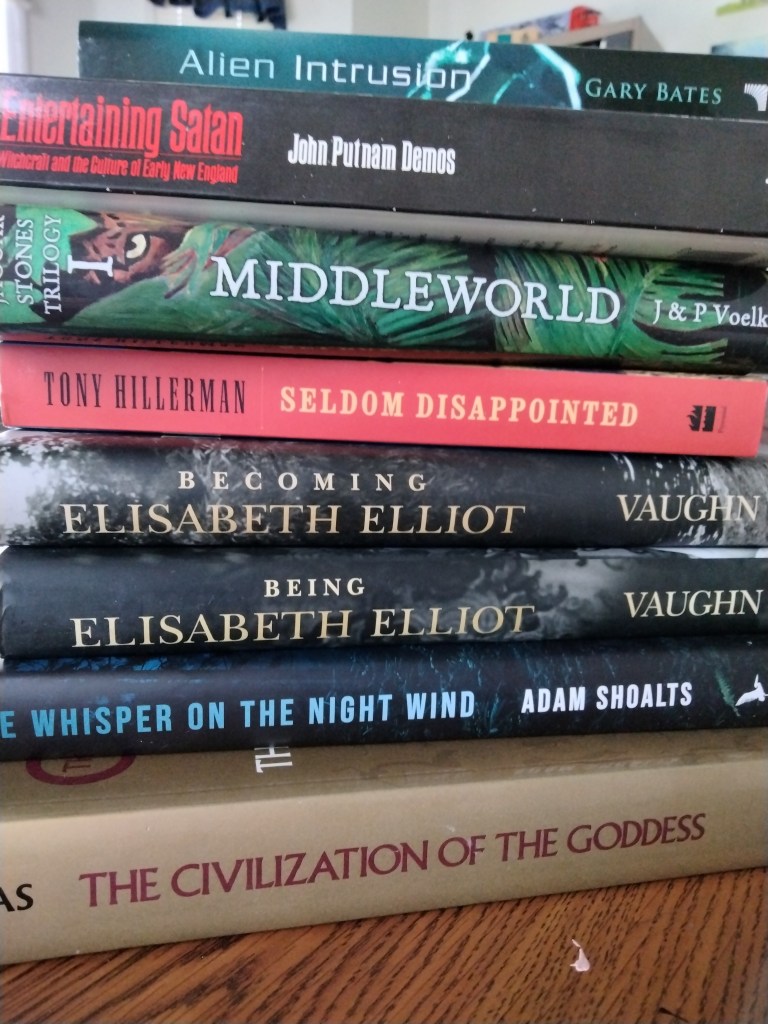
TBR/TBF
Books to be read or, if already begun, finished:
TBA
Events to be attended:
https://mysticrealmsfantas.wixsite.com/mysticrealmsfair
https://www.newchristendompress.com/conference
TBK
Items to be knitted:
- Finish woolen knee socks, to be worn with trousers, before Spring (for self)
- Wanderer shawl: bias-knit chevron patterns to show off the beautiful striped yarn my sister gave me for Christmas (for self)
- Brioche hat: continue to make different editions of this brioche hat, in different color combinations (gifts for various others)
- Maybe try to ad lib a brioche bonnet (for sister in law?)
- as the Spirit moves
TBSE
To be set up: My classroom in the new school building, which we hope to be moved into by Fall.
TBW
To be wrote: The book that goes with this map:
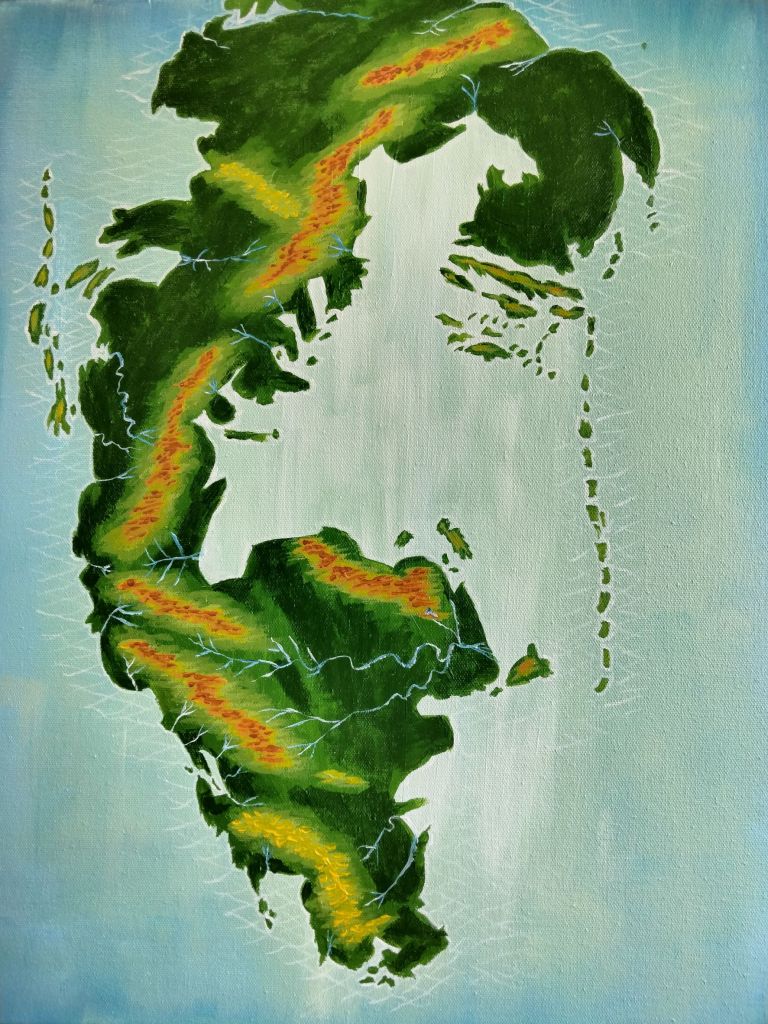
Last year, I went on a writing retreat in order to make some progress on the draft. At this rate, it looks as if I may have to do the same thing again.
TBC/P
To be cleaned/planted: Clean chicken coop (add more space for hens?), maybe actually plant a garden this year???
TB Top Secret
Various family events with loved ones, which privacy forbids blogging about.
A Caveat
Now listen, you who say, “Today or tomorrow we will go to this or that city, spend a year there, carry on business and make money.” Why, you do not even know what will happen tomorrow. What is your life? You are a mist that appears for a little while and then vanishes. Instead, you ought to say, “If it is the Lord’s will, we will live and do this or that.”
James 4:11 – 15
 Out of Babel Books