
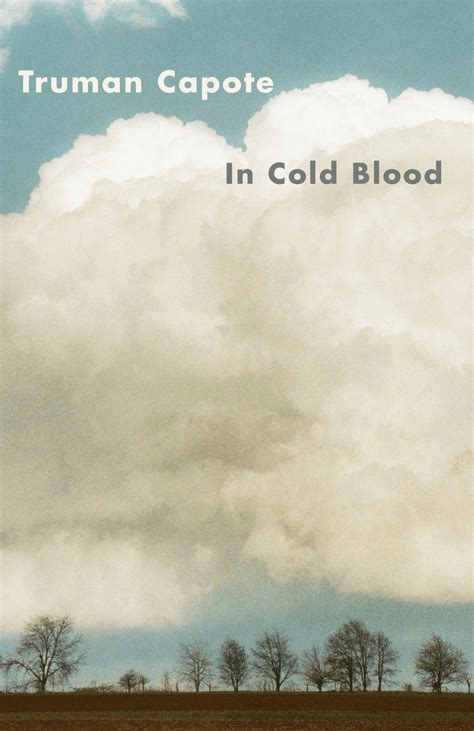
Well, I will be thinking about this one for a long time.
On November 15, 1959, in the small town of Holcomb, Kansas, four members of the Clutter family were savagely murdered by blasts from a shotgun held a few inches from their faces. There was no apparent motive for the crime, and there were almost no clues. As Truman Capote reconstructs the murder and the investigation that led to the capture, trial, and execution of the killers, he generates both mesmerizing suspense and astonishing empathy.
from the back of the book
The first thing to know about In Cold Blood that it’s incredibly well-written. Each paragraph is a work of art. Truly. It’s not ornate, which is why I don’t say “each sentence,” but it’s simply and eloquently told.
The book reads like a novel. It goes in chronological order – roughly – but it also slips through time seamlessly, like a good novel should, filling in glimpses of each character’s backstory just when it is needed, and in just the right dosage, no more. The details of the crime itself aren’t revealed until the last quarter of the book, though before Part II of the narrative, the crime has already taken place.
The other thing about this book is that it is really, really tragic. And not just because a family of four were shot in their beds. Just about every conceivable tragedy happens to someone, somewhere in this book. The only ameliorating thing I can say about it is that no indecent assault happens, as it were, “on camera.” We are given to understand that people have experienced it, but we have to read between the lines. The author uses the smallest effective dose.
The thing I really can’t forgive, though, is the way that Capote made me care about the murderer … one of them, that is. Dick Hickock is what today we would call a sociopath (the psychiatrist’s diagnosis is “severe character disorder”). I don’t give two figs for him, except that I wish he wasn’t crashing around the world, ruining everybody’s lives. The other one, though, is more complicated.
Perry Smith (“very nearly a paranoid schizophrenic” according to the doctor) is basically a lost man-child. He is “sensitive,” prescient, plays the guitar, and cherishes a dream, left over from boyhood, of finding sunken treasure. He “has a brilliant mind” (his words) and resents that he never got more than a third-grade education. (He got his high school equivalence during one of his stints in jail.) Perry travels with a cardboard suitcase full of books, journals, maps, and adventure magazines.
… his personal dictionary, a non-alphabetically listed miscellany of words he believed “beautiful” or “useful,” or at least “worth memorizing.” (Sample page: “Thanatoid = deathlike; Omnilingual = versed in languages; Amerce = punishment, amount fixed by court; Nescient = ignorance; Facinorous = atrociously wicked; Hagiophobia = a morbid fear of holy places & things; Lapidicolous = living under stones, as certain blind beetles; Dyspathy = lack of sympathy, fellow feeling; Psiloper = a fellow who fain would pass as a philosopher; Omophagia = eating raw flesh, the rite of some savage tribes; Depredate = to pillage, rob, and prey upon; Aphrodisiac = a drug or the like which excites sexual desire; Megalodactylous = having abnormally large fingers; Myrtophobia = fear of night and darkness.”)
page 146
This is a remarkable list, especially if it was truly taken from Perry Smith’s papers. It is remarkable for the way that every single entry seems to have some special relevance to Perry. Taken together, they almost constitute his biography as it is starting to emerge from the book at this point.
So, what makes him dangerous? Perry has dissociative tendencies, and a substratum of rage that he’s not even aware of. He thinks of himself as a genius with spiritual depths whom nobody appreciates. His is the rage that comes from being inadequately parented. Perry came from an unstable home and spent time in orphanages, where (to take just a sample incident) the nuns would beat and humiliate him for wetting the bed. He’s never had a good mother or father, and has roamed the world trying to find a home. All this deprivation has made him weak, and so he is dangerous in the way that weak, conceited men are dangerous. He is too weak to control his own actions when it matters.
Dad snatched a biscuit out of my hand, and said I ate too much, what a greedy, selfish bastard I was, and why didn’t I get out, he didn’t want me there no more. He carried on like that till I couldn’t stand it. My hands got hold of his throat. My hands–but I couldn’t control them. They wanted to choke him to death.
page 136
Perry also suffers chronic pain. A motorcycle accident left his legs never the same again, and the pain in his legs (and head) tends to flare up when he gets emotionally disturbed, making it even harder for him to concentrate.
I started feeling the tragedy within a page of meeting Perry. The first thing the book tells us is that it’s his dream to learn to skin dive and find buried treasure, and I had a feeling that dream was never going to come to pass. Damn you, Truman Capote!
I may do a whole separate post about Perry as a character, but there’s one more thing I will say about this book. Both Perry and Dick are types of people that you meet very often today. Perry’s history, in particular, is mirrored by many, many others. In fact, his wild, nearly fatherless youth of knocking about the American West reminds me very much of the family history of some of my own cowboy relatives.
Both murderers are treated by the psychiatrist who is called to write reports about them as if they are uniquely mentally ill individuals. Perhaps at the time they were (or perhaps the fact that they had already committed murder made them seem more egregious), but as I look at our society nowadays, their mental landscapes seem more like the rule than the exception. Do with that what you will.
Read this book if you don’t cry easily and want to enjoy 343 pages of the most amazing writing. But just be aware of what you are getting into.

