
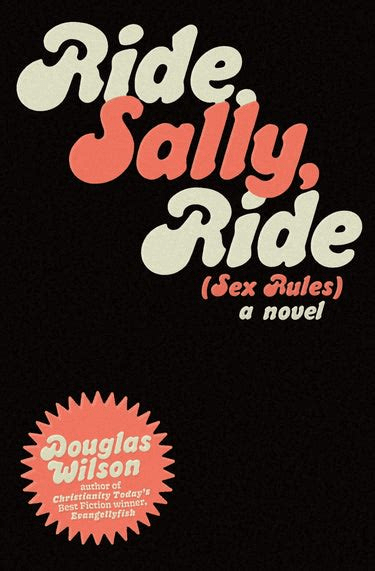
O.K., I’ll just say it. Douglas Wilson is a great theologian/expositional preacher, he seems to be a highly competent counselor, and he is an excellent polemical writer. He is not an excellent novelist.
He is just an okay novelist. I will explain.
Ride, Sally, Ride was published in 2020, which means it was being written in the 20-teens, pre-Covid and pre-George Floyd riots (though not pre-Ferguson and a lot of other riots). It is set in the late 2030s, in a somewhat dystopian setting.
A Little Bit of Orwell
In this setting, the United States is not officially fragmented, but almost. On the Left Coast and the East Coast, you have blue states, which is what we Americans call politically leftist states, with increasingly draconian laws outlawing hate speech and enforcing the rainbow. In the middle of the country, you have red states, which is what we Americans call politically conservative states, also known as “free states.” The free states have been able to survive economically, despite not having access to the East and West Coasts, because they have really developed their natural gas, oil, and grain production, and they still have the Mississippi River. They are able to ship their products down this and out into the Gulf of Mexico (as I still call it). So, in Ride Sally, these United States are not quite separate “states” (read: countries) yet, but they are in the middle of a slo-mo breakup.
Wilson didn’t foresee the Covid debacle, but his characters make frequent references to “the Troubles of 2024,” which seem to have been widespread unrest leading to widespread legal changes.
Most of the action in Ride Sally takes place in Colorado. It (but not Wyoming) is part of the blue, Diversity Gestapo bloc that also includes Washington, Oregon, and California. Americans will recognize this as plausible. Not only have gay marriage, polyamory, and porn been legalized and widely promoted in these states, but so has the sale of “sex bots.” You can order them online for a few thousand dollars, and they can be programmed to say whatever you want.
A Little Bit of Old Testament
Our hero, Ace (short for Asahel) is a twentysomething living with his parents while he attends university. His parents are Christians, but they are sort of cowardly and compromised, as is their church, which is the only reason they have been able to go on living in Colorado. Ace, on the other hand, has been reading Puritan theology (outlawed as hate speech) on the dark web, and has grown into a fine young man. Their last name is Hartwick.
As our story opens, the Hartwicks have a new neighbor. Their new neighbor has a wife, “Sally.” Sally is a sex bot.
The new neighbor introduces Sally as if it were a real person. The Hartwicks are maneuvered into inviting the “couple” over for dinner, at which the neighbor speaks to the bot as if it were a person and eats off its plate to make it appear that Sally has finished her meal. It’s creepy, though it could have been creepier if this were a horror story, which it’s not.
The next day, neighbor asks Ace to go “look in on Sally” while neighbor goes to pick up a package (which turns out to be another bot). He tells Ace this would be “the right thing” to do. Ace, also determined to do the right thing, but in a different way, goes over to the neighbor’s house and sees Sally posed seductively, in an obvious setup. He helpfully puts a t-shirt on the doll, takes it over to the recycling center where he works, and crushes it in the trash compactor. All of this takes place in the first chapter. The rest of the book deals with Ace being put on trial for the “murder” of the neighbor’s “wife.”
And a Little Bit of Wodehouse
The trial unfolds through a series of zany, madcap events. There are slimy lawyers. There are conniving governors. There are riots, conversions, and assassination attempts. There is a refugee from an Amish community. There are crossed wires and mixed signals galore.
Many of the plot points turn on one of the Team Sanity characters causing mayhem at strategic moments. Example: a slimy lawyer is about to hold a press conference where he will trot out a false accusation of rape against Ace from a would-be influencer who knew him slightly in high school. The press conference is totally derailed when another woman, watching in the crowd, yells out, “Then why did you molest me, Dwight?” as soon he says “believe all women.”
In short, this book, besides being a dystopia, also sort of wants to be a P.G. Wodehouse comic adventure.
So, Douglas Wilson, you have tried to combine 1984 with P.G. Wodehouse, with a little bit of Stepping Heavenward. How did it go?
This reader’s verdict is that it was mixed. The absurdity of the Diversity Gestapo laws certainly do lend themselves to Wodehouse-like hijinks on the part of Team Sanity. When the establishment has no category for objective truth, this creates a quite a few loopholes. For example, at one point Ace’s defense attorney makes a motion that the jury have at least three sex bots on it. They cannot be programmed to vote guilty or innocent, of course, as that would constitute jury tampering. This is a stroke of brilliance worthy of Jeeves near the end of one of the Jeeves and Bertie books.
However, one of the things that makes the Jeeves and Bertie books so fun is that the stakes are always so low. Will Bertie’s uncle to get to purchase the coveted antique that he’s had his eye on? Will Anatole, Bertie’s aunt’s temperamental but genius cook, quit, leaving the family without good food to eat? Will Bertie be forced to marry the soppy and naive Madeline Bassett, or will she end up with the man who really loves her, i.e. Augustus Fink-Nottle? Whenever Bertie or one of his friends are in danger of being jailed, it’s not for murder, it’s for something like “stealing a policeman’s helmet.”
The stakes are a lot higher in Ride, Sally, Ride, which makes things a little less funny. Yes, it is possible to write about life-or-death situations in a comedy, but we must not be seriously concerned that disaster will befall the protagonists. Whereas in a dystopia, we should. Furthermore, the stakes in Ride, Sally don’t only involve whether Ace will be unjustly jailed by the state of Colorado. There are quite a number of potentially heartbreaking, messed-up family situations also on the line. These are resolved, in this book, in the same way that interpersonal misunderstandings are resolved in a Bertie and Jeeves novel, which is just frankly weird. It gives the reader the feeling, as Bertie would say, “that you get when you step on the top step and it isn’t there.” If we were reading 1984, we would not expect Wilson and Julia to hash out their mutual betrayal in one heart-to-heart talk.
Douglas Wilson Can’t Write Dialogue
I’m sorry, but he just can’t. His narrative is brilliant. It’s funny, satirical, and extremely quotable. He does sometimes get a little bit lost in the satire at the expense of moving the story, which is not something that usually happens with Wodehouse. He also sometimes neglects to inform the reader, at the beginning of a scene, where this scene is taking place, or what the protagonists look like. For example, we have to wait until the end of the book to find out that the defense lawyer’s wife is a ginger with hazel eyes, tall, and with a full figure. It would have been nice to know that the first time we met her. But this is a flaw for which I have criticized many other authors.
But anyway, back to the dialogue. It stinks. All of the characters talk, to greater or lesser extents, just like the narrative voice. The only exceptions are the woke characters, when they are spouting boilerplate woke stuff. They do that pretty well. And, I’m not saying the dialogue is consistently bad. There are certainly moments when a character says something, and it sounds like a real American person talking. The last line, for example, is great. But for the most part, the characters speak in sentences that are way too complete and way too complex. They sound like they were composed, not blurted. And this is true even in moments of great emotion. When they do get off a funny, half the time it’s British sounding, like the original P.G. Wodehouse.
Look, Bertie is a British character, so he can sound British, even when he is being a dip. But if you want to write an American dip, they should sound like one. Ace’s false accuser is portrayed as being not very bright … but you wouldn’t know it from her speech patterns. Another character, Sarah, left her Amish community just about a month ago, but she says to another woman, “You, my dear, are gorgeous.” Amish people don’t say stuff like that. This is not difficult. I mean, it would not have been difficult to research just a little bit. Go talk to an Amish person, or even just a Mennonite, or even just somebody with German heritage, and take a few notes on their speech patterns.
But that wasn’t Wilson’s priority. He has a lot of irons in the fire, and my impression is that he wasn’t trying to write a book with good dialogue. He wanted to write a rip-roaring satire with a quick-paced plot, and he did. He probably wasn’t going for Great Literature. (And to be fair, P.G. Wodehouse is Great Literature, in his own special way. So maybe it’s not fair to expect Wilson to write fiction as well as Wodehouse.)
Perhaps this inconsistent-dialogue thing would not bother some readers, but in addition to writing fiction, I read a lot of it, and as for this reader, it drove me crazy. I did finish the book, but that problem nearly ruined it for me.
Characters. Should. Talk. Like. Real. People! The end.
The Stepford Wives, and some Spoilers
Brian pointed out in the comments that creepy-sexbot-as-horror-story has been much better done by the original Stepford Wives. He is right. In fact, these two pieces of literature (?) are using the same trope to critique two different things. The Stepford Wives was asserting that having a middle-class, two-parent family living in suburbia is dehumanizing to women, and Ride Sally is asserting the same thing, but about the every-kind-of-sexual-desire-is-sacred value system.
Although Ride Sally is a worse-written book, I think it makes a better case. Here are some spoilers. Near the end of the book, it turns out that Neighbor is a serial sex-bot buyer. Every few months, he finds something that his “wife” has done wrong. He then destroys her and replaces her, because she was a “bad wife.” From this point of view, it becomes clear why Neighbor set up Ace to avail himself of Neighbor’s “wife.” He was also setting up Sally. He had already ordered another “wife,” and his plan was to come home, find Sally “committing adultery,” and get rid of her.
To be honest, I find this portrayal more realistic than in Stepford, where the “wives” live with their husbands for years, just like a regular wife. Men who do not have their impulses directed to something godly, the kind of men who would buy a sexbot, are unlikely to be content with the same Sally year after year. Because what they want is not really a wife.
At one point in Wilson’s novel, a researcher reveals that the sexbot companies keep data about all the units they sell. The average bot has been used a total of only three times. I know this is fiction, but that fictional stat rings depressingly true. Because whatever users are doing with a bot, it cannot be called having sex. That requires two actual people. So users are bound be disappointed.
The psychology is solid. But the development and execution of all these different plotlines is lacking. It’s a shame. It makes me wish that someone else had written this book.


Okay, this is all nutty, but the destruction of private property still doesn’t sit well with me….
I think I’ll stick with The Stepford Wives. That *was* a horror novel and yet it sounds from your description of this book a lot funnier! (This book would probably grate on me like that awful Nicole Kidman remake of Stepford. Way over the top.)
LikeLiked by 1 person
It’s very interesting that you mention Stepford Wives! I’ll add a section about that to the review above.
LikeLike
Ok, sure, you can talk about the “dehumanization of women” but that’s not very funny, is it? : -)
Maybe it’s because I’m a man, but I think the truth at the heart of The Stepford Wives is that men are pigs with shoes. It’s cautionary — in a darkly comic way. And I’ll add a couple of points here. First, what is Stepford but a whole town filled with Guy’s? Guy, of course, was Rosemary’s husband. Rosemary was very different from her sisters in Stepford and yet her husband is just the same as his brothers there. And second, that’s why (in both cases really) Levin was so smart to make his POV characters women, so that men would have to identify and empathize with the other side, as it were.
About that point that in Stepford the men stay with the wives for years. Well, there you have to remember that the men did *not* want sexbots exclusively; they wanted the whole package. Trophy wife, clean house, excellent food, a perfect mix of respectability and comfort.
Finally I personally can’t buy that fake statistic, which I admit is funny in a make-your-political-point kind of way. In the real world, people aren’t going to spend “a few thousand dollars” on an item that they throw away after only three uses. And not only that. You can see it happening now. People are more likely to embellish what they have by changing outfits, tweaking personality, etc., to get what they want.
LikeLiked by 1 person
And there’s the fact that Guy is named Guy. I mean, come on. : -)
LikeLiked by 1 person
O.K., I’m at a disadvantage because I haven’t read Stepford Wives, only a synopsis. And I have only seen the Nicole Kidman version. So take my analysis with a grain of salt. Also it’s kinda rambling, sorry.
That said, yeah, I get your point about what the Stepford husbands really wanted was a woman who would meet ALL his needs (not just those ones) without having any icky feelings or personality of her own to bother him. And sure, that’s a human temptation, so sure, husbands are going to be tempted to want that. However. When feminist works of art try to make the point that Men Are Pigs and they put that within the context of an intact family that looks pretty idyllic from the outside, usually they are not just critiquing the men. After all, men who are willing to marry a woman, settle down with her, and support her and children are the least piggy kind (granting that individual sin can make any human being pretty awful). They are saying that, even in this supposedly ideal setting, there is no place for a woman who is a real human being. Because the men are just so awful? Because the family itself is awful and caters to the worst impulses of men? I can’t sign on to either. Though I’m certainly not against any given guy getting better at considering his wife’s point of view. But when men are REALLY being pigs, they aren’t faithful husbands of one wife. They’re Andrew Tate.
About the fake stat, I could go either way. True that once someone is committed to a vice, they tend to keep trying to make it work. But, counterpoint, we know that deviancy decreases sex drive over time (not to get too gross here), and that societywide, 50 years after the sexual revolution the long-term result has been fewer young people getting married or even dating than ever before. When we make an idol out of something, we lose the thing too. So I dunno. Nobody buys a car and then doesn’t use it (O.K., just my father-in-law), but plenty of people buy lots of ambitious hobby stuff and then hoard it and then it becomes inaccessible to them. But anyway, you may have a point.
LikeLike
Oh, I’m sorry — I thought you’d read it! Well, I won’t belabor the point except to say this. Levin’s book has been adopted by feminists, that much is true. However, though the elements are there, the vibe is not. It amuses me because I think it stems from a time — ah, remember the days — when men and women could joke with each other without being called misogynists and man-hating hags. I don’t mean the time of publication, either, I mean Levin’s formative years. With its gender-bashing wit, it is sort of like a screwball comedy gone horribly wrong.
And lastly…Andrew Tate. Low blow. : -)
Tate, though, belongs more to the now of Ride, Sally, Ride than the pre-1970s type of male chauvinist pig.
LikeLiked by 1 person
So, the original Stepford Wives is more like Taming of the Shrew than it is like the Handmaid’s Tale?
Not calling you, or anyone else who would comment on this blog, Andrew Tate. I don’t think he’s that literate, for one thing. Which was my whole point. Painting all men like him is just ridiculous.
LikeLike
Oh god yes. Not that Stepford is a comedy, but in its use of the elements of horror and suspense it’s as tightly wound as Shrew or those screwball comedies. You must have read some suspense books that are so good they become funny.
And as for the “feminism,” well I remember when you were posting all those Will Durant quotations. He wasn’t writing jokes or one-liners, but he was nonetheless writing humorously. Levin’s like that (at his best). Just the complete opposite of an Atwood. Much more charm and wit. Like “Baby, It’s Cold Outside.” : -)
LikeLiked by 1 person
Well, now I’ll read it if I come across it. 😉 Thanks for the rec
LikeLike
Authors should stick to what they are good at. Having read some of Wilson’s nonfiction, I can’t imagine him doing fiction very well.
LikeLiked by 1 person
I bought some of his nonfiction at the same event I bought this, and reading it is like candy.
LikeLiked by 1 person
Ditto-ing Brian, the only thing that stood out to me in the synopsis was the theft/destruction of property. What the heck, hero?
Also: 60s cover vibe much?
LikeLiked by 1 person
I dunno, I like the cover. Maybe it’s a reference to the original Ride Sally song, which I am not familiar with.
Ace would have been willing to plead guilty to destruction of property, but the defense team decided to go for a murder charge to establish the human rights of sex bots.
LikeLiked by 1 person