
Being nineteen didn’t sit right with Cal. He thought it did at the time, when he was running wild in Chicago, giddy on freedom, working as a bouncer at skeevy clubs and playing house with Donna in a fourth-floor walkup with no air-conditioning. It was only a few years later, when they found out Alyssa was on the way, that he realized running wild never had suited him. It had been a lot of fun, but deep down, so deep that he’d never spotted it there, Cal yearned after getting his feet on the ground and doing right by someone.
The Searcher, by Tana French, pp. 163 – 164
Tag: book reviews
Happy Columbus Day! Here’s a book review about Indian reservations
How History Goes
You may notice that I have a large tag in my tag cloud called Native Americana. I’ve always been a sucker for American Indians. The second two books in my trilogy are a speculative exploration of what their distant ancestor’s lives might have been like.
This subject comes up every year because of the efforts to change Columbus Day to Indigenous Peoples’ Day. I’m not in favor of this, but I do love all things American Indian. (Traditional things, that is. I’m not a fan of the cultural disintegration brought about by enforced socialism on the rez. For more on this, see the book review below.) Anyway, this is the time of year when I find myself annoyed yet again by Matt Walsh.
Walsh has done yeoman’s work fighting the forces of evil in our culture, but he just doesn’t know very much about American Indians. He’ll portray pre-conquest America as an extremely backwards place, full of “stone-age” people, who “hadn’t even invented the wheel.” This annoys me. There actually had been civilizations in the Americas (howbeit, without wheels), including astronomically aligned earthworks and pyramids, even in North America. The Americas suffered a population collapse about a hundred years before Columbus arrived, as documented by Nathaniel Jeansen of Answers in Genesis and in his book Traced. So, what the Europeans found were the scattered remains of civilizations. (Except Cortez. He found the real thing, and it was terrible to behold.)
Now granted, the American civilizations had not yet been Christianized, so they resembled Ancient Near Eastern pagan theo-states rather than European medieval kingdoms. It was probably this, in fact, that gave the Europeans the intellectual edge and enabled them to conquer the continents. Other things being equal, paganism tends to make people more passive. Fatalism, you know.
So Walsh is right that the Europeans conquered the Americans fair and square, as it were. Just like everywhere else throughout history. Now, the conquerors celebrating and romanticizing those they have conquered is a tradition that goes way back. See Homer writing sympathetically about the Trojans. See the beautiful Roman statue, The Dying Gaul. See the Romans commemorating the abduction of the Sabine women, but also celebrating Romulus and Remus, whose story is enough to curl you hair. So I am all for celebrating indigenous peoples (because I love ’em), but also Columbus (because there is no call to demonize your own culture).
That said, let’s not let sympathy turn into damaging infantilization. That’s what the United States government has done with the American Indians, as documented in the book below.
Book Review: The New Trail of Tears by Naomi Schaefer Riley

Life is very bad on our American Indian reservations.
People on the reservations experience rates of corruption, unemployment, depression, drug addiction, sexual assault and child abuse that are as high or higher than any other place in the nation.
But why?
Those with overly simplistic views of American Indians tend to oversimplify in one of two ways: your average American Indian is seen either as Wise Noble Victim, or Worthless Lazy Drunk. My instincts have always put me in the Wise Noble Victim camp, but I recognize that neither of these oversimplifications explains conditions on the rez. American Indians are people, which means they are sinful but not worthless. As Schaefer Riley puts it, “Indians, just like all people, respond to the economic incentives and political conditions around them” (page 178).
I have occasionally spoken with people who seem to resent all that American Indians receive from the government. Tribal governments are “sovereign.” Tribes have the right to operate casinos on their land (in most states no one else can), and in many cases, tribal governments or even individuals receive direct payments of federal dollars. None of this is false, but what has been the effect of it? It has not led to a cushy life for tribe members; quite the opposite.
The Incentives
Here’s my quick summary of the “economic incentives and political conditions” created by the way the federal government has handled the tribes:
- Law enforcement on the rez is a nightmare. Since Indians are not considered as being under the jurisdiction of the state in which they live, if there is a serious crime, it is considered a federal crime, and you could have three or four agencies involved. “He became especially concerned ‘with the lack of coordination between the tribal police and the Bureau of Indian Affairs and the FBI and the Justice Department.'” (page 164) Often, other law enforcement agencies defer to the tribal police, who often, because of nepotism, don’t prosecute. This creates a lawless situation on the rez, with high crime. It gives victims the impression that nothing will be done.
- It is difficult for Indians to own land; or, if they happen to own some, to develop or sell it. Most land is not individually owned, but belongs to the tribe. A combination of tribal politics, environmental concerns, and federal red tape tends to block any attempts at development. This means that it is very hard to create or find jobs on the reservation … except jobs in tribal government.
- While casinos provide some jobs, the linking of the casinos with tribal membership has introduced all kinds of corruption. Some tribal governments run their casinos essentially as cartels. The effect is that tribal membership is “commodified.” A common political move against a rival would be to get them declared no longer a member of the tribe.
- Schools on the rez tend to be as bad as the worst inner-city schools. Schaefer Riley profiles a few schools that have bucked this trend, at least for a few years. One is a Catholic school. There are also Teach for American volunteers who are very motivated to give Indian kids a better education. But these people are usually met with mistrust and actively undermined or driven out because they are outsiders and because of the bad experiences that the older generation had with residential schools trying to forcibly assimilate them.
- While it is important for Indian kids to learn about their traditional language and culture, “this is not a good first step.” Schaefer Riley points out that those tribes that have done the most to preserve their language and culture are those that have done the best economically. When no longer just struggling to survive, they use the money and the energy they now have to create museums and cultural centers.
In short, massive amounts of government money and regulations have had the same effects on the Indian reservations that they always have elsewhere. The red tape is at least tripled compared to the red tape faced by other Americans, which pretty much brings any kind of enterprise to a grinding halt. The infusion of government money through the tribal government incentivizes corruption. The lack of private property and actual employment makes people depressed. The white guilt (and the red tape) have made a lost cause of law enforcement.
Possible Solutions
Schaefer Riley ends with a call for American Indians to be treated like all other American citizens. She points out that American Indians have had very high rates of serving in the military.
Indeed, despite centuries of broken promises from the federal government, despite the bitterness that often pervades Indian communities, and despite years of being told by their own leaders and by Washington’s that they must remain a people apart, American Indians largely see themselves as Americans.
pp. 175 – 176
There has to be a way to ensure that Indian crime victims have the same rights under law as other crime victims … that Indians can own land and start businesses as individuals, not just as members of the tribe … that Indian families have access to a choice of schools that will prepare their kids to succeed. It has been suggested that the larger reservations be made into their own states. Then the people who live there would be considered full citizens who happen to reside in that state. This might not be feasible politically (although I think it would be really cool), but there are a few bands in Canada who are trying to get their tribal lands incorporated as cities. This would allow them to do development that they can’t do now, and the tribal leaders would be like city governments. Failing all this, a good step would be to drastically reform (or, ideally, eliminate) the Bureau of Indian Affairs, which is known for being the one of the most corrupt and inefficient government agencies in a field where the competition is stiff.
I sincerely hope that Schaefer Riley’s book catalyzes a move in this direction. It should, of course, be read by anyone with the slightest interest in American Indians’ living conditions in these modern times. But it should also be read by anyone who is concerned about the effect of government micromanaging of citizens’ lives.
A Cautionary Tale
I see at least three ways in which the federal government’s treatment of Indians serves as a sample of what it would like to do with all citizens:
- It’s coming from good – or at least utopian – intentions. In the case of the Indians, many people feel that the government owes them lots and lots of money and special rights because of the ways that same government mistreated them in the past. (Turns out, the money and “rights” are a new kind of mistreatment.) There is also an assumption that less development is better, because we don’t want to impact the environment at all. In the same way, there is a strong movement to put all citizens in the same position: “You will own nothing, and you will be happy.” Putting the most charitable interpretation on it, the idealists believe that this would bring about a utopia in which everyone has a high (but more importantly, “equal”) standard of living … there is no family loyalty or private property to cause conflicts … and everyone’s lifestyle is perfectly “green.”
- It features forced assimilation. Schaefer Riley points out that Indians are in fact assimilating culturally to the United States, but forced assimilation is a very different story. A few generations ago, Indian children were forcibly removed from their homes and sent to boarding schools where they were not allowed to speak their own language. This idea that, if the parents don’t share the government’s value system, the government has a right to separate children from their parents and re-educate them, has not died away. The idealists have not yet gained enough power to practice forced assimilation on all American children, but they are trying.
- It is collectivist. The degree to which Indians have been denied private property and individual initiative is the exact degree to which they have been brought to poverty and despair. In their case, this has been brought about partly from a sort of Rousseauian “noble-savage” myth about the way the Indians lived before Columbus (spoiler: they weren’t collectivists then either). In the case of other Americans, there has been an attempt to demonize private property, small business, and intact families as the problem with humanity. In fact, these things are key to human flourishing. Sin certainly shows up in them, but that is because it is present in human nature and shows up in whatever humans do.
This guy REALLY liked The Strange Land

Here’s another volunteer review from onlinebookclub, by Raeesa Naidoo:
“Beautifully written … quite an emotional book. It is a phenomenal book that will have you wanting to finish it in a single sitting.”
Raeesa’s review contains some spoilers, but it’s a long book and there will still be surprises.
The Unwilling: A Book Review

Mormon vampires. Need I say more?
Actually, that calls for a lot of explanation, doesn’t it?
The Setup
Carl is a faithful Mormon who is grieving his family. His wife, Sharon, and their three small children were killed by a drunk driver who ploughed over them on the sidewalk. But, Carl knows that if he remains faithful, he will be reunited with his family in the Celestial Kingdom. Per the Mormon promises, they’ll be together forever.
Then, Carl’s sister, who has had a troubled history, is killed by a mysterious woman in an alley. Carl becomes obsessed with finding the killer (the police seem to have given up). He tracks her to what appears to be a sex cult with gothic trappings. Thinking he is just going undercover to collect evidence, Carl takes an oath he doesn’t mean and finds himself becoming a vampire.
He doesn’t finish the ceremony, though. As soon as it becomes clear that he is supposed to drink the blood of an innocent girl, Carl instead breaks free and takes her to the nearest hospital. There, he collapses, and is rescued by Moira. Moira is another well-intentioned vampire (a “Penitent”), who works at the hospital so that she can work nights and have access to blood without having to attack people. Moira shows Carl the ways of surviving as a vampire without doing evil. Incredibly, it later turns out that she too is Mormon. She actually became a Mormon after she was already a vampire, thanks to two very persistent missionaries. For about fifty years, one Mormon bishop after another has handed down to his successor a letter explaining Moira’s special “condition.”
Like I said … Mormon vampires.
Pros and Cons, and Why I Was Crying in Public
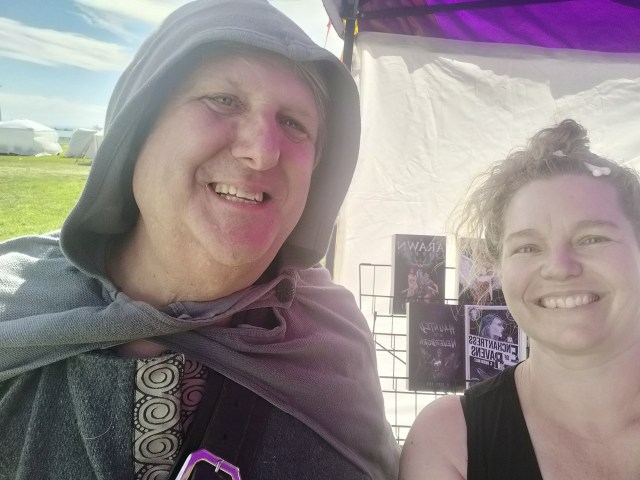
(P.S. This section turned out kind of long. Sorry about that.)
C. David Belt (shown here with me at the recent Fantasy Faire) is a fantastic horror writer because he pairs the horror writer’s instincts and penchant for research with a uniquely right-side-up view of the world.
Take, for example, his take on vampires. I don’t usually read vampire books because the vampires are usually presented as like mortals, but better: they don’t age, they’re beautiful, they’re sexy. Mortals who don’t want their blood sucked are prudes and bigots and super intolerant. Not so with Belt. In his books, vampires are actually, you know, evil. Vampirism is actually a horror, like it would be if you encountered it in real life. That’s what I mean by a right-side-up view of the world.
Now, this strong sense of the wholesome can shade into a bit of naivete about the human heart. The whole premise of this series is based upon the idea that Carl took the vampire oath and even allowed his own blood to be drunk … “innocently.” Because he “didn’t mean it” and “didn’t think it was real,” he is blameless. He is, in all of history, the only Unwilling vampire.
This raises two questions. Now, perhaps these will be raised by the author himself later in the series, but I’m taking The Unwilling on its own terms. So here we go.
First, is it really possible to take an oath and not be responsible for it because “you don’t mean it”? That would be an extremely convenient thing, if so. Picture this: you are a follower of the One True God. But you live in a pagan environment, and you’re being pressured to take an oath of loyalty to Kukulkan, or Zeus, or the divine Caesar, or Big Brother is requiring you to “just say” there is no God but Big Brother. I think you see where I’m going with this. Now, granted, in The Unwilling Carl was not clinging to secret reservations just to get out of martyrdom when he took the oath to be loyal to Lilith. We know this because he fled the ceremony room, endangering himself, as soon as he realized what he was really being asked to do. So there are degrees of culpability, and of self-awareness. However, the principle that “I didn’t really mean it” or “I thought it was a game” is a dangerous one to introduce. As G.K. Chesterton has pointed out in The Everlasting Man, there is an element of game to much of pagan worship. It’s not always 100% clear how seriously the pagan followers themselves take all their superstitions. However, God still tells Israel in no uncertain terms not to pour out libations to any foreign god or take up their names in oath. So, “it was a game” or “it was maybe partly a game” is not going to cut it.
This leads directly to the second question. How is it possible that, in all of history, Carl is the first person to take the vampire oath without realizing it is real? Wouldn’t we expect that to be true of almost every person that gets inducted into the vampire cult? Or true of at least 50%? In modern times, most people do not really believe that vampires are an actual thing. Surely, the majority of the people that join this “empowering” gothic sex cult think of it as a sort of cosplay.
After all, this is how people join cults: there are concentric circles. There are the hangers-on or wannabes, then the neophytes, then the journeymen, and so on. Typically only the people in the inner circle know what the cult is really about. By the time someone gets that far in, however, they have so much trauma bonding, Stockholm syndrome, sunk cost fallacy, mental confusion and spiritual deception that they tend not to be repelled by even the most bizarre and obviously evil beliefs.
The only way I can square this circle is to figure that, if there were any other Converted who didn’t take the vampire element seriously, then when it came time to commit the ritual murder, unlike Carl they didn’t balk, but rather went ahead. And this because, we can assume, they were not as strong-minded as Carl, or not as pure of heart and motive.
One downside of having a right-side-up view of the world, where you recognize that good and evil actually exist and that people can choose to do good or evil, is that there’s a tendency to think as though the world consists of some good people and some bad ones. Belt falls prey to this, to a certain degree. I don’t want to overstate this flaw, because on the whole he is quite insightful about human psychology, as any good novelist has to be. But here are some examples of what I mean.
Vampires, it appears, can “smell” when a person is truly depraved, truly far gone in their evil. Such a person’s blood “calls” to the vampire, creating an almost irresistible urge to kill. In this book, occasionally Carl will encounter such a person. One is a crooked cop, who is also molesting his stepdaughter. Another is a random mother we encounter at the Mormon church service. The precise nature of her evil is never revealed, but as Carl puts it when he warns the bishop about this woman, “something is very wrong” in that house.
So far so complex, right? I actually love the scene where Carl and Moira have to restrain themselves from attacking this apparently pious Mormon woman. My beef with this phenomenon is that there are far too few of these people who call to Carl with their rotten/sweet-smelling blood.
Technically, on an orthodox Christain view of the world, the taint is in everybody. “There is none righteous, no, not one. All have turned aside; they have together become corrupt.” But let’s grant that this does not mean (as indeed the doctrine of total depravity doesn’t) that everyone is as bad as they could possibly be. Nevertheless, part of a mature Christain world view is realizing more and more uncomforable truths like the following:
- Given the intervening steps, anyone is capable of anything.
- I am far weaker and more sinful than I ever realized, but the grace of God is far deeper and stronger than I ever realized.
- “I know that in myself lives no good thing.”
- “Cheer up! You are worse than you think.”
- “Christ Jesus came into this world to save sinners, of whom I am the chief.”
So, to modify our illustration, if The Unwilling had been written by an orthodox Christian, it would show a world where every single person had this taint in their blood, but some of them were in remission. Nevertheless, the proportion of people who had gone far down the road towards “capable of anything” would be quite large – large enough that Carl would be certain to be distracted by their intoxicating scent every time he went out in public.
But Belt is a Mormon, so although his worldview is basically right-side-up, it doesn’t include total depravity. His picture of the world is basically a bunch of lost, but essentially wholesome and well-meaning people, and a few stinkers. Furthermore, in the Mormon cosmology, salvation is not for the stinkers. It is for the well-meaning people who do their best to save themselves and trust God for the rest.
Take this scene, where Carl and Moira are trying to convince a mortal-turned-vampire to repent of his sins. Things start out well enough:
“You’re Catholic, aren’t you?” I ask him.
He laughs bitterly. “Lapsed.”
“Go to your priest,” I say. “Or go to a Mormon bishop. Only God can help you now.”
So far so good. Carl continues,
“Stop killing. Go to your priest or to a Mormon bishop. Pray. Lean on God. I believe you can find your way back. Atone for your sins as best you can. Put your trust in the Savior to take care of the rest. It’s the only way you can ever find redemption.”
And there we have the difference between Mormonism and orthodox Christianity. Ephesians 2:8 – 9 says, “For by grace you are saved, through faith, and this [faith] is not of yourselves, not of works, lest any man should boast.” The Mormons have a similar verse, but it runs like this: “We are saved by grace, through faith, after we have done all we can.” What this misses is that, if we are “doing all we can,” then one of two things is going on. If we are truly repenting and making restitution, then that itself is a gift and is a sign that the Holy Spirit is already revivifying our heart. Which means that He started this good work in us before we were repentant. The other possibility is that we are “doing all we can” in a cynical way, as a work of our own righteousness, so as to put God in a position where He “has to” forgive us. This is a grievous sin against God, probably far worse than the original bad things we did.
To an orthodox Christian, “Atone for your sins as best you can. Put your trust in the Savior to take care of the rest” is a HUGE insult to the Savior. Did He really suffer torture and the wrath of God to take care of our leftovers? Doesn’t it seem that we could have done a little more and spared Him all that? Or, if there was a portion of our sins that called for torture and death on His part, then doesn’t that suggest that the rest of them were equally bad and probably can’t be dealt with by “doing the best we can”?
These are the things that crossed my mind as I read this book. The psychology is good, and somewhat deep, but it’s not the deepest of the deep. That is reserved for writers like Dostoyevsky and St. Paul.
Finally, I won’t give the background of this because you really should read the book, but there was a certain character whose story had me in tears in the doctor’s office. I had brought this book with me to my son’s doctor appointment, to read in the waiting room, as one does. And – well, it was a really hard to put down part, and so it was that the doctor came in to see us just at the moment when my heart got broke. And I had to knuckle a tear away and say, “Sorry, we are fine. This book made me cry.” Good job, Mr. Belt, good job.
New Review of The Great Snake

https://forums.onlinebookclub.org/viewtopic.php?f=21&t=521141
This review is through the Online Book Club, a book discussion site where volunteers review books in exchange for a free copy or, sometimes, a small fee. As an author, I had purchased a batch of reviews. They are done by book lovers who select the books to review based on whether it sounds like something that would interest them. They agree to give an honest review.
I appreciate this review by Li Zapata. She has picked up on how The Great Snake is the story of not just one person, but of a community and how they develop. (This is true of the entire trilogy, actually. Ensemble cast.) The weaknesses she found in the book have been noted by others as well, so I can’t fault her there.
Check out her review, my book, and onlinebookclub.
The House of Love and Death: A Book Review

I ordered this and it arrived a long time ago, but I just now got to it. (Look at me! I am powering through my TBR like a good girl!) Once I opened it, I finished in just a few days because it’s that good.
This is the third book in the Cameron Winter series. Winter is a character created by Andrew Klavan, reportedly the first character Klavan has created that he’s felt could sustain a whole series. Winter is a former spy who is now a professor of Romantic English Literature at an unnamed university in an unnamed Great Lake state (but pretty obviously Madison, Wisconsin). So he fits into that beloved mystery trope, a character who looks unprepossessing (in this case, because he’s a slight, blond, pretty-boy academic) and whom people consequently underestimate, unaware of his hand-to-hand combat skills.
It was fortuitous that I read House not too long after reading The Bourne Treachery, which is also a spy story featuring a longstanding character. Winter even has, in this book, some experiences similar to those Bourne has in Treachery. However, the two books couldn’t be more different.
Winter does check many of the same boxes as Bourne, and House checks many of the same action-novel boxes as Treachery. It moves a little slower and is a little less intricate, but not much. But it is way more emotional. This is one of those mysteries where, after you find out whodunit, you have to set the book down and (if you are a soft touch) cry for a while as you contemplate just how tragic the whole thing was. And like any good tragedy, it has the simultaneous feel of “This was so preventable! This should have been easily preventable!” and of inescapability.
Winter has a “strange habit of mind” (also the title of the first book in the series), where sometimes he will go into a “fugue state” and zone out for several minutes while his subconscious, essentially, becomes his conscious and works on a puzzle he is contemplating. As a writer and artist, I recognize this habit of mind and actually don’t find it that strange (although it doesn’t help me solve mysteries, more’s the pity). I assume that Klavan has given Winter this “strange habit” because, as an artist and writer, he also has some version of this habit. Certain kinds of mind tend to do this. Call it what you want – hyperfocus, being “in the zone.” Being an introvert. Not everyone is “on” (in the sense of externally focused) all the time.
It does make a person wonder whether this tendency, which is similar to narcolepsy, disadvantaged Winter as a spy. In fact, it makes one wonder how he ever managed to survive his espionage years. If Jason Bourne were to zone out like that even for a minute, he’d be dead. Once in House, Winter is driving somewhere and keeping an eye out for a tail. He briefly enters the fugue state, and when he comes out of it, sure enough, he is now being followed.
Yet somehow, those of us with the strange habit of mind do manage to survive. Some of us even manage to raise children. I dunno.
Anyway (shakes shoulders) aaahh, good book. Recommend. Very very sad though.
The Bourne Treachery: A Book Review

by Robert Ludlum, but actually by Brian Freeman
As you might expect from a Ludlum novel written by somebody else, this book has the feel of something made on an assembly line. It has all the parts and doodads that you expect from the genre, and it does what you want it to do (in this case, be thriller), but it has no particular artistry or character. To be fair, this also means it’s lacking some of the flaws that might show up in quirkier, more idiosyncratic books.
Pacing and Action: A+
This is, I gather, the outstanding characteristic of Bourne books. The action is almost constant. Nevertheless, the author does a good job of introducing characters and explaining the setup and the stakes, so that we don’t get the phenomenon of action that we don’t know the significance of. I will say that to a certain degree, tension is inflationary, so the shock and horror isn’t quite as shocking and horrible as it would be with a slower buildup.
Tours of Foreign Cities: A
Traveling the world is one of the things we expect from the Bourne novels. Freeman does a good job of making us feel as if we are familiar with the cities where the action takes place by mentioning particular roads, parks, markets, and squares. He also does a decent job with the weather and atmospherics.
Russians Betraying Each Other: A
Also other spies betraying Bourne, and Bourne possibly betraying other people (who knows, since he lost his memory). The hypocrisy of people in espionage, as well as the messed-up kind of person that years in espionage makes you, is a major theme of this book. Speaking of which:
Character Development: B-
The book tries to do some character development with Bourne discovering his past, wishing he could get out of the espionage game, and realizing that he has been made into the kind of person who probably isn’t capable of anything else. There’s a fair amount of character development given that this is a thriller. But, the thriller distinctives limit the emotional impact of all this, at least for me. The pace is too fast and the writing too matter-of-fact for character development to get really emotional. Speaking of which:
Relationships between Men and Women: C-
Okay, so there is a lot of sex. Including one scene that lasts several pages. But it’s written the way a man would write it, which is to say, the emotional element is minimal. Speaking of which:
Portrayal of Women: D
Hmm, where to start?
Obviously, we are talking about spy women, so that skews the sampling. But these ladies are ruthless killers. They are also … how to put it …? Not overly concerned with monogamy. They can go from killing to kissing, or worse, in no time flat. They don’t seem to get emotionally attached as a result of sexual involvement, the way a normal woman would. They aren’t adversely affected by all the gruesome things they have to do, even as much as Bourne is.
There are two women who don’t appear to be nymphos, but they are both cool as cucumbers. One only cares about science, one about spycraft. You know, like most women you meet.
Also, spy goddess is petite and very athletic, but also has “deep curves.” I dunno. Deep curves (such as wide hips) affect the way a person runs, tumbles, throws, etc. I went through most of the book picturing her as wiry and boyish, and then all of a sudden the author threw these curves at me. Also, their hair is always loose. Not very practical, ladies.
I’m not even trying to be feminist here. I just find these women hella unrealistic and unrelatable, which in turn makes the “romance” (such as it is) tepid.
Russians Talking: F-
This was the thing that annoyed me the most, because it messed with the verisimilitude even more than the Bond-style spy women. Many of the characters in this book are expatriate Russians. Many of them need to monologue to explain their positions. All of them talk exactly like an American explaining something in a business seminar. Listen, Russian sentence structure, word choice, and so on, is very distinctive, even when they are speaking English. It should not have been hard to watch a few movies where this was well done, and then imitate it in this book. If you are going to research foreign cities and bring them to life, why not make the dialogue believable too? I think I would have enjoyed this book a lot more if the Russians had sounded like Russians. And it would have supported the theme. Make them sound like Russians!
Out of Office Post, Patreon, and the Return of the Gods
I am traveling this weekend. I’ll be going to a conference, where I hope to personally connect with the proprietors of Haunted Cosmos Podcast. These guys are (I believe) kindred spirits in that they are Reformed Christians with an interest in paranormal ancient mysteries weird stuff. If I can convince them to re-issue my books under their imprint, maybe I will be free no longer need to promote my own books and all our troubles will be over. Anyway, a lot of things are up in the air just now (at least, in my mind they are), so pray for God’s will to be done there. And in the meantime, definitely check out the Haunted Cosmos podcast.
Secondly, I have finally broken down and become a creator on Patreon. Not much happening over there yet (or maybe ever), but please do visit Out of Babel Art and Novels if you are seized with an inexplicable urge to give me money.
Finally, here is the book I’m currently reading.

Obviously, the chilling topic of the old gods and their ongoing activity in this world is one that’s near and dear to my heart. I bought this book because I wanted to see what the Dispensationalists were saying about it. So far, it’s solid and pretty hard to argue with. Here’s a quote:
Since the house is clean, swept, and in order, the spirit brings in seven other spirits to join in the repossession. The implication is that if the house had not been cleansed and set in order, the spirit would not have brought back the other spirits to occupy it.
And therein lies the warning. The house that is cleansed and put in order but remains empty will be repossessed. And if it should be repossessed, it will end up in a worse state than if it had never been cleansed. What happens when we apply this to an entire civilization? … Should a culture, a society, a nation, or a civilization be cleansed, exorcised of the gods and spirits – but then remain or become empty – it will be repossessed by the gods and spirits that once possessed it, and more. And it will end up in a far worse state than if it had never been cleansed or exorcised at all. …
A post-Christian civilization will end up in a far darker state than a pre-Christian civilization. It is no accident that the modern world and not the ancient has been responsible for unleashing the greatest evils upon the world. A pre-Christian civilization may produce a Caligula or a Nero. But a post-Christian civilization will produce a Stalin or a Hitler. A pre-Christian society may give birth to barbarity. But a post-Christian society will give birth to even darker offspring, Fascism, Communism, and Nazism. A pre-Christian nation may erect an altar of human sacrifice. But a post-Christian nation will build Auschwitz.
ibid, pp. 25 – 26
This Meta Mystery has me in Stitches
… Of course, there’s a whole lot of this book to go, and so you already know that means that either Royce is wrong [about who the murderer is], or he’ll be killed before he can tell me. I will refrain from stating my preference on this particular matter.
-Benjamin Stevenson, Everyone on this Train is a Suspect, pp. 130 – 131
Goodbye to the Chubby-Girl Genre

Hi, everyone. I still have a low fever plus the muzzy head and joint aches that go with it, so this post should be … interesting.
Within the last week I finished the book above. If the Shoe Fits is a sort of very loose Cinderella re-telling. The heroine’s name is Cindy. She has a stepmother and stepsisters. They are not hostile to her as in the original story — they are actually quite affectionate — but they are gorgeous, thin Hollywood babes, very much in the T.V. world, and Cindy is plus-sized, so there are some hints that things were a bit rough in high school. The handsome prince is the heir to a fashion empire. Cindy has just graduated from fashion school, with a special interest in shoe design. As you can see on the cover, the author does manage to get her into an outfit that parallel’s Disney’s Cinderella. And yes, there are crystal-covered shoes at one point. (No, she does not lose them, though I was waiting for that.)
O.K., those are the similarities. Now, the differences. This book takes place in the fashion world and in the world of reality T.V. Cindy and Henry must get to know each other while they are both contestants on a show that is obviously The Bachelor (a show whose producer is actually Cindy’s stepmother). So, all of this is pretty different from a fairytale.
A Sensible Story of Chub
If the Shoe Fits was written by Julie Murphy, who is also the author of Dumplin’. I have not read Dumplin’ but I did see the movie. This book, I would say, has the same strengths and weaknesses as the ones I noticed in Dumplin’.
First, the strengths. Both books feature a romantic heroine who is fat. In both cases, the amount of self-pity that gal displays is very low. This is so refreshing. Plus-sized girls need role models who are not whiny and self-obsessed. Dumplin’ is in high school, so she has a few more issues with her weight than Cindy does, and it’s shown how this leads her to be unfair to her naturally thin best friend. Cindy notes that she has gotten catty comments and the like, and it’s hard to find a variety of clothes in her size, especially in the fashion world, but for the most part she’s confident and she displays no envy or hostility to the more Barbie-like women who are also contestants on the T.V. show. Finally, in both books there is an attractive male romantic interest who seems to really like Cindy or Dumplin’, and this is accepted as a matter of course. There’s no insulting discussion along the lines of, “I like you even though you’re fat because …” blah blah blah. Is this unrealistic? Maybe. But remember, this is a romance genre, so it’s a fantasy for women. Also, some guys are attracted to women who would consider themselves fat (correctly or incorrectly). Finally, whenever one person says to another, “I like you even though …,” I would say that’s a red flag. Unless it is Mr. Darcy speaking, it probably means the “even though”-er feels superior to their prospective romantic partner, and expects that they will be able to treat them badly.
The Less Sensible Part
So, those are the strengths of each book. The downside? Both books have a subtext that being fat is just like being gaaay.
In Dumplin’, the heroine has warm memories of “Dolly Parton parties” that she and her beloved aunt used to have. Later, she finds out that her aunt was longtime friends with a whole bunch of drag queens who are also huge fans of Dolly. The drag queens, and their theatre, are a safe space for Dumplin’ and they help her prepare for the beauty pageant. So, a major theme of Dumplin’ seems to be that drag queens are kind, safe people who make great mentors. We have found this not to be true.
In If the Shoe Fits, we have Jay.
“Jay?” Henry calls.
A beautiful person with short, perfectly edged lavender hair, a manicured beard to match, razor-sharp eyeliner, and nude lipstick rounds the corner. Jay wears a flirty skirt with a cropped sweater topped with a trench coat and platform sneakers.
“This is Jay,” says Henry.
“Follow me,” says Jay as Henry helps them down from the stage.
So, Jay is a basically a very lost and confused young man whom the author insists on calling they throughout the entire book.
I realize that what I’m about to point out is well-trodden ground, but I’m going to tread it again.
How do I know Jay is a young man? He has a beard, and he’s “beautiful.” If Jay were a young woman who had been taking testosterone, he would be overweight, balding, with acne, and the beard would be scraggly. So, my instinct is that Jay is a young man. I pictured him that way as soon as the character was introduced, and I continued to think of him as “he” throughout the book.
As a mom, I really feel for Jay. I’d like to just give him a hug and a cup of tea, and introduce him to some genuinely good father figures so he can see there’s nothing wrong with being a man. Jay needs Jesus. And yes, I realize all the real-life Jays out there would howl with indignation if they were to come to this blog and see me say that. They can only interpret “You need Jesus” as a condescending slam, not a genuine expression of love and concern. People have been reacting that way to the name and message of Jesus for 2000 years. I don’t know who needs to hear this, but just because that is your reaction right now, doesn’t mean it has to be that way forever.
Second well-trodden point: go back to the quote above and look at Jay’s outfit. A flirty skirt with a cropped sweater – already sad on a man – but the trench coat and the sneakers take the outfit to a whole new level. That level is chaos. Jay has selected for himself an outfit that screams, “I have no idea what’s going on or what or who I want to be, and I want you to admire this chaos and join me in it.” Yes, this book does take place in the fashion world, which is notoriously in love with the weird … but Cindy describes a number of her own outfits throughout the course of the book, and they all make sense. No matter how creative Cindy gets with her outfits, they are integrated, coordinated, works of art, because Cindy knows what she is: a woman.
Finally (the most well-trodden ground of all) despite the author’s best efforts, it doesn’t really work to use the pronoun they for a character we already know. (They in the singular is fine in English, when it’s referring to an unspecified or unknown individual. When we have already met a character, that person is no longer unspecified.) For example, at one point Jay leads a group of dignitaries into the boutique, and then a little later they hop down from the counter they were sitting on. (Were all the dignitaries sitting on the counter? Or just Jay?)
Just Gotta’ Do It Myself
As someone who wears plus sizes, has a belly, and has in the past been fat, I like the idea of these chubby-heroine books. This is especially true since the majority of women in the U.S. are what the fashion industry considers plus-sized. But sadly, I think I’m done with the genre. The last chubby-heroine book I read tied confidence in a plus sized woman to female empowerment, and female empowerment to abortion, with a side advertisement for “spouse-sharing.” The one before that, a murder mystery, was tame by comparison, but it did include a bunch of little digs at white girls. I’m done.
I guess I will just have to write a chubby heroine into my own books … oh, wait, I already have!
Magya is a short, curvy mother of four who stepped out of the shadows to grab her own romantic subplot in my book The Strange Land. She was pregnant when her husband was tragically killed. Another member of the tribe stepped in to care for Magya and her children, and he found himself falling in love with her as she went through pregnancy and grieving and the hardships of a Siberian winter. He spends the year sitting on his hands so as not to bother her, and by the next year, they are married.
Sari is also a mother of four and a larger lady, but her story, in the same book, is much more tragic.
Don’t go to my novels just for the chubby girls, of course. Go for the survival and the demons and the dinosaurs. But don’t be surprised if you encounter all kinds of women – and men – along the way. That’s what happens when we just write about life.
 Out of Babel Books