Venus was the spirit of desire, mating, fertility; sacred to her was April, the month of opening buds (“aperire“).
–Caesar and Christ, by Will Durant, p. 61
Aperire means “to open” in Latin.

Venus was the spirit of desire, mating, fertility; sacred to her was April, the month of opening buds (“aperire“).
–Caesar and Christ, by Will Durant, p. 61
Aperire means “to open” in Latin.
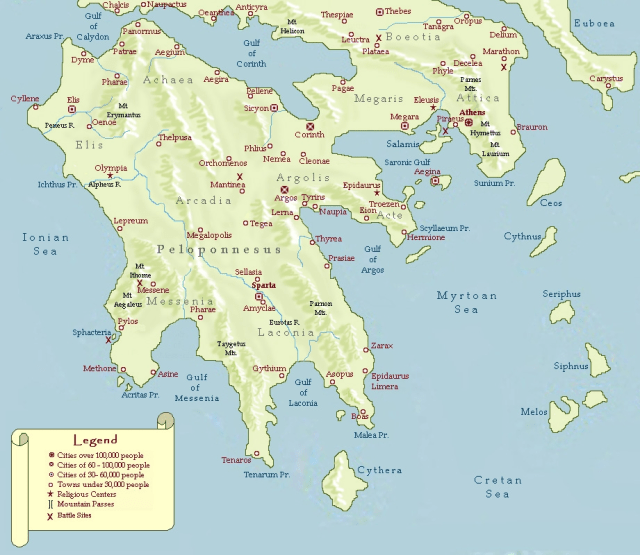
This is my final post about The King Must Die. It will have spoilers. They will be the sort of spoilers that make you want to read the book.
Like any good literary book with a strong theme, this one announces the theme in its title. The King Must Die. Why? Why must the king die? The entire story is an effort to provide the answer.
The first major incident in the book involves the slaughter of a sacred horse. Theseus, who is about seven at the time, loves this horse. It is the “king horse,” the stallion of the sacred herd. Theseus, who has been told that the god Poseidon is his father, thinks of this horse as his literal brother. He is taken to the sacred island to attend a special ceremony. He has no idea that this ceremony is going to culminate in the slaughter of the horse he adores.
It was a good clean killing. I myself, with all Athens watching, am content to do no worse. Yet, even now, I still remember. How he reared up like a tower, feeling his death, dragging the men like children; the scarlet cleft in the white throat, the rank hot smell; the ruin of beauty, the fall of strength, the ebb of valor; and the grief, the burning pity as he sank upon his knees and laid his bright head in the dust. That blood seemed to tear the soul out of my breast, as if my own heart had shed it.
As the newborn babe, who has been rocked day and night in his soft cave knowing no other, is thrust forth where the harsh air pierces him and fierce light stabs his eyes, so it was with me.
p. 13
This is the first king to die in the story. And for Theseus, it is also a kind of death, and a kind of birth. He is the grandson of a king, and this is his birth into the world where the king must die.
Then Theseus is “dedicated.” This involves smearing the horse’s blood on his forehead. But when his older cousin tells him “Come, you must be dedicated,” he thinks that he is about to be sacrificed like the King Horse. So the little boy steps forward in his first act of courage, ready to give his life. And for the first time, he senses the presence of the god Poseidon with him.
Theseus’s grandfather, the king, notices that his grandson is struggling with what just happened. Later, in grandfather’s upper room, the two of them have a talk.
The Lord Poseidon, who rules everything that stretches under the sky, the land and the sea. He told the King Horse, and the King Horse led [our ancestors to new grazing grounds].”
I sat up; this I could understand.
“When they needed new pastures, they let him loose; and he, taking care of his people as the god advised him, would smell the air seeking food and water. Here in Troizen, when he goes out for the god, they guide him round the fields and over the ford. We do that in memory. But in those days he ran free. The barons followed him, to give battle if his passage was disputed; but only the god told him where to go.
And so, before he was loosed, he was always dedicated. The god only inspires his own. Can you understand this, Theseus?
The King Horse showed the way; the barons cleared it; and the King led the people. When the work of the King Horse was done, he was given to the god, as you saw yesterday. And in those days, said my great-grandfather, as with the King Horse, so with the King.”
I looked up in wonder; and yet, not in astonishment. Something within me did not find it strange.
“Horses go blindly to the sacrifice; but the gods give knowledge to men. When the King was dedicated, he knew his moira [=destiny]. In three years, or seven, or nine, or whenever the custom was, his term would end and the god would call him. And he went consenting, or else he was no king, and power would not fall on him to lead the people. And the custom changes, Theseus, but this token never.
“Later the custom altered. Perhaps they had a King they could not spare, when war or plague thinned the Kindred. Or perhaps Apollo showed them a hidden thing. But they ceased to offer the King at a set time. They kept him for the extreme sacrifice, to appease the gods in their greatest angers … And it was no one’s place to say to him, ‘It is time to make the offering.’ He was the nearest to the god, because he consented to his moira; and he himself received the god’s commandment.”
He paused; and I said, “How?”
“In different ways. And so it is still, Theseus. We know our time. Listen, and do not forget, and I will show you a mystery. It is not the sacrifice, whether it comes in youth or age, or the god remits it; it is not the bloodletting that calls down power. It is the consenting, Theseus. The readiness is all. It washes heart and mind from things of no account, and leaves them open to the god. But one washing does not last a lifetime; we must renew it, or the dust returns to cover us.”
pp. 16 – 19
Thus the king of Troizen lays out the entire rationale for Hellene royal sacrifice. Perhaps you have already noticed a few Bible Easter eggs. “Behold, I tell you a mystery” and Jesus saying, “The Father loves me because I lay down my life. No one takes it from me; I lay it down of my own accord. I have authority to lay it down and authority to take it up again. This command I received from my Father.” (John 10:17 – 18) Those few lines map exactly onto what Theseus’s grandfather has just told us, albeit with perfect clarity instead of wrapped in mysterious ancient customs.
Was all this really present in the culture of the ancient Greeks and their Indo-European forebears? Or is Renault reading it back into that culture from the Bible? Or, did Jesus borrow all this from the ancients? I’m looking into it.
You might think that Theseus’s grandfather’s speech is too heavy-handed; showing instead of telling. But Renault knows what she is doing. This is not the whole secret of the book laid bare within the first twenty pages. It is only the beginning. This instruction from his grandfather sets Theseus’s attitude towards the god, himself, and his duty. It will guide how he responds to things throughout the rest of the book.
Spoiler time. Here is a quick list of all the kings whose death Theseus causes or witnesses in this book:
All of these tragic events might seem like an unrelated potpourri of senseless suffering. But actually, they are all closely bound up with each other, and we can see it if we look at the Hellene, Minyan, and Cretan attitudes towards sacrifice.
Sacrifice is everywhere in this ancient world. Every year, the people of Troizen kill a “scapegoat,” a non-royal person that they have decided is causing their troubles. There are animal sacrifices, there are libations of wine poured out, and so forth. The priestess, when she goes to do divination, offers the “house snake” a dish of milk. In Crete, when a man is going to become king, he throws a ring into the sea to “marry the sea lady.” I want to here mention two notable sacrifices that royal characters make.
Early in the book, we learn that during a time of drought and plague, Theseus’s mother sacrifices her virginity. Typical of ancient pagan thinking, when none of the gods of the Hellenes claimed responsibility for the plague, the king, with increasing desperation, finally figured out that the god who was angry was “the Mother.” He offers a “holocaust” (a burnt offering) of pigs all around the large mossy rock in the Mother’s shrine, but apparently this is not sufficient. The old priestess, who is unattractive and dislikes pretty girls, tells the king that his fifteen-year-old daughter must “hang up her girdle for the Mother.” This means she must go to the “myrtle house” (a shrine on the sacred island) and give herself to the first man who shows up, as an offering to the Mother. Then the drought will stop.
It’s an incredibly poignant scene as the king, now a grandfather, describes to Theseus how he felt he could not get out of this. He goes to his daughter about it, and she says of course she is willing to make this sacrifice to save the life of the people.
As it happens, the king of Athens is visiting Troizen, and he agrees to go and visit the young princess on the island so that at least her experience will be with a man who is kind, and whom she has met before. But the king of Troizen cannot tell his daughter that this is going to happen, because as a member of the royal family, she has to go to the sacrifice consenting. “The readiness is all.” So the king of Athens swims over to the sacred island and becomes Theseus’s father. As he jumps into the water, a thunderstorm is already coming to end the drought.
Later, Theseus sacrifices himself for his people when he volunteers to go to Crete as part of the tribute of seven youths and seven maidens. He feels the god Poseidon calling him to do this, “sending him to the bulls.” (The bull-dance of Crete is actually a sacrificial rite in honor of Poseidon.) At first, Theseus resists. He tries to offer the god his horses instead, but he can feel the presence of the god withdrawing from him in response to this. So, in a moment of anguish, he makes the decision to give up his life in Athens, with his father and eventually the throne. Going to Crete does not mean instant death, though it’s understood that bull-dancers last a maximum of six months in the ring. But it is a death to all of Theseus’s hopes and dreams.
As I’ve hinted in this and in previous posts, the customs of the earth-mother-worshipping Minyans differ quite a bit from those of the sky-god-worshipping Hellenes when it comes to sacrifice. In contrast to the Hellene approach laid out in the first section of this post by Theseus’s grandfather, the Minyan solar “kings” are not really kings at all, but more like sacrificial animals. The “king” serves as the consort of the priestess/queen for one year. During this time, he is pampered in every way, sort of like fattening an animal for slaughter, but he has no real power. The queen, together with the other matriarchs, is one who conducts the business of the land. In Eleusis, the war chief is not the queen’s husband but her brother. In these “earthling” societies, the important thing is not how the king dies but simply that he die.
Just inshore, the road sloped upwards to a flat open place at the foot of a rocky bluff. Stairs led up to the terrace where the Palace stood: red columns with black bases, and yellow walls. The cliff below it was undercut; the hollow looked dark and gloomy, and had a deep cleft in its floor that plunged into the earth. The breeze bore from it a faint stench of rotten flesh.
She pointed to the level place before it, and said, “There is the wrestling ground.”
I looked at the cleft and said, “What happens to the loser?”
She said, “He goes to the Mother. At the autumn sowing his flesh is brought forth and plowed into the fields, and turns to corn.”
ibid, p. 68
It is not the king’s life, his attitude, his self-sacrifice, or his leadership that the goddess-worshippers need, but only his rotting body, his symbolic and literal death.
This system produces a fatalism in Minyan “kings” that is very different from the warrior spirit of the Hellenes.
As we met each other’s eyes, I thought, “He has stood where I stand now, and the man he fought with is bones under the rock.” And then I thought, “He has not consented to his death.”
I drank of the mixed drink, and the priestess gave it to the King. He drank deep. The people gazed at him; but no one cheered. Yet he stripped well, and bore himself bravely; and for a year he had been their king. I remembered what I had heard of the old religion. “They care nothing for him,” I thought, “though he is going to die for them, or so they hope, and put his life into the corn. He is the scapegoat. Looking at him, they see only the year’s troubles, the crop that failed, the barren cows, the sickness. They want to kill their troubles with him, and start again.”
I was angry to see his death not in his own hand … But I saw from his face that none of this came strange to him; he was bitter at it, but did not question it, being Earthling as they were.
“He too,” I thought, “would think me mad if he knew my mind.”
ibid, pp. 69, 71
Theseus encounters this same unbridgeable disconnect again near the end of the book, when on the island of Dia he meets their sixteen-year-old “king.”
There was something about him I could put no name to, a daimon in his eyes; not that they wandered, like men’s eyes whose wits are troubled; rather they were too still. Whatever he fixed his gaze on, it was as if he would drain it dry.
Something oppressed me in his silence, and I said only to break it, “You have a god’s feast here tomorrow.”
“Yes.” That was all; but something woke in my mind, and of a sudden I saw everything. I remembered Pylas saying to me in the mountains above Eleusis, “I know how a man looks who foreknows his end.”
He read it in my face. For a moment our eyes met, seeking to speak together. It was in my mind to say, “Be on my ship before cocklight, and with the dawn we will be away. I too have stood where you stand now; and look, I am free. There is more in a man than the meat and corn and wine that feeds him. How it is called I do not know; but there is some god that knows its name.”
But when I looked into his eyes, there was nothing in them that I could say it to. He was an Earthling, and the ancient snake was dancing already in his soul.
ibid, pp. 319 – 320
The Minyans kill their king, and “do not share the sacrifice, offer nothing of their own.” This attitude is even more pronounced in Crete, as Theseus finds when he goes there.
Theseus takes his call to go “to the bulls” very seriously, as a form of sacrifice. Indeed, the bull-dancing developed from an original simple human sacrifice where a single victim was thrown into a pit to be gored by a bull, representing the god. But in the aeons since then, it has developed into entertainment. Originally, it was the youths of the noble families of Crete who would dance with the bulls until the day they were killed. Even then, they were celebrities. But now, the people of Crete do not enter the bull-ring themselves. Instead, the bull-dancers are slaves taken as tribute, captured, or bought from all corners of the world: not only the Greek islands but Libya, Phoenicia, Assyria, Scythia, even Israel. The Cretan upper classes adore these teenaged bull-dancers. They bet on them, send them gifts, have affairs with them, invite them to parties. They cry over their deaths. But ultimately, what is life and death to the bull-leapers is, to the Cretans, a diversion.
Theseus does not resent being the one to put his life on the line in the bull-ring, because the sport itself is intoxicating, perfect for a teenaged adrenaline junkie. But he observes more than once, “These people only play at their sacrifices.” For example, the Cretan upper classes have dolls made of themselves which they hang on the trees every year in their place, at the time of year when, in ancient times, a royal person would be sacrificed.
“But that is a …” She checked herself and said, “only a mainland custom. Here in Crete no king has been sacrificed for two hundred years. We hang our dolls on the trees instead, and the Mother has not been angry.”
I made over her the sign against evil.
p. 253
As a result of this unwillingness to do the actual sacrifice, even the family of Minos no longer have the presence of the god. Theseus is appalled when Ariadne tells him how she plans to fake a fit of prophecy in her capacity as priestess. And he is stunned to find that Minos does not hear the voice of the god.
“Come,” he said, “tell me of this. The god spoke to you, you say. You have heard the voice that calls the king. How does it speak? In words? In a sound of music, or the wind? How does it call?”
I stared at him. Amazement rooted my tongue. I thought I must have heard wrong, yet knew not how to ask. We were silent, looking at each other.
He was the first to speak. He leaned his head on his hand, and said in his sad muffled voice, “Boy, how old are you?”
I said, “If I live to spring, my lord, I shall be nineteen.”
“And after dark, when the bats fly over, you hear their cry?”
“Why, yes,” I said. “Often the night is full of it.”
“They cry to the young. And when the old man passes, they are not silent; it is his ear that has hardened. So also with kings’ houses; and it is time then to think of our going. When the god calls you, Theseus, what is in your heart?”
Finding what words I could, I opened my heart in this small closed room to Star-Born Minos, Lord of the Isles.
When I had said my say … he raised his crystal eyes again, and slowly nodded. “So,” he said, “you made the offering. And yet, it is your father who is King.”
His words went sounding through me, deeper even than my grandfather’s long ago; deeper than my own thought could follow. “No matter,” I said. “A good Shepherd will give his life for the sheep.”
pp. 265 – 266
So Minos has lost, but he knows what he has lost. There is an even deeper depth of cynicism displayed in his stepson, Astarion, Pasiphae’s illegitimate child by a bull-leaper. When Theseus finds out that Astarion is planning to become king by a political coup, he can barely comprehend it:
“But,” I said, “then Crete is being ruled by a man who does not belong to any god; who was never dedicated. He has all power; yet he has not consented to make the sacrifice. Has he consented?”
There was a shadow on her cheek, as if she would smile; but her face grew grave, and she shook her head.
“Then,” I said, “the god will never speak to him. How can he lead the people? Who will see their danger coming? What will happen, if the god is angry, and there is no one to offer himself? He takes service, tribute, honor; and he gives nothing! Nothing! He will be death to your people if they let him live.”
p. 256
Theseus understands what many Cretans, and many in our godforsaken time, do not: that being a king is about more than just power.
Eventually, Astarion commits what reads to Theseus as the ultimate sacrilege. Astarion has sponsored Theseus’s team of bull-leapers for almost a year. Hard up for money, and with no access as yet to the royal treasury, Astarion seeks to make some money off his team. He places bets that they will die in the next dance, and then secretly has their bull drugged to madden it. Though Theseus is gored, the team manages to survive for a few minutes, and then the stratagem backfires when the bull dies of the drugs. The team, when they realize what he has done, are furious: “How this man has despised us!”
But Astarion has not only despised his team. He has despised the bull, the ritual, and hence, the god. Within twenty-four hours, Theseus is feeling the warning in his body and spirit that always comes over him right before Poseidon sends an earthquake. But this time, it is stronger than ever before.
The noise tormented me; the warning surged and roared and crashed through my head, or withdrew leaving a dreadful hollow hush filled with the tread of the approaching god. The awe and terror which it is man’s nature to feel before the Immortals goaded and spurred me to fly for my life. And when I held my ground, the madness burned me up, and the warning would not be contained within me. I shook Amyntor off and leaped on the table among broken winecups, and shouted it aloud.
“Poseidon is coming! Poseidon is coming! I Theseus tell you so, I his son. The sacred bull was killed and the Earth Bull has wakened! The House of the Ax will fall! The House will fall!”
p. 294
After the massive earthquake, when Theseus defeats Astarion,
Now I saw his face, grimacing with bared teeth. I stepped up to him, to hear what he would say to me. But he only stared at me as at some shape of chaos, seen in a dream when nothing makes sense. He who had thought to rule without the sacrifice, who had never felt the god’s breath that lifts a man beyond himself, had nothing to take him kinglike to the dark house of Hades.
p. 312
By denying the gods and expecting others to sacrifice for him, Astarion has destroyed his own mind and ushered himself into hell. This is the darkest place. It is darker even than the Minyan solar kings. Though they are about 90% scapegoat and only about 10% king, yet even they, because the Minyans still take their sacrifices seriously, provide some faint foreshadowing of Christ. When the young king of Dia rides off in a cart to go up the mountain and be torn to pieces, he goes crowned with ivy, raising a wine cup in his hand, and scattering wheat (bread) onto his people. Apparently, this is part of the deep structure of a properly done sacrifice: sharing out the bread and the cup before one’s death. Going up the hill. A vegetable crown.
What did I mean, “And Now”? I can barely remember why I put that in the title.
Obviously, we no longer live in a world where human sacrifice is necessary to keep ourselves alive. Arguably, it never was, but I think this novel makes a pretty good case that there was something deep going on there. Human sacrifice bad, yes, but we cannot by the same token say paganism worthless, with no glimpses of the truth and with nothing to teach us.
Regarding the question of where these resemblances came from, I do not have time to go into whether Christianity “copied” from ancient Greek mystery religions, was not even aware of them, or was aware of them and did some riffing on them. But in the providence of God, I recently ran across a book that looks into exactly that. I’ll be back when I’ve read it, with a more robust case that these types and shadows found in paganism had their source in God.
The book of Hebrews–and in fact the entire New Testament–makes a strong case that, when our King laid down His life, that was the last, sufficient sacrifice, making it no longer necessary even to sacrifice animals. The only reason Theseus comes out looking so heroic is because of his resemblance to the King of Kings. And a Happy Easter to you. He is risen indeed!
But there is a miniature version of “the king must die” that applies in the daily life of every Christian, indeed of every adult. Being a king is about much more than just power, and this goes for every kind of leader. In order to be a good parent, you should be sacrificing yourself for your children much more often than you expect them to sacrifice for you, although of course this doesn’t mean that you let them be in charge. Most of a parent’s sacrifice is invisible to the children. And in fact, the one who sacrifices the most is the one who has the most authority. Otherwise, how will the unction of the god fall upon you to lead your people? Who will see danger coming?
Similarly, a good boss or manager works harder than any of his employees. A major principle of leadership and love is “my life for yours.” As Jesus said, “Whoever wants to come after me must deny themselves, pick up their cross, and follow me.” “Pick up their cross” corresponds to getting in the cart, the one that takes you up the hill. So, you, know, in a small way, we should all strive to be Theseus and not Astarion.
1 The heavens declare the glory of God;
the skies proclaim the work of His hands.
2 Day after day they pour forth speech;
night after night they display knowledge.
3 There is no speech or language where their voice is not heard.
4 Their voice goes out into all the earth, their words to the ends of the world.
In the heavens He has pitched a tent for the sun,
5 which is like a bridegroom coming forth from his pavilion,
like a champion rejoicing to run his course.
6 It rises at one end of the heavens and makes its circuit to the other;
nothing is hidden from its heat.
7 The law of the LORD is perfect, reviving the soul.
The statutes of the LORD are trustworthy, making wise the simple.
8 The precepts of the LORD are right, giving joy to the heart.
The commands of the LORD are radiant, giving light to the eyes.
9 The fear of the LORD is pure, enduring forever.
The ordinances of the LORD are sure and altogether righteous.
10 They are more precious than gold, than much pure gold;
they are sweeter than honey, than honey from the comb.
11 By them is your servant warned; in keeping them is great reward.
12 Who can discern his errors? Forgive my hidden faults.
13 Keep your servant also from willful sins;
may they not rule over me.
Then will I be blameless, innocent of great transgression.
14 May the words of my mouth and the meditation of my heart
be pleasing in your sight,
O LORD, my Rock and my Redeemer.
–Psalm 19, of David
The following is a reader-response literary analysis of Psalm 19.
This is an extremely famous psalm. If you have been around Bible circles for any length of time, you probably have heard it quoted. I was no different, but for some reason, it took me 40 years to really understand why the elements of this psalm are here and how they all work together. So perhaps you can find some benefit from following my plodding steps.
The first four verses of Psalm 19 are often quoted. They describe how the skies and space themselves testify to all humankind that there is a God and that He is glorious. Paul alludes to this in Romans 1, where he says, “since the creation of the world God’s invisible qualities–His eternal power and divine nature–have been clearly seen, being understood from what has been made, so that men are without excuse.” Of course, God makes it abundantly clear to the Israelites that the sun, moon, and stars are in fact creatures and that He is not pleased when people worship them … which raises the question of sun-worship … which we will get to momentarily.
Similarly, the last three verses of the psalm–the prayer for personal cleansing from sin–are also often quoted. These are very accessible. You could pick them up and pray them, with no obstacles to understanding, if you became a Christian just yesterday. On a slightly deeper level, I have heard these verses taught as a very savvy description of the progressive nature of sin. It starts out as “hidden faults,” then if unrepented becomes “willful,” which leads to sin ruling over a person, and this state of being ruled by sin eventually leads to some egregious “great transgression.”
And this is really a psalm that is best understood back to front. If the last three verses are the most easily accessible, verses 7 – 11, about the law of God, are a close second. True to Hebrew poetry, David uses a bunch of different synonyms: law, statutes, precepts, commands, ordinances, and, interestingly, fear. Obviously these are English translations of Hebrew words for God’s law, of which the language had quite a number.
To David, he wasn’t just referring to the Ten Commandments or to the book of Leviticus. By all these synonyms he meant the whole “law of God,” that is all the revealed word of God that they had at the time. And by his inclusion of fear, it’s also clear that he meant the revelation of God’s nature, His presence with His people, and the holy awe that they were supposed to have in response.
However, I don’t want to unsay what the psalm says. The emphasis in these verses is clearly on the moral, right-and-wrong aspect of God’s word. God has given us a law. But rather than just being an obscure collection of ancient rules, this is a law that somehow revives the human soul, makes the simple wise, gives joy to the heart, light to the eyes, endures forever, warns, and is sweeter than honey.
It was for this passage that I returned to Psalm 19 recently. I had noticed after forgetting for a while–again–as one does–that without some kind of moral standard coming from outside ourselves, human beings are really and truly sunk. If there is no objective right and wrong, then might makes right and all truth claims are actually just attempts to grab power. (Thank you, Derrida!) The last couple of hundred years have been a big social experiment demonstrating this. Again.
So, my original reason for pulling out Psalm 19 was so I could pray verses 7 – 11 and thank God for His Word. Of course, as a Christian, I had an even more in-depth appreciation for the treasure that Bible truly is. It doesn’t just give us the only extra-human set of truth claims upon which a civilization can be built. It’s also, by far, our most comprehensive and reliable source text on ancient history. As if that weren’t enough, it’s not written in dry legalese or as lists of facts, but in the form of stirring stories, terrifying mythological scenes, and challenging and moving poetry. Books, and libraries, are already a treasure, but this particular library of books is truly “more precious than gold, than much pure gold.”
So I really just wanted to quote that back to God. But it’s a short psalm, and the confession verses at the end are sooo good, so of course I ended up reading the whole thing out loud whenever I went to use it.
The only sour note in this symphony of devotion were the verses about the sun. They seemed overdone. I get that we are talking about the skies and things in the skies, but why devote three whole verses just to poetically describing the sun? Rabbit trail much, David?
Then, after I don’t know how many iterations, it dawned (even) upon me that there might, possibly, be a few similarities between the sun and the law of God as described in the verses that follow it. Let’s see: nothing is hidden from its heat. It covers the whole earth and all people. It’s inescapable. It gives light to the eyes, and it revives the soul (think about the effect of sunlight after a long night!). It gives hope. But it can also be kind of oppressive. It “warns.” It also disinfects things that are exposed to it. Hiding from the sun is not usually a good sign. It can be a metaphor for hiding wrongdoing. However, we do still need shelter from the sun, because it’s pretty intense. Almost as if it were a small picture of the One Who is too holy to look upon.
Haha! I get it now!
There was just one remaining fly in the ointment. I really didn’t see why it was necessary for David to compare the sun to “a bridegroom coming forth from his pavilion” … that is, to a young man who has just had sex with his wife for the first time. Yeah, I suppose that does give a guy a certain glow. Yeah, Hebrew poetry is earthy. I get it. But … why? Is this just there to make modern readers squirm?
In the providence of God, I happened to be reading Till We Have Faces. In this book, the narrator (Orual) has a little sister (Psyche) who marries a god. This is literal, not figurative. It is a retelling of the Cupid and Psyche myth.
Orual meets her divine brother-in-law twice. The first time, it is in terrible judgment:
There came as it were a lightning that endured. That is, the look of it was the look of lightning, pale, dazzling, without warmth or comfort, showing each smallest thing with fierce distinctiveness, but it did not go away. This great light stood over me as still as a candle burning in a curtained and shuttered room. In the center of the light was something like a man. It is strange that I cannot tell you its size. Its face was far above me, yet memory does not show the shape as a giant’s. And I do not know whether it stood, or seemed to stand, on the far side of the water or on the water itself.
Though this light stood motionless, my glimpse of the face was as swift as a true flash of lightning. I could not bear it for longer. Not my eyes only, but my heart and blood and very brain were too weak for that. A monster would have subdued me less than the beauty this face wore. And I think anger (what men call anger) would have been more supportable than the passionless and measureless rejection with which it looked upon me.
-Till We Have Faces, pp. 172 – 173
The second time, Orual’s literal and metaphorical ugliness has been cleansed, and the god coming to judge her is going to see only beauty:
“Did I not tell you, Maia,” she said, “that a day was coming when you and I would meet in my house and no cloud between us?”
Joy silenced me. But now, what was this? You have seen torches grow pale when men open the shutters and broad summer morning shines in on the feasting hall? So now. Suddenly, from a strange look on Psyche’s face, or from a glorious and awful deepening of the blue sky above us, or from a deep breath like a sigh uttered all round us by invisible lips, or from a deep, doubtful, quaking and surmise in my own heart, I knew that all this had been only a preparation. Some far greater matter was upon us. The voices spoke again; but not loud this time. They were awed and trembled. “He is coming,” they said. “The god is coming into his house. The god comes to judge Orual.”
The air was growing brighter and brighter about us; as if something had set it on fire. Each breath I drew let into me new terror, joy, overpowering sweetness. I was pierced through and through with the arrows of it. I was being unmade. And he was coming. The most dreadful, the most beautiful, the only dread and beauty there is, was coming. The pillars on the far side of the pool flushed at his approach. I cast down my eyes.
“You also are Psyche,” came a great voice.
–ibid, pp. 306 – 308
The bridegroom is actually the one Who links everything together in this poem. C.S. Lewis had to hit me over the head with an extremely long, vivid description before I could see it, but I see it now. The god–Christ–is the bridegroom and He’s also the sun. He comes in horrible, revealing judgment, he comes in shining beauty, He overwhelms the senses. He convicts and purifies and beautifies the people that His light touches. And, of course, He is also the Word. And Word also does all these things.
Amen. Come, Lord Jesus.
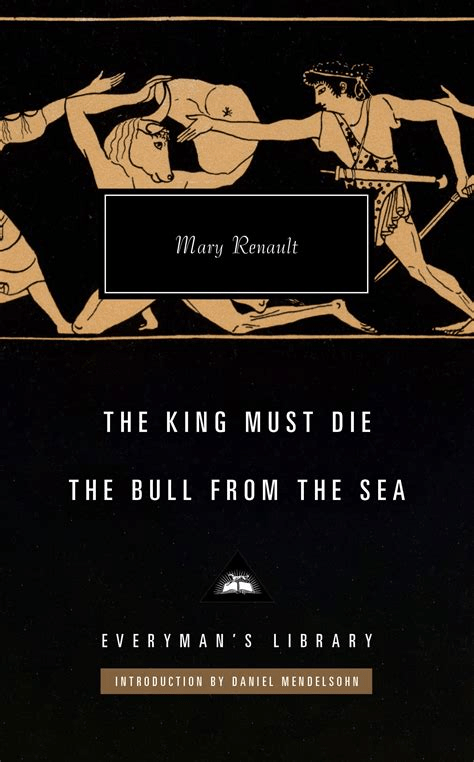
I read The King Must Die back in university. My education up to that point had some gaping holes, but I had been privileged to attend a school one time where they spent an entire year getting us thoroughly familiar with Greek myths and history. My point is, I knew the story of Theseus. I knew the labyrinth and the Minotaur were the main event. And I was eager to get to them. So I moved through the first part of the book at a pretty good clip, the part that tells of Theseus’ childhood in Troizen, his coming of age, and his journey across the Peloponnesian Peninsula to find his father, the king of Athens.
I thought then, and still think now, that Theseus is not an especially likeable character to modern eyes. He’s a prince of Heroic Age Greek culture, and he is, as they say, a product of his time. He is proud, ambitious, pious towards the gods, stoic, brave, and clever (those are his virtues), and also snobby, entitled, callous, cruel, sexist, and promiscuous. He has all the virtues of ancient paganism, but none of the virtues a Christian man. You can’t endorse all his actions or even his value system. (By the way, that is exactly what makes this such a fantastic historical novel.) But despite all this, there are moments in his story that ring incredibly poignant. And these are moments that I either forgot since my first reading, or missed entirely.
You want to hear about the Minotaur? Let me tell you about a son and his father.
Theseus’s grandfather is king in Troizen, a small Greek kingdom on the east coast of the Peloponnesian Peninsula (or what they call the Isle of Pelops). His mother, a princess, had him when she was a teenager. She lives, still unmarried, in the palace, and serves as a priestess of the Mother, who is goddess left over from before the Greeks arrived, whom they feel they must give her due.
Theseus’s mother has always told him that he is the son of Poseidon. Theseus takes this seriously as a little child. He views the sacred horse, also called a son of Poseidon, as his brother. He whispers “Are you there, Father?” into the sacred well that sometimes grumbles when Poseidon is stirred up. But as he gets a little older, he sees that other people doubt he has a divine father. He becomes defensive.
Truly “god-got” children are known to be really tall, and Theseus has always been small for his age. He waits and waits to grow (he hopes to be six or seven feet tall). He develops “short man syndrome,” taking daring risks in order to prove himself in front of the other boys. He is the best at every sport except for Hellene-style wrestling, because that requires mass and weight.
Once, he even swims way out into the ocean, figuring either Poseidon will prove he is his father, or Theseus will welcome a death by drowning. The current sweeps him back to the island, and he figures he has his answer.
Then Theseus turns seventeen, and his mother shows him the rock that his father said he should try to raise in order to prove whose son he is. So, it wasn’t Poseidon after all.
Theseus tries and can’t raise it by brute strength. He is broken, furious with his mother who won’t tell him anything.
But eventually, he realizes that he can raise it with a lever. That’s when he finds the sword.
His grandfather tells him the story, which is full of the tragedy, ugliness and beauty of ancient paganism is and basically a mini novel within this novel. There was a plague, a drought. Apollo claimed not to be responsible. Poseidon wasn’t answering. Finally, the priestess said it was the Mother. “A virgin must go and wait in the myrtle-house and give herself to the first man who comes along.” The priestess disliked Theseus’s mother, because she was an attractive young girl. His grandfather couldn’t see a way to get her out of this.
But it happened that Aigeus, the thirtysomething king of Athens, was visiting Troizen. He agreed with Theseus’s grandfather that he would be the man. At least the princess would lose her virginity to someone she had met before, and he would be kind and gentle with her. They could not tell her about this arrangement beforehand, because when a member of the royal family is in some way sacrificing themselves for the people, their willingness to make the sacrifice is a critical element. Only then will the god bless it.
The thunderstorm was already arriving. Aigeus stripped and swam across the channel to the sacred island where the Myrtle House was. A flash of lightning revealed to the princess a dark-haired man rising up out of the water, with a ribbon of seaweed on his shoulder. She thought he was Poseidon. She knelt, and crossed her arms over her chest, as one would do for a god.
Why didn’t he wait for the boat? Why did he jump into unknown waters, in a rainstorm, and swim across? Was Poseidon indeed possessing him? say these pagans. Who knows?
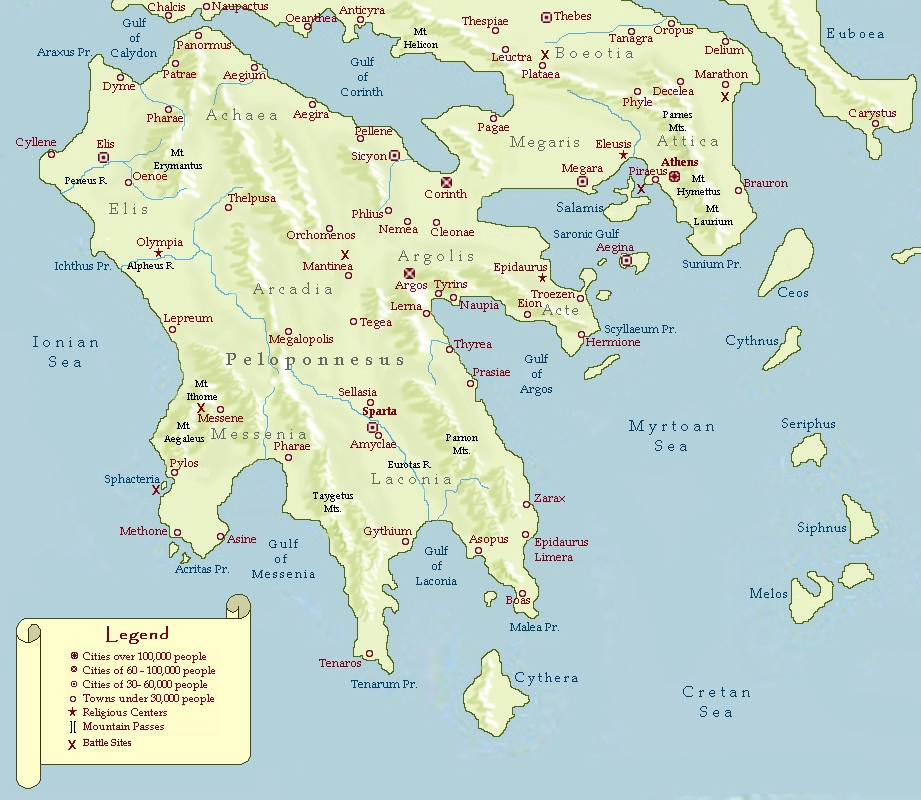
Theseus is disappointed, but intrigued, to find out that he has a human father. He travels over the Isthmus (a dangerous and lawless place), gets entangled with the earth-mother-worshipping people of Eleusis, which is very creepy, and eventually makes it to Athens and reveals himself to his father, narrowly escaping being assassinated first.
On the map above, if you look around the Saronic Gulf, you can see Troezen on the south side, Athens on the north side, and Eleusis just a bit west of Athens. I wish I’d had this map 25 years ago, when I first read the book.
Aigeus has no other sons. He is thunderstruck and delighted to see Theseus.
There’s not exactly hugging and crying, because both of them are proud, aristocratic, cautious men. On the whole, Aigeus probably wears his feelings closer to the surface than Theseus does. Still, they start getting to know each other.
Theseus’s birthday is approaching. Aigeus wants to have a feast for him. Theseus suggests sending to Troizen to bring his mother for the feast, but Aigeus dismisses this plan. If they wait, the time will get too close to “the tribute” (the sending of young men and women to Crete), and he doesn’t want to be celebrating his long-lost son when some of his subjects have just had to give up theirs.
It’s at this point that the reader who knows the outline of the story realizes that Theseus and his father are not going to have much more time together.
The day of the feast comes. Aigeus gifts Theseus a chariot, “of dark polished cypress-wood, with ivory inlays and silver-bound wheels, a craftsman’s masterpiece.”
It was a gift beyond my dearest wish. I thank him on one knee, putting his hand to my brow; but he said, “Why this haste, before you have seen the horses?”
They were matched blacks, with white-blazed foreheads; strong and glossy, sons of the north wind. My father said, “Aha, we slipped them up here, as neat as Hermes the Trickster lifting Apollo’s steers. The chariot while you were in Eleusis; and the horses this very morning, while you still slept.”
He rubbed his hands together. I was touched at his taking all this care to surprise me, as if I had been a child. “We must take them out,” I said. “Father, finish your business early, and I will be your charioteer.” We agreed that after the rites, we would drive to Paionia below Hymettos.
pp. 154 – 155
In case you missed it, Aigeus just gave his son a sports car.
After the rites, Theseus goes to the stables and waits and waits for his father. When the king does show up, he seems to have forgotten their plan to take a ride. He is stressed out by something. He urges Theseus to ride by himself, but to leave by the back gate.
The reader realizes, with a sinking feeling, that the representatives from Crete have come early to collect the youths and maidens for the tribute.
Aigeus, almost in tears, is trying to get Theseus away from there. But Theseus, too sharp not to realize something is wrong and too proud to be hustled out the back, quickly finds out what is happening and insists on entering the deadly lottery.
And now, the reader realizes that they are never, ever going to take that chariot ride.
The youths and maidens of Athens are chosen by putting their names on scraps of pottery, which are then drawn at random out of a bowl. Aigeus puts in a lot for his son, on which he has surreptitiously written some other youth’s name. But Theseus, standing among the crowd, realizes what has happened when he sees that his father is not worried. What should he do? Should he let the deception stand? Or should he stride forward and insist on being among those who are sacrificed?
I thought, “What was it? What has my father done? What every father would do if he could. And he is King. He has to think for the kingdom. It is true enough that I am needed here. I ought not to think like a warrior only. Has someone else gone to Crete for me? I have led such lads to war, and never thought I wronged them, though some were sure to die. Why then do I hate my father, and myself still more, and feel I cannot bear my life?”
I looked at my father, and remembered how he had invoked Poseidon, praying him to choose the victims. And I thought, “Yes! That is it! He has mocked the god, the guardian of the house, who brought him to beget me. Well may I be angry! This man has mocked my father.”
p. 163
Theseus begins praying his heart to Poseidon. He senses that the god wants him to go to Crete. It is time to make the sacrifice.
Sorrow fell black upon my eyes and the sun grew cold. I thought of what I had planned to do in Athens: small things I had to hoped to force my father’s hand to, great ones when my own time came. I knelt where I was, with my hair hiding my face, and thought of my life; of hunting with the Guard, of feasts and dances, of my room with the lion walls; of a woman I wanted, and had meant to speak to at the festival; of my beautiful horses, who had scarcely felt my hand; of the war paean, the bright rage of battle, and the triumph song. And I thought, “The god cannot mean it. He sent me here to be king.”
“Father Poseidon,” I whispered, “take something else from me. I will not ask to live long, if I can make a name and be remembered in Athens. Now it will be as if I had never been born.” I heard the name called of some Athenian. It was the last of the seven. “Lord Poseidon, I will give you my horses, the best I ever had. Take anything but this.”
The sea-sound grew fainter in my ears. And I thought, “The god is leaving me.”
p. 164
So off he goes. Rather than lose the unction of the god to rule, Theseus insists on going to Crete, where, he has been told, bull-dancers last six months at the most.
“Don’t grieve, Athenians. The god is sending me. He has called me to the bulls, and I must obey his sign. But don’t weep for me, I will come again.” I did not know these words till I had spoken them; they came to me from the god. “I will go with your children, and take them into my hand. They shall be my people.”
They had left off weeping, and their voices sank to a hush. I turned, and faced my father.
I saw the face of a man who has got his death-wound.
p. 165
I mean!
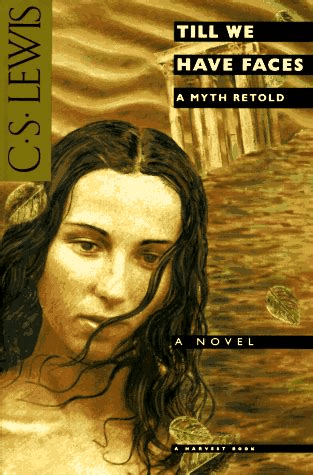
Friends, I have had a harrowing experience.
I read Till We Have Faces.
Again.
That’s right, this wasn’t even a first-time read, and it destroyed me. Again. Maybe worse this time.
It’s tempting to do a super detailed book review, including an analysis of all the ancient customs, the Bible Easter eggs, and the symbolism. (My God, the symbolism!) But I’m not going to do that, because I really think you should read it if at all possible. And, even though this book is possibly more powerful on re-reads, I still don’t want to ruin your first read with spoilers.
Any analysis I gave, would be less of an immersive experience than the story itself, because that is the power of fiction.
I will just say a few things about the setting and genre, so you can decide whether to subject yourself to it.
I read TWHF as part of my 2026 “Greco-fiction” project, where I read books set in and/or inspired by the Heroic Age of Greece. When I mentioned this project to someone, they suggested Till We Have Faces. They were right, of course, though I hadn’t put it in the same category in my mind as, say, The Song of Achilles.
The action takes place in a fictional country called Glome. Based upon hints in the text, Glome is located somewhere just south or just north of the Caucasus Mountains, between the Black and Caspian seas. Georgia, Azerbaijan, perhaps southern Russia. Glome is not a mountainous kingdom, but it is near mountains. In the distance, they can see “what we call the sea, though it is nowhere nearly as great as the Great Sea of the Greeks.” This would probably be the Caspian. They are far from Greece, but near enough that they occasionally encounter a Greek captive taken in war. They are near enough to “Phars” (Persia) for that country to present a problem. At one point, the narrative makes a passing mention of “the wagon people, who live beyond the Grey Mountain.” These “wagon people” are probably steppe-dwellers related to the Scythians or Kazaks.
The people of Glome worship a fertility goddess called Ungit, who is embodied in a large irregular black stone that is said to have pushed its way up from the earth. Ungit’s “house” is a group of megaliths joined together with walls. Her worship involves temple prostitution, animal sacrifice, and sometimes human sacrifice, all the usual things that you expect with a fertility religion. Her priest wears a large bird mask on his chest, and dangles with amulets and animal bladders.
The narrator, a little girl named Orual, is frightened of the priest and of Ungit. The story will go on to focus on this fear. Orual very much hopes that the gods are, as her Greek tutor has told her, merely “lies of poets, lies of poets, child.” But are they? Or is there a power in Ungit (and in her son, who dwells on the Grey Mountain) that will leave Orual quite outmatched?
C.S. Lewis is an underrated horror writer. In this story he draws back the curtain on the horror of paganism. We also see, I think, hints of how he himself felt when he was an atheist: desperately hoping there is no spiritual world; uneasily worried that there might be. Relieved, but unsatisfied, by the “clear, shallow” Greek explanations.
So, I’ve said enough. Read it if you dare. I doubt that this year will bring me a better book in the category of Greco-Fiction.
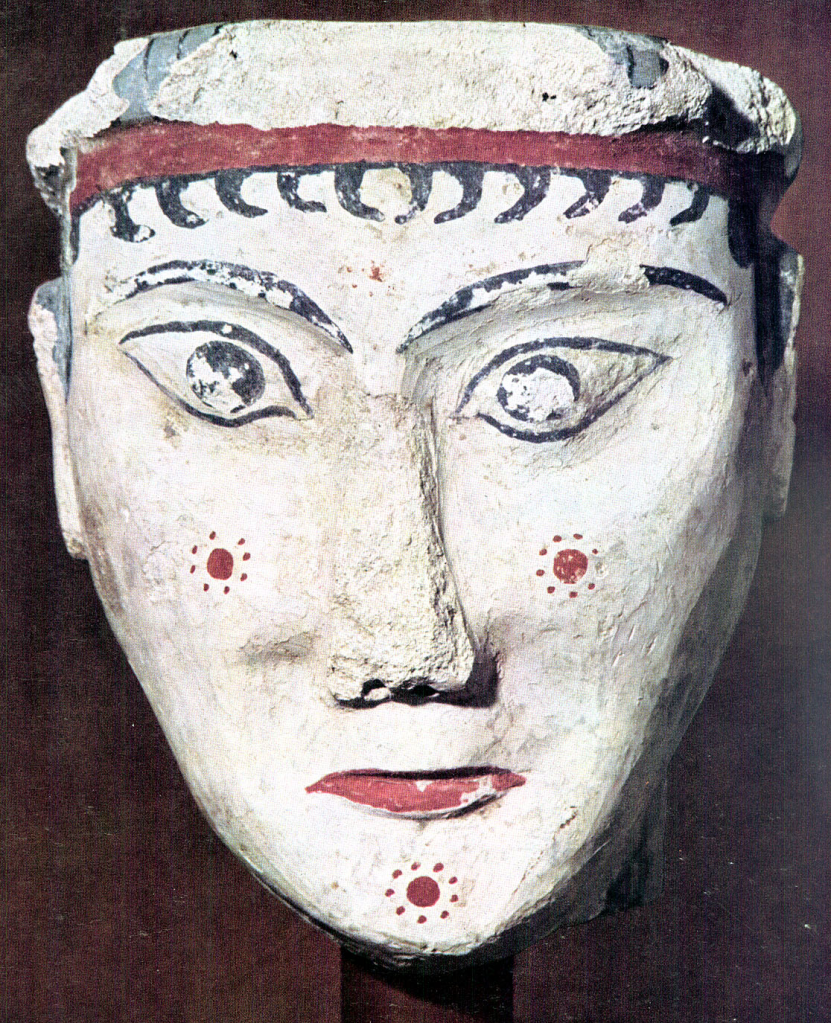
As part of my ongoing, yearlong foray into fiction set in the ancient Mediterranean, I am now re-reading Mary Renault’s The King Must Die. There is so much history and speculation packed into this book, that I make free to do a series of posts on different topics from it, en route to the final book review. So, buckle up! I hope you like ancient historical fiction! (And, since you are visiting Out of Babel Books, I assume you at least don’t hate it!) Today’s topic is Renault’s theme of the two conflicting cultures of Hellenes vs. what they call the “Shore People.”
I have always had the impression that the story of Theseus was one of the older historical myths. It happens when Knossos, on Crete, is still a thriving city. So, in my mind, I put it a few generations before the Iliad. Madeline Miller, author of Circe, seems to agree. In her book, Circe hears of Theseus having killed the Minotaur well before Odysseus comes to land on her island.
If you do the math, Theseus living before the Odyssey would also put him living before Agamemnon returns from the war at Troy and is slaughtered in his bath by his wife, Clytemnestra. In the play Agamemnon (written, of course, much later), Clytemnestra kills her husband in revenge for his having sacrificed their thirteen-year-old daughter before he sailed for Troy, in addition to a couple of other grudges. Like most women, I find it hard not to think Clytemnestra has a case.
Renault, however, takes a different tack. She has a teenaged Theseus hear the following story from a bard:
The song he gave us was the Lay of Mycenae: how Agamemnon the first High King took the land from the Shore Folk, and married their Queen. But while he was at war she brought back the old religion, and chose another king; and when her lord came home she sacrificed him, though he had not consented. Their son, who had been hidden by the Hellenes, came back when he was a man, to restore the Sky Gods’ worship and avenge the dead. But in his blood was the old religion, to which nothing is holier than a mother. So, when he had done justice, horror sent him mad, and the Night’s Daughters chased him half over the world.
ibid, p. 40 in my copy
So here we have Agamemnon, Clytemnestra, their son Orestes, and the Furies. At the same time, this passage raises some questions.
The Shore People make their appearance on the very first page of The King Must Die.
Our house is Hellene, sprung from the seed of Ever-Living Zeus. We worship the Sky Gods before Mother Dia and the gods of the earth. And we have never mixed our blood with the blood of the Shore People, who had the land before us.
-ibid, p. 1
As the story progresses, it rapidly becomes obvious that the Hellenes have, in fact, mixed their blood with the blood of the Shore People. There is the story of Agamemnon, above; Theseus is said to be “blonde and blue-eyed like the Hellenes, but small and wiry like the Shore People,” and Theseus, who is very promiscuous, even has a child who “came out small and dark, but so was [his mother’s] brother.”
So we have two populations, one that is native to the Greek coastlands (or at least has been there a long time), and one that came there from the steppes. Theseus’s grandfather explains to him their ethnic history, which he got from his own grandfather:
“Long ago, he said, our people lived in the northland, beyond Olympos. He said, and he was angry when I doubted it, that they never saw the sea. Instead of water they had a sea of grass, which stretched as far as the swallow flies, from the rising to the setting sun. They lived by the increase of their herds, and built no cities; when the grass was eaten, they moved where there was more. … When they journeyed, the barons in their chariots rode round about, guarding the flocks and the women … [Lord Poseidon] told the King Horse, and the King Horse led them. When they needed new pastures, they let him loose; and he, taking care of the people as the god advised him, would smell the air seeking food and water. The barons followed him, to give battle if his passage was disputed; but only the god told him where to go.”
ibid, pp. 16 – 17
This is a description of the Indo-European lifestyle and homeland. The Indo-Europeans took their reverence for the horse, and their wheeled carts and chariots, with them wherever they went, including to Scandinavia. So the Hellenes are Indo-European, and the Shore People, presumably, Hamitic or Semitic.
The mask at the top of this post is Mycenaean. Mycenae is located in the Peloponnesian Peninsula, which is also the location of Troizen, Theseus’s home. The ancient Mycenaean culture, older than classical Greece, took its cues from the Cretan urban culture of the time. In later Greece, you get men wearing himations and women wearing finely woven chitons. This is usually how Helen of Troy, for example, is illustrated. However, she probably looked more like the Mycenaean and Cretan women. Here is someone’s attempt to reconstruct the probable hairstyle and costume of the most beautiful woman in the world:
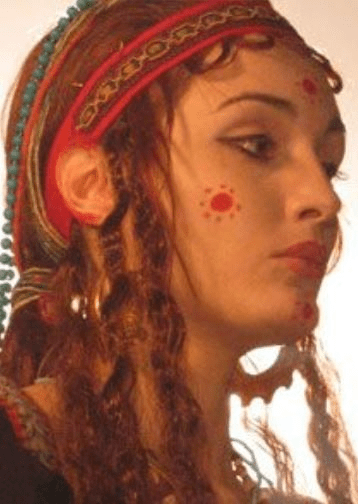
Notice the Egyptian-style, kohl-lined eyes, and the red suns for makeup. Helen might have been blonde, being a Hellene, but her clothing was perhaps more like this.
Here is someone else, reconstructing a traditional Mycenean costume and pose:
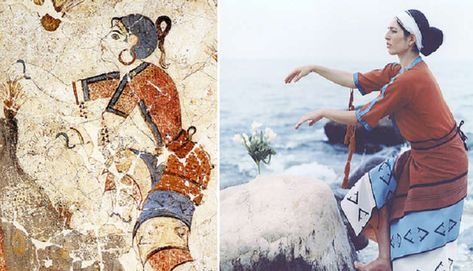
I’m guessing these fashion choices came from the Shore People.
Theseus’s mother is described as wearing this ancient Mycenaean style. She wears a tiered, flounced skirt hung with charms, exposed breasts (what was going on, Crete and Mycenae?) and hair that is curled by the use of “crimping braids” (probably to attain a very curly look for those who do not, like the Shore People, have it naturally). Though a blonde Hellene, she is a priestess of the mother goddess, and so she takes some of her cues from the Shore People, and here is where we find the tension.
Both the Hellenes and the Shore People practice the sacrifice of their kings. However, there is a difference. For the Hellenes, it does not come on a regular schedule. Theseus’s grandfather explains:
“When the work of the King Horse was done, he was given to the god … And in those days, said my great-grandfather, as with the King Horse, so with the King. When the king was dedicated, he knew his moira [i.e. doom]. In three years, or seven, or nine, or whenever the custom was, his term would end and the god would call him. And he went consenting, or else he was no king, and no power would fall on him to lead the people. And the custom changes, Theseus, but the token never. … Later the custom altered. They ceased to offer the King at a set time. They kept him for the extreme sacrifice … And it was no one’s place to say to him, ‘It is time to make the offering.’ He was the nearest to the god, because he had consented to his moira; and he himself received the god’s commandment. And so it is still, Theseus. We know our time. … It is not the sacrifice … it is not the bloodletting that calls down power. It is the consenting, Theseus. The readiness is all.”
ibid. pp. 18 – 19
This might explain why so many kurgan burials are of high-born individuals who seem not to have died of old age.
It also, of course, explains the title of the book.
Meanwhile, it has been established that the Shore People do things a different way: “old laments have come down from the Shore People, of young heroes who love a goddess for a year, and foreknow their deaths” (p. 37). In other words, the Shore People treat their king primarily as the goddess or priestess’s consort, and kill him after just a year.
Marija Gimbutas has tried to make the case that the Shore People practiced a gentle, feminine, goddess-worshipping religion, and that they were cruelly exterminated by the warlike, sky-god worshipping evil Indo-Europeans. Renault is not going to paint with such a broad brush. Realistically, she shows both groups living next to one another and influencing each other. Also, throughout the course of the story, she is going to show by increasingly vivid illustrations that these two cultural systems are absolutely incompatible with each other. And that the mother-worship, in the end, is at least as bloody as the worship of Zeus.
Renault’s take on the story of Agamemnon is a great illustration of this. She interprets the story as a conflict between Clytemnestra’s mother-goddess culture and Agamemnon’s sky-father culture. When Clytemnestra brings back the “old religion,” it means that Agamemnon must die–not in battle, not some day, but now, and actually, yesterday. It means that Orestes is doubly cursed. He has loyalty to both religions, with their incompatible demands, and he is put at the mercy of the furies, the representatives of the goddess-religion. They chase him because he killed his mother, but if we string out the implications, even if he had not, they would probably be chasing him anyway. After all, he is a male heir to the throne, so his days are definitely numbered. Behold, the kindness of the religion of the goddess.
Obviously, there are some universal truths and some redemptive metaphors here, hidden under a thick layer of occultism, war between the sexes, and general pain and suffering for everyone. It is going to take a much greater King than Theseus to cut this difficult knot.
Oh, and Happy Valentine’s Day to everyone! Such a romantic post, I realize.
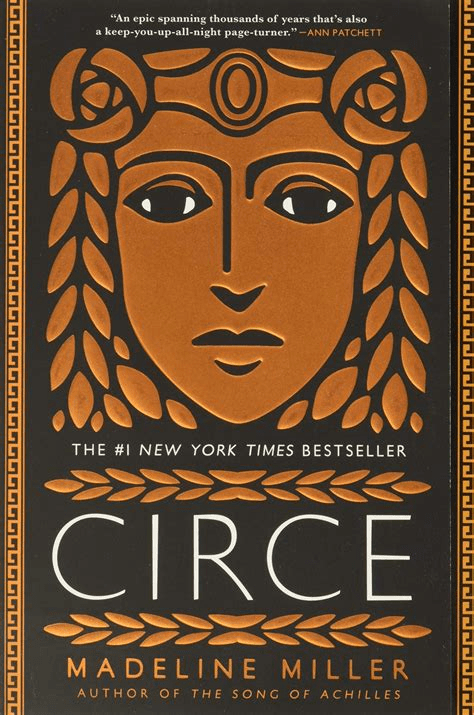
This year, I decided that my fiction focus would be novels inspired by ancient Greek myths. I don’t always pick a fiction focus, but this year, things just coalesced.
In the classical Christian school where I teach, we follow a 4-year “history cycle.” Ancient World, Medieval World, Exploration/Renaissance, Modern World. This year, we are cycling through Ancient, so I have been immersed in the Flood, the Sumerians, Abraham, Egypt, and the Iliad and Odyssey. (Somewhat immersed, of course. We could always immerse ourselves more.)
Revisiting Mycenae and Crete, I remembered that back in university (in the last millennium!) I read what I thought was a fantastic book that was a re-telling of Theseus. Looked it up, and it turns out it was The King Must Die by Mary Renault. And it turns out that Renault has a bunch of other books that I’ve never read. (Back in the last millennium, the way we found books was we stumbled upon them in the library.) So, onto the list went at least a re-read of The King Must Die and its sequel, The Bull from the Sea. I bought myself copies of these for Christmas using my husband’s money, so technically he bought me the copies for Christmas.
Meanwhile, years ago I had won a copy of Circe, and had been waiting to read it until I was ready to stick my head back in the ancient Mediterranean. I’m also aware that Madeline Miller has at least one more book, The Song of Achilles, which is from Patroclos’s point of view. Gay, of course (and that is historically accurate). I decided I might read that, depending upon how I enjoyed or didn’t enjoy Circe. You can write about ancient Greek events from a hard-core feminist/queer perspective, or you can not. I wanted to know first what approach Miller was taking.
Finally, some of my students have been reading Percy Jackson, with the result that they are already quite familiar with the Greek pantheon. I’d known that the Jackson books were out there, so perhaps now is the year when I read at least a few of them. Jackson went onto the list.
Then there are the rereads. Til We Have Faces is C.S. Lewis’s masterpiece, set probably in Scythia or the Caucasus, near the Greeks but not too near. Moving farther from Greece, we have Taliesin, Merlin, and Arthur by Steven R. Lawhead. I read Taliesin in high school. It’s Celtic, not Greek, except that about half the book takes place on Atlantis, with bull dancing and stuff, so I figure that counts. Now, the Daily Wire has made a TV series based on these books. The events of Taliesin take up about an episode and a half. So, if I have time, I’ll reread/read Steven R. Lawhead.
So, here is the list as it stands …
This should fulfill the twelve books that I told Goodreads I’m planning on, this year.
In the course of my teaching year, I have already read The Cat of Bubastes with my students, and am now reading Hittite Warrior, which is also very good. Also on the docket is The Young Carthaginian.
I loved this book. It is exactly the genre I like. Miller did a fantastic job keeping track of all the gods, titans, and nymphs, their little feuds, and their family relations to one another.
Circe, in The Odyssey, is a “witch” whom Odysseus and his men encounter on the island of Aiaia (Corsica or Sardinia … I was imagining Corsica). She turns some of them into pigs, but Odysseus convinces her to change them back. She becomes a sort of ambiguous ally, giving him advice about how to handle the Moving Rocks, the Sirens, and Charybdis and Scylla.
Of course, there is always more detail to the story. Miller has researched this deeply, and I appreciate her portrait of where Circe came from. Circe is the daughter of the sun, Helios, who is a titan, and his one legitimate wife. This makes her the sister of Pasiphaë, wife of King Minos (ahem), and also of Aeetes, father of the witch Madea.
Given that she is divine, Circe gets a front-row seat to nearly all the earliest myths. She meets Prometheus in person. She watches the whole ugly episode with Minotaur go down (this is centuries before Odysseus). Time passes quickly for her. At the same time, she is sort of fascinated by mortals. On the plus side, this means she does not view them as disposable, as most of her relatives do. On the down side, she at first fails to see them as a threat.
Near the end of the book, she has this to say.
I thought once that gods are the opposite of death, but I see now they are more dead than anything, for they are unchanging, and can hold nothing in their hands.
p. 385
Though a page-turner, Circe was a heavy read emotionally. As you might expect, it really stinks to be an ancient Greek god or Titan. You are likely to have horrible parents, for example. The hardest part for me was finding out what we might have suspected by reading between the lines: that Odysseus was actually a real [censored], and that things did not go happily after he made it home to Ithaka. Thankfully, Miller does not leave us there but introduces at least one good man and gives the book’s ending a faint note of redemption.
Based on this read, I think I will try The Song of Achilles if I come across it. Miller’s writing is not ideological. It is extremely tragic, with heartbreaking near misses and so forth, but that is actually how these ancient stories go.
Juno Regina was the queen of heaven, the protective genius of womanhood, marriage, and maternity; her month of June was recommended as the luckiest for weddings.
–Caesar and Christ, by Will Durant, p. 61
Among these original national gods Jupiter or Jove was the favorite … In the early centuries of Rome he was still a half-impersonal force–the bright expanse of the sky, the light of the sun and moon, a bolt of thunder, or (as Jupiter Pluvius) a shower of fertilizing rain; even Virgil and Horace occasionally use “Jove” as a synonym for rain or sky. In time of drought the richest ladies of Rome walked in barefoot procession up the Capitoline hill to the Temple of Jupiter Tonans–Jove the Thunderer–to pray for rain. Probably his name was a corruption of Diuspater, or Diespiter, Father of the Sky.
–Caesar and Christ, by Will Durant, p. 61
… and when the Romans encountered Zeus, they said, “Hmm, seems to be Jupiter.”
You can read the incident that this is a reference to, in I Samuel chapters 4 – 6.
The Philistines were a culturally Aegean/Mycenaean people who had settled along the coast of Canaan. Though culturally Greek, they spoke a Semitic language. Their god, Dagon, was a man/fish god who had antecedents going all the way back to Sumeria.
The genre of these particular chapters of Scripture might be described as dark comedy. It’s a unique story, because it presents the reaction of an Aegean people when confronted with the God of Israel. The story is told in a Hebrew historical record, but the amount of detail means that the Hebrew chronicler must have had spies or eyewitness accounts.
The Philistines, though, or perhaps because, they are pagans, are pretty canny. They start out thinking they have won a victory over the Israelites by capturing their god, but it doesn’t take them too long to figure out that this God is trouble, and to ascertain, by process of elimination, what He wants.
Or you could say that God is very adept at communicating with the Philistines.


