A Roundup of Atlantis Theories

Photo by Pixabay on Pexels.com

Too many Atlantises. An embarrassment of Atlantises. One Atlantis, two Atlantis, red Atlantis, blue Atlantis …

Atlantis is Now Off the Coast of Cuba

This article describes an intact granite city, with pyramids, discovered off the West coast of Cuba, about 2,000 feet down, in December of 2001. As our old friend KFM, of Bad Archaeology, points out, the city would be unlikely to survive intact like this if it actually dropped dramatically from what is now sea level, as Plato seems to describe. The article points out that there is another city, the Yonaguni Monument, off the coast of Japan, and Graham Hancock in his book, Underworld, points out that there are submerged megalithic cities in many places around the world, including off the coast of India. (Hancock has cycled through seriously advancing a number of different Atlantis theories, so he will be sort of the workhorse of this post.)

It seems to me that the city off the coast of Cuba is part of a worldwide phenomenon where sea levels were once much lower. We can include in this phenomenon Doggerland (which will make another appearance later in this post), and the land bridges known to have once connected Asia to the Americas and the Indonesian islands to the mainland.

If you are an old-earth believer and have to juggle millions of years, multiple cooling and warming periods, slow but somehow effective continental drift, and some confusing archeological indications that humans were perhaps around well before they should have been … good luck. As someone who believes that the history of the earth is measured in thousands or tens of thousands, but not millions or billions of years, my guess is that this period of low sea levels plus advanced civilization came right after the Great Flood.

You would have a much colder, rainier climate as the earth adjusted to the recent cataclysm (about this more in a minute). You would have had frequent snow and rain storms, with all this precipitation getting frozen in the rapidly forming ice sheets, causing Earth’s water supply to be greatly reduced. Meanwhile, you would have Noah’s children and grandchildren branching out as quickly as possible, building megalithic cities wherever they went, still remembering the techniques and technology (and possibly still assisted by the giants and gods) that they had seen pre-Flood. This period of low sea levels would have had to last long enough for people to disperse and to build, but it need not have been very long. It could have a been a matter of a few hundred to a thousand years. As the climate stabilized, you would have had floods covering settlements and civilizations in different parts of the world. This, I believe, is the reason we have an embarrassment of Atlantises.

There have also been assertions that the reason for the Bermuda Triangle phenomenon is that Atlantis lies underneath it. (Note that the west coast of Cuba is outside of the Bermuda Triangle.) This theory certainly appeals to those who are interested in the potential paranormal effects of the lost city, but I do not know of any actual submerged city found in the Bermuda Triangle area. (If you do, please enlighten me in the comments. I’m always looking for another Atlantis to add to my collection.) This article discusses how ocean-floor mapping technology can create lines that look like city streets.

Atlantis as Antarctica

Graham Hancock makes the case for this in his book Fingerprints of the Gods. He posits that the evidence points to an ancient, advanced civilization which was destroyed by a cataclysm, and asserts that the refugees from it seeded their scientific knowledge, in code form, by creating new religious cults all around the world that featured certain sacred numbers.

If you’ve been reading Out of Babel for a while, you know my assessment of all of this is that it’s right, but not in the way that Hancock thinks it is. Among other things, his scientific materialism and evolutionary beliefs make it impossible for him to imagine that people groups like the Maya, for example, would have come up with advanced mathematics on their own, so he needs to posit a more “advanced” civilization bringing these things from without.

Anyway. For his advanced ancient civilization, Hancock realizes he needs a continent-sized homeland (because, again, his evolutionary beliefs about man require that such a civilization develop gradually, over millennia, from hunter-gatherers to farmers and so on). Antarctica is a good candidate because it’s an entire continent; there is some evidence that it was mapped before it was quite so covered in ice; its general pre-ice outline corresponds roughly to Plato’s description of Atlantis; and there is a theory available for how it could have gone from being in a temperate part of the Atlantic, to being at the South Pole, in a relatively short amount of time. Hancock calls this “earth crust slippage” and posits that it happened about 20,000 B.C.

Now for the version I find more plausible: Creation scientist Dr. Kurt Wise presents his team’s model for “continental sprint” in this video. I find Dr. Wise’s model persuasive as a model of the Great Flood, and as we will discuss, it could explain the Atlantis legend wherever in the world Atlantis proves to have been. However, even if you buy into “continental sprint,” it does not follow that Plato was describing Antarctica when he wrote about Atlantis. If all the land on the earth were breaking up, the ultimate fate of that portion that later became Antarctica would seem like a minor detail.

Atlantis as North America

This one was put forward by Graham Hancock, after he abandoned his Antarctica theory, in his book America Before, a review of which I react to here. Although weak, the theory relies on the fact that there are large structures, either megalithic or earthworks, which align to different astronomical features and/or function as observatories, all around the world, including in North America. For example, the pyramid complex at Teotihuacan appears to be a model of the solar system; the Giza Plateau appears to be a model of Orion, and Serpent Mound in Ohio, which sites towards the sunrise at solstices, may be according to Hancock a model of the constellation Draco.

All that to say, anywhere you can find a large astronomical structure, you can make a case for Atlantis, and Hancock has made that case for North America.

Atlantis as the Cyclades Plateau in the Aegean

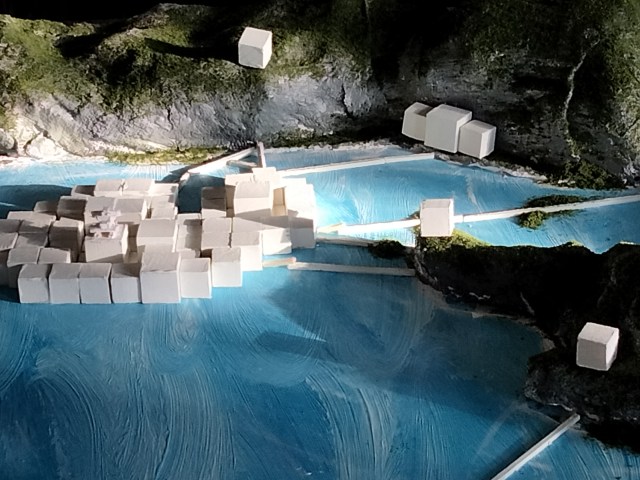
This article, which I posted last summer, asserts that Plato’s descriptions of Atlantis are admirably matched by the Cyclades Plateau (now the Cyclades islands), which would have existed when sea levels were 400 feet lower than they are now. The Cyclades Plateau is a rather large formation right in the middle of the Aegean. (If we consider that lower sea levels would have also expanded the coastlines of the rest of Greece, then it would have been even closer to the mainland.) This is an attractive theory in terms of its being what Plato was actually talking about (since he makes Atlantis contemporary with Athens), but it does depend upon this:

Recently, a four year study that included a thorough analysis of Plato’s work established that serious errors by early translators allowed for the mixed messages in the translated document.

Atlantis as Part of Doggerland

Yet another underwater location that used to be inhabited when sea levels were lower, Doggerland was a vast region that stretched between England, France, Holland, and Scandanavia, and is now the relatively shallow southern part of the North Sea. Archaeological discoveries have handily established that this area was once inhabited, here and here among others. As with other now-submerged human habitations, the reader’s preconceptions will determine how long ago you believe it was inhabited, and for how long.

This article describes an entire book which puts forth a detailed theory Plato was describing Doggerland. Apparently, Atlantis had a large, roughly rectangular plain surrounded by “ditches,” which the author thinks could also be translated “dikes.” He imagines the inhabitants of AtlantiDoggerland using these dikes to keep the sea back from a certain region of Doggerland for a period of time. Without some very expensive underwater archeological expeditions (in a notoriously dangerous sea), there is no way to confirm whether the ruins of a large city lie where this theory would predict. The maps are well worth looking at.

Atlantis as the Richat Structure

The Richat Structure, of the “Eye of the Sahara,” is a large (c. 40 km) formation of concentric rings of stone located in present-day Mauritania. Because of its size and remote location, it is hard to spot except from orbit.

Depending upon how you calculate, the structure matches the recorded dimensions of Atlantis quite well. There are also, of course, explanations about how this structure could have formed geologically. I’m not enough of an expert to assess these, but I am more skeptical of geological explanations than I used to be, now that I’ve seen “mountains” that turned out to be pyramids with insides, and geologists’ attempts to explain how a single fossilized tree could cross-cut millions of years’ worth of sedimentary rock layers. In other words, could go either way.

For the Richat structure to be Atlantis, we have to imagine that it was once nearer to coast and was inundated by a tsunami or something of that nature. This theory actually works fairly well with the geological model that Dr. Kurt Wise presents above. “Continental sprint” would have included many earthquakes and resultant tsunamis. Africa, in the model, does not move as much as the other pieces of Pangea, but it would still have undergone earthquakes and, possibly, some uplift.

On this theory, with his tale of Atlantis Plato somehow retained a memory of a pre-Flood incident (and read Athens back into it?). Below is a video of Pastor Joel Webbon discussing the theory with Brian Suave and Ben Garrett of Haunted Cosmos. They get into local lore around the Richat structure, how this dovetails with Greek legends about Atlantis, and how this all could have been plausible in a pre-Flood world haunted by gods and nephilim.

Conclusion

When I first started composing this post, I thought I was going to come out in support of the Richat Structure. Now, I just don’t know. The Haunted Cosmos guys make it sound very plausible, but a few of the other candidates are also plausible (some less so). There does not seem to be any way to “find” Atlantis without sacrificing at least some of what Plato has to say about it. (For example, Athens existed before the Flood? Before there was a Europe?) This makes it really difficult to favor any one theory (although we can probably discard others). What is clear, is that the prehistoric world had many sophisticated cities, lots of things built with megaliths, pyramids on almost every continent, and that there was a period when many human settlements were submerged as sea levels rose. The details are a matter of speculation, of the kind suitable for someone writing a novel.

Thank You, St. Boniface: A Repost About Christmas

This post is about how we got our Christmas trees. For the record, I would probably still have a Christmas tree in the house even if it they were pagan in origin. (I’ll explain why in a different post, drawing on G.K. Chesterton.) But Christmas trees aren’t pagan. At least, not entirely.

My Barbarian Ancestors

Yes, I had barbarian ancestors, in Ireland, England, Friesland, and probably among the other Germanic tribes as well. Some of them were headhunters, if you go back far enough. (For example, pre-Roman Celts were.) All of us had barbarian ancestors, right? And we love them.

St. Boniface was a missionary during the 700s to pagan Germanic tribes such as the Hessians. At that time, oak trees were an important part of pagan worship all across Europe. You can trace this among the Greeks, for example, and, on the other side of the continent, among the Druids. These trees were felt to be mystical, were sacred to the more important local gods, whichever those were, and were the site of animal and in some cases human sacrifice.

God versus the false gods

St. Boniface famously cut down a huge oak tree on Mt. Gudenberg, which the Hessians held as sacred to Thor.

Now, I would like to note that marching in and destroying a culture’s most sacred symbol is not commonly accepted as good missionary practice. It is not generally the way to win hearts and minds, you might say.

The more preferred method is the one Paul took in the Areopagus, where he noticed that the Athenians had an altar “to an unknown god,” and began to talk to them about this unknown god as someone he could make known, even quoting their own poets to them (Acts 17:16 – 34). In other words, he understood the culture, knew how to speak to people in their own terms, and in these terms was able to explain the Gospel. In fact, a city clerk was able to testify, “These men have neither robbed temples nor blasphemed our goddess” (Acts 19:37). Later (for example, in Ephesus) we see pagan Greeks voluntarily burning their own spellbooks and magic charms when they convert to Christ (Acts 19:17 – 20). This is, in general, a much better way. (Although note that later in the chapter, it causes pushback from those who were losing money in the charm-and-idol trade.)

However, occasionally it is appropriate for a representative of the living God to challenge a local god directly. This is called a power encounter. Elijah, a prophet of ancient Israel, staged a power encounter when he challenged 450 priests of the pagan god Baal to get Baal to bring down fire on an animal sacrifice that had been prepared for him. When no fire came after they had chanted, prayed, and cut themselves all day, Elijah prayed to the God of Israel, who immediately sent fire that burned up not only the sacrifice that had been prepared for Him, but also the stones of the altar (I Kings chapter 18). So, there are times when a power encounter is called for.

A wise missionary who had traveled and talked to Christians all over the world once told me, during a class on the subject, that power encounters tend to be successful in the sense of winning people’s hearts only when they arise naturally. If an outsider comes in and tries to force a power encounter, “It usually just damages relationships.” But people are ready when, say, there had been disagreement in the village or nation about which god to follow, and someone in authority says, “O.K. We are going to settle this once and for all.”

That appears to be the kind of power encounter that Elijah had. Israel was ostensibly supposed to be serving their God, but the king, Ahab, had married a pagan princess and was serving her gods as well. In fact, Ahab had been waffling for years. There had been a drought (which Ahab knew that Elijah — read God — was causing). Everyone was sick of the starvation and the uncertainty. Before calling down the fire, Elijah prays, “Answer me, O LORD, answer me, so these people will know that you, O LORD, are God, and that you are turning their hearts back again.” (I Kings 18:37)

Similar circumstances appear to have been behind Boniface’s decision to cut down the great oak tree. In one of the sources I cite below, Boniface is surrounded by a crowd of bearded, long-haired Hessian chiefs and warriors, who are watching him cut down the oak and waiting for Thor to strike him down. When he is able successfully to cut down the oak, they are shaken. “If our gods are powerless to protect their own holy places, then they are nothing” (Hannula p. 62). Clearly, Boniface had been among them for some time, and the Hessians were already beginning to have doubts and questions, before the oak was felled.

Also note that, just as with Elijah, Boniface was not a colonizer coming in with superior technological power to bulldoze the Hessians’ culture. They could have killed him, just as Ahab could have had Elijah killed. A colonizer coming in with gunboats to destroy a sacred site is not a good look, and it’s not really a power encounter either, because what is being brought to bear in such a case is man’s power and not God’s.

And, Voila! a Christmas Tree

In some versions of this story, Boniface “gives” the Hessians a fir tree to replace the oak he cut down. (In some versions, it miraculously sprouts from the spot.) Instead of celebrating Winter Solstice at the oak tree, they would now celebrate Christ-mass (during Winter Solstice, because everyone needs a holiday around that time) at the fir tree. So, yes, it’s a Christian symbol.

Now, every holiday tradition, laden with symbols and accretions, draws from all kinds of streams. So let me hasten to say that St. Boniface was not the only contributor to the Christmas tree. People have been using trees as objects of decoration, celebration, and well-placed or mis-placed worship, all through history. Some of our Christmas traditions, such as decorating our houses with evergreen and holly boughs, giving gifts, and even pointed red caps, come from the Roman festival of Saturnalia. This is what holidays are like. This is what symbols are like. This is what it is like to be human.

Still, I’d like to say thanks to St. Boniface for getting some of my ancestors started on the tradition of the Christmas tree.

Bonus rant, adapted from a discussion I had …

... in a YouTube comments section with a Hebraic-roots Christian who was insisting that Christmas is a “pagan” holiday:

So, as we can see, the evergreen tree is a Christian symbol, not a pagan one, and has been from the very beginning of its usage. St. Boniface cut down the tree that was sacred to Thor, and that was an oak tree, not a Christmas tree. Sacred oaks are pagan. Christmas trees, which incidentally are not actually considered sacred, are Christian.

Yes, I am aware, as are most Christians, that Jesus was probably not actually born on Dec. 25th. Yes, I am aware that Yule was originally a pagan feast time.

But let’s look at the symbolism, shall we?

For those of us who live in northern climes, and especially before the industrial revolution, the winter solstice is the scariest time of the year. The light is getting less and less, and the weather is getting worse and worse, and all in all, this is the time of year when winter officially declares war on humanity. Winter comes around every year. It kills the sick and weak. It makes important activities like travel and agriculture impossible. It makes even basic activities, like getting water, washing things, bathing, and going to the bathroom anywhere from inconvenient to actually dangerous to do without freezing to death. If winter never went away, then we would all surely die. That is a grim but undeniable fact. Read To Build A Fire by Jack London, and tremble.

Thus, people’s vulnerability before winter is both an instance and a symbol of our vulnerable position before all the hardships and dangers in this fallen world, including the biggie, death. And including, because of death, grief and sorrow.

Yule is a time of dealing with these realities and of waiting for them to back off for another year. After the solstice, the days slowly start getting longer again. The light is coming back. Eventually, it will bring warmth with it. Eventually, life.

Thus, it is entirely appropriate that when the Germanic tribes became Christians, they picked the winter solstice as the time to celebrate Jesus’ birth. He is, after all, the light of the world. A little, tiny light – a small beginning – had come into the bitter winter of the sad, dark world, and it was the promise of life to come. The light shines in the darkness, and the darkness has not overcome it. All this biblical, very Hebrew symbolism answers beautifully the question raised by the European pagans’ concern with the sun coming back.

Our ancestors were not “worshipping pagan gods” at Christmas. They were welcoming Christ (who is the God of Abraham, Isaac, and Jacob) into the heart of their culture. They were recognizing that He was the light, using terms they knew, which were Germanic terms, and this is not surprising because they were Germans.

So, if you want to make the case that no holidays are lawful for Christians except those prescribed in the Old Testament for Israel, be my guest. Try to find some Scriptures to back that up. And maybe you can. But you cannot make that case by accusing people who put up a Christmas tree of worshipping pagan gods. All you’ll do then is reveal yourself to be historically ignorant.

Sources

BBC, “Devon Myths and Legends,” http://www.bbc.co.uk/devon/content/articles/2005/12/05/st_boniface_christmas_tree_feature

Foster, Genevieve, Augustus Caesar’s World: 44 BC to AD 14, Beautiful Feet Books, 1947, 1975, Saturnalia on p. 56 ff.

Hannula, Richard, Trial and Triumph: Stories from church history, Canon Press, 1999. Boniface in chapter 9, pp. 61 – 64.

Puiu, Tibi, “The origin and history of the Christmas tree: from paganism to modern ubiquity,” ZME Science, https://www.zmescience.com/science/history-science/origin-christmas-tree-pagan/

Why I Think It’s Funny That We Have Angel-Shaped Cookies

(I was going to include a picture of our angel Christmas cookies, but … we ate them all.)

Angels are scary beings that usually inspire terror whenever they appear. We don’t really understand what they are. We know they have a different kind of body, one that exists in the heavenly realms, and is probably unpicturable to us as it actually is. We know they were created by God and serve Him (the unfallen ones, anyway), but we don’t know how many kinds there are or much at all about what they actually do. We do know that they are very dangerous.

And we make … cookies of them.

I just love that.

I think it’s hilarious.

I’m sure that being made into a cookie is very insulting to the dignity of angels … those that care the most about their own dignity, anyway, which would be the fallen ones.

The unfallen ones probably just get a smile out of it, because they know that the reason for their cooki-fication, the reason humans refer to them at all, is that they played a minor but striking role in announcing the birth of Jesus … that is, in God’s dealings with humanity. And being unfallen, they probably know that since this was part of God’s plan, it was in fact very good, so it follows that having cookies made of them is actually to the glory of God. So I suppose they don’t mind.

For a more serious post about angels, click here.

R.I.P., Huitzilopochtli

The name Huitzilopochtli means “hummingbird of the left [hand]” or “hummingbird of the South.” Now, if we were to play a word-association game and I said “hummingbird,” I doubt that the first thing out of your mouth would be “human sacrifice.” This was not true of the tribe of the Mexica, however.

The hummingbird was closely linked both with human sacrifice and with rain, since it appears in the rainy season, so the bird was associated with the form of death believed to feed the sun and with fertility as well. Huitzilopochtli [after, in the myth, killing his sister and routing his brothers] was no longer just an obscure earth deity, he was now the Lord of the Daylight Sky, the Rising Sun, and his symbol, the hummingbird, also came to represent the fallen warriors who accompanied the sun on his daily journey. Among his other attributes, the Mexica came to believe in Huitzilopochtli as the God of War … who incited his chosen people to greatness … by the force of their own hearts and their arms which would “lift the Mexican nation to the clouds.” These same hearts and arms were also to provide the vital, nourishing blood that sustained the god and the Aztec world.

The Aztecs, by Brian M. Fagan, pp. 55 – 56

Got that? Hummingbird >>> rainy season >>> fertility >>> human sacrifice >>> war.

The Mexica were sacrificing to Huitzilopochtli as they wandered around central Mexico, fighting one people after another, before they ever founded their great capital city of Tenochtitlan. (We are still not clear on the location of their original homeland.) However, if we count from the founding of Tenochtitlan in the year Two House (probably about A.D. 1325), when the Mexica built a reed temple to the hummingbird god on the small island where they had seen an eagle perched on a prickly pear, then Huitzilopochtli reigned in central Mexico just under 200 years. Cortez arrived in 1519, and by 1522, Tenochtitlan was destroyed.

According to the ancient world view that dates back to Genesis, the One God temporarily gave the lesser gods control over various nations. At Babel, when He scatters the peoples, there are 70 groups, corresponding to the 70 gods that traditionally composed God’s council in Ugaritic and Hebrew mythology. But the gods do a rotten job of leading their people. They tend to behave tyrannically, as do the human rulers who both serve and imitate them. Hints begin very early that one day, the gods’ time will be up. The One God will take back direct rule, not just of the Hebrews, but of all nations of the earth. Then all the nations will once again be His portion, His inheritance.

In the meantime, He lets them run, and things get very bad. When things get too bad in a nation, the One God often judges them. He brings that civilization to an end, usually by using another nation (equally wicked but not yet ready for their own judgement). Defeat in war was well known in the ancient world as a sign that our god had either abandoned us or been defeated by a foreign god. It was well known to the Hebrews as a sign that the One God had had enough of the way this lesser god, and these human kings, were running this nation.

Some nations got to go a very long time. Before the Israelites went into slavery in Egypt, the One God predicted that He would bring them to the land of Canaan four hundred years later — but not yet, “for the sin of the Amorites has not yet reached its full measure.” The Phoenicians, who would burn live babies to appease their god Moloch, got to go on with their wicked ways until Rome destroyed Carthage in 146 B.C. … a very long run indeed. Rome would have her turn many centuries later.

Using this scale, the reign of Huitzilopochtli was shockingly short. Less than two centuries … but what centuries they were! By the time judgement arrived in the person of Cortez, the Mexica were carrying out raids and wars farther and farther afield (almost to Guatemala) to feed the demand for prisoners whose hearts were ripped out of them and offered to Huitzilopochtli, now almost daily. The bodies were kicked down the steps of the temple. Depending upon the type of sacrifice, the arms and legs might later be eaten with some prickly pear on the side. The skulls were stored on massive skull racks. Aztec warriors moved up the ranks based upon how many prisoners they had captured for sacrifice. After a certain number, they were allowed to wear a mohawk. More captures, and they earned a cotton cloak, a necklace, a feathered headdress.

When Cortez and his men were fighting their way out of the city for the first time, astoundingly they managed to capture the temple, though it was covered in hundreds of very tough Aztec warriors. They then took the statue of Huitzilopochtli and hurled it down the temple steps … the very steps down which so many human bodies had been flung. Then, with heavy casualties, a few of them managed to escape the city. On the way back to their base among the Tlaxcalans, they fought battle after battle in which they were massively outnumbered. They should have perished dozens of times, but they didn’t. About a year later, Tenochtitlan was under siege and the Mexica, unable to keep up with death rate, began throwing the bodies of their fallen loved ones into the canals of the city. Hardened Spanish warriors couldn’t handle the smell when they entered the city. Nor could they stop their Tlaxcalan allies from slaughtering the Aztec civilians. God’s judgement on a 200-year orgy of bloodshed was a terrible thing to behold.

Today, Huitzilopochtli is an obscure name. Many people have heard of the Aztecs, and even of Quetzalcoatl, but the hummingbird of the south is not a name on everyone’s lips. He who once filled millions of people with terror has passed into obscurity. Now he’s a bit of trivia, a name known to experts on Mesoamerican history and archaeology only. Nor is Huitzilopochtli alone in this. He has joined the ranks of many gods, such as Moloch, Ishtar, Vesta, Cernunnos, and Tanit, who were once mighty in their lands and now are known only by people with a special interest in a particular corner of history. There are other gods, of course, whose names we do not know. We find a strangely shaped cultic object and we can only speculate. All of these lesser gods have become part of history. But everyone knows the name of Christ, the one Who sets the prisoners free. If someone wants to break into a strong man’s house and take his precious possessions, his people, one must first tie up the strong man.

R.I.P., Huitzilopochtli. You had a good run — 200 years — but beating hearts will be cut out and offered to you no more.

Video: What Did Ham Do Wrong and Why? What’s So Terrible About Women’s Hair? Will We Ever Stop Talking about the Nephilim?

Turns out, “uncovering your father’s nakedness” isn’t quite as bad you suspected … but it’s still pretty bad.

Also, lots of interesting stuff about other aspects of worldview in the ancient world, including that hair was seen as a genital structure by first-century Greek scientists, which is probably the explanation for why women were supposed to cover their hair in public (particularly in church) and men to wear theirs short.

Also, if memory does not fail me, Nephilim!

Scary stuff! Welcome to Halloween!

I Love It When them Aliens Be Comin’ Around

I posted the following several years ago in response to some information being released from Navy pilots about UFOs. Making the necessary adjustments, most of what I say below is still relevant to the more recent sensational revelations about aliens, which are getting ignored by everyone except Matt Walsh.

If you want more interesting theories about all this, see also the interviews I’ve done with Jason McLean. I am watching his YouTube channel, SIRU papers, for his reaction to these latest news stories.

So, now for the repost …

Finally Facing the News

You guys may have noticed, there has been a spate of news articles and videos about U.S. Navy pilots sighting what appear to be UFOs.

U.S. Navy videos declassified last year

60 Minutes interview with Navy pilots

Former head of the Pentagon’s UFO program says they have “exotic material” … what???

I’ve ignored these news items for a long time, mostly because I didn’t know what to do with them. Now I’m ready to give my analysis. It will be just as expert as anyone else’s, and no more expert than any comments you may leave.

Problems with all the Possible Theories

  1. This is all just a big hoax by our government, to distract us from the attempted power grab by [fill in your favorite villains]. The problems: First of all, it’s not working if that was indeed the plan. The media have not camped on this nearly as hard as on some other, less sensational things, and even when they have run stories, the public (including me, I might add) seem much more interested in their own problems. The government and media are not using these reports to whip up fear or preparations for an intergalactic war, nor are they trying to turn this into a scandal about past administrations’ lack of preparedness on the space alien issue. They have just kind of thrown out all this newly declassified information with a clunk, a shrug, and a big trombone slide. Secondly, the pilots who were interviewed seemed like sane, professional people. They did not seem like people who “want to believe” in space aliens. Thirdly, some of these reports and videos go back for decades.
  2. These aircraft belong to another world power, such as China, which has developed technology far more advanced than we suspected. Possible but implausible, because again, these sightings go back for decades. It’s hard to imagine a geopolitical rival having advanced millennia beyond us in terms of their technology, and not having already used it to conquer us. Regular earth people don’t have that kind of self-control.
  3. The aircraft belong to a private, independently wealthy genius, like Elon Musk, who does not want to take over the world but just zips over the Pacific Ocean as a hobby. Possible. Very possible. Although again, it would take phenomenal humility and self-control for a private organization to have these capabilities and not try to leverage them for whatever their own pet project is: fame, space travel, stopping perceived climate change, etc.
  4. The aircraft belong to an advanced civilization of space aliens. The first problem with this is that, if this is an invading force, they are taking their time. At the risk of repeating myself: these sightings go back decades. So if these are space aliens, they frankly don’t seem super interested in us. Perhaps they are just here as tourists. The Pacific Ocean would certainly be a worthy destination for tourism, and perhaps it is more interesting to them than humans. But there is another huge problem with the space alien theory; that is, if we are imagining these space aliens as they are usually conceived of: physical beings, designed to live in three dimensions, like us, physically inhabiting a very different ecosystem on a distant planet or planets in a distant solar system. The problem is this: any possible life-supporting planets in our universe are prohibitively distant for vehicles traveling at normal speeds. The time (and, if I may say so, the risks) involved are not at all practical for tourism or warfare, or even for beings not designed for space to survive the journey probably. Of course, there is a that hoary sci-fi trope of hyperspace (going faster than the speed of light). But everything I’ve ever heard about this indicates it’s either not possible, or would almost certainly destroy any object that accelerated to that speed, and would certainly kill any physical being, designed to live in three dimensions, that tried it. All of this makes it impossible for me to swallow a Star Wars or Avatar-like scenario where there are physical aliens living galaxies away, who have traveled through hyperspace to get to Earth. But there is another possibility.

Interdimensional Beings

In the short satirical novel Flatland, the protagonist is a square who lives in a two-dimensional world of geometric beings. These two-dimensional beings are visited by a sphere. The sphere shows himself to them by intersecting his body with the plane of their universe. The way this looks to the two-dimensional beings is that a point appears out of nowhere, then becomes a rapidly growing circle as the sphere inserts more of his diameter into their plane of existence. When he wishes to, the sphere can move out the other side. This looks to the two-dimensional shapes as if the circle shrinks and then vanishes. The sphere can then move to somewhere else on the two-dimensional plane and appear there, again giving the impression that he has appeared out of nowhere. Later, the sphere takes the square on a mystical journey to observe lower dimensions, so as to give him an idea of how higher dimensions might exist. There is a one-dimensional world (a line) where the inhabitants are all line segments. Each can only see the end of his neighbor (he or she looks like a point), but they can hear one another and communicate by harmonizing. The square is also shown a universe that consists of a single point. This point is the only being in its universe and thinks it is God. It is impossible to communicate with this point. If it hears a voice not coming from within its own universe, it imagines that it must be having auditory hallucinations.

Returning to the vehicles in the section above, I’m sure you can see where I’m going with this. If these mysterious vehicles turn out to be piloted by nonhuman beings, it seems most probable to me that they would be creatures designed to live in more dimensions than we do. Creatures in a higher dimension can do things that appear miraculous in lower dimensions, such vanishing abruptly or appearing to defy the laws of physics. Though wild, the “higher-dimensional beings” theory seems to me more plausible than the idea of three-dimensional beings who are subject to the same laws of physics that we are, yet somehow have managed to pull off intergalactic travel and vanishing through “technology.”

And, by the way, notice your own reaction to this. Did you breathe a sigh of relief? Does the phrase “interdimensional beings” sound way more intelligent than “space aliens” or “angels”? I confess it rolls off my tongue much more smoothly. (More syllables = better?) Some people might say that interdimensional beings was what they meant all along by “aliens,” and moving through multiple higher dimensions was what they meant by “technology.” O.K., that’s fair. Such beings would certainly be alien to us. Still, I think it’s a helpful distinction to make, because I don’t think “creatures designed to live in a higher dimension” is the first thing that comes to most people’s minds when they hear “aliens,” or especially “space aliens.” We might think of aliens as having the ability to mess with higher dimensions than we can, but I think most people think of that as a sort of extra, while conceiving of the aliens as primarily creatures like us (perhaps smarter and uglier), who make their primary home on a physical planet and are anchored in the three dimensions (four if you count time).

The Third Circle of Weird

Ready to get even stranger with me? Let’s go.

On this blog, I have in the past reviewed the excellent, very odd, very mind-blowing Collision Series, which consists of the books The Resolve of Immortal Flesh and The Formulacrum. That series is a lot of things, including a hilarious, Hitchhiker’s Guide-style romp … but more than anything it’s an extended exploration of this idea of interdimensional beings. Human characters in the series get ahold of a vehicle that can travel in higher dimensions. They exploit their access to higher dimensions to move through walls, travel the depths of the sea, and vanish when there’s trouble, and they do it a lot. Of course, the convenience of this is limited by the fact that throughout the books, the human protagonists are at different times being hunted by beings who also have access to these higher dimensions.

A major thesis of these books is that the beings we are used to referring to as angels and demons are actually interdimensional beings whose goals intersect with human life in complex ways. One interesting thing that comes up is that humans do in fact move through some of these higher dimensions, but we do so without knowing it. We experience our interdimensional blunders as intuitions, insights, creepy feelings, etc. This makes sense. After all, in theory there’s nothing to stop a two-dimensional creature from blundering through the body of a three-dimensional creature, right? Anyway, that’s an interesting detail but I’m getting off track here.

Helped by Rich Colburn, the author of The Formulacrum, I am now ready to cap off the weirdness by integrating this interdimensional beings idea into the world view of my own book series.

The Long Guest and The Strange Land both proceed on the premise, taken from Genesis 6, that in ancient times “the sons of God” (interdimensional beings?) walked the earth in some kind of physical form that allowed them somehow to reproduce with human women, thus producing a race of monsters. The resulting chaos was in fact the main reason for the Flood: God was doing triage to save the human race as originally created. This horrifying period in history was also the source of the all the legends and origin stories about gods, giants, and monsters that we find in cultures worldwide. For more on this theory, see my post, here, or the book Giants: sons of the gods by Douglas Van Dorn.

So, yes, strange as it sounds, I am speculating that your “aliens” might be what the ancient world called “gods” … but only if we specify that they were not regular “space aliens” but interdimensional beings who could probably appear as people or animals or whatever they wanted to look like (hat tip to the Greek myths).

So, Why Am I Not Terrified?

I’m not terrified because the gods ain’t what they used to be.

I see the “gods” as having less influence on human life now than ever before. I basically see three phases of this. In the first phase, they were actually here, manifesting physically, demanding worship in person. God put a stop to that with the Flood.

After the Flood, people still remembered the gods, and they seem to have continued to be pretty active on earth, but unable to manifest physically. So, each nation had a god that was responsible for it (or that it was responsible to). They built altars to these gods, identified them with different stars and constellations, and kept trying to get in touch with them physically even though that door had now been closed. “In the past,” Paul says, “God let all nations go their own way.” He picked one people and told them not to worship false gods (gods which were not the Creator and which, in many cases, didn’t even try to hide the fact that they were evil). If we look at legends and even recorded history, it seems to me that often these gods were actual spiritual presences who, though they could no longer manifest physically, could have quite an influence on human life through things like visions, possessions, illnesses, and disasters. For example, in Palestine in Jesus’ day we see many cases, unironically reported, of people being possessed by “unclean spirits.” This is in a region that had been heavily Hellenized, and where people were definitely still worshipping the Roman gods, the Greek gods, and the pre-Hellenistic local deities such as Artemis of the Ephesians. In this second phase, it was truly a dangerous thing to turn from your local deity to worship “the living God,” the God of Israel. Local deities perhaps could actually harm people they took a hate-on to. God spends a lot of time in the Old Testament reassuring the people that if they forsake the fertility and rain gods, and worship Him, He will bless their households and crops and will take care of them.

So, in phase two, God has set some limits on the interdimensional beings but there are still lots of manifestations from other dimensions and lots of communication (or attempts at such) between them and humans.

In phase three, we get Jesus. He opens the way for all human beings to relate directly to the living God. When people turn to Him, they turn away from the worship of the lesser gods. And when people do this in large numbers, a funny thing happens. Paganism no longer works any more. It’s as if the lesser gods have been banished — not partially, but completely now — from their traditional territories. In the Christian era, as worship of the true God spreads slowly but surely throughout the world like leaven, the world becomes less and less spooky. Now, 2000 years later, in many parts of the world, interdimensional/spooky/spiritual manifestations are so rare that we do not have to worry about them and many people don’t even believe that they exist or ever did. If we see a weird thing, we have to find some kind of physical explanation for it, whether it’s a hallucination caused by chemicals in our brain or physical, three-dimensional beings from somewhere else in our physical galaxy.

I’m OK with this change, frankly. It might make the world a little more boring … but, my gosh, it makes it so much less scary! It even means that, if these tic-tac-shaped spacecraft are being driven by interdimensional beings, we probably don’t have to worry. Probably the reason they have not used their capabilities to enslave us is that they aren’t allowed to interact with us in any significant way. Zip around a little, make us scratch our heads, yes. Manifest, show their power, attack us, no. Those days are gone. Christ is the victor. We can all breathe a sigh of relief.

This Is Extremely Unsettling

If Monday’s picture of the quonset hut didn’t convince you that we are living in a sci-fi dystopia …

If Wednesday’s quote about a powerful media magnate who thinks he is God is did not unsettle you …

Then the video below should do it.

Yes, it’s three hours long. But like any good horror movie, you will not be able to turn it off.

You may recall that earlier this year, Jason McLean and I had a conversation about a certain Madame Blavatsky, how she was into the occult, how she had a great influence on a certain German dictator, and aliens entered into the conversation as I recall.

This video traces Madame Blavatsky’s influence through eugenics to Planned Parenthood and through a certain writer named Alice Bailey to social-emotional learning and common core in our public schools, which (James argues) is nothing less than a social-engineering project meant to evolve those children who are capable of it, and which has its roots unapologetically in the occult.

This might seem kind of niche — okay, really niche — but a) what’s a blog for if not to share things the author is currently fired up about?, and b) for the one or two people who actually listen to this podcast, you will see that it actually affects nearly every aspect our lives.

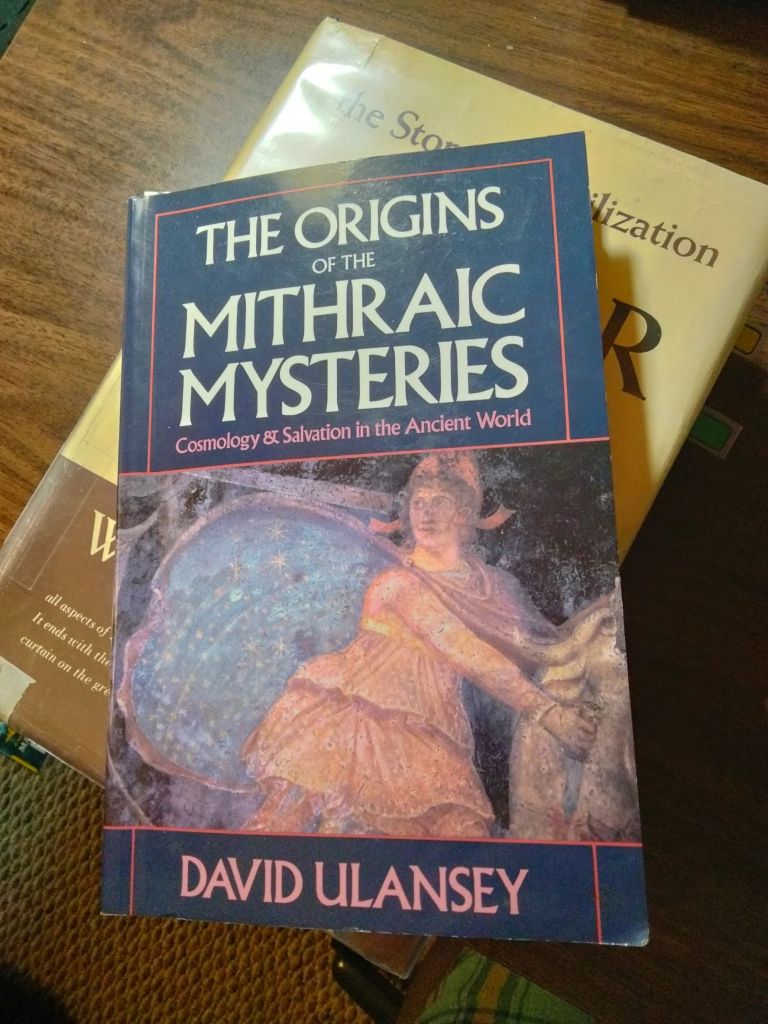
Book Review: The Origins of the Mithraic Mysteries by David Ulansey

I thought you should know that this book exists.

I don’t even remember where I got it. I have a feeling I got it at a used book store or a library sale, or maybe I stole it from my dad’s library. I know it’s been sitting around my study for a few years, waiting for me to get to it. It was published in 1989.

This is a good, accessible piece of scholarly work that first explains what the cult of Mithros was, then traces the history of scholarly thinking about it, and then advances Ulansey’s theory about what was really behind the cult.

What Is Mithraism

Mithraism began to spread throughout the Roman Empire in the first century C.E., reached its peak in the third century, and finally succumbed to Christianity at the end of the fourth century. At the cult’s height mithraea could be found from one end of the empire to the other, “from the banks of the Black Sea to the mountains of Scotland and to the borders of the great Sahara Desert,” as one authority puts it.

ibid, p. 4

As a result, many of the underground Mithraic temples whose iconography Ulansey shows pictures of are found in Germany or in Italy, although this is a cult that had its origins in Tarsus, in southern Turkey.

For a long time, the accepted theory among scholars was that the god Mithras got his start as the Iranian god Mithra, because they happen to share a name. However, the attributes of Mithras don’t line up very well with those of Mithra, which leaves the door open to other explanations.

The cult was apparently based on a story where Mithras slaughters a bull, and from the bull’s body sprang all the plants that man finds useful, such as wheat, grapes, etc. Because it was a mystery cult, nothing was ever written down about the secret meaning of this story, nor of the levels through which the neophyte progresses as he is initiated deeper and deeper into the mysteries. But in all Mithraic temples, there is consistent iconography. This includes a picture of Mithras slaying the bull, with wheat coming out of the wound. Mithras is typically looking away from the bull (though this is “corrected” in some reconstructions), wearing a distinctive hat which was associated with Persia and with Perseus in the ancient world. Around him are placed other figures which will prove to have significance in unravelling the meaning of the cult. Sometimes, the whole scene is placed under an arch or inside a circle that shows the zodiac. Sometimes, Mithras is also portrayed as standing inside a circle or hoop lined with star symbols.

A Brief Tour of the Ancient Mediterranean, Near East, and Europe

In unfolding his theory, Ulansey takes us on a fascinating tour of the ancient world. For example, he spends a lot of time establishing how and why Mithras came to be associated with (based on?) Perseus, who was the founder and hero of the city of Tarsus and, in fact, the local god of that whole region. (Mithras’ hat — a “Phrygian cap” — was originally worn by Perseus, and Ulansey contends that he looks away from the bull as he slaughters it because Perseus looked away from Medusa as he slaughtered her.) He gets into the fact that the cult may have originated with pirates of Cicilia, which lies just off the coast from Tarsus:

[T]he Cicilian pirates were far more than a mere band of thieves. Rather, the pirates, who numbered at least twenty thousand, formed what amounted to a small nation which at its height controlled the entire Mediterranean Sea.

ibid, p. 88

Ulansey then quotes Plutarch from Life of Pompey:

“The power of the pirates had its seat in Cicilia at first … then, while the Romans were embroiled in civil wars, the sea was left unguarded … until they no longer attacked navigators only, but also laid waste islands and maritime cities … There were also fortified roadsteads and signal-stations for piratical craft in many places … more annoying than the fear [the pirate fleets] inspired was the odious extravagance of their equipment, with their gilded sails, and purple awnings, and silvered oars … For you see, the ships of the pirates numbered more than a thousand, and the cities captured by them four hundred … Presently men whose wealth gave them power, and those whose lineage was illustrious, and those who laid claim to superior intelligence, began to embark on piratical craft and share their enterprises.”

ibid, p. 88

There are plenty of other fascinating historical nooks in this edifice, such as the figure of a lion-headed man, entwined by a snake, standing on a sphere; the idea of Mithras being born out of the rock; the exact nature of the Gorgon, and many, many others. Every single one makes sense when it comes up in context. That said, there were certainly some bizarre ideas floating around in the ancient world.

The Zodiac

So, to get right down to it, Ulansey’s case is that the Mithraic mysteries were a way of encoding astronomical knowledge. Because this is the ancient world we are talking about, this knowledge could equally be considered scientific, cosmological, and religious, as will become clear shortly.

Lately, I’ve been studying the zodiac in a desultory fashion. Don’t worry, I am not planning to take up astrology. Astrology is specifically forbidden to faithful Jews, and to children-of-Abraham-by-faith like myself. But it is of interest to me, because it was so important to the people of the ancient world. They worked it into their monuments and their mythology. The signs of the zodiac, and other constellations, were associated with the gods, and a good case could be made that this association started in pre-Flood days.

The other thing that fascinates me about the zodiac is that it’s so hard to observe. Now that I keep chickens and also work outside the home, I’ve been obliged to get up before dawn to let the chickens out. I live in a rural area with relatively dry weather, so you’d think it would be easy for me to take a quick glance at the horizon while I’m out there, and be able to tell which constellation is in the east, right where the sun is going to rise in an hour or two. As it turns out, it’s not so easy as all that. You not only have to know which direction is due east, you also have to have something that helps you sight where the sun is going to rise … and it moves. Then you have to be able to recognize the constellations. To really figure out the whole zodiac, you’d have to be making these observations daily, throughout all the seasons of the year, until you noticed that the constellations of the zodiac make a notional belt around the earth, and that at different times of year, they take turns “housing” the sunrise. This is already difficult enough that you’d have to have a pretty strong motivation to pursue it. (Stronger than mine is right now.) Ancient people thought this was so worthwhile that they managed to master the very difficult science of astronomy. Many ancient monuments, in fact, were built as observatories, from Stonehenge to many structures in the Americas.

Why were they so motivated to study the stars? That’s a discussion for another time.

According to Ulansey, the Mithraic iconography (and probably the whole cult) was designed to encode the secret of Equinoctal Precession. This is a really complicated phenomenon, so if you don’t know what it is, I’ll let you look it up. Basically, because of an irregularity in the earth’s rotation, the zodiac sign that “houses” the sunrise on the equinox will stay the same for 2,160 years, by which time the sunrise has migrated back to the previous zodiacal sign (hence, precession). (Also, incidentally, Polaris has not always been the the pole star.) Precession has been discovered at different times in the past by different civilizations. Graham Hancock makes a pretty good case that it was known by somebody, before conventional history began. But due to the difficulty of observing it, it has not been known at all times by all peoples. Around the time that the cult of Mithras apparently started, it had recently been discovered, and begun to be talked about, in the vicinity of Tarsus, in the same intellectual circles that were also providing aristocratic pirates.

Breaking Hoops and Wheels and Mills

Now, to you and me, equinoctal precession might fall into the category of “Oh, that’s interesting.” Not so for the ancients. For one thing, this cult probably started among pirates, who use the stars to navigate. The idea that the stars were once different and are not the same all the time would be earth-shattering to them. But this news gets even more ominous when we understand ancient cosmology.

(And when I say “ancient” here, I am talking about the cultures of the Mediterranean, Ancient Near East, and parts of Europe. Though, not to keep mentioning Graham Hancock, but in his book Fingerprints of the Gods he finds similar cosmology in ancient India, Central America, and Scandanavia. So a case could be made that this cosmology was once worldwide.)

This ancient cosmology, then, conceived of the heavens as a huge machine, constructed of two or more intersecting hoops (the zodiac, the celestial equator, and, essentially, the prime meridian/international date line projected into the sky). Sometimes the heavenly machinery is portrayed more as a big edifice with four pillars supporting it. Sometimes it’s a “mill” that turns. Probably some ancient people took this more literally than others; some understood it was notional, but represented something real.

Now, imagine that you think of the universe as a big, finely tuned machine, where the constellations always end up in the place they are supposed to be. If the whole hoop has moved out of its place, this could be conceived of as “breaking” the machine. This is why cycles of a certain number of years (not everyone got the precessional intervals right) were thought to bring cataclysms upon the world. So, we get myths worldwide about a mill being broken, and this causing the stars to fall from their places, the sky to become dark, fire and floods to sweep over the earth, etc. Again, read Hancock to find out more about this than you ever wanted to know.

But the point is, whether the Cicilian pirates thought that precession caused a cataclysm, or whether it just meant the universe was less stable than they had imagined, this would have been a revolution in their scientific, cosmological, and religious thought. (Religious because, in ancient times, science and cosmology and religion were really all a part of one system, especially when you consider that the stars and other heavenly bodies were thought to metaphysically influence events on earth.) So, whether you count it as belonging to three, two, or just one unified field of knowledge, this was a big enough discovery to be kept secret (a “mystery”) and passed on to initiates in a whole new cult religion.