
Storytime.
Last year, I taught Ancient History to a group of third, fourth, and fifth graders.
One pair of brothers in my class were very knowledgeable, and very enthusiastic, about the Greek monsters, myths, and pantheon. This was great. Some of their “knowledge” was a little overly specific, however. They gave me to understand that they had learned all this from reading the Percy Jackson books, which were so good and I really ought to read them.
So, when I decided to spend a year reading Greek-mythology-inspired fiction, I added “at least one Percy Jackson book” to my reading list.
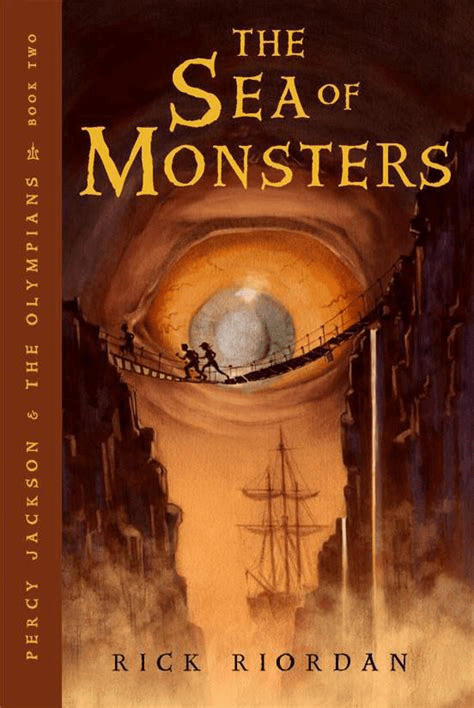
The library had a bunch of the Percy Jackson series, but curiously, not the first one. So I checked out books #2 and #3. Sea of Monsters is #2 in the series.
Having read it, I get the idea. It was enjoyable enough, but I don’t feel the need to read any more of them.
Riordan has done some nice, internally consistent worldbuilding where the ancient Greek gods, monsters, and even locations, move around the world depending upon where the center of Western Civilization is at the time. So, in the Bronze Age, they were based in the Mediterranean. Now, in modern times, they are based in and around New York City (with the ocean conveniently nearby). The titular Sea of Monsters, which used to be the entire Mediterranean, is now (spoilers) the Bermuda Triangle.
Percy (short for Perseus) Jackson is a son of Poseidon, who lives with his mother in New York City. During the summers, he attends Camp Half-Blood, a training camp for children of the gods. It is staffed by the centaur Chiron (who, in the original myths, trained Achilles — very appropriate). In this book, Chiron has been fired, and one of the camp directors is Tantalus. Tantalus spends the entire book chasing pieces of food (donuts, burgers, etc.), which flee from him so that he never gets to take a bite.
We also meet Hermes, a fit, middle-aged man in a jogging suit, whose caduceus has been transformed into a cell phone around whose antenna twine two small green snakes by the names of George and Martha.
You get the idea. The book is a lighthearted blend of ancient Greek characters with modern technology, slang, and what is supposed to be teen culture.
Like many books that are supposed to be relatable for tweens, it’s told in the first person. There is some generic slang (“Dude!” etc.), and many of the adult authority figures are clueless and/or careless about the teens’ well-being. These are the pitfalls of such books. The use of technology and slang runs the risk that the books will not age well. The portrayal of the adults, while it might facilitate the requisite adventure, does not encourage respect. Surely, there could be ways for the author to show teachers that actually care about their students, and still get Percy away from the camp and off on his own.
As a teacher, I’m also concerned about the portrayal of bullies in Percy’s private school in New York City. The idea that there is a vicious hierarchy in middle- and high- school is definitely a Hollywood trope. I’m sure this is true in some places, but in the schools I’ve been in (both as a student and teacher), the successful, “popular” kids were mostly very kind. Kids who are less socially adept (like I was) tend to be fearful and envious, and project their feelings of inferiority onto the “popular” kids. Stories like this are not helping them gain social confidence or believe the best about others’ intentions, as we are told to do in I Corinthians 13.
This book had some poignant moments, especially near the end, but the author kept it mostly lighthearted. The series is clearly building towards some big showdown, having to do with a plot by Kronos. If I didn’t have such a long reading list, I might finish it.


I enjoyed the first series (about Percy), but when it got to the second series about Jason, it lost me and I never went back to Riordan.
LikeLiked by 1 person
That’s understandable. I have heard that the worldbuilding gets gayer as it goes?
LikeLiked by 1 person
Correct.
LikeLike
The first two books were good but it went downhill from there.
Riordan puts a lot of “current” things in his books. Plus I do not like how everyone act like these books are the only fiction books on Greek myth for kids. Has anyone heard of The Cronus Chronicles by Anne Ursu?
LikeLiked by 1 person
Well, I hadn’t heard of the Cronus Chronicles, but now I’ll keep an eye out for them, thanks.
I was certainly aware this is a popular genre. I’ve seen graphic novels for teens about the different gods. I also see a lot of new books for adults. I browsed through the first pages of a few that were on the new books shelf at the library, and decided I didn’t need to pursue them. First person, present tense, lots of focus on s3xual involvement, no thanks.
LikeLiked by 1 person